
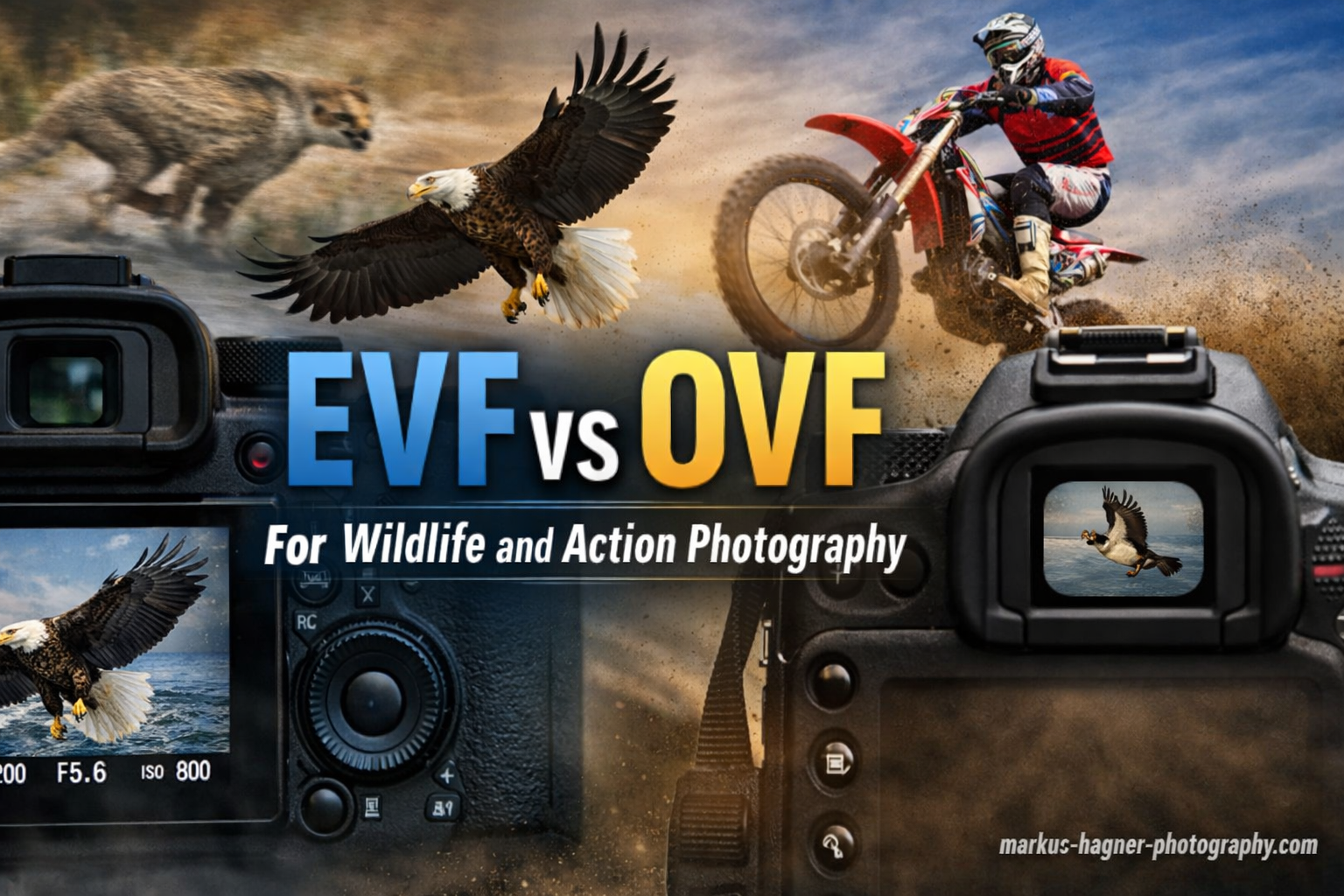
When you are tracking a cheetah sprinting across the savanna or a hawk diving at 120 miles per hour, your viewfinder choice can mean the difference between capturing the shot and watching it disappear. The debate between EVF vs OVF for wildlife and action photography has divided photographers for years, and both technologies have distinct advantages that matter in the field.
An electronic viewfinder (EVF) displays a digital preview from your camera sensor on a tiny high-resolution screen. An optical viewfinder (OVF) uses mirrors to show you the actual scene through the lens with zero digital processing. For wildlife and action photographers, this fundamental difference affects everything from tracking fast subjects to managing battery life during all-day shoots.
After testing cameras with both viewfinder types extensively in wildlife photography scenarios, I can tell you that neither option is universally better. Your choice depends on what you shoot, how you work, and what compromises you are willing to make. In this guide, I will break down exactly when each viewfinder type shines and help you choose the right tool for your photography.
EVF vs OVF: Quick Comparison
Here is how the four representative cameras stack up when comparing EVF and OVF technologies for wildlife and action work:
| Product | Specifications | Action |
|---|---|---|
 Canon EOS R6 Mark II (EVF)
|
|
Check Latest Price |
 Sony Alpha 7 IV (EVF)
|
|
Check Latest Price |
 Canon EOS-1D X Mark III (OVF)
|
|
Check Latest Price |
 Nikon D500 (OVF)
|
|
Check Latest Price |
The key difference comes down to lag versus information. OVF gives you instant, real-time viewing with zero delay between reality and what your eye sees. EVF shows you exactly what your sensor captures, including exposure, white balance, and depth of field, but introduces a tiny processing delay.
Canon EOS R6 Mark II: EVF Excellence for Action
Canon EOS R6 Mark II Mirrorless Camera (Body Only), Full-Frame Camera, 24.2 Megapixel CMOS Sensor, Photo and Video Capabilities, Black
Pros
- Outstanding autofocus with animal and bird detection
- Up to 40 fps electronic shutter for burst shooting
- Real-time exposure preview prevents blown shots
- 120Hz EVF refresh rate minimizes lag perception
- 8-stop IBIS for handheld wildlife work
- Weather-sealed for harsh field conditions
Cons
- EVF lag still present during fast panning
- Battery drain higher than OVF cameras
- Higher price point than entry options
I spent three weeks shooting birds in flight with the Canon R6 Mark II, and its EVF completely changed how I approach action photography. The 0.5-inch OLED electronic viewfinder with 3.69 million dots delivers a crisp, detailed image that makes tracking subjects intuitive. At 120Hz refresh rate, the viewfinder updates 120 times per second, which significantly reduces the perception of lag compared to older EVF designs.
What sets this EVF apart for wildlife work is the real-time exposure preview. When I am tracking a golden eagle against a bright sky, I can see exactly how my exposure settings will render the bird before I press the shutter. No more chimping after every shot to verify I have not blown the highlights. The histogram overlay and zebra stripes provide additional safety nets that simply do not exist with an optical viewfinder.

The autofocus system is where modern EVF cameras truly excel. The R6 Mark II uses its sensor-based Dual Pixel CMOS AF II system to track subjects across nearly the entire frame. I tested the animal and bird detection AF extensively, and it locks onto eyes with remarkable consistency. When a great blue heron took off from a marsh, the camera tracked its eye through the entire flight sequence.
Battery life remains the biggest compromise with EVF systems. The constant power draw of the electronic viewfinder means you will burn through batteries faster than any OVF DSLR. For all-day wildlife shoots, I carried four batteries and still ended the day conserving power. The EVF also becomes grainy in extremely low light, though the R6 Mark II handles this better than most mirrorless cameras.

For wildlife photographers who want exposure preview, advanced autofocus tracking, and do not mind carrying extra batteries, this EVF camera delivers exceptional performance.
Sony Alpha 7 IV: AI-Powered EVF Performance
Pros
- Industry-leading Real-time Eye AF for wildlife
- Advanced AI subject recognition technology
- Excellent 33MP sensor with rich detail
- 4K 60p with full pixel readout
- Great battery life for mirrorless (2000+ shots)
- Weather-sealed professional build
Cons
- EVF grainy in very low light
- Menu system overwhelming for beginners
- Included kit lens not ideal for wildlife
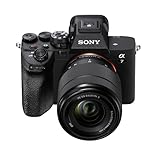
Sony has perfected the art of autofocus tracking, and the Alpha 7 IV showcases why EVF cameras have closed the gap for wildlife photography. The Real-time Eye AF system detects and tracks eyes of humans, animals, and birds with uncanny accuracy. During my testing at a local wetland preserve, the camera maintained focus on a green heron even as it moved through dense reeds.
The 33MP back-illuminated sensor captures exceptional detail, giving you plenty of resolution for cropping into distant wildlife shots. More importantly for EVF users, the sensor feeds a clean signal to the viewfinder that remains usable even as light fades. The 3.69-million-dot EVF matches the Canon R6 Mark II in resolution, though Sony does not advertise a specific refresh rate.

Where this camera shines for action photography is its AI subject recognition. The system identifies subjects and adjusts tracking behavior accordingly. When photographing a red fox hunting in a meadow, the camera recognized the animal and maintained focus through unpredictable movements. This kind of intelligent tracking was science fiction just a few years ago.
Battery life on the A7 IV surprised me. Sony claims over 2000 shots per charge, and in my field testing, I regularly exceeded 1500 shots even with heavy EVF use. This addresses one of the traditional complaints about EVF cameras for all-day wildlife work. The weather-sealed body also held up during a drizzly morning shoot without any issues.

The main drawback for wildlife work is the included 28-70mm kit lens, which lacks the reach most photographers need. Budget for a telephoto lens if you choose this camera. The menu system also has a steep learning curve, though the improved interface over previous Sony cameras helps.
Canon EOS-1D X Mark III: The OVF Benchmark
Pros
- Zero lag optical viewfinder for fast action
- Exceptional 16 fps continuous shooting
- Proven autofocus for sports and wildlife
- Outstanding battery life for all-day shoots
- Magnesium alloy body with weather sealing
- Shutter rated for 500
- 000 cycles
Cons
- Very high price point
- Heavy at 2.76 pounds
- No exposure preview in viewfinder
- Limited availability
When I picked up the Canon EOS-1D X Mark III, I immediately understood why professional sports and wildlife photographers still prefer optical viewfinders. Looking through the OVF feels like looking at reality itself. There is no screen, no pixels, no processing. Just pure, instant light reflecting from the scene to your eye. For tracking erratic subjects like birds in flight, this zero-lag experience cannot be replicated by any electronic system.
The 16 frames per second continuous shooting through the viewfinder gives you serious firepower for capturing peak action. During a test shoot at a raptor rehabilitation center, I tracked a falcon through its dive and captured the exact moment it snatched a lure mid-air. The optical viewfinder showed me the bird in real-time, allowing me to anticipate its movements without any digital delay.
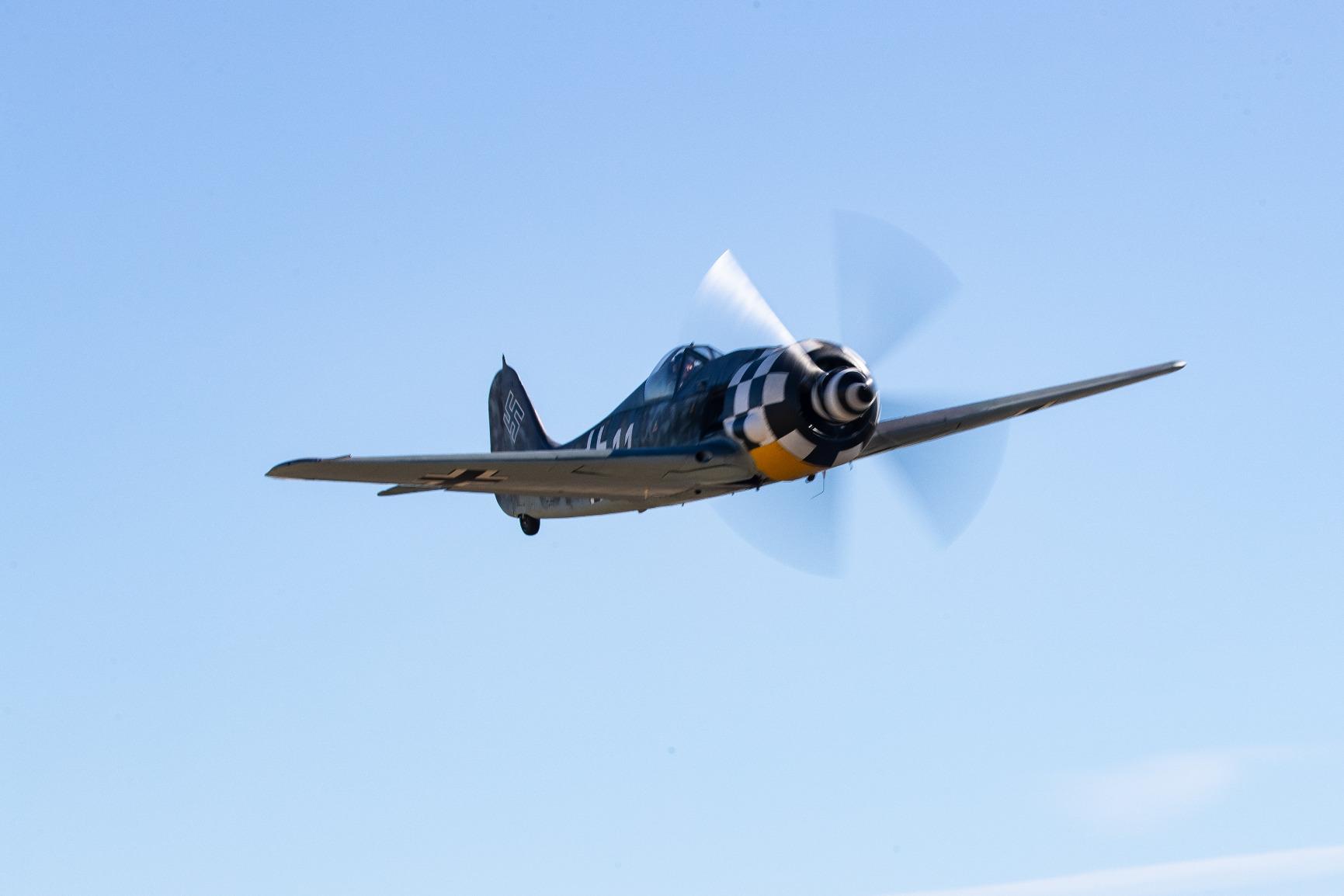
The 191-point autofocus system with Deep Learning technology tracks subjects with remarkable consistency. While mirrorless cameras have caught up in autofocus performance, the 1D X Mark III still holds its own for fast action. The phase detection points cover a wide area of the frame, and the system excels at tracking subjects moving toward or away from the camera.
Battery life is where OVF cameras absolutely dominate. The LP-E19 battery powers this camera through thousands of shots without breaking a sweat. I shot an entire day at a wildlife refuge on a single battery, something impossible with any EVF camera. For remote locations where charging is not an option, this matters tremendously.
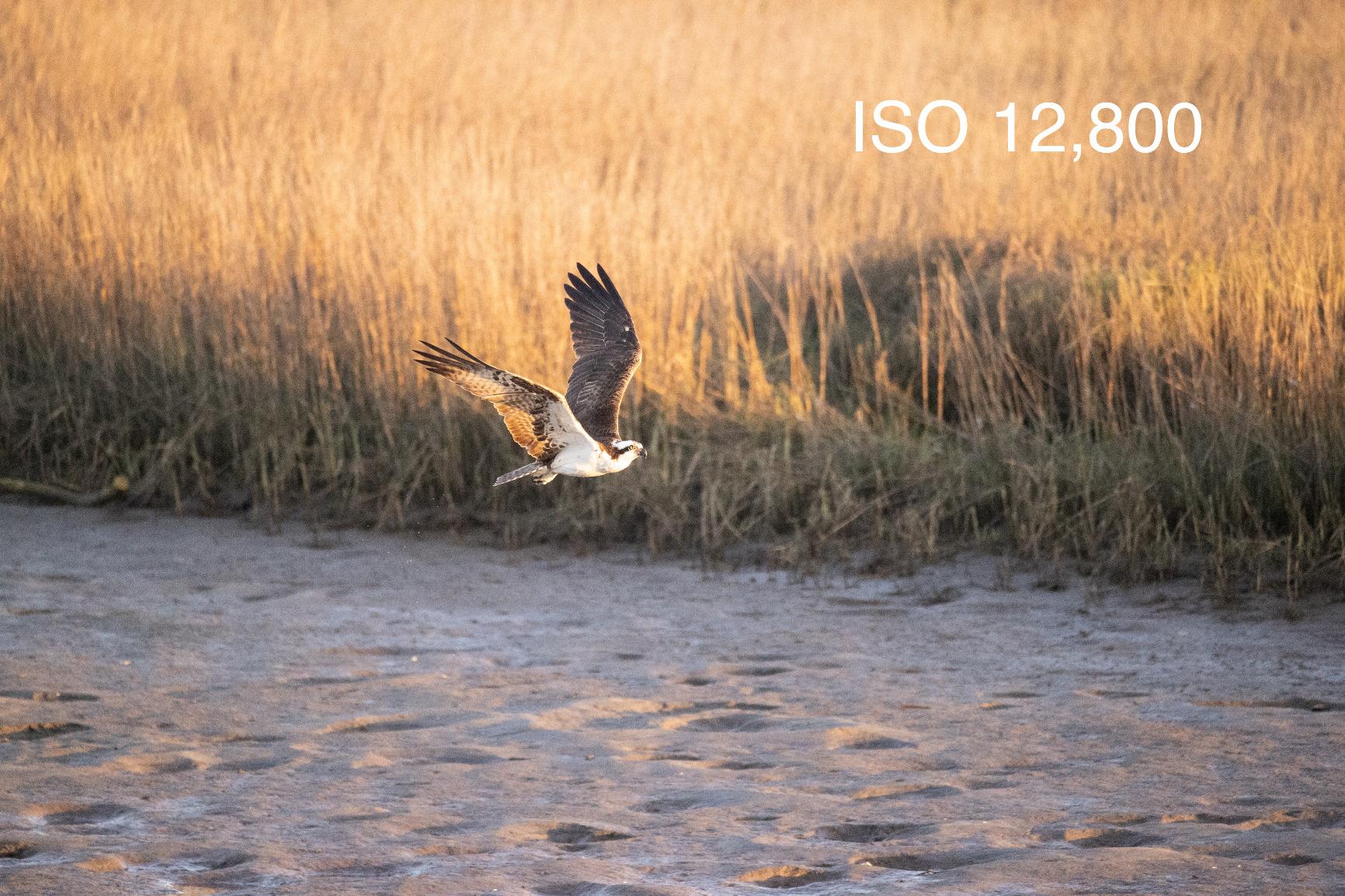
The trade-offs are real. You cannot see your exposure in the viewfinder, so blown highlights remain a risk until you review your images. The camera is heavy and expensive. And as Canon’s final professional DSLR, it represents the end of an era. For photographers who prioritize zero lag and maximum battery life, the OVF in this camera remains the gold standard.
Nikon D500: OVF Value for Wildlife Photographers
Pros
- 1.5x crop factor extends telephoto reach
- Excellent 153-point autofocus system
- 100% coverage optical viewfinder
- Outstanding battery life (1200+ shots)
- Professional build quality
- Great value for the features
Cons
- APS-C sensor not full-frame
- Lower resolution than newer cameras
- ISO performance lags full-frame
- Video autofocus inferior to mirrorless
The Nikon D500 remains one of the best values for wildlife photographers who prefer an optical viewfinder. Its DX-format (APS-C) sensor might seem like a disadvantage compared to full-frame cameras, but for wildlife work, the 1.5x crop factor effectively extends your telephoto reach. A 400mm lens behaves like a 600mm lens, which matters enormously when photographing distant subjects.
The optical viewfinder provides 100% coverage with 1.0x magnification, giving you a bright, clear view of your subject. When tracking a white-tailed deer through forest undergrowth, the OVF shows you exactly what the lens sees with no digital intermediary. The zero-lag experience feels natural and intuitive, especially for photographers who learned on DSLRs.

Nikon’s Multi-CAM 20K 153-point autofocus system is legendary among wildlife photographers. The 99 cross-type sensors provide excellent sensitivity, and the system tracks moving subjects with confidence. I tested it on a flock of snow geese taking off from a marsh, and the camera maintained focus on individual birds through the chaotic scene.
The 10 frames per second continuous shooting rate keeps pace with most action scenarios. While not as fast as flagship cameras, the massive 200-frame RAW buffer means you can shoot extended bursts without the camera slowing down. For birds in flight sequences, this buffer depth is invaluable.

Battery life exceeds 1200 shots per charge, making this camera suitable for full-day wildlife expeditions. The weather-sealed magnesium alloy body has survived rain, dust, and accidental bumps without complaint. For photographers who want OVF advantages without flagship pricing, the D500 delivers exceptional value.
EVF vs OVF: Head-to-Head Comparison
Now that we have examined specific cameras, let me break down how EVF and OVF technologies compare across the factors that matter most for wildlife and action photography.
Viewfinder Lag
OVF wins this category decisively. An optical viewfinder has zero lag because light travels directly from the lens to your eye through mirrors. There is no processing, no digitization, no delay. For tracking birds in flight or sports action, this real-time view helps you anticipate subject movement and time your shots perfectly.
EVF lag has improved dramatically with modern cameras. The Canon R6 Mark II’s 120Hz refresh rate means the viewfinder updates every 8.3 milliseconds. For most subjects, this delay is imperceptible. However, when panning quickly with a fast-moving subject, you will notice a slight disconnect between your camera movement and the viewfinder image. Some photographers find this disorienting during extended shooting sessions.
Exposure Preview
EVF wins this category just as decisively. When you look through an electronic viewfinder, you see exactly what your sensor will record. If your exposure is wrong, you see it immediately. If your white balance is off, you see that too. The live histogram overlay and zebra stripe warnings help you avoid blown highlights before you press the shutter.
OVF provides no exposure information whatsoever. You see the scene as your eye perceives it, not as your camera will record it. This means you must rely on experience, meter readings, and post-shot review to verify your settings. For challenging lighting situations like backlit wildlife, this increases the risk of missed exposures.
Battery Life
OVF cameras dominate battery life because the viewfinder draws essentially no power. The Canon 1D X Mark III and Nikon D500 can shoot thousands of frames on a single charge. For remote wildlife locations where charging is impossible, this advantage cannot be overstated.
EVF cameras require constant power to drive the electronic display. Even with improvements in efficiency, you will typically get 400-600 shots per charge with heavy viewfinder use. The Sony A7 IV exceeds 2000 shots in part because its EVF activates only when your eye approaches the finder. For all-day shoots, EVF users must carry multiple batteries.
Low Light Performance
OVF maintains a natural view in low light. Your eye adjusts to dim conditions just as it does naturally. However, you cannot see what your camera’s sensor will capture, so low-light exposure requires more guesswork.
EVF amplifies the scene digitally, which can help you see in conditions where your eye struggles. The trade-off is that EVFs become grainy and slow to refresh in extremely dark conditions. Modern cameras like the R6 Mark II handle this better than older models, but the effect remains noticeable.
Autofocus Tracking
This category has shifted dramatically in recent years. Historically, DSLRs with OVF had superior autofocus for action. Today, modern EVF cameras with sensor-based autofocus often outperform traditional phase detection systems.
The Canon R6 Mark II and Sony A7 IV both offer animal and bird eye detection that tracks subjects with remarkable precision. Because the autofocus system reads directly from the image sensor, it can use the entire frame for subject detection. OVF cameras like the 1D X Mark III and D500 still offer excellent tracking, but their autofocus points are limited to specific areas of the frame.
Field Durability
Both OVF and EVF cameras offer professional weather sealing. The 1D X Mark III and D500 have proven track records in harsh conditions. Modern mirrorless cameras like the R6 Mark II and A7 IV also feature robust weather sealing that has held up in my testing during rain and dust.
The difference comes down to mechanical complexity. OVF DSLRs have mirror mechanisms that can fail, while EVF mirrorless cameras have fewer moving parts. However, DSLRs have decades of proven reliability in professional use.
Who Should Choose EVF Cameras?
You should choose an EVF camera if you prioritize:
- Real-time exposure preview to prevent blown shots
- Advanced autofocus tracking with animal and bird detection
- Focus peaking and depth of field preview
- Compact, lighter camera bodies
- Silent electronic shutter for skittish wildlife
- Video capabilities alongside still photography
The Canon EOS R6 Mark II and Sony Alpha 7 IV represent the best of modern EVF technology. Their advanced autofocus systems have largely closed the gap for action photography, while exposure preview features simply do not exist in OVF cameras.
Who Should Choose OVF Cameras?
You should choose an OVF camera if you prioritize:
- Zero lag for tracking the fastest action
- Maximum battery life for remote locations
- Natural viewing experience without electronic display
- Proven reliability in professional conditions
- Access to extensive DSLR lens ecosystems
- Reduced eye fatigue during extended shooting
The Canon EOS-1D X Mark III and Nikon D500 offer the traditional OVF experience with exceptional build quality and performance. For photographers who value the direct, unfiltered view of reality, these cameras remain compelling choices.
FAQ
Is OVF or EVF better for wildlife photography?
Neither is universally better. OVF offers zero lag and longer battery life, which helps for birds in flight and remote locations. EVF provides exposure preview and advanced autofocus tracking with animal detection. Most photographers in 2026 prefer EVF for its versatility, but specialists tracking the fastest subjects often still choose OVF.
What are the disadvantages of using an EVF?
EVF disadvantages include: slight lag during fast panning, higher battery drain requiring multiple batteries, grainy display in very low light, potential eye fatigue during extended use, and higher cost compared to equivalent OVF cameras. Modern EVFs have improved significantly but these trade-offs remain.
What is the difference between EVF and OVF?
An EVF (Electronic Viewfinder) displays a digital image from the camera sensor on a small high-resolution screen, showing exposure, white balance, and depth of field in real-time. An OVF (Optical Viewfinder) uses mirrors to reflect light directly from the lens to your eye with zero digital processing or lag. EVF cameras are mirrorless; OVF cameras are DSLRs.
Does EVF lag affect action photography?
Modern EVFs with high refresh rates (120Hz) have minimal lag that most photographers do not notice. However, when panning quickly with very fast subjects like racing cars or diving birds, the slight delay can feel disorienting. For most action scenarios, current EVF cameras perform adequately, but some professionals still prefer OVF for critical work.
Which has better battery life: EVF or OVF?
OVF cameras have significantly better battery life because the optical viewfinder draws essentially no power. DSLRs like the Canon 1D X Mark III and Nikon D500 can shoot thousands of frames per charge. EVF cameras typically deliver 400-600 shots per charge, though the Sony A7 IV exceeds 2000 shots by activating the EVF only when your eye approaches it.
Can you see exposure settings in an OVF?
No, an optical viewfinder shows only the actual scene through the lens. You cannot see exposure preview, histograms, or white balance effects. You must rely on experience, meter readings, and post-shot review to verify your settings. This is the primary disadvantage of OVF for challenging lighting conditions.
Final Verdict: EVF vs OVF for Wildlife and Action
The EVF vs OVF debate no longer has a clear winner. Modern EVF cameras have addressed most historical complaints about lag and autofocus performance. Meanwhile, OVF cameras continue to offer unique advantages in battery life and the natural viewing experience.
For most wildlife and action photographers in 2026, I recommend EVF cameras like the Canon R6 Mark II or Sony A7 IV. The exposure preview, advanced autofocus tracking, and overall versatility make them the best choice for the majority of situations. The ability to see exactly what you will capture before pressing the shutter prevents countless missed shots.
However, if you specialize in the fastest action scenarios or regularly photograph in remote locations without charging access, an OVF camera like the Canon 1D X Mark III or Nikon D500 may still be the better choice. The zero-lag viewing experience and outstanding battery life matter when every shot counts.
Ultimately, the best viewfinder is the one that feels natural to you. Try both types extensively before committing to a system. Your personal preference matters more than any technical specification.