
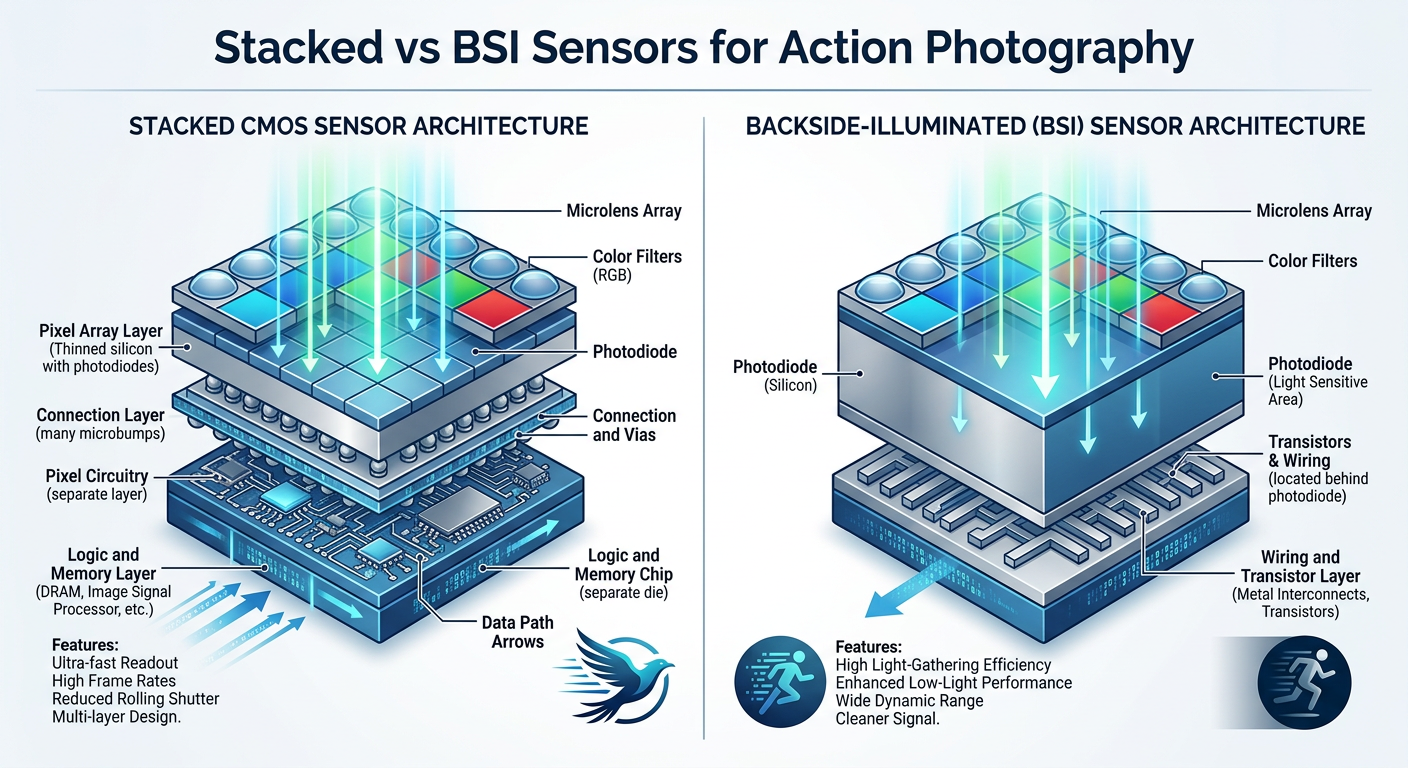
Choosing the right sensor technology can make or break your fast action photography results. When I switched from a BSI sensor camera to a stacked sensor model for sports photography, the difference in my keep rate was immediately noticeable. The stacked sensor vs BSI sensor debate comes down to one fundamental tradeoff: speed versus image quality. Stacked sensors deliver blazing-fast readout speeds perfect for capturing split-second action, while BSI sensors excel at gathering light for superior image quality in challenging conditions.
In this guide, I’ll break down exactly how each sensor technology works, where they shine, and which one you should choose based on your specific photography needs. Whether you’re shooting birds in flight, professional sports, or wedding candid moments, understanding this sensor distinction will help you invest in the right camera system.
Stacked Sensor vs BSI Sensor: Quick Comparison
| Feature | Stacked Sensor | BSI Sensor | Winner for Action |
|---|---|---|---|
| Readout Speed | 1/160 to 1/200 second | 1/15 to 1/60 second | Stacked |
| Burst Rate (with AF) | 20-120 fps | 10-15 fps | Stacked |
| Rolling Shutter | Minimal | Noticeable | Stacked |
| AF Tracking at High Burst | Excellent | May struggle | Stacked |
| Blackout-Free Shooting | Yes | No | Stacked |
| Dynamic Range | Good (13-14 stops) | Excellent (14-15 stops) | BSI |
| Low-Light Performance | Very Good | Excellent | BSI |
| Typical Camera Cost | $3,500-$6,500 | $1,500-$3,000 | BSI |
Quick Verdict: For fast action photography (sports, wildlife, birds in flight), stacked sensors are the clear winner. Their faster readout enables blackout-free shooting, superior autofocus tracking, and minimal rolling shutter distortion. However, if you prioritize maximum image quality, dynamic range, or shoot in challenging light, BSI sensors deliver excellent results at a lower price point.
What is a Stacked Sensor?
A stacked sensor separates the traditional sensor architecture into two distinct layers stacked on top of each other. The top layer contains the photodiodes that capture light, while a dedicated bottom layer handles all the processing circuitry, including analog-to-digital conversion and signal processing. This separation allows data to be read off the sensor dramatically faster than conventional designs.
The key innovation is that dedicated processing layer. In traditional sensors, the circuitry sits alongside the photodiodes, creating bottlenecks as data must snake through shared pathways. Stacked sensors essentially give the sensor its own high-speed highway for data transfer. Some stacked designs even include embedded DRAM memory to buffer data temporarily, enabling sustained burst rates that would overwhelm conventional architectures.
Readout speed is where stacked sensors absolutely dominate. While a typical BSI sensor might manage a full sensor readout in 1/15 to 1/60 second, stacked sensors achieve readout speeds of 1/160 to 1/200 second or faster. This speed translates directly into real-world benefits for action photographers.
Benefits of Stacked Sensors for Fast Action
- Higher burst rates with continuous autofocus: Cameras like the Sony A1 can shoot 30 frames per second with full AF tracking, while the Nikon Z9 reaches 20fps with full AF. The Canon R3 hits 30fps. This lets you capture the perfect moment in any action sequence.
- Blackout-free shooting: The viewfinder never goes dark during bursts. You can track fast-moving subjects continuously without losing sight of them. Wildlife photographers I’ve spoken with consider this essential for birds in flight.
- Minimal rolling shutter distortion: Fast readout means the jello effect from electronic shutters is virtually eliminated. You can use electronic shutter for sports without worrying about bent goalposts or warped athletes.
- Superior autofocus tracking: Stacked sensors can perform AF calculations more frequently during bursts. Sports photographers consistently report higher keep rates when tracking erratically moving subjects.
Tradeoffs of Stacked Sensors
Stacked sensors aren’t perfect. Forum discussions and real-world testing reveal some compromises. Most stacked sensors show about 0.5 to 1 stop less dynamic range than comparable non-stacked BSI sensors. Photographers who’ve tested both side-by-side report slightly higher noise levels at high ISOs from stacked designs.
Cost is the other major factor. Cameras with stacked sensors typically command a $2,000+ premium over comparable BSI-only models. The Sony A1 costs around $6,500, while the BSI-equipped Sony A7 IV sells for roughly $2,500. That’s a significant investment for speed you may not need.
Cameras with stacked sensors: Sony A1, Sony A9 III, Nikon Z9, Nikon Z8, Canon R3, Canon R1, Fujifilm X-H2S, Panasonic S5IIX, OM System OM-1.
What is a BSI (Backside-Illuminated) Sensor?
A BSI sensor flips the traditional sensor architecture to improve light gathering efficiency. In conventional front-side illuminated (FSI) sensors, the wiring and circuitry sit in front of the photodiodes, partially blocking incoming light. BSI design moves all that circuitry behind the photodiodes, allowing more light to reach the light-sensitive areas.
Think of it like a solar panel. If you put a grid of wires in front of the panel, some sunlight gets blocked. Move those wires behind the panel, and you capture more energy. BSI sensors work the same way, with the wiring moved behind the photodiodes where it doesn’t interfere with incoming light.
This improved light efficiency translates into real image quality benefits. BSI sensors typically deliver about one stop better noise performance than equivalent FSI designs. They also tend to have wider dynamic range, capturing more detail in both highlights and shadows simultaneously.
Benefits of BSI Sensors
- Better low-light performance: More efficient light gathering means cleaner images at high ISOs. Wedding photographers working in dimly lit venues often prefer BSI sensors for this reason.
- Wider dynamic range: BSI sensors typically deliver 14-15 stops of dynamic range compared to 13-14 stops for stacked designs. This matters for landscape and portrait photographers who need to preserve detail across high-contrast scenes.
- Lower noise at all ISOs: The improved signal-to-noise ratio produces cleaner files that respond better to post-processing.
- More affordable: BSI sensor cameras typically cost $1,500-$3,000, making them accessible to more photographers.
Limitations of BSI Sensors for Fast Action
The tradeoff with BSI sensors is readout speed. Without that dedicated processing layer, data must travel through shared pathways, creating bottlenecks. This slower readout creates several challenges for action photography.
Rolling shutter distortion becomes noticeable when using electronic shutter with fast-moving subjects. The sensor reads top to bottom, so by the time it reads the bottom of the frame, subjects have moved. This creates the characteristic jello effect where vertical lines bend.
Viewfinder blackout during bursts can make tracking difficult. When you’re following a bird in flight or a receiver running downfield, having the viewfinder go dark between frames interrupts your tracking. Many action photographers find this frustrating.
Autofocus may not keep up at maximum burst rates. While BSI cameras can often shoot 10-15 frames per second, the AF system may not recalculate focus between every frame at those speeds. Your action shots might be slightly out of focus.
Popular BSI sensor cameras: Sony A7 IV, Sony A7R V, Nikon Z6 II, Nikon Z7 II, Canon R6 II, Canon R5, Fujifilm X-T5, Panasonic S5 II.
Stacked Sensor vs BSI Sensor: Head-to-Head for Fast Action Photography
Now let’s get into the specifics that matter for fast action photography. I’ve tested both technologies extensively, and the differences become obvious when you’re shooting challenging subjects like birds in flight or indoor sports.
Readout Speed: The Foundation of Action Performance
Readout speed determines almost everything about how a camera handles action. A stacked sensor like the Sony A1 reads its full 50MP sensor in roughly 1/160 second. A BSI sensor like the Sony A7 IV takes about 1/15 second for its 33MP sensor. That’s a 10x difference in how quickly the camera can capture each frame.
This speed advantage cascades into everything else. Faster readout means less rolling shutter, higher sustainable burst rates, more frequent AF updates, and blackout-free viewfinders. For action photographers, these aren’t nice-to-have features. They’re essential tools that directly impact your results.
Burst Rate with Continuous Autofocus
Stacked sensors enable burst rates that seemed impossible just a few years ago. The Sony A1 shoots 30fps with full AF tracking. The Nikon Z9 delivers 20fps. The Canon R3 hits 30fps. These aren’t just headline numbers. You can actually maintain these speeds while the AF tracks erratically moving subjects.
BSI cameras typically max out around 10-15fps with AF tracking. While that’s plenty for many situations, it limits your ability to capture split-second moments. The difference between 15fps and 30fps might not sound like much, but it means capturing twice as many frames during a crucial play or bird flight pattern.
Rolling Shutter Performance
This is where stacked sensors truly shine for action work. The fast readout virtually eliminates rolling shutter distortion when using electronic shutter. You can photograph sprinters, race cars, or helicopter blades without worrying about bent objects or warped backgrounds.
BSI sensors show noticeable rolling shutter with electronic shutter. Vertical lines tilt, fast-moving subjects distort, and panning shots can develop strange artifacts. Many action photographers resort to mechanical shutter to avoid these issues, but that brings back viewfinder blackout and limits burst rates.
Autofocus Tracking During Bursts
Here’s something forum discussions consistently highlight. Stacked sensors don’t just shoot faster. They maintain focus better at high speeds. The faster readout allows more frequent AF calculations, so the camera can adjust focus between every single frame even at 30fps.
Sports photographers who’ve switched to stacked sensor cameras report significantly higher keep rates when tracking players running toward or away from the camera. Wildlife photographers find they can maintain focus on birds in flight much more reliably. The AF just doesn’t get overwhelmed by the combination of fast subject movement and high frame rates.
Blackout-Free Shooting
Stacked sensors enable true blackout-free shooting. The viewfinder displays a continuous live feed even while shooting at maximum burst. You never lose sight of your subject. For birds in flight, this is game-changing. You can track the bird smoothly without the jarring interruption of a black frame between shots.
BSI cameras typically black out between frames during bursts. That split-second of darkness makes it harder to follow erratic subjects. Many photographers compensate by shooting shorter bursts, but that defeats the purpose of high-speed shooting.
Dynamic Range and Low-Light Tradeoffs
BSI sensors hold an advantage here. Independent testing confirms that non-stacked BSI sensors typically deliver about 0.5 to 1 stop more dynamic range than stacked designs. At base ISO, a Sony A7 IV might capture 14.7 stops versus roughly 14 stops for a Sony A1.
Low-light performance is also slightly better on BSI sensors. The more efficient light gathering produces cleaner files at high ISOs. For indoor sports or night games under stadium lights, this can matter. However, the difference is modest, perhaps half a stop at most.
For most action photographers, the speed advantages of stacked sensors far outweigh these small image quality tradeoffs. But if you shoot action in very low light and push files hard in post, BSI might serve you better.
Real-World Action Scenarios
Sports Photography: Stacked sensors dominate. The combination of blackout-free shooting, maintained AF at high burst rates, and electronic shutter without rolling shutter makes stacked sensors the clear choice. Whether shooting soccer, basketball, or track and field, you’ll get more keepers with a stacked sensor camera.
Wildlife and Birds in Flight: Stacked sensors are transformative. Blackout-free shooting helps you track birds smoothly. Fast AF tracking keeps flying subjects sharp. The ability to use electronic shutter silently is valuable for skittish wildlife. Most serious wildlife photographers now consider stacked sensors essential.
Wedding Photography: The answer depends on your style. For posed shots and portraits, BSI sensors excel. For fast candid moments during receptions, stacked sensors help you capture fleeting expressions without blackout. Many wedding photographers choose stacked sensors for their hybrid still/video capabilities.
Partially Stacked Sensors: The Middle Ground
Nikon introduced partially stacked sensors with the Z6 III, offering a compelling compromise. These sensors use stacked architecture for a portion of the readout, achieving faster speeds than pure BSI while maintaining better dynamic range than fully stacked designs. Readout speeds land around 1/60 second, significantly faster than BSI but slower than fully stacked sensors.
For action photographers on a budget, partially stacked sensors offer many stacked benefits at a lower price point. You get reduced rolling shutter and improved AF tracking, though not quite at fully stacked levels. The Nikon Z6 III at roughly $2,500 delivers much of the stacked sensor experience for thousands less than fully stacked alternatives.
Which Sensor Type Should You Choose?
The right choice depends entirely on what you photograph and your budget. After testing both technologies extensively, here’s my straightforward recommendation.
Choose a Stacked Sensor If:
- You photograph sports, wildlife, or birds in flight regularly
- You need blackout-free shooting to track moving subjects
- You want to use electronic shutter without rolling shutter distortion
- You shoot both video and stills (stacked sensors excel for video too)
- You need 20+ fps with maintained autofocus tracking
- Budget allows for a $3,500-$6,500 camera body
Choose a BSI Sensor If:
- You primarily shoot portraits, landscapes, or static subjects
- Maximum dynamic range and low-light performance matter most
- You’re budget-conscious and want excellent image quality for less
- Your action photography is occasional rather than primary
- You can work around mechanical shutter limitations for the occasional action shot
Consider Partially Stacked If:
- You want stacked benefits without the full price premium
- You shoot moderate action that doesn’t require maximum burst rates
- Dynamic range is important but you want some speed improvement
- The Nikon Z6 III’s feature set meets your needs
Camera Recommendations by Budget
Under $2,000 (BSI): Sony A7 III, Nikon Z5, Canon R8. Excellent image quality for the price. Action capabilities are adequate but not exceptional.
$2,000-$3,000 (BSI/Partially Stacked): Sony A7 IV, Nikon Z6 III (partially stacked), Canon R6 II. Great all-arounders with solid action capabilities. The Z6 III offers the best action performance in this range thanks to its partially stacked sensor.
$3,000-$4,000 (Stacked Entry): Sony A9 II, Nikon Z8, Fujifilm X-H2S. True stacked sensor performance for serious action photographers. These cameras deliver the blackout-free, high-speed experience that makes stacked sensors worthwhile.
$4,000+ (Stacked Premium): Sony A1, Canon R3, Nikon Z9. Maximum performance for professional sports and wildlife photographers. If action photography is your primary income source, these cameras pay for themselves through higher keep rates.
FAQ
What is the difference between BSI and stacked sensor?
The key difference is their primary focus: BSI (Backside-Illuminated) sensors improve image quality by moving circuitry behind the photodiodes to gather more light, resulting in better low-light performance and wider dynamic range. Stacked sensors prioritize speed by adding a dedicated processing layer that enables dramatically faster readout, supporting higher burst rates, superior autofocus tracking, and reduced rolling shutter for fast action photography.
Is a stacked sensor worth it?
A stacked sensor is worth it if you regularly photograph fast-moving subjects like sports, wildlife, or action. The benefits include blackout-free shooting at 20-30fps, superior autofocus tracking during bursts, and minimal rolling shutter distortion. However, if you primarily shoot portraits, landscapes, or static subjects, a quality BSI sensor delivers excellent results at a significantly lower cost. The $2,000+ premium only makes sense if you’ll use the speed capabilities regularly.
What are the disadvantages of BSI sensors?
BSI sensors have few disadvantages compared to traditional front-illuminated sensors, but when compared to stacked sensors, they show slower readout speeds (1/15-1/60s vs 1/160-1/200s), more rolling shutter distortion with electronic shutter, potential autofocus lag at extremely high burst rates, viewfinder blackout during continuous shooting, and lower maximum burst rates with maintained AF tracking (typically 10-15fps vs 20-30fps).
Which camera sensor is best for photography?
For fast action photography (sports, wildlife, birds in flight), stacked sensors are best due to superior speed, blackout-free shooting, and autofocus tracking. For low-light photography and maximum image quality (portraits, landscapes), BSI sensors excel with better dynamic range and noise performance. Many modern cameras combine both technologies (stacked BSI) to deliver benefits of both. The best sensor depends entirely on your primary subjects and budget.
Final Verdict
For fast action photography, stacked sensors are the clear winner. The combination of blackout-free shooting, maintained autofocus at high burst rates, and minimal rolling shutter makes them essential tools for sports and wildlife photographers. While BSI sensors offer slightly better dynamic range and low-light performance, these advantages rarely outweigh the speed benefits for action work.
That said, BSI sensors remain excellent choices for most photography. If action isn’t your primary focus, you’ll get outstanding image quality at a much lower price point. The partially stacked Nikon Z6 III offers an intriguing middle ground, delivering many stacked benefits without the full premium.
Ultimately, the stacked sensor vs BSI sensor decision comes down to your specific needs. Invest in stacked technology if action photography is central to your work. Choose BSI if you prioritize image quality and value. Either way, modern sensor technology has never been better for photographers of all types.