
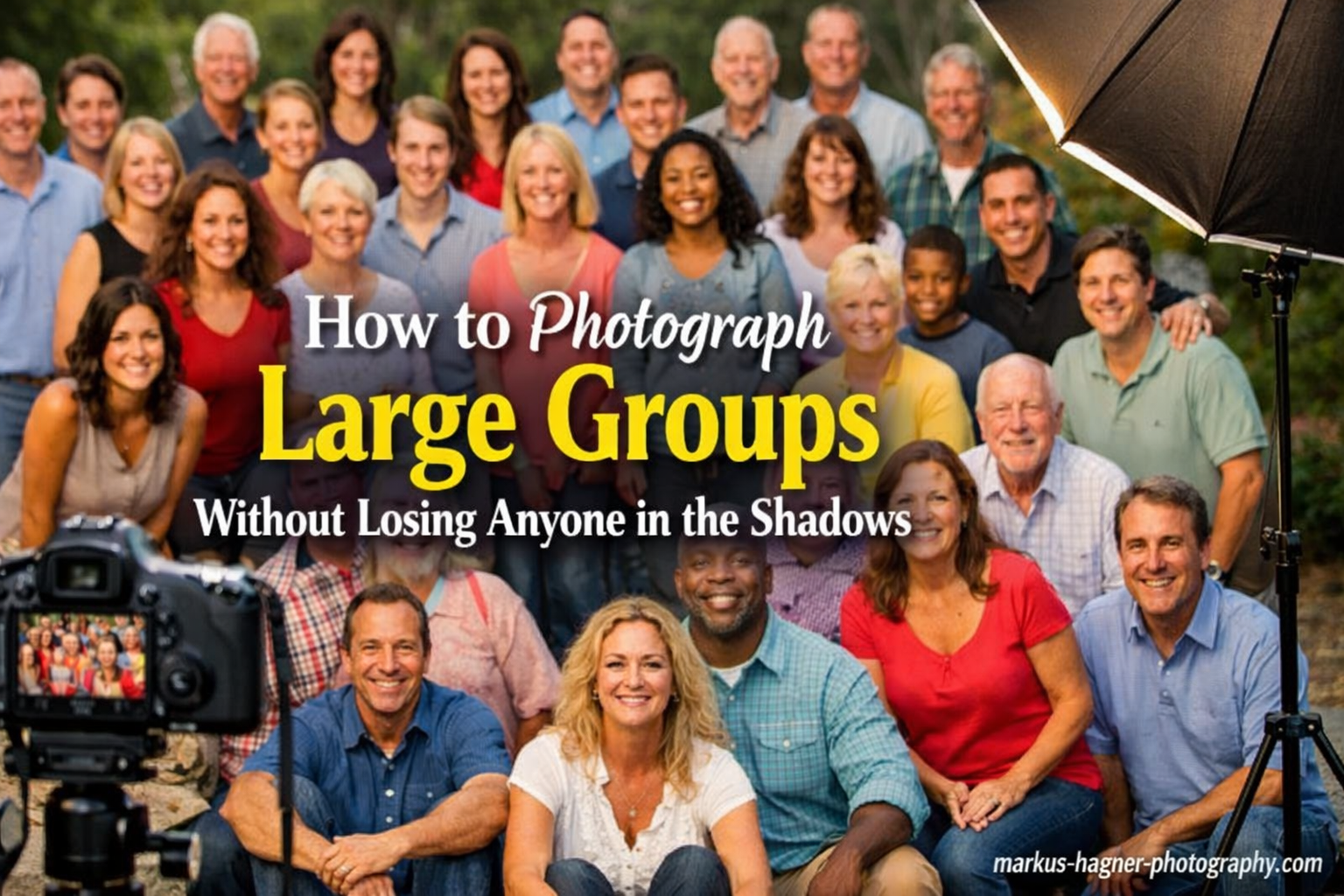
Nothing frustrates me more than reviewing a group photo and realizing half the faces are hidden in shadows. After photographing countless family reunions, wedding parties, and corporate events, I’ve learned that learning how to photograph large groups without losing anyone in the shadows comes down to three things: finding the right light, using the correct camera settings, and positioning your subjects strategically. Let me walk you through exactly how I handle this challenge so you can capture group photos where every single person looks their best.
In this guide, I’ll share the techniques I’ve developed over years of shooting groups ranging from 10-person families to 50-plus corporate teams. You’ll learn why shadows happen, how to find lighting that eliminates them, and the specific camera settings I use for consistently even exposure across large groups.
Why Shadows Ruin Group Photos (And How to Spot Them)?
Shadows in group photography aren’t just annoying. They can make some faces completely unrecognizable while others look perfect. I’ve had clients point to family members “lost” in dark patches of their photos, and it’s heartbreaking to explain that the lighting worked against us.
Types of Shadows That Appear in Group Photos
Understanding what causes shadows helps you prevent them before they ruin a shot. Here are the main culprits I watch for:
Face shadows from overhead light: Midday sun creates deep shadows under eyes, noses, and chins. These unflattering patterns make people look tired or harsh.
Background shadows from flash: When you use on-camera flash indoors, shadows often appear behind your subjects on walls. Moving your group at least 6 feet from any background eliminates this problem.
Dappled light patches: Tree canopies create inconsistent lighting where some faces sit in bright sun while others fall into dark shade. This creates exposure nightmares where no single setting works for everyone.
Row-to-row shadows: In multi-row arrangements, people in front can cast shadows on those behind them, especially when the light comes from above and behind the group.
Reading Light Before You Shoot
Before I even set up a group shot, I take 30 seconds to study the light. I look at where shadows fall and whether the lighting is even across the space where I’ll position people. If I see patchy shadows or harsh contrast, I know I need to either move the group or modify the light.
One trick I use: I stand where the group will be and look toward where I’ll shoot from. If I see harsh shadows on my own face or squint from the brightness, I know my subjects will have the same problem.
Lighting Techniques to Photograph Large Groups Without Shadows
The secret to shadow-free group photography is controlling your light source. I’ve found that natural light works beautifully when you know where to find it, and artificial light gives you complete control when natural options fall short.
Finding Open Shade
Open shade is my go-to solution for outdoor group photography. This is the even, soft light you find in the shadow of a building, under a large tree canopy (without dappled light), or on the shaded side of a structure. The key is finding shade that’s consistent across your entire group area.
Here’s how I locate good open shade:
Building shadows: Large buildings create broad areas of even shade. I position groups in the shadow with their backs to the building, facing open sky for beautiful wraparound light.
Porch overhangs and gazebos: These provide overhead shade while still allowing soft directional light from the open sides.
Open shade from trees: Only works when the canopy is dense enough to block all direct sun. I avoid trees with sparse leaves that create dappled patterns.
The best open shade feels bright but lacks any harsh transitions between light and dark. Your subjects should be evenly lit from head to toe without squinting.
Using Fill Flash for Shadow Control
When I can’t avoid challenging light, fill flash becomes essential. The trick is using it subtly so the flash doesn’t look obvious. I set my flash power between -1 and -2 EV (exposure value) to lift shadows without overpowering the natural light.
For fill flash to work effectively in group photography:
Position flash directly above your camera: This minimizes side shadows that can fall on faces. I mount my speedlight on the hot shoe or use a bracket that keeps it centered above the lens.
Use a diffuser: A simple diffuser softens the flash and spreads light more evenly across your group. I never shoot fill flash without one.
Bounce when possible: Indoors, I angle my flash toward a white ceiling or wall. The bounced light wraps around subjects naturally and eliminates harsh shadows.
Watch your distance: Fill flash works best when your group is relatively close. Beyond 15-20 feet, most speedlights lose effectiveness.
Working with Diffusers and Reflectors
For groups smaller than 15 people, I sometimes use large diffusers to soften harsh sunlight. A 5-in-1 reflector with a diffuser panel held between the sun and your group creates instant open shade even in direct sun.
Reflectors help bounce light into shadowed areas. I position a white or silver reflector opposite the main light source to fill in shadows naturally. This works especially well for smaller groups where one reflector can cover everyone.
For larger groups, diffusers and reflectors become impractical because you’d need enormous modifiers. That’s when I rely on finding natural open shade or using off-camera flash.
Time of Day Strategies
The time you shoot dramatically affects shadow problems. Here’s my approach to different times:
Golden hour (first and last hour of daylight): Beautiful soft light with minimal shadows. My favorite time for outdoor groups, though scheduling around it isn’t always practical.
Overcast days: Clouds act as a giant diffuser, creating perfect flat light. I actually prefer overcast conditions for group photography because the lighting is completely even.
Midday (10am-4pm): The most challenging time. Harsh overhead light creates strong shadows. I avoid midday shooting unless I have open shade or use fill flash.
Early morning: Similar benefits to golden hour with soft directional light. Also tends to be less crowded at popular locations.
Camera Settings for Shadow-Free Group Photography
Once you’ve sorted your lighting, the right camera settings ensure everyone stays sharp and properly exposed. I shoot in manual mode for groups because it gives me complete control.
Aperture Settings by Group Size
Aperture controls depth of field, which determines how many rows stay in focus. I use these guidelines:
Small groups (5-10 people in 1-2 rows): f/5.6 to f/8 provides enough depth of field while maintaining some background separation.
Medium groups (10-25 people in 2-3 rows): f/8 to f/11 ensures front-to-back sharpness across multiple rows.
Large groups (25+ people in 3+ rows): f/11 to f/14 for maximum depth of field. I rarely go beyond f/16 due to diffraction softening.
The farther your first row sits from the camera, the more depth of field you naturally have. I position myself at least 15 feet from large groups.
Shutter Speed and ISO Considerations
For groups, I never drop below 1/125 second shutter speed. Any slower and slight movements create blur. When photographing elderly subjects or children who might move, I prefer 1/200 second or faster.
ISO depends on your lighting. In good open shade or overcast conditions, ISO 100-400 works fine. In darker shade or with fill flash, I might push to ISO 800. Modern cameras handle ISO 800 cleanly, so don’t fear higher settings when needed.
Focus Strategies for Multiple Rows
Getting everyone in focus requires smart focus placement. Here’s my approach:
Focus on the front row: Depth of field extends more behind your focus point than in front of it. By focusing on the front row (or slightly in front of it), more of your group falls into the sharp zone.
Use single-point autofocus: I select my focus point manually rather than letting the camera choose. This ensures I focus exactly where I intend.
Consider back-button focus: Separating focus from the shutter button lets me lock focus once and take multiple shots without refocusing.
Take test shots: Before the full group gathers, I have one person stand at various distances and check sharpness at 100% magnification on my LCD.
How to Arrange Groups to Minimize Shadow Problems
How you position people affects both shadows and the overall success of your photo. Good arrangement complements good lighting.
Staggered Heights and Row Arrangement
I arrange groups so every face is visible. This means varying heights within each row and staggering taller people between shorter ones in the row behind.
Front row: I place shorter adults or those who need to sit (elderly, mobility issues) in front. Children can sit on the ground or on adults’ laps.
Second row: Taller people stand behind shorter ones in the front row. I use natural height variations to create visual interest.
Third row and beyond: Each row gets progressively taller, or I use elevated platforms, stairs, or hills to add height.
Shooting from slightly above helps with larger groups. I’ve used ladders, balconies, and even stood on chairs to get elevation for groups of 30+ people.
Positioning Relative to Light Source
Once I’ve found good lighting, I position the group so everyone benefits from it equally:
Face the light source: In open shade, groups should face toward the open sky, not toward the building or structure creating the shade.
Avoid mixed lighting: If part of your group would be in sun and part in shade, reposition everyone into one consistent lighting zone.
Watch for reflected light: White walls, light-colored pavement, and even light clothing can bounce fill light into shadows.
Background Distance Recommendations
Distance from the background serves two purposes: it eliminates background shadows from flash and creates separation that makes your group stand out.
I position groups at least 6 feet from walls, hedges, or other background elements. For flash photography, 10-12 feet of separation works even better. This distance also allows some background blur at wider apertures.
Equipment That Helps Eliminate Shadows in Group Photos
While technique matters more than gear, the right equipment makes shadow-free group photography significantly easier.
Lens Recommendations
50mm prime (on full frame): My go-to for groups. It provides natural perspective without wide-angle distortion and typically offers excellent sharpness.
24-70mm zoom: Versatile for varying group sizes and space constraints. I use this when I need to quickly adjust framing without moving.
70-200mm telephoto: Surprisingly excellent for groups when you have space to back up. Telephoto compression flatters faces and the longer focal length creates beautiful background separation.
I avoid wide-angle lenses (wider than 35mm) for groups because edge distortion makes people on the sides look unnatural.
Tripod Necessity
I always use a tripod for formal group shots. It keeps my camera perfectly level, allows slower shutter speeds if needed, and frees my hands to direct subjects. A tripod also ensures consistent framing across multiple shots.
For informal or candid group situations, I handhold but still maintain stable shooting posture.
Flash and Modifier Options
Speedlight: A single hot-shoe flash works for fill light on groups up to about 15 people. Add a diffuser and you’re set for most situations.
Off-camera flash: For larger groups or more control, I position one or two speedlights on stands to the sides of the group. This creates even, directional lighting.
Large modifiers: Softboxes and umbrellas spread light more evenly across groups. A 60-inch umbrella can cover a 20-person group with soft light.
Flash brackets: These position your flash higher and to the side of the camera, reducing red-eye and creating more flattering shadow angles.
Pre-Shot Checklist for Shadow-Free Groups
Before I press the shutter for any group photo, I run through this mental checklist:
1. Is the lighting even across all faces in the group?
2. Are there any harsh shadows or dappled light patterns?
3. Is everyone’s face visible (not blocked by someone in front)?
4. Is my aperture set correctly for the group depth?
5. Is my focus point locked on the front row?
6. Is the background clean and sufficiently far behind the group?
7. Are there any clothing or color issues that distract?
8. Is everyone looking at the camera?
9. Are any eyes closed? (I take multiple shots to ensure at least one good frame)
10. Have I checked for details like flyaway hair or awkward hand positions?
Using continuous shooting mode, I capture 3-5 frames for each pose. This gives me options if someone blinks or looks away in one shot.
Frequently Asked Questions
How to take photos of a very large group?
For very large groups (50+ people), I recommend using a higher aperture like f/11-f/14 for maximum depth of field, shooting from an elevated position like a ladder or balcony, arranging people in multiple rows with staggered heights, and using continuous shooting mode. Position your group in open shade or overcast light for even illumination, and consider having an assistant help direct people and check for issues.
How do I eliminate shadows when shooting groups in limited space?
In tight spaces, position your group as far from walls as possible (even 3-4 feet helps), bounce your flash off a white ceiling rather than aiming it directly at subjects, use a diffuser on your flash to soften light, and try positioning people near windows or other natural light sources. If space is truly limited, consider shooting from outside the room through a doorway.
Should I use flash for outdoor group photos?
Yes, fill flash outdoors helps eliminate harsh shadows from overhead sun. Set your flash to -1 or -2 EV so it lifts shadows without looking obvious. Flash is especially helpful when shooting in dappled shade or when part of your group is in shade and part in sun. For best results, use a diffuser and position your flash directly above your camera.
What is the best aperture for group photos to keep everyone in focus?
For 1-2 rows of people, use f/5.6 to f/8. For 3-4 rows, use f/8 to f/11. For 5+ rows or very large groups, use f/11 to f/14. Focus on the front row since depth of field extends more behind your focus point. Avoid apertures smaller than f/16 as diffraction will soften your entire image.
How do I deal with dappled light in group photos?
Dappled light from trees creates patchy shadows that are nearly impossible to fix. Your best options are: reposition the group entirely to an area of even shade or full sun, use a large diffuser held between the sun and group to create artificial shade, or use powerful fill flash to lift the shadowed areas. When possible, simply avoid locations with dappled light.
Conclusion
Learning how to photograph large groups without losing anyone in the shadows transforms your group photography from frustrating to professional. The key principles I’ve shared, finding even lighting through open shade or overcast conditions, using fill flash at reduced power, selecting the right aperture for your group depth, and arranging people strategically, work together to create photos where every face is clearly visible and evenly lit.
Start by scouting locations with good natural shade, practice your camera settings with smaller groups before tackling large events, and always take multiple shots in continuous mode. With these techniques, you’ll capture group photos that make every person look their best, no matter the lighting challenges you face.