
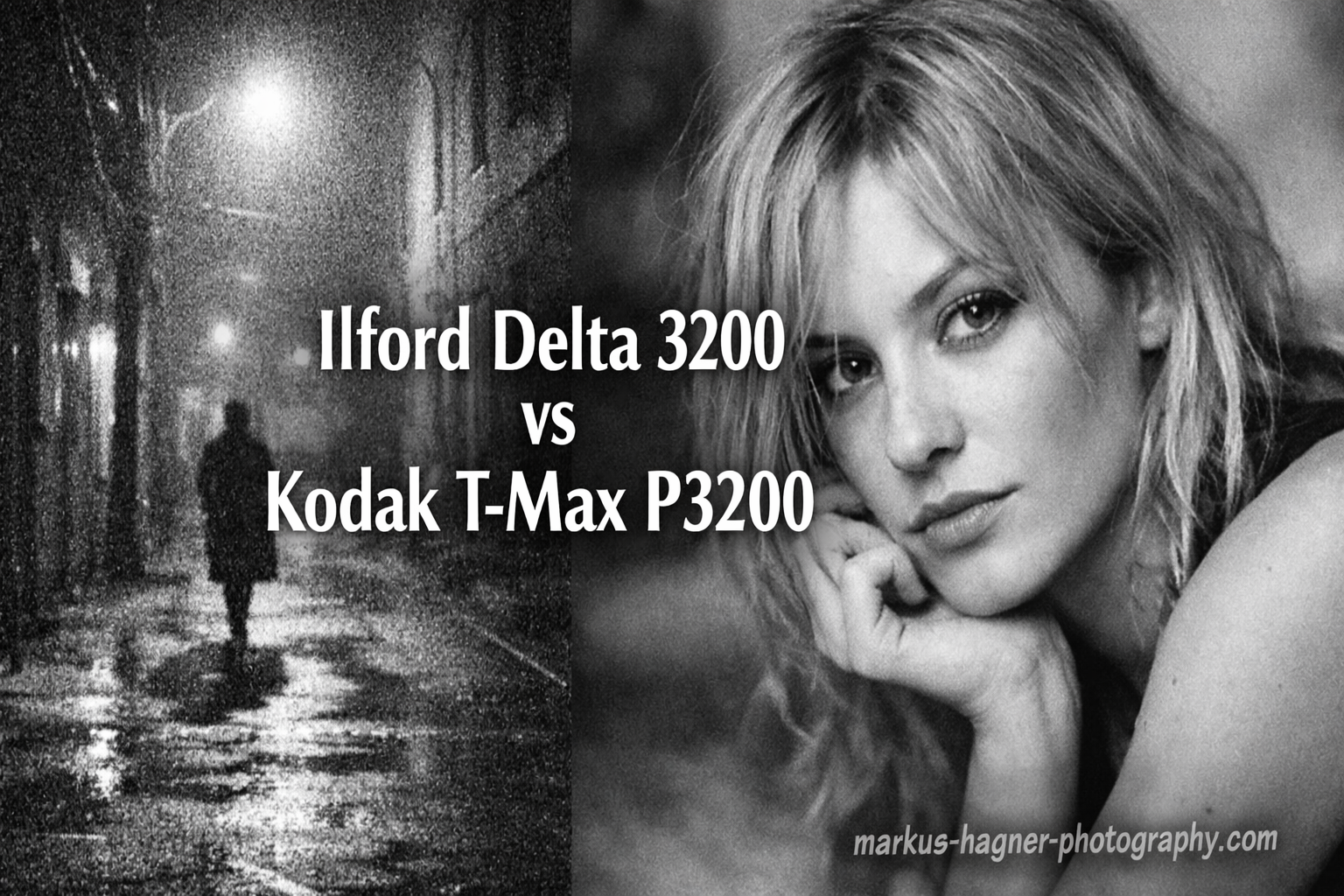
When you need to shoot in extremely low light, two films dominate the conversation: Ilford Delta 3200 vs Kodak T-Max P3200. Both are legendary high-speed black and white stocks that can handle dim concert venues, nighttime street scenes, and indoor events where slower films simply fail.
The main difference between these films is contrast. T-MAX P3200 has significantly higher contrast that makes images pop straight out of the camera, while Delta 3200 offers more subtle contrast with greater flexibility in post-processing. This single characteristic shapes everything else about how you use each film.
After shooting both stocks extensively in challenging conditions, I can tell you that neither is universally better. Your choice depends entirely on the look you want and how you prefer to work. Let me break down exactly what separates these two films so you can pick the right one for your next low-light adventure.
Ilford Delta 3200 vs Kodak T-Max P3200: Quick Comparison
| Product | Specifications | Action |
|---|---|---|
 Ilford Delta 3200 Professional 35mm Ilford Delta 3200 Professional 35mm |
|
Check Latest Price |
 Kodak T-MAX P3200 35mm Kodak T-MAX P3200 35mm |
|
Check Latest Price |
Looking at the specs alone tells part of the story. Delta 3200 has a native speed of ISO 1000, while T-MAX P3200 sits at ISO 800. Both films are designed to be pushed to their box speed of 3200, but they behave quite differently when you do.
Ilford rates their film at 3200 on the box, but experienced photographers know that shooting at native ISO yields the best results. The same applies to Kodak’s offering. Understanding this distinction between box speed and native speed is crucial for getting the most from either stock.
Ilford Delta 3200 Professional: Deep Dive
Ilford 1887710 DELTA 3200 Professional, Black and White Print Film, 135 (35 mm), ISO 3200, 36 Exposures
Pros
- Excellent low light performance
- Beautiful smooth grain structure
- Great tonality and contrast
- Flexible ISO rating 1600-6400
- Fantastic for artistic photography
Cons
- More expensive than standard films
- Grain can be more noticeable than T-MAX
- Requires careful exposure management
I have shot Ilford Delta 3200 extensively for night photography and indoor concerts, and it has become my go-to when I want that classic, gritty documentary look. The grain structure is beautiful in a way that feels intentional rather than accidental. It gives images a timeless quality that works perfectly for street photography and artistic projects.
At its native ISO 1000, Delta 3200 produces remarkably smooth tones with excellent shadow detail. Many photographers I know prefer shooting it at 1600 for a bit more speed while still maintaining image quality. Push it to 3200, and you get that characteristic grainy look that many film photographers actively seek out.

Where Delta 3200 really shines is in post-processing flexibility. The more subtle contrast profile means you have room to adjust curves and levels without blowing out highlights or crushing shadows. If you enjoy spending time in the darkroom or working with scans in Lightroom, this film rewards that effort.
For developers, Ilford DD-X is the natural pairing and delivers excellent results. HC-110 also works well, particularly if you prefer a slightly different tonal character. The key is avoiding Rodinal with this film. Many forum users have learned the hard way that Rodinal struggles to reach box speed with Delta 3200 while maintaining shadow detail.
The film handles pushing exceptionally well. I have pushed it to 6400 for extremely dark situations and still got usable negatives. The grain increases, naturally, but it maintains a pleasing structure rather than becoming muddy or unpleasant. This pushability makes it incredibly versatile for unpredictable lighting conditions.

At around $19 per roll, Delta 3200 costs more than standard black and white films. But for the low-light capabilities it provides, most photographers find it worth the premium. With 36 exposures per roll, you get plenty of shots to work with, and the consistent quality from Ilford means you can trust every roll to perform.
Kodak T-MAX P3200: Deep Dive
Pros
- Excellent for very low light conditions
- Punchy high contrast look
- Finer grain than Delta 3200
- Professional T-MAX emulsion
- Great straight out of camera
Cons
- Limited availability in some regions
- May be expired stock from some sellers
- Less flexibility in post-processing
- Higher price point
Kodak T-MAX P3200 delivers a completely different shooting experience. The first thing you notice is that contrast. Images come out of the camera looking punchy and dramatic, with deep blacks and bright highlights. If you want that gritty, high-impact look without spending time in post, this film delivers it automatically.
The native ISO of 800 means you get slightly less sensitivity than Delta 3200 at base, but the trade-off is a finer grain structure. Kodak’s T-Grain technology really shows here. Even at pushed speeds, the grain remains tight and controlled rather than becoming overwhelming. For photographers who want speed without sacrificing too much sharpness, this is appealing.
I have found T-MAX P3200 particularly effective for concert photography where the dramatic lighting benefits from higher contrast. Stage lights against dark backgrounds look striking with this film. The punchy rendering matches the energy of live music events perfectly.
Kodak’s own T-Max Developer is the obvious choice for processing, and it produces excellent results with rich blacks and controlled highlights. DD-X also works beautifully if you already have it on hand. Like Delta 3200, avoid Rodinal unless you specifically want to sacrifice shadow detail for a particular effect.
One consideration with T-MAX P3200 is availability. Depending on where you shop, you may encounter older stock. The film was discontinued and then brought back, so inventory freshness varies. Always check expiration dates when ordering, and consider buying from reputable film specialists rather than general marketplaces.
The higher contrast does mean less flexibility in post-processing. If you prefer to shape your images significantly in the darkroom or digitally, you might find T-MAX P3200 somewhat limiting. But for photographers who want strong results with minimal manipulation, this characteristic becomes a strength.
Ilford Delta 3200 vs Kodak T-Max P3200: Head-to-Head Comparison
Contrast
T-MAX P3200 wins decisively for high contrast. Images have immediate visual impact with deep blacks and bright highlights. Delta 3200 takes the opposite approach with flatter, more subtle contrast that some photographers describe as washed out but others appreciate for its flexibility.
If you want punchy images straight from the scan, choose T-MAX. If you prefer to build contrast yourself in post-processing or want more tonal gradation to work with, Delta 3200 gives you that freedom.
Grain Structure
T-MAX P3200 has the finer, more controlled grain thanks to Kodak’s T-Grain technology. Delta 3200 shows more noticeable grain that many photographers describe as having character and charm. Neither is objectively better.
For commercial work or situations where grain needs to be minimized, T-MAX is the safer choice. For artistic documentary work where grain adds to the mood, Delta 3200 excels.
Native Speed and Push Processing
Delta 3200’s native ISO of 1000 gives it a slight sensitivity advantage over T-MAX P3200’s ISO 800. Both films push remarkably well to their box speed of 3200 and beyond. I have pushed both to 6400 with usable results.
The consensus among experienced film photographers is that shooting either film at native speed produces the best quality. But when you need that extra stop or two of speed, both stocks handle pushing admirably.
Developer Recommendations
Delta 3200 pairs best with Ilford DD-X, though HC-110 works well too. T-MAX P3200 shines with Kodak T-Max Developer or DD-X. Both films struggle with Rodinal if you are trying to reach box speed while maintaining shadow detail.
Price and Availability
Delta 3200 typically costs around $19 per roll and enjoys consistent availability from major retailers. T-MAX P3200 runs slightly higher at around $22 but can be harder to find fresh stock. Availability varies significantly by region and retailer.
Frequently Asked Questions
What is the difference between Delta 3200 and TMAX P3200?
The main difference is contrast. TMAX P3200 has significantly higher contrast that makes images pop, while Delta 3200 has more subtle contrast offering greater flexibility in post-processing. TMAX P3200 also has finer grain structure, while Delta 3200 has more noticeable grain that many photographers find artistically appealing.
Is Ilford Delta 3200 grainy?
Yes, Ilford Delta 3200 is known for having noticeable grain, especially when pushed to its box speed of 3200. However, many photographers consider this grain beautiful and intentional, giving images a timeless, documentary quality. At its native ISO 1000, the grain is more controlled while still providing character.
What is Ilford Delta 3200 good for?
Ilford Delta 3200 is excellent for low-light photography including night scenes, indoor concerts, street photography after dark, and any situation where flash is not practical or desired. Its subtle contrast and flexible tonality make it ideal for documentary work and artistic photography where post-processing control matters.
What is the difference between Ilford and Kodak film?
Ilford specializes exclusively in black and white film with a focus on traditional emulsion characteristics and post-processing flexibility. Kodak offers both color and black and white films, with their T-MAX line featuring modern T-Grain technology for finer grain and higher contrast. Ilford films generally offer flatter contrast profiles, while Kodak films tend toward punchier rendering.
Verdict: Which Film Should You Choose?
For the Ilford Delta 3200 vs Kodak T-Max P3200 decision, your choice comes down to creative preference rather than objective quality. Both films deliver exceptional low-light performance that slower stocks simply cannot match.
Choose Ilford Delta 3200 if:
You prefer subtle contrast with post-processing flexibility. You appreciate grain as an artistic element rather than something to minimize. You want consistent availability and slightly better value. You shoot documentary, street, or artistic photography where a timeless look matters.
Choose Kodak T-MAX P3200 if:
You want punchy, high-contrast images straight from the camera. You prefer finer grain structure. You shoot concerts, events, or dramatic scenes where immediate visual impact matters. You do not want to spend time manipulating images in post.
My personal preference leans toward Delta 3200 for its flexibility and that beautiful grain character. But I keep T-MAX P3200 in my bag for situations where I know I want that high-contrast look without any post-processing work.Frequently Asked Questions