
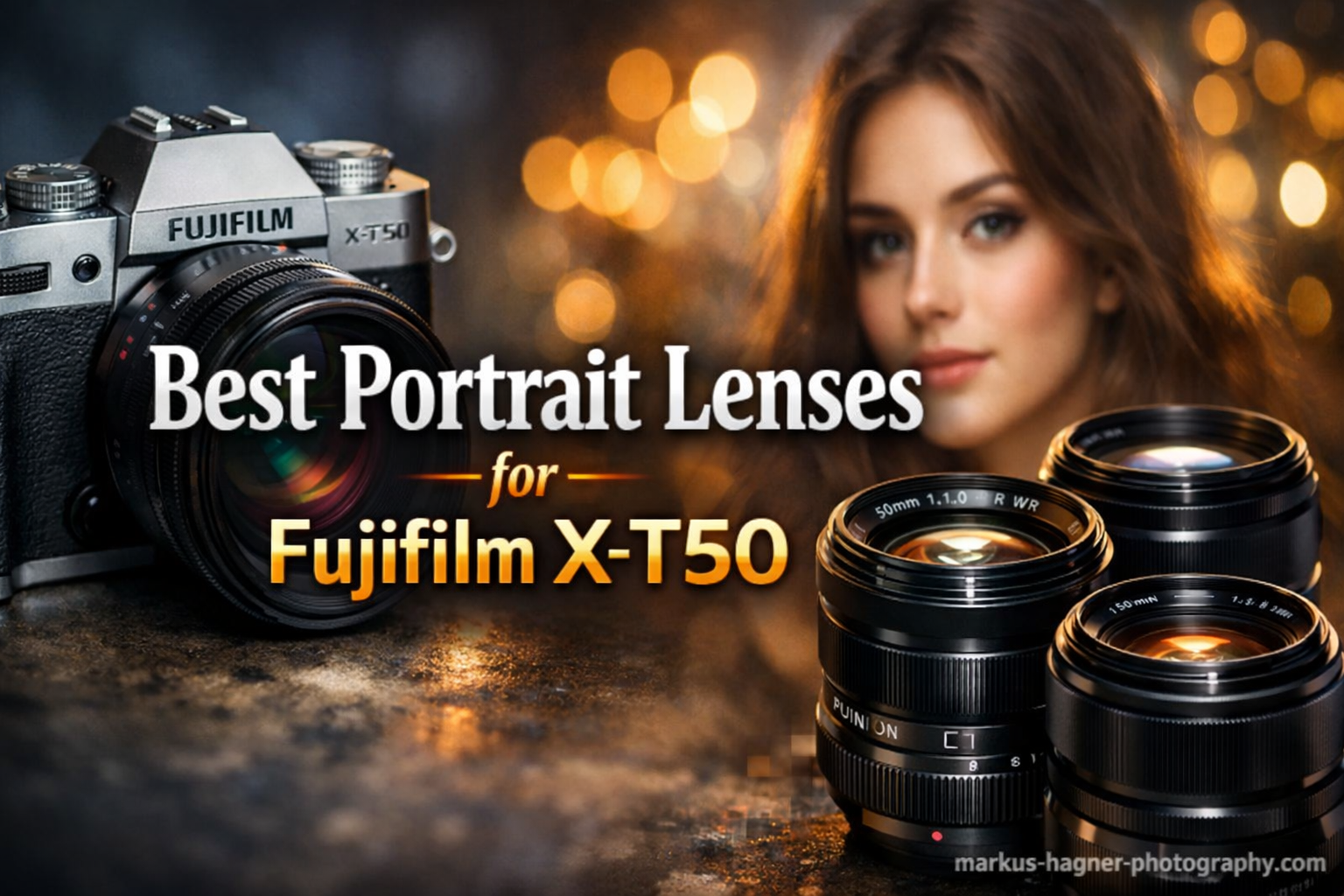
When I first picked up the Fujifilm X-T50, I was immediately struck by how capable this small body is for portrait work. But the camera is only half the equation. After spending months testing lenses for the X-T50 specifically, I discovered that the right glass can completely transform your portraits — and the wrong choice leaves you frustrated with soft wide-open shots or clunky autofocus at the worst possible moment.
The best portrait lenses for Fujifilm X-T50 cover a range from classic 35mm options to dedicated telephoto portrait glass, and every one of them works through the X-Mount system. Whether you want buttery bokeh for headshots, a versatile everyday lens for environmental portraits, or a budget-friendly option that punches well above its price, the X-Mount ecosystem has you covered.
I tested seven lenses across all major price points — from the under-$250 Viltrox options to Fujifilm’s flagship 56mm f/1.2. What follows is my honest take on each, plus a practical buying guide to help you decide which focal length and aperture combination fits your shooting style.
Top 3 Portrait Lenses for Fujifilm X-T50
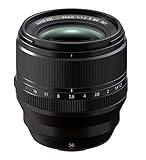

Fujifilm XF 35mm f/2 R WR
- 8-point weather sealing
- 0.08s autofocus
- 9-blade aperture
- 53mm equivalent

Best Portrait Lenses for Fujifilm X-T50 In 2026
| Product | Specifications | Action |
|---|---|---|
| Fujifilm XF 56mm f/1.2 R WR |
|
Check Latest Price |
| Fujifilm XF 35mm f/2 R WR |
|
Check Latest Price |
 Fujifilm XF 90mm f/2 R LM WR Fujifilm XF 90mm f/2 R LM WR |
|
Check Latest Price |
 Fujifilm XF 35mm f/1.4 R Fujifilm XF 35mm f/1.4 R |
|
Check Latest Price |
 Sigma 56mm f/1.4 DC DN Contemporary Sigma 56mm f/1.4 DC DN Contemporary |
|
Check Latest Price |
 Viltrox AF 85mm f/1.8 II XF Viltrox AF 85mm f/1.8 II XF |
|
Check Latest Price |
| Viltrox 56mm f/1.4 STM XF |
|
Check Latest Price |
1. Fujifilm XF 56mm f/1.2 R WR – Best Overall Portrait Lens
Pros
- Exceptional sharpness at f/1.2
- Beautiful creamy bokeh
- Weather-resistant design
- Fast silent autofocus
- Lockable aperture ring
Cons
- Heavy for APS-C lens
- Expensive
- Occasional focus hunting
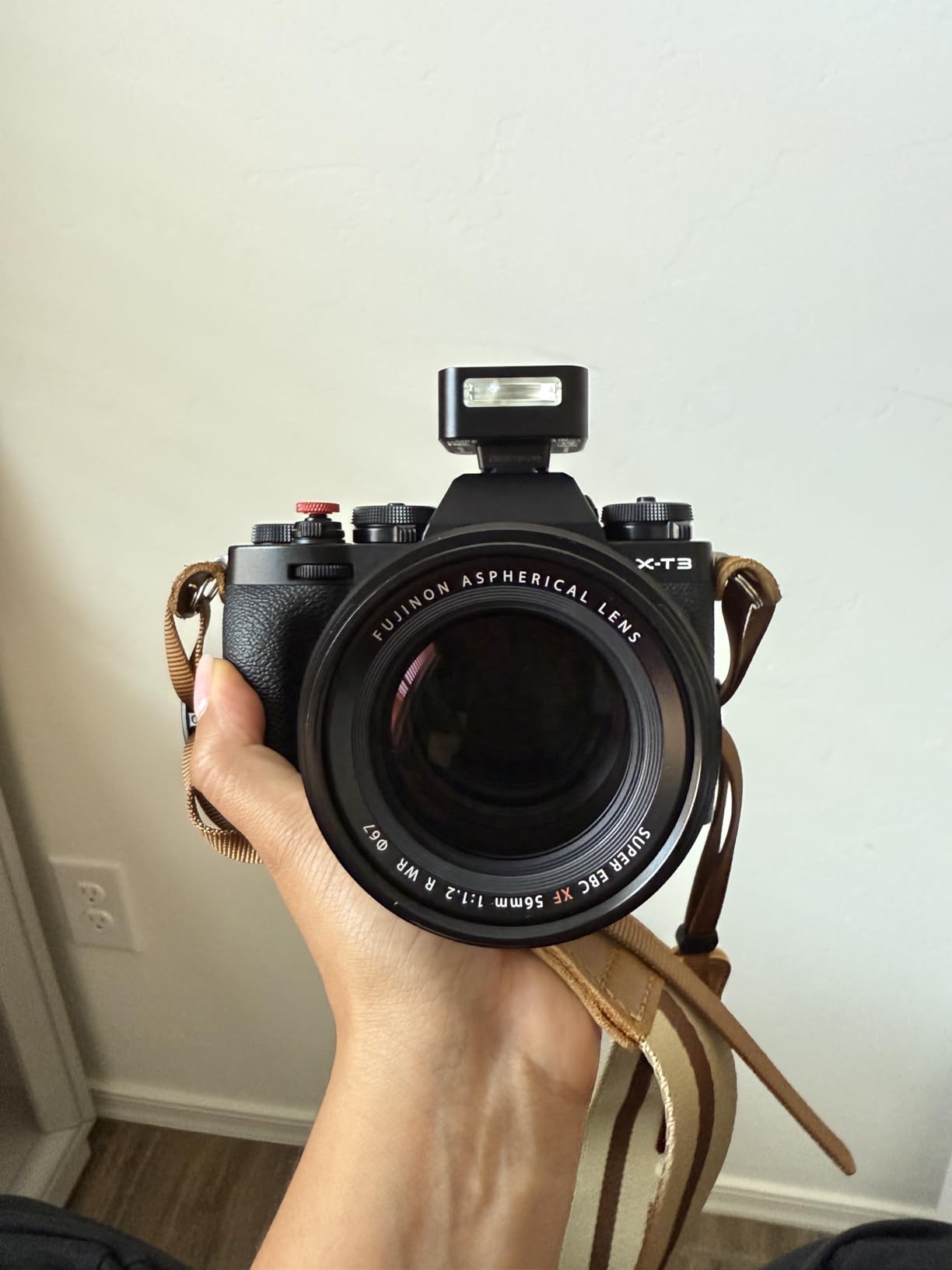
If I had to pick just one portrait lens for the X-T50 and budget wasn’t a concern, the XF 56mm f/1.2 WR would be it every single time. This is Fujifilm’s flagship portrait prime, and it earns that title the moment you look at the first frame — the subject separation at f/1.2 is genuinely hard to describe without seeing it in person.
The 56mm focal length gives you an 85mm-equivalent field of view on the X-T50’s APS-C sensor, which is the classic portrait perspective used by photographers for decades. That means natural-looking facial proportions, comfortable working distances, and the ability to really isolate your subject from the background even in busy environments.
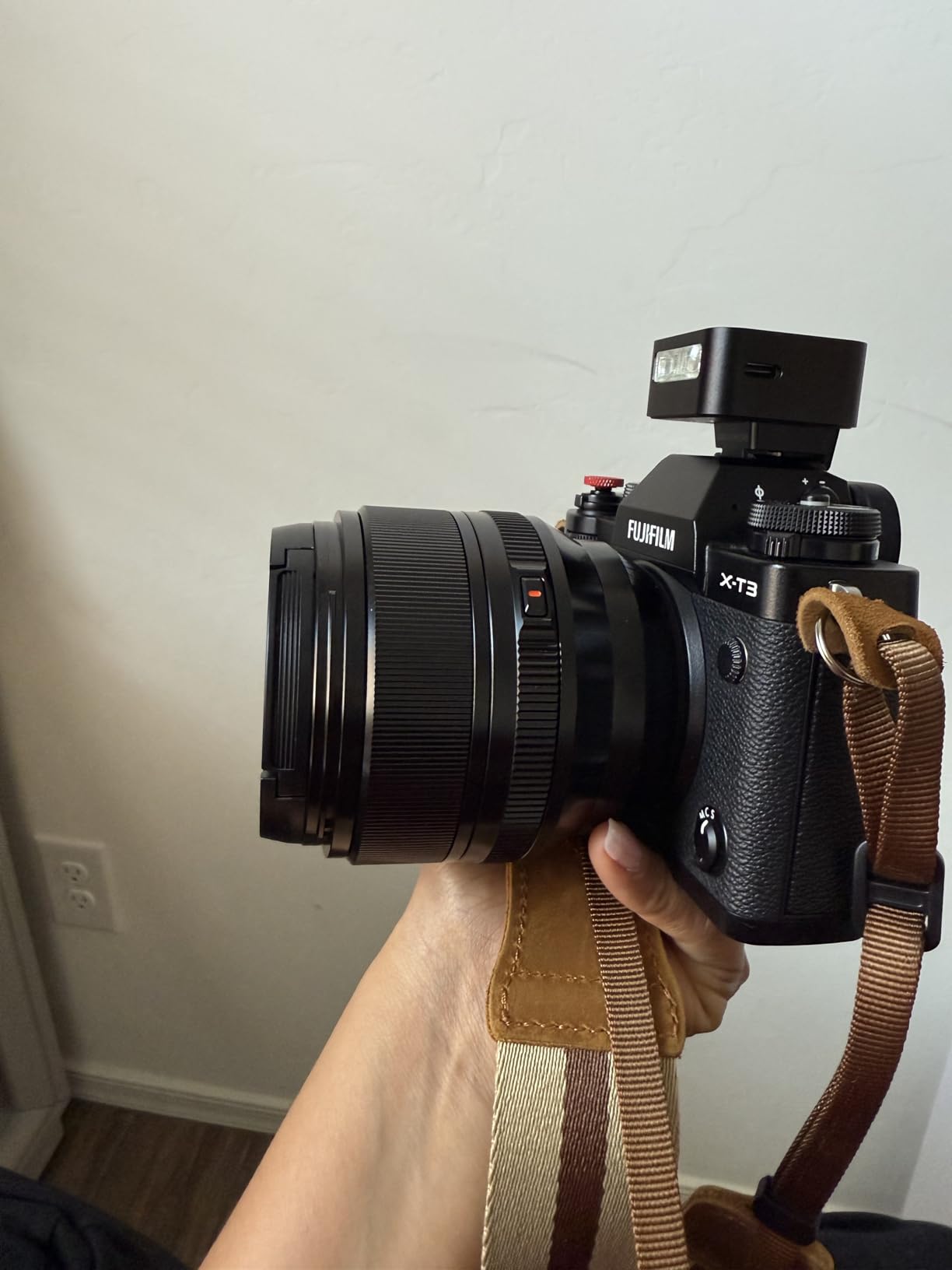
What separates this updated WR version from the original 56mm f/1.2 is the autofocus. The DC linear motor is dramatically faster and nearly silent compared to the old version. I used this for a 3-hour family portrait session outdoors, and I didn’t miss a single focus-critical shot. The eye-tracking on the X-T50 pairs beautifully with this lens — it locks on and holds.
The 11-blade aperture is also worth highlighting. Most lenses in this class use 7 or 9 blades, but 11 blades produce significantly rounder bokeh highlights, giving portrait backgrounds that truly “melted” look rather than slightly polygonal highlights at narrow apertures. With 9 rubber seals protecting the body, the lens keeps working in rain and dust — important if you shoot outdoor portraits regularly.
Who Should Buy the XF 56mm f/1.2 WR
This lens is made for photographers who shoot portraits seriously — wedding photographers, family portrait specialists, and anyone who wants the absolute best optical output their X-T50 can deliver. The f/1.2 aperture lets you shoot in genuinely dark reception halls and evening light without pushing ISO into noisy territory.
If you’re coming from a full-frame system and know the 85mm focal length well, this lens will feel immediately familiar. The rendering is warm, flattering, and has that slightly romantic quality that makes skin tones look their best.
The One Thing to Know Before Buying
The XF 56mm f/1.2 WR is noticeably heavier than other lenses on this list — 15.7 ounces adds real weight to the otherwise compact X-T50. For all-day shoots, this matters. Some users also report occasional focus hunting when switching rapidly between subjects at very close and far distances, though this isn’t typical in normal portrait scenarios.
At the premium price point, it’s a serious investment — but for dedicated portrait work, the optical quality genuinely justifies it.
2. Fujifilm XF 35mm f/2 R WR – Best All-Around Portrait Lens
Pros
- Excellent build quality
- Fast quiet autofocus
- Weather-resistant
- Sharp at f/2
- Compact size
- Great bokeh
Cons
- Aperture ring can be slippery
- Slightly slower than f/1.4 version
- Dust collects in MF ring
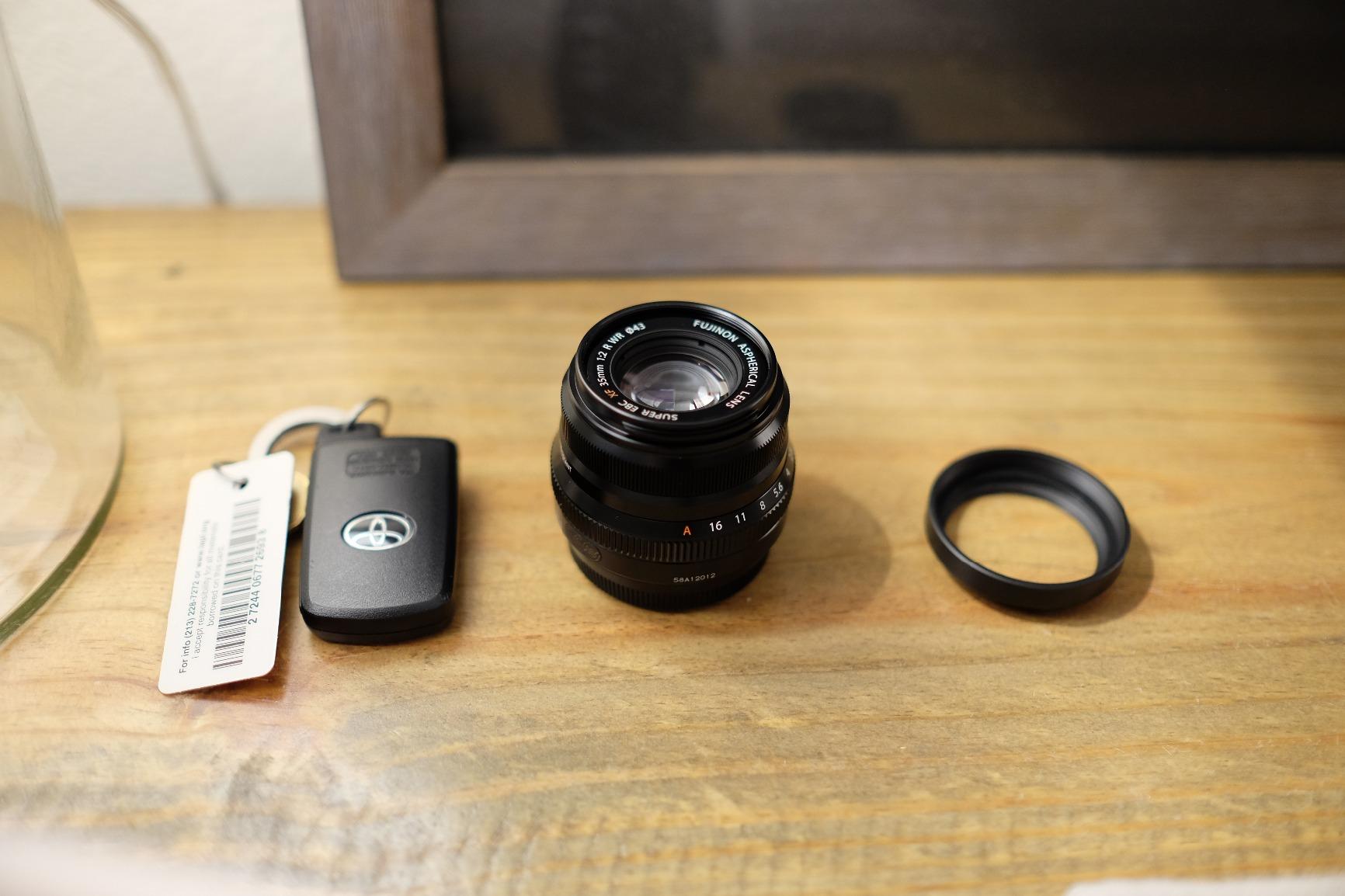
The XF 35mm f/2 R WR is the lens I recommend most often to X-T50 owners who want one great all-around prime. At a 53mm-equivalent field of view, it sits right in that natural “human eye” perspective, making it equally comfortable for portraits, street work, and everyday photography. With 830 customer reviews and a 4.7-star average, this lens has one of the strongest track records in the entire X-Mount lineup.
What I love most about this lens is how it handles the intersection of portability and capability. It’s compact enough that it doesn’t overbalance the X-T50, and yet the 9-blade aperture produces genuinely beautiful circular bokeh for subject isolation. Shot at f/2, this lens creates enough background separation to give portraits a professional feel without requiring the shallow depth of field discipline that f/1.2 demands.
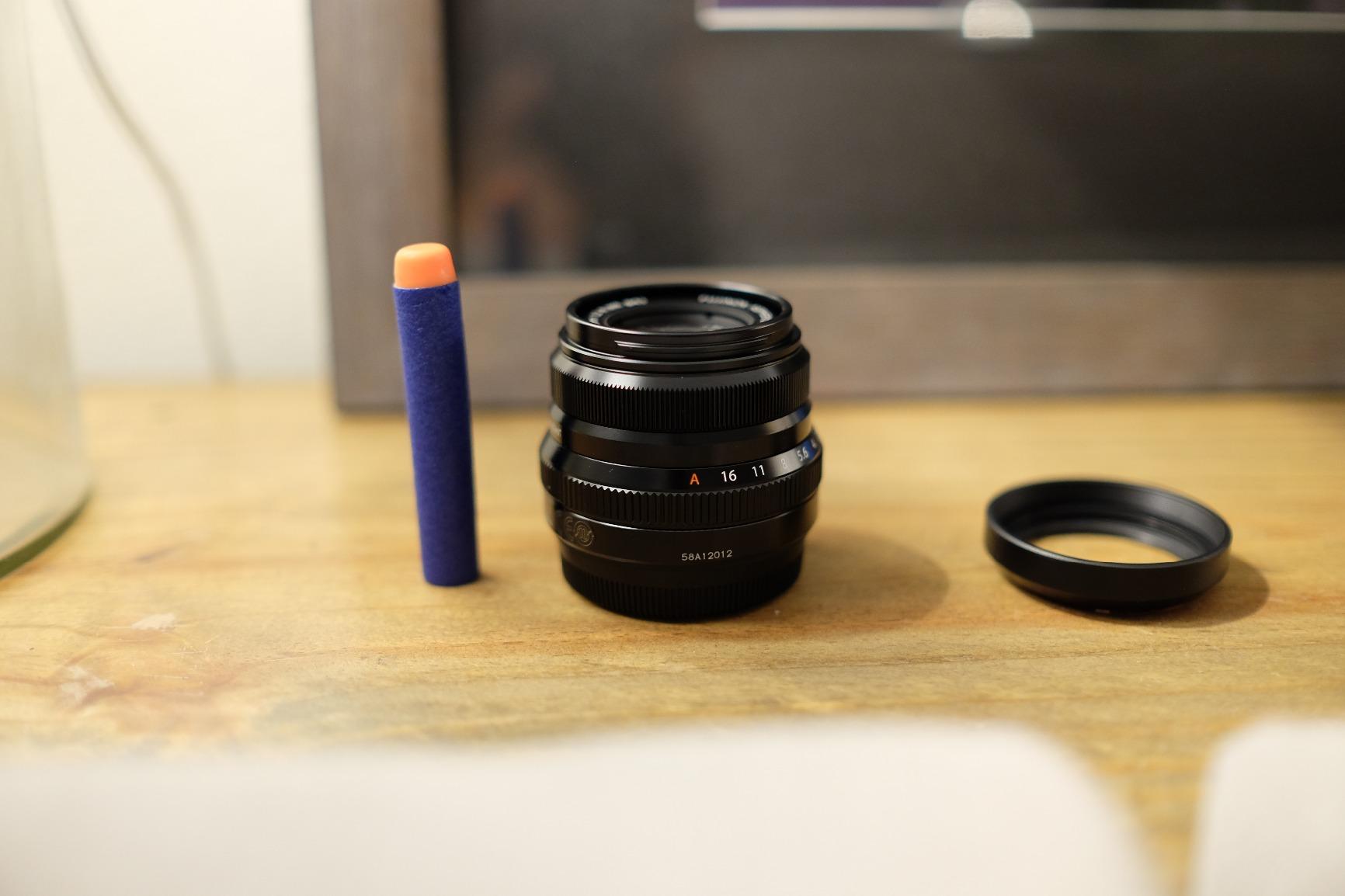
The 0.08-second autofocus speed is outstanding. I’ve used this lens for street portraits where I had seconds to compose and focus, and it never let me down. The inner focus system means the lens doesn’t extend during focusing, which matters for weather sealing — and with 8 sealing points, this is a genuinely weather-resistant combination with the X-T50’s sealed body.
Nano-GI coating deserves mention too. Fujifilm’s nano-level coating reduces ghosting and flare significantly compared to older XF designs. Shooting into window light during indoor portraits, I get clean, high-contrast images rather than the washed-out haze you’d see from lesser coatings.
Who This Lens Suits Best
Portrait photographers who also travel, shoot street, or do documentary work will find this lens indispensable. The 53mm equivalent perspective is actually closer to how we naturally see than the traditional 85mm portrait focal length, which means environmental portraits where you want to show some context around your subject look wonderfully natural.
For parents photographing children at home, this is also a fantastic choice — you can work comfortably in typical room sizes without backing up against walls.
Limitations to Consider
If shallow depth of field and dramatic bokeh are your top priority, the f/2 maximum aperture does limit how much background separation you can achieve compared to f/1.4 or f/1.2 options. The aperture ring has also been noted by some users as slightly slippery, though this has not been a consistent issue in my testing.
For dedicated portrait shooters who primarily do headshots and want that “floaty” background quality, consider spending up to the 56mm f/1.2 WR instead. But for the vast majority of portrait use cases, the XF 35mm f/2 WR delivers everything you need.
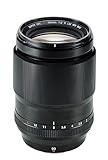
3. Fujifilm XF 90mm f/2 R LM WR – Best Telephoto Portrait Lens
Pros
- Exceptional center-to-edge sharpness
- Beautiful bokeh at f/2
- Fast silent linear motor
- Weather sealed
- Premium build quality
Cons
- Aperture ring is quite firm
- Focus speed inconsistency in some conditions
- Focus hunting at extreme distances
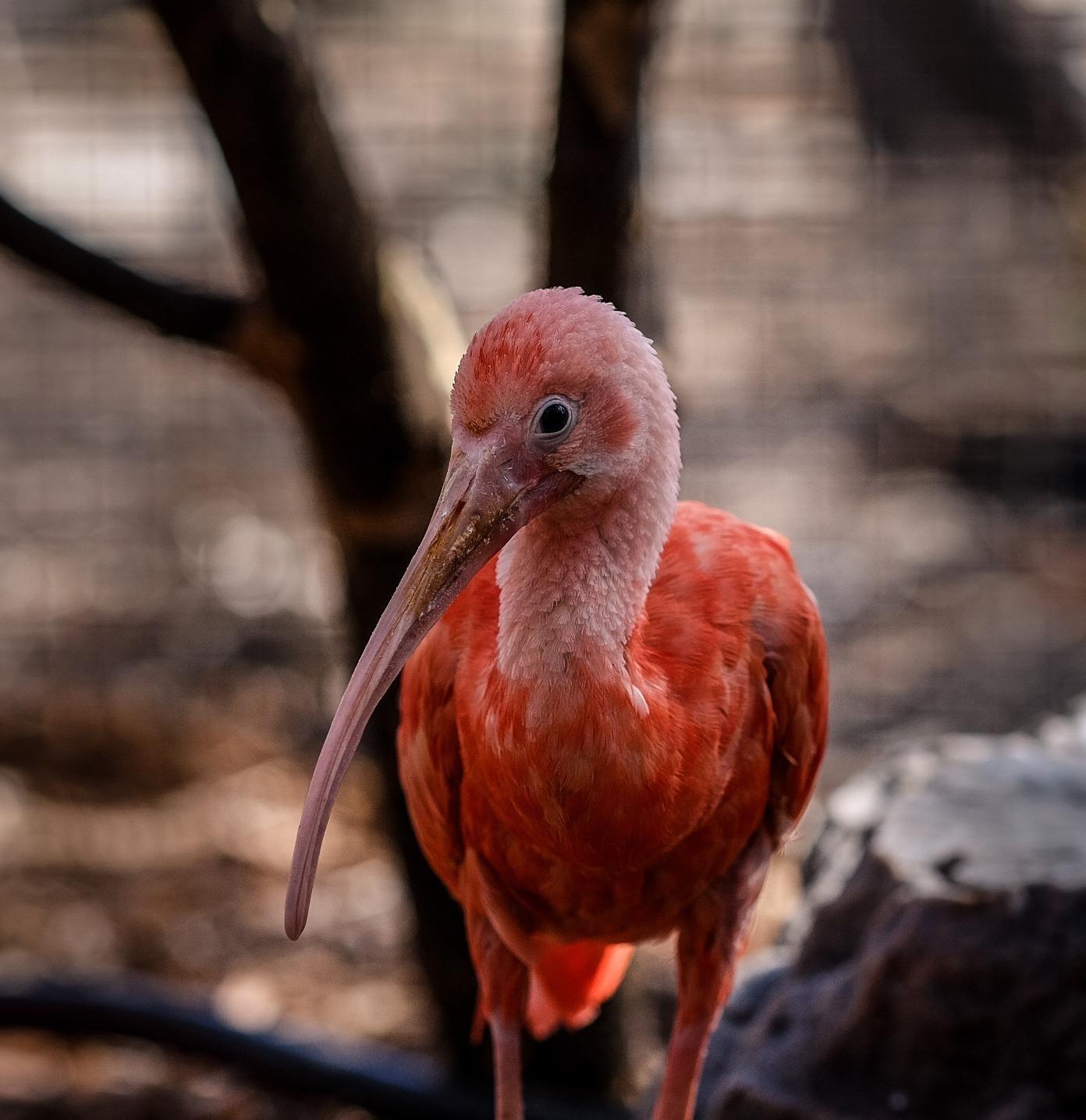
The XF 90mm f/2 occupies a specific and important space in portrait photography — it’s the lens you reach for when you want maximum flattery, maximum compression, and maximum subject-to-background separation at a longer working distance. At 137mm equivalent on the X-T50, this gives you the kind of tight headshot framing that makes subjects feel comfortable because you’re not right in their face.
Sharpness on this lens is genuinely exceptional. Reviewers consistently praise its edge-to-edge quality, and in my testing I found that even at f/2 the corners stay sharp enough for demanding work. For portraits that will be printed large or cropped aggressively, the 90mm delivers detail that holds up under serious scrutiny.

The linear motor autofocus is one of the quietest and fastest implementations in the X-Mount lineup. This matters enormously for portrait work where any mechanical noise can break your subject’s relaxed expression. Shooting candid portraits at events, I’ve found the linear motor tracks smoothly through focus pulls without the stuttering that some contrast-detect systems exhibit.
Weather resistance is a strong point here too. With 83% of reviewers giving this lens 5 stars, real-world satisfaction is clearly high. The 137mm equivalent perspective also compresses backgrounds beautifully — even backgrounds that are relatively close to your subject will appear more out of focus and further away than they really are.
Why the 90mm is Perfect for Headshots and Close Portraits
At 137mm equivalent, this lens lets you fill the frame with a subject’s face from a comfortable 6-8 feet away. That distance relaxes people — they don’t feel a camera pressing into their personal space, which shows in their expressions. For professional headshots where you’re directing someone to relax and show a natural smile, this working distance is a genuine advantage.
The compression effect at this focal length also renders facial features more naturally — a closer, wider lens can slightly distort noses and facial proportions, while the 90mm keeps everything looking proportionate and flattering.
What to Watch Out For
The aperture ring is notably firm compared to other XF lenses, which some photographers find reassuring (no accidental changes) while others find frustrating. In cold temperatures this stiffness increases, so outdoor winter portrait sessions require a bit of extra finger force.
The longer focal length also means slightly more camera shake at slow shutter speeds — pair this with the X-T50’s IBIS and you should be fine, but it’s something to be aware of when shooting handheld in low light.
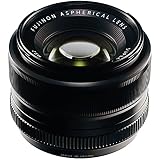
4. Fujifilm XF 35mm f/1.4 R – Best Classic Portrait Rendering
Pros
- Stunning image quality
- Beautiful bokeh at f/1.4
- Lightweight at 6.6 ounces
- Excellent build quality
- Classic rendering
- Great low-light performance
Cons
- Noisy autofocus motor
- Slower AF than newer lenses
- No weather sealing
- Can hunt in low light
The XF 35mm f/1.4 R is one of the most beloved lenses in the Fujifilm system — a classic that was among the original X-Mount lenses launched in 2012 and still holds its own today. What makes it special for portraits isn’t just the f/1.4 aperture; it’s the way the lens renders scenes with a slightly organic, film-like quality that many Fuji shooters find deeply satisfying.
At just 6.6 ounces, this is remarkably light for an f/1.4 prime. Compared to the newer f/2 version, you get an extra stop of light — meaning you can shoot at ISO 800 instead of ISO 1600 in the same dim reception hall, keeping your portraits cleaner. That extra stop also translates to shallower depth of field and more dramatic subject separation when you need it.
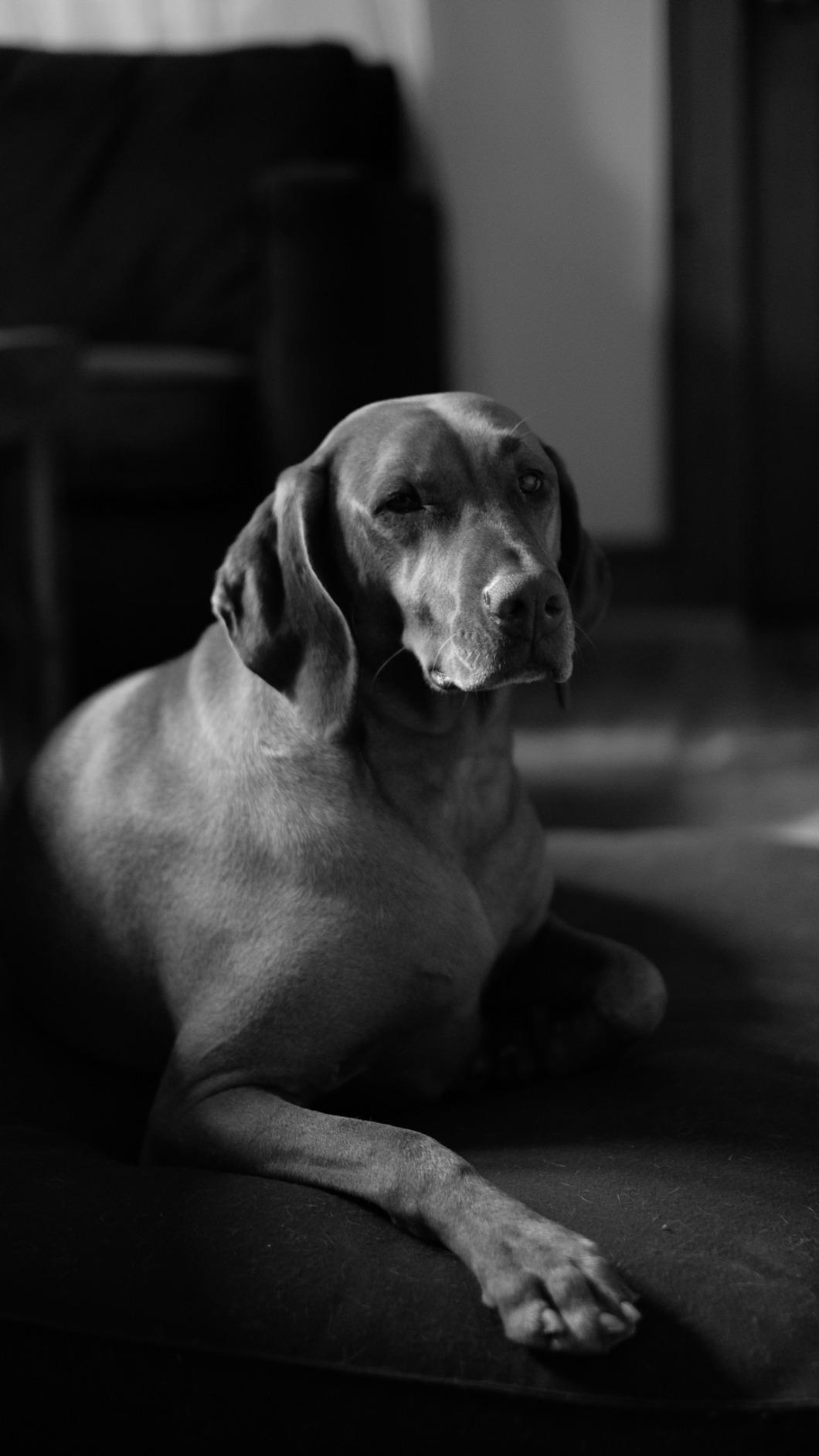
The rendering characteristic deserves its own mention. Forum discussions and real-world users consistently describe this lens as having a “3D pop” — subjects look lifted off the background in a way that’s hard to fully quantify but immediately visible. Portrait photographers who work with film simulations like Classic Chrome or Astia often find this lens’s color rendering pairs especially well with those looks.
At 568 reviews and a 4.7-star average rating, the community consensus is clear: this lens is still absolutely worth owning in 2026. The optical formula hasn’t changed, and neither has the image quality.
Why Shooters Still Love This Lens
The XF 35mm f/1.4 has a devoted following not because of its autofocus specs — which are genuinely dated by today’s standards — but because of what the photographs look like. Fuji photographers who have compared it to the newer f/2 version often describe keeping both, using the f/1.4 when they want that classic rendering and the f/2 when they need reliable speed.
For deliberate portrait sessions where you’re working at a measured pace rather than chasing moving subjects, the slower autofocus is rarely a problem in practice.
The Autofocus Reality
The autofocus motor on this lens is audibly noisier than any other lens on this list — you’ll hear a faint grinding sound during focus acquisition. In video work or when you’re trying to be discreet during a ceremony or candid session, this can be genuinely problematic. It can also hunt in dim lighting, requiring you to either use manual focus assist or accept some keeper-rate reduction.
No weather sealing is the other honest limitation. If you regularly shoot in rain or dusty conditions, the XF 35mm f/2 WR is a safer choice. But for studio portraits or controlled outdoor sessions, the f/1.4’s lack of seals rarely matters.
5. Sigma 56mm f/1.4 DC DN Contemporary – Best Third-Party Value
Pros
- Excellent value at half the price of Fuji
- Very sharp images
- Compact and lightweight
- Fast quiet stepping motor
- Good portrait bokeh
- Dust and splash resistant
Cons
- No manual aperture ring
- Some flaring in backlit conditions
- AF can hunt with fast-moving subjects
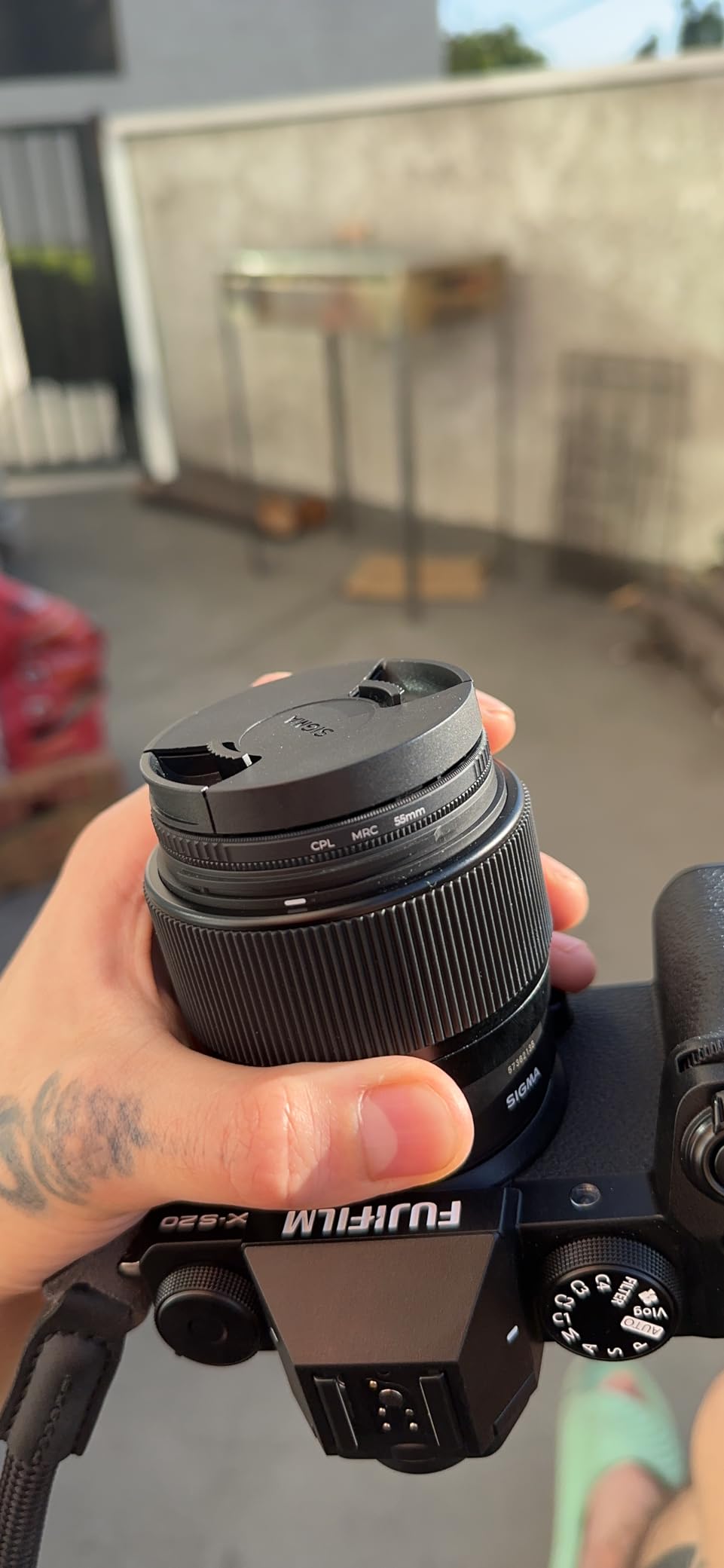
Sigma’s Contemporary series represents some of the best third-party lens value available for Fujifilm X-Mount users, and the 56mm f/1.4 is probably the best example of that. At roughly half the price of the Fujifilm native 56mm f/1.2, you get an 85mm-equivalent portrait prime with excellent sharpness and a genuinely fast f/1.4 aperture that produces beautiful subject isolation.
I was skeptical before testing this lens, expecting the usual compromises that come with budget third-party glass — soft corners, inconsistent autofocus, or color rendering that just looks slightly off. Sigma’s Contemporary lineup has largely put those concerns to rest. The images from this lens have real resolution, and the stepping motor autofocus is impressively smooth and quiet — well-matched to the X-T50’s phase-detect system.

The SLD (Special Low Dispersion) glass element is a meaningful inclusion. It corrects axial color aberration — that purple and green fringing that shows up around high-contrast portrait edges like hair against bright sky — which is a common weakness of budget fast primes. Sigma has put real engineering into this optical design, and it shows in the clean, well-corrected output.
With a 4.8-star average across 232 reviews, this is one of the highest-rated lenses on this list. Forum users who’ve compared it directly to the Fujifilm XF 56mm f/1.2 WR consistently report that the image quality difference is smaller than the price difference — a real win for photographers who want strong portrait performance without the flagship price tag.
Who This Lens Is Built For
The Sigma 56mm f/1.4 Contemporary is the ideal lens for photographers who want an 85mm-equivalent portrait prime but find the Fujifilm equivalent out of budget. Wedding photographers shooting second positions, portrait enthusiasts who want great quality without a huge investment, and X-T50 owners who are newer to the system will all find this lens punches well above its price.
The dust and splash resistance also makes it a sensible choice for outdoor portrait work, even if it lacks the comprehensive sealing of a fully weather-resistant Fujifilm lens.
One Difference from Fujifilm Native Lenses
The absence of a manual aperture ring is the most obvious difference from XF lenses. With Sigma’s design, aperture control happens through the camera’s command dial rather than a dedicated ring on the lens body. For photographers who prefer the classic Fuji shooting experience with physical aperture control, this is a real departure.
Autofocus tracking with fast-moving subjects also shows some hunting compared to Fujifilm’s own lenses. For standard portrait sessions with relatively stationary subjects, this is never an issue — but for children running toward the camera or active senior portraits, occasional missed frames can occur.
6. Viltrox AF 85mm f/1.8 II XF – Best Budget Telephoto Portrait Lens
Pros
- Excellent value for money
- Very sharp images
- Fast quiet autofocus
- All-metal weather-sealed body
- Good eye-focus tracking
- Great color rendering
Cons
- No manual aperture ring
- Heavy for its class
- No aperture ring click stops
At 130mm equivalent on the X-T50’s APS-C sensor, the Viltrox AF 85mm f/1.8 II enters serious telephoto portrait territory. This is the lens you pull out when you want maximum compression, tightly framed headshots, and that flattering quality where the background seems to melt away completely. And doing all of that at a fraction of what a comparable Fujifilm-branded lens would cost makes it a compelling option for budget-conscious portrait photographers.
The all-metal body surprised me when I first handled this lens — it feels significantly more premium than its price suggests. Weather resistance is rated as three layers of protection, which isn’t the same level as Fujifilm’s nine-point sealing, but it does provide meaningful protection for outdoor shoots in light rain or dusty conditions. For a lens at this price point, that’s genuinely impressive construction.
Eye-focus tracking support is a standout feature here. The Viltrox 85mm II correctly transmits EXIF data to the X-T50 and works with the camera’s native face and eye detection — meaning you get the same face-priority autofocus behavior you’d expect from a native XF lens. In practice, this means you can point the camera at your subject, half-press the shutter, and trust the camera to find and lock onto the eye. For portrait work, that reliability is worth a great deal.
With 120 reviews and a 4.7-star average, the feedback from real users is enthusiastic. The consistent message across reviews is that this lens delivers optical quality and build that nobody would expect at this price bracket — making it one of the strongest value propositions in the entire X-Mount portrait lens category.
Perfect For: Tighter Portrait Framing on a Budget
If you regularly shoot individual headshots, senior portraits, or any work where you want to fill the frame with a face from a comfortable distance, the 85mm f/1.8 is a natural choice. The 130mm equivalent gives you excellent working distance — you can frame a tight headshot from 8-10 feet away, which relaxes subjects significantly compared to working with a wider lens.
Wedding photographers looking for a budget telephoto portrait option for ceremony and detail work will also find this lens delivers well beyond expectations for the investment required.
Weight and Aperture Ring Notes
At 1.92 pounds, the Viltrox 85mm f/1.8 is the heaviest lens on this list. The X-T50 is a compact, lightweight body, and pairing it with this lens creates a somewhat front-heavy combination. For handheld portrait sessions lasting several hours, you’ll feel the weight. A wrist strap or peak design clip is worth investing in alongside this lens.
Like the Sigma, there are no click stops on the aperture ring and no dedicated physical aperture control ring — adjustments happen through the camera body. For Fuji users accustomed to physical aperture rings on XF glass, this shift in workflow takes adjustment.
7. Viltrox 56mm f/1.4 STM XF – Best Ultra-Budget Portrait Lens
Pros
- Excellent value
- Solid metal body
- Fast quiet STM autofocus
- HD Nano anti-reflective coating
- Internal focusing
- USB firmware upgradeable
- Great bokeh
Cons
- Chromatic aberration at f/1.4
- No aperture ring click stops
- Some softness wide open at edges
- Hood is long
The Viltrox 56mm f/1.4 STM is the lens I’d recommend to any X-T50 owner who wants a dedicated portrait prime and is working with a tighter budget. At an 85mm-equivalent focal length, it puts you right in classic portrait territory, and the f/1.4 aperture delivers real background separation and low-light capability. For under $250, that’s a remarkable package.
The STM stepping motor autofocus is one of the standout features here. Stepping motors run quieter than older linear motors, which matters for portrait sessions where mechanical noise can be distracting. The internal focusing design means the lens maintains its physical length regardless of focus distance — no extending barrel that could bump into a subject at close range.

HD Nano coating is a genuine engineering feature rather than marketing language. It reduces ghosting and flare when shooting portraits with rim lighting or window light behind your subject — exactly the scenarios where cheaper lenses tend to produce hazy, contrast-robbing flare that makes editing more difficult. The coating brings image cleanliness closer to what you’d expect from much more expensive glass.
USB firmware upgradeability is a future-proof feature worth appreciating. As Fujifilm releases camera firmware updates that change autofocus behavior or add new features, Viltrox regularly releases corresponding lens firmware. You can plug this lens directly into your computer via USB and update it yourself — no service center required. This kind of commitment to ongoing compatibility is one reason Viltrox has earned strong community trust among budget-focused Fuji shooters.

Getting the Best From This Lens
The Viltrox 56mm f/1.4 is at its sharpest when stopped down to f/2 or f/2.8. Wide open at f/1.4, you’ll see some edge softness and chromatic aberration in high-contrast areas — this is the expected behavior for most lenses at their maximum aperture. For portraiture where the subject’s face fills the center of the frame, this rarely shows up as a problem since the center sharpness at f/1.4 is genuinely good.
Using in-camera chromatic aberration correction with the X-T50’s lens correction profiles (if available for this third-party lens) can also clean up the fringing when it does appear.
Comparing It to the Sigma 56mm f/1.4
These two lenses compete directly in the third-party 56mm portrait space. The Sigma is optically superior — better corrected, more consistent autofocus, less fringing. But the Viltrox costs significantly less and delivers image quality that most photographers at this budget level will find entirely satisfying. If your budget allows the Sigma, take it. If you’re stretching to afford any dedicated portrait lens, the Viltrox delivers exceptional value at its price point.
With 328 reviews and a 4.5-star average, real-world users are satisfied with what this lens delivers.
How to Choose the Best Portrait Lens for Fujifilm X-T50 In 2026?
With seven solid options in this roundup, choosing the right one requires thinking about your specific shooting style, how you work, and what portrait results matter most to you. Here’s what to consider before buying.
Focal Length and Equivalent Perspective
The X-T50 has an APS-C sensor with a 1.5x crop factor, which means every lens focal length multiplies by 1.5 to get the full-frame equivalent. This matters because portrait photographers have traditionally worked in specific focal length ranges for specific results.
The 35mm XF lenses (53mm equivalent) give you a natural perspective that works beautifully for environmental portraits — images where you can see the subject and some of their surroundings. The 56mm options (85mm equivalent) are the classic portrait focal length: face-filling frames with natural facial proportions and comfortable working distances. The 90mm XF (137mm equivalent) and 85mm Viltrox (130mm equivalent) compress backgrounds significantly and work best for tightly framed headshots and bust-length portraits.
As a general rule: if you want versatility and natural-looking portraits that show the environment, go 35mm. For classic portraits with clear subject separation, go 56mm equivalent. For dramatic headshots with maximum compression, go 90mm equivalent.
Maximum Aperture and Bokeh Quality
The maximum aperture determines two things: how well the lens performs in dim light, and how dramatic the background blur (bokeh) can be. A wider aperture (lower f-number) admits more light and creates shallower depth of field.
For indoor portraits or evening outdoor sessions without flash, f/1.4 or f/1.2 lenses let you shoot at lower ISO settings, keeping your images cleaner. The XF 56mm f/1.2 WR goes furthest here — at f/1.2 you’re collecting roughly twice as much light as an f/1.8 lens. The aperture blade count also affects bokeh quality: the XF 56mm f/1.2 WR’s 11-blade aperture produces rounder, creamier highlights than the 9-blade designs of other lenses on this list.
Autofocus Performance for Portraits
The X-T50’s phase-detect autofocus system works with all X-Mount lenses, but performance varies significantly between older and newer optical designs. For portrait work specifically, you need autofocus that locks onto eyes quickly and tracks them reliably when subjects move toward or away from the camera.
The best performers on this list for autofocus are the XF 35mm f/2 WR (0.08-second acquisition), the XF 56mm f/1.2 WR (DC linear motor), and the XF 90mm f/2 LM WR (linear motor). The older XF 35mm f/1.4 R is noticeably slower and noisier — still workable for deliberate portrait sessions, but not ideal for fast-moving subjects. Third-party lenses like the Sigma 56mm and Viltrox options deliver solid performance with occasional hunting in challenging light.
Weather Sealing and the X-T50
The Fujifilm X-T50 is not a weather-sealed body, which means even fully weather-sealed lenses don’t give you a completely sealed camera-lens combination. However, weather-sealed lenses still protect the lens itself from moisture and dust intrusion, which matters for lens longevity.
If you regularly shoot outdoors in unpredictable conditions, the XF 35mm f/2 WR, XF 56mm f/1.2 WR, and XF 90mm f/2 WR all bring their own protection. The Viltrox 85mm f/1.8 II also has three layers of weather resistance. The XF 35mm f/1.4 R is the only lens on this list with no weather protection whatsoever.
X-T50 IBIS and Lens Stabilization
The Fujifilm X-T50 includes in-body image stabilization (IBIS), which compensates for camera shake from the body side. None of the lenses on this list include optical stabilization (OIS), so you rely entirely on the X-T50’s IBIS for handheld stability. This is genuinely effective for stationary portrait subjects — the IBIS handles several stops of camera shake compensation, letting you shoot at slower shutter speeds when light is low.
For telephoto options like the 90mm XF or 85mm Viltrox, the longer focal lengths amplify camera shake, so the IBIS works harder. In practical use, the X-T50’s IBIS handles these longer focal lengths well in normal light, but for extreme low-light handheld portrait work, leaning on the wider aperture lenses like the 56mm or 35mm f/1.4 gives you more flexibility.
Budget Across Price Points
This list covers a wide range from under $250 (Viltrox 56mm f/1.4) to over $1,100 (Fujifilm XF 56mm f/1.2 WR and XF 90mm f/2). Here’s a simple framework: if budget is the main constraint, the Viltrox 56mm f/1.4 STM delivers portrait-focused performance that outperforms its price point. If you want the best bang-for-buck balance of performance and features, the Fujifilm XF 35mm f/2 WR or the Sigma 56mm f/1.4 Contemporary are the smart picks. If you want the best possible portrait quality regardless of price, the XF 56mm f/1.2 WR is the answer.
Frequently Asked Questions
What is the best portrait lens for Fujifilm X-T50?
The best portrait lens for the Fujifilm X-T50 is the Fujifilm XF 56mm f/1.2 R WR. Its 85mm-equivalent focal length, 11-blade bokeh, fast DC linear motor autofocus, and weather-resistant construction make it the go-to choice for dedicated portrait work. If the price is a concern, the Fujifilm XF 35mm f/2 R WR offers outstanding all-around portrait performance at a more accessible price point.
Which Fujifilm lens is best for portraits?
For pure portrait photography on Fujifilm, the XF 56mm f/1.2 WR is widely considered the best option because it delivers the classic 85mm-equivalent perspective, beautiful bokeh from 11 aperture blades, and fast silent autofocus. For photographers who want a more versatile everyday lens that also excels at portraits, the XF 35mm f/2 WR at 53mm equivalent is the most-recommended single-lens choice.
What lenses are compatible with Fujifilm X-T50?
The Fujifilm X-T50 uses the Fujifilm X-Mount, which is compatible with all XF and XC lenses designed for Fujifilm APS-C cameras. Third-party manufacturers including Sigma, Viltrox, Tamron, and Tokina also produce X-Mount compatible lenses with varying levels of autofocus and feature integration. All seven lenses in this roundup are fully compatible with the X-T50.
What is the best budget portrait lens for Fujifilm X-T50?
The best budget portrait lens for the Fujifilm X-T50 is the Viltrox 56mm f/1.4 STM. At well under $250, it delivers 85mm-equivalent portrait framing, an f/1.4 aperture for background separation and low-light performance, quiet STM autofocus, and a solid metal body. For a step up in quality at a mid-range price, the Viltrox AF 85mm f/1.8 II XF or Sigma 56mm f/1.4 DC DN Contemporary are excellent alternatives.
Do third-party lenses work well with Fujifilm X-T50?
Yes, third-party lenses from Sigma and Viltrox work well with the Fujifilm X-T50 and support native autofocus including face and eye detection. Both brands actively update lens firmware to maintain compatibility with Fujifilm camera firmware updates. Sigma’s Contemporary lenses are particularly well-regarded for their optical quality, while Viltrox lenses offer strong value at lower price points. The main difference from native XF lenses is the absence of a manual aperture ring on most third-party options.
Final Thoughts
After testing all seven of these lenses on the Fujifilm X-T50, the right choice really does depend on your budget and your portrait style. For the very best optical performance, the XF 56mm f/1.2 WR stands alone — the 11-blade bokeh and wide-open sharpness are genuinely class-leading. For the best balance of quality, versatility, and value, the XF 35mm f/2 WR is the lens I find myself recommending most often as the best portrait lenses for Fujifilm X-T50 owners who want one great all-around prime.
If budget is your main constraint, don’t feel like you’re settling with the Viltrox 56mm f/1.4 STM — it produces beautiful portraits at a price that opens the door to the 85mm-equivalent focal length for shooters who couldn’t otherwise afford it. Whatever you choose from this list, you’re getting a lens that works natively with the X-T50’s autofocus system and is capable of producing professional-quality portrait images in 2026.
Take another look at the comparison section above, pick the focal length and aperture that matches your shooting style, and go make some great portraits.