
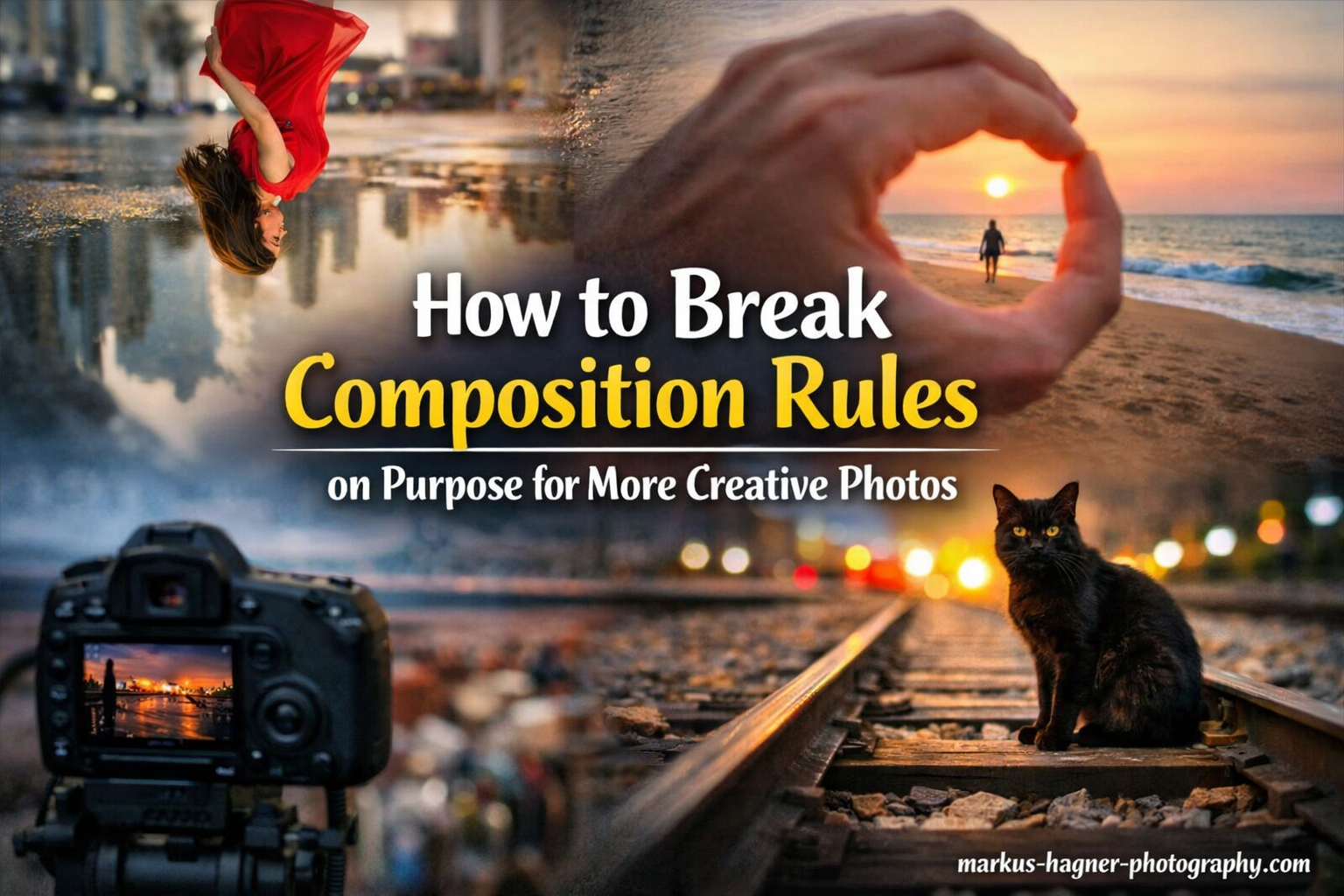
Composition rules taught me structure. Breaking them taught me style. After years of following the rule of thirds and keeping my horizons perfectly level, I discovered something unexpected. My technically correct photos looked competent but forgettable. They blended into the sea of well-composed images flooding social media feeds every day. The moment I started to break composition rules on purpose, everything changed.
Yes, it is absolutely okay to break composition rules. The key word here is “purpose.” Random rule-breaking creates chaos. Intentional rule-breaking creates art. The difference lies in understanding why a rule exists, then choosing to ignore it for a specific creative reason. Your viewer should feel the intention behind your choices, not wonder if you simply made a mistake.
In this guide, I will show you how to break composition rules on purpose to create more creative photos that grab attention and evoke emotion. We will explore which rules to break, when to break them, and how to make your broken-rule compositions look intentional rather than accidental.
Understanding Composition Rules Before Breaking Them
Composition rules did not appear out of thin air. They trace back to Renaissance artists who studied how the human eye moves through a painting and how the brain processes visual information. Painters like Michelangelo and Leonardo da Vinci used the golden ratio and leading lines centuries before photography existed. These principles work because they tap into deep psychological patterns of human perception.
Before you can break composition rules effectively, you need to understand what they are and why they work. Here are the core composition rules that most photographers learn:
The 10 Rules of Composition in Photography:
1. Rule of Thirds – Place subjects along grid lines or at intersection points
2. Leading Lines – Use natural lines to guide the eye toward your subject
3. Fill the Frame – Get close to eliminate distracting backgrounds
4. Frame Within a Frame – Use foreground elements to create depth
5. Level Horizon – Keep horizontal lines straight for stability
6. Negative Space – Leave empty space to emphasize your subject
7. Rule of Odds – Odd numbers of subjects create visual interest
8. Symmetry and Patterns – Use repeating elements for visual harmony
9. Color Theory – Use complementary colors for visual impact
10. Depth and Layers – Create foreground, middle, and background elements
Think of these rules as a vocabulary, not a law book. Once you know the words, you can write poetry that breaks grammatical conventions. The same applies to visual grammar. Master the fundamentals first, then bend them to serve your creative vision.
How to Break Composition Rules on Purpose for More Creative Photos
The most powerful compositions often come from intentional deviation. When every photographer follows the same rules, images start looking predictable. Breaking rules creates visual tension that forces viewers to stop scrolling and engage with your work. Let me walk you through specific techniques for breaking each major composition rule.
Breaking the Rule of Thirds: When Centering Wins
The rule of thirds tells us to place subjects off-center for dynamic compositions. But centering your subject can create powerful impact when done intentionally. Symmetrical subjects demand symmetrical framing. A lone tree in a foggy field, a person standing in perfect isolation, or architecture with strong geometric lines all benefit from dead-center placement.
Center composition works particularly well for portraits where you want to convey formality, power, or direct connection with the viewer. Fashion photography often breaks the rule of thirds to create striking, confrontational images. The key is making the centering so deliberate that viewers immediately recognize it as a creative choice.
I break this rule most often when shooting minimalist scenes. Placing a small subject dead center against vast negative space creates a sense of isolation and introspection that off-center placement cannot achieve. The symmetry becomes part of the emotional message.
Tilting Horizons: The Dutch Angle Technique
Photography instructors drill one rule into students: keep your horizon level. A tilted horizon screams amateur mistake. But what if you tilt it on purpose? The Dutch angle, borrowed from German expressionist cinema, creates immediate visual tension and unease. It injects energy into static scenes and suggests a world slightly off-kilter.
Action and street photography benefit most from intentional horizon tilting. A skateboarder catching air looks more dynamic when the entire frame leans into the motion. A chaotic street scene feels more authentic when the tilt mirrors the energy of the moment. The technique works because it forces viewers to actively engage with the image rather than passively consume it.
The danger lies in subtlety. A slight tilt looks like a mistake. If you are going to break this rule, commit fully. Make the angle obvious enough that viewers understand your intent. Five degrees looks careless. Twenty degrees looks artistic.
Embracing Extreme Negative Space
Traditional composition advice says to fill your frame with interesting elements. But sometimes emptiness speaks louder than detail. Extreme negative space creates mood, isolation, and contemplation. It forces viewers to focus intensely on your small subject surrounded by vastness.
Minimalist photography thrives on breaking the fill-the-frame rule. A tiny bird against an empty sky, a solitary figure on an endless beach, a single window in a blank wall. These compositions work because the emptiness becomes the subject as much as the physical object. The space tells the story.
I use this technique most in landscape and environmental portrait work. When I want to convey loneliness, freedom, or the overwhelming scale of nature, I push my subject into a tiny portion of the frame. The uncomfortable amount of empty space creates the emotional response I am seeking.
Genre-Specific Rule Breaking
Different photography genres call for different approaches to breaking composition rules. What works in street photography might feel forced in portrait work. Understanding these nuances helps you choose which rules to break based on your specific creative goals.
Portrait Photography: Breaking Subject Placement Rules
Portraits typically follow predictable patterns. Subject off-center, looking into the frame, plenty of headroom. Breaking these conventions creates memorable images. Try placing your subject at the very edge of the frame, looking away from the camera, or cropped unusually close. Each deviation from the norm adds psychological complexity to the image.
Cropping through joints or amputating limbs violates standard portrait rules. But intentional amputation can create tension and suggest stories beyond the frame. A portrait cropped at the waist with empty space above might suggest vulnerability. A face pressed against the frame edge might convey entrapment or escape.
Street Photography: Embracing Chaos Over Simplicity
Street photography composition usually emphasizes clean backgrounds and isolated subjects. But real streets are chaotic, crowded, and messy. Breaking the simplify rule by embracing complexity can create more authentic urban images. Layer your frames with multiple subjects, overlapping stories, and visual confusion that mirrors actual city life.
The great street photographers understood this. Look at work from Alex Webb or Martin Parr. Their frames overflow with competing elements that somehow resolve into cohesive compositions. They broke the simplicity rule to capture the true nature of street experience.
Landscape: When Centering Horizons Fails
Landscape photography traditionally places horizons along the upper or lower third line. But dramatic skies deserve more frame space. A tiny sliver of land beneath an explosive sunset often works better than a balanced thirds composition. Similarly, interesting foreground with boring sky might call for placing the horizon near the top of the frame.
Breaking horizon placement rules responds to the specific conditions of each scene. Rules provide starting points, not mandates. Let the landscape tell you where the horizon belongs.
Common Mistakes When Breaking Composition Rules
Breaking rules without understanding them produces garbage. I see this constantly in online photo communities. Photographers skip the fundamentals and jump straight to experimental compositions that look like mistakes rather than artistic statements. The result confuses viewers instead of engaging them.
Breaking rules without clear intent creates the biggest problem. Ask yourself why you are deviating from standard composition. If you cannot articulate a reason, your viewer will not find one either. Every broken rule should serve the story, emotion, or message you want to convey.
Making broken rules look accidental undermines your creative vision. Some rule violations, especially centering and horizon tilting, appear so often in beginner work that viewers default to assuming incompetence. You must break rules boldly enough that intention becomes obvious.
Overusing broken rules creates new cliches. Dutch angles in every shot become as predictable as rule-of-thirds compositions. Vary your approach. Sometimes follow the rules, sometimes break them. Let each image dictate its own composition rather than forcing a signature style onto every frame.
How to Know When Breaking a Rule Works
Evaluating your own rule-breaking compositions requires honest assessment. Does the image create the emotional response you intended? Show it to others without explanation and observe their reaction. If they ask about your “mistake,” the rule-breaking probably failed. If they engage with the image and comment on its mood or impact, you succeeded.
Strong broken-rule compositions share common characteristics. They create visual tension that resolves into meaning. They force longer viewing time as the eye works through unexpected arrangements. They stick in memory because they defy expectations. If your image achieves these outcomes, the broken rules served their purpose.
Not every rule-breaking attempt succeeds. Sometimes the standard composition works better. Developing intuition about when to break rules takes practice. Shoot both versions when possible. Compare them later with fresh eyes. Over time, you will develop instinct for which scenes benefit from deviation and which demand traditional treatment.
The best photographers move fluidly between following and breaking rules based on what each moment requires. They do not break rules for the sake of rebellion. They break rules because the image demands something different.
Frequently Asked Questions
Is it okay to break composition rules?
Yes, it is absolutely okay to break composition rules when done intentionally and with purpose. The key difference between amateur mistakes and artistic rule-breaking lies in intent. When you understand why a rule exists and choose to violate it for a specific creative reason, you create more dynamic and memorable images. Random rule-breaking creates confusion. Intentional rule-breaking creates impact.
What are the 9 rules of composition in photography?
The 9 essential rules of composition in photography are: 1) Rule of Thirds – placing subjects along grid lines, 2) Leading Lines – using natural lines to guide the eye, 3) Fill the Frame – eliminating distracting backgrounds, 4) Frame Within a Frame – creating depth through foreground elements, 5) Level Horizon – keeping horizontal lines straight, 6) Negative Space – using emptiness to emphasize subjects, 7) Rule of Odds – using odd numbers of subjects for visual interest, 8) Symmetry and Patterns – creating harmony through repetition, and 9) Depth and Layers – building foreground, middle, and background elements.
What is the 20-60-20 rule in photography?
The 20-60-20 rule in photography suggests dividing your image into three zones: 20% foreground, 60% middle ground, and 20% background. This creates balanced depth and visual flow through the image. The middle ground typically contains your main subject while foreground and background provide context and atmosphere. This rule helps photographers create three-dimensional feeling in two-dimensional images.
What are the 10 rules of composition in photography?
The 10 rules of composition in photography include: 1) Rule of Thirds, 2) Leading Lines, 3) Fill the Frame, 4) Frame Within a Frame, 5) Level Horizon, 6) Negative Space, 7) Rule of Odds, 8) Symmetry and Patterns, 9) Color Theory – using complementary colors for impact, and 10) Depth and Layers. These guidelines help photographers create visually balanced and engaging images that guide viewer attention effectively.
Conclusion
Learning to break composition rules on purpose transformed my photography from technically competent to personally expressive. The rules gave me structure. Breaking them gave me voice. Your journey will follow a similar path if you commit to understanding fundamentals before abandoning them.
Start small. Pick one rule to break intentionally in your next shoot. See how it feels. Evaluate the results honestly. Build your intuition through experimentation. Over time, you will develop instinct for when standard composition serves your vision and when it constrains it.
The photographers whose work we remember did not follow rules blindly. They understood visual grammar deeply enough to write their own sentences. Your unique perspective deserves the same creative freedom. Master the rules, then break them with purpose.