
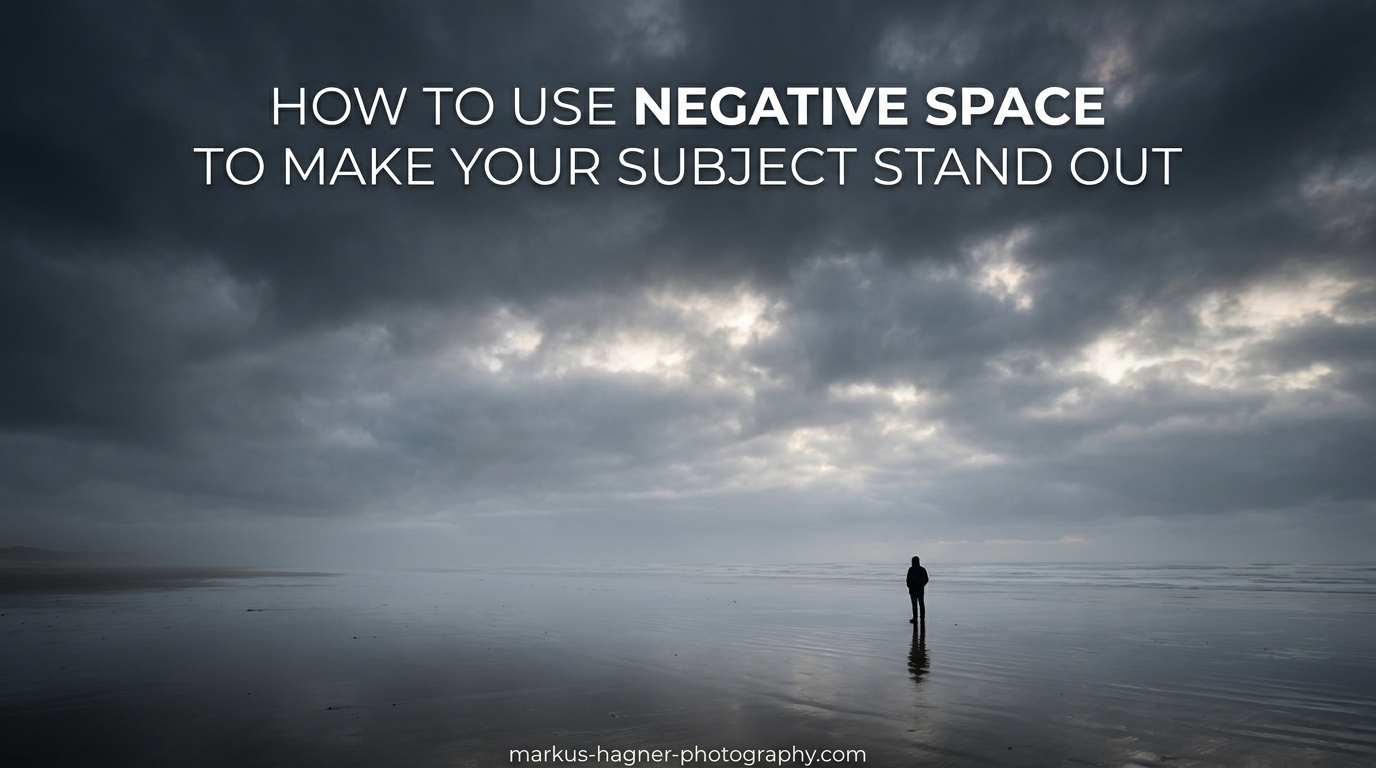
Negative space is the empty area surrounding your main subject that gives it room to breathe and naturally draws the viewer’s eye exactly where you want it. When I first started experimenting with this composition technique, I was amazed at how something as simple as emptiness could transform an ordinary snapshot into a compelling image. In this guide, I will show you exactly how to use negative space to make your subject stand out, from understanding the basics to applying it across different photography genres.
What Is Negative Space in Photography?
Negative space refers to the unoccupied areas of your frame, the blank or minimalist regions that surround your main subject. Think of it as the quiet moments between musical notes that give the melody meaning. Without these pauses, the music would feel cluttered and overwhelming.
The opposite of negative space is positive space, which is your main subject, whether that is a person, object, or point of interest. Every photograph contains both, but the ratio between them dramatically changes how your image feels and where the viewer looks first.
I like to think of negative space as the supporting actor that never tries to steal the scene. It frames, enhances, and elevates your subject without demanding attention for itself. A clean sky, a blank wall, a stretch of water, or a blurred background can all serve as negative space.
Understanding this concept changed how I compose every shot. Instead of filling every corner with something interesting, I learned that sometimes the most powerful element is what you choose to leave out.
Why Negative Space Matters in Your Photos?
Negative space does more than just look clean. It actively shapes how viewers experience your photograph.
It directs attention. When you remove visual clutter around your subject, the viewer’s eye has nowhere else to go. The empty space acts like an arrow pointing directly at what matters most.
It creates balance. A subject cramped against the edge of a frame feels uncomfortable. Negative space provides breathing room that makes compositions feel intentional and pleasing.
It evokes emotion. Minimalist compositions with generous negative space often feel calm, contemplative, or even mysterious. The emptiness invites viewers to linger and imagine.
It emphasizes scale. A tiny figure against a vast landscape tells a story about size and context. The negative space becomes part of the narrative, not just background.
One forum photographer put it perfectly: negative space needs a strong subject that can carry the whole image. The emptiness only works when what fills it is compelling enough to deserve that spotlight.
How to Use Negative Space to Make Your Subject Stand Out?
Learning to use negative space effectively requires both technical skill and artistic intention. Here is my step-by-step approach.
Step 1: Find or Create Clean Backgrounds
The easiest way to add negative space is starting with a clean background. Look for solid-colored walls, clear skies, calm water, or open fields. I often scout locations specifically for their minimalist potential.
In busy environments, try shooting from a low angle to use the sky as your negative space. Or position your subject against a distant, uncluttered background that can blur into smooth emptiness.
Step 2: Position Your Subject Intentionally
Where you place your subject within the negative space matters enormously. The rule of thirds offers a reliable starting point. Position your subject off-center, leaving the larger portion of empty space on one side.
Consider where your subject is looking or moving. If a person faces left, place them on the right side of the frame so the negative space sits in front of them, giving them room to look into.
Step 3: Use Aperture and Depth of Field
A shallow depth of field transforms busy backgrounds into smooth, blurred negative space. I frequently shoot with my aperture wide open (f/1.8 to f/2.8) specifically to create this effect.
Telephoto lenses enhance this further. The longer focal length compresses the background and increases blur, turning even cluttered scenes into creamy negative space that isolates your subject beautifully.
Step 4: Embrace Minimalist Composition
Resist the urge to include everything. Ask yourself what the photo is really about, then eliminate anything that does not serve that purpose. Sometimes the strongest compositions are the simplest.
This decluttering extends to colors too. A limited color palette with your subject in a contrasting hue against neutral negative space creates powerful visual impact.
Step 5: Leave Room for Movement and Gaze
Dynamic subjects need space to move into. A runner, a bird in flight, or a car traveling through the frame all benefit from negative space ahead of them. This creates a sense of anticipation and direction.
The same principle applies to portraits. When someone looks to the side, leave negative space where their gaze lands. This feels natural and invites the viewer to follow their line of sight.
Negative Space Techniques for Different Photography Genres
Each photography genre offers unique opportunities for negative space. Here is how I apply this technique across different styles.
Portrait Photography
In portraits, negative space emphasizes the person and their expression. I love positioning subjects against simple backdrops, letting clean negative space frame their face. Wide apertures create beautiful bokeh that turns backgrounds into soft, non-distracting negative space.
Landscape Photography
Expansive skies, vast oceans, and open fields naturally provide negative space in landscapes. A small element, perhaps a lone tree or a single figure, becomes dramatically significant when surrounded by emptiness. This contrast tells stories about scale and solitude.
Street Photography
Street photography often involves chaotic scenes, making negative space especially powerful when you find it. I look for patches of shadow, blank walls, or open sky between buildings. Silhouettes against bright backgrounds create natural negative space compositions.
Product Photography
Products need to stand out clearly, making negative space essential. Clean backgrounds with generous empty space around products draw complete attention to the item. This minimalist approach communicates professionalism and lets product details shine.
Wildlife Photography
Animals in their environment benefit enormously from negative space. A bird against a clear sky, a deer in a snowy field, or a whale breaching open water all use emptiness to emphasize the subject. The negative space also conveys habitat and isolation.
Common Mistakes to Avoid When Using Negative Space
Negative space can backfire if used incorrectly. Here are mistakes I have made and seen others make.
Too much empty space. If the negative space overwhelms your subject, the image feels empty rather than intentional. The subject should still feel like the star, not lost in vastness.
Weak subjects. Negative space demands a subject strong enough to carry the composition. If your focal point is not visually compelling, the emptiness will highlight that weakness rather than enhance the image.
Ignoring visual balance. Even minimalist compositions need balance. A subject placed awkwardly in a sea of negative space feels uncomfortable. Consider the overall harmony of positive and negative elements.
Forgetting the story. Negative space should serve your narrative, not replace it. Ask why you are using emptiness. Does it add emotion, scale, or direction? If not, reconsider whether it belongs.
Inconsistent lighting. Harsh shadows or bright spots in your negative space can become distractions. The empty areas should remain relatively uniform so they do not compete with your subject.
Frequently Asked Questions
How to effectively use negative space?
To effectively use negative space, position your main subject against a clean or blurred background, place them off-center using the rule of thirds, and leave empty space in the direction they are looking or moving. Use a wide aperture to blur busy backgrounds into smooth negative space, and ensure your subject is strong enough to carry the minimalist composition.
How to make a subject stand out in photography?
Make your subject stand out by using negative space to remove distractions, employing shallow depth of field to blur the background, positioning your subject where lighting creates contrast, using color contrast between subject and background, and applying composition rules like the rule of thirds or leading lines to direct viewer attention.
What is the golden rule of negative space?
The golden rule of negative space is that it should occupy roughly 50% or more of your frame while remaining visually subordinate to your subject. The empty space must enhance rather than overwhelm, giving your subject room to breathe without stealing attention. Balance is key, as too little space feels cramped while too much feels empty.
How much negative space should a photo have?
There is no fixed amount, but effective negative space typically occupies 50-70% of the frame. The right amount depends on your subject strength, the story you want to tell, and the emotion you wish to convey. A strong subject can handle more emptiness, while weaker subjects need less space to avoid feeling lost.
Putting It All Together
Negative space is one of the most powerful composition techniques for making your subject stand out. By understanding what negative space is, why it matters, and how to create it through camera settings and intentional framing, you can transform cluttered images into compelling visual stories.
Remember that negative space works best when your subject is strong enough to deserve the spotlight. Start by finding clean backgrounds, experiment with shallow depth of field, and practice positioning your subjects with intentional empty space around them. With time, seeing and using negative space will become second nature, and your photographs will carry more impact and emotion.
Grab your camera and start practicing. The best way to master negative space is to experiment, review your results, and refine your approach. Every empty corner of your frame is an opportunity to tell a stronger story.