
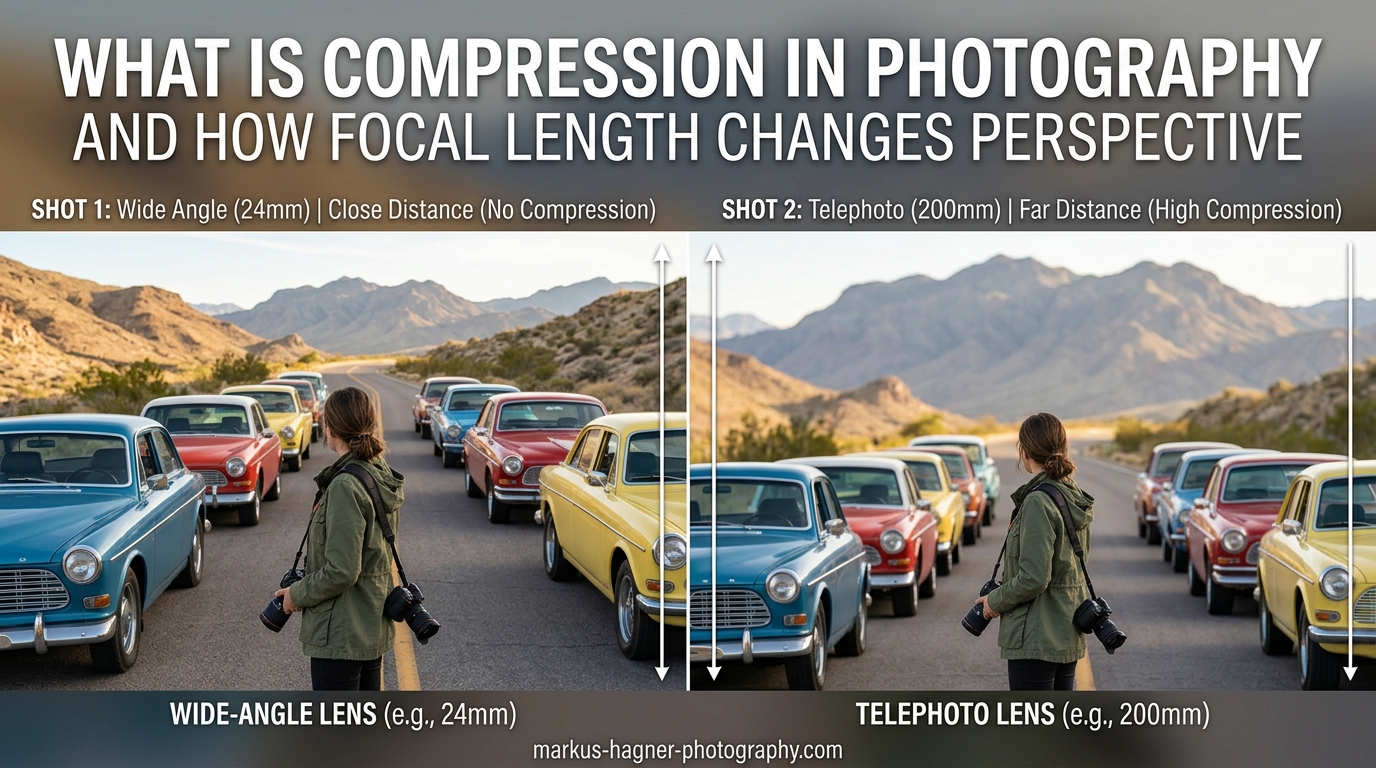
Have you ever looked at a portrait where the background seems to sit right behind the subject, making everything feel compressed together? That is the compression effect in action. In photography, compression in photography refers to the visual phenomenon where the distance between a subject and the background appears shorter than it actually is. This effect occurs when you increase the camera-to-subject distance while using a longer focal length to maintain the same subject size in the frame.
When I first started learning about focal length and perspective, I assumed that my 70-200mm lens somehow magically squeezed the scene together. The truth surprised me. The compression effect has less to do with the lens itself and everything to do with where you stand when taking the photo.
In this guide, I will explain what compression really is, how focal length and perspective work together, and most importantly, how you can use this knowledge to create more impactful images. Whether you shoot portraits, landscapes, or travel photography, understanding this concept will transform your approach to composition.
The topic of lens compression generates passionate debate in photography forums and communities. Some photographers insist that telephoto lenses create compression. Others argue that the term itself is misleading and prefer “perspective compression.” By the end of this article, you will understand why both sides have valid points and how to think about this concept clearly.
What Is Compression in Photography
Lens compression creates the illusion that background elements appear closer to your subject than they are in reality. Imagine photographing a person standing 50 feet in front of a mountain. With the right technique, that mountain can look like it is looming directly behind them, creating a dramatic, intimate scene.
The compression effect is often called perspective compression or telephoto compression. All these terms describe the same visual outcome: background elements appear larger relative to your subject, and the perceived distance between foreground and background seems reduced.
This effect works because of simple geometry. When you stand farther from your subject and zoom in with a telephoto lens, the relative size difference between near and distant objects decreases. The background occupies more of your frame simply because you have magnified that portion of the scene.
Photographers use compression for several reasons. In portraits, it creates flattering facial proportions by reducing the distortion common with wide-angle lenses. In landscapes, it makes distant mountains or sunsets feel more present and dramatic. In sports and wildlife photography, it isolates subjects against compressed backgrounds that emphasize the action.
The term “lens compression” can be slightly misleading because it suggests the lens itself compresses the scene. A more accurate term might be “perspective compression” or “distance compression” since the effect results from camera position rather than optical properties of the lens. However, “lens compression” remains the most commonly used term in photography education, so I will use it throughout this guide while keeping the distinction clear.
Understanding compression also requires distinguishing it from other related concepts. Depth of field describes how much of your scene appears in focus. Background blur describes the aesthetic quality of out-of-focus areas. Compression describes the spatial relationship between subjects and backgrounds. These three elements often appear together in telephoto images, but they are separate phenomena that can be controlled independently.
Does Focal Length Really Cause Compression
Here is where things get interesting. Many photographers believe that focal length directly causes compression. Switch to a 200mm lens, and suddenly everything compresses, right? Not exactly. This section addresses one of the most persistent myths in photography education.
Why Focal Length Gets the Credit
Focal length receives credit for compression because longer lenses require you to stand farther from your subject to maintain the same framing. If you want your subject to fill the frame with a 200mm lens, you must position yourself much farther back than you would with a 35mm lens.
This increased distance is what actually creates the compression effect. The focal length simply allows you to maintain subject size in the frame while standing at that distance. Think of focal length as the tool that lets you work from farther away, not the cause of the effect itself.
I tested this concept by photographing the same subject from the same position using different focal lengths, then cropping the wider shots to match the telephoto framing. The perspective remained identical across all images. The only thing that changed was image quality from cropping. This simple experiment proves that focal length alone does not change perspective.
Another way to think about this: imagine cropping a wide-angle photo to match the field of view of a telephoto lens. The cropped image shows the same perspective as if you had used the telephoto lens from the same position. The compression effect is identical because the camera position never changed. You simply removed the outer portions of the frame.
This understanding has practical implications. If you want more compression in your images, changing lenses will not help unless you also change your position. A 200mm lens used at the same distance as a 50mm lens (with appropriate cropping) produces the same perspective. The longer lens just gives you more pixels on your subject and better image quality.
The Real Cause: Camera Position
Camera-to-subject distance determines perspective, not focal length. When you move your camera closer or farther from your subject, you change the geometric relationship between foreground and background elements. This change in position alters how those elements relate to each other in your final image.
The ratio between your camera-to-subject distance and the subject-to-background distance matters most. When this ratio is small (you stand close to your subject while the background is far away), the background appears small and distant. When this ratio is large (you stand far from your subject while the background remains at the same distance), the background appears larger and closer.
This explains why telephoto lenses create compression. They force you into a position farther from your subject, increasing that distance ratio and making the background loom larger in your frame. The lens itself does not compress anything. It simply enables you to work from a distance that creates the compressed perspective.
Consider a practical example. Your friend stands 10 feet in front of a building that is 40 feet tall. If you photograph from 5 feet away using a 24mm lens, the building occupies a small portion of your frame. The distance ratio (5 feet to 10 feet) means the building appears relatively tiny. If you back up to 50 feet and use a 200mm lens to keep your friend the same size in frame, that same building now appears much larger behind them. The distance ratio (50 feet to 10 feet) has increased dramatically, creating the compression effect.
How Focal Length Changes Perspective
While focal length does not directly cause compression, different focal lengths certainly create different perspectives. Each focal length range offers unique characteristics that affect how your subjects and backgrounds appear in the final image. Understanding these characteristics helps you choose the right lens for your creative vision.
Wide-Angle Lenses (14-35mm)
Wide-angle lenses create the opposite effect of compression. They expand the scene, making background elements appear smaller and farther away. This expansion happens because you must stand close to your subject to fill the frame with a wide lens.
Standing close exaggerates the size difference between near and far objects. Your subject appears larger relative to the background, which appears tiny and distant. This creates a strong sense of depth and space in your images.
Wide-angle lenses work beautifully for environmental portraits where you want to show context, architectural photography where you need to capture expansive interiors, and landscape images where foreground elements should dominate. The expansion effect draws viewers into the scene and emphasizes the vastness of spaces.
Just be careful with portraits at these focal lengths. The close camera position can distort facial features unflatteringly. Noses appear larger, faces appear stretched, and limbs closest to the camera look disproportionately big. Save wide-angle lenses for full-body environmental portraits where you can maintain a more comfortable working distance.
Real estate photographers love wide-angle lenses because they make rooms appear larger and more spacious. The expansion effect works in their favor when the goal is to emphasize square footage. Landscape photographers use similar techniques to make foreground flowers or rocks dominate compositions while distant mountains recede into the background.
Normal Lenses (50mm)
A 50mm lens on a full-frame camera produces perspective similar to human vision. The spatial relationships between objects appear natural, without obvious expansion or compression. Many photographers consider this focal length the most honest representation of a scene.
This natural perspective makes 50mm lenses versatile for documentary photography, street photography, and casual portraits. The images feel authentic because the spatial relationships match what our eyes expect to see. Viewers are not distracted by unusual perspectives or distorted proportions.
I often recommend 50mm lenses to beginners learning about perspective. The neutral rendering helps them understand composition without the confusing effects of extreme focal lengths. Once you master the normal perspective, you can deliberately choose wider or longer lenses for creative effect.
The 50mm focal length also offers practical advantages. These lenses are typically lightweight, affordable, and fast (with many offering f/1.8 or f/1.4 maximum apertures). This makes them excellent choices for low-light photography and achieving shallow depth of field effects.
Keep in mind that crop sensors change the effective field of view of a 50mm lens. On an APS-C camera, a 50mm lens behaves like a 75mm lens on full-frame. On a Micro Four Thirds camera, it behaves like a 100mm lens. The perspective remains the same from any given position, but the framing changes.
Telephoto Lenses (85-200mm)
Telephoto lenses in the 85-200mm range create the classic compression effect that photographers love for portraits. At these focal lengths, you stand far enough from your subject that background elements appear closer and larger in the frame.
An 85mm lens offers mild compression perfect for head-and-shoulders portraits. A 135mm lens increases the effect slightly. A 200mm lens produces noticeable compression that makes backgrounds feel intimate with the subject.
Portrait photographers gravitate toward 85-135mm for good reason. These focal lengths compress facial features slightly, creating flattering proportions without making the face appear flat. The background compresses enough to feel connected to the subject without overwhelming the composition.
The working distance also affects how subjects behave in front of the camera. Many people feel more comfortable when the photographer stands farther away. This can result in more natural expressions and relaxed poses. The telephoto compression then enhances the portrait by connecting the subject with their environment in a visually pleasing way.
Sports photographers working from sidelines often use 70-200mm lenses. The compression effect helps isolate athletes against stadium backgrounds while the moderate telephoto range provides flexibility for varying subject distances. The compressed perspective also emphasizes the intensity of athletic competition by making backgrounds feel more present and immediate.
Super Telephoto Lenses (300mm+)
Super telephoto lenses create extreme compression effects. Wildlife photographers use 400mm, 500mm, and 600mm lenses not just to reach distant animals, but also to compress those animals against their environments in powerful ways.
At 400mm and beyond, even distant background elements appear large relative to your subject. A mountain miles away can frame a bird on a branch. The setting sun can seem to engulf a silhouette in the foreground. This extreme compression creates some of the most dramatic wildlife and sports images.
Astrophotographers use super telephoto compression to photograph the moon or sun behind terrestrial subjects. The optical compression makes these celestial bodies appear enormous relative to foreground elements like buildings, trees, or people. The technique requires precise positioning and timing, but the results can be stunning.
The extreme compression of super telephoto lenses also affects background rendering. Even at smaller apertures, the compressed background appears softer and more diffused. This happens because the background elements are magnified significantly, spreading any detail across more of the frame and creating a natural softening effect.
Bird photographers particularly benefit from this compression characteristic. A bird photographed at 600mm appears against a background that looks like a painted wash of color, even when that background is distant trees or vegetation. The compression magnifies the background so much that individual leaves become unrecognizable, creating smooth, pleasing bokeh.
Camera-to-Subject Distance: The Missing Piece
Understanding the relationship between camera position and subject position unlocks the full creative potential of perspective control. This section explains the mathematical foundation behind compression in practical, accessible terms.
Understanding Distance Ratios
The compression effect depends on the ratio between two distances: your camera-to-subject distance and your subject-to-background distance. When these distances are similar, compression increases. When they differ greatly, expansion occurs.
Consider this example. Your subject stands 10 feet in front of a building. If you photograph from 5 feet away, your camera-to-subject distance is half the subject-to-background distance. The building will appear small and distant. If you photograph from 50 feet away using a telephoto lens, your camera-to-subject distance is now five times the subject-to-background distance. That same building will appear much larger and closer.
This ratio explains why compression works so well for sports and wildlife photography. When you photograph a bird from 100 feet away against a mountain that is 1,000 feet behind it, the ratio is 1:10. But when you photograph a portrait from 15 feet against a building 30 feet behind your subject, the ratio is 1:2. The bird photograph will show more extreme compression simply because of these distance relationships.
You can actually calculate the compression effect mathematically. If your subject is 10 feet from the background and you photograph from 10 feet away, the ratio is 1:1. Move back to 30 feet, and the ratio becomes 3:1. The background will appear roughly three times larger relative to your subject than in the first scenario.
This understanding gives you precise control over compression. Instead of guessing which lens to use, you can calculate the exact position you need to achieve your desired effect. The focal length then becomes a simple choice based on the framing you want from that position.
Why Moving Your Feet Matters Most
Experienced photographers often say “zoom with your feet.” This advice recognizes that physical movement, not focal length adjustment, controls perspective. Zooming your lens changes framing without changing the spatial relationships in your scene.
I learned this lesson while photographing a friend in front of a city skyline. I wanted the buildings to loom large behind her. Standing close with my 24-70mm zoomed to 70mm, the buildings appeared tiny. I backed up 30 feet and zoomed to 70mm again. Now the same buildings filled the background. The focal length stayed constant, but my position created the effect I wanted.
This principle has practical implications. If you want more compression, step back from your subject. If you want less compression, move closer. Your lens choice simply determines what focal length you need to maintain your desired framing from each position.
The advice to zoom with your feet also applies to prime lens shooters. When you use a fixed focal length lens, you must move your body to change framing. This physical movement automatically changes perspective. Prime lenses can actually teach you about perspective more effectively than zooms because they force you to think about position.
Zoom lenses offer convenience, but they can also mask the relationship between position and perspective. When you zoom without moving, you change framing without changing the spatial relationships in your scene. When you move without zooming, you change both framing and perspective. Understanding this distinction helps you use zoom lenses more intentionally.
How to Use Compression in Your Photography
Now that you understand the mechanics, let us explore practical applications across different photography genres. Each genre offers unique opportunities to use compression creatively.
Portrait Photography
Compression transforms portrait photography by controlling how subjects relate to their backgrounds. Most portrait photographers prefer focal lengths between 85mm and 135mm because these lenses create flattering compression without extreme flattening.
At these focal lengths, facial features compress slightly. Noses do not appear oversized, and faces do not look distorted. The moderate compression also helps separate subjects from busy backgrounds by making those backgrounds appear closer and softer when shot wide open.
For environmental portraits where context matters, try 70mm or 85mm. You capture enough background to establish setting while still benefiting from mild compression. For headshots and beauty work, 135mm or 200mm creates that coveted compressed look where the background feels like a painted backdrop.
I recommend avoiding wide-angle lenses for close-up portraits. The expansion effect makes faces appear distorted, with noses looking too large and faces appearing stretched. Save your 24mm or 35mm lenses for full-body environmental portraits where you can stand farther back.
Consider your background selection carefully when using compression. Because compressed backgrounds appear larger in your frame, busy or distracting backgrounds become more prominent. Look for clean, simple backgrounds that complement rather than compete with your subject. Solid colors, smooth textures, and uncluttered scenes work beautifully with telephoto compression.
Landscape Photography
Landscape photographers often overlook compression, but it offers powerful creative possibilities. By using telephoto lenses from distant vantage points, you can compress layers of mountains, compress foreground elements against dramatic skies, or make the setting sun appear massive behind distant peaks.
The key is finding the right camera position. Scout locations that offer distant views of your subject. Then use focal lengths between 100mm and 400mm to compress the scene. The compression effect works particularly well during golden hour when warm light enhances the layered appearance.
Sunset and moonrise photography benefits enormously from compression. By positioning yourself far from a foreground subject like a tree, building, or person, you can use a telephoto lens to make the sun or moon appear enormous behind them. This technique creates those dramatic silhouette images that capture attention.
Mountain photography showcases compression beautifully. When you photograph distant peaks from a far vantage point, the layers of mountains stack together in a compressed arrangement. Each ridge appears closer to the next, creating a sense of depth and majesty that wide-angle landscape photography cannot achieve.
Telephoto landscapes also offer compositional advantages. By isolating specific portions of a scene, you can create abstract landscape images that focus on patterns, textures, and light. The compression effect emphasizes these graphical elements by reducing the apparent distance between them.
Travel and Street Photography
Travel photography often involves capturing people against iconic landmarks or beautiful backgrounds. Compression helps connect these elements, making landmarks appear closer to and more integrated with your subjects.
For travel portraits in front of famous buildings or monuments, step back and use a telephoto lens. The compression will make that landmark loom larger in the background, creating a stronger sense of place than a wide-angle shot from close range.
Street photographers working with compression often use 85mm or 135mm lenses. These focal lengths allow candid shooting from a comfortable distance while compressing busy urban backgrounds into cohesive backdrops. The compression also helps isolate subjects from chaotic street scenes.
When traveling, consider the storytelling potential of compression. A compressed image of a person in front of a famous landmark tells a different story than a wide-angle environmental shot. The compression creates intimacy between subject and place, suggesting a deeper connection than physical distance would indicate.
Smartphone photographers face limitations with compression because of the short actual focal lengths of phone cameras. Even phones marketed as having “telephoto” lenses typically use relatively short focal lengths compared to dedicated cameras. For serious compression work while traveling, a dedicated camera with a telephoto lens remains the better choice.
Wildlife and Sports Photography
Wildlife photographers rely on compression for two reasons: reaching distant subjects and creating impactful compositions. A 400mm or 600mm lens does more than magnify a bird or animal. It compresses that subject against its habitat in visually striking ways.
The compression effect isolates wildlife subjects against backgrounds that appear closer and more connected. A bird on a branch compresses against a blurred forest backdrop. A lion on the savanna compresses against grasslands that seem to surround it intimately.
Sports photographers use similar techniques. Baseball pitchers compress against stadium backgrounds. Soccer players compress against crowds of fans. The compression effect emphasizes the athlete while creating contextual backgrounds that feel present rather than distant.
Action sports benefit from compression in another way. When you photograph fast-moving subjects with a telephoto lens from a distance, the compressed background appears to move with the subject. This creates a sense of speed and dynamism that wide-angle coverage from close range cannot match.
The choice of background becomes critical in wildlife and sports photography. Because compression magnifies backgrounds, you want clean, uncluttered environments that support your subject. Busy backgrounds become even more distracting when compressed, so position yourself carefully to find the cleanest possible angles.
Common Misconceptions About Lens Compression
Several myths about compression persist in photography communities. Let me address the most common ones with clear explanations.
Myth: Focal Length Directly Causes Compression
As I explained earlier, focal length does not cause compression directly. Camera position causes compression. Focal length simply allows you to work from that position while maintaining your desired framing. If you do not move, changing focal length only crops your image without changing perspective.
This myth persists because focal length and camera position are so closely linked in practice. When you switch to a longer lens, you typically move back to maintain framing. The compression effect appears to come from the lens change, but it actually comes from your movement.
Myth: Crop Sensors Change Compression
Crop sensors do not affect compression. A 50mm lens on an APS-C camera produces the same perspective as a 50mm lens on a full-frame camera from the same position. The crop sensor simply captures a smaller portion of the image circle. The compression effect remains identical because your camera-to-subject distance has not changed.
The confusion arises because crop sensors change the effective field of view. That 50mm lens on APS-C frames like a 75mm lens on full-frame. But the perspective and compression characteristics come from the actual focal length and camera position, not the sensor size.
Myth: You Need Expensive Telephoto Lenses
You can achieve compression with any telephoto lens, including affordable options. A 70-300mm budget lens creates the same compression effect as a professional 70-200mm lens from the same position. The difference lies in optical quality, maximum aperture, and build quality, not in the compression characteristics.
The compression effect depends entirely on your camera position. Whether you use a thousand-dollar lens or a hundred-dollar lens, standing in the same place produces the same perspective. The more expensive lens may deliver sharper images, better bokeh, and faster autofocus, but the compression effect remains identical.
Myth: Compression Is the Same as Depth of Field
Compression and depth of field are different phenomena. Compression refers to the perceived spatial relationship between subjects and backgrounds. Depth of field refers to how much of the scene appears sharp. You can have shallow depth of field without compression (close-up with wide lens) or compression without shallow depth of field (distant landscape with small aperture).
The confusion arises because telephoto lenses often produce both compression and shallow depth of field in the same image. Photographers see the soft, compressed background and assume both effects come from the same cause. In reality, compression comes from camera position while depth of field comes from aperture, focal length, and subject distance working together.
Frequently Asked Questions
What is compression in photography?
Compression in photography is the visual effect where the distance between a subject and background appears shorter than reality. This occurs when you increase camera-to-subject distance while using a longer focal length to maintain subject size in the frame.
What lens compresses perspective?
Telephoto lenses in the 85mm to 400mm range are typically used for compression effects. Longer focal lengths like 135mm, 200mm, and 400mm create more noticeable compression. Remember that the lens enables compression by allowing you to work from a greater distance, but your camera position creates the actual effect.
Does focal length change perspective?
Focal length does not directly change perspective. Camera-to-subject distance determines perspective. Focal length affects your field of view and requires you to adjust your position to maintain framing, which then changes perspective. If you stay in the same position, changing focal length only crops the image without altering perspective.
How do I achieve lens compression?
To achieve lens compression, position yourself farther from your subject and use a telephoto lens to maintain subject size in your frame. For portraits, try 85-135mm from 10-15 feet away. For landscapes, find a distant viewpoint and use 100-400mm to compress background elements like mountains or clouds.
Putting It All Together
Understanding compression in photography transforms how you approach composition. Remember that camera-to-subject distance, not focal length, determines perspective. Use telephoto lenses when you want compression, but understand that your position creates the effect, not the glass itself.
For flattering portraits, choose 85-135mm lenses and position yourself at an appropriate distance. For dramatic landscapes, find distant vantage points and use telephoto focal lengths to compress layers. For travel photography, step back from your subjects to compress landmarks and people together.
Most importantly, experiment with this concept. Photograph the same subject from different distances using different focal lengths. The results will teach you more than any article can. Once you internalize how distance ratios affect perspective, you will make intentional creative choices rather than relying on focal length alone.
Compression in photography offers powerful creative control. Now you understand the mechanism behind it and can use it deliberately in your work. The next time someone asks what compression is, you can explain that it is about where you stand, not just what lens you use.
The best photographers understand both the technical and creative aspects of their craft. Compression sits at the intersection of these domains. It has a mathematical foundation in distance ratios, but its creative application produces images that move viewers emotionally. Master this concept, and you add a powerful tool to your photographic repertoire.