
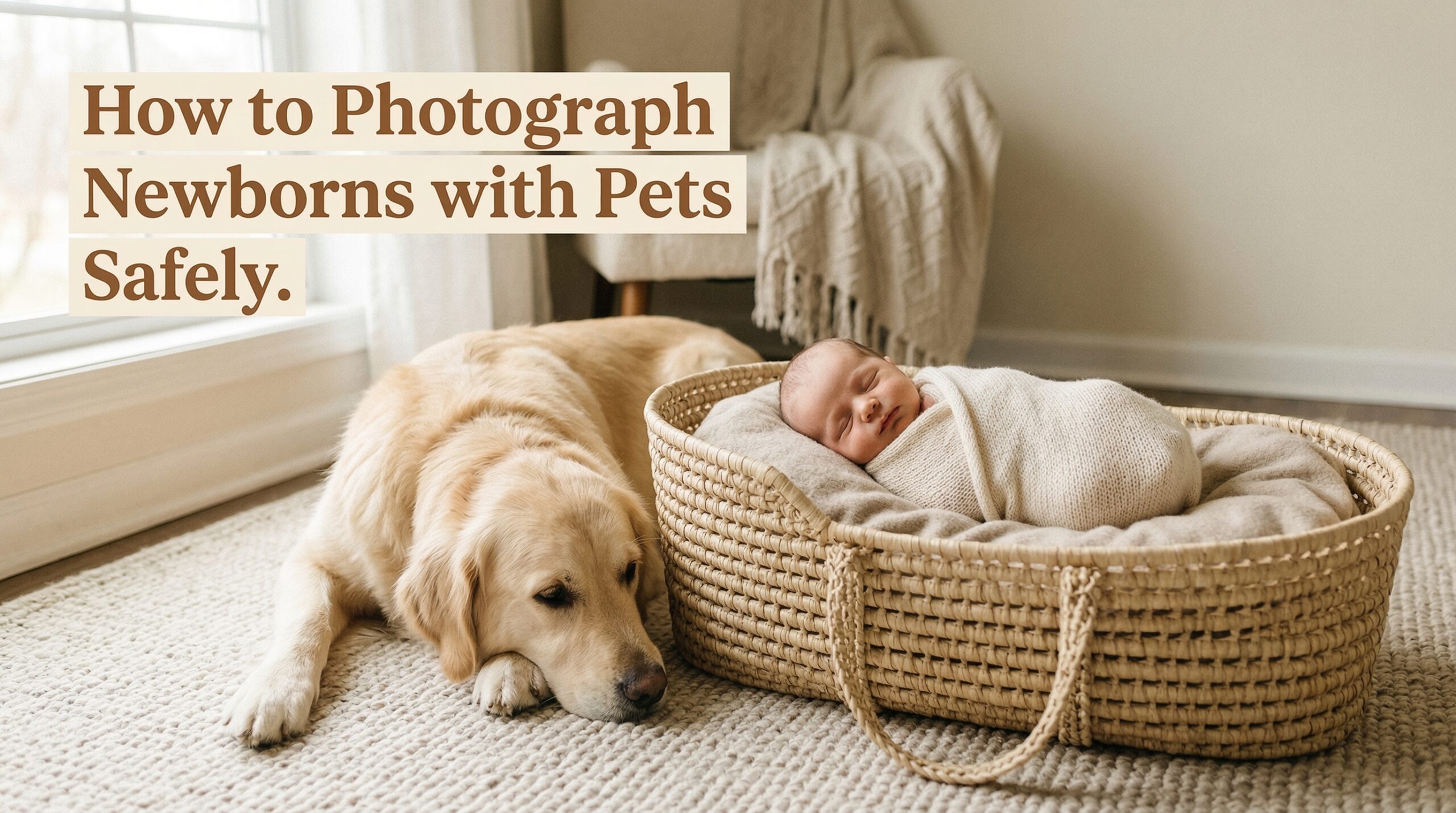
Capturing your newest family member alongside your beloved pet creates heartwarming images that tell your complete family story. I’ve photographed hundreds of newborn sessions with pets over the past decade, and I understand the delicate balance between creating beautiful memories and ensuring absolute safety. In this guide, I’ll show you exactly how to photograph newborns with pets safely in the same frame.
These furry sibling photos become treasured heirlooms. There’s something magical about seeing your newborn curled up next to the family dog or cat who has been your baby before this human arrived. But I cannot stress this enough: newborn safety must always come first, always, without exception.
Safety First: The Golden Rules
Before we dive into techniques and poses, let’s establish the non-negotiable safety rules. I’ve seen too many unsafe practices on social media, and as professional photographers, we need to set the standard. Safety isn’t just important—it’s everything.
Constant adult supervision is mandatory. I mean constant. Never leave a baby alone with an animal, even for a second. Even the most gentle, well-trained pet is still an animal with instincts we cannot predict. I always require at least one parent or dedicated spotter whose sole job is watching the baby-pet interaction.
Know your pet’s temperament honestly. Has your dog shown jealousy? Does your cat have a history of unpredictability? Be realistic about your pet’s personality. Some pets simply should not be included in newborn sessions, and that’s okay. A beautiful family photo without the pet is infinitely better than an unsafe one with it.
The newborn’s age matters significantly. I recommend waiting until the baby is at least two weeks old before attempting photos with pets. Those first two weeks are crucial for bonding and establishing routines. Plus, older newborns (2-4 weeks) tend to be more settled and sleep deeper during sessions.
Assessing Pet Temperament
Not every pet is ready for newborn photography, and recognizing this is part of being a responsible photographer. I’ve developed a quick assessment checklist I use during client consultations:
Does your pet respond reliably to basic commands? Sit, stay, and come are essential. Food-motivated pets tend to be easier to work with since we can use high-value treats to maintain position. Has your pet been around babies or young children before? How did they react?
Watch for warning signs: excessive jumping, pawing at people, food aggression, or anxiety around new situations. These behaviors don’t make your pet bad—they just mean newborn photography might not be their thing. There’s no shame in waiting until the baby is older for pet photos.
When to Say No to Including Pets
Sometimes the safest choice is to exclude pets from the newborn session entirely. I recommend skipping pet inclusion if: your pet has any history of aggression or snapping, the pet has shown recent behavioral changes, the pet is highly anxious in new environments, or you cannot provide extra helpers for supervision.
Remember that lifestyle photos with pets can happen anytime. There’s no rush. Your baby will only be a newborn for a few weeks, but you’ll have years to capture beautiful pet and child photos together safely.
Preparing for a Safe Session
Proper preparation makes the difference between a stressful session and a smooth, safe experience. I’ve learned through experience that the work we do before the session day is just as important as the session itself.
Start preparing your pet at least two weeks before the scheduled session. This isn’t about training new behaviors—it’s about reinforcing existing ones and getting your pet accustomed to the equipment and routines they’ll experience during photography.
Pet Preparation Steps
Exercise is your secret weapon. A tired pet is a well-behaved pet. Schedule a good long walk or active play session immediately before your photography session. I’m talking at least 30-45 minutes of vigorous activity. This significantly reduces the likelihood of hyperactive behavior.
Bring high-value treats that your pet absolutely loves. We’re talking the good stuff—small, soft treats that can be consumed quickly without making a mess. Reserve these special treats only for photography sessions to maintain their novelty and effectiveness.
Acclimate your pet to the photography environment. If you’re shooting in a studio, visit beforehand if possible. If at home, set up any equipment you’ll be using ahead of time so your pet can investigate and get comfortable with the new items.
Essential Items Checklist
Every safe newborn and pet session requires these essentials: high-value treats for your pet, a dedicated pet handler or spotter, toys to keep the pet focused, wipes for quick cleanups, extra blankets and props, backup memory cards and batteries, and someone specifically assigned to baby duty at all times.
Don’t underestimate the importance of extra hands. I recommend having at least two additional adults beyond the photographer—one for the baby, one for the pet. This allows the photographer to focus entirely on capturing images while ensuring both subjects are safe and comfortable.
Timing and Scheduling
Schedule your session for your baby’s best time of day—usually mid-morning after a feeding. A full, sleepy baby is easier to pose and less likely to startle the pet with sudden movements or cries.
Keep the entire session short, especially when pets are involved. Aim for 60-90 minutes maximum. Both babies and pets have limited patience, and pushing beyond their comfort zone increases safety risks and decreases image quality.
The Composite Technique: The Safest Approach
Here’s the professional secret that makes the safest and most stunning newborn pet images: composite photography. This is the technique I use for 90% of my newborn and pet sessions, and it’s absolutely worth the extra editing time.
Composite photography means we photograph the baby and pet separately, then combine the images in post-processing. This eliminates virtually all risk while still creating the illusion that they were photographed together. I’ve used this technique for everything from gentle dogs sleeping next to newborns to curious cats peeking into baskets.
Why Composite is Safest
The composite approach eliminates physical contact between baby and pet entirely. The baby never actually touches the animal, removing any possibility of scratches, jumps, or unexpected movements. This is especially important for cat owners—cats are naturally drawn to warmth and may try to curl up on or near a sleeping baby, which poses real safety risks.
Another advantage? The pet doesn’t need to be perfectly behaved. Since we’re photographing them separately, we can work with the pet’s energy level and attention span without worrying about disturbing the baby. I can photograph a rambunctious dog in the yard, then a peacefully sleeping baby indoors, and create a seamless final image.
Step-by-Step Composite Workflow
Step 1: Set up your camera on a tripod and lock down all settings. Take a test shot without any subjects to establish your base exposure and framing. This shot will be crucial for alignment during editing.
Step 2: Photograph your pet first while they’re fresh and attentive. Have your pet handler position the animal exactly where you want them in the frame. Capture multiple angles and expressions. For dogs, a simple sit or down position works beautifully. For cats, natural poses are best—let them curl up or stretch comfortably.
Step 3: Remove the pet completely from the area. This is critical. The pet should be in a different room with the handler so there’s zero chance of them wandering back into the shot.
Step 4: Set up and pose your baby. Swaddled poses work exceptionally well for composites because they create a contained, compact shape. Position the baby where the pet was positioned, using your reference photos as a guide. Take care to match the angle and perspective from the pet photos.
Step 5: Capture the baby images. Since babies are more time-sensitive to photograph, I recommend doing the pet shots first when they’re fresh. A well-fed, sleepy baby is the ideal subject for composite work.
Post-Processing Tips
In your editing software, layer your pet and baby images using the blank reference shot as alignment. Use masking techniques to reveal the portions of each image you want. Pay special attention to shadows—they should be consistent across both subjects to create a realistic final image.
Refine edges carefully, especially around fur. Hair and fur require precise masking to look natural. I recommend using a tablet and stylus for this detailed work, though careful mouse work can achieve good results too.
Match color grading and lighting between both images so they appear to have been captured in the same moment. Slight differences can be distracting and make the composite obvious. Your final image should look so natural that no one suspects it was created from two separate photos.
Safe Posing Options for Newborns and Pets
When you do photograph baby and pet together (with proper safety measures), certain poses consistently work better than others. I’ve refined these over years of sessions, prioritizing both safety and visual appeal.
The key is creating physical separation between subjects while maintaining the appearance of closeness. Props, positioning, and careful composition achieve this beautifully. Let me share my go-to safe poses that still capture that precious connection.
Swaddled Newborn Poses
Swaddled poses are my top recommendation for including pets. The tightly wrapped baby creates a contained, secure shape that’s easy to position safely. Plus, swaddled babies tend to sleep more deeply and startle less easily.
Place the swaddled baby in a basket or bowl, elevated on a sturdy platform. Position the pet beside or slightly behind the container, creating a layered composition. The baby appears nestled next to their furry sibling, but there’s actual physical separation provided by the prop.
This setup works beautifully for both dogs and cats. For dogs, place them in a stay position beside the baby’s container. For cats, allow them to naturally perch or sit near the basket—they’re drawn to cozy spaces and will often arrange themselves photogenically.
Seated and Lifestyle Poses
For slightly older newborns (3-4 weeks), seated poses with parental supervision work wonderfully. Seat a parent on a couch or bed with the baby securely supported in their arms. Position the pet beside the family, perhaps resting a head on a knee or sitting close to the parent’s side.
This creates a natural lifestyle moment while maintaining complete safety. The baby is physically supported by the parent throughout, and the pet can be positioned for optimal connection without any risk to the newborn.
Another lifestyle option: photograph the baby in a bassinet or crib with the pet looking in from outside. The pet’s curiosity creates a sweet, protective image without any physical contact. This works particularly well for cat owners—cats naturally want to investigate new arrivals, and capturing that interest from a safe distance produces touching images.
Props and Accessories Safety
Props enhance both safety and aesthetics, but they must be chosen thoughtfully. Sturdy baskets, bowls, and crates create designated spaces for each subject. I favor containers with low sides that allow easy visual connection between baby and pet.
Always weight down lightweight props to prevent tipping. An excited pet could accidentally knock over an unstable container, which would be dangerous for the baby inside. I use sandbags or strategically placed towels to secure all props before placing any subjects.
Textured blankets and backdrops add visual interest without introducing risk. Avoid props with small pieces that could become choking hazards, and never use items that could tip over or collapse. Every prop choice should pass a safety-first assessment before being used in a session.
During the Session: Best Practices
All the preparation in the world doesn’t matter if you don’t execute safely during the actual session. I’ve developed protocols that I follow without exception, and these practices have kept hundreds of newborns safe while still creating beautiful images.
The most important rule: never let your guard down. It only takes a second for something to go wrong. I maintain heightened awareness throughout every session, watching for any signs of stress or discomfort from either the baby or the pet.
Supervision and Spotting
Assign clear roles before the session begins. One person is solely responsible for the baby—this person never takes their eyes off the newborn, never handles the pet, and never leaves the baby unattended. Another person manages the pet, keeping them focused and positioned correctly.
I position myself as the photographer, but I’m also constantly assessing safety. If I see any potential issue—a pet getting too excited, a baby starting to stir, a prop looking unstable—I immediately pause the session to address it. There’s no photo worth compromising safety.
Use physical barriers strategically. A simple ottoman or pillow can create separation between baby and pet while being disguised as part of the composition. These invisible safety measures allow for beautiful images while maintaining protected spaces around the newborn.
Working with Different Pet Types
Dogs and cats require different approaches, and understanding these differences is key to safe sessions. Dogs generally respond well to commands and can hold positions reliably. Food-motivated dogs are particularly easy to work with since treats maintain their focus.
Cats, however, march to their own beat. They’re less predictable and more likely to make sudden movements. For cats, I almost exclusively use the composite technique or pose them looking in from outside a safe container. Their natural curiosity makes for beautiful images, but their unpredictability requires extra caution.
Other pets—birds, rabbits, reptiles—require specialized knowledge and are generally not recommended for newborn sessions. If a client asks about including less common pets, I carefully assess each situation individually and often recommend waiting until the child is older.
Camera Settings and Equipment
While safety is paramount, having the right technical setup helps you capture beautiful images efficiently. Shorter sessions mean less time for either subject to become fussy or tired, so being prepared technically supports overall safety.
Recommended Camera Settings
Use a fast shutter speed to freeze motion, especially with pets who may move unexpectedly. I aim for at least 1/200th of a second, though 1/250th or higher is even better. Faster shutter speeds ensure sharp images even if subjects make slight movements.
Choose a wide aperture (f/2.8 or wider) to create beautiful background separation. This also allows for faster shutter speeds in lower light conditions. Just be mindful of depth of field—you want both baby and pet in focus when they’re in the same plane.
Keep your ISO as low as possible while maintaining proper exposure. Modern cameras handle high ISO beautifully, but I try to stay under ISO 800 when possible to maintain image quality. Proper lighting setup helps achieve this goal.
Essential Equipment
A sturdy tripod is non-negotiable for composite work. It keeps your framing identical between shots, which makes post-processing significantly easier. Invest in a quality tripod that won’t shift during the session.
Fast prime lenses (50mm or 85mm) are ideal for newborn and pet photography. They allow for wider apertures and beautiful background blur while providing enough working distance to not crowd either subject. A 35mm lens works well for environmental lifestyle shots showing more of the home environment.
Good lighting makes everything easier and faster. Natural window light is my preference, but a simple softbox or reflector can fill in shadows and create consistent lighting conditions. Avoid on-camera flash which can startle both baby and pet.
Common Mistakes to Avoid
Learning from others’ mistakes is just as valuable as learning from successes. These are the errors I see most often, and avoiding them will make your sessions safer and more successful.
Leaving baby and pet alone together, even for seconds. This is the most dangerous mistake and absolutely never acceptable. Always have dedicated supervision for both subjects.
Choosing the wrong time of day when the baby is typically fussy. Work with your baby’s natural rhythms, not against them. A well-fed, sleepy baby is safer and easier to photograph.
Skipping the pre-session exercise for pets. A tired pet is a cooperative pet. Make time for vigorous activity before the session begins.
Attempting advanced poses without proper experience. Master the basics before trying complex setups. Simple, safe poses produce beautiful images without unnecessary risk.
Relying on treats alone to manage pet behavior. Combine treats with clear commands, proper handling, and appropriate session length. Food motivation is a tool, not a complete solution.
Forgetting that pets can sense stress. If you’re anxious, your pet will be too. Approach sessions calmly and confidently. Your energy influences both the baby and the animal.
Trying to force interactions between baby and pet. Let moments develop naturally. The most beautiful images come from authentic connection, not staged interactions.
Not having a backup plan. Sometimes despite all preparation, a session doesn’t go as planned. Be ready to pivot to composite images or postpone pet portions for another day.
Overlooking the importance of breaks. Both babies and pets need downtime during sessions. Build in pauses for feeding, changing, and pet rest periods.
Ignoring your instincts about pet temperament. If something feels off, it probably is. Trust your assessment and be willing to adjust plans for safety.
Is it safe to photograph newborns with pets?
Yes, it can be safe with proper precautions. The key is constant adult supervision, assessing pet temperament beforehand, and often using composite photography techniques to photograph baby and pet separately then combine images. Never leave a newborn alone with an animal, even briefly. Some pets may not be suitable for newborn photography depending on their behavior and training.
What age should a baby be for photos with pets?
I recommend waiting until the baby is at least 2 weeks old before attempting photos with pets. This gives the family time to establish routines and allows the baby to be more settled. Newborns aged 2-4 weeks tend to sleep more deeply during sessions and are less likely to startle pets with sudden movements. There’s no rush—pet photos can be taken anytime during the first year.
How do I prepare my dog for newborn photos?
Start preparing at least 2 weeks before the session by reinforcing basic commands like sit, stay, and come. Exercise your dog thoroughly right before the session—at least 30-45 minutes of vigorous activity. Bring high-value treats reserved specifically for the photo session. If possible, acclimate your dog to the photography environment beforehand. A tired, well-exercised dog is typically calm and cooperative during sessions.
Can cats be included in newborn photos safely?
Yes, cats can be included safely with extra precautions. I recommend using composite photography for cats since they’re less predictable than dogs. You can also pose cats looking in from outside a safe container or bassinet. Avoid poses where the cat can physically reach the baby. Cats are naturally curious and may try to curl up near warm babies, so maintain physical separation through props or composite techniques.
What if my pet is too excited during the session?
If your pet becomes overly excited, take a break and try to settle them. Step away from the baby and work on simple commands with treats. Sometimes a short walk outside can reset their energy level. If excitement persists, switch to composite technique—photograph the pet separately when they’re calm, then combine with baby images later. There’s no shame in adapting your plan based on your pet’s behavior that day.
Should I use flash when photographing newborns?
I recommend avoiding on-camera flash for newborn sessions whenever possible. Flash can startle both babies and pets, potentially causing sudden movements that create safety risks. Instead, use natural window light or continuous softbox lighting. If flash is absolutely necessary, use it diffused and at low power, and position it away from directly facing the subjects. Natural light produces softer, more flattering results anyway.
How long does a newborn and pet session take?
Plan for 60-90 minutes maximum when including pets in a newborn session. Both babies and pets have limited patience and attention spans. Shorter sessions reduce the chance of either subject becoming fussy or tired. I typically photograph the pet first while they’re fresh, then move to baby photography once the pet shots are complete. This approach allows flexibility to adjust based on everyone’s energy and needs during the session.
What are the safest poses for baby and pet photos?
The safest poses maintain physical separation between baby and pet. Swaddled baby poses in a basket or bowl with the pet positioned beside or behind are excellent. Lifestyle shots with parents holding the baby while the pet sits nearby are completely safe. Bassinet shots with the pet looking in from outside also work beautifully. Avoid poses where the pet can physically reach or climb onto the baby. Composite photography is the safest approach since it eliminates all physical contact.
Final Thoughts
Learning how to photograph newborns with pets safely in the same frame opens up wonderful creative possibilities while protecting the most vulnerable subject. I’ve found that composite photography, combined with thorough preparation and constant supervision, produces the most beautiful and safest results.
Remember that these images will become family treasures, cherished for generations. Taking the time to do them correctly—prioritizing safety above all else—ensures that the memories you capture are joyful ones, free from any regret or near-miss stories.
Every pet is different, every baby is unique, and every session requires thoughtful assessment. Trust your instincts about your pet’s readiness, don’t rush the process, and never compromise on safety standards. The most beautiful newborn and pet photos are those created with patience, preparation, and respect for both subjects’ needs.
Whether you’re a professional photographer or a parent wanting to capture these special moments, the principles remain the same: prepare thoroughly, supervise constantly, choose safe poses, and use composite techniques when needed. Your future self will thank you for taking the careful approach.