
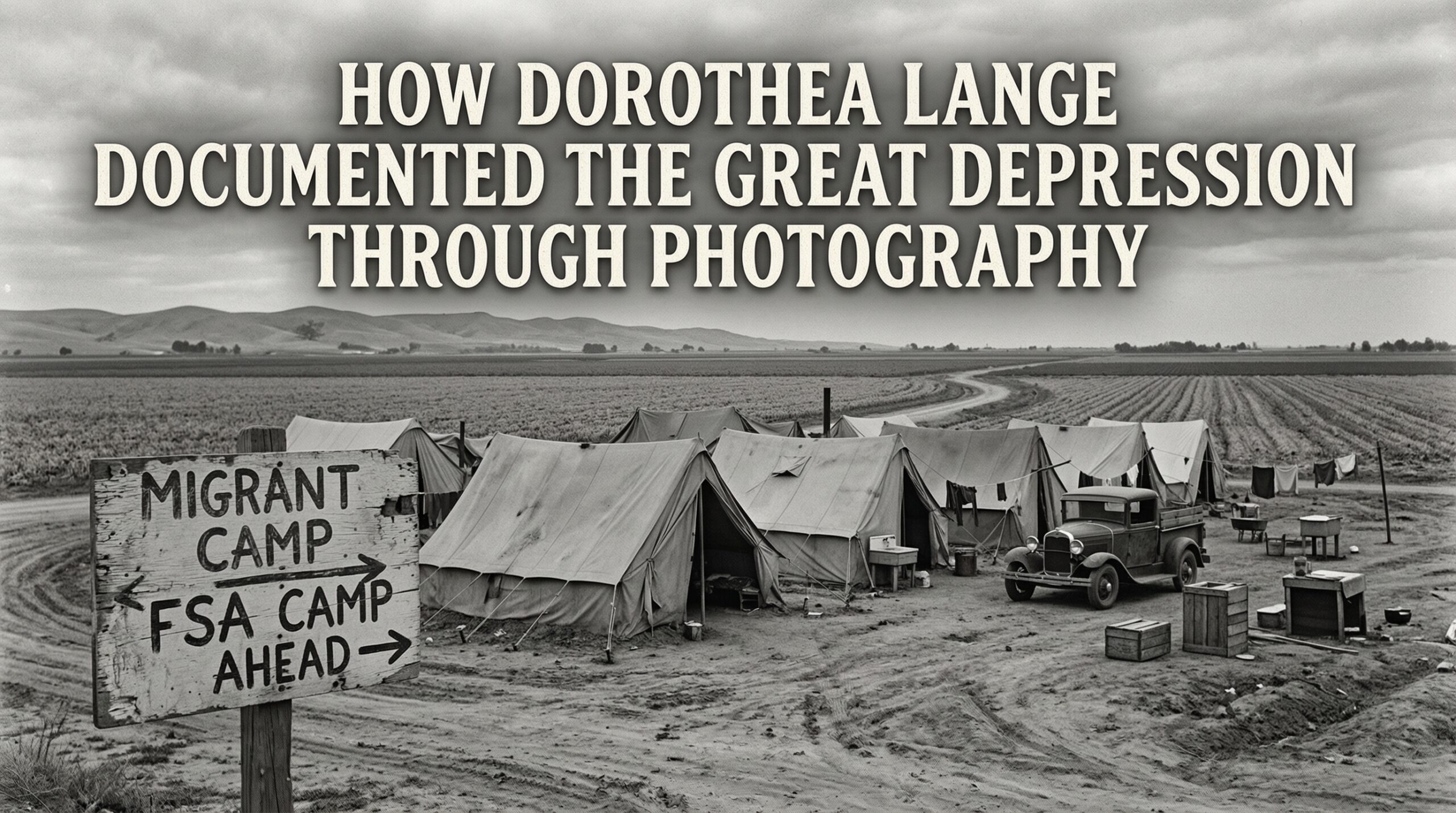
In March 1936, a government photographer pulled over to the side of a rainy California road and changed how Americans would remember the Great Depression forever. The image she captured that day, a weary mother surrounded by her children in a migrant workers’ camp, became one of the most recognized photographs in history. That photographer was Dorothea Lange, and her approach to documenting the Great Depression through photography revolutionized how visual storytelling can drive social change.
Lange did not simply point her camera at suffering and click the shutter. She developed a method built on empathy, collaboration, and meticulous documentation that transformed photojournalism. Her work for the Farm Security Administration created an unprecedented visual record of American life during the nation’s worst economic crisis. This guide examines how Dorothea Lange documented the Great Depression through photography, exploring her techniques, equipment, field methods, and the philosophy that guided her work.
By understanding Lange’s approach, modern photographers can learn valuable lessons about building trust with subjects, creating authentic documentary work, and using images as tools for social awareness. Her methods remain relevant for anyone interested in documentary photography, visual storytelling, or the intersection of art and social justice.
Who Was Dorothea Lange?
Dorothea Lange was born in 1895 in Hoboken, New Jersey. At age seven, she contracted polio, which left her with a permanent limp in her right leg. Rather than viewing this as a limitation, Lange later described it as her most important credential as a photographer. She believed her disability made her more empathetic and helped her connect with people who were also struggling.
After high school, Lange studied photography at Columbia University and apprenticed with portrait photographer Arnold Genthe. In 1918, she moved to San Francisco and within a year opened her own successful portrait studio. For over a decade, she photographed wealthy families and dignitaries, building a thriving business and reputation in the city’s artistic circles.
Everything changed in 1933. Looking out her studio window, Lange watched unemployed men drift past in the streets below. The Great Depression had devastated the American economy, and San Francisco’s streets filled with people who had lost everything. Lange felt compelled to act. She later recalled, “I was aware that all around me things were happening, and I was not in them.”
She grabbed her camera and walked outside, photographing the breadlines and homeless men she encountered. This first venture into street photography produced “White Angel Breadline,” her breakthrough documentary image. From that moment, Lange knew her portrait studio days were over. She had found her true calling in documenting the lives of ordinary Americans facing extraordinary hardship.
The Great Depression: Setting the Historical Stage
To understand Lange’s work, you need to grasp the magnitude of the crisis she documented. The stock market crash of October 1929 triggered the worst economic disaster in American history. By 1933, unemployment reached 25 percent. Banks failed by the thousands, wiping out life savings. Families lost homes and farms to foreclosure. Breadlines stretched for blocks in every major city.
The crisis hit rural America especially hard. Years of drought and poor farming practices transformed the Great Plains into the Dust Bowl, a vast region where topsoil blew away in massive dust storms. Thousands of farming families abandoned their land, becoming migrant workers heading west in search of work and survival. These Dust Bowl refugees became some of Lange’s most important subjects.
President Franklin D. Roosevelt’s New Deal programs attempted to address the crisis through unprecedented government intervention. One component was the Resettlement Administration, later renamed the Farm Security Administration. This agency provided loans and assistance to struggling farmers and migrant workers. Roy Stryker, who headed the FSA’s historical section, believed photography could document the need for these programs and build public support for government relief efforts.
This historical context shaped everything about Lange’s documentary work. She was not simply creating art. She was building a visual record that could influence policy and public opinion. The stakes were real, and her photographs carried the weight of human lives hanging in the balance.
White Angel Breadline: Lange’s First Documentary Photograph
In 1933, before she joined any government program, Lange took the photograph that launched her documentary career. San Francisco had a soup kitchen operated by a wealthy widow known as the White Angel. Every day, unemployed men lined up for a free meal. Lange positioned herself behind the line, focusing on a single figure: an elderly man in a fedora, his back to the crowd, clutching his cup and tin can.
The composition is striking. The lone figure faces away from the camera, emphasizing his isolation even within a crowd. His body language speaks of exhaustion and dignity. Lange shot from a low angle, making the man appear monumental despite his obvious hardship. The image captures both individual humanity and the vast scale of Depression-era poverty.
What drew Lange to this scene was not pity but recognition. She saw herself reflected in these struggling men. Her polio had taught her what it felt like to face adversity. She approached her subjects not as distant observers but as fellow humans. This empathetic perspective became the foundation of her entire documentary method.
White Angel Breadline established Lange’s reputation as a serious documentary photographer. More importantly, it clarified her mission. She realized photography could serve a purpose beyond art or commerce. Images could bear witness, create awareness, and potentially drive change. This insight guided every photograph she made throughout the Great Depression.
The Farm Security Administration and Roy Stryker
In 1935, Lange began working for the Resettlement Administration, which became the Farm Security Administration in 1937. The FSA photography project was the brainchild of Roy Stryker, a former economics instructor who believed images could communicate the human impact of economic crisis more powerfully than statistics alone.
Stryker assembled a remarkable team of photographers, including Walker Evans, Gordon Parks, Arthur Rothstein, and Russell Lee. Each photographer brought a different style and perspective. Evans favored formal, detached compositions that treated his subjects with artistic seriousness. Parks, who would later become famous for his work with Life magazine, brought an African American perspective to documenting rural poverty.
Lange’s role was distinctive. Stryker sent her on extended road trips through California, Arizona, and the American South. Her assignment was open-ended: document the conditions of migrant workers, sharecroppers, and tenant farmers. She had remarkable freedom to follow her instincts and develop her own approach.
The FSA project produced over 250,000 photographs between 1935 and 1943. Lange contributed thousands of images, including many of the project’s most iconic works. The photographs were distributed to newspapers and magazines, appearing in publications like Life, Survey Graphic, and the New York Times. They shaped public understanding of the Depression and built support for government relief programs.
Stryker and Lange maintained a complex professional relationship. He pushed her to document specific subjects and sometimes criticized her compositions. But he also recognized her unique ability to capture human emotion and dignity. Their collaboration helped define what government-sponsored documentary photography could achieve.
How Dorothea Lange Approached Her Subjects
What set Lange apart from other documentary photographers was her method for approaching and photographing people. She did not swoop in, snap pictures, and leave. Instead, she developed a collaborative process built on conversation, listening, and mutual respect.
When Lange arrived at a migrant camp or sharecropper’s farm, she would often put down her camera and start talking. She asked questions about where people had come from, what they had experienced, and what they hoped for. She listened carefully to their answers, taking mental notes that would later become captions. This conversation served multiple purposes. It put subjects at ease. It gave her insight into their lives. And it established her as someone who cared about their story, not just their image.
Lange’s granddaughter, filmmaker Dyanna Taylor, described this approach as “intimate and respectful.” Lange believed that truly meaningful photographs required connection. She said, “You have to be able to see the person, not just the situation.” This philosophy guided her throughout the Great Depression years.
The physical demands of this approach were significant. Lange’s polio left her with a limp, and her Graflex camera was heavy and awkward to carry. She drove thousands of miles on poor roads, often working alone in remote areas. Yet she never let her physical limitations prevent her from getting close to her subjects.
Lange also developed techniques for capturing authentic moments. She sometimes worked quickly, shooting a sequence of images before subjects became self-conscious. Other times, she waited patiently until people forgot about her presence and returned to their natural behavior. Her goal was always the same: to document people as they truly were, not as they performed for the camera.
Ethical considerations weighed heavily on Lange. She knew her subjects could not pay her, and she never exploited their hardship for personal gain. The photographs belonged to the government, and Lange never profited directly from her most famous images. She also worried about how her subjects would feel about being photographed in moments of vulnerability. This ethical awareness was unusual for her era and remains relevant for documentary photographers today.
Lange’s Photographic Equipment and Technical Methods
Understanding how Lange worked requires examining her equipment and technical approach. She primarily used a Graflex Series D camera, a 4×5 single-lens reflex that was standard equipment for press photographers of the era. The camera used sheet film, meaning each exposure required loading a single film holder. This technical limitation forced deliberation. Lange could not spray and pray. Every shot had to count.
The 4×5 format produced large negatives that captured extraordinary detail. This technical quality mattered because Lange’s photographs were often printed in magazines and displayed in exhibitions. The clarity and depth of her images helped viewers feel present in the scenes she documented.
Lange worked almost exclusively with natural light. Flash photography was available, but she found it intrusive and artificial. Instead, she learned to work with available light, positioning subjects near windows or in open shade. This approach required patience and skill, but it produced more authentic results. The soft, natural illumination in her photographs contributes to their emotional intimacy.
Composition was central to Lange’s method. She typically placed her camera at eye level with her subjects, creating a sense of equality between photographer and subject. She used environmental details, tents, fields, dilapidated buildings, to provide context without overwhelming the human element. Her backgrounds often included horizontal lines that created visual stability in images of people living unstable lives.
Lange’s field workflow followed a consistent pattern. She would arrive at a location, observe the scene, and identify potential subjects. After approaching and talking with people, she would begin photographing. She often shot multiple frames of the same subject, adjusting composition and exposure as she worked. After shooting, she took detailed notes about what she had seen and heard. These notes became the captions that accompanied her photographs in government archives.
Migrant Mother: The Story Behind an Iconic Image
No discussion of Dorothea Lange’s Great Depression photography is complete without examining Migrant Mother, the image that became the era’s defining symbol. The story behind this photograph reveals much about Lange’s working methods and the power of documentary photography.
In March 1936, Lange was driving home from a month-long assignment when she spotted a sign for a pea pickers camp near Nipomo, California. She almost drove past, but something made her turn around. The camp was filled with migrant workers whose crops had frozen, leaving them without work or income. Families were living in tents and makeshift shelters, surviving on vegetables and birds they could catch.
Lange approached one shelter and met Florence Owens Thompson, a 32-year-old mother of seven children. Thompson had come to California from Oklahoma, part of the vast Dust Bowl migration. Her family was destitute, living on frozen vegetables from the surrounding fields and birds her children killed. Thompson had just sold her car tires to buy food.
Lange did not rush. She spent time talking with Thompson and her children, learning about their situation. Then she began photographing. Lange took six frames of Thompson and her children over about ten minutes. She moved closer with each shot, adjusting composition and eliminating distracting elements. The final image shows Thompson in the center, her hand to her face, two children leaning on her shoulders with their faces turned away.
Several factors make this image powerful. Thompson’s expression combines exhaustion, worry, and determination. The composition centers her face while the children become almost abstract shapes, representing all children affected by the Depression. The shallow depth of field keeps focus on Thompson while softening the background.
Lange sent her film to Washington immediately. The government rushed 20,000 pounds of food to the camp, though Thompson and her family had already moved on by the time aid arrived. The photograph was published in newspapers across America and quickly became the most recognizable image of the Great Depression.
Later controversy surrounded the image. Some critics claimed Lange had staged the photograph, though evidence supports that she found Thompson exactly as depicted. Thompson herself expressed mixed feelings about the image, embarrassed by the poverty it revealed. She never benefited financially from the photograph, which belonged to the government. Lange also received no payment for what became one of history’s most reproduced images.
Captioning and Note-Taking: The Taylor-Lange Method
One of Lange’s most important innovations was her approach to captioning and documentation. This method developed through her collaboration with Paul Taylor, an economist at the University of California whom she met in 1934 and later married. Taylor believed that photographs needed words to achieve their full impact.
Together, Lange and Taylor developed what they called “visual sociology.” Lange would photograph a scene, then record the words of the people she met. These quotes became captions that appeared with her images in publications and archives. The combination of image and text created a fuller, more powerful record than either could achieve alone.
Lange’s field notes were meticulous. She recorded names, locations, dates, and circumstances. More importantly, she captured the voices of her subjects. A photograph of a migrant mother might be accompanied by her own words about leaving Oklahoma, losing a farm, or hoping for work in California. These personal testimonies transformed images from documents of poverty into portraits of individual human beings.
This method reached its fullest expression in “An American Exodus,” a book Lange and Taylor published in 1939. The book combined Lange’s photographs with extensive quotes from the people she documented. Unlike traditional photography books that let images speak for themselves, “An American Exodus” let subjects speak for themselves. Reviewers praised this innovative approach, though the book sold poorly during the anxious pre-war period.
Modern documentary photographers still study the Taylor-Lange method. The insight that images gain power from context remains central to photojournalism and social documentation. Lange showed that photographers have a responsibility not just to see but to listen, and to share what they hear alongside what they photograph.
Impact on Policy and Public Awareness
Did Lange’s photographs actually change anything? This question matters for understanding the purpose and potential of documentary photography. The evidence suggests that her images had significant impact, though the relationship between photography and social change is complex.
Lange’s photographs were used by government agencies to build support for New Deal programs. Images of destitute migrant workers made abstract statistics feel real and urgent. Politicians cited her work when arguing for relief appropriations. The FSA photography project, which Lange helped define, demonstrated how visual documentation could serve policy goals.
Magazine publication extended the reach of Lange’s work. Life magazine reproduced her photographs for millions of readers. Newspapers across America featured her images. This exposure shaped public understanding of the Depression’s human cost. Urban Americans who might never encounter Dust Bowl refugees saw their faces in Lange’s photographs.
However, the impact had limits. Lange documented poverty and suffering throughout the 1930s, yet migrant workers continued to struggle for decades. Government aid helped many but never fully addressed the structural problems underlying rural poverty. Some critics argued that documentary photography risked turning suffering into spectacle without necessarily improving conditions.
Lange herself was aware of these tensions. She said, “I saw and approached the hungry and desperate mother, as if drawn by a magnet.” Her motivation was personal and emotional, not strategic. She photographed because she felt compelled to bear witness. Whether this changed policy was beyond her control. But she believed that seeing was the first step toward caring, and caring was the first step toward action.
Legacy: How Lange Changed Documentary Photography
Dorothea Lange’s influence on documentary photography extends far beyond her Depression-era work. She established principles and methods that continue to guide photographers working today. Her legacy is visible in photojournalism, social documentary, and humanitarian photography around the world.
The most important lesson from Lange is that empathy matters more than equipment. She proved that a photographer who genuinely cares about subjects will create more powerful images than one who simply has better cameras. This insight remains relevant in an era when technology often dominates discussions of photography.
Lange also demonstrated the importance of context and collaboration. Her work with Paul Taylor showed that photographers achieve more when they work with writers, economists, and activists. The Taylor-Lange method of combining images with subjects’ own words created a template for documentary projects that remains influential.
After the Great Depression, Lange continued working. She documented Japanese American internment camps during World War II, producing images so critical of the government that many were impounded. She traveled internationally, photographed environmental issues, and mentored younger photographers. Throughout her career, she maintained the ethical standards and empathetic approach she had developed during the 1930s.
Lange died in 1965, but her photographs live on. The Oakland Museum of California holds an extensive archive of her work. The Library of Congress maintains the FSA collection, making thousands of her images available online. New generations discover her photographs through exhibitions, books, and digital archives. Each encounter confirms what Lange understood: that images of human dignity and struggle transcend their historical moment to speak across time.
What techniques did Dorothea Lange use in photography?
Lange used natural lighting exclusively, finding flash intrusive and artificial. She worked with a Graflex 4×5 camera that required careful composition since each shot used a single sheet of film. Her signature technique was building rapport with subjects through conversation before photographing, capturing authentic moments rather than posed images. She typically shot at eye level with her subjects and used environmental details to provide context.
How did Lange approach her subjects?
Lange approached subjects by first putting down her camera and engaging in conversation. She asked about their origins, experiences, and hopes while listening carefully to their responses. This method built trust and gave her insight into their lives. She believed meaningful photographs required genuine human connection, stating that photographers must ‘see the person, not just the situation.’
What did Dorothea Lange document?
Lange documented the human impact of the Great Depression, including breadlines in San Francisco, Dust Bowl migrants in California, sharecroppers in the American South, tenant farmers facing foreclosure, and Japanese Americans in internment camps during World War II. Her work focused on people affected by economic hardship and government policies, creating an unprecedented visual record of American life during crisis.
Why did Dorothea Lange become a photographer?
Lange became a photographer after studying at Columbia University and apprenticing with Arnold Genthe. She opened a successful portrait studio in San Francisco in 1919. In 1933, watching unemployed men from her studio window during the Great Depression, she felt compelled to document their suffering. This decision transformed her from a society portrait photographer into one of America’s most important documentary photographers.
How did Dorothea Lange impact society?
Lange’s photographs shaped public understanding of the Great Depression and influenced government policy. Her images appeared in Life magazine and newspapers nationwide, building support for New Deal relief programs. The government rushed food aid to migrant camps after seeing her Migrant Mother photograph. She established documentary photography as a tool for social change and created a visual record that continues to educate new generations about American history.
What organization did Dorothea Lange work for?
Lange worked for the Farm Security Administration, originally called the Resettlement Administration, from 1935 to 1942. The FSA was a New Deal agency that provided loans and assistance to struggling farmers. Its photography section, headed by Roy Stryker, employed photographers to document rural poverty and build public support for government relief programs. Lange was one of the most productive and influential FSA photographers.
Why is the Migrant Mother photo so famous?
Migrant Mother became famous because it perfectly captured the human cost of the Great Depression in a single image. The photograph showed Florence Owens Thompson, a 32-year-old mother of seven, in a California migrant camp. Her expression combined exhaustion, worry, and determination, while her children leaning on her shoulders represented all Depression-era families. The image was published nationwide and immediately became the defining symbol of the 1930s economic crisis.
Dorothea Lange’s documentation of the Great Depression stands as one of the most significant achievements in American photography. Her methods, building trust through conversation, working with natural light, combining images with subjects’ own words, and approaching photography as a tool for social awareness, established principles that continue to guide documentary photographers today.
What makes Lange’s work endure is not just technical skill but emotional honesty. She photographed people as individuals with dignity, not as symbols of poverty. Her subjects appear as complex human beings facing difficult circumstances, not as victims to be pitied. This respectful approach gives her images lasting power that transcends their historical moment.
For photographers working today, Lange offers invaluable lessons. She demonstrated that meaningful documentary work requires time, patience, and genuine engagement with subjects. She showed that images gain power when combined with words and context. And she proved that photography can serve purposes beyond art or commerce, bearing witness to truth and potentially inspiring change.
You can view Lange’s photographs at the Oakland Museum of California, the Library of Congress online archives, and in numerous books and exhibitions. Her images remain as powerful today as when she first developed them in her field darkroom. They remind us that behind every statistic lies a human story, and that seeing those stories clearly is the first step toward understanding and action.