
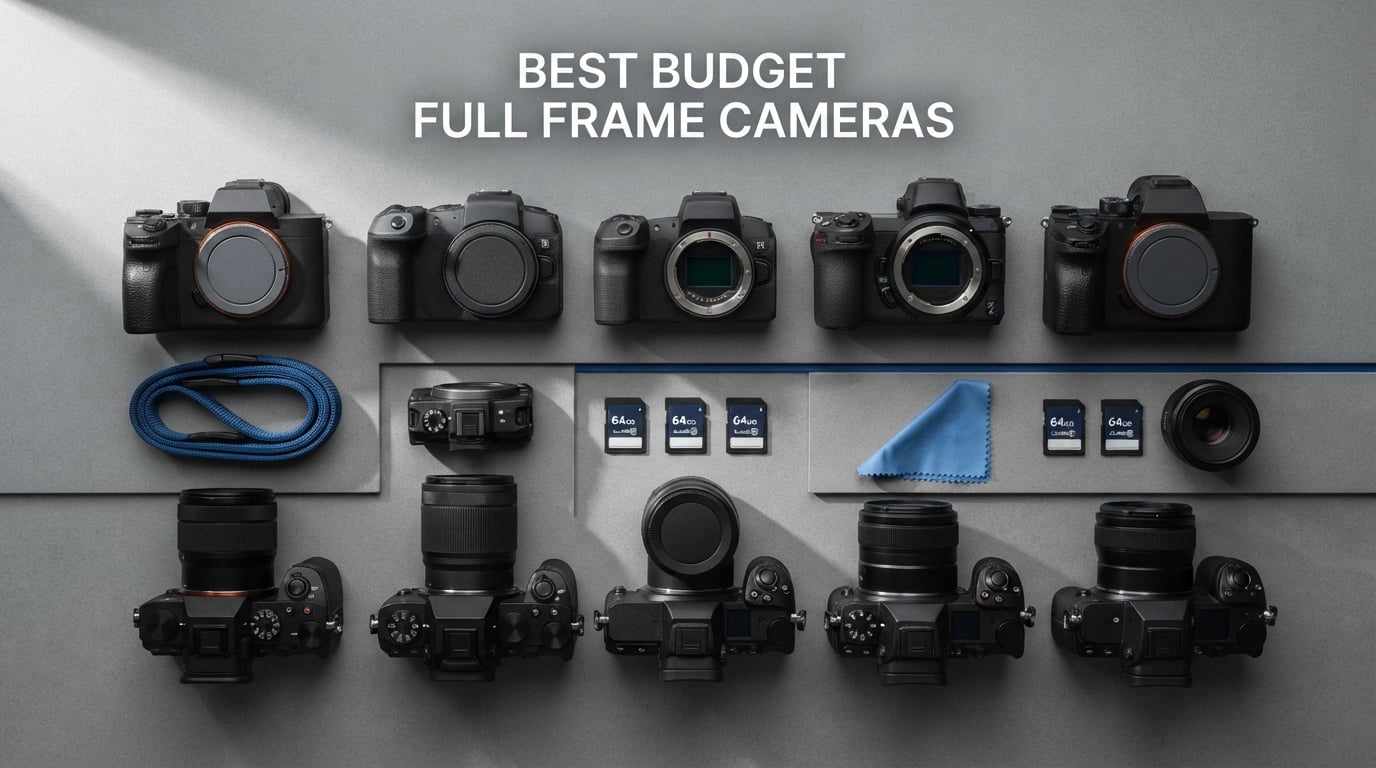
The best budget full frame cameras make the move to a 36 × 24mm sensor feel realistic without asking you to buy a flagship body. A larger sensor can give portraits more background separation, landscapes more editing latitude, and low-light scenes a cleaner starting point than many smaller-sensor cameras.
That does not make full frame an automatic upgrade for everyone. Camera bodies are only part of a system, and the lens mount, lens size, storage, battery needs, and how you shoot matter just as much.
I built this 2026 guide around the ten full-frame bodies in the available product data, then separated them by the job they do best. The Canon EOS R8 is the simple pick for a light hybrid setup, while the Panasonic LUMIX S5IIX is the clear fit for creators who need long-form video tools.
Our research also found a pattern in photographer discussions: an older body with a good lens can be more satisfying than a newer body with no room left for glass. Keep that thought in view as you compare these picks, especially if you are moving from APS-C or a phone.
The top 3 picks give most photographers a clear starting point (August 2026)
Choose the Canon EOS R8 for a small, capable hybrid camera; choose the Nikon Z5 II when stabilized shooting and very dim focusing are priorities; choose the Panasonic LUMIX S9 when a compact camera-and-lens package for travel and social content is the goal.
The labels above are about fit rather than a claim that one camera is universally better. A photographer who needs 4K 120p or fast wildlife tracking should read beyond the first three cards, because the Sony Alpha 7 V and Canon EOS R6 Mark II are built for a different pace of work.
The best budget full frame cameras in 2026 cover ten different shooting priorities
The comparison below puts the sensor resolution, focusing approach, video strength, and mount choice in one place. It is the quick reference I would use before reading the longer notes.
| Product | Specs | Action |
|---|---|---|
 Canon EOS R8 Canon EOS R8 |
|
Check Latest Price |
 Nikon Z5 II Nikon Z5 II |
|
Check Latest Price |
 Panasonic LUMIX S5IIX Panasonic LUMIX S5IIX |
|
Check Latest Price |
 Canon EOS R6 Mark II Canon EOS R6 Mark II |
|
Check Latest Price |
 Sony Alpha 7 V Sony Alpha 7 V |
|
Check Latest Price |
 Canon EOS R6 Mark III Canon EOS R6 Mark III |
|
Check Latest Price |
 Sony Alpha 7C II Sony Alpha 7C II |
|
Check Latest Price |
 Nikon Z f Nikon Z f |
|
Check Latest Price |
 Panasonic LUMIX S1II Panasonic LUMIX S1II |
|
Check Latest Price |
 Panasonic LUMIX S9 Panasonic LUMIX S9 |
|
Check Latest Price |
The Canon EOS R8 is the best compact all-round starting point
Canon EOS R8 Mirrorless Camera Body, Full‑Frame CMOS Sensor, 24.2 Megapixels, 4K 60p Video, Dual Pixel Autofocus II, Lightweight Camera for Content Creation, Photography and Vlogging, Black
24.2MP full frame
Dual Pixel AF II
Uncropped 4K 60p
Pros
- Very light body
- Fast subject detection
- Uncropped 4K 60p
- Vari-angle screen
Cons
- No in-body stabilization
- Single 1/4000 shutter ceiling
The EOS R8 is the first body I would put in front of a photographer who wants full-frame image quality without carrying a large camera. Its 24.2MP sensor and DIGIC X processor give it a sensible resolution for portraits, travel work, and everyday RAW files.
Canon’s Dual Pixel CMOS AF II covers up to the full frame with 1,053 AF zones, and it can recognize people, animals, and vehicles. That is a meaningful advantage for beginners who would rather concentrate on timing and composition than move focus points constantly.
The customer feedback is notably consistent: the compact body, reliable tracking, and video quality are recurring positives across 479 reviews at a 4.8 average. I would still pair it with a stabilized RF lens if handheld slow-shutter photos or walking footage are on the plan, because this body has no in-body stabilization.
The EOS R8 works best for travel and everyday hybrid shooting
The 120fps electronic viewfinder and fully vari-angle touchscreen make the R8 easy to use at awkward angles or when recording yourself. It records uncropped 4K at up to 60p from a 6K source, plus Full HD up to 180fps, so it has real room to grow beyond stills.
Its small format is helpful when a full-frame camera needs to fit into a day bag. A compact body does not make lenses compact, though, so balance the kit with the actual focal lengths you expect to carry.
The EOS R8 needs stabilized lenses for slower handheld work
The missing IBIS is the point to understand before buying. It does not stop the camera from making excellent images, but it changes how comfortable the setup is with non-stabilized lenses in dim rooms or after sunset.
The listed 1/4000-second maximum shutter speed is also less ambitious than some picks here. For family, travel, portraits, and general video, those trade-offs are reasonable; for specialized action or bright-light fast-lens work, another body may fit better.
The Nikon Z5 II is the best choice for dim scenes and steady handheld photos
Nikon Z5 II | Full-Frame mirrorless Stills/Video Camera | USA Model, Black
24.5MP BSI sensor
AF to -10EV
4K 60p
Pros
- Strong low-light AF
- Up to 7.5 stops stabilization
- 30fps burst
- Bright EVF
Cons
- Specification data lists JPEG only
- Viewfinder resolution is modest
The Nikon Z5 II puts its strongest arguments where budget full-frame buyers often need help: dark scenes, handheld shooting, and a camera that can handle both stills and video. Its 24.5MP BSI-CMOS sensor uses the Z mount and the EXPEED 7 processor.
Nikon specifies autofocus detection down to -10EV, alongside 299 AF points with 273 phase-detection points. That makes the Z5 II especially interesting for indoor events, evening street photography, and early starts where a weaker system can hunt.
I also like the practical combination of a 3.2-inch articulating screen, a 3,000-nit electronic viewfinder, and stated stabilization of up to 7.5 stops. The 4.8 average from 89 reviews supports the impression that this is a broadly capable camera rather than a narrowly focused bargain body.
The Z5 II is strongest for low-light photos and mixed travel work
The body can recognize nine subject types, including people, birds, dogs, cats, cars, and aircraft. Its 30fps burst rate gives it a useful action mode, while the BSI sensor and low-light AF are the more persuasive reasons to choose it.
SnapBridge wireless transfer and remote release are welcome for travelers who want to move files without making a laptop the center of the workflow. Nikon Imaging Cloud support adds another route for connected shooting.
The Z5 II deserves a file-format check before important work
The supplied specifications list JPEG as the file format, so I would verify the recording choices in the exact retail configuration before basing a RAW-heavy workflow on it. Product listings can compress or omit details, and that is a poor place to make an assumption.
Although the data describes up to 7.5 stops of built-in stabilization, another field calls stabilization digital. Confirm the body’s current firmware and feature documentation if this feature is central to your decision.
The Panasonic LUMIX S5IIX is the best budget-oriented video-first kit
Panasonic LUMIX S5IIX Mirrorless Camera, 24.2MP Full-Frame with Phase Hybrid AF, New Active I.S. Technology, Unlimited 4:2:2 10-Bit Recording with 20-60mm F3.5-5.6 L Mount Lens, DC-S5M2XKK9, Black-9
24.2MP full frame
6K Open Gate
20-60mm lens
Pros
- Unlimited video recording
- Active stabilization
- 779-point AF
- Dual SD slots
Cons
- 9fps mechanical burst
- Larger body
The LUMIX S5IIX is the camera I would shortlist first when video matters as much as photography. This listing includes the LUMIX S 20-60mm lens, which gives a new user a practical starting focal range instead of an immediate lens search.
Its 24.2MP full-frame sensor is paired with 779-point Phase Hybrid AF, sensor-shift stabilization, and dual SD card slots. Panasonic also specifies Active I.S. for walking shots, a feature that speaks directly to handheld creators.
The video specification is unusually deep for this group: 6K 30p Open Gate, 14+ stops in V-Log/V-Gamut, Real-time LUT support, and unlimited recording with a fan and heatsink. The 4.8 average across 55 reviews reflects why filmmakers regularly value this model.
The S5IIX is made for creators who want flexible video files
Open Gate recording is useful because one capture can be reframed for horizontal and vertical delivery. The camera also supports in-camera color work through Real-time LUTs, which can shorten the path from capture to a consistent look.
For long interviews, lessons, or event coverage, heat management and unlimited recording are not minor details. They remove a common interruption that can turn a solo shoot into a frustrating process.
The S5IIX is less suited to fast mechanical action shooting
The listed mechanical burst rate is 9fps, which is modest beside the 30fps and 40fps figures elsewhere in this guide. It can still photograph movement, but it is not the pick I would prioritize for relentless sports sequences.
At 740 grams before the included lens, the camera is also more substantial than the EOS R8 or Alpha 7C II. That extra mass brings controls and cooling, but it should be held before a travel-focused purchase when possible.
The Canon EOS R6 Mark II is the best choice for active subjects
Canon EOS R6 Mark II Mirrorless Camera (Body Only), Full-Frame Camera, 24.2 Megapixel CMOS Sensor, Photo and Video Capabilities, Black
24.2MP full frame
8-stop IBIS
40fps electronic burst
Pros
- Excellent stabilization
- 40fps shooting
- Deep subject detection
- Dual UHS-II slots
Cons
- No built-in flash
- Some modes have recording limits
The EOS R6 Mark II is a confident hybrid body for photographers whose subjects refuse to stay still. Canon lists a 24.2MP sensor, five-axis IBIS rated to eight stops, and a 40fps electronic burst at 20MP.
Its Dual Pixel CMOS AF II can identify people, animals, cars, motorcycles, horses, trains, and aircraft. In practical terms, that breadth makes it easier to shift between family photos, pets, travel, and action without changing to a different focusing philosophy.
The body has two UHS-II SD card slots, 5GHz Wi-Fi, and a vari-angle touchscreen. With 632 reviews at a 4.7 average, it is one of the more extensively reviewed bodies here, and buyers repeatedly highlight stabilization and autofocus.
The R6 Mark II is the safer option for moving people and animals
The fast electronic burst and subject detection work together rather than acting as isolated spec-sheet numbers. I would choose this body for an active child, a dog on a beach, or birds at a feeder ahead of a camera whose main strength is compactness.
It also records 6K-oversampled uncropped 4K at 60fps and Full HD up to 180fps. That gives a stills-first photographer a credible video tool without changing systems.
The R6 Mark II needs video-mode planning for long productions
The listing gives a 29-minute recording capacity for some video modes, although it also cites up to six hours of continuous Full HD. Read the mode-specific limits before committing it to an uninterrupted production.
There is no built-in flash, so event shooters who rely on one need an external solution. The camera’s strengths are speed and stabilization, not a minimal travel kit or the simplest video workflow.
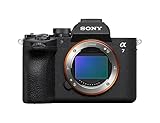
The Sony Alpha 7 V is the strongest performance-oriented upgrade
Sony Alpha a7 V Full-Frame Mirrorless Camera Body AI AF 30fps
33MP stacked sensor
30fps blackout-free
4K 120p
Pros
- 16 stops dynamic range
- Advanced AI AF
- Fast 1/16000 shutter
- 7.5-stop IBIS
Cons
- Body only
- Complex menu system
The Alpha 7 V sits at the high-performance edge of this selection, and it makes sense only when its fast sensor, 33MP resolution, and advanced tracking solve a real need. Its partially stacked Exmor RS sensor and BIONZ XR2 processor are designed for speed as well as detail.
Sony lists blackout-free 30fps shooting with AF/AE tracking, 759 autofocus points, a 1/16000-second top shutter speed, and 4K at 120p. Those are serious tools for wildlife, quick movement, and footage where slow motion is a planned part of the edit.
The stated 16 stops of dynamic range and five-axis stabilization up to 7.5 stops make it a persuasive landscape and travel body too. The 4.7 average from 90 reviews points to strong early satisfaction, particularly with autofocus behavior.
The Alpha 7 V is right for action, wildlife, and demanding hybrid work
AI-based recognition can track humans, animals, birds, vehicles, and insects, while human pose estimation helps it stay with a person even when their face turns away. This is useful for photographers who miss moments because the subject is not facing the camera.
The Sony E and FE mounts also offer a broad lens path, but that variety calls for discipline. Pick the focal length you need first, then compare the size and handling of the lenses rather than letting the menu of choices make the decision for you.
The Alpha 7 V is not the simplest first interchangeable-lens camera
This is a body-only listing, so it requires a separate lens choice from the start. That is normal for experienced users, but it can slow down a beginner who wants one straightforward setup.
Sony’s menu system is named as a downside in review feedback. Spend time setting custom buttons and a personal menu early; the camera rewards that work, but it asks more of the user than a stripped-back entry-level body.
The Canon EOS R6 Mark III offers the most advanced Canon resolution and stabilization
Canon EOS R6 Mark III Body, Full-Frame Mirrorless Camera
32.5MP full frame
40fps shooting
8.5-stop stabilization
Pros
- Higher 32.5MP resolution
- 40fps with pre-capture
- Strong IBIS
- Dual card formats
Cons
- No built-in flash
- Uses CFexpress Type B
The EOS R6 Mark III brings a 32.5MP full-frame sensor to Canon’s fast R6-style body. That extra resolution is appealing for a photographer who values cropping flexibility but still wants the camera to respond quickly.
Canon specifies up to 40fps shooting with 20 frames of pre-continuous capture, Dual Pixel CMOS AF II subject detection, and sensor-shift stabilization rated to 8.5 stops in the center. Those features support fleeting moments where pressing the shutter a fraction late would otherwise matter.
The camera uses an RF mount and has two card slots: CFexpress Type B and UHS-II SD. Its 4.7 average from 77 reviews is based on a smaller pool than the R6 Mark II, so I would treat feedback as useful but still developing.
The R6 Mark III is designed for high-resolution action in the RF system
The 32.5MP sensor makes more sense than 24MP when you routinely crop a distant subject or deliver detailed images. Pre-continuous shooting is also useful for unpredictable gestures, takeoffs, and sporting moments.
The 1/16000-second maximum shutter speed and 1/320-second flash sync expand what the camera can do under bright conditions. It is a capable match for photographers already committed to RF lenses.
The R6 Mark III calls for storage planning before shooting
A CFexpress Type B slot can be a benefit for fast capture, but it is a different card format from the SD cards many photographers already own. Include media choice in the kit plan rather than treating the body as the whole purchase.
Like the other R6 body in this guide, it lacks a built-in flash. That is a normal trade-off in this class, but indoor event work still benefits from deciding in advance how you will add light.
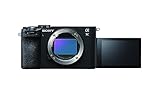
The Sony Alpha 7C II is the best compact 33MP travel body
Sony Alpha 7C II Full-Frame Interchangeable Lens Camera – Black
33MP full frame
AI subject recognition
4K 10-bit video
Pros
- Small and light
- High-resolution sensor
- AI tracking
- 4K 10-bit capture
Cons
- No built-in flash
- 10fps burst
The Alpha 7C II has a strong appeal for anyone who wants a full-frame camera that does not dominate a day out. It pairs a 33MP sensor and BIONZ XR processing with a body listed at 15.2 ounces.
It has 759 autofocus points, 273 phase-detection points, sensor-shift stabilization, and a dedicated AI processor for subject recognition and tracking. Sony also specifies 4K 4:2:2 10-bit recording up to 60p or 50p.
The 4.6 average from 222 reviews is supported by recurring comments about the small size, image quality, and AI-powered autofocus. For a traveler, compactness is only meaningful if the selected E-mount lens keeps that balance, so avoid pairing it automatically with a large zoom.
The Alpha 7C II is best for photographers who carry a camera every day
Its 33MP sensor creates room for crops in street and travel photography, while the small body makes it easier to keep nearby. That combination is often more useful than a larger camera left at home.
The electronic viewfinder is specified at 0.70x magnification, and the three-inch touchscreen can support flexible framing. The 10fps continuous rate is plenty for casual action, travel, and portraits.
The Alpha 7C II favors portability over big-body controls
Photographers who wear gloves, use large telephoto lenses, or want expansive direct controls should handle this body first. Compact bodies bring compromises in grip and button spacing that a specification list cannot fully convey.
There is no built-in flash and the listed maximum shutter speed is 1/8000 second. Neither is unusual, but someone photographing indoor gatherings often should plan for a small external light rather than expect a pop-up solution.
The Nikon Z f is the best choice for tactile controls and detailed stills
Nikon Z f | Full-Frame Mirrorless Stills/Video Camera with Iconic Styling | Nikon USA Model
24.5MP BSI sensor
96MP Pixel Shift
4K 60p
Pros
- Physical-control style
- 96MP Pixel Shift
- Nine-subject tracking
- Vari-angle display
Cons
- No built-in flash
- Listing states 32GB SD maximum
The Nikon Z f offers a different kind of appeal: it brings modern focusing and processing into a camera centered on a more tactile shooting experience. The 24.5MP BSI full-frame sensor uses the EXPEED 7 processor and the Nikon Z mount.
Its autofocus has 273 phase-detection points and can recognize nine subjects with 3D Tracking. The body also offers Pixel Shift shooting for 96MP stills, a feature that rewards stable scenes where detail matters more than speed.
I would look at the Z f for travel, portraits, still life, and deliberate landscape work rather than buying it just for its appearance. The 4.5 average across 92 reviews is positive, and reviewers particularly mention the sensor, AF breadth, and Pixel Shift option.
The Z f works best for deliberate photography and high-detail scenes
Pixel Shift is useful for architecture, artwork reproduction, and still subjects where the camera can remain stable. It is not a replacement for a higher-resolution sensor when leaves, people, or water are moving through the frame.
The 3.2-inch vari-angle touchscreen and 0.8x viewfinder support both careful tripod work and everyday shooting. It can record 4K/30p oversampled from 6K and up to 4K/60p, with 1080/120p slow motion.
The Z f needs media details confirmed for your intended workflow
The supplied listing states a 32GB SD maximum, which is unusual enough that I would check the current official specification before buying cards. It is always better to verify a listing detail than build a workflow around a potentially incomplete field.
The body has no built-in flash and weighs 1.6 pounds. It is not the lightest travel choice, but photographers who value direct physical interaction may prefer that trade-off over a smaller, menu-led design.
The Panasonic LUMIX S1II is built for professional-grade video and fast bursts
Panasonic LUMIX S1II Full Frame Mirrorless Digital Camera, Supports the Work of Professionals, for Photography and Video Recording, Black-9, DC-S1M2BODY9
24.1MP BSI sensor
30fps AFC burst
6K 10-bit video
Pros
- 30fps continuous AF
- 8-stop stabilization
- 6K recording
- Real Time LUT
Cons
- Heavier body
- CFexpress Type B required for some workflows
The LUMIX S1II is for photographers and filmmakers who want a more production-minded full-frame body. Panasonic lists a 24.1MP BSI CMOS sensor, 30fps AFC burst shooting, five-axis stabilization rated to eight stops, and 6K 30p 10-bit recording.
It supports L-mount lenses, uses CFexpress Type B and SD media, and records in formats including H.264, H.265, ProRes RAW, and ProRes. The Real Time LUT and Photo Styles tools are also useful for creators who want a consistent color direction at capture.
The review pool is only 36 ratings, with a 4.4 average, so it is less proven by buyer volume than some other choices. Still, the shared praise for color science and reliable pro-level behavior matches the feature list.
The S1II is well matched to demanding video and hybrid production
Its stated 30fps burst with continuous AF makes it more action-ready than a video-only body. The 6K and internal 4:2:2 10-bit options are meaningful for creators who grade footage or need more room to reframe.
The 0.78x viewfinder, three-inch screen, and numerous metering modes point to a camera meant for users who want direct creative control. It is a more serious tool than the LUMIX S9, not simply a bigger version of it.
The S1II is best when body size is not your first concern
At 1.76 pounds before a lens, this is not the camera I would choose for the lightest possible carry. Larger L-mount zooms can create a substantial kit, so consider the complete setup rather than the body alone.
Fast media and professional formats can add operational complexity. If your output is mainly simple social clips and stills, the S9 or S5IIX may be a more straightforward fit.
The Panasonic LUMIX S9 is the simplest full-frame travel and social-content kit
Panasonic LUMIX S9 Full-Frame Mirrorless Camera with S 18-40mm F4.5-6.3 Lens, Compact, Lightweight Body, Perfect for Social Media and Travel, Digital Cameras for Photography, DC-S9NR9
24.2MP full frame
6K Open Gate
18-40mm lens
Pros
- Lens included
- Compact concept
- Fast phone transfer
- Open Gate framing
Cons
- Mixed customer feedback
- No burst rate listed
The LUMIX S9 focuses on making full-frame capture easy to carry and easy to share. This listing includes an 18-40mm lens, a useful range for travel scenes, casual portraits, and short-form video without an immediate lens decision.
It has a 24.2MP full-frame CMOS sensor, 6K MOV video, Open Gate framing, sensor-shift and optical stabilization, and LUMIX Lab connectivity. Panasonic’s pitch is clear: capture with a larger sensor, then transfer content rapidly to a phone.
The 4.1 average from 44 reviews is the lowest in this roundup, and the feedback is mixed, with a reported 13% one-star share. I would treat it as a fit-driven choice rather than a default recommendation.
The S9 is made for light travel kits and quick phone sharing
The included 18-40mm lens makes the package less intimidating for a first-time buyer. Open Gate capture can be useful when you publish the same scene in several aspect ratios, and LUMIX Lab supports wireless transfer.
Its listed low-light image-quality emphasis and full-frame sensor can be appealing for evening travel shots. The compact intent also makes it a logical alternative for a creator who would leave a larger hybrid body behind.
The S9 requires realistic expectations about controls and feedback
The available data does not list a continuous-shooting rate, so I would not select it specifically for sports or wildlife. Its Depth From Defocus autofocus is another reason to compare it carefully with phase-detection rivals when erratic action is central.
Mixed customer feedback means reading recent owner reports is useful, especially around the exact lens kit and phone workflow you want. Choose it for its sharing-focused purpose, not because its small size suggests it does every job equally well.
A budget full-frame purchase starts with the lens system, not the body
The most important buying decision is usually the mount. Canon RF, Nikon Z, Sony E/FE, and Leica L lenses do not mount directly to one another, and adapters can alter size, focusing behavior, or feature support.
Start with the photographs you want in six months: a wide lens for landscapes and interiors, a moderate prime for portraits and low light, or a telephoto for wildlife and sport. A body that leaves room in the kit for that first useful lens is often the smarter choice.
Forum users repeatedly raise this point because lens costs can exceed a camera body over time. I agree with the long-game approach: choose a mount with lenses you will actually carry, then add glass slowly as your work clarifies.
A full-frame sensor helps most in low light, portraits, and broad dynamic range
A full-frame sensor is 36 × 24mm, giving it more area than APS-C and Micro Four Thirds sensors. That can support lower-noise images at higher sensitivities, more flexible depth of field, and more recoverable detail in bright skies and deep shadows.
It is not magic. A good APS-C camera with a sharp lens can produce excellent work, and the smaller system may be easier to carry. Full frame is worthwhile when its strengths solve a frequent problem in your photography rather than simply because it sounds more professional.
Mirrorless cameras suit most new buyers, while used DSLRs still make sense
Every model in this guide is mirrorless, which brings electronic viewfinders, modern subject tracking, and video-oriented features. Mirrorless systems also tend to be the active home for new lens development.
A used full-frame DSLR can still be a very good route for someone who primarily shoots stills and values optical viewfinders, battery endurance, and mature used-lens availability. The trade-off is older autofocus behavior in live view and generally less refined video.
Used full-frame bodies are safer when you inspect the right details
Buy from a specialist used retailer with a clear grading system and return window when possible; photographers in the research often mention KEH and MPB. Check the sensor for marks, test every dial and port, inspect the lens mount, and make sample photos at several apertures.
Ask for the shutter count where it applies, but do not treat that number as the only condition test. Battery health, card-slot operation, viewfinder condition, screen hinges, and accurate autofocus matter just as much in real use.
Older bodies can be excellent value, but they can lack current subject recognition or stabilization. Decide which omissions you can live with before shopping, since a low-cost body is no bargain if it blocks the work you want to make.
Autofocus and stabilization should match the subject you photograph
For children, pets, sport, or birds, prioritize phase-detection autofocus, subject recognition, and burst speed. The R6 Mark II, R6 Mark III, Alpha 7 V, and Z5 II stand out here from their listed tracking and burst specifications.
For architecture, landscapes, travel, and posed portraits, stabilization and resolution can matter more than an extreme burst rate. The Z f’s Pixel Shift mode and the strong stabilization claims on Canon, Nikon, Sony, and Panasonic bodies are more relevant in those cases.
Video buyers should check recording modes before committing
Look past a single 4K label. Frame rate, crop, recording duration, stabilization, card requirements, heat behavior, audio inputs, and the option for 10-bit files determine whether a camera fits a real production.
The S5IIX is especially strong for unlimited recording, 6K Open Gate, V-Log, and Active I.S.; the Alpha 7 V adds 4K 120p; the R8 offers uncropped 4K 60p. Choose the feature that matches your actual delivery rather than the longest spec list.
The most common full-frame questions have straightforward answers
What is the cheapest used full-frame camera?
The cheapest used full-frame camera depends on local condition and availability, so there is no single permanent answer. Older full-frame DSLRs and first-generation mirrorless bodies are commonly the entry point. Buy from a seller with a return policy, inspect the sensor and mount, test controls and card slots, and budget for a compatible lens before choosing the lowest listing.
Is it worth buying a full-frame camera?
A full-frame camera is worth buying when you regularly benefit from stronger low-light performance, shallower depth of field, or added dynamic range for landscapes and portraits. It is not automatically better for every photographer: APS-C kits can be smaller and lighter. Compare the full kit, including the lenses you need, rather than judging the sensor by itself.
Which is the cheapest full-frame camera?
Availability changes, so the cheapest full-frame camera changes with the used market and current listings. Among the products reviewed here, the Panasonic LUMIX S9 is the sharing-focused compact option with an included 18-40mm lens. Older used DSLRs and early mirrorless bodies can be less expensive, but condition and lens availability are more important than a low body-only figure.
What is a good full-frame camera?
A good full-frame camera fits your subjects and lens plan. The Canon EOS R8 is a strong compact hybrid choice, the Nikon Z5 II favors dim scenes and stabilization, the Panasonic LUMIX S5IIX favors video, and the Canon EOS R6 Mark II suits active subjects. Choose the one whose mount and handling support the photography you do most often.
The right pick is the camera system you will keep using in 2026
For most people, the Canon EOS R8 is the cleanest all-round recommendation because it combines a 24.2MP sensor, advanced subject detection, and uncropped 4K 60p in a light package. The Nikon Z5 II is the better direction for dark scenes and stabilization, while the LUMIX S5IIX remains the video-centered choice.
The best budget full frame cameras are not defined only by their body specifications. Choose the mount, the first lens, and the carrying weight that fit your actual work, then make photographs often enough to learn what your next addition should be.