
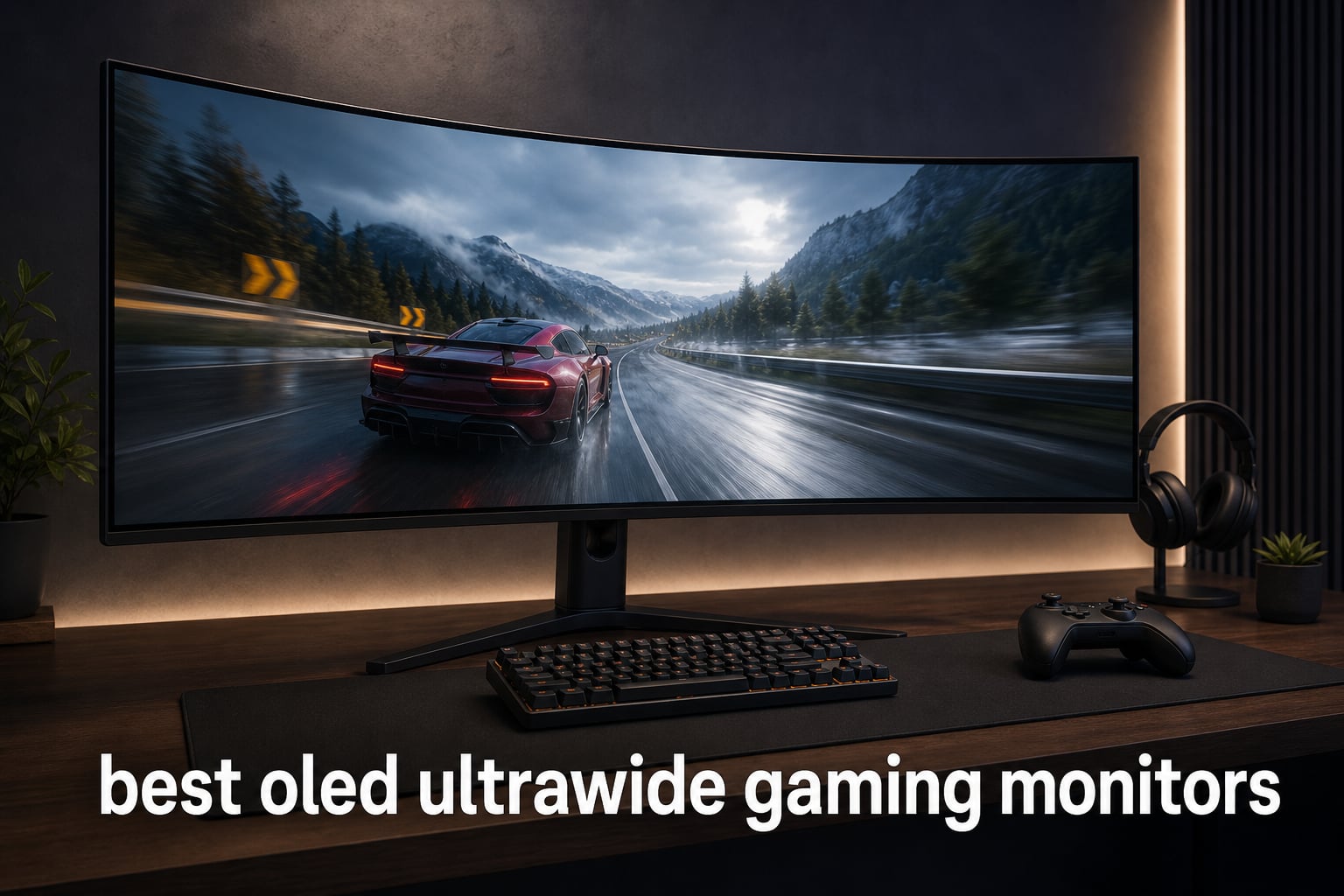
The best OLED ultrawide gaming monitors pair true black levels and near-instant pixel response with a wider field of view than a standard 16:9 display. For most PC players, a 34-inch 3440 x 1440 model is the balanced place to start; a 45-inch 21:9 screen makes single-player worlds feel much larger, while a 49-inch 32:9 panel is a serious dual-screen replacement.
I narrowed this list to eight verified OLED and QD-OLED displays with a stated 0.03ms response time, then separated them by the decisions that actually change day-to-day use: resolution, refresh rate, curve, ports, panel care, and physical width. Every pick supports adaptive-sync gaming, but the right choice depends on whether you play competitive shooters, drive a sim rig, work with two systems, or want an immersive story-game screen.
OLED changes the picture because every pixel can switch itself off rather than relying on a backlight. That produces deep blacks in dark scenes and very fast transitions; the trade-offs are more attention to static desktop content, reflection handling in bright rooms, and the graphics power required to run an ultrawide resolution well.
Community discussions make one point especially clear: moving from an LCD ultrawide to OLED is often most noticeable in contrast and HDR scenes, not in a spec sheet. I would not choose only on the highest refresh-rate number, either; 240Hz is already a strong target when your PC can consistently deliver more than 240 frames per second.
The Top 3 Picks Give Most Gamers a Clear Starting Point
The ASUS ROG Strix XG34WCDG is my color-first 34-inch recommendation because it combines a QD-OLED panel, true 10-bit color, a stated Delta E below 2, and OLED Care Pro with a proximity sensor. The Alienware AW3425DW is the easier choice for gamers who want 240Hz in the familiar 34-inch format, while the LG 45GX950A-B is the technical standout for a large 5K2K screen and dual-mode operation.
These picks are not interchangeable. The ASUS runs at 175Hz, the Alienware makes a cleaner case for high-frame-rate PC play, and the LG asks for much more desk space and graphics performance in exchange for its expansive 5120 x 2160 canvas.
These Are the Best OLED Ultrawide Gaming Monitors in 2026
The overview below covers every model reviewed here. Start with screen format: 21:9 works well for a conventional desk and broad game support, while 32:9 puts two 16:9-sized work areas side by side but needs a very wide desk and games that handle super-ultrawide properly.
The quoted brightness figures are not interchangeable HDR scores, so I treat them as context rather than a ranking. Panel type, curve, refresh rate, and the ports you need are more dependable ways to narrow this group before comparing your final two choices.
| Product | Specifications | Action |
|---|---|---|
 ASUS ROG Strix XG34WCDG ASUS ROG Strix XG34WCDG |
|
View Details |
 Alienware AW3425DW Alienware AW3425DW |
|
View Details |
 LG 45GX950A-B LG 45GX950A-B |
|
View Details |
 MSI MPG 491CQPX QD-OLED MSI MPG 491CQPX QD-OLED |
|
View Details |
 LG 34GX900A-B LG 34GX900A-B |
|
View Details |
 AOC Agon PRO AG346UCD AOC Agon PRO AG346UCD |
|
View Details |
 Samsung Odyssey G93SC Samsung Odyssey G93SC |
|
View Details |
 LG 45GX900A-B LG 45GX900A-B |
|
View Details |
The ASUS ROG Strix XG34WCDG Is the No. 1 Color-First 34-Inch Pick
Pros
- True 10-bit color
- 99.3% DCI-P3
- OLED Care Pro
- 3-year burn-in coverage
Cons
- 175Hz ceiling
- Small review pool
The ASUS ROG Strix XG34WCDG makes the most sense for someone who wants a 34-inch QD-OLED to handle games and color-conscious work from the same desk. Its 3440 x 1440, 21:9 screen uses a moderate 1800R curve, which I find easier to place in a normal desk setup than the much tighter 800R displays in this list.
ASUS specifies 99.3% DCI-P3 coverage, true 10-bit color, and Delta E below 2. Those claims, along with VESA DisplayHDR 400 True Black, make it a particularly logical pick for players who also edit photos or video and care about the panel’s stated color credentials.
The 175Hz maximum is below the 240Hz contenders, but the stated 0.03ms response time still targets clean motion. It supports both G-SYNC Compatible operation and FreeSync Premium Pro, so either major PC graphics ecosystem has an adaptive-sync path.
The feature that separates it from a generic QD-OLED is OLED Care Pro with a Neo Proximity Sensor. I like that ASUS pairs the care suite with a three-year warranty that includes burn-in coverage; buyers who keep static app windows open will appreciate having both a mitigation feature and stated coverage.
The ASUS fits mixed gaming and color work best
Choose this model if 34 inches is your preferred physical size and color accuracy matters beyond game night. The 31.9-inch stated width is also much less demanding than a 49-inch super ultrawide, while the 21:9 frame gives racing, RPG, and exploration games extra side vision without becoming difficult to manage.
Its HDMI ports, DisplayPort, two USB Type-A ports, and DisplayWidget Center add practical flexibility. I would use the DisplayPort connection for a main gaming PC, then reserve HDMI for secondary hardware where needed.
The ASUS makes less sense for a 240Hz-first setup
Skip this one if your buying decision begins and ends with reaching 240Hz. The Alienware AW3425DW, LG 34GX900A-B, and both 49-inch models in this roundup all state 240Hz, so the ASUS is not the speed leader.
It also has 54 reviews in the analyzed data, a much smaller pool than several alternatives. That does not invalidate its 4.6 rating, but I would weigh the documented specifications and warranty terms more heavily than trying to read too much into a limited review sample.
The Alienware AW3425DW Is the No. 2 Balanced 240Hz 34-Inch Choice
Pros
- 240Hz QD-OLED
- TrueBlack 400
- Adjustable stand
- USB connectivity
Cons
- No speakers
- Burn-in concerns reported
The Alienware AW3425DW is the simple recommendation for PC gamers who want the familiar 34-inch ultrawide format but do not want to settle below 240Hz. Its 34.2-inch QD-OLED panel combines 3440 x 1440 resolution, a stated 0.03ms response time, and an 1800R curve, making it a highly balanced best oled ultrawide gaming monitors candidate for fast and cinematic games alike.
Alienware lists VESA DisplayHDR TrueBlack 400, 99.3% DCI-P3 coverage, NVIDIA G-SYNC Compatible support, AMD FreeSync Premium Pro, and VESA AdaptiveSync. That collection covers the important basics without making you choose a monitor around one graphics-card brand.
There are 322 reviews in the analyzed listing, with a 4.5 average rating. I treat that larger sample as useful context, especially because the summary repeatedly points to gaming fluidity and color quality rather than a single niche use case.
Ergonomics are a strength here. The stand has height, swivel, and tilt adjustment, and the monitor includes two HDMI ports, DisplayPort, and three USB ports; that gives a desk setup more flexibility than a screen that only tilts or has a thin port selection.
The Alienware is right for high-frame-rate 21:9 PC gaming
Pick the AW3425DW if your computer can sustain high frame rates at 3440 x 1440 and you play a mix of shooters, racers, and story games. A 240Hz refresh cycle offers a clear step in motion cadence over 175Hz when the game and PC are both keeping up.
The 1800R curve is gentle enough for productivity windows and immersive enough for the 21:9 image. I would choose this curve over 800R if you spend as much time browsing, writing, or arranging timelines as you do gaming.
The Alienware is not for buyers who need integrated sound
This monitor has no built-in speakers, according to the supplied product data. That is not a problem for a headset or dedicated speakers setup, but it is a real detail if you want a minimal desk with no extra audio device.
Some reviewer feedback also raises burn-in concerns. The model has a three-year warranty, yet it remains sensible to let normal panel care routines run and avoid leaving fixed bright elements on screen for long unattended periods.
The LG 45GX950A-B Is the No. 3 5K2K Dual-Mode Immersion Pick
Pros
- 5K2K resolution
- Dual Mode
- DisplayPort 2.1
- USB-C 90W
Cons
- 30.9 pound weight
- 2-year warranty
The LG 45GX950A-B is the technical outlier here because its 45-inch OLED screen runs at 5120 x 2160 rather than 3440 x 1440 or 5120 x 1440. LG calls this 5K2K WUHD, states 125 PPI, and lists a dual-mode option for 5K2K at 165Hz or WFHD at 330Hz.
That dual-mode design gives one monitor two very different jobs. I would use the full 5K2K mode for detailed desktop space, creative material, and sharp text, then consider WFHD at 330Hz for games where frame-rate headroom matters more than fine resolution.
The 800R curvature is deliberate and pronounced, matching the width of the panel by pulling the outer edges toward you. LG also lists up to 1300 nits peak brightness, HDR True Black 400, 98.5% DCI-P3, G-SYNC Compatible operation, and FreeSync Premium Pro.
Connection options are unusually forward-looking: two HDMI 2.1 ports, DisplayPort 2.1, USB Type-C with 90W power delivery, and three USB ports. DisplayPort 2.1 is a meaningful consideration for a high-resolution, high-refresh display, though the benefit still depends on the graphics hardware and cable used.
The LG 45GX950A-B suits detail-first large-screen players
Choose this LG if you want an ultrawide that can serve as both a serious game display and a sharp work canvas. The listed 125 PPI directly addresses a frequent large-OLED concern: a big screen does not automatically mean coarse-looking text when the resolution also rises.
It is also a compelling match for single-player games, driving games, and flight titles where a large, tightly curved image changes the sense of scale. Built-in speakers and USB-C power delivery can simplify a desk shared with a laptop or another USB-C device.
The LG 45GX950A-B needs a deep desk and capable GPU
At 39.04 inches wide and 30.9 pounds, this is not a casual monitor-arm purchase. I would measure desk depth, verify an arm’s weight rating if using one, and leave room for the 800R curve before committing to this format.
5K2K at 165Hz is demanding for modern games, and the product’s two-year manufacturer warranty is shorter than the three-year terms stated for some other models here. The dual mode offers flexibility, but it does not remove the need to plan around your PC’s output.
The MSI MPG 491CQPX Is the No. 4 Two-System Super-Ultrawide Pick
Pros
- 32:9 DQHD panel
- 240Hz speed
- KVM switch
- Console Mode
Cons
- Very wide footprint
- Contrast spec is lower
The MSI MPG 491CQPX replaces a conventional two-monitor setup with one 49-inch QD-OLED panel at 5120 x 1440. Its 32:9 ratio is effectively two 2560 x 1440 areas placed side by side, which is useful for wide game views, multi-window work, or one PC and one secondary device.
MSI states a 240Hz refresh rate, 0.03ms response time, VESA DisplayHDR TrueBlack 400, G-SYNC Compatible status, and FreeSync Premium Pro. Those specifications make it a faster super-ultrawide choice without giving up the contrast strengths that draw people to OLED in the first place.
The KVM function is the stand-out practical feature. I would give it extra weight if a work laptop and gaming desktop share the same keyboard, mouse, and display, because switching input devices can be as important as image quality in a crowded desk workflow.
The supplied data also lists MSI OLED Care 2.0, Console Mode with HDMI 2.1 48Gbps, three USB ports, two HDMI 2.1 ports, built-in speakers, and a three-year manufacturer warranty. That is a broad feature set for a monitor intended to be the center of a multi-device station.
The MSI fits wide desks, sim rigs, and KVM workflows
Pick this model if you want the 32:9 view for sim racing, flight simulation, or a two-screen-style workspace with no bezel in the middle. The 47.05-inch stated width deserves serious measurement; a large desk is a requirement, not a convenience.
Console Mode and HDMI 2.1 bandwidth make it the clearest console-oriented model in this group on paper. Console support varies by title and device output mode, so I would still check the resolution and VRR behavior of the exact console game you play most.
The MSI is not the simplest choice for ordinary 21:9 games
Not every game handles 32:9 as naturally as 21:9. Some titles may use black bars or need configuration adjustments, so players who mainly want broad compatibility may be happier with a 34-inch 3440 x 1440 screen.
MSI lists a 400:1 contrast ratio in its supplied specifications, which is much lower than the other stated contrast figures in this roundup. Since product listings can report specifications differently, I would not make a direct image-quality ranking from that one number alone.
The LG 34GX900A-B Is the No. 5 Tight-Curve 240Hz 34-Inch Pick
Pros
- 800R curve
- 240Hz OLED
- USB-C 65W
- Built-in speakers
Cons
- 2-year warranty
- Limited review pool
The LG 34GX900A-B brings the 800R curve normally associated with larger immersive displays into a 34-inch 3440 x 1440 OLED. It is an unusually focused option for a player who wants 240Hz and 0.03ms response time but prefers an enveloping curve over the milder 1800R shape.
LG lists VESA DisplayHDR True Black 400, G-SYNC Compatible support, FreeSync Premium Pro, 98.5% DCI-P3, and brightness up to 1300 nits at 1.5% APL. Its stated 1,500,000:1 contrast ratio and OLED pixel control should be especially appealing for dark scenes and high-contrast game art.
The 34GX900A-B also includes Dynamic Action Sync, Black Stabilizer, and an FPS Counter. I view those as handy gaming controls rather than a reason to buy the monitor by themselves; the panel, 240Hz ceiling, and curve remain the big decisions.
Two HDMI 2.1 ports, DisplayPort 1.4, USB Type-C with 65W power delivery, three USB ports, and built-in speakers make the connectivity more versatile than many focused gaming displays. That USB-C port is useful if the same desk also hosts a compatible laptop.
The LG 34GX900A-B serves close-up immersive PC play
Choose this one if you sit fairly close to your screen and actively want the sides of a 21:9 panel to wrap inward. The 800R curve is far stronger than 1800R, so it can feel very involving in cockpit games and cinematic third-person titles.
It also fits players who want a fast 34-inch OLED without moving to a 49-inch width. The 30.9-inch stated monitor width is manageable on many desks, though the full stand depth still needs a quick measurement.
The LG 34GX900A-B is less suited to flat-layout desktop work
A tight curve is personal. If you spend long periods with spreadsheets, straight design lines, or side-by-side documents, I would think carefully about whether 800R feels comfortable before making it your only display.
This model has a two-year manufacturer warranty and 104 reviews in the supplied data. Buyers who put warranty length or a larger body of customer feedback at the top of their list may prefer one of the three-year options.
The AOC Agon PRO AG346UCD Is the No. 6 Glossy QD-OLED Alternative
Pros
- Glossy QD-OLED
- HDR400 True Black
- 150mm height adjustment
- G-SYNC Compatible
Cons
- One HDMI port
- No speakers
- Glossy reflections
The AOC Agon PRO AG346UCD is a straightforward 34-inch QD-OLED alternative for players who like a glossy screen finish. It has 3440 x 1440 resolution, a 21:9 format, a 175Hz refresh rate, and a stated 0.03ms response time, with HDR400 True Black and G-SYNC Compatible support.
A glossy surface can make the image feel direct and clear in a controlled room, but it also brings the bright-room issue into sharper focus. Forum discussions repeatedly show that coating preference is personal, so I would choose this model only when you can keep direct windows and strong lamps out of the screen’s reflection path.
AOC gives this display tilt, swivel, and up to 150mm of height adjustment. That range is useful on a shared desk, because an ultrawide positioned a little too low can make its upper edges uncomfortable during a long session.
The analyzed data records a 4.4 rating from 34 reviews. Feedback highlights the visuals, fast response time, and ergonomics, but the smaller review count means I would focus more on the verified port layout and panel characteristics than on tiny rating differences.
The AOC works best in a light-controlled setup
Choose the AG346UCD if you have command over the lighting in your room and want a glossy QD-OLED 21:9 image. Its HDR400 True Black label and per-pixel OLED behavior are well suited to dark game scenes where deep blacks matter.
The 175Hz ceiling remains fast for most genres. I would prioritize 240Hz over 175Hz only if you play competitive titles at frame rates high enough to expose that difference on a regular basis.
The AOC is less convenient for multi-device entertainment setups
The supplied listing specifies one HDMI port and no built-in speakers. That makes the connectivity less convenient for a PC, console, and streaming device all connected at once, or for anyone who wants audio without external hardware.
The glossy finish is also not a neutral choice. A sunlit room or lamp behind you can distract from the very black levels that make an OLED monitor attractive, so screen placement deserves as much attention as the panel specification.
The Samsung Odyssey G93SC Is the No. 7 Matte 49-Inch OLED Option
Pros
- Matte 32:9 panel
- 240Hz
- DQHD workspace
- Picture-by-Picture
Cons
- 250-nit brightness
- Quality concerns in reviews
The Samsung Odyssey G93SC gives super-ultrawide buyers a 49-inch, 5120 x 1440 QD-OLED panel with a matte screen finish. It combines a 32:9 ratio, 240Hz refresh rate, stated 0.03ms response time, and 1800R curvature in a form that can replace two separate 16:9 displays.
Its DisplayHDR True Black 400 certification, G-SYNC Compatible status, and FreeSync Premium Pro support cover the central gaming features. Samsung also lists Picture-by-Picture and Auto Source Switch Plus, two features that make sense when this one screen serves several sources.
The matte coating is the main reason to pick this Samsung over a glossy super-ultrawide. I would favor it in a room where reflections are hard to control, while remembering that finish preference is visual and personal rather than a universal performance ranking.
This product has the largest review pool in the group at 1,230 reviews, alongside a 4.2 rating. The supplied review distribution includes a 12% one-star share, so I would take the time to read current ownership feedback and confirm the return and warranty terms available from your retailer.
The Samsung fits bright rooms and expansive multitasking
Choose the G93SC if a 49-inch 32:9 workspace is your goal and you would rather have a matte finish. The 47.1-inch stated width makes it a large visual field for games and a practical canvas for placing apps side by side.
Picture-by-Picture can be useful for a work machine and gaming PC, or for checking a second source without a separate monitor. The adjustable stand adds height and tilt adjustment, which matters with a screen this wide.
The Samsung is not the pick for brightness-first HDR expectations
Samsung lists 250 candela brightness for this model, lower than the peak figures stated for the two LG OLEDs above. HDR performance also depends on scene behavior and panel management, so I would frame this as a specification to compare rather than a complete HDR verdict.
The 32:9 format again demands game compatibility and physical space. If you are unsure whether that width fits your desk or favorite titles, a 34-inch 21:9 panel is the more conservative and widely supported answer.
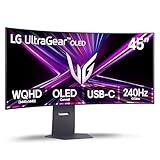
The LG 45GX900A-B Is the No. 8 Fast 44.5-Inch 800R OLED Pick
Pros
- Large 800R OLED
- 240Hz speed
- Built-in speakers
- Anti-glare surface
Cons
- 3440 x 1440 at 45 inches
- 12% one-star reviews
The LG 45GX900A-B is for players who want a huge 21:9 OLED with 240Hz operation but do not need the 5K2K resolution of the 45GX950A-B. Its 44.5-inch 3440 x 1440 screen uses an 800R curve, FreeSync Premium Pro, G-SYNC Compatible support, and a stated 0.03ms response time.
The scale and curve are the real story. This is the kind of display I would consider for a dedicated game desk or a simulator seat where the screen can sit at a sensible distance, rather than for a shallow work desk where the image may feel too close.
LG lists DisplayHDR True Black 400, Dynamic Action Sync, Black Stabilizer, an FPS Counter, built-in speakers, and anti-glare technology with UL verification. The anti-glare approach is useful for bright-room play, and it clearly differs from the glossy AOC option.
The analyzed data lists 29.8 pounds and a 39.1-inch width, so the footprint needs planning even though it is narrower than a 49-inch panel. Its 4.2 rating is drawn from 106 reviews, and the supplied distribution also shows a 12% one-star share.
The LG 45GX900A-B fits dedicated big-screen gaming spaces
Choose this screen if physical immersion is your priority and you are comfortable with 3440 x 1440 across a very large panel. The 240Hz refresh rate makes it a more speed-focused alternative to the 45GX950A-B’s full-resolution 165Hz mode.
The built-in speakers and stated gaming tools can reduce extra desk clutter. I would still connect a proper headset or speakers for positional audio in competitive games, but integrated sound is handy for casual use.
The LG 45GX900A-B is not the sharpest 45-inch desktop choice
A 44.5-inch panel with 3440 x 1440 offers far less desktop density than the 45GX950A-B at 5120 x 2160. For fine text, close-up editing, or detailed office work, the 5K2K LG is the more logical large-screen direction based on its stated 125 PPI.
The supplied listing also does not mention a desk stand and lists wall mounting in its review data, so confirm the exact included mounting hardware before planning your setup. Its two-year manufacturer warranty is another detail to weigh against the three-year coverage noted for ASUS, Alienware, and MSI.
The Right OLED Ultrawide Depends on Panel, Format, and Daily Habits
The fastest way to choose is to decide on physical format before comparing fine specifications. A 34-inch 3440 x 1440 21:9 display is the most broadly practical choice, 45-inch 21:9 displays favor close-up immersion, and 49-inch 5120 x 1440 screens demand a wide desk but can replace two monitors.
Then match resolution and refresh rate to your computer. More pixels create a sharper image and more desktop room, yet they also add work for the GPU; a screen capable of 240Hz or 330Hz only reaches its potential when the game can produce frames at a comparable rate.
QD-OLED and WOLED differ most in color approach and room fit
QD-OLED uses a blue OLED light source with quantum-dot color conversion, while WOLED uses a white OLED structure with color filters. In this list, ASUS, Alienware, MSI, AOC, and Samsung are identified as QD-OLED; the LG models are identified simply as OLED in the source data.
I would not declare one category automatically better from the name alone. Instead, compare the exact monitor’s coating, stated color gamut, brightness information, curvature, and care features, then judge it in the room where it will actually live.
Text rendering is also worth considering if you work on the same screen. Community feedback flags color fringing on older QD-OLED generations, while the supplied ASUS data calls out its true 10-bit color and Delta E below 2; the 45GX950A-B specifically states 125 PPI, a helpful figure for users who prioritize fine desktop detail.
A 34-inch 3440 x 1440 screen is the easiest all-purpose format
For most desks, 34 inches and 3440 x 1440 hit a comfortable middle ground. The image is wide enough to feel more involving than 16:9, the width is manageable, and game support for 21:9 is generally a safer bet than 32:9.
The ASUS, Alienware, LG 34GX900A-B, and AOC all occupy this category. Choose 1800R for a gentler arc, as on ASUS and Alienware, or 800R for a much more wrapped-in view, as on LG.
If you want a larger display without super-ultrawide width, the two 45-inch LGs keep the 21:9 format. Measure screen width, stand depth, and your normal viewing distance rather than treating the diagonal figure as enough information.
A higher refresh rate helps only when your system can feed it
For slower RPGs, strategy games, and atmospheric single-player titles, image quality and resolution may matter more than chasing the highest refresh option. A 175Hz screen is already fast, and each monitor in this guide states a 0.03ms response time.
For competitive FPS play, 240Hz is a sensible target if your GPU and CPU can consistently produce more than 240 frames per second at the selected ultrawide resolution. The LG 45GX950A-B is unusual because its WFHD dual mode states 330Hz, giving it a separate high-speed option.
I would not buy for a refresh ceiling you cannot realistically use in the games you play. Adaptive sync, whether G-SYNC Compatible or FreeSync Premium Pro, helps the display track changing frame rates and should remain enabled when it suits your setup.
An 800R curve favors immersion while 1800R favors flexibility
Curve measurements describe radius: lower numbers mean a tighter curve. The 800R LG models bring the side edges toward you aggressively, which can feel excellent in cockpit views and racing games but more pronounced when reading straight lines or arranging desktop windows.
The 1800R curve on the ASUS, Alienware, and Samsung is less dramatic. I would start there if the monitor has to serve games, documents, and creation tasks in equal measure, while an 800R screen is better approached as an immersion-first choice.
For the 49-inch MSI and Samsung, the sheer 32:9 width is nearly as important as the curve. Leave enough room for the screen’s full width, stand, keyboard, and comfortable eye-to-screen distance before replacing a dual-monitor setup.
HDR and ports matter most when they match your real devices
All eight monitors have OLED’s pixel-level black control and list HDR support, with most carrying a True Black 400 label. The LG 45GX950A-B and LG 34GX900A-B also state up to 1300 nits peak brightness under their listed conditions, but peak figures do not tell the whole HDR story.
For a gaming PC, start with the port the monitor lists for your chosen resolution and refresh rate. The 45GX950A-B has DisplayPort 2.1, while the LG 34GX900A-B lists DisplayPort 1.4; HDMI 2.1 is listed on several models and is particularly relevant when attaching a modern console.
The MSI is the clearest all-in-one console candidate in the supplied specifications because it explicitly lists Console Mode with HDMI 2.1 48Gbps. The LG 34GX900A-B, LG 45GX950A-B, and Samsung also list HDMI 2.1 connections, but console output and VRR behavior can vary by game, console, and selected mode.
OLED care reduces risk but does not remove the need for sensible use
Burn-in concerns are common in OLED gaming communities because static taskbars, HUDs, and desktop elements can stay in one position for long periods. Modern monitors respond with features such as ASUS OLED Care Pro, MSI OLED Care 2.0, and the OLED Care tools listed for the LG 34GX900A-B.
I would let panel-maintenance prompts run, use screen sleep when stepping away, and avoid leaving a bright static desktop on screen for hours unattended. These are simple habits, not a reason to avoid OLED if the contrast, motion response, and wide image are what you want.
Warranty duration is also part of the decision. ASUS lists three-year coverage with burn-in coverage, while Alienware and MSI list three-year warranties; both reviewed LG products list two-year manufacturer warranties, so read the exact terms that apply where you buy.
The Most Common OLED Ultrawide Questions Have Straight Answers
What is the best OLED ultrawide gaming monitor?
The ASUS ROG Strix XG34WCDG is the best all-around pick in this list for a 34-inch 21:9 setup because it combines 3440 x 1440 QD-OLED, 175Hz, true 10-bit color, OLED Care Pro, and a three-year warranty with burn-in coverage. Choose the Alienware AW3425DW instead if 240Hz is your priority.
What are the key differences between QD-OLED and WOLED panels?
QD-OLED uses quantum-dot color conversion on a blue OLED light source, while WOLED uses a white OLED structure with color filters. Compare the specific monitor’s coating, color claims, brightness data, resolution, and care features rather than choosing by panel label alone.
What refresh rate do I need for competitive gaming?
A 240Hz OLED ultrawide is a strong target for competitive gaming when your PC can regularly output more than 240 frames per second at your selected resolution. A 175Hz model is still fast, and the 330Hz WFHD mode on the LG 45GX950A-B is for players who prioritize maximum frame rate over full 5K2K detail.
Is a 34-inch ultrawide sufficient for immersive gaming?
Yes. A 34-inch 3440 x 1440 21:9 monitor is sufficient for immersive gaming and is the easiest ultrawide format to fit on a normal desk. Its width, pixel density, and broad 21:9 game support make it a practical choice for gaming and everyday work.
How long do OLED monitors last with gaming use?
The supplied product data does not provide a verified lifespan figure. Use the manufacturer care routines, turn the display off or let it sleep when unattended, and compare the stated warranty terms; ASUS lists three-year burn-in coverage, while Alienware and MSI list three-year warranties.
The ASUS Is the Best Starting Choice for Most OLED Ultrawide Buyers
For most people comparing the best oled ultrawide gaming monitors in 2026, the ASUS ROG Strix XG34WCDG is the most rounded starting point: its 34-inch 21:9 format is practical, its QD-OLED color specifications are strong, and OLED Care Pro plus stated burn-in coverage address a real ownership concern.
Choose the Alienware AW3425DW for a 240Hz 34-inch focus, the LG 45GX950A-B for 5K2K dual-mode flexibility, or the MSI MPG 491CQPX for a KVM-equipped 49-inch super ultrawide station. Before you choose, measure the desk, match refresh rate to your PC, and give panel care the same attention as HDR and speed.