
The best 1440p 240Hz gaming monitors pair a sharp 2560 × 1440 image with a screen that can refresh 240 times every second. That is the sweet spot for players who want cleaner detail than 1080p without making every game as demanding as 4K, especially in shooters, racers, and competitive multiplayer games.
A 240Hz panel does not create frames your PC cannot produce, but it can show up to 240 distinct frames per second when the game and graphics card keep up. In 2026, this category splits neatly between OLED models, which bring near-instant pixel changes and deep blacks, and IPS models, which avoid OLED image-retention concerns while retaining good color and viewing angles.
I would start with the kind of game you play rather than a feature list. A competitive FPS player may care most about stable high frame rates, sync support, and motion clarity; a single-player player may put HDR contrast first; and a mixed PC-and-console setup needs the right HDMI implementation as well as a 240Hz headline number.
This guide compares eight 27-inch-class QHD 240Hz gaming monitors using their listed panel, response-time, connection, adjustment, warranty, and sync information. There are no invented benchmark results here: where a specification such as 0.03ms or HDR is manufacturer-listed, I treat it as a useful starting point rather than a substitute for your own game settings and room conditions.
The top 3 picks give most gamers a clear starting point (September 2026)
The LG 27GX704A-B is my broadest OLED recommendation because its listed True Black 400 support, two HDMI 2.1 ports, G-Sync Compatible and FreeSync Premium Pro support, plus height, pivot, and swivel adjustments make it unusually flexible. The AOC Q27GAZDV is the QD-OLED choice for shoppers who want a USB hub and a three-year manufacturer warranty, while the AOC Q27G41ZE is the practical IPS route for players who prefer LCD technology.
Each pick is a 27-inch-class 2560 × 1440 screen with a stated 240Hz refresh rate. That common baseline matters: choose among them for panel behavior, ports, warranty terms, desk ergonomics, and the games you actually play rather than expecting one monitor to fit every setup.
All eight 1440p 240Hz gaming monitors at a glance in 2026
The list below keeps the decision simple: OLED choices prioritize contrast and a stated 0.03ms response time, while the two IPS choices give buyers a non-OLED alternative. Check the connection list closely if you need a console, a USB hub, or more than one HDMI input.
| Product | Specifications | Action |
|---|---|---|
 LG 27GX704A-B LG 27GX704A-B |
|
View monitor details |
 AOC Q27GAZDV AOC Q27GAZDV |
|
View monitor details |
 AOC Q27G41ZE AOC Q27G41ZE |
|
View monitor details |
 LG 27GS93QE LG 27GS93QE |
|
View monitor details |
 Samsung Odyssey OLED G6 Samsung Odyssey OLED G6 |
|
View monitor details |
 Acer Predator X27U W1 Acer Predator X27U W1 |
|
View monitor details |
 LG 27GR83Q-B LG 27GR83Q-B |
|
View monitor details |
 ASUS ROG Strix XG27AQDMG ASUS ROG Strix XG27AQDMG |
|
View monitor details |
1. LG 27GX704A-B is the most balanced OLED choice
Pros
- Two HDMI 2.1 ports
- Full ergonomic stand
- G-Sync and FreeSync
- USB ports
Cons
- Two-year warranty
- OLED retention needs care
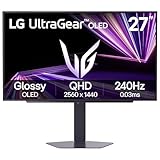
The LG 27GX704A-B combines the traits I look for in an all-purpose OLED gaming display: a 27-inch QHD OLED panel, a stated 240Hz refresh rate, and a listed 0.03ms response time. Its 98.5% DCI-P3 coverage and VESA DisplayHDR True Black 400 certification also make it more appealing for atmospheric games than a basic LCD with a modest contrast ratio.
LG lists both NVIDIA G-Sync Compatible and AMD FreeSync Premium Pro support, so it is a sensible fit whether your gaming PC uses an NVIDIA or AMD card. The listing’s 1,500,000:1 contrast figure describes the black-level advantage OLED buyers expect, but the more practical point is that dark scenes can retain separation without the gray haze common on IPS panels.
Connection flexibility is a major reason this model ranks first. It has two HDMI ports, DisplayPort, and three USB Type-A ports, while the stand supports height, pivot, swivel, and tilt; that makes desk placement far less of a compromise than with a tilt-only design.
The LG is best for a PC-and-console desk with several devices
Two HDMI 2.1 inputs are useful when a PC, PlayStation 5, or Xbox Series X share one screen. Those consoles top out below 240Hz, but HDMI 2.1 is still the relevant connection family for high-bandwidth console modes, and the extra input reduces cable swapping.
The stand’s pivot adjustment is also useful outside games if you read long chats, code, or work with a tall portrait document. At 15.9 pounds and roughly 23.8 inches wide, it remains a familiar 27-inch-class size for a standard desk rather than demanding an unusually deep setup.
The LG needs OLED-friendly daily habits from its owner
The listed warranty is two years for parts and labor, so I would read its full terms before treating the display as a static desktop screen all day. OLED’s image quality is compelling, yet persistent UI elements, taskbars, and game HUDs are part of the ownership question rather than something to ignore.
Use sensible display-sleep settings, vary long static content where practical, and allow the monitor’s own panel-care routines to run. If you play varied games and also want rich blacks and fast pixel behavior, this is the strongest all-rounder in this group.
2. AOC Q27GAZDV is the QD-OLED pick with a useful hub
Pros
- QD-OLED color
- Two HDMI ports
- Height-adjustable stand
- Three-year warranty
Cons
- Listed 200-nit brightness
- Small review sample
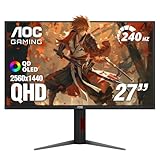
The AOC Q27GAZDV is a 27-inch QD-OLED monitor with 2560 × 1440 resolution, 240Hz, and a stated 0.03ms response time. QD-OLED uses a quantum-dot layer with OLED light, and AOC lists 147% sRGB and 110% DCI-P3 coverage, figures that point to a notably wide color presentation.
I like this monitor’s straightforward feature balance. The listing includes G-Sync support, HDR True Black, two HDMI ports, DisplayPort, two USB ports, and a height-adjustable stand, covering the connections and positioning that many barebones gaming displays omit.
The available listing data reports a 4.7-star rating from 49 reviews. That is encouraging but a much smaller feedback pool than several monitors here, so I would put more weight on its panel and warranty specification than on a score alone.
The AOC is a strong match for gamers who use USB desk accessories
The two-port USB hub is the practical differentiator. It can simplify a keyboard, mouse receiver, or other low-bandwidth accessory setup, although the listing does not provide a full USB data-rate breakdown, so do not assume it replaces every kind of dedicated dock.
Its 178-degree stated viewing angle and frameless format suit a side-by-side monitor arrangement too. QD-OLED’s color gamut can look especially striking in colorful games, but wide-gamut content may need a suitable color mode when your priority is restrained, standard-gamut desktop color.
The AOC is best when its stated brightness fits your room
AOC lists brightness at 200 nits, which calls for extra thought if the monitor will face a bright window or strong desk lighting. OLED black levels help perceived contrast in dimmer spaces, while room reflections can be more noticeable than a specification sheet suggests.
The three-year manufacturer warranty is a meaningful ownership detail in an OLED shortlist. Confirm current warranty terms and panel coverage at purchase, then use the screen’s care features and normal screen-sleep behavior as part of the decision.
3. AOC Q27G41ZE is the straightforward IPS choice for competitive play
Pros
- IPS avoids OLED retention
- Optional 260Hz mode
- Three-year coverage
- Console-ready listing
Cons
- Tilt-only stand
- HDMI 2.0 only
The AOC Q27G41ZE makes the case for a conventional IPS panel in a category crowded with OLED. It delivers QHD resolution and a listed 240Hz refresh rate, with an optional 260Hz overclock, and its stated 0.3ms MPRT figure speaks directly to the motion-focused audience this 1440p gaming monitor 240Hz is made for.
Its 1,000:1 contrast ratio is normal for IPS and will not create OLED-like blacks, yet IPS remains a very practical screen technology for long desktop sessions with fixed windows. AOC also lists FreeSync and G-Sync Compatible support, 300 cd/m² brightness, HDR, a blue-light filter, flicker-free operation, Shadow Control, and game-mode presets.
The listing reports a 4.6-star rating from 423 reviews and includes a three-year manufacturer warranty with zero-bright-dot coverage. Those details will matter more to many competitive players than chasing an OLED panel when they use the same static HUD for hours.
The AOC IPS model is right for long sessions with fixed interface elements
IPS has no OLED burn-in concern, so it is easier to recommend for a screen that doubles as a work display or runs the same game interface daily. That does not mean it is automatically better in every area; it means the ownership tradeoff is simpler for players who do not want to manage OLED care habits.
The monitor has two HDMI 2.0 ports, DisplayPort 1.4, and audio out. DisplayPort is the natural PC choice for its listed high-refresh operation, while HDMI 2.0 means console-focused buyers should verify the exact resolution and refresh modes their console offers.
The AOC asks buyers to accept limited stand adjustment
This stand tilts but does not list height, swivel, or pivot adjustment. Plan on a monitor arm or a riser if your eye line is not already correct, because a fast panel is much less comfortable when the screen sits too low.
The 260Hz overclock is a bonus rather than the reason to buy. Stable frame delivery, sensible overdrive choices, and a PC capable of high frame rates will influence competitive feel more than an extra 20Hz on the box.
4. LG 27GS93QE is the OLED choice with a fully adjustable stand
Pros
- True Black 400
- HDMI 2.1
- Height pivot and tilt
- G-Sync and FreeSync
Cons
- Two-year warranty
- OLED care required
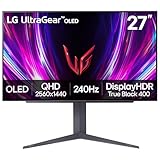
The LG 27GS93QE is another 27-inch OLED option with 2560 × 1440 resolution, 240Hz, and a listed 0.03ms gray-to-gray response time. It adds VESA DisplayHDR True Black 400, 98.5% DCI-P3 color coverage, and LG’s familiar gaming-oriented controls such as Dynamic Action Sync and FPS or RTS modes.
Its 1.5M:1 listed contrast ratio and OLED pixel behavior are well suited to games built around shadow detail, night scenes, and dramatic HDR contrast. LG lists FreeSync Premium Pro and G-Sync Compatible support, so variable refresh rate should be available to both major PC GPU camps when configured correctly.
The product listing reports a 4.6-star rating from 340 reviews. This is a close sibling in purpose to the 27GX704A-B, so I would compare the exact connection and warranty details that matter to your desk rather than assume every UltraGear OLED carries the same arrangement.
The LG 27GS93QE fits players who need ergonomic flexibility
The included stand lists tilt, height, and pivot movement. That is a better starting point than a tilt-only stand for anyone who alternates between a reclined controller position, a chair at desk height, and upright keyboard-and-mouse play.
It also has two HDMI ports, DisplayPort, and three USB ports. The listed HDMI 2.1 support makes it a logical candidate for people who want to connect modern consoles alongside a PC, with the reminder that console gaming is normally capped below the monitor’s 240Hz ceiling.
The LG 27GS93QE favors contrast over static-screen convenience
OLED can produce the clean black levels IPS cannot match, yet its two-year parts-and-labor warranty should be reviewed in detail by people who expect constant spreadsheets, editing timelines, or one persistent game overlay. The panel’s strengths come with sensible care expectations.
If HDR game atmosphere is high on your list and your room allows you to control direct reflections, this LG is a persuasive QHD 240Hz gaming monitor. Its combination of OLED speed, adaptive sync, and stand movement is its real appeal.
5. Samsung Odyssey OLED G6 is the glare-conscious QD-OLED option
Pros
- Glare-free coating
- Pantone validation
- OLED Safeguard
- Three-year warranty
Cons
- One HDMI port
- Limited review count
The Samsung Odyssey OLED G6 G61SH targets a common OLED concern from a different direction: it has a listed glare-free screen treatment. Its 27-inch QD-OLED panel runs at QHD and 240Hz with a stated 0.03ms response time, paired with HDR10 and a 400 cd/m² listed brightness figure.
Samsung lists Pantone validation for more than 2,100 colors and 99% color coverage, making this one of the more color-conscious gaming choices in the group. It also carries FreeSync Premium support and a height-adjustable stand, so the specification is not focused on picture quality alone.
The listing shows a 4.6-star rating from 61 reviews. I would interpret that as a useful but early signal, then assess the glare-free finish in the context of your room because a coating preference can be surprisingly personal.
The Samsung suits bright or reflection-prone gaming spaces
A glare-free panel can be the deciding feature if a window, overhead lights, or a pale wall regularly reflects in your screen. OLED’s deep blacks are most impressive in controlled lighting, but a less reflective surface may be a more comfortable daily choice in a typical multipurpose room.
Samsung also lists OLED Safeguard burn-in protection and a three-year manufacturer warranty. Those are reassuring ownership features, although care features work alongside—not instead of—reasonable treatment of stationary content.
The Samsung has one HDMI port, so connection planning matters
This model lists one HDMI input and DisplayPort. A single HDMI port is enough for many PC users, but it is less convenient for a PC-and-two-console setup than monitors with two HDMI connections.
Check the exact cable and source layout before buying, especially if you route audio through a receiver or capture hardware. The screen’s 178-degree listed viewing angle and adjustable stand help with placement, but ports determine how painless the everyday setup feels.
6. Acer Predator X27U W1 is the QD-OLED option for color-aware players
Pros
- True 10-bit listing
- Delta E under 2
- Two HDMI 2.1 ports
- Full stand adjustments
Cons
- No G-Sync listing
- Stock status unavailable
The Acer Predator X27U W1 has a 26.5-inch QD-OLED panel at 2560 × 1440, 240Hz, and a stated 0.03ms response time. Acer lists true 10-bit output, 99% DCI-P3 coverage, and Delta E under 2, all of which make it particularly interesting if gaming shares a desk with color-sensitive visual work.
It supports AMD FreeSync Premium and HDR10, with a ZeroFrame design that keeps the bezel minimal. The listed connection set is generous: two HDMI 2.1 ports and two DisplayPort 1.4 connections give it the most explicitly detailed multi-source input list among these products.
The available product data reports a 4.5-star rating from 89 reviews and a three-year parts-and-labor warranty. Its source data marks stock status as unknown, so availability should be checked directly rather than assumed from a roundup list.
The Acer is the right fit when color specifications matter beside gaming
Delta E under 2 and 99% DCI-P3 are meaningful listed claims for a gamer who also edits images or video. They do not replace calibration for color-critical delivery, but they show Acer is positioning this QD-OLED beyond pure esports speed.
The full stand range—height, tilt, pivot, and swivel—is equally helpful for a mixed-use desk. I favor this combination over a strong panel in a fixed stand when the monitor will be used for long creative sessions as well as evening games.
The Acer needs a sync check for NVIDIA-focused systems
The listing specifically names FreeSync Premium, while it does not list G-Sync Compatible certification. NVIDIA users should verify current compatibility and desired variable-refresh behavior from the product documentation before making the model their default choice.
That is not a judgment on the screen’s image quality or speed; it is a compatibility detail worth checking before purchase. For AMD systems and multi-device desks that can use its two HDMI 2.1 and two DisplayPort 1.4 inputs, the port selection is a substantial advantage.
7. LG 27GR83Q-B is the versatile IPS option with HDMI 2.1
Pros
- Two HDMI 2.1 ports
- USB 3.0 hub
- Full adjustable stand
- G-Sync and FreeSync
Cons
- IPS contrast
- One-year warranty
The LG 27GR83Q-B is the IPS counterweight to LG’s OLED entries. Its 27-inch 2560 × 1440 IPS LCD runs at 240Hz with a stated 1ms gray-to-gray response time, and it pairs DisplayHDR 400 with 95% DCI-P3 color coverage for a capable all-round QHD image.
The feature list is unusually complete for an IPS gaming monitor: G-Sync Compatible, FreeSync Premium, two HDMI 2.1 ports, DisplayPort 1.4, USB-C, three USB 3.0 ports, and a four-pole headphone output with DTS Headphone:X support. LG also includes Dynamic Action Sync, Black Stabilizer, an FPS counter, and a crosshair option.
The available data shows a 4.4-star rating from 777 reviews, the largest review count in this set. That breadth does not make the monitor perfect, but it gives the listing score more context than a very small sample.
The LG 27GR83Q-B is ideal when HDMI 2.1 matters but OLED does not
For a PC plus current-console setup, two HDMI 2.1 ports are a serious convenience. A PlayStation 5 or Xbox Series X can use supported 1440p and 120Hz modes, while the PC can pursue the monitor’s 240Hz ceiling through the appropriate source connection.
IPS lacks OLED’s per-pixel black control, which is reflected in the listed 1,000:1 contrast ratio. In return, it is a less complicated option for static desktop use, and its 400-nit listed brightness may be easier to live with in a brighter room.
The LG is best for buyers who will use its connectivity every day
The USB-C, USB 3.0, and headphone connections are useful only if your desktop actually needs them, but they can reduce adapter clutter. The tilt, height, and pivot stand helps turn that flexible connection set into a more adaptable workstation as well.
The main compromise is the listed one-year manufacturer warranty. Buyers who see this as a long-term display should review warranty terms alongside the feature list, rather than focusing solely on the very good port selection.
8. ASUS ROG Strix XG27AQDMG is the glossy WOLED pick with burn-in coverage
Pros
- Glossy WOLED panel
- Burn-in warranty coverage
- Custom heatsink
- Anti-flicker feature
Cons
- Glossy finish reflects light
- No HDMI 2.1 listed
The ASUS ROG Strix XG27AQDMG is a 26.5-inch glossy WOLED monitor with QHD resolution, 240Hz, and a stated 0.03ms response time. Its glossy screen is the central reason to consider it: it can emphasize the clarity and perceived punch of OLED imagery, but it also makes room lighting a major part of the experience.
ASUS lists 99% DCI-P3 coverage, G-Sync Compatible and FreeSync Premium support, two HDMI ports, DisplayPort, and two USB 3.2 Gen 1 Type-A ports. It also lists a custom heatsink, OLED Anti-flicker technology, a uniform-brightness option, and a three-year warranty with burn-in coverage.
The listing reports a 4.4-star rating from 757 reviews. That is a sizeable feedback base, and the explicit burn-in warranty coverage directly addresses one of the recurring concerns buyers raise when comparing an OLED gaming monitor 240Hz with IPS alternatives.
The ASUS is best for a light-controlled room and glossy-screen fans
A glossy WOLED panel is most persuasive when you can position it away from direct windows and bright reflected lamps. In that situation, the coating can make games look especially immediate, while a bright untreated room can turn reflections into a constant distraction.
The third-generation WOLED panel is listed as offering brighter whites and clearer text, which targets a known OLED desktop concern. Still, screen coating and subpixel behavior are personal enough that reading current documentation and seeing a similar panel in person can be worthwhile.
The ASUS offers ownership features that OLED buyers should value
The custom heatsink, anti-flicker technology, uniform-brightness option, and three-year burn-in coverage form a more complete ownership story than a refresh-rate claim alone. Confirm current coverage terms, because warranty conditions can be as important as panel care features.
ASUS does not list HDMI 2.1 in the supplied connection details, so console-first buyers should confirm supported console modes before choosing it over the LG IPS or OLED models with explicitly listed HDMI 2.1. For a PC-centered, light-controlled desk, its glossy presentation is the reason it stands apart.
The right buying guide starts with your games, GPU, and room
A QHD 240Hz monitor is good for gaming because it balances resolution and motion rather than maximizing only one. The 2560 × 1440 pixel grid looks substantially sharper than 1080p at this size, while 240Hz reduces the time between refreshes compared with 144Hz or 165Hz when your system can deliver the frames.
OLED is best for contrast, while IPS is best for simpler static use
OLED and QD-OLED displays switch pixels extremely quickly and can show very deep blacks because each pixel emits its own light. They are compelling for dark games, HDR scenes, and motion-heavy play, but any OLED purchase should include a realistic plan for static content, panel-care features, and warranty coverage.
WOLED is an OLED variant that uses a white OLED subpixel arrangement, while QD-OLED combines OLED light with quantum dots for wide color output. Neither label alone decides the better monitor; consider the coating, brightness listing, ports, warranty, and whether your room has strong reflections.
IPS has lower listed contrast in these examples, around 1,000:1, so black scenes will not have the same depth. It remains the less anxious choice for permanent desktop elements, repetitive work windows, and long game sessions with a fixed HUD.
A capable GPU is required to make 240Hz feel worthwhile
No fixed GPU model can promise 240 frames per second in every game at 1440p, because engine demands, ray tracing, game patches, and settings vary widely. The practical target is a system that can hold high frame rates in the games you play, then use adaptive sync to smooth the range below 240fps.
For lighter esports titles, the RTX 3070, RTX 4070, RX 6800, or better class of GPU can be a reasonable starting point at QHD with competitive settings. For demanding new single-player games, higher-tier cards such as RTX 4080-, RTX 5080-, or RTX 5090-class hardware have more headroom, but settings choices still matter.
Prioritize frame-time consistency over a one-time peak frame-rate number. Disable or reduce the visual features that hurt your preferred games most, use DisplayPort or the monitor’s supported high-bandwidth input, and set the operating system and game to the intended refresh rate after installation.
HDMI 2.1 is best for console flexibility, not 240Hz console output
PlayStation 5 and Xbox Series X gaming is generally capped at 120Hz, not 240Hz. A QHD 240Hz monitor can still be a good console display because the panel can accept supported 1440p and 120Hz modes, while its 240Hz capability remains useful for a gaming PC.
Look for explicitly listed HDMI 2.1 if a console is central to your setup, then verify the monitor’s current support documentation for your exact console, game, HDR mode, and VRR mode. The LG 27GX704A-B, LG 27GS93QE, Acer X27U W1, and LG 27GR83Q-B list HDMI 2.1 in the supplied data.
HDR labels tell part of the story, so panel contrast tells the rest
DisplayHDR True Black 400, DisplayHDR 400, HDR10, and HDR True Black are not interchangeable promises of identical HDR. OLED’s per-pixel lighting helps it display dark contrast convincingly, while an IPS HDR400 display may offer useful brightness and color without the same black-level control.
Assess HDR with your room and games in mind. A bright room can reduce the perceived benefit of deep blacks, and a glare-free finish or stronger listed brightness may matter more in daylight than a certification label by itself.
The best setup uses a suitable cable and correct monitor settings
After connecting the monitor, select 240Hz in your operating system, enable G-Sync Compatible or FreeSync if applicable, and verify the game has not defaulted to a lower refresh rate. A monitor can be excellent on paper yet feel ordinary when it is accidentally running at 60Hz or when a cable and source path limit its mode.
Use the monitor’s game presets and black-level controls carefully rather than assuming the highest setting is always best. In competitive games, a clearer shadow setting can help visibility; in story games, preserving the creator’s intended contrast may be more satisfying.
These answers cover the key 1440p 240Hz questions
Is 240Hz overkill for 1440p?
No. A 240Hz 1440p monitor is worthwhile for competitive games when your PC can produce high frame rates. It also gives smoother motion than 144Hz or 165Hz in fast games. For demanding single-player games that run far below 240fps, image quality, HDR, adaptive sync, and panel type may matter more than the 240Hz ceiling.
Is a 2K 240Hz monitor good for gaming?
Yes. The term 2K is commonly used for 2560 × 1440 QHD monitors, and a 240Hz version combines sharp 27-inch-class detail with very smooth motion. OLED models add deep contrast and very fast stated pixel response, while IPS models are a practical choice for long sessions with persistent desktop elements.
What GPU do I need for 1440p 240Hz?
It depends on the game and settings. An RTX 3070, RTX 4070, RX 6800, or better can be a reasonable starting point for high frame rates in lighter esports games at 1440p. Demanding games may need higher-tier GPUs such as RTX 4080-, RTX 5080-, or RTX 5090-class cards and tuned settings; adaptive sync still improves play when frame rate is below 240fps.
The best choice is the monitor that matches your actual setup
For the best 1440p 240Hz gaming monitors in 2026, the LG 27GX704A-B is the most complete OLED choice for mixed PC-and-console desks. Pick the AOC Q27GAZDV for QD-OLED plus a hub and three-year warranty, the AOC Q27G41ZE for a fast IPS approach, or the LG 27GR83Q-B when HDMI 2.1 and IPS convenience lead your list.
Buy the panel technology you can live with, verify the inputs your devices need, and set a realistic frame-rate target for your GPU. Those three decisions will have a larger effect on daily satisfaction than a headline refresh rate alone.