
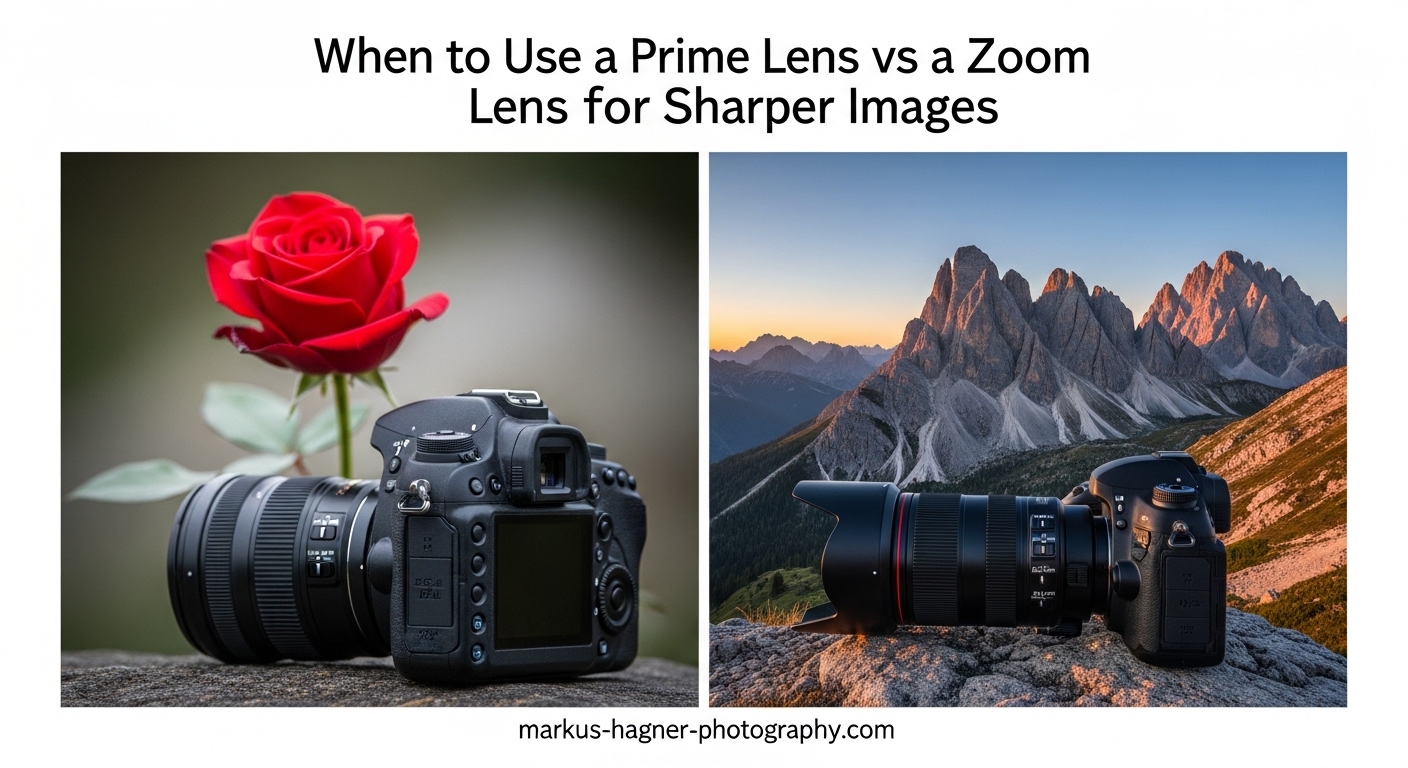
Every photographer faces this dilemma at some point: do you grab that sharp prime lens or the versatile zoom? After shooting with both for over 15 years across landscapes, portraits, events, and everything in between, I can tell you the answer isn’t straightforward. The question of when to use a prime lens vs a zoom lens for sharper images depends heavily on what you’re shooting, how you’ll use the photos, and honestly, how much gear you want to carry.
Here’s what I’ve learned from testing dozens of lenses and talking with professional photographers who shoot everything from weddings to wildlife: primes generally hold a sharpness advantage, but modern zooms have narrowed that gap significantly. The real question becomes whether that difference matters for your specific work.
In this guide, I’ll break down the technical reasons behind sharpness differences, share specific scenarios where each type wins, and help you make the right call for your photography. By the end, you’ll know exactly when to reach for a prime and when a zoom will serve you better.
Why Prime Lenses Tend to Be Sharper: The Technical Reality
Let’s start with what actually makes prime lenses sharper. It comes down to optical physics and design compromises. Prime lenses have fixed focal lengths, which means engineers optimize every glass element for one specific optical formula. Zoom lenses, on the other hand, must perform reasonably well across a range of focal lengths, which introduces inherent compromises.
A typical prime lens contains 6 to 10 glass elements. A professional zoom covering a similar range might have 15 to 20 elements, many of which must move precisely during zooming. More glass elements mean more air-to-glass surfaces where light can scatter, reflect, or introduce aberrations. Each additional element also adds weight and potential for optical imperfections.
Optical Construction Differences
The simpler construction of prime lenses allows manufacturers to use higher quality glass and more sophisticated coatings at each price point. When you’re building a 50mm f/1.8 prime, you can pour your engineering budget into making that single focal length as sharp as possible. With a 24-70mm zoom, you’re spreading resources across a much more complex optical design.
This doesn’t mean all primes are sharper than all zooms. A budget prime might actually perform worse than a professional zoom. But at equivalent price points, primes typically deliver superior optical quality. I’ve seen this repeatedly when testing lenses: a $500 prime often matches or exceeds the sharpness of a $1,500 zoom at the same focal length.
Wider Apertures Mean Faster Shutter Speeds
Prime lenses almost always offer wider maximum apertures than zooms. A 50mm f/1.4 prime lets in four times more light than a 24-70mm f/2.8 zoom at its widest setting. This translates to faster shutter speeds in the same lighting conditions, which directly affects sharpness by reducing camera shake and subject motion blur.
In practical terms, if you’re shooting handheld in dim light at ISO 3200 with your zoom at f/2.8 and 1/60 second, the same shot with an f/1.4 prime would let you shoot at 1/250 second. That difference alone can make or break sharpness, regardless of the lens’s optical quality.
Corner-to-Corner Sharpness Advantage
Where primes really shine is corner sharpness. Zoom lenses often show significant softness in the corners, especially at wider focal lengths and wider apertures. This happens because correcting aberrations across a zoom range is incredibly difficult. Prime lenses can be designed to deliver consistent sharpness from center to edge.
For landscape photographers and anyone making large prints, this matters tremendously. That corner softness becomes very visible when you print at 20×30 inches or larger. For web use or social media, most viewers will never notice the difference.
The Modern Zoom Revolution
Here’s where things get interesting. Modern professional zooms from Sony (GM series), Canon (L series), and Nikon (Z S-line) have narrowed the sharpness gap dramatically. I’ve tested current-generation 24-70mm and 70-200mm zooms that deliver prime-like sharpness through most of their range.
The trade-off is price and weight. These professional zooms cost $2,000 to $3,000 and weigh significantly more than equivalent primes. But if your budget allows, many working professionals find these zooms sharp enough that they rarely reach for primes anymore.
When to Use a Prime Lens for Sharper Images
Now let’s get specific about situations where prime lenses deliver noticeably sharper results and make the most sense for your photography.
Landscape Photography
For landscape work, I almost always reach for primes. Maximum detail and corner-to-corner sharpness matter here more than almost any other genre. When you’re capturing sweeping vistas that you might print large or crop significantly, every bit of resolution counts.
Wide-angle primes like a 14mm, 20mm, or 24mm typically deliver superior edge performance compared to zooms covering the same focal lengths. The difference shows up clearly in distant foliage, mountain textures, and fine details throughout the frame. Since you’re usually shooting from a tripod at smaller apertures, the wider maximum aperture of primes isn’t the advantage here—it’s pure optical quality.
Portrait Photography
Portraits benefit from primes in two ways: sharpness and bokeh quality. A quality 85mm or 105mm prime renders eyes and facial details with micro-contrast that gives images a three-dimensional quality. The background blur (bokeh) from fast primes also tends to be smoother and more pleasing than what zooms produce.
Professional portrait photographers often own the “Holy Trinity” of portrait primes: 35mm for environmental portraits, 50mm for standard portraits, and 85mm for headshots. Each delivers that combination of biting sharpness on your subject with creamy background separation that clients love.
Low Light and Indoor Photography
When light gets dim, primes become essential. That f/1.4 or f/1.8 aperture lets you shoot at shutter speeds that would be impossible with an f/2.8 or f/4 zoom. I’ve shot indoor events with a 35mm f/1.4 where zoom users around me were struggling with motion blur or excessive noise from high ISOs.
The sharpness advantage here is practical rather than optical. A slightly softer image shot at a usable shutter speed beats a theoretically sharper lens that produces blurry photos because you can’t hold it steady.
Astrophotography
For capturing the night sky, fast primes aren’t just helpful—they’re essential. You need wide apertures to gather enough light from faint stars, and you need to keep exposure times reasonable to avoid star trailing. A 20mm or 24mm f/1.4 or f/1.8 prime is the standard tool for this work.
The corner performance of primes also matters significantly for astrophotography. Stars in the corners of the frame will show coma and other aberrations more clearly with zoom lenses.
Product and Commercial Photography
When clients are paying for product shots that might appear in catalogs or advertisements, edge-to-edge sharpness is non-negotiable. Macro primes and high-quality standard primes deliver the consistent detail reproduction that commercial work demands.
I’ve found that even mid-tier primes often outperform professional zooms for this type of work, simply because the optical design can be optimized for the specific focal length and working distance.
Large Format Printing
If you’re printing at 16×20 inches or larger, the sharpness difference between primes and zooms becomes visible. What looks identical on screen reveals itself in print. Fine details, textures, and edge acuity all benefit from prime lens quality.
For web-only work or social media, this consideration largely disappears. A quality zoom produces images that look perfectly sharp on any screen.
When Zoom Lenses Are Sharp Enough (or Better)
Despite everything I’ve said about prime lens advantages, there are many situations where a zoom is the smarter choice—and where its sharpness is more than adequate for professional work.
Event Photography
Wedding and event photographers overwhelmingly choose zooms, and for good reason. When moments happen quickly and you can’t predict where you’ll need to be, the ability to reframe instantly is invaluable. A 24-70mm and 70-200mm combo covers 95% of event situations without lens changes.
I’ve shot alongside wedding photographers using professional zooms, and their images are plenty sharp for albums, prints, and client deliverables. The flexibility of zooming outweighs the marginal sharpness advantage of primes in fast-moving situations.
Sports and Wildlife Photography
You simply cannot “zoom with your feet” when your subject is a bird in flight or a player sprinting down a field. Long telephoto zooms like 100-400mm or 150-600mm are essential tools for these genres. Modern versions deliver excellent sharpness, especially at the price point compared to prime telephotos.
A 500mm or 600mm prime might be slightly sharper than a zoom, but it costs five to ten times as much and offers zero flexibility. Most wildlife photographers I know use zooms for the versatility and reach.
Travel Photography
When you’re carrying gear all day through airports, cities, and hiking trails, weight matters. One quality zoom replacing two or three primes saves significant weight and bulk. A 24-105mm or 24-200mm zoom covers an enormous range in a single package.
For travel, I’ve found that the best camera is the one you actually want to carry. A zoom that stays on your camera gets more shots than a prime that lives in your hotel room because you’re tired of switching lenses.
Street Photography
While many street photographers love small primes for their discreet size and weight, others prefer the framing flexibility of compact zooms. Being able to shoot at 28mm one moment and 50mm the next without changing lenses can mean capturing or missing decisive moments.
The sharpness requirements for street photography are generally modest—images are rarely printed large, and the documentary nature of the work prioritizes content over technical perfection.
Web and Social Media Output
Let’s be practical: for Instagram, Facebook, or website use, the sharpness difference between a good zoom and a prime is essentially invisible. When your image will be displayed at 1080 pixels wide, even a kit zoom looks plenty sharp.
I’ve posted images from professional zooms alongside prime lens shots, and viewers cannot tell the difference. The content, composition, and lighting matter far more than the marginal sharpness advantage for this type of output.
High-End Zooms Match Primes for Most Uses
Current-generation professional zooms from the major manufacturers have reached a quality level that makes the sharpness discussion largely academic for many photographers. A Sony 24-70mm f/2.8 GM II, Canon RF 24-70mm f/2.8 L, or Nikon Z 24-70mm f/2.8 S delivers resolution that satisfies most professional requirements.
Many working professionals have transitioned to zoom-only kits and report no client complaints about image quality. The time saved by not changing lenses often translates to more and better shots.
Factors That Affect Sharpness Beyond Lens Choice
Before you rush out to buy primes for their sharpness advantage, consider that many other factors affect image sharpness—often more than the lens itself.
Camera Shake and Technique
The sharpest lens in the world produces blurry images if you can’t hold it steady. Proper handholding technique, bracing against objects, and using image stabilization when available often matter more than optical quality. I’ve seen photographers with expensive primes produce soft images because of poor technique.
Using a tripod, even for relatively fast shutter speeds, can improve sharpness noticeably. Many landscape photographers use tripods not because their lenses aren’t sharp, but because maximum stability extracts every bit of resolution from their gear.
Aperture Selection: The Sweet Spot
Every lens has an aperture where it performs best—typically 2 to 3 stops down from maximum. A prime shot wide open at f/1.4 might actually be less sharp than a zoom at f/5.6. Understanding your lens’s characteristics and shooting at its optimal aperture often matters more than which type of lens you’re using.
For critical work, I always try to shoot at my lens’s sweet spot when possible. This often means stopping down primes to f/2.8 or f/4, which narrows the aperture advantage they have over zooms.
Focus Accuracy
Sharpness means nothing if your focus is slightly off. Fast apertures create razor-thin depth of field where focusing errors become obvious. A zoom at f/4 has more depth of field margin for focus errors than a prime at f/1.4.
Modern autofocus systems are remarkably accurate, but they’re not perfect. For critical work, taking multiple shots or using focus peaking in live view can ensure you get truly sharp results.
Sensor Resolution Interaction
Higher resolution sensors demand more from lenses. A 45 or 60 megapixel sensor will reveal lens weaknesses that don’t show on a 24 megapixel sensor. If you’re shooting high-resolution bodies, lens quality becomes more critical.
That said, even high-resolution sensors produce excellent results with quality zooms. The difference shows up mainly in extreme pixel-peeping or very large prints.
Post-Processing and Sharpening
Modern sharpening tools in Lightroom, Capture One, and specialized software can extract impressive detail from any quality lens. Skilled post-processing can narrow the perceived gap between primes and zooms significantly.
I’ve processed zoom images to match prime sharpness for most output sizes. The raw files from primes still contain more detail, but for practical output, processing matters enormously.
Print Size vs Display Medium
Consider your actual output. For web use, phone screens, and small prints, any quality lens produces sharp results. The sharpness differences between lens types only become relevant for large prints or heavy cropping.
Be honest about how you use your images. If you rarely print larger than 8×10 and primarily share online, investing heavily in primes for sharpness alone may not be worthwhile.
Quick Decision Guide: Prime vs Zoom for Sharpness
Still not sure which way to go? Ask yourself these questions:
1. What do you photograph most? Landscapes, portraits, and product work favor primes. Events, sports, and travel favor zooms.
2. How do you use your images? Large prints and commercial work benefit from prime sharpness. Web and social media are well-served by zooms.
3. How much can you carry? Primes mean more weight and more lens changes. One zoom covers multiple focal lengths in a lighter package.
4. What’s your budget? A quality zoom often costs less than two or three primes covering the same range. But a single prime can deliver exceptional quality at one focal length for less money.
5. Do you value flexibility or maximum quality? Zooms give you options in the moment. Primes give you the best possible image at their focal length.
Many photographers end up with a hybrid approach: a quality standard zoom for general work plus one or two primes for situations where maximum sharpness matters. A 24-70mm zoom plus 35mm and 85mm primes covers most situations beautifully.
Frequently Asked Questions
Are prime lenses always sharper than zoom?
Generally yes, but with important caveats. Prime lenses typically offer superior optical quality at equivalent price points due to their simpler construction. However, high-end professional zooms from Sony GM, Canon L, and Nikon Z S-line series can match or exceed the sharpness of budget primes. The sharpest zooms approach prime quality, though primes often maintain an edge in corner-to-corner consistency. For most practical purposes, quality zooms are plenty sharp—it’s mainly at extreme enlargements or critical commercial work that prime advantages become clearly visible.
When to use Prime vs zoom?
Use prime lenses when maximum sharpness matters most: landscape photography, portraits, low light situations, astrophotography, product photography, and large format printing. Use zoom lenses when flexibility is essential: event photography, sports, wildlife, travel, street photography, and work primarily destined for web or social media. The best choice depends on your specific situation—many photographers own both types and select based on the shoot’s requirements.
What is a drawback of using a prime lens?
The main drawback of prime lenses is their fixed focal length, which limits framing flexibility. You must physically move to adjust your composition—photographers call this ‘zooming with your feet.’ This isn’t always possible in confined spaces or when photographing distant subjects. Primes also mean carrying multiple lenses to cover different focal lengths, adding weight and requiring lens changes in the field. For fast-moving situations like weddings or sports, constant lens changes can mean missing critical moments.
What is the Holy Trinity of prime lenses?
The Holy Trinity refers to the three essential prime focal lengths that cover most photography needs: 35mm for street and environmental portraits, 50mm for standard everyday photography, and 85mm for portraits with pleasing compression and background separation. Some photographers substitute 24mm for 35mm depending on their style. Together, these three focal lengths handle everything from landscapes to headshots with maximum optical quality and low-light capability.
Conclusion
Understanding when to use a prime lens vs a zoom lens for sharper images comes down to matching your gear to your actual needs. Primes deliver superior optical quality, wider apertures, and better corner-to-corner sharpness—advantages that matter for landscapes, portraits, low light work, and large prints. Zooms offer unmatched flexibility that often translates to more and better shots in dynamic situations like events, sports, and travel.
Modern professional zooms have narrowed the sharpness gap enough that many working photographers use them exclusively without sacrificing client-deliverable quality. The best approach for most photographers is a hybrid kit: a quality general-purpose zoom for flexibility plus one or two primes for situations where maximum sharpness truly matters.
Choose based on what you shoot, how you use your images, and what you’re willing to carry. The right lens is the one that helps you make the photographs you want to make.