
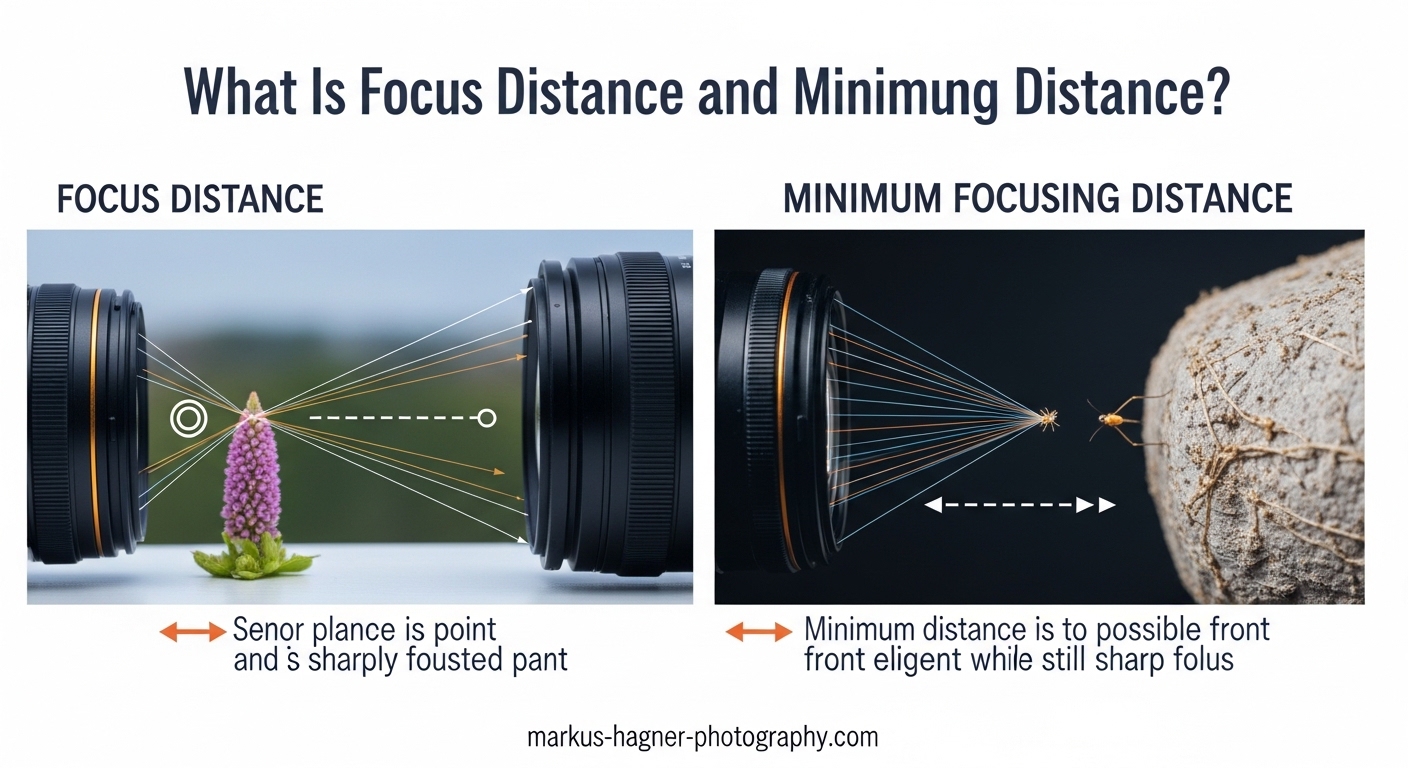
Every camera lens has specific distance capabilities that determine how close you can get to your subject while maintaining sharp focus. Focus distance is the measurement from your camera’s sensor plane to your subject at any given focus setting. Minimum focusing distance is the closest point at which your lens can achieve sharp focus. Go closer than this limit, and your lens simply cannot render a sharp image no matter how much you turn the focus ring.
Understanding these concepts transforms how you approach photography. I have spent years working with different lenses, and knowing their focus distance limitations has saved me countless frustrating moments when trying to capture close-up shots. Whether you shoot portraits, products, or macro photography, this knowledge helps you work within your equipment’s capabilities or choose the right tools for specific situations.
In this guide, I will explain exactly what focus distance and minimum focusing distance mean, how they are measured, why they vary across lens types, and practical ways to work around limitations. By the end, you will have a complete understanding that helps you make better decisions in the field and when purchasing new glass.
What Is Focus Distance on a Lens
Focus distance refers to the distance between your camera’s focal plane (sensor) and the subject that appears sharp in your image. This distance changes constantly as you adjust focus or move your camera. When you rotate the focus ring on your lens, you are essentially telling the optics which distance should be rendered sharply on the sensor.
Every lens can focus from its minimum focusing distance all the way to infinity. The focus distance scale printed on most lens barrels shows this range. You might see markings like 0.45m, 1m, 3m, and the infinity symbol. These indicate where the lens is focused at any given setting.
I find it helpful to think of focus distance as a variable that shifts based on your composition needs. When photographing a distant landscape, your focus distance might be 50 meters or more. For a portrait across a room, it could be 3 meters. Move in tight for a headshot, and you might be working at 1 meter. Each scenario requires a different focus distance setting.
How Focus Distance Changes During Shooting
As you photograph, the focus distance adjusts in two ways. First, turning the focus ring moves lens elements internally or externally to change which distance appears sharp. Second, physically moving closer or farther from your subject changes the actual distance between sensor and subject.
Modern autofocus lenses handle this adjustment automatically. The camera’s phase detection or contrast detection system determines the correct focus distance and drives the lens motor accordingly. Manual focus lenses require you to judge the distance visually or use distance scales for zone focusing techniques.
Focus Distance Scale Markings Explained
Many lenses feature a distance scale window or markings on the barrel. These scales show the current focus distance in both meters and feet. Understanding these markings helps with zone focusing, especially for street photography where autofocus might be too slow.
The scale typically shows the minimum focusing distance at one end and infinity at the other. Between these extremes, you will find intermediate markings. Some premium lenses include depth of field indicators alongside the distance scale, showing how much of the scene will appear acceptably sharp at different apertures.
I rely on these scales when shooting in low light or when I want to pre-focus for fast action. Setting focus distance to 3 meters at f/8, for example, gives me a generous zone of sharpness from about 2 meters to 5 meters on many lenses.
What Is Minimum Focusing Distance
Minimum focusing distance is the closest distance from your camera’s sensor plane at which a lens can achieve sharp focus. This is a physical limitation of the lens design. Move any closer, and the lens elements cannot bend light rays enough to create a sharp image on the sensor. The image will remain blurry regardless of focus adjustments.
This specification varies dramatically between lens types. A typical 50mm prime lens might focus down to 0.45 meters (about 18 inches). A dedicated macro lens could focus as close as 0.15 meters. Telephoto lenses often have minimum focusing distances of 1 meter or more. Understanding your lens’s specific limit prevents frustration when attempting close-up work.
Why Lenses Have Minimum Focus Limitations
The minimum focusing distance is determined by the optical design of the lens. To focus closer, lens elements need to move farther apart or extend more significantly. There are physical constraints on how far elements can travel within the lens barrel. Additionally, focusing closer requires more complex optical corrections to maintain image quality.
Lens manufacturers balance several factors when designing focus mechanisms. Closer focusing capability requires larger, heavier elements and more complex optical formulas. This increases cost, weight, and size. Most lenses are designed with practical use cases in mind, optimizing for typical shooting distances rather than extreme close-focus capabilities.
Internal focusing lenses, which move elements inside the barrel without external extension, often have slightly longer minimum focusing distances than externally focusing designs. The trade-off is faster autofocus and better weather sealing.
The Critical Measurement Point: Sensor Plane, Not Lens Front
One of the most common misconceptions I encounter involves where minimum focusing distance is measured from. Many photographers assume it is measured from the front element of the lens. This is incorrect. Focus distance is always measured from the camera’s focal plane, which is the sensor (or film) position inside the camera body.
Camera manufacturers mark this focal plane position with a symbol: a circle with a horizontal line through it. You will find this marking on the top plate of most cameras. When a lens specification states a minimum focusing distance of 0.5 meters, that means 0.5 meters from this focal plane mark to your subject.
This distinction matters practically. If your lens has a 0.5-meter minimum focusing distance, and the lens itself is 15 centimeters long, you can actually get the front of your lens much closer than 50 centimeters to your subject. The working distance (front of lens to subject) will be around 35 centimeters, but the focus distance remains 50 centimeters from the sensor plane.
Finding Your Camera’s Focal Plane Marker
Locate the focal plane marker on your camera body. On most DSLRs and mirrorless cameras, this symbol appears on the top plate near the viewfinder or LCD. It looks like a circle intersected by a line. This mark indicates exactly where the sensor sits inside the camera.
When testing minimum focusing distance or planning close-up shots, I use this marker as my reference point. Measuring from the sensor plane gives accurate results that match manufacturer specifications. Measuring from the lens front will give inconsistent results depending on lens length and design.
How Focus Distance Is Measured
Focus distance measurement follows an industry standard: the distance from the camera’s focal plane to the plane of sharpest focus on your subject. This measurement system ensures consistency across all camera and lens brands, though it often confuses photographers who naturally think in terms of distance from the lens front.
The Focal Plane Reference Point
The focal plane, also called the sensor plane or image plane, is where your camera’s sensor (or film in older cameras) sits. This is the surface that captures the image formed by the lens. All focus distance measurements reference this point because it represents where the light finally comes together to form a sharp image.
When light enters your lens, it converges to form an image at the focal plane. The lens elements adjust their positions to ensure this convergence happens precisely on the sensor surface. Different focus distances require different element positions to achieve this sharp convergence.
Working Distance vs Focusing Distance
Understanding the difference between working distance and focusing distance helps in practical shooting situations. Working distance is the space between the front of your lens and your subject. Focusing distance is measured from the sensor plane to the subject.
Working distance matters for lighting, subject disturbance, and physical access. If you are photographing insects or shy animals, greater working distance lets you stay farther away while still filling the frame. Macro photographers often seek lenses with longer working distances at 1:1 magnification to avoid casting shadows on subjects or frightening them away.
The relationship between these two distances depends on lens length. A long telephoto lens might have a 2-meter minimum focusing distance but offer 1.5 meters of working distance. A compact 50mm lens with the same 0.45-meter minimum focusing distance provides only about 30 centimeters of working distance.
Reading Focus Distance Scales
Lens distance scales provide visual feedback about current focus position. These scales typically show distance in both meters and feet, with the minimum focusing distance at one end and infinity at the other. The spacing between markings is not linear; closer distances are spaced farther apart because focus changes more dramatically at close range.
On manual focus lenses, the distance scale moves as you rotate the focus ring. Many modern autofocus lenses also include distance scales, though some budget models omit them. Premium lenses often feature more detailed scales with depth of field markings that show the zone of acceptable sharpness at different apertures.
I use distance scales extensively for zone focusing in street photography. By setting focus to a specific distance and using a smaller aperture, I create a zone where everything appears acceptably sharp. This eliminates autofocus delay and lets me capture fleeting moments instantly.
Focus Distance vs Focal Length: Understanding the Difference
These two terms sound similar but describe completely different lens characteristics. Focal length is a fixed optical property measured in millimeters that determines the angle of view and magnification. Focus distance is a variable that changes as you adjust focus and represents how far your subject is from the sensor plane.
A 50mm lens always has a 50mm focal length regardless of focus setting. But the focus distance on that same lens might be 0.5 meters when focused close or 10 meters when focused on a distant subject. Focal length stays constant; focus distance changes constantly during use.
Why the Confusion Occurs
The confusion between these terms often stems from their similar names and related effects on image composition. Both affect how subjects appear in the frame. Longer focal lengths magnify distant subjects. Closer focus distances also make subjects appear larger in the frame. Photographers sometimes conflate these effects.
Additionally, zoom lenses have variable focal lengths, which adds another layer of potential confusion. A 70-200mm zoom can change both its focal length (zooming) and its focus distance (focusing) independently. Understanding that these are separate adjustments helps you control your images more precisely.
Practical Examples Showing the Difference
Consider photographing a flower. With a 50mm lens focused at 0.5 meters, the flower fills a moderate portion of the frame. Switch to a 100mm lens at the same 0.5-meter focus distance, and the flower appears twice as large because of the longer focal length.
Now keep the 100mm lens but change focus distance to 2 meters. The flower now appears smaller in the frame because you are farther away, even though the focal length remains the same. This demonstrates how focus distance and focal length affect images differently.
I often explain this by thinking of focal length as zoom and focus distance as physical proximity. Zoom controls how much of the scene the lens captures. Focus distance determines which part of that scene appears sharp.
Minimum Focusing Distance Across Different Lens Types
Different lens categories exhibit dramatically different minimum focusing capabilities. Understanding these patterns helps you choose appropriate equipment for specific shooting situations.
Macro Lenses: The Close-Focus Champions
True macro lenses are designed specifically for close-up photography. They typically focus down to life-size (1:1) magnification, meaning subjects project onto the sensor at their actual size. A 1-inch butterfly fills a 1-inch portion of your sensor. Most macro lenses achieve this at focus distances of 20 to 30 centimeters from the sensor plane.
Popular macro focal lengths include 60mm, 90mm, 100mm, and 180mm. Longer macro lenses provide greater working distance at 1:1 magnification, which is valuable for photographing skittish insects or avoiding shadow casting. I prefer a 100mm macro for most close-up work because it balances working distance with manageable size.
Standard Prime Lenses
Standard primes like 35mm, 50mm, and 85mm lenses typically have minimum focusing distances between 0.3 and 0.8 meters. A nifty fifty (50mm f/1.8) usually focuses to about 0.45 meters. This is adequate for portraits, still lifes, and general photography but limiting for true close-up work.
Faster prime lenses sometimes have slightly longer minimum focusing distances because their large, complex optical designs make close focusing more challenging. A 50mm f/1.2 might focus to 0.5 meters while a 50mm f/1.8 reaches 0.45 meters.
Wide-Angle Lenses
Wide-angle lenses often have impressively close minimum focusing distances. A 24mm lens might focus to 0.25 meters or closer. This makes them surprisingly capable for environmental portraits and close-up shots with context. The close focus capability combined with wide angle of view creates dramatic perspectives.
However, getting that close with a wide-angle creates significant distortion. Features closest to the lens appear enlarged. This effect can be used creatively or avoided depending on your vision.
Telephoto Lenses
Telephoto lenses typically have the longest minimum focusing distances. A 70-200mm zoom might focus to 1.4 meters at 200mm. A 400mm prime could require 3 meters or more. These longer distances reflect the optical challenges of focusing long focal lengths at close range.
Some modern telephoto lenses feature improved close-focus capabilities. Recent 100-400mm designs often focus to under 1 meter, making them more versatile than older telephoto zooms. I have used such lenses for surprising close-up work of flowers and small objects while maintaining telephoto compression.
Zoom Lens Variations
Zoom lenses present an interesting characteristic: minimum focusing distance often changes depending on focal length setting. Many zooms focus closer at their wide end than at their telephoto end. A 24-70mm lens might focus to 0.38 meters at 24mm but require 0.5 meters at 70mm.
This variation occurs because different focal length settings require different optical configurations within the same lens. The zoom mechanism changes element positions, which affects close-focus capability. Some premium zooms maintain consistent minimum focusing distance throughout the range, but this requires more complex (and expensive) optical designs.
How to Overcome Minimum Focus Distance Limitations
When your lens cannot focus close enough for your creative vision, several accessories and techniques can help extend its capabilities.
Extension Tubes: Moving the Lens Farther from the Sensor
Extension tubes are hollow rings that fit between your camera body and lens. By moving the lens farther from the sensor, they reduce the minimum focusing distance and increase magnification. The lens can now focus closer than its original specification because the optical relationship between lens and sensor has changed.
Extension tubes come in various thicknesses. Thicker tubes provide more extension and greater magnification increase. A 25mm extension tube on a 50mm lens can bring magnification close to 1:2 (half life-size). The trade-off is that you lose infinity focus and must focus by moving the camera closer or farther from the subject.
I keep a set of extension tubes in my bag for occasional macro work without carrying a dedicated macro lens. They are lightweight, affordable, and maintain full electronic communication with modern lenses. Image quality remains excellent because tubes contain no optics.
Close-Up Filters (Diopters)
Close-up filters screw onto the front of your lens like any filter. They act as magnifying glasses, allowing the lens to focus closer than its normal minimum. These are also called close-up lenses or diopters. They come in different strengths, with higher numbers providing more magnification.
Quality varies significantly among close-up filters. Cheap single-element versions introduce chromatic aberration and reduce sharpness, especially at edges. Achromatic doublet designs correct these issues and maintain image quality much better. I recommend investing in quality achromatic close-up filters if you plan to use them regularly.
Unlike extension tubes, close-up filters do not cost you light. You maintain the same maximum aperture. However, image quality generally degrades more with filters than with tubes, especially with lower-quality options.
Choosing Lenses with Better Close-Focus Capabilities
The most straightforward solution is selecting lenses known for close-focus performance. Some lenses are specifically designed with extended close-focus capabilities. The Canon EF 100-400mm II, for example, focuses to 0.98 meters, remarkable for a telephoto zoom. Many modern primes also offer better-than-average minimum focusing distances.
Research specifications before purchasing if close-up capability matters to you. Check both the minimum focusing distance and the maximum magnification ratio. A lens with 0.3x magnification at minimum focus produces significantly larger subject reproduction than one with 0.15x magnification, even if both have similar minimum focusing distances.
Understanding Focus Breathing
Focus breathing refers to the change in apparent focal length as focus distance changes. Some lenses exhibit significant breathing, effectively becoming wider when focused close. A 100mm lens focused at its minimum distance might behave more like an 85mm lens in terms of field of view.
This phenomenon particularly affects videographers who rack focus during recording. The subtle zoom effect can be distracting. For still photographers, focus breathing mainly affects framing consistency when shooting at different distances. Cinema lenses are designed to minimize focus breathing, but most still photography lenses exhibit it to some degree.
Practical Applications for Photography
Understanding focus distance translates directly into better photographs across multiple genres.
Portrait Photography Considerations
For portraits, minimum focusing distance determines how tight you can frame while maintaining focus. An 85mm portrait lens with 0.8-meter minimum focusing distance might not focus close enough for tight headshots. You would need to back up and crop, or choose a different lens. Knowing this limitation beforehand lets you plan accordingly.
I prefer portrait lenses with closer minimum focusing distances because they offer more compositional flexibility. Being able to move from environmental portraits to tight headshots without changing lenses keeps the session flowing smoothly.
Macro and Close-Up Photography
Macro photography demands understanding of minimum focusing distance because achieving high magnification requires focusing very close. True 1:1 macro means the subject is reproduced at actual size on the sensor. This typically occurs at or near the minimum focusing distance.
Working distance becomes critical here. Spooking insects, casting shadows, or struggling with lighting all relate to how close you must physically get. Lenses with longer focal lengths provide more working distance at the same magnification, which is why 100mm and 180mm macros are popular for insect photography.
Product and Still Life Photography
Product photographers often work at close distances to fill the frame with smaller items. Knowing your lens’s minimum focusing distance helps determine camera placement and lighting setup. If your lens requires 0.5 meters, you can position lights accordingly and know your working space.
For small products, extension tubes or macro lenses often become necessary. The minimum focusing distance of standard zooms usually proves inadequate for detailed product shots of jewelry, electronics, or small consumer goods.
Street and Documentary Photography
Street photographers often use zone focusing, setting a specific focus distance and relying on depth of field to render subjects sharp. This technique requires understanding focus distance scales and how aperture affects the zone of acceptable sharpness at different distances.
Wide-angle lenses with close minimum focusing distances offer flexibility for street work. You can capture environmental scenes from a distance or move in tight for intimate moments without focus hunting.
Frequently Asked Questions
What is the minimum focus distance of a lens?
The minimum focus distance of a lens is the closest distance from the camera’s sensor plane (focal plane) to the subject at which the lens can achieve sharp focus. If you move closer than this distance, the lens cannot focus properly regardless of focus ring adjustments. This distance varies significantly by lens type, with macro lenses typically having the closest minimum focusing distances and telephoto lenses having the longest.
How is focus distance measured on a lens?
Focus distance is always measured from the camera’s focal plane (sensor) to the subject, not from the front of the lens. Most cameras have a focal plane marker on the top plate showing the sensor position. When a lens specification states 0.5 meters minimum focusing distance, this means 0.5 meters from this sensor mark to your subject. The actual working distance from lens front to subject will be shorter.
What is the difference between focal length and focus distance?
Focal length is a fixed optical property measured in millimeters that determines angle of view and magnification. A 50mm lens always has a 50mm focal length. Focus distance is a variable that changes as you adjust focus, representing how far your subject is from the sensor plane. Focal length stays constant (except on zooms); focus distance changes constantly during shooting.
What is working distance in photography?
Working distance is the space between the front of your lens and your subject. This differs from focusing distance, which is measured from the sensor plane. Working distance matters for practical considerations like lighting access and avoiding subject disturbance. A lens with 0.5-meter minimum focusing distance might provide only 0.3 meters of working distance depending on lens length.
Does minimum focus distance change with zoom lenses?
Yes, minimum focus distance often varies across the zoom range on many lenses. Most zooms focus closer at their wide-angle setting than at their telephoto setting. A 24-70mm lens might focus to 0.38 meters at 24mm but require 0.5 meters at 70mm. Some premium zooms maintain consistent minimum focusing distance throughout the range.
How can I get closer focus than my lens allows?
Extension tubes and close-up filters are the two main solutions. Extension tubes fit between camera and lens, reducing minimum focusing distance while maintaining image quality. Close-up filters screw onto the lens front like magnifying glasses. Extension tubes generally produce better image quality, while close-up filters are more convenient and maintain maximum aperture.
Conclusion
Focus distance and minimum focusing distance are fundamental lens characteristics that directly impact your photography. Focus distance describes how far your subject is from the sensor plane at any focus setting. Minimum focusing distance represents the closest point at which sharp focus is possible. Both are measured from the sensor plane, marked on your camera body with the focal plane symbol.
Understanding these concepts helps you work within your equipment’s capabilities and choose appropriate lenses for specific situations. When close-focus capability is essential, macro lenses or accessories like extension tubes extend your options. For general photography, knowing your minimum focusing distance prevents frustration and helps you plan shots effectively.
I encourage you to test your own lenses and discover their exact minimum focusing distances. Mark the focal plane on your camera, grab a ruler or tape measure, and find the closest point where each lens achieves sharp focus. This practical knowledge will serve you every time you pick up your camera.