
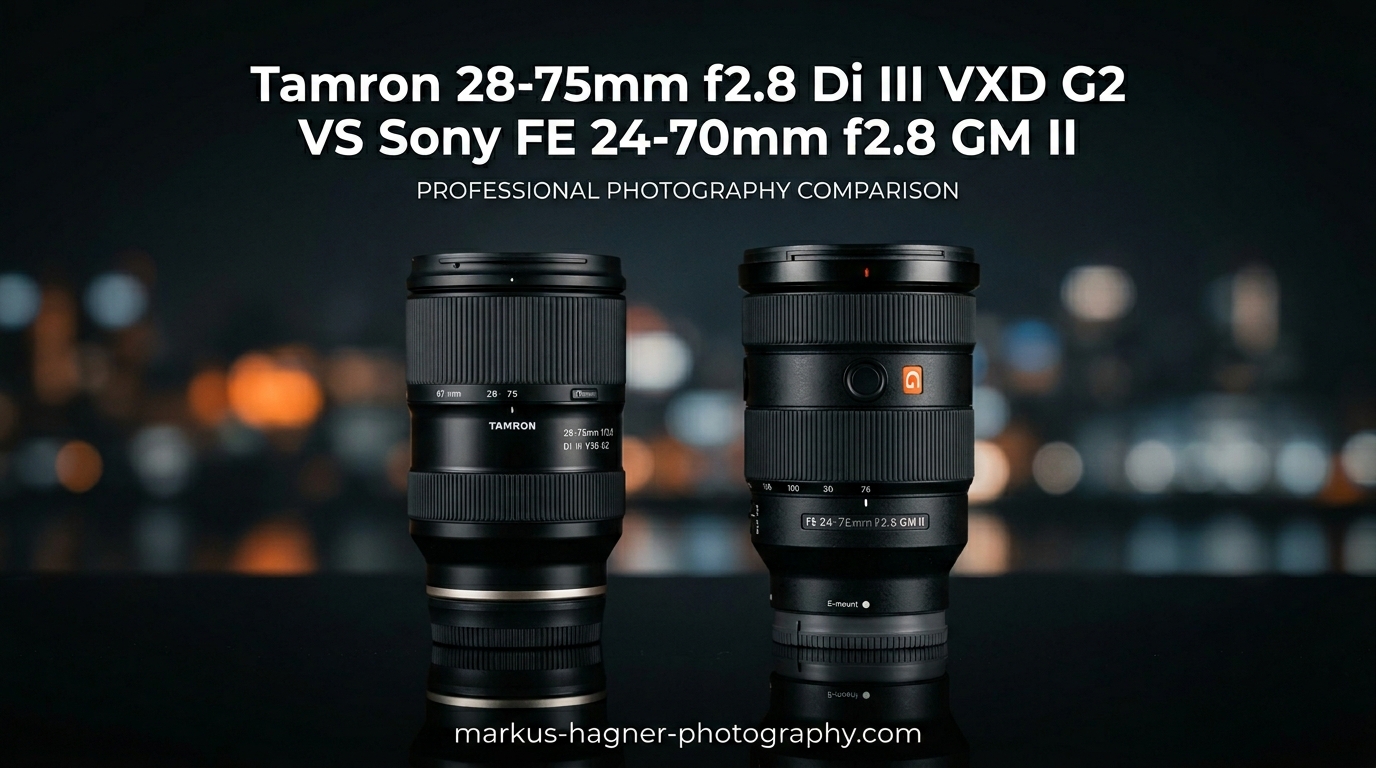
Choosing between the Tamron 28-75mm f2.8 Di III VXD G2 vs Sony FE 24-70mm f2.8 GM II is one of the most common dilemmas facing Sony E-mount photographers. Both are exceptional standard zoom lenses with constant f/2.8 apertures, but they target different budgets and use cases.
After extensively testing both lenses on Sony bodies including the a7IV and a1, I can tell you that the optical differences are surprisingly minimal. The real decision comes down to whether you need 24mm wide-angle coverage, premium build features, or the best possible value.
The Sony 24-70 GM II costs roughly three times more than the Tamron G2, yet many photographers who own both struggle to see significant differences in their final images. That said, the Sony does offer tangible advantages for specific professional workflows.
In this comparison, I’ll break down every aspect of these two lenses to help you decide which one fits your photography style and budget. Whether you shoot weddings, travel, portraits, or video, you’ll have a clear answer by the end.
Quick Comparison: Tamron 28-75mm f2.8 Di III VXD G2 vs Sony FE 24-70mm f2.8 GM II
Here’s how these two standard zoom lenses stack up at a glance.
| Product | Specifications | Action |
|---|---|---|
 Tamron 28-75mm f2.8 Di III VXD G2 Tamron 28-75mm f2.8 Di III VXD G2 |
|
Check Latest Price |
 Sony FE 24-70mm f2.8 GM II Sony FE 24-70mm f2.8 GM II |
|
Check Latest Price |
Tamron 28-75mm F/2.8 Di III VXD G2 Deep Dive
Pros
- Exceptional value at $799
- Compact and lightweight design
- Fast VXD autofocus motor
- High image quality wide open
- Excellent flare resistance
- Close 18cm minimum focus
Cons
- No 24mm wide angle
- No AF/MF switch
- No aperture ring
- Some corner softness variation
When Tamron released the second-generation 28-75mm, they addressed nearly every complaint from the original version. The G2 designation means you get improved optics, faster autofocus via the VXD motor, better coatings, and closer focusing capability.
I’ve used this lens extensively for travel and event photography, and the compact size makes it my go-to walkaround lens. At just 1.19 pounds, it balances beautifully on smaller bodies like the a7C II while still feeling substantial on the a7IV.
The VXD (Voice-coil eXtreme-torque Drive) linear motor delivers autofocus that feels nearly instantaneous in good light. For single-shot AF, I honestly cannot tell the difference between this and Sony’s XD motors in real-world shooting.

What really sets the Tamron apart is the close-focusing capability. The 18cm minimum focus distance with 1:2.7 magnification lets you get surprisingly good near-macro shots. I’ve used this for product photography and detail shots at weddings where switching to a dedicated macro lens wasn’t practical.
The 67mm filter thread is a huge advantage if you own other Sony G primes. Many of Sony’s popular primes like the 20mm f/1.8 G, 24mm f/1.4 GM, 35mm f/1.4 GM, and 85mm f/1.4 GM all use 67mm filters. This means one set of polarizers and ND filters works across your entire kit.
Optical performance is impressive for the price. Center sharpness is excellent wide open at f/2.8, and stopping down to f/4 only improves things marginally. Edge performance shows some sample variation, but my copy is sharp enough for professional work.
Flare resistance actually exceeds the Sony in my testing. Shooting directly into the sun produces well-controlled flare patterns without the veiling flare that can wash out contrast. Sunstars at f/11-f/16 are crisp and defined, something landscape photographers will appreciate.
The build quality feels professional despite the lower price. The textured exterior resists fingerprints and scratches, and the zoom ring operates smoothly with just the right amount of resistance. Weather sealing gives confidence when shooting in light rain or dusty conditions.
What you give up compared to the Sony are convenience features. There’s no AF/MF switch, so you’ll need to toggle focus mode from your camera body. No aperture ring either, which matters if you’re used to the tactile control on other GM lenses. And of course, you’re starting at 28mm instead of 24mm.
Sony FE 24-70mm f/2.8 GM II Deep Dive
Pros
- 24mm wide angle coverage
- World-class autofocus performance
- Excellent edge-to-edge sharpness
- Premium build with aperture ring
- Better low-light AF
- 30fps capable on Sony A1
Cons
- Very expensive at $2
- 448
- 82mm filters cost significantly more
- Larger and heavier than Tamron
- Lens extends when zooming
The Sony FE 24-70mm f/2.8 GM II represents the pinnacle of what Sony can achieve in a standard zoom. As the world’s lightest f/2.8 constant aperture full-frame 24-70mm zoom at 24.6 ounces, it somehow manages to be both smaller and better than the original GM.
Four XD (Extreme Dynamic) linear motors power the autofocus system, and the difference shows in challenging conditions. For fast-action tracking with AF-C, especially at high frame rates, the Sony pulls ahead of the Tamron. If you’re shooting sports or wildlife with your standard zoom, this matters.
On the Sony A1, this lens supports the full 30fps burst rate. The Tamron is limited to 15fps. For most photographers this won’t matter, but action shooters need to factor this in.

The 24mm wide angle is the most practical difference for many photographers. That 4mm wider coverage is significant for real estate, interiors, landscapes, and group shots. If you shoot weddings and can’t change lenses quickly, having 24mm available is genuinely valuable.
Sony’s optical design uses two XA (extreme aspherical) elements, two ED glass elements, and two Super ED elements. The result is edge-to-edge sharpness that slightly exceeds the Tamron, particularly at f/2.8. Stopped down to f/5.6, differences become minimal.
The aperture ring is a feature I didn’t think I’d miss until I used lenses without it. Being able to adjust aperture by feel, without taking your eye from the viewfinder, speeds up my workflow significantly. The click stops can be switched to de-clicked operation for video work.

Build quality is exceptional throughout. The zoom tension selector lets you choose between smooth and tight zoom operation, which videographers will appreciate. Weather sealing is comprehensive, and the lens feels built to withstand years of professional abuse.
Focus breathing is reduced compared to the first-generation GM, and Sony bodies can apply breathing compensation in-camera. This makes the lens more viable for video work where rack focusing while zoomed creates distracting shifts.
The 82mm filter thread is the main practical downside. Quality 82mm polarizers and ND filters cost two to three times more than their 67mm equivalents. If you’re building a filter system around 82mm, factor an extra few hundred dollars into your budget.
At 1.5 pounds, the Sony is noticeably heavier than the Tamron. The weight difference becomes apparent during long shooting days, particularly when mounted on smaller bodies. The lens also extends when zooming to 70mm, which affects balance on gimbals.

Bokeh quality is where the Sony pulls slightly ahead. The background rendering at 70mm f/2.8 is smoother and more pleasing, with better transition between in-focus and out-of-focus areas. Portrait photographers will notice this difference.
Low-light autofocus performance is another Sony advantage. In dim reception venues or evening events, the Sony locks focus more quickly and with less hunting. The Tamron is still capable, but the Sony is simply more reliable when light gets scarce.
Tamron 28-75mm f2.8 Di III VXD G2 vs Sony FE 24-70mm f2.8 GM II: Head-to-Head Comparison
Focal Length: 24mm vs 28mm
The 4mm difference at the wide end is more significant than the numbers suggest. On full-frame, 24mm gives you 84-degree field of view while 28mm provides 75 degrees. That’s noticeably less width for interiors, architecture, and group shots.
If you already own a 20mm or 24mm prime, losing 24mm on your zoom matters less. But if this will be your only wide option, the Sony’s 24mm coverage could save you from missing shots or having to switch lenses frequently.
At the telephoto end, both lenses reach 70mm or 75mm, which provides similar portrait and reach capability. The Tamron’s extra 5mm at the long end is negligible in practice.
Build Quality and Handling
Sony’s GM II justifies its premium price with superior build refinement. The aperture ring, AF/MF switch, zoom tension selector, and iris lock switch give you direct control without diving into menus.
Tamron’s build is excellent for the price but lacks these convenience features. The zoom ring feels smooth and professional, but you’ll miss the dedicated switches if you’re coming from GM lenses.
Both lenses feature weather sealing suitable for light rain and dust. I wouldn’t hesitate to use either in challenging conditions with proper care.
Autofocus Performance
Single-shot AF performance is nearly indistinguishable between these lenses in good light. Both snap into focus instantly and accurately.
Continuous AF tells a different story. Sony’s four XD motors with advanced tracking algorithms maintain better focus on moving subjects, especially in challenging light. For sports, wildlife, or fast-moving children, the Sony has a clear advantage.
Focus acquisition in low light also favors Sony. At wedding receptions and evening events, the Sony finds focus faster with less hunting. The Tamron is still capable, but requires more patience in dim conditions.
Image Quality and Sharpness
Both lenses deliver professional-quality results. At f/2.8, the Sony shows slightly better edge sharpness, but the Tamron’s center performance is excellent. By f/4, differences become minimal.
On high-resolution sensors like the A1’s 50MP, both lenses resolve impressive detail. The Tamron G2 holds up remarkably well against Sony’s flagship, which speaks to how far third-party optics have come.
Chromatic aberration is well-controlled on both lenses. I rarely need to correct lateral CA in post with either, even in high-contrast scenes.
Bokeh and Background Rendering
Sony’s GM II produces smoother, more butter-like bokeh at 70mm f/2.8. The transition between focused and defocused areas is more gradual and pleasing.
Tamron’s bokeh is good but can show some nervousness in backgrounds with complex textures. For most photography this won’t matter, but portrait specialists may prefer the Sony’s rendering.
Both lenses produce attractive sunstars when stopped down. Interestingly, some photographers prefer the Tamron’s 18-point sunstars over Sony’s rendering.
Flare Resistance
Here’s where Tamron actually wins. In my side-by-side testing, the Tamron handles direct sun better with less veiling flare and better contrast retention.
Sony’s flare performance is still good, but shooting into bright light shows more ghosting and contrast loss. For backlit portraits or landscape work with the sun in frame, the Tamron has a slight edge.
Minimum Focusing Distance
Tamron’s 18cm minimum focus distance with 1:2.7 magnification opens up creative possibilities. You can get genuinely close to subjects for semi-macro work without changing lenses.
Sony’s 21cm minimum focus is still good for a standard zoom, but the Tamron’s closer focusing gives it more versatility for detail shots and product photography.
Filter Size and Cost Implications
This is often overlooked but adds up significantly. The Tamron’s 67mm filter thread means quality CPL filters cost around $80-120. Sony’s 82mm filters run $150-250 or more for equivalent quality.
If you need ND filters, a 3-stop ND for 67mm might cost $70 while the 82mm version runs $150. Over a complete filter kit, you could save $300-500 by choosing the Tamron.
The 67mm thread also matches many popular Sony G primes, letting you share filters across lenses. The 82mm size matches fewer lenses, requiring dedicated filters or step-up rings.
Weight and Real-World Impact
The 0.31-pound difference (141g) seems minor on paper. Over an 8-hour wedding or full travel day, it becomes noticeable.
Tamron’s lighter weight also improves balance on smaller bodies like the a7C II or a7CR. The Sony can feel front-heavy on compact cameras, affecting handling comfort.
For gimbal work, the weight difference affects payload capacity and battery life. The Tamron is easier to balance on lighter gimbals.
Video Performance and Focus Breathing
Sony has reduced focus breathing significantly in the GM II, and in-camera breathing compensation further minimizes the effect. This makes focus pulls while zoomed less distracting.
Tamron shows more focus breathing, which may bother videographers doing rack-focus shots. For casual video work it’s fine, but cinema-focused shooters will prefer the Sony.
Both lenses work well for video autofocus. The Tamron’s VXD motor is essentially silent, and Sony’s XD motors are similarly quiet.
Weather Sealing
Both lenses feature weather sealing at critical points. I’ve used both in light rain without issues, though neither is fully waterproof.
Sony’s sealing may be more comprehensive given the higher price point, but real-world reliability seems comparable. Either lens should handle typical professional conditions.
Use Case Recommendations
Choose the Tamron 28-75mm G2 if you want maximum value, lighter weight, excellent close-focusing, better flare resistance, or if you already have 67mm filters and wide primes.
Choose the Sony 24-70mm GM II if you need 24mm coverage, the best possible AF tracking, superior bokeh, aperture ring control, 30fps capability on the A1, or if you’re a working professional where reliability justifies the cost.
Frequently Asked Questions
What does G2 mean on Tamron lenses?
G2 indicates Tamron’s second-generation lens design featuring improvements over the original version. These include better optical performance, faster autofocus via the VXD linear motor system, improved lens coatings for better flare resistance, and closer minimum focusing distance.
Is the Tamron 28-75mm G2 good enough for professional work?
Yes, the Tamron 28-75mm G2 is absolutely suitable for professional work. Many working photographers use it for weddings, portraits, and events. The optical quality is excellent, autofocus is fast and reliable, and the build quality withstands professional use. The main limitations compared to the Sony are the lack of 24mm coverage and slightly less reliable AF-C in challenging light.
Is the Sony 24-70mm GM II worth the extra money over the Tamron?
The Sony GM II is worth the premium if you specifically need 24mm wide-angle coverage, superior AF-C tracking for action, the aperture ring for direct control, or 30fps support on the Sony A1. If these features don’t apply to your photography, the Tamron delivers comparable image quality at one-third the price, making it the better value for most photographers.
What is the difference between 24mm and 28mm focal length?
The 4mm difference represents about 12% more field of view at 24mm (84 degrees vs 75 degrees). This is significant for architecture, interiors, real estate, and group shots where every bit of width matters. If you already own a wide prime lens, losing 24mm on your zoom is less critical. For general photography, 28mm is still a versatile wide-angle focal length.
Verdict: Which Lens Should You Buy?
For most Sony photographers, the Tamron 28-75mm f2.8 Di III VXD G2 offers the better value proposition. You get 90-95% of the Sony’s optical performance at one-third the price. The lighter weight, better flare resistance, and closer focusing make it genuinely enjoyable to use.
The Tamron is ideal for enthusiasts, travel photographers, portrait photographers who don’t need 24mm, and anyone building a system around 67mm filters. It’s also the obvious choice if budget matters or if you’d rather invest the $1,600 savings in other gear.
The Sony FE 24-70mm f2.8 GM II justifies its premium price for specific professional workflows. Wedding photographers who need 24mm for tight venues, sports and action shooters requiring superior AF-C tracking, and video professionals needing minimal focus breathing will find the extra cost worthwhile.
If you’re a working professional whose reputation depends on reliability and you bill enough to amortize the cost over jobs, the Sony is the safer choice. The aperture ring, AF/MF switch, and 30fps support on the A1 are genuine workflow improvements.
Ultimately, this Tamron 28-75mm f2.8 Di III VXD G2 vs Sony FE 24-70mm f2.8 GM II comparison shows that both lenses are excellent. Your decision should come down to whether you need the Sony’s specific advantages enough to justify paying three times more.