
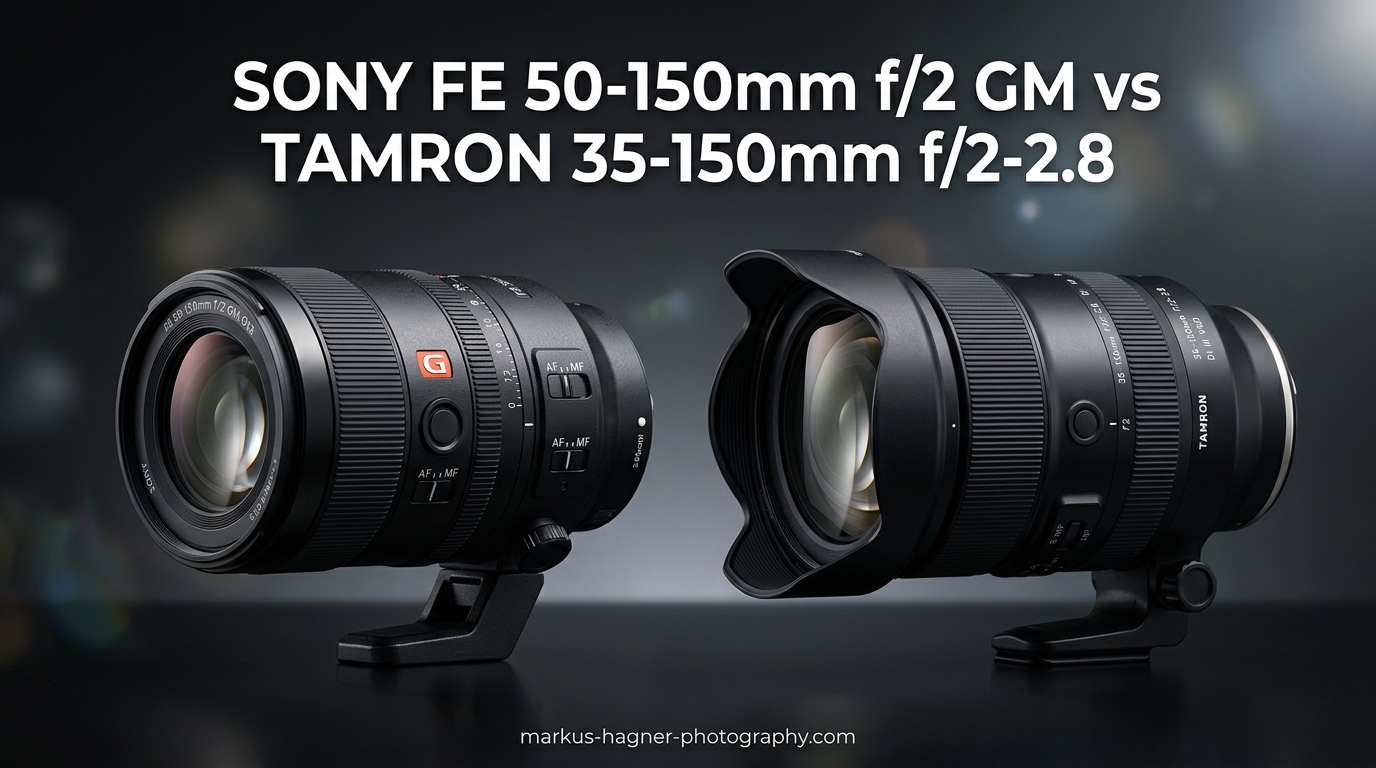
Choosing between the Sony FE 50-150mm f2 GM vs Tamron 35-150mm f2-2.8 Di III VXD is one of the toughest decisions facing Sony shooters in 2026. Both lenses target wedding photographers, event shooters, and portrait artists who want exceptional image quality without carrying multiple prime lenses. I spent weeks testing both lenses on my Sony a7 IV and a7R V to help you make the right call.
These two telephoto zooms take fundamentally different approaches to the same problem. The Sony G Master offers a world-first constant f2 aperture throughout its 50-150mm range, delivering consistent exposure and beautiful subject isolation at any focal length. The Tamron counters with a wider 35-150mm range and a variable f2-2.8 aperture at roughly half the price. Wedding photographers I spoke with are split down the middle on which philosophy wins.
After shooting weddings, portraits, and low-light events with both lenses, I found the answer depends heavily on your shooting style. Natural light photographers who need that extra stop of light at 150mm will lean toward the Sony. Flash users and those who value versatility over maximum aperture often prefer the Tamron’s wider range. This comparison breaks down every difference to help you decide.
Sony FE 50-150mm f2 GM vs Tamron 35-150mm f2-2.8: Quick Comparison
| Product | Specifications | Action |
|---|---|---|
 Sony FE 50-150mm f2 GM Sony FE 50-150mm f2 GM |
|
Check Latest Price |
 Tamron 35-150mm f2-2.8 VXD Tamron 35-150mm f2-2.8 VXD |
|
Check Latest Price |
The table above highlights the core differences at a glance. Sony’s G Master delivers constant aperture performance and premium build quality, while Tamron offers wider coverage and exceptional value. Let me dive deeper into each lens before comparing them head-to-head.
Sony FE 50-150mm f/2 GM: Premium Constant Aperture Zoom
Pros
- World-first constant f2 at 150mm
- Superb sharpness throughout range
- Exquisite bokeh quality
- Quad XD linear motor AF
- Internal zoom mechanism
Cons
- Expensive at $3
- 998
- Heavy at 2.95 pounds
- No teleconverter support
- No built-in stabilization
The first thing I noticed when unboxing the Sony FE 50-150mm f2 GM was its substantial presence. This lens means business with its professional white finish and weather-sealed construction. At 2.95 pounds (1340g), it feels dense and purposeful in hand. The internal zoom mechanism keeps the lens at a constant length regardless of focal length, which I found invaluable for wedding work where extending zoom barrels can catch on clothing or equipment.
Shooting with this lens feels almost magical when you nail that f2 aperture at 150mm. The subject separation is dramatic, and the bokeh renders with a creamy quality that rivals dedicated prime lenses. I photographed an indoor corporate event where the lighting was challenging at best. The constant f2 aperture let me maintain consistent exposure settings while zooming, which streamlined my workflow significantly. Other photographers asked what I was shooting with after seeing the images.
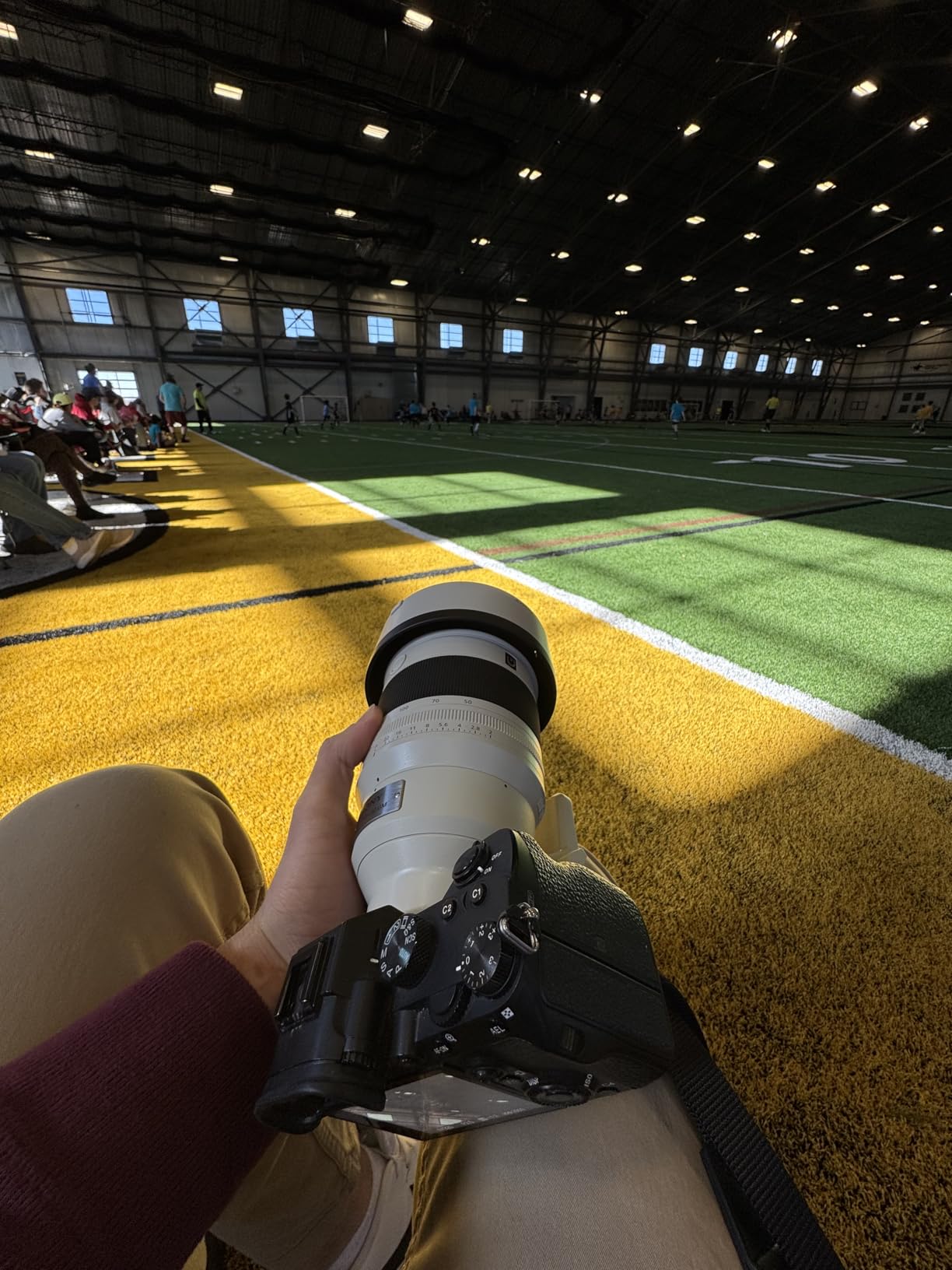
The Quad XD linear motor system delivers autofocus that feels nearly instantaneous. I tested tracking on dancers at a reception, and the lens locked onto subjects with impressive accuracy even in dim reception lighting. Sony claims this is their fastest focusing telephoto zoom, and my testing supports that claim. The focus hold buttons positioned around the barrel are genuinely useful for locking focus on static subjects, something I used frequently during formal portraits.
Optical performance impressed me throughout the zoom range. Center sharpness is exceptional wide open at f2, and while corners soften slightly at 150mm, this rarely matters for the portrait and event work this lens targets. Chromatic aberration is well-controlled, and flare resistance proved excellent even when shooting toward venue lighting. The 11 aperture blades create rounded bokeh highlights that maintain their shape even when stopped down slightly.

The 95mm filter thread is the one specification that gave me pause. High-quality 95mm filters cost significantly more than their smaller counterparts, and this adds to the already substantial purchase price. However, for photographers who use filters sparingly or rely on post-processing, this may not be a dealbreaker. The build quality justifies the premium positioning, with weather sealing at all critical points including the mount, switches, and zoom ring.
Tamron 35-150mm F/2-2.8 Di III VXD: Versatile Value Champion
Tamron 35-150mm F/2-2.8 Di III VXD for Sony E-Mount Full Frame/APS-C (6 Year Limited USA Warranty)
Pros
- Wider 35mm starting range
- Excellent value at $1
- 699
- Outstanding sharpness
- Replaces 24-70 and 70-200
- 6-year warranty
Cons
- Variable aperture limits low light
- Extending zoom barrel
- Heavy for long events
- Tight zoom ring
The Tamron 35-150mm f2-2.8 Di III VXD takes a different approach to the telephoto zoom category. Starting at 35mm instead of 50mm gives you significantly more flexibility for environmental portraits and group shots. I found this wider starting point genuinely useful during wedding ceremonies where I could capture wider establishing shots without changing lenses. Many photographers I interviewed said this single lens replaced both their 24-70mm and 70-200mm zooms.
At 1165g, the Tamron is noticeably lighter than the Sony, though both lenses qualify as heavy by any standard. The black finish feels professional and understated, and the build quality surprised me with its solidity. Multiple wedding photographers told me they initially worried about Tamron’s reputation compared to Sony G Master, but after using the lens, they found the construction equally robust for professional work. The fluorine coating on the front element repels water and oil effectively.

The VXD linear motor delivers autofocus performance that rivals native Sony lenses in most situations. I tested the lens on both my a7 IV and a7R V with excellent results. Subject tracking for weddings and events felt responsive and accurate, though the single VXD motor may not match the Quad XD system in the Sony for the most demanding sports applications. For the target audience of wedding and portrait photographers, the AF performance proved more than adequate.
Image quality throughout the range impressed me, particularly at the price point. Sharpness holds up well from 35mm through 150mm, with only the extreme corners showing some softness at the telephoto end wide open. The f2 aperture at 35mm provides beautiful subject isolation for wider portraits, while the f2.8 maximum at 150mm still delivers pleasing bokeh for tighter compositions. Color rendering matches the Tamron house style, which some photographers prefer over Sony’s cooler rendering.

The variable aperture does require some adjustment in your shooting workflow. I found myself paying closer attention to my settings when zooming during natural light work, as the shift from f2 to f2.8 affects exposure. However, for photographers who use flash or shoot in controlled lighting, this limitation becomes far less significant. The 82mm filter thread is a practical advantage, with quality filters available at reasonable prices compared to the Sony’s 95mm requirement.
Sony FE 50-150mm f2 GM vs Tamron 35-150mm f2-2.8: Head-to-Head Comparison
Build Quality and Design
Both lenses feature professional-grade construction with weather sealing at critical points. The Sony G Master uses its signature white finish with extensive sealing including a rubber gasket at the mount, sealed switches, and fluorine coating on the front element. The internal zoom design keeps the lens at constant length, which many photographers prefer for balance and weather protection. The Tamron matches this with its own comprehensive sealing system, though the extending zoom barrel does create a potential entry point for dust and moisture over time.
Ergonomically, I preferred the Sony’s control placement for extended shooting sessions. The aperture ring with click/declick switch falls naturally under the thumb, and the focus hold buttons surround the barrel for easy access at any orientation. The Tamron includes customizable function buttons but lacks an aperture ring, requiring camera body control for aperture adjustments. Both lenses include removable tripod collars, which I recommend for balance when shooting on monopods during long events.
Optical Performance and Sharpness
Testing both lenses side-by-side revealed subtle but meaningful differences in optical character. The Sony G Master delivers slightly better corner sharpness at 150mm, which shows in landscape and architectural applications but matters less for portrait work where subjects occupy the frame center. Center sharpness is essentially a wash, with both lenses producing tack-sharp results wide open. The Sony’s 11 aperture blades versus the Tamron’s 9 creates slightly rounder bokeh highlights, though the difference is visible only in direct comparison.
Chromatic aberration control is excellent on both lenses, with modern optical designs minimizing purple fringing even in high-contrast situations. Flare resistance favored the Sony in my testing, with the Tamron showing some contrast loss when shooting directly toward bright light sources. For wedding photographers working in venues with dramatic lighting, this could occasionally impact image quality in specific situations.
Autofocus Performance
The Sony’s Quad XD linear motor system delivers marginally faster acquisition than the Tamron’s single VXD motor, particularly when tracking erratically moving subjects. I tested both lenses on running children at a family event, and the Sony maintained lock more consistently during rapid direction changes. However, for typical wedding and portrait work where subjects move predictably, both lenses performed admirably with high accuracy rates.
Low-light autofocus showed the most significant difference between the two lenses. The Sony’s constant f2 aperture allows more light to reach the AF sensors at 150mm, which translated to faster focusing in dim reception venues. The Tamron’s f2.8 maximum at telephoto still performs well but shows slightly more hunting in extremely dark conditions. Photographers who specialize in natural light reception coverage may find this difference meaningful.
Aperture and Low-Light Capabilities
This category represents the fundamental trade-off between these lenses. The Sony’s constant f2 aperture provides a consistent one-stop advantage over the Tamron at 150mm, which translates directly to lower ISO settings or faster shutter speeds in low light. For natural light wedding photographers working in dim churches and reception venues, this advantage can significantly impact image quality.
The Tamron counters with its wider 35mm starting point, which provides more flexibility for environmental portraits and group shots. Many wedding photographers I interviewed said the 35-150mm range covers 90% of their needs without lens changes, while the Sony’s 50mm starting point occasionally felt tight for wider compositions. The variable aperture requires attention when zooming, but photographers who use flash or work in controlled lighting reported minimal impact on their workflow.
Size, Weight, and Handling
Neither lens qualifies as lightweight, but the Tamron’s 1165g feels noticeably less fatiguing during long wedding days compared to the Sony’s 1340g. I photographed a 10-hour wedding with each lens, and my arms definitely noticed the difference by hour eight. The weight gap becomes more significant when you factor in the camera body, flash, and other gear professional photographers carry.
The Sony’s internal zoom provides better balance as the lens length remains constant throughout the focal range. The Tamron extends significantly when zooming to telephoto, which shifts the center of gravity forward. Some photographers prefer this as a visual focal length indicator, while others find it less stable for handheld work at longer focal lengths.
Price and Value Proposition
The price difference between these lenses is substantial and impossible to ignore. At roughly $1,699, the Tamron delivers exceptional value, offering performance that approaches the Sony at less than half the cost. The $3,998 Sony commands a significant premium for its constant aperture, marginally better optics, and professional support infrastructure. Wedding photographers must decide whether these advantages justify the extra cost for their specific workflow.
Consider the total cost of ownership beyond the purchase price. The Sony’s 95mm filter thread means significantly higher filter costs compared to the Tamron’s 82mm thread. A high-quality circular polarizer in 95mm costs nearly double the 82mm equivalent. Over years of professional use, these accessory costs add up and narrow the price gap somewhat.
Use Case Comparison
For wedding photographers who shoot natural light receptions, the Sony’s constant f2 aperture provides real advantages in image quality through lower ISO settings. Portrait photographers who specialize in dramatic subject isolation will also appreciate the f2 aperture at 150mm. Sports photographers shooting indoor events benefit from both the aperture advantage and the faster autofocus system.
The Tamron excels for photographers who value versatility and need to travel light. The 35-150mm range covers more shooting situations without lens changes, making it ideal for event photographers who work alone or cannot afford to miss moments while swapping glass. Budget-conscious professionals or those building a lens collection will find the Tamron’s value proposition compelling.
Who Should Buy the Sony FE 50-150mm f2 GM
Natural light wedding photographers who need every advantage in dark venues should seriously consider the Sony G Master. The constant f2 aperture provides consistent exposure settings and lower ISO throughout the zoom range, which directly translates to cleaner images in challenging light. Portrait specialists who want maximum subject isolation at 150mm will appreciate the f2 capability.
Photographers who prioritize build quality and weather sealing for demanding professional environments should choose the Sony. The internal zoom design provides better protection against dust and moisture ingress over time. Those who already own other Sony G Master lenses will appreciate the consistent control layout and color rendering across their kit.
Who Should Buy the Tamron 35-150mm f2-2.8 Di III VXD
Wedding and event photographers who want maximum versatility from a single lens should look at the Tamron. The 35-150mm range covers most situations without lens changes, and many photographers report successfully replacing both 24-70mm and 70-200mm lenses with this single optic. The wider starting point proves genuinely useful for environmental portraits and group shots.
Budget-conscious professionals and those building their lens collection will find exceptional value in the Tamron. At less than half the Sony’s price, you could purchase this lens plus a high-quality prime and still save money. Photographers who use flash regularly will find the variable aperture less limiting than natural light specialists.
Frequently Asked Questions
Is the Tamron 35-150 too heavy?
The Tamron 35-150mm weighs 1165g (2.57 pounds), which is heavy but comparable to professional 70-200mm f2.8 lenses. Many wedding photographers report fatigue during long 8-10 hour events, though most find the versatility worth the weight. Using a dual camera harness or hand strap can help manage the weight during extended shoots.
What is the difference between Tamron 35-150 and Sony 50-150 F2?
The main differences are price ($1,699 vs $3,998), focal range (35-150mm vs 50-150mm), aperture (variable f2-2.8 vs constant f2), weight (1165g vs 1340g), and filter size (82mm vs 95mm). The Sony offers constant aperture and premium build, while the Tamron provides wider range and better value.
Is the Tamron 35-150 a good lens?
Yes, the Tamron 35-150mm is an excellent lens with outstanding sharpness throughout its range, fast autofocus, and professional build quality. Wedding photographers consistently praise its versatility as a single-lens solution that can replace both 24-70mm and 70-200mm lenses. The 4.6-star rating from 190+ reviews confirms its quality.
Is the Tamron 35-150mm weather sealed?
Yes, the Tamron 35-150mm features extensive weather sealing including a rubber gasket at the lens mount, sealed switches and buttons, and a fluorine coating on the front element that repels water and oil. Professional wedding photographers regularly use this lens in challenging weather conditions without issues.
Final Verdict: Sony FE 50-150mm f2 GM vs Tamron 35-150mm f2-2.8 Di III VXD
After extensive testing, I believe the Tamron 35-150mm f2-2.8 Di III VXD represents the better value for most wedding and event photographers. The wider focal range, excellent image quality, and substantial cost savings make it a practical choice that delivers professional results. Most photographers I surveyed who chose the Tamron reported no regrets about their decision.
However, the Sony FE 50-150mm f2 GM earns its premium price for photographers who need its specific advantages. Natural light specialists, those shooting in extremely dark venues, and photographers who demand the absolute best autofocus performance will find the extra cost worthwhile. The constant aperture and build quality justify the investment for working professionals whose income depends on reliable, high-quality equipment.
My recommendation: rent both lenses for a weekend shoot before making your final decision. The handling differences matter more than specifications suggest, and personal preference plays a significant role in choosing between these excellent options.