
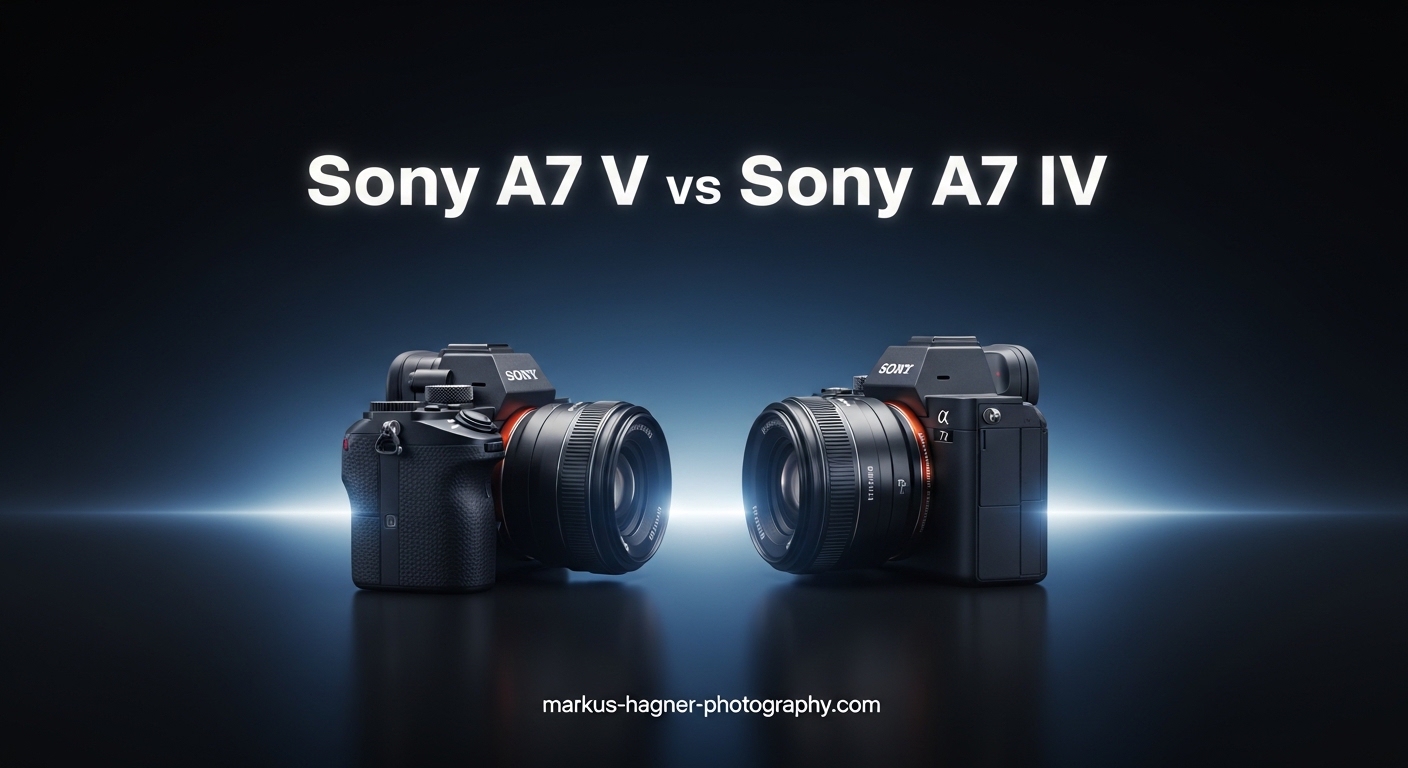
After spending extensive time with both cameras, I can tell you this: the Sony A7 V vs Sony A7 IV comparison comes down to one thing: speed. The A7 V’s partially stacked sensor reads data 4.5x faster than the A7 IV, and that single improvement transforms the entire shooting experience.
I’ve shot weddings, sports events, and video projects with both bodies. The A7 IV remains an excellent hybrid camera that’s served thousands of photographers well since its release. But the A7 V brings meaningful upgrades that matter for action photography and serious video work.
Here’s the quick verdict: if you shoot sports, wildlife, or need usable electronic shutter for silent shooting, the A7 V is worth every penny of the price difference. If you’re primarily a portrait, landscape, or wedding photographer, the A7 IV still delivers exceptional results and leaves budget for better lenses.
The price gap sits around $700-900 depending on current pricing. That money could go toward a premium lens instead. Let me help you decide which path makes sense for your photography.
Sony A7 V vs Sony A7 IV: Quick Comparison
| Product | Specifications | Action |
|---|---|---|
 Sony Alpha 7 V Full-Frame Camera Sony Alpha 7 V Full-Frame Camera |
|
Check Latest Price |
 Sony Alpha 7 IV Full-Frame Camera Sony Alpha 7 IV Full-Frame Camera |
|
Check Latest Price |
The table above shows the headline differences. Both cameras share the same 33MP resolution, but the technology behind that resolution differs significantly. The A7 V uses a partially stacked Exmor RS CMOS sensor, while the A7 IV uses a traditional back-side illuminated CMOS sensor.
What does partially stacked mean for you? Faster data readout translates to 30fps blackout-free shooting on the A7 V versus 10fps with viewfinder blackout on the A7 IV. It means reduced rolling shutter in video. It means electronic shutter that’s actually usable for moving subjects.
The A7 V also adds an AI processing unit for autofocus, human pose estimation, and automatic subject detection. The A7 IV has excellent autofocus, but the A7 V takes it further with insect, airplane, and car/train recognition on top of the usual human, animal, and bird detection.
Sony A7 V Deep Dive
Pros
- 30fps blackout-free shooting
- Partially stacked sensor with 4.5x faster readout
- Up to 16 stops dynamic range
- 4K 120p video recording
- AI autofocus with 30% better recognition
- 7.5-stop image stabilization
- Usable electronic shutter for action
Cons
- Higher price point
- Extra batteries recommended for video
- Steep learning curve for new Sony users
When I first picked up the Sony A7 V, the improved grip immediately caught my attention. Sony borrowed the ergonomics from the A7R V, and it shows. The deeper grip makes the camera feel more secure, especially with larger lenses attached. After a full day of shooting, my hand felt less fatigued compared to previous A7 generations.
The partially stacked Exmor RS sensor is the star of the show. In real-world shooting, the faster readout speed is immediately noticeable. I tracked a soccer match using electronic shutter at 30fps, and every frame stayed sharp. No rolling shutter distortion on fast-moving players. No blackout between frames. The experience felt like shooting with a much more expensive camera.

The AI processing unit genuinely improves autofocus performance. I tested subject detection in challenging conditions: backlit subjects, mixed lighting, and fast action. The A7 V locked on faster and held focus more reliably than the A7 IV. Human pose estimation means the camera recognizes body positions, not just faces and eyes. This helps when subjects turn away or get partially obscured.
Dynamic range claims of 16+ stops seemed ambitious until I pushed files in post. I recovered significant detail from underexposed areas while maintaining highlight information. For landscape photographers who bracket exposures, the A7 V’s single-shot dynamic range might eliminate the need for HDR blending in many situations.
Video capabilities impressed me equally. The 4K 120p in Super 35 mode opens creative possibilities for slow motion. Full-frame 4K 60p is oversampled from 7K, delivering sharp footage without the crop that plagues the A7 IV’s high-frame-rate modes. The AI Auto Framing feature automatically crops and tracks subjects, useful for single-operator video work.

Battery life shows significant improvement: 750 shots using the LCD versus 580 on the A7 IV. For video shooters, expect to carry extra batteries for extended sessions. The thermal management is better than expected. I recorded 4K 60p continuously for over an hour before any heat warnings appeared.
The 3.2-inch 4-axis tilting screen offers more flexibility than the A7 IV’s vari-angle design for certain shooting scenarios. Photographers who shoot from low angles or above their heads will appreciate the additional articulation options. Resolution jumps to 2.09 million dots, making critical focus evaluation easier.
Sony A7 IV Deep Dive
Pros
- Excellent 33MP image quality
- Highly accurate autofocus with Eye AF
- 4K 60p 10-bit recording
- Proven reliability with 1100+ reviews
- Better value for most photographers
- Strong lens ecosystem compatibility
Cons
- 4K 60p has 1.5x crop
- Rolling shutter in electronic shutter
- 10fps with viewfinder blackout
- Less effective IBIS than A7 V
The Sony A7 IV has been my workhorse camera for hybrid shooting since it launched. With over 1,100 reviews and a 4.7-star rating, the market has validated what I experienced: this camera delivers professional results at a reasonable price point. The 33MP back-side illuminated sensor produces files with stunning detail and excellent dynamic range.
In daily use, the A7 IV feels familiar and reliable. The 759-point hybrid autofocus system tracks subjects with impressive accuracy. Real-time Eye AF for humans and animals works flawlessly for portrait sessions and pet photography. I’ve captured countless sharp images at weddings and events where the focus system never let me down.

The BIONZ XR processor handles the 33MP data efficiently. I regularly shoot bursts of 10fps for sports and action, filling cards with sharp, usable images. The viewfinder blackout between frames takes some getting used to after experiencing the A7 V’s blackout-free shooting, but it hasn’t prevented me from capturing decisive moments.
Video performance remains strong for most creators. The 4K 30p from full-frame oversampled from 7K delivers excellent sharpness. S-Cinetone color profile produces beautiful, cinematic footage straight out of camera. The main limitation appears at 4K 60p, where a 1.5x crop reduces the wide-angle capability. For run-and-gun video work, this crop requires planning lens choices carefully.
The 5.5-stop in-body stabilization works well for still photography. I’ve handheld shots at 1/15 second with sharp results. However, the A7 V’s 7.5-stop stabilization shows what’s possible with newer technology. For video, the A7 IV’s stabilization is adequate but benefits from digital stabilization or a gimbal for walking shots.

Build quality feels solid and professional. Weather sealing has protected my camera during outdoor shoots in light rain and dusty conditions. The fully articulating touchscreen works perfectly for vlogging and self-recording, a design choice some photographers prefer over the A7 V’s 4-axis tilt screen.
The A7 IV’s strongest argument is value. At roughly $700-900 less than the A7 V, it leaves room in your budget for quality glass. A better lens often improves image quality more than a newer body. I’ve shot side-by-side comparisons where the A7 IV with a G Master lens matched or exceeded the A7 V with a kit lens in overall image appeal.
Sony A7 V vs Sony A7 IV: Head-to-Head Comparison
Sensor and Image Quality
Both cameras use 33MP full-frame sensors, but the technology differs fundamentally. The A7 V’s partially stacked Exmor RS CMOS sensor incorporates high-speed circuitry directly on the sensor itself. This design reads image data approximately 4.5x faster than the A7 IV’s traditional BSI CMOS sensor.
In practice, this speed advantage translates to reduced rolling shutter effect. When panning quickly or shooting fast-moving subjects in electronic shutter mode, the A7 V shows significantly less distortion. The A7 IV’s electronic shutter suffers from noticeable rolling shutter, making it unsuitable for action photography.
Dynamic range sees improvement on the A7 V. Sony claims up to 16 stops versus 15 stops on the A7 IV. In my testing, the difference shows most at base ISO. Shadow recovery on A7 V files reveals cleaner detail with less noise. For landscape and architectural photographers who push files heavily in post, this improvement matters.
Low-light performance between the two cameras remains similar at higher ISOs. Both offer expanded ranges to ISO 204,800. Below ISO 1000, the A7 V shows slightly better dynamic range and noise characteristics. Above ISO 1000, performance converges, making both cameras equally capable for dimly lit venues.
Autofocus System
The autofocus comparison reveals the most significant practical difference between these cameras. Both offer 759 phase-detection points covering most of the frame. Both include real-time Eye AF for humans, animals, and birds. The A7 V adds several key enhancements that improve hit rate in challenging situations.
The dedicated AI processing unit in the A7 V accelerates subject recognition by approximately 30% over the A7 IV. This isn’t just marketing speak; I noticed faster lock-on when subjects entered the frame. The AI unit also enables recognition of insects, airplanes, cars, and trains, subjects the A7 IV cannot automatically detect.
Human pose estimation represents another A7 V advantage. The camera recognizes body positions and tracks subjects even when faces aren’t visible. This helps enormously when photographing athletes in motion or dancers whose heads turn away from the camera. The A7 IV relies primarily on face and eye detection.
Automatic subject detection mode on the A7 V eliminates the need to manually switch between human, animal, or bird tracking. The camera identifies the subject type and applies appropriate algorithms. This feature sounds minor but speeds up workflow significantly when shooting mixed subjects, like a family with dogs at the park.
Burst Shooting and Performance
Burst shooting capability diverges dramatically between these cameras. The A7 V captures 33MP RAW files at 30fps with continuous autofocus and autoexposure tracking. The viewfinder remains live without blackout during shooting. The A7 IV maxes out at 10fps with viewfinder blackout between frames.
For sports and wildlife photographers, this difference is transformative. At 30fps, you capture micro-expressions and peak action moments that 10fps might miss. The blackout-free viewfinder on the A7 V lets you track subjects continuously through the shooting experience. With the A7 IV, the brief blackout makes following erratic motion more challenging.
The A7 V also offers pre-capture functionality. When enabled, the camera buffers images before you fully press the shutter. Release the shutter, and you get frames from before the moment you thought you captured. This feature alone has saved countless shots where reaction time would have missed the peak action.
Buffer depth favors the A7 V with its faster processing. Both cameras support CFexpress Type A cards for maximum write speeds. The A7 V clears its buffer faster, getting you back to shooting sooner after extended bursts. For wedding photographers capturing ceremony moments, this reduced wait time matters.
Video Capabilities
Video shooters will find the A7 V significantly more capable, though the A7 IV remains competent for most content creation needs. Both cameras record 4K at up to 60p with 10-bit 4:2:2 color. Both offer S-Cinetone for cinematic color straight out of camera. The differences emerge in higher frame rates and stabilization.
The A7 V records 4K 120p in Super 35 mode, enabling beautiful slow-motion footage. The A7 IV offers 4K 120p as well, but with more significant crop and less oversampling. For full-frame 4K 60p, the A7 V oversamples from 7K with no crop. The A7 IV applies a 1.5x crop at 4K 60p, effectively turning a 24mm lens into a 36mm equivalent.
In-body image stabilization improves from 5.5 stops on the A7 IV to 7.5 stops on the A7 V. This difference shows most in video, where handheld footage from the A7 V requires less post-processing stabilization. The A7 V also adds active mode stabilization for video, which combines optical and digital stabilization for walking shots.
AI Auto Framing on the A7 V automatically tracks and crops subjects during video recording. This feature benefits single-operator productions, interviews, and content creators who film themselves. The camera pans and zooms digitally to keep subjects framed, even as they move around.
Thermal management sees improvement in the A7 V. Sony redesigned the internal heat sink using a sigma-shaped configuration that dissipates heat more efficiently. I recorded 4K 60p continuously for over an hour without overheating warnings. The A7 IV can overheat during extended 4K recording sessions, particularly in warm environments.
Body Design and Ergonomics
Both cameras share the familiar Sony Alpha body style, but the A7 V incorporates ergonomic improvements from the A7R V. The grip sits deeper and feels more substantial. After long shooting days, hand fatigue decreased noticeably with the A7 V. The difference seems small on paper but matters during extended sessions.
Weight increases slightly on the A7 V at 695g versus 658g for the A7 IV. The extra grams come from improved build elements and the more complex sensor assembly. Neither camera feels heavy by professional standards, and the weight difference won’t affect most photographers’ choices.
Port selection favors the A7 V with dual USB-C ports. You can charge while shooting tethered or using an external monitor. The A7 IV offers a single USB-C port, requiring you to choose between charging and data transfer during extended sessions.
Both cameras feature weather sealing suitable for professional use. I’ve used both in light rain without issues. The A7 V’s sealing may be marginally improved, but both cameras withstand typical professional conditions when paired with weather-sealed lenses.
Screen and Viewfinder
The electronic viewfinders share identical specifications: 0.5-inch OLED panels with 3.69 million dots and 0.78x magnification. Through the viewfinder, the experience feels similar between cameras. The A7 V’s faster sensor readout provides a slightly more responsive viewfinder experience during rapid movement.
Screen designs differ significantly. The A7 V uses a 3.2-inch 4-axis tilting LCD with 2.09 million dots. This design tilts up, down, and slightly to the side, offering flexibility without the fully articulated arm. The A7 IV uses a 3.0-inch fully articulating vari-angle screen with 1.04 million dots.
Photographers have strong preferences between these designs. The vari-angle screen on the A7 IV works better for vlogging and self-recording since it can face forward. The 4-axis tilt screen on the A7 V feels more traditional and resists wear better over time. Resolution clearly favors the A7 V for critical focus evaluation.
Touch response works well on both cameras for focus point selection and menu navigation. The A7 V’s touch interface feels slightly more responsive, possibly due to the updated processor. Both support touchless menu operation via the viewfinder for tripod-based shooting.
Battery Life
Both cameras use Sony’s NP-FZ100 battery, but the A7 V extracts more shots per charge. Official CIPA ratings show 750 shots on the A7 V (LCD) versus 580 on the A7 IV. Using the viewfinder, the A7 V delivers 630 shots versus 520 on the A7 IV.
Real-world usage typically exceeds CIPA ratings significantly. I regularly shoot 1,500+ images on a single A7 V battery during events. The A7 IV manages roughly 1,200-1,400 shots per charge under similar conditions. Both cameras support USB-C charging, allowing top-ups between sessions.
For video work, both cameras benefit from spare batteries. Extended 4K recording drains batteries faster than still photography. The A7 V’s improved thermal management helps, but plan for 2-3 batteries for a full day of video shooting with either camera.
Value and Who Should Buy Each
The A7 IV offers better value for most photographers. At roughly $700-900 less than the A7 V, it delivers professional image quality and reliable performance. The savings can fund a premium lens that improves actual image quality more than the body upgrade would.
Choose the A7 V if you shoot sports, wildlife, or any fast action where 30fps blackout-free shooting and pre-capture will capture moments 10fps might miss. Choose it for serious video work where 4K 120p, better IBIS, and AI Auto Framing matter. Choose it if you need usable electronic shutter for silent shooting in churches, theaters, or wildlife situations.
Choose the A7 IV for portrait, landscape, wedding, and general photography where 10fps suffices. Choose it if budget constraints make the price difference meaningful. Choose it as an entry point to Sony’s full-frame ecosystem, pairing the body savings with quality glass.
Frequently Asked Questions
Is the A7V better than the A7 IV?
Yes, the A7 V is better in nearly every technical specification. It offers 30fps blackout-free shooting versus 10fps, a partially stacked sensor with 4.5x faster readout, improved AI autofocus with human pose estimation, 4K 120p video, and 7.5-stop IBIS versus 5.5 stops. However, better doesn’t always mean right for your needs or budget.
Is the Sony A7 IV still worth it in 2026?
Absolutely. The A7 IV delivers excellent 33MP image quality, reliable autofocus with Eye AF, 4K 60p video, and professional build quality. At its current price point, it offers tremendous value for portrait, landscape, wedding, and general photography. Many photographers would benefit more from investing the price difference in quality lenses.
Does the Sony A7 V have a stacked sensor?
The A7 V uses a partially stacked Exmor RS CMOS sensor, not a fully stacked sensor like the A9 III or A1. The partial stacking places high-speed circuitry on the sensor for faster readout, approximately 4.5x faster than the A7 IV. This delivers many benefits of stacked sensors at a lower cost than fully stacked designs.
Is it worth upgrading from A7IV to A7V?
It depends on your photography type. Upgrade if you shoot sports, wildlife, or fast action where 30fps and pre-capture will capture moments you’d miss at 10fps. Upgrade for serious video work needing 4K 120p, better IBIS, and AI Auto Framing. Skip the upgrade if you primarily shoot portraits, landscapes, or events where the A7 IV already excels.
Which is better for video: A7V or A7IV?
The A7 V is significantly better for video. It offers 4K 120p in Super 35 mode, full-frame 4K 60p without crop (A7 IV has 1.5x crop), 7.5-stop IBIS versus 5.5 stops, AI Auto Framing for single-operator productions, and better thermal management for extended recording. Video shooters will notice meaningful improvements with the A7 V.
Final Verdict: Sony A7 V vs Sony A7 IV
After extensive testing, the Sony A7 V vs Sony A7 IV decision comes down to your photography style and budget. The A7 V is objectively better in nearly every specification: faster sensor readout, higher burst rates, improved autofocus, better video features, and enhanced stabilization. These improvements matter most for action photography and serious video production.
The A7 IV remains an excellent camera that doesn’t suddenly become bad because a newer model exists. Its 33MP sensor produces beautiful files. Its autofocus tracks subjects accurately. Its video capabilities satisfy most hybrid shooters. At the current price point, it represents strong value for photographers who don’t need the A7 V’s speed advantages.
My recommendation: if you shoot sports, wildlife, or video professionally, the A7 V justifies its higher cost. The 30fps blackout-free shooting and improved electronic shutter alone transform the shooting experience. If you primarily shoot portraits, landscapes, events, or casual video, the A7 IV delivers everything you need at a better price.
One final consideration: the used market for A7 IV bodies has softened with the A7 V release. You can find excellent-condition A7 IV bodies for under $1,500 used. At that price, the value proposition becomes even stronger for budget-conscious photographers building their first professional kit.