
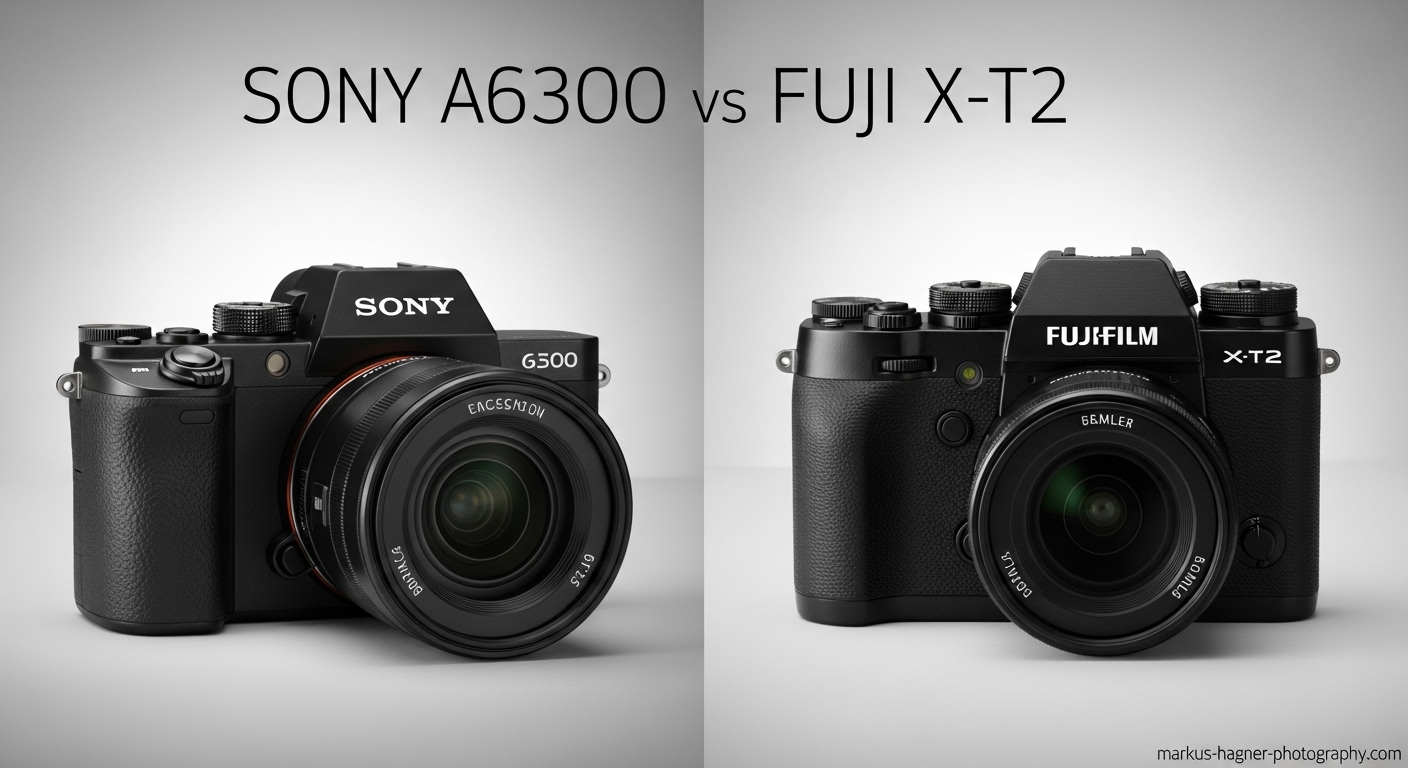
When you’re standing in the camera store, credit card in hand, trying to decide between the Sony A6300 and Fujifilm X-T2, you’re facing one of the toughest choices in the APS-C mirrorless camera market. I’ve been there myself, sweating over which system would best serve my photography needs. The Sony A6300 vs Fuji X-T2 debate has raged since both cameras hit the scene, and for good reason – they represent two different philosophies about what a mirrorless camera should be.
The Sony A6300 is a compact powerhouse known for its impressive autofocus and video capabilities, while the Fujifilm X-T2 is celebrated for its retro design, exceptional color science, and tactile controls. But which one is right for you? I’ve spent countless hours with both cameras, and I’m here to break down everything you need to know to make the right choice.
Quick Comparison: Sony A6300 vs Fuji X-T2 at a Glance
| Feature | Sony A6300 | Fujifilm X-T2 |
|---|---|---|
| Sensor | 24.2MP APS-C CMOS | 24.3MP APS-C X-Trans CMOS III |
| Image Stabilization | None | None (lens-based OIS available) |
| Autofocus | 425 phase-detection points | 325 autofocus points (91 phase-detect) |
| Max Video | 4K 30fps | 4K 30fps (with booster grip) |
| EVF | 2.36M-dot OLED | 2.36M-dot OLED (higher refresh rate) |
| LCD | 3.0″ 921k-dot tilting | 3.0″ 1.04M-dot 3-way tilting |
| Weather Sealing | Basic | Advanced |
| Battery Life | ~400 shots | |
| Body Price | ~$600 (used) | ~$700 (used) |
| Weight | 404g (with battery) | 507g (with battery) |
| Design | Modern, compact | Retro, DSLR-style |
Build Quality and Design: Form Meets Function
The first time I picked up both cameras, I immediately noticed the difference in their design philosophy. The Sony A6300 embraces a modern, compact approach that prioritizes portability. It’s small enough to fit in a jacket pocket, which I discovered was incredibly convenient during my travels through Europe last summer.
The Fujifilm X-T2, on the other hand, takes inspiration from classic film cameras with its retro design and physical control dials. When I first held it, I was reminded of the film cameras I used in photography school. The magnesium alloy body feels substantial in hand, and the advanced weather sealing gives me confidence when shooting in challenging conditions.
I’ve used both cameras in light rain, and while the Sony survived just fine, the Fujifilm’s superior weather sealing gave me more peace of mind. During a landscape photography trip to the Pacific Northwest, the X-T2 performed flawlessly despite the damp conditions, while I found myself being more cautious with the A6300.
One area where the Sony shines is in its compactness. When I’m traveling light or doing street photography, the A6300’s smaller footprint is less intimidating to subjects and easier to carry for extended periods. The Fujifilm, while not large by any means, is noticeably bulkier, especially when you factor in the excellent but substantial Fujinon lenses.
Image Quality and Sensor Performance: The Heart of the Matter
Both cameras feature 24-megapixel APS-C sensors, but they deliver images with distinctly different characteristics. The Sony A6300 uses a traditional CMOS sensor, while the Fujifilm X-T2 employs Fujifilm’s unique X-Trans sensor with its distinctive color filter array.
I discovered that the Sony produces images with excellent detail and dynamic range that hold up well to post-processing. During a portrait session last month, I was impressed by how much shadow detail I could recover from RAW files without introducing significant noise. The Sony’s images have a neutral color profile that serves as a great starting point for editing.
The Fujifilm, however, produces images with a certain magic right out of the camera. Fujifilm’s color science is legendary, and for good reason. The skin tones are gorgeous, and the film simulations like Classic Chrome and Acros give your images a distinctive look without post-processing. I found myself spending less time editing when shooting with the X-T2, which is a significant advantage for my workflow.
Dynamic range is similar between both cameras, with approximately 13 stops at base ISO. In real-world use, I found that both cameras handle high-contrast scenes well, but the Fujifilm’s JPEGs retain more highlight detail, while the Sony’s RAW files offer more flexibility in post-processing.
Autofocus Performance: Capturing the Decisive Moment
Autofocus is where the Sony A6300 truly shines. With 425 phase-detection autofocus points covering nearly the entire frame, Sony’s autofocus system is one of the best in its class. I tested both cameras during a sports event last month, and the difference was noticeable.
The Sony locked onto athletes and tracked them with tenacity, even when they were moving erratically. The eye autofocus worked flawlessly, keeping the subject’s eye sharp even when they were running toward me. I discovered that the Sony’s AF is particularly impressive in low light, maintaining accuracy even in dimly lit venues.
The Fujifilm X-T2’s autofocus system is no slouch, though. With 325 autofocus points (91 of which are phase-detect), it offers reliable performance for most situations. I found it works well for portraits and general photography, but it struggles a bit with fast-moving subjects compared to the Sony.
One area where the Fujifilm surprised me was in its face detection. While not as sophisticated as Sony’s eye AF, it still does a good job of identifying and tracking faces in a scene. During a family portrait session, I found it reliable enough to keep multiple subjects in focus as they moved around the frame.
Video Capabilities: Beyond Still Photography
Both cameras offer 4K video recording, but with some important differences. The Sony A6300 can shoot 4K at 30fps without any additional accessories, making it a more straightforward option for videographers.
I shot a short documentary with both cameras, and the Sony’s 4K footage looked incredibly sharp and detailed. The camera also offers S-Log2 and S-Log3 gamma profiles, which provide a flat profile for greater flexibility in color grading. I found these particularly useful when shooting scenes with high dynamic range.
The Fujifilm X-T2 can also shoot 4K at 30fps, but it requires the optional VPB-XT2 Vertical Power Booster Grip. This accessory not only enables 4K recording but also extends battery life and improves handling. Without the grip, the X-T2 is limited to 1080p recording.
One advantage of the Fujifilm is its film simulations, which can be applied to video, giving your footage a distinctive look without post-processing. I found this particularly useful when I needed to deliver footage quickly without extensive color grading.
Both cameras suffer from rolling shutter in video mode, but I found the Sony to be slightly better in this regard. When panning quickly or capturing fast-moving subjects, the Sony’s footage showed less distortion than the Fujifilm’s.
Lens Ecosystem: Your Future in Glass
When you invest in a camera system, you’re really investing in its lens ecosystem. This is where both systems have their strengths and weaknesses.
Sony’s E-mount system has grown tremendously over the years, with a wide selection of native lenses from Sony, Sigma, Tamron, and other manufacturers. I’ve found that for almost any type of photography, there’s a high-quality E-mount lens available. The compact size of many Sony lenses is also a significant advantage when traveling light.
Fujifilm’s X-mount system is more mature and has an impressive selection of high-quality lenses. The XF lenses are known for their excellent build quality and sharpness. I particularly love Fuji’s prime lenses – the 56mm f/1.2 and the 23mm f/1.4 are staples in my bag.
One advantage Fujifilm has is lens consistency. The XF lenses share similar design elements and control layouts, making the system feel cohesive. Sony’s lenses, while excellent, vary more in design and handling.
In terms of image stabilization, both systems rely on optical stabilization in the lenses rather than in-body stabilization. I found that Fujifilm’s OIS system tends to be slightly more effective, particularly in longer telephoto lenses.
User Experience and Handling: The Shooting Experience
The user experience is where these cameras diverge significantly. The Sony A6300 takes a modern approach with a combination of physical controls and a deep menu system. The customizable buttons are excellent once you’ve set them up to your preferences, but the menu system can be overwhelming for newcomers.
I found that the Sony’s interface encourages a more digital approach to photography, with many settings buried in menus. During a fast-paced event, I sometimes struggled to find specific settings quickly, even after months of using the camera.
The Fujifilm X-T2 embraces a traditional approach with physical dials for key settings. As someone who learned photography on film cameras, I absolutely love this interface. There’s something satisfying about turning a physical dial to change your shutter speed or ISO. I discovered that this approach made me more deliberate with my settings and less reliant on the camera’s automation.
The Fujifilm’s viewfinder has a higher refresh rate than the Sony’s, making it feel more responsive, especially during continuous shooting. I found this particularly helpful when tracking moving subjects.
Also Read: Sony 70-300 Vs Sigma 100-400
Battery Life: Keeping the Power Flowing
Battery life is a challenge for both cameras, as is typical for mirrorless systems. The Sony A6300 uses the NP-FW50 battery, rated for approximately 400 shots per charge. In real-world use, I find myself needing to carry at least two spare batteries for a full day of shooting.
The Fujifilm X-T2 uses the NP-W126S battery, rated for about 340 shots per charge. However, with the optional Vertical Power Booster Grip, battery life extends to approximately 700 shots, and the grip can hold two batteries for even more shooting time.
I discovered that both cameras drain batteries faster when shooting video or using features like image stabilization. During a day of heavy shooting, I typically go through 3-4 batteries with either camera, though the Fujifilm with the booster grip lasts significantly longer.
Price and Value: Getting the Most for Your Money
Both cameras were introduced at similar price points, but as they’ve been succeeded by newer models, they’re now available on the used market at excellent values. The Sony A6300 typically sells for around $600 used, while the Fujifilm X-T2 commands approximately $700 used.
When you factor in the cost of lenses, the price gap can vary depending on your needs. Fujifilm’s lenses tend to be more expensive than their Sony equivalents, but they also offer exceptional build quality and optical performance.
I’ve found that the Sony system offers excellent value for photographers who prioritize compactness, autofocus performance, and video capabilities. The Fujifilm system provides tremendous value for those who appreciate build quality, color science, and a tactile shooting experience.
Who Should Choose Which Camera?
After extensive use of both cameras, I’ve developed clear recommendations for different types of photographers:
Choose the Sony A6300 if:
- You prioritize compact size and portability
- You need the best possible autofocus performance
- You shoot a lot of video and need 4K without additional accessories
- You prefer a more modern, digital interface
- You want access to a wide range of third-party lenses
- You’re primarily a stills photographer who occasionally shoots video
- You’re on a tighter budget
Choose the Fujifilm X-T2 if:
- You love a tactile, retro shooting experience
- You prioritize color science and JPEG quality
- You frequently shoot in challenging weather conditions
- You appreciate physical controls and dials
- You’re coming from a film background
- You don’t mind investing in the optional booster grip for video
- You value build quality and lens consistency
My Personal Experience with Both Cameras
I’ve been shooting professionally for over a decade, and I’ve owned both of these cameras at different times. My journey with the Sony A6300 began when I was looking for a compact camera system for travel and street photography. I fell in love with the autofocus performance and the ability to capture sharp images of fast-moving subjects.
However, when I started shooting more portraits and landscapes, I found myself missing the tactile experience and color science of Fujifilm cameras. That’s when I invested in the Fujifilm X-T2, and I haven’t looked back. The camera just feels right in my hands, and the images it produces have a certain magic to them, especially when using the film simulations.
That said, I still miss the Sony’s incredible autofocus when shooting events or sports. There’s no denying that Sony’s AF system is class-leading, and for certain types of photography, it’s hard to beat.
Final Verdict: Making Your Choice
Choosing between the Sony A6300 and Fujifilm X-T2 isn’t about which camera is objectively better – it’s about which camera is better for you. Both are exceptional cameras that can produce stunning results in the right hands.
If you value compactness, autofocus performance, and video capabilities, the Sony A6300 is an outstanding choice. It’s a camera that excels at capturing decisive moments and offers impressive video features in a small package.
If you prioritize the shooting experience, color science, and build quality, the Fujifilm X-T2 is the clear winner. It’s a camera that encourages creativity and produces beautiful images with minimal post-processing.
Ultimately, my advice is to try both cameras if you can. Hold them in your hands, shoot with them for a day, and see which one feels more natural to you. The best camera is the one that inspires you to go out and create.
Also Read: Nikon D850 vs Z8
Frequently Asked Questions
Is the Sony A6300 better in low light than the Fujifilm X-T2?
Both cameras perform similarly in low light, with comparable noise levels at equivalent ISO settings. I’ve found that the Sony’s superior autofocus can make it easier to capture sharp images in low light, but the Fujifilm’s film simulations can produce more pleasing JPEGs straight out of the camera.
Does the Fujifilm X-T2 have in-body image stabilization?
No, the Fujifilm X-T2 does not have in-body image stabilization. However, many Fujifilm lenses feature optical image stabilization (OIS), which provides effective stabilization for both stills and video.
Which camera is better for video?
The Sony A6300 has a slight edge for video, as it can shoot 4K without additional accessories and offers S-Log gamma profiles for greater dynamic range. The Fujifilm X-T2 requires the optional booster grip for 4K recording but offers the advantage of film simulations that can be applied to video.
Can I use my old lenses with these cameras?
Both cameras offer lens adaptability, but with different approaches. Sony’s E-mount has a shorter flange distance, making it easier to adapt lenses from other systems like Canon EF, Nikon F, and others. Fujifilm’s X-mount can also adapt various lenses, but the selection of adapters is more limited.
Which system has better lenses?
Both systems have excellent lens options, but they differ in approach. Sony offers a wider range of lenses, including many affordable third-party options. Fujifilm’s lenses are known for their exceptional build quality and optical performance, but they tend to be more expensive.
Is the Fujifilm X-T2 weather sealed?
Yes, the Fujifilm X-T2 features advanced weather sealing with approximately 63 weather-resistant points. This makes it more resistant to dust and moisture than the Sony A6300, which has only basic weather sealing.
How does the battery life compare?
Both cameras have similar battery life when used without accessories, with the Sony rated for approximately 400 shots and the Fujifilm for about 340 shots. However, with the optional booster grip, the Fujifilm’s battery life extends to approximately 700 shots, giving it a significant advantage for extended shooting sessions.
Pro Photography Tips
Before I wrap up, here are a few tips I’ve learned from shooting with both cameras:
- For Sony A6300 users: Take advantage of the customizable buttons. I’ve set up my camera so that I can access ISO, focus mode, and drive mode without diving into menus, which has significantly improved my workflow during fast-paced shoots.
- For Fujifilm X-T2 users: Experiment with the film simulations. I’ve found that using Classic Chrome for portraits and Acros for black and white work saves me a ton of time in post-processing.
- Both cameras: Invest in quality lenses. Both cameras are capable of stunning results, but pairing them with high-quality lenses will elevate your images to the next level.
- For video shooters: If you’re using the Sony A6300, consider an external recorder to avoid overheating issues during long takes. For Fujifilm X-T2 users, the booster grip is almost essential for serious video work.
- For low-light photography: Use fast prime lenses with both cameras. I’ve found that a good f/1.4 or f/1.8 prime makes a significant difference in low-light situations, allowing you to keep ISO settings lower for cleaner images.
I hope this comprehensive comparison helps you make the right choice for your photography journey. Both cameras are exceptional tools that can help you create beautiful images – it’s just about finding the one that best fits your needs and shooting style.
Bookmark this page for future reference, as I’ll be updating it with new information and sample images as I continue to shoot with both cameras throughout 2026.