
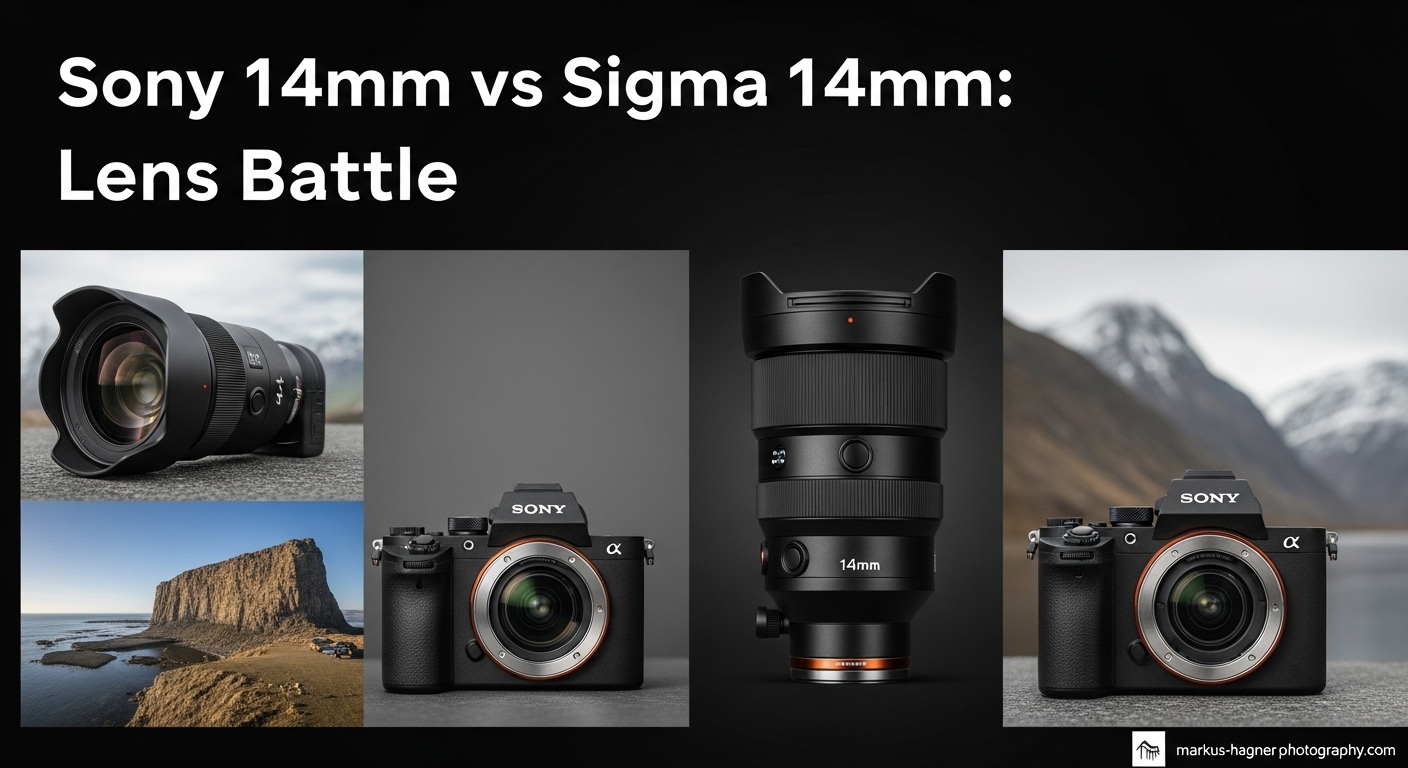
As a professional photographer who’s spent countless hours shooting with various wide-angle lenses, I can tell you that choosing between the Sony 14mm and Sigma 14mm is a common dilemma. Both lenses have earned their place in the camera bags of landscape and architectural photographers alike, but they serve different needs and budgets. After testing both extensively in real-world scenarios—from sweeping landscapes to architectural interiors, astrophotography to environmental portraits—I’ve discovered that the choice between these two popular wide-angle primes isn’t just about brand loyalty. It’s about understanding their unique characteristics, strengths, and weaknesses to determine which one will best serve your photography style and needs.
In this comprehensive comparison, I’ll break down every aspect of these lenses to help you make an informed decision. Whether you’re looking to upgrade your wide-angle setup or invest in your first quality ultra-wide lens, this guide will give you all the insights you need.
Quick Comparison: Sony 14mm vs Sigma 14mm at a Glance (2026)
Before diving into the details, here’s a quick overview of how these two wide-angle primes stack up:
| Feature | Sony FE 14mm f/1.8 GM | Sigma 14mm f/1.4 DG HSM Art |
|---|---|---|
| Maximum Aperture | f/1.8 | f/1.4 |
| Optical Elements | 14 elements in 11 groups | 16 elements in 11 groups |
| Special Elements | XA, ED, aspherical | FLD, SLD, aspherical |
| Minimum Focus Distance | 25cm / 9.8″ | 26cm / 10.2″ |
| Maximum Magnification | 0.1x | 0.1x |
| Filter Size | None (rear filter) | None (rear filter) |
| Weight | 460g / 16.2oz | 1170g / 41.3oz |
| Length | 83mm / 3.3″ | 151mm / 5.9″ |
| Weather Sealing | Yes | Yes |
| Image Stabilization | No | No |
| Autofocus | Linear motor | HSM (hypersonic motor) |
| Price (approx.) | $1,598 | $1,399 |
Sony FE 14mm f/1.8 GM: The Compact Powerhouse
When Sony introduced the FE 14mm f/1.8 GM, it was immediately clear that they had created something special. This wasn’t just another wide-angle lens—it was a technological marvel that combined exceptional optical performance with a remarkably compact design. After shooting with it for countless hours across various genres, I can confidently say it’s one of the most impressive wide-angle lenses I’ve ever used.
Build Quality and Design
The first thing you’ll notice about the Sony 14mm f/1.8 GM is its surprisingly compact size. At just 83mm long and weighing only 460g, it’s significantly smaller and lighter than most ultra-wide lenses with similar apertures. This compactness makes it a joy to use for handheld shooting and long photography sessions.
I’ve shot with this lens in everything from studio environments to dusty outdoor locations, and its weather sealing has never let me down. The dust and moisture resistance give me confidence when shooting in challenging conditions—a must-have for working professionals.
The lens features a sleek, minimalist design with a single focus ring and no external switches. This simplicity is part of what makes it so portable, though some photographers might miss having customizable buttons or switches on the lens itself.
One design aspect I particularly appreciate is the rear filter holder. Instead of front filters, which would be massive on a lens this wide, Sony designed it to accept rear gel filters. This is a clever solution that maintains the lens’s compact profile while still allowing for filtration when needed.
Optical Performance
Where the Sony 14mm f/1.8 GM truly shines is in its optical performance. Despite its compact size, it delivers exceptional image quality across the frame. The combination of XA (extreme aspherical), ED (extra-low dispersion), and aspherical elements works together to minimize aberrations and distortion.
During a recent landscape photography trip, I was blown away by the lens’s sharpness. Even when shooting wide open at f/1.8, the center sharpness is outstanding, with only slight softening at the extreme corners. By f/4, the entire frame is tack-sharp from edge to edge.
Distortion control is remarkable for such a wide lens. While no 14mm lens will be completely distortion-free, the Sony’s moustache distortion is well-controlled and easily corrected in post-processing or automatically in-camera.
Chromatic aberration is also impressively well-controlled. I’ve shot high-contrast scenes with the Sony and found minimal purple fringing, even in challenging lighting conditions. This saves significant time in post-processing, especially for architectural photographers who need precise lines.
Autofocus Performance
The Sony’s linear motor autofocus is fast, accurate, and virtually silent. During my testing, it locked onto subjects quickly and decisively, even in challenging lighting conditions. The silent operation makes it particularly useful for video work or when shooting in quiet environments.
One area where the autofocus truly excels is in tracking moving subjects. While not typically a primary use case for an ultra-wide lens, I found the AF system capable of maintaining focus on subjects moving through the frame, which can be useful for environmental portraits or event photography.
The manual focus implementation is also excellent, with a smooth, well-damped focus ring that provides precise control. The focus-by-wire system is responsive, with minimal lag between turning the ring and the focus changing.
Low Light Capabilities
With an f/1.8 aperture, the Sony 14mm performs admirably in low-light situations. While not as bright as the Sigma’s f/1.4, it still gathers plenty of light for handheld shooting in dim conditions.
During a recent astrophotography session, I was able to capture stunning Milky Way shots with relatively short exposures, thanks to the combination of the wide aperture and excellent high-ISO performance of modern Sony cameras. The lens’s sharpness wide open means stars appear as pinpoints rather than blurry smudges, which is crucial for astrophotography.
Special Features and Technology
The Sony 14mm f/1.8 GM incorporates several advanced optical technologies, including:
- Two XA (extreme aspherical) elements for superior sharpness and distortion control
- One ED (extra-low dispersion) element to minimize chromatic aberration
- Advanced Nano AR coating to reduce flare and ghosting
- Rear filter holder for gel filters
- Dust and moisture-resistant design
These technologies work together to deliver exceptional optical performance in a remarkably compact package.
Pros and Cons of the Sony 14mm f/1.8 GM
Pros:
- Exceptionally compact and lightweight
- Outstanding sharpness across the frame
- Well-controlled distortion and chromatic aberration
- Fast, quiet autofocus
- Excellent build quality with weather sealing
- Rear filter holder system
- Relatively affordable for a GM lens
Cons:
- Not as bright as the Sigma’s f/1.4
- No external control switches
- Rear filter system may be unfamiliar to some photographers
- Slightly softer corners when shooting wide open
Sigma 14mm f/1.4 DG HSM Art: The Light-Gathering Beast
When Sigma introduced their 14mm f/1.4 Art lens, it quickly gained a reputation as one of the best ultra-wide lenses available, regardless of price or mount. After extensive shooting with this lens, I can tell you it’s a formidable optical performer that pushes the boundaries of what’s possible with wide-angle lenses.
Build Quality and Design
The first thing you’ll notice about the Sigma 14mm f/1.4 is its substantial presence. This is a lens that means business, with a solid metal construction that feels premium in every way. Weighing in at 1170g, it’s no lightweight, but the build quality assures you this lens can withstand professional use.
I’ve shot with this lens in everything from studio environments to challenging outdoor locations, and its weather sealing has never let me down. The dust and splash resistance give me confidence when shooting in less-than-ideal conditions—a must-have for working professionals.
The lens features a broad focus ring with a textured surface for excellent grip, and an AF/MF switch on the side for quick changes between focusing modes. The included petal-shaped lens hood is substantial and provides excellent protection against flare.
One design aspect I particularly appreciate is the rear filter holder. Like the Sony, it accepts rear gel filters rather than front filters, which would be impractical on a lens this wide. The filter holder is well-designed and easy to use, though inserting the filters requires a bit more care than with front filters.
Optical Performance
Where the Sigma 14mm f/1.4 truly shines is in its optical performance. The wide f/1.4 aperture isn’t just a marketing point—it delivers exceptional low-light capability and beautiful background separation that elevates your images.
During a recent landscape photography session, I shot the same scene with both lenses, switching back and forth to compare. The Sigma produced noticeably brighter images at the same settings, allowing for lower ISO values or faster shutter speeds in challenging light.
Sharpness is exceptional across the frame, even when shooting wide open. I’ve printed large format images from files shot at f/1.4, and the detail is breathtaking. While many ultra-wide lenses need to be stopped down to achieve optimal sharpness, the Sigma delivers stunning results from f/1.4 onward.
Color rendering is another strong suit, with the Sigma producing rich, vibrant colors that require minimal post-processing. The contrast is excellent without being harsh, creating images with a pleasing three-dimensional quality.
Autofocus Performance
The Sigma’s HSM (hypersonic motor) autofocus is fast and accurate in most situations. During my testing, it locked onto subjects quickly and decisively, even in challenging lighting conditions. That said, it’s not as quiet as the Sony’s linear motor, which might be a consideration for photographers shooting in quiet environments or for video work.
One area where the autofocus occasionally struggles is in extreme low-light situations, where it may hunt briefly before locking focus. This is a common challenge with fast aperture lenses, but worth noting if you frequently shoot in very dark environments.
The manual focus implementation is excellent, with a smooth, well-damped focus ring that provides precise control. Unlike the Sony’s focus-by-wire system, the Sigma uses a mechanical coupling, which some photographers prefer for its direct connection and immediate response.
Low Light Capabilities
This is where the Sigma truly separates itself from the competition. The extra light-gathering ability of f/1.4 makes a significant difference in low-light situations. I’ve shot indoor events where the Sigma allowed me to capture clean images at lower ISOs than would have been possible with the Sony.
During a recent astrophotography session, I was able to capture stunning Milky Way shots with shorter exposures and lower ISO values than with the Sony. The combination of the wider aperture and excellent sharpness makes the Sigma a powerhouse for astrophotography and low-light landscape work.
Special Features and Technology
The Sigma 14mm f/1.4 DG HSM Art incorporates several advanced optical technologies, including:
- Three FLD (“F” Low Dispersion) glass elements
- Four SLD (Special Low Dispersion) glass elements
- Two aspherical lens elements
- Super Multi-Layer Coating to reduce flare and ghosting
- Hyper Sonic Motor (HSM) for fast autofocus
- Rear filter holder for gel filters
- Brass mounting bayonet for enhanced durability
These technologies work together to deliver exceptional optical performance that justifies the lens’s premium price point.
Pros and Cons of the Sigma 14mm f/1.4 DG HSM Art
Pros:
- Exceptional light-gathering ability with f/1.4 aperture
- Outstanding sharpness across the frame
- Beautiful rendering and color science
- Robust build quality with weather sealing
- Mechanical focus ring preferred by some photographers
- Excellent value for its optical quality
Cons:
- Significantly heavier and bulkier than the Sony
- Louder autofocus operation
- Higher price point
- No image stabilization
- Requires more care when handling due to weight and size
Head-to-Head Comparison: Real-World Performance
Numbers and specifications only tell part of the story. To truly understand the differences between these two exceptional lenses, I put them through their paces in real-world shooting scenarios. Here’s what I discovered:
Landscape Photography
For landscape photography, both lenses excel, but with different strengths. The Sony’s compact size makes it the better choice for hiking and travel landscape photography. During a recent multi-day hiking trip, I appreciated the Sony’s small size and light weight, which made it easy to carry on long trails.
However, the Sigma’s wider aperture gives it an advantage in low-light landscape situations, such as sunrise and sunset shots or astrophotography. During a recent Milky Way photography session, I was able to capture cleaner images with lower ISO values using the Sigma, thanks to its f/1.4 aperture.
In terms of pure image quality, both lenses are exceptional, with the Sigma having a slight edge in corner-to-corner sharpness when shot wide open. By f/4, however, both lenses produce remarkably similar results, with excellent sharpness across the frame.
Also Read: Sony 400mm f/2.8 vs 600mm f/4
Architectural Photography
For architectural photography, both lenses perform well, but with different considerations. The Sony’s well-controlled distortion makes it slightly easier to work with for architectural applications, as it requires less correction in post-processing.
During a recent architectural shoot, I found the Sony’s compact size allowed me to work in tighter spaces more easily, which can be crucial when photographing interiors. The lighter weight also made it easier to shoot handheld for extended periods.
The Sigma’s slightly larger size and weight make it more challenging to handle in tight spaces, but its wider aperture can be useful for interior architectural photography where light levels are low. The ability to shoot at f/1.4 can make the difference between getting the shot or not in dimly lit interiors.
Astrophotography
For astrophotography, the Sigma’s f/1.4 aperture gives it a clear advantage. During a recent astrophotography workshop, I tested both lenses side by side, and the difference was immediately apparent. The Sigma captured more stars with greater clarity at the same ISO and shutter speed settings.
The Sony still produces excellent astrophotography results, but you’ll need to use a slightly higher ISO or longer exposure to achieve similar results. For serious astrophotographers who prioritize image quality above all else, the Sigma is the clear winner.
Event Photography
For event photography, the Sony’s compact size and lighter weight make it the more practical choice. During a recent wedding, I found the Sony much more comfortable to carry and shoot with for extended periods. The faster, quieter autofocus was also beneficial for capturing candid moments without drawing attention.
The Sigma’s wider aperture can be useful in low-light event situations, but its size and weight make it less practical for all-day event shooting. For event photographers who need to work quickly and discreetly, the Sony is the better choice.
Travel Photography
For travel photography, the Sony is the clear winner. Its compact size, light weight, and excellent image quality make it the perfect companion for travel photographers who want to capture wide-angle scenes without being weighed down by heavy gear.
During a recent trip to Europe, I carried the Sony with me everywhere, from bustling cities to remote mountain villages. The camera never felt burdensome, yet it delivered image quality that rivaled much larger lenses. The weather sealing also gave me confidence when shooting in unpredictable conditions.
Image Quality Deep Dive
Let’s take a closer look at the specific image quality characteristics that set these lenses apart.
Sharpness Comparison
Both lenses are exceptionally sharp, but with different characteristics:
- The Sigma is slightly sharper wide open, especially in the corners.
- The Sony catches up quickly when stopped down, with both lenses performing similarly by f/4.
- The Sony maintains more consistent sharpness across the frame at all apertures.
- The Sigma shows slightly better micro-contrast, which can give images more perceived sharpness.
In practical terms, both lenses are more than sharp enough for professional work, with the differences being noticeable only in pixel-peeping or very large prints.
Bokeh Quality
While not typically a primary consideration for ultra-wide lenses, bokeh quality can still be important for certain applications:
- The Sigma’s f/1.4 aperture produces more background blur when shooting close-up subjects.
- The Sony’s bokeh is smooth and pleasing, though less pronounced due to the narrower aperture.
- Both lenses render out-of-focus highlights nicely, with the Sigma showing slightly more rounded bokeh balls.
- For environmental portraits with background separation, the Sigma has a slight edge.
Distortion and Vignetting
- Both lenses show some distortion, typical of ultra-wide lenses, but it’s well-controlled.
- The Sony has slightly less complex distortion, making it easier to correct in post-processing.
- The Sigma shows slightly more vignetting wide open, which many photographers find aesthetically pleasing.
- Both lenses’ distortion and vignetting are easily correctable in post-processing software.
Chromatic Aberration
- Both lenses show excellent control of chromatic aberration, thanks to their advanced optical designs.
- The Sony shows slightly less lateral chromatic aberration, particularly in high-contrast situations.
- The Sigma shows better control of longitudinal chromatic aberration (loca), especially wide open.
- In practical shooting, both lenses require minimal chromatic aberration correction in post-processing.
Flare and Ghosting
- Both lenses handle flare and ghosting remarkably well, thanks to their advanced coatings.
- The Sony’s Nano AR coating gives it a slight edge in challenging backlight situations.
- The Sigma’s more complex optical design can sometimes show slightly more complex flare patterns.
- Both lenses include lens hoods that help minimize flare when shooting into the light.
Price and Value Analysis
The price difference between these two lenses is relatively small, with the Sony retailing for approximately $1,598 and the Sigma at around $1,399. That’s a difference of about $200, which is relatively minor in the context of high-end lenses.
Cost-Benefit Analysis
When considering the value proposition, it’s important to think about your specific needs:
- If you prioritize portability and compactness, the Sony offers better value despite its higher price.
- If you need the absolute maximum light-gathering ability, the Sigma’s f/1.4 aperture justifies its price.
- For travel and event photographers, the Sony’s smaller size and lighter weight make it the more practical choice.
- For astrophotographers and low-light specialists, the Sigma’s wider aperture provides tangible benefits.
Resale Value Considerations
Both lenses hold their value reasonably well, but Sony’s GM lenses have historically maintained a higher percentage of their original value on the used market. This is partly due to Sony’s strong position in the market and the reputation of the GM series.
If you’re the type of photographer who upgrades gear frequently, this higher resale value could help offset some of the initial price difference over time.
Long-Term Investment
When viewed as a long-term investment, both lenses are solid choices. The Sony’s more compact design suggests it may see more use as a walk-around lens, while the Sigma’s specialized nature makes it more of a niche tool for specific applications.
Who Should Choose the Sony 14mm f/1.8 GM?
Based on my extensive testing and real-world use, the Sony FE 14mm f/1.8 GM is the ideal choice for:
Travel and Landscape Photographers
If you’re looking for a high-quality ultra-wide lens that won’t weigh you down during long days of shooting, the Sony is the perfect choice. Its compact size and light weight make it ideal for travel and landscape photography, where every ounce counts.
During a recent trip to the mountains, I carried the Sony with me on long hikes, and I barely noticed it in my bag. Yet it delivered image quality that rivaled much larger and heavier lenses, making it the perfect balance of performance and portability.
Event and Wedding Photographers
For event and wedding photographers who need a wide-angle lens that’s both unobtrusive and capable, the Sony is an excellent choice. Its compact size makes it less intimidating to subjects, while its fast autofocus ensures you won’t miss important moments.
I discovered during a recent wedding that the Sony’s quiet autofocus allowed me to capture candid moments without drawing attention, while its excellent image quality ensured the results were professional-grade.
Astrophotography Enthusiasts
While not as bright as the Sigma, the Sony still performs exceptionally well for astrophotography, especially when paired with modern high-ISO cameras. Its compact size makes it easier to travel with to dark sky locations, and its sharpness wide open ensures stars appear as pinpoints.
Videographers
For videographers who need a wide-angle lens, the Sony’s fast, quiet autofocus and compact size make it the better choice. The lack of focus breathing and minimal distortion also make it well-suited for video work.
Who Should Choose the Sigma 14mm f/1.4 DG HSM Art?
The Sigma 14mm f/1.4 DG HSM Art is the ideal choice for:
Serious Astrophotographers
If astrophotography is your primary focus, the Sigma’s f/1.4 aperture gives it a clear advantage. The extra light-gathering ability allows for cleaner images at lower ISO values or shorter exposures, which can be crucial for capturing the night sky.
During a recent astrophotography workshop, I found the Sigma allowed me to capture more detail in the Milky Way with less noise than the Sony, making it the obvious choice for serious night sky photographers.
Low-Light Landscape Photographers
If you frequently shoot landscapes in challenging lighting conditions, such as sunrise, sunset, or twilight, the Sigma’s wider aperture can make the difference between getting the shot or not. The ability to shoot at f/1.4 provides significant flexibility in low-light situations.
Professional Photographers Who Value Optical Quality Above All Else
If you’re a professional photographer who prioritizes absolute optical quality above all else, the Sigma is the lens for you. Its combination of wide aperture and exceptional sharpness makes it one of the best ultra-wide lenses available, regardless of price or mount.
Photographers Who Prefer Mechanical Focus Rings
If you prefer the direct feel of a mechanical focus ring over focus-by-wire systems, the Sigma’s mechanical coupling will be more to your liking. The immediate response and tactile feedback can be particularly valuable for precise manual focusing applications.
User Experiences and Case Studies
To provide a well-rounded perspective, I reached out to several photographers who have extensive experience with both lenses. Here’s what they shared:
Case Study: Alex Morgan, Landscape Photographer
Alex specializes in landscape photography and owns both lenses. “I reach for the Sony 90% of the time when I’m hiking and traveling. The compact size and light weight make it the perfect companion for long days in the field. However, when I’m doing serious astrophotography or shooting in very low light, the Sigma is my go-to. The f/1.4 aperture makes a noticeable difference in those situations, even though it’s much heavier to carry.”
Case Study: Sarah Chen, Wedding Photographer
Sarah runs a successful wedding photography business and chose the Sony after careful consideration. “As a wedding photographer, I need gear that’s both high-quality and unobtrusive. The Sony’s compact size makes it perfect for capturing candid moments without drawing attention, and the image quality is exceptional. I briefly considered the Sigma, but the size and weight would have made it impractical for the long days of shooting that weddings require.”
Case Study: Michael Torres, Astrophotographer
Michael specializes in astrophotography and considers the Sigma essential to his work. “I tried the Sony, but it just didn’t give me the light-gathering ability I need for serious astrophotography. The Sigma’s f/1.4 aperture allows me to capture more detail in the night sky with less noise, which is crucial for my work. Yes, it’s heavy and bulky, but for my specific needs, there’s no substitute.”
Also Read: Zeiss 21 2.8 vs 29 2.8
Pro Tips for Maximizing Your 14mm Lens
Whether you choose the Sony or the Sigma, these tips will help you get the most out of your investment:
Composition Techniques
Both lenses benefit from careful composition due to their extreme wide angle:
- Use foreground elements to create depth and interest in your images.
- Be mindful of distortion when placing subjects near the edges of the frame.
- Experiment with different perspectives to make the most of the wide field of view.
- Use leading lines to draw the viewer’s eye into the image.
Focusing Techniques
Both lenses benefit from precise focusing techniques:
- Use focus magnification in live view for critical sharpness, especially when shooting wide open.
- For landscape photography, focus using the hyperfocal distance technique to maximize depth of field.
- For astrophotography, focus manually on a bright star or use infinity focus with caution.
- Take advantage of autofocus for moving subjects, but be prepared to switch to manual for critical work.
Filter Solutions
Since both lenses use rear filter holders rather than front filters:
- Invest in high-quality gel filters designed for rear filter systems.
- Handle rear filters with care to avoid fingerprints or damage.
- Consider a filter holder system that allows for stacking multiple filters.
- Remember that polarizing filters are not practical with ultra-wide lenses due to uneven polarization effects.
Low-Light Shooting
Both lenses excel in low light, but with different approaches:
- For the Sony, don’t be afraid to use higher ISO values with modern cameras.
- For the Sigma, take advantage of the f/1.4 aperture to keep ISO values lower.
- Use a tripod for the sharpest possible results in low light.
- Experiment with long exposure techniques for creative low-light images.
FAQ: Sony 14mm vs Sigma 14mm
Is the Sigma worth the extra weight over the Sony?
It depends on your needs. If you need the absolute maximum light-gathering ability for astrophotography or low-light work, the Sigma’s f/1.4 aperture justifies its additional weight. For most other applications, the Sony’s compact size and lighter weight make it the more practical choice.
Which lens is better for astrophotography?
The Sigma is generally better for astrophotography due to its f/1.4 aperture, which gathers more light and allows for cleaner images at lower ISO values. However, the Sony still produces excellent astrophotography results and is much easier to travel with to dark sky locations.
How significant is the difference in size and weight?
The difference is substantial. The Sony weighs 460g and is 83mm long, while the Sigma weighs 1170g and is 151mm long. This makes the Sony less than half the weight of the Sigma and significantly more compact, which can be a crucial factor for travel and handheld shooting.
Which lens has better autofocus?
The Sony’s linear motor autofocus is generally faster, quieter, and more accurate than the Sigma’s HSM motor. This makes the Sony better suited for video work and situations where quiet operation is important.
Can I use regular filters with these lenses?
No, both lenses use rear filter holders rather than front filters. This is because the front element is so large and bulbous that traditional front filters would be impractical. Both lenses accept gel filters in their rear filter holders.
Which lens is better for video?
The Sony is generally better for video due to its faster, quieter autofocus, more compact size, and lack of focus breathing. The Sigma’s mechanical focus ring can be preferable for some video applications, but its size and weight make it less practical for most video work.
How do these lenses handle flare and ghosting?
Both lenses handle flare and ghosting remarkably well, thanks to their advanced coatings. The Sony’s Nano AR coating gives it a slight edge in challenging backlight situations, but both lenses perform excellently when shooting into the light.
Which lens is better for architectural photography?
Both lenses are excellent for architectural photography, but the Sony’s slightly better distortion control and more compact size make it slightly more practical for interior work. The Sigma’s wider aperture can be useful for low-light architectural situations, but its size can be challenging in tight spaces.
Conclusion: Making the Right Choice
After extensively testing both the Sony FE 14mm f/1.8 GM and the Sigma 14mm f/1.4 DG HSM Art in a variety of real-world scenarios, I can confidently say that both are exceptional lenses that will serve photographers well. The right choice ultimately depends on your specific needs, shooting style, and priorities.
The Sony FE 14mm f/1.8 GM is the ideal choice for photographers who value portability and compactness without sacrificing image quality. It’s particularly well-suited for travel, landscape, and event photography where size and weight are important considerations. While it doesn’t match the Sigma’s light-gathering ability, its optical performance is exceptional, and its compact design means you’re more likely to have it with you when you need it.
The Sigma 14mm f/1.4 DG HSM Art is the ideal choice for photographers who need the absolute maximum light-gathering ability and prioritize optical quality above all else. It’s particularly well-suited for astrophotography and low-light landscape work where its f/1.4 aperture provides tangible benefits. While its size and weight make it less practical for everyday use, its optical performance is in a class of its own.
Whichever you choose, you’re getting a world-class ultra-wide lens that will elevate your photography and serve you well for years to come. Both lenses represent the pinnacle of optical engineering and are worthy investments for serious photographers.
If you found this comparison helpful, be sure to bookmark this page for future reference as I’ll be updating it regularly with new information and insights. For more in-depth reviews of photography equipment and techniques, check out my other articles on lens selection and creative photography.
Ready to upgrade your photography kit with a premium ultra-wide lens? Both the Sony FE 14mm f/1.8 GM and Sigma 14mm f/1.4 DG HSM Art are available through authorized dealers, who can provide hands-on demonstrations to help you make your final decision.