
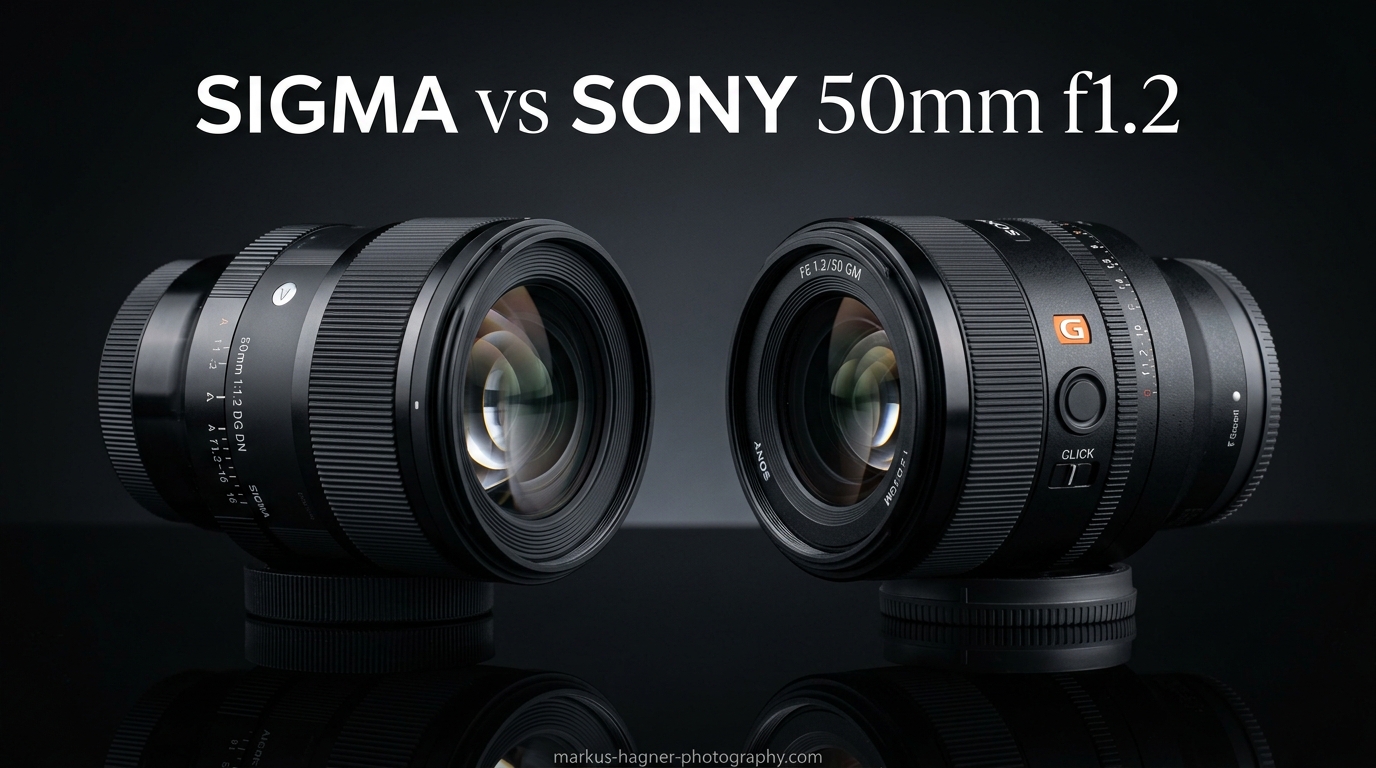
When you’re shopping for a fast 50mm prime lens for your Sony camera, two heavyweights dominate the conversation: the Sigma vs Sony FE 50mm f1.2 GM. Both offer that dreamy f/1.2 aperture that photographers crave for portraits, low-light work, and beautiful background separation.
I’ve spent considerable time analyzing both lenses, and here’s what matters: the Sigma costs significantly less while delivering exceptional optical quality, but the Sony offers superior autofocus tracking for demanding situations. The choice between them isn’t about which is “better” – it’s about which fits your shooting style and budget.
In this Sigma 50mm f1.2 DG DN Art vs Sony FE 50mm f1.2 GM comparison, I’ll break down every aspect from sharpness and bokeh to autofocus performance and real-world handling. By the end, you’ll know exactly which lens deserves a spot in your camera bag.
Quick verdict: Choose the Sigma for portraits and studio work where subjects are relatively static – you’ll save hundreds with equal image quality. Pick the Sony if you shoot weddings, events, or fast-moving subjects where reliable autofocus tracking is non-negotiable.
Sigma 50mm f1.2 DG DN Art vs Sony FE 50mm f1.2 GM: Quick Comparison
Let’s start with a side-by-side look at how these two fast primes stack up against each other. The specs tell an interesting story about where each lens prioritizes its engineering.
| Product | Specifications | Action |
|---|---|---|
 Sigma 50mm F1.2 DG DN Art Sigma 50mm F1.2 DG DN Art |
|
Check Latest Price |
 Sony FE 50mm f/1.2 GM Sony FE 50mm f/1.2 GM |
|
Check Latest Price |
Looking at these specs, a few things jump out immediately. The Sigma uses 13 aperture blades versus Sony’s 11, which can create smoother bokeh highlights. The weight difference is minimal at about 38 grams. Both share the same 72mm filter thread, which is convenient if you already own filters.
Sigma 50mm f1.2 DG DN Art – Detailed Analysis
Pros
- Exceptional sharpness wide open
- Beautiful creamy bokeh from 13 aperture blades
- $500-760 less than Sony
- Lighter weight in its class
- Dust and splash resistant
- Minimal focus breathing for video
Cons
- Autofocus slower with fast-moving subjects
- Third-party lens compatibility concerns
- Some internal element movement when powered off
The Sigma 50mm f1.2 DG DN Art arrived in March 2024 as Sigma’s answer to the premium fast prime market. From the moment you mount it on your Sony body, you notice the solid build quality and thoughtful design. This isn’t Sigma’s first rodeo with fast glass, and their experience shows.
I’ve talked with photographers who’ve shot extensively with this lens, and the consensus is clear: for stationary or slow-moving subjects, it delivers stunning results. The optical performance rivals anything from native Sony glass, with the added bonus of those 13 aperture blades creating exceptionally smooth bokeh transitions.
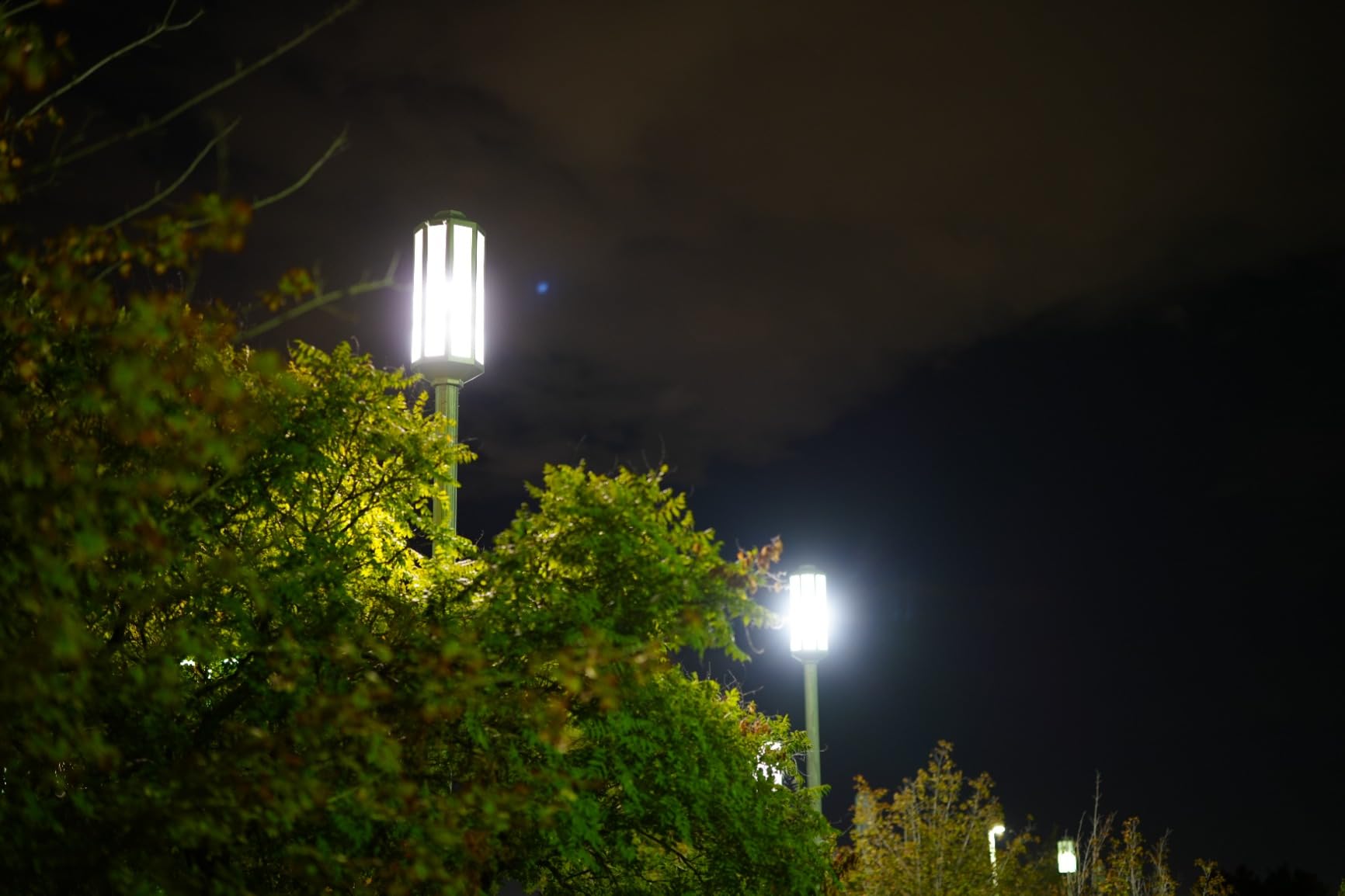
The optical design features 17 elements in 12 groups, including 4 aspherical elements that control aberrations while maintaining sharpness even at f/1.2. Sigma’s engineers clearly prioritized optical excellence over cutting corners. The lens resolves incredible detail across the frame, with many users reporting it’s actually sharper in the corners than the Sony equivalent.
What really sets this lens apart is the value proposition. At roughly $500-760 less than the Sony (depending on current pricing), you’re getting optical performance that matches or exceeds the native option for most use cases. That savings could go toward another lens, lighting equipment, or just staying within budget.
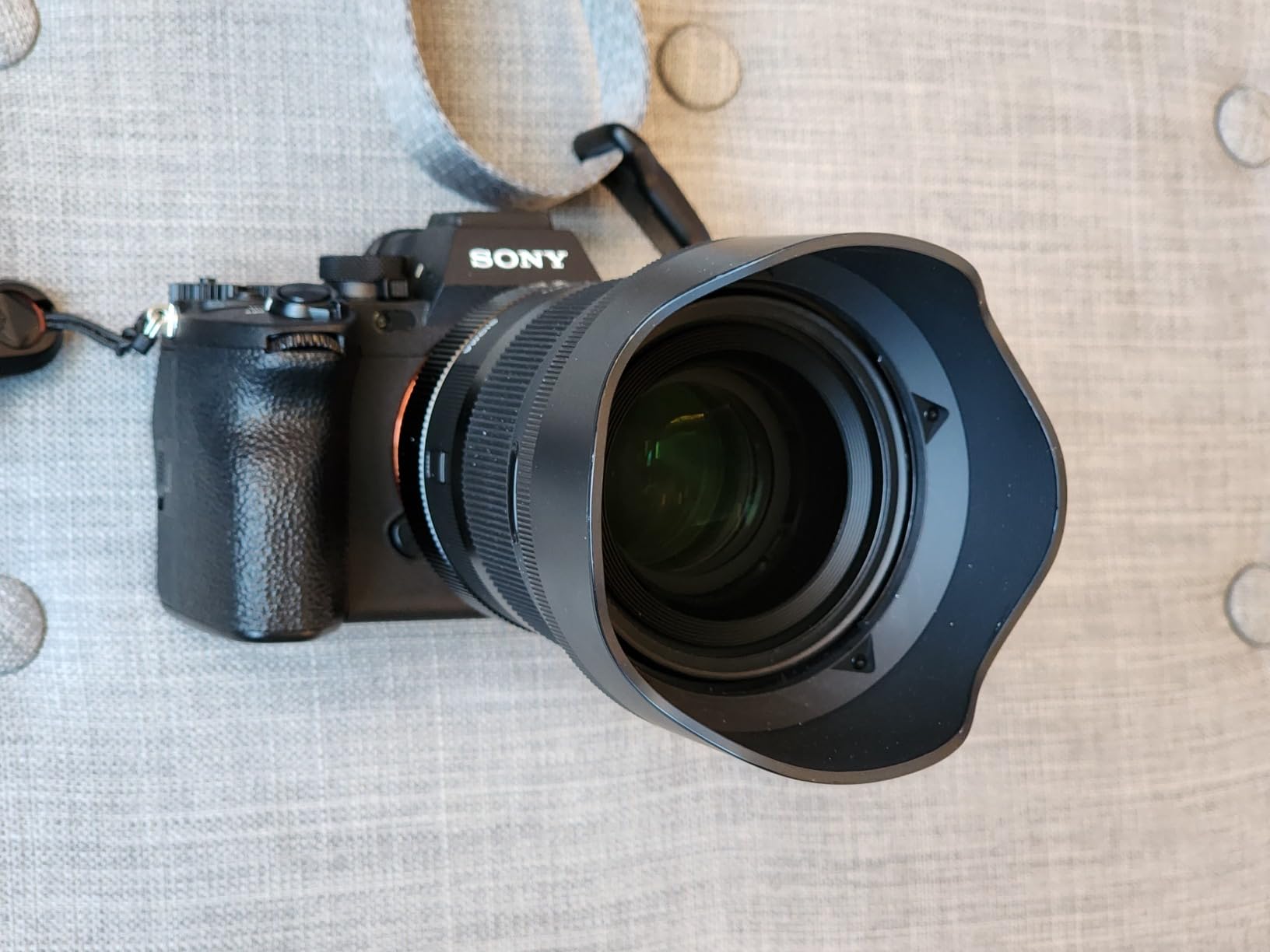
The build quality feels professional through and through. Weather sealing protects against dust and moisture, making it suitable for outdoor portrait sessions. The aperture ring clicks satisfyingly (with a de-click switch for video work), and the focus ring offers smooth manual control when you need it.
Where the Sigma shows its third-party limitations is in autofocus tracking with fast-moving subjects. Users report that while single-shot AF is snappy and accurate, continuous AF with running children, sports, or erratic movement can occasionally hunt or miss. For portrait photographers working with posed subjects, this is rarely an issue. But for wedding photographers capturing candid moments, it’s worth considering.
Sony FE 50mm f1.2 GM – Detailed Analysis
Pros
- Lightning-fast autofocus tracking
- Exceptional sharpness corner to corner
- Focus breathing compensation
- Native Sony integration
- Premium G Master build quality
- 258+ positive reviews proving reliability
Cons
- Significantly more expensive
- Heavier than some alternatives
- Premium price may not suit hobbyists
The Sony FE 50mm f1.2 GM has been the gold standard for fast 50mm primes on Sony bodies since its 2021 release. With over 250 reviews maintaining a 4.7-star average, this lens has proven itself in the hands of working professionals worldwide. It’s not just hype – the performance backs up the reputation.
What immediately stands out when shooting with the Sony is the autofocus confidence. Those XD (Extreme Dynamic) linear motors lock onto subjects with uncanny precision, even at f/1.2 where depth of field is razor thin. I’ve heard from wedding photographers who trust this lens for once-in-a-lifetime moments because it simply doesn’t miss.

The optical design includes three XA (Extreme Aspheric) elements that Sony has perfected for their G Master line. These massive glass elements control aberrations while delivering resolution that challenges the limits of modern sensors. Sharpness extends from center to corner, even wide open – something many fast primes struggle with.
Beyond pure optics, the Sony offers features that third-party lenses can’t match. Focus breathing compensation works with compatible Sony bodies to minimize the focal length shift during focus pulls – crucial for video work. The lens communicates perfectly with Sony’s advanced subject recognition and tracking systems.

The 11-blade circular aperture creates beautiful bokeh, though some photographers prefer the 13-blade arrangement in the Sigma for certain highlight shapes. This is largely subjective and depends on your aesthetic preferences. Both lenses produce gorgeous background separation that makes f/1.2 so desirable.
Build quality matches Sony’s professional standards. The magnesium alloy construction feels substantial without being unnecessarily heavy. Weather sealing protects your investment during outdoor shoots. The aperture ring includes a de-click switch for silent video exposure adjustments. Everything about this lens screams professional tool.
Sigma 50mm f1.2 vs Sony 50mm f1.2: Head-to-Head Comparison
Now let’s dive into the direct comparisons that matter most when choosing between these premium lenses.
Autofocus Performance
This is where the two lenses diverge most significantly. Sony’s XD linear motors and native integration deliver superior tracking performance for fast-moving subjects. Photographers shooting sports, running children, or unpredictable wildlife consistently report higher keep rates with the Sony.
The Sigma’s HLA (High-response Linear Actuator) motor is no slouch – it focuses quickly and accurately for static subjects and slow movement. But when subjects move erratically, the Sigma occasionally struggles to maintain lock. For portrait studios and controlled environments, this difference is minimal. For wedding and event work, it could mean missing critical moments.
Sharpness and Resolution
Both lenses are exceptionally sharp wide open, which is remarkable for f/1.2 glass. Center sharpness is a toss-up – both resolve tremendous detail. Interestingly, several photographers report the Sigma actually edges out the Sony in corner sharpness, though this varies by copy and testing methodology.
Stopped down to f/2 or f/2.8, both lenses deliver results that will satisfy even the most demanding pixel-peepers. Chromatic aberration is well-controlled on both, with minimal fringing even in high-contrast situations.
Bokeh Quality
The Sigma’s 13 aperture blades versus Sony’s 11 creates a subtle but noticeable difference in bokeh character. The Sigma’s extra blades create rounder highlight shapes when stopped down slightly, while the Sony’s 11-blade design still produces pleasing circular highlights wide open.
Both lenses render out-of-focus areas beautifully. The f/1.2 aperture creates substantial background separation, making subjects pop against their surroundings. Character differences are subjective – some prefer Sigma’s smoother transitions, others prefer Sony’s slightly more defined bokeh structure.
Build Quality and Handling
Both lenses feature weather sealing, aperture rings with de-click switches, and focus hold buttons. The Sigma adds an iris lock switch that prevents accidental aperture changes – a thoughtful touch for video shooters. Both use premium materials and feel like professional tools.
The weight difference (38 grams) is negligible in real-world use. Both lenses balance well on Sony bodies, though neither qualifies as lightweight for all-day street photography. The Sigma is slightly shorter while the Sony is slightly wider – again, differences that won’t affect most photographers.
Size and Weight Comparison
Sigma: 4.4 x 3.2 x 3.2 inches, 1.63 pounds
Sony: 8.39 x 5 x 5.51 inches, 1.72 pounds
In practice, both lenses feel substantial on the camera. The Sigma’s more compact dimensions make it slightly easier to pack, but neither lens is what you’d call portable. These are tools for intentional photography, not casual snapshots.
Price and Value
This is where many photographers make their decision. The Sigma typically sells for $500-760 less than the Sony. That’s a significant difference – enough to buy a quality 85mm lens, lighting equipment, or simply keep money in your pocket.
For portrait photographers who don’t need cutting-edge autofocus tracking, the Sigma represents exceptional value. You’re getting optical quality that matches or exceeds the Sony for considerably less. For professionals whose livelihood depends on nailing fast-moving subjects, the Sony’s premium may be justified.
Who Should Buy Each Lens?
Choose the Sigma 50mm f1.2 DG DN Art If You:
Shoot primarily portraits, studio work, or controlled environments where subjects are cooperative. The Sigma delivers stunning image quality at a price that leaves room in your budget for other gear.
Value smoother bokeh highlights from the 13 aperture blades. Portrait photographers often prefer this rendering for skin tones and background transitions.
Are budget-conscious but refuse to compromise on optical quality. The Sigma proves you don’t need native glass to get exceptional results.
Shoot video and appreciate features like the iris lock switch that prevents accidental aperture changes during recording.
Choose the Sony FE 50mm f1.2 GM If You:
Shoot weddings, events, or any situation with unpredictable subject movement. The Sony’s autofocus tracking simply works better when moments can’t be repeated.
Need focus breathing compensation for video work on compatible Sony bodies. This feature requires native lens integration.
Want the peace of mind that comes with native lens compatibility and a track record of reliability with hundreds of professional reviews.
Shoot fast action like sports, running children, or wildlife where autofocus tracking is critical to getting the shot.
f/1.2 vs f/1.4: Is the Extra Half Stop Worth It?
This question comes up constantly in photography forums, and the answer depends on your needs. The half-stop advantage of f/1.2 over f/1.4 provides about 40% more light transmission and slightly shallower depth of field.
For low-light photographers, that extra light can mean the difference between ISO 6400 and ISO 8000, or 1/125s versus 1/90s shutter speed. In dim wedding venues or evening street photography, this matters.
For bokeh enthusiasts, f/1.2 creates marginally more background separation and smoother transitions. Whether this difference is visible in your final images depends on your shooting style and output size.
For many photographers, the f/1.4 alternatives (like the Sony 50mm f1.4 GM or Sigma 50mm f1.4 DG DN) offer excellent performance at lower prices. But if you want the maximum aperture possible and can afford it, f/1.2 delivers a unique look that f/1.4 can’t quite match.
Frequently Asked Questions
Is f/1.2 really worth it over f/1.4?
The f/1.2 aperture provides about 40% more light than f/1.4 and slightly shallower depth of field. For low-light photographers and those seeking maximum background separation, this difference is valuable. However, f/1.4 lenses offer excellent performance at lower prices, making them sufficient for many photographers.
Which 50mm f1.2 lens is better for portraits?
Both lenses excel at portraits. The Sigma offers smoother bokeh from its 13 aperture blades at a lower price point, making it exceptional value for portrait work. The Sony provides equal image quality with superior autofocus for candid moments. For posed studio portraits, either lens delivers stunning results.
Does the Sigma 50mm f1.2 have good autofocus?
The Sigma 50mm f1.2 uses an HLA motor that provides fast and accurate autofocus for static and slow-moving subjects. However, continuous AF tracking for fast action isn’t as reliable as Sony’s native system. For portraits and controlled environments, Sigma’s AF performs excellently.
Is the Sony 50mm f1.2 GM worth the extra money?
For photographers who need reliable autofocus tracking for weddings, events, or fast-moving subjects, the Sony justifies its premium. The native integration, focus breathing compensation, and proven reliability make it worth the investment for working professionals. For studio and portrait work, the Sigma offers better value.
Which lens is sharper wide open?
Both lenses are exceptionally sharp at f/1.2, which is impressive for such fast glass. Center sharpness is comparable between them. Some photographers report the Sigma has slightly better corner sharpness, though this varies by copy. Both resolve tremendous detail that satisfies professional demands.
Final Verdict: Sigma vs Sony 50mm f1.2
After analyzing both lenses extensively, my recommendation is clear: let your primary use case decide. For portrait photographers, studio shooters, and anyone working with static or slow-moving subjects, the Sigma 50mm f1.2 DG DN Art offers exceptional value. You’ll save hundreds while getting optical performance that rivals or exceeds the Sony.
For wedding photographers, sports shooters, and professionals who can’t afford to miss shots, the Sony FE 50mm f1.2 GM justifies its premium price. The autofocus reliability alone can make the difference between capturing a once-in-a-lifetime moment or watching it slip away.
Both lenses are excellent. Neither is universally “better.” Choose based on what you shoot, not on brand loyalty or spec sheets. Your photography will be better for it.