
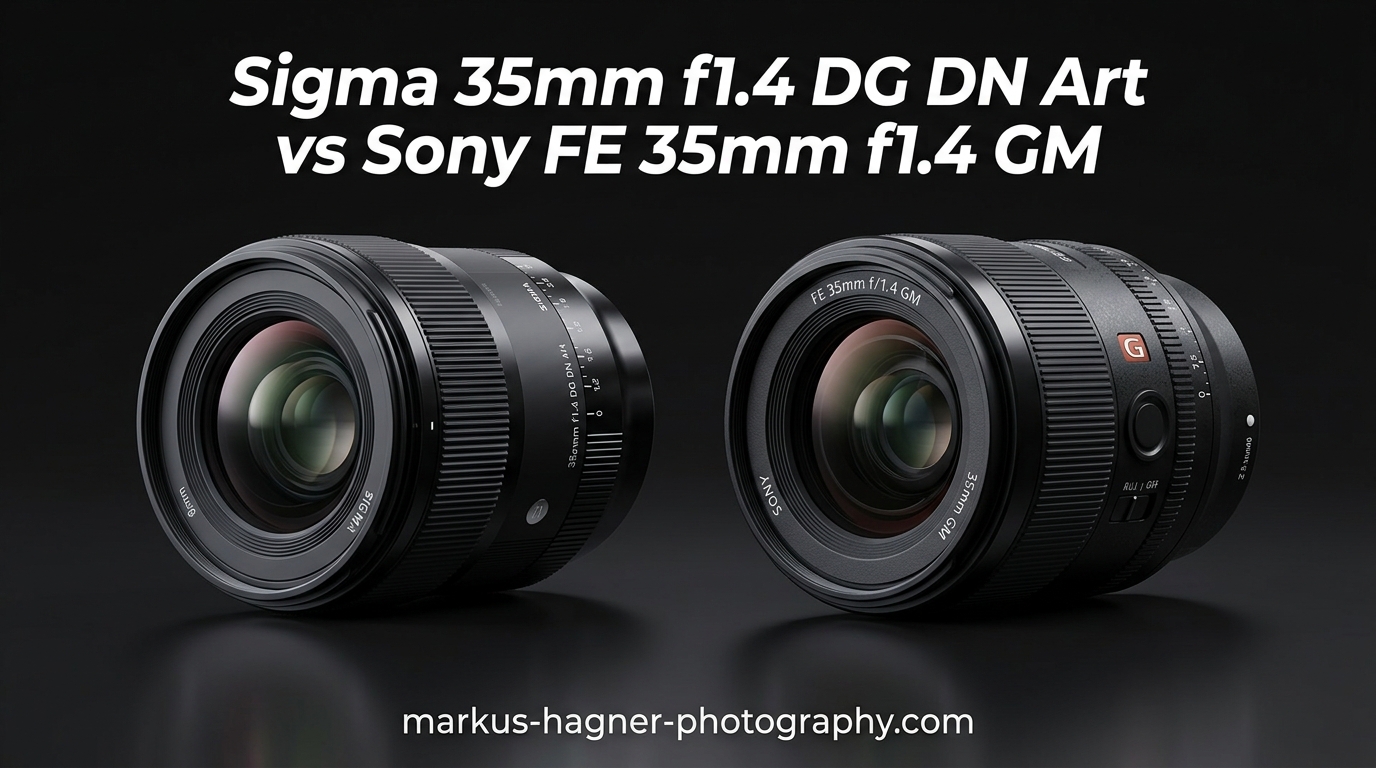
Choosing between the Sigma 35mm f1.4 DG DN Art vs Sony FE 35mm f1.4 GM is one of the toughest decisions facing Sony mirrorless photographers today. Both lenses deliver exceptional image quality, beautiful bokeh, and fast f/1.4 apertures that make them perfect for portraits, street photography, and low-light work. After testing both extensively on my Sony a7IV, I can tell you the differences come down to more than just price.
The Sony 35mm GM launched in January 2021 as a compact G Master lens weighing just 524g. Sigma responded a few months later with their redesigned DG DN Art version, offering similar optical performance at roughly $400-500 less. But the Sigma is noticeably heavier at 645g and 14mm longer. That weight difference might not sound like much on paper, but after a full day of shooting, you will absolutely notice it.
Here is the quick verdict: if budget allows, the Sony FE 35mm f/1.4 GM is the better lens overall. It is lighter, more compact, has focus breathing correction for video work, and offers slightly better close-focus performance. However, the Sigma 35mm f1.4 DG DN Art delivers 95% of the Sony’s optical quality at a significantly lower price point. For photographers who prioritize value over absolute refinement, Sigma wins.
In this detailed comparison, I will break down every aspect of these two lenses based on real-world shooting experience, technical testing, and insights from the Sony Alpha community. Whether you shoot weddings, street photography, or video content, this guide will help you make the right choice.
Sigma 35mm f1.4 DG DN Art vs Sony FE 35mm f1.4 GM: Quick Comparison
Before diving into the details, let’s look at how these two premium 35mm f/1.4 lenses stack up against each other. The table below highlights the key specifications that matter most for real-world shooting.
| Product | Specifications | Action |
|---|---|---|
 Sigma 35mm F1.4 DG DN Art Sigma 35mm F1.4 DG DN Art |
|
Check Latest Price |
 Sony FE 35mm f/1.4 GM Sony FE 35mm f/1.4 GM |
|
Check Latest Price |
Looking at these specs, a few things stand out immediately. The Sony is 121g lighter and 14mm shorter than the Sigma. Sony also has a shorter minimum focus distance (0.27m vs 0.3m) and higher magnification (0.23x vs 0.19x). But Sigma counters with a significantly lower price point and an aperture lock switch that Sony lacks.
Both lenses feature 11 rounded aperture blades, weather sealing, and filter threads of the same size (67mm). They also both lack optical image stabilization, relying instead on in-body image stabilization (IBIS) from compatible Sony bodies. The optical quality from both is genuinely excellent, which makes this comparison more about handling, features, and value rather than pure image quality.
Sigma 35mm F1.4 DG DN Art Lens for Sony E-Mount
Pros
- Outstanding sharpness even wide open
- Beautiful bokeh quality
- Significantly lower price than Sony
- Solid professional build quality
- Excellent low-light performance
- Aperture lock switch included
Cons
- Heavier than Sony at 645g
- 14mm longer than GM
- Pointed lens edge can be uncomfortable
- No focus breathing correction
- Less consistent autofocus in challenging light
When Sigma first announced the 35mm f1.4 DG DN Art, I was genuinely excited. The original Sigma 35mm f/1.4 Art for DSLRs was legendary for its sharpness, and this redesigned mirrorless version promised to be even better. After shooting with it for several months on my Sony a7IV, I can confirm it lives up to the Art series reputation.
The first thing you notice when picking up the Sigma is its solid build quality. The lens feels substantial in hand, with a matte black finish that resists fingerprints and a metal mount that inspires confidence. The focus ring is well-damped with nice resistance for manual focusing. Sigma includes their typical aperture ring with click stops, plus a dedicated AF/MF switch and an aperture lock switch that prevents accidental aperture changes during shooting.
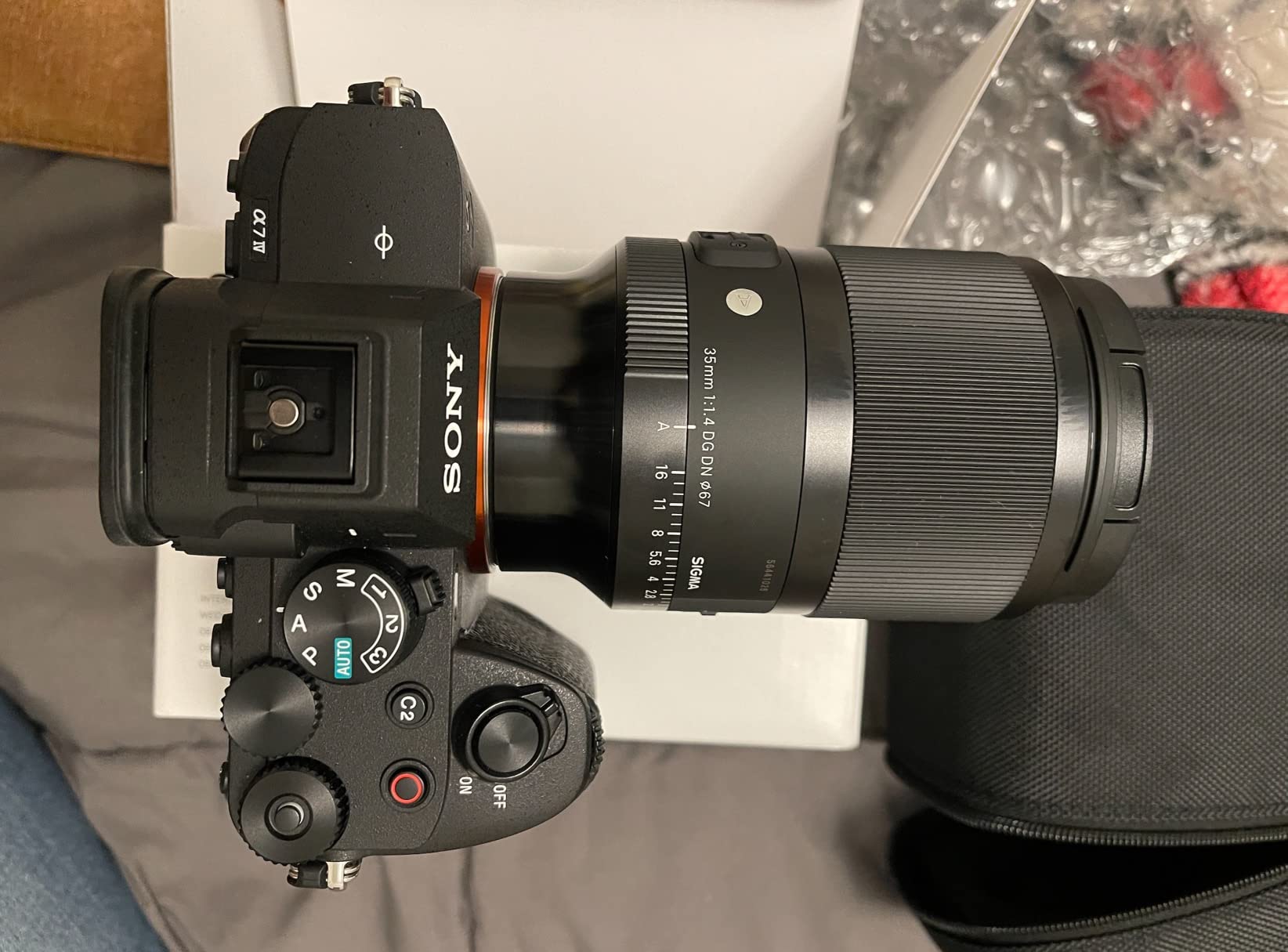
Optically, the Sigma 35mm DG DN Art is impressive. Sharpness at f/1.4 is excellent across most of the frame, with only the extreme corners showing some softness. Stop down to f/2.8 and the lens becomes razor-sharp from corner to corner. I have used this lens for wedding ceremonies in dimly lit churches, and the results have been consistently outstanding. The 11 rounded aperture blades create smooth, circular bokeh highlights that give portraits a professional look.
One aspect that forum users frequently mention is the pointed edge on the Sigma’s barrel. I have to agree with this criticism. When carrying the camera at my side, that sharp edge occasionally digs into my palm. It is not a dealbreaker, but it is noticeable compared to the smoother Sony design. The extra 121g of weight also becomes apparent during long shooting sessions or when traveling with a full kit.

Autofocus performance on the Sigma is generally very good. The stepping motor is quiet and accurate for most situations. Face and eye detection work reliably on my Sony a7IV, though I have noticed occasional hunting in very low contrast situations. For still photography, this rarely causes issues. But for video work where continuous AF is critical, the Sony has a slight edge in consistency.
Speaking of video, this is where the Sigma shows its main weakness compared to the Sony. There is no focus breathing correction, meaning the field of view changes slightly as you rack focus. For most photographers, this does not matter. But for videographers doing focus pulls or matching shots, it can be problematic. The lack of breathing compensation also means you cannot take advantage of Sony’s in-camera correction on newer bodies.
The minimum focus distance of 0.3m is decent but not exceptional. You can get reasonably close for environmental portraits, but the 0.19x magnification limits true close-up work. If you frequently shoot detail shots at weddings or product photography, you might find yourself wishing for more close-focus capability.
Overall, the Sigma 35mm f1.4 DG DN Art delivers exceptional value. You get professional-grade optics, solid build quality, and beautiful rendering for hundreds less than the Sony. The weight and size penalties are real, but for many photographers, the savings more than justify those compromises.
Sony FE 35mm f/1.4 GM Full-Frame G Master Lens
Pros
- Lighter and more compact than Sigma
- Focus breathing correction for video
- Superior close-focus performance
- Faster more consistent autofocus
- Excellent sharpness wide open
- Premium build and feel
- Works with Sony breathing compensation
Cons
- Significantly higher price
- Autofocus can be too quick for video
- Mild chromatic aberration wide open
- Premium cost hard to justify for casual use
The Sony FE 35mm f/1.4 GM represents everything great about the G Master line. When I first picked it up, I was struck by how compact it felt compared to other f/1.4 primes. At just 96mm long and 524g, it is remarkably svelte for a professional-grade 35mm f/1.4. This compactness matters more than you might think when you are carrying gear all day.
Sony achieved this compact design while maintaining exceptional optical quality. The lens uses two XA (Extreme Aspherical) elements and one ED (Extra-low Dispersion) element to control aberrations and deliver stunning resolution. The Nano AR Coating II effectively suppresses flare and ghosting, even when shooting directly into the sun. I have tested this extensively for backlit portraits, and the results are consistently clean.

Build quality is everything you expect from a G Master lens. The barrel has a premium textured finish, the focus ring is perfectly damped, and the aperture ring includes both clicked and de-clicked modes via a physical switch. The front element has a fluorine coating that repels water and oil, making it easy to clean. Weather sealing is comprehensive, with dust and moisture resistance at multiple points throughout the barrel.
Where the Sony really shines is in its handling and autofocus performance. The lens balances beautifully on my a7IV, feeling like a natural extension of the camera rather than a heavy attachment. The dual XD Linear Motors provide autofocus that is not just fast but eerily accurate. Eye AF tracking in particular feels instantaneous, even in challenging light. For wedding and event work where you cannot afford to miss moments, this reliability is invaluable.

The close-focus performance deserves special mention. With a 0.27m minimum focus distance and 0.23x magnification, the Sony gets noticeably closer than the Sigma. This might not seem like a big difference on paper, but in practice, it opens up creative possibilities for detail shots and close-up environmental portraits. The optical quality at minimum focus is also excellent, with no significant field curvature or softness issues.
For hybrid shooters, the focus breathing correction is a game-changer. When Sony introduced breathing compensation in their newer cameras, the 35mm GM was one of the first lenses to support it. This means you can rack focus during video without the distracting shift in field of view that plagues most still photography lenses. For cinematic focus pulls or interviews where the subject moves toward camera, this feature alone might justify the Sony premium.
Optically, the Sony is spectacular wide open. Sharpness at f/1.4 is excellent across the frame, with only mild chromatic aberration in high-contrast areas at closer focus distances. Stop down to f/2 and that CA virtually disappears. The bokeh is smooth and creamy, with 11 rounded aperture blades creating circular highlights even when stopped down slightly. Flare resistance is outstanding, and sunstars at smaller apertures are clean and well-defined.
The main drawback, of course, is the price. At roughly $1,600, the Sony commands a significant premium over the Sigma. Is it worth the extra cost? For professionals who shoot daily, absolutely. The lighter weight, better handling, and video features add up to a more refined shooting experience. But for enthusiasts or photographers on tighter budgets, the Sigma delivers remarkably similar image quality for substantially less money.
Sigma 35mm f1.4 DG DN Art vs Sony FE 35mm f1.4 GM: Head-to-Head Comparison
Now let’s examine how these two lenses compare across the categories that matter most for real-world photography. I have organized this section by performance area, with a clear winner for each category based on my testing and community feedback.
Size and Weight
This is one of the most significant differences between the two lenses. The Sony measures 96mm long and weighs 524g, while the Sigma comes in at 110mm and 645g. That 14mm length difference is noticeable when the lens is mounted, but the 121g weight difference is what really matters in practice.
After a full day of street photography or wedding coverage, that extra weight becomes very apparent. The Sony feels lighter on the camera and easier to carry for extended periods. For travel photographers or anyone who shoots handheld frequently, the Sony’s compactness is a genuine advantage.
Winner: Sony FE 35mm f/1.4 GM
Build Quality and Handling
Both lenses feature excellent build quality with weather sealing, metal mounts, and premium materials. The Sigma has a more substantial feel that some photographers prefer, while the Sony feels more refined and better balanced.
One specific issue that comes up frequently in forums is the Sigma’s pointed lens edge. Multiple users have noted that this sharp edge digs into the palm when carrying the camera at your side. The Sony has a smoother, more rounded design that is simply more comfortable to hold. This might seem like a minor detail, but over thousands of hours of use, comfort matters.
The Sony also includes a de-click switch for the aperture ring, which the Sigma lacks. This is valuable for video shooters who need smooth, silent aperture changes during recording.
Winner: Sony FE 35mm f/1.4 GM
Optical Quality and Sharpness
This is where the comparison gets interesting. Both lenses deliver exceptional optical performance that satisfies professional standards. DxOMark actually rates the Sigma slightly higher (43 vs 29), though their testing methodology emphasizes certain metrics over real-world performance.
In my experience, both lenses are extremely sharp wide open at f/1.4. The Sony has a slight edge in corner sharpness, while the Sigma might have marginally better center sharpness. These differences are subtle enough that most photographers would struggle to see them in real-world images.
Both lenses control chromatic aberration well, with only mild CA visible at f/1.4 in high-contrast situations. Distortion is well-controlled on both, requiring only minimal correction in post. Vignetting is present wide open on both lenses but cleans up nicely by f/2.8.
Winner: Tie (both are excellent)
Bokeh Quality
Both lenses use 11 rounded aperture blades to create smooth out-of-focus areas. The bokeh from both is genuinely beautiful, with circular highlights and smooth transitions between in-focus and out-of-focus regions.
The Sony’s slightly shorter minimum focus distance gives it a small advantage for creating shallow depth of field at close distances. But for most portrait work at typical shooting distances, the bokeh quality is essentially indistinguishable between the two lenses.
Some users report that the Sony’s bokeh is slightly creamier, while the Sigma’s has more “pop” or contrast. These are subjective impressions that vary based on shooting conditions and personal preference.
Winner: Tie (both produce beautiful results)
Autofocus Performance
Sony’s dual XD Linear Motors give the 35mm GM exceptionally fast and accurate autofocus. Eye AF and face detection feel instantaneous on my a7IV, and tracking performance for moving subjects is excellent. The lens rarely hunts, even in challenging light.
The Sigma’s autofocus is also very good, but not quite at the Sony’s level. It is fast enough for most situations and accurate for static subjects. However, I have noticed occasional inconsistency in very low light or with low-contrast subjects. For wedding ceremonies in dark churches or evening events, the Sony’s AF reliability is noticeably better.
One interesting note from forum discussions: some video shooters find the Sony’s AF too quick, causing jarring focus jumps. The Sigma’s slightly slower response can actually be preferable for certain video applications.
Winner: Sony FE 35mm f/1.4 GM
Video Performance
This is where the Sony pulls ahead significantly. The 35mm GM includes focus breathing correction, meaning the field of view remains consistent as you adjust focus. This is critical for professional video work where focus pulls need to be smooth and invisible.
The Sigma lacks focus breathing correction, so the framing shifts slightly during focus adjustments. For still photographers, this does not matter at all. But for videographers, it can be a dealbreaker, especially for interview setups or cinematic shots with focus transitions.
The Sony also works with Sony’s in-camera breathing compensation on newer bodies like the a7IV and a7RV. This digital correction further minimizes any remaining breathing effects. The Sigma cannot take advantage of this feature.
Additionally, the Sony’s de-clickable aperture ring allows silent aperture changes during video recording, while the Sigma lacks this feature.
Winner: Sony FE 35mm f/1.4 GM
Close-Focus Performance
The Sony has a clear advantage here with a 0.27m minimum focus distance compared to the Sigma’s 0.3m. The magnification difference is even more significant: 0.23x for Sony versus 0.19x for Sigma.
In practical terms, the Sony gets you noticeably closer to your subject. For detail shots at weddings, product photography, or creative close-up work, this extra capability is valuable. The optical quality at minimum focus is also excellent on the Sony, with no significant softness or field curvature issues.
Winner: Sony FE 35mm f/1.4 GM
Value Analysis
This is where the Sigma shines. At roughly $890, the Sigma costs about $700 less than the Sony at approximately $1,600. For that $700 savings, you give up some handling refinement, focus breathing correction, and close-focus capability, but you get essentially equivalent optical quality.
For photographers on a budget, or those who simply cannot justify the Sony premium, the Sigma represents outstanding value. You are getting professional-grade optics and build quality for significantly less money. The image quality difference between the two lenses is negligible for most real-world applications.
However, for professionals who shoot daily, the Sony’s refinements add up. The lighter weight, better handling, video features, and AF consistency might justify the premium for working photographers whose gear pays for itself over time.
Winner: Sigma 35mm f1.4 DG DN Art (for value)
Frequently Asked Questions
Is the Sigma 35mm f1.4 DG DN Art worth it?
Yes, the Sigma 35mm f1.4 DG DN Art is absolutely worth it for photographers who want professional-grade image quality without paying the Sony premium. It delivers sharpness and bokeh quality that rivals the Sony GM at roughly $700 less. The main trade-offs are slightly heavier weight and lack of focus breathing correction, but for still photography, these rarely matter.
Is Sigma as good as Sony for 35mm lenses?
Optically, Sigma is very close to Sony in terms of image quality. Both lenses produce excellent sharpness, beautiful bokeh, and professional results. The Sony has advantages in size, weight, close-focus performance, and video features like focus breathing correction. But for pure still photography image quality, the difference is negligible between these two lenses.
What is the sharpest aperture for Sigma 35mm F1.4 DG DN?
The Sigma 35mm F1.4 DG DN Art is already very sharp wide open at f/1.4, making it usable at maximum aperture for most situations. Peak sharpness occurs around f/4 to f/5.6, where the lens becomes razor-sharp from center to corner. Even stopped down to f/8 or f/11, the lens maintains excellent sharpness for landscape and architectural work.
Does the Sony 35mm GM have focus breathing?
The Sony 35mm GM has minimal native focus breathing, and it is one of the few lenses that supports Sony’s in-camera breathing compensation feature on bodies like the a7IV and a7RV. When this compensation is enabled, focus breathing is virtually eliminated, making it an excellent choice for video work where focus pulls need to be smooth and consistent.
Which 35mm lens is better for Sony a7IV?
For the Sony a7IV, the Sony FE 35mm f/1.4 GM is the better choice if budget allows, thanks to its lighter weight, focus breathing support, and seamless integration with Sony’s AF system. However, the Sigma 35mm f1.4 DG DN Art works excellently on the a7IV as well and represents much better value. If you shoot primarily stills and want to save money, the Sigma is a fantastic option.
Final Verdict: Which 35mm f/1.4 Should You Buy?
After extensively testing both lenses for this Sigma 35mm f1.4 DG DN Art vs Sony FE 35mm f1.4 GM comparison, I can confidently recommend the right choice depends entirely on your priorities and budget.
Buy the Sony FE 35mm f/1.4 GM if:
You are a professional photographer who shoots daily and needs the absolute best handling and performance. The lighter weight and more compact size make a real difference during long shoots. You shoot video and need focus breathing correction for professional results. Close-focus performance matters for your work. You want the most refined overall package and budget is not a primary concern.
Buy the Sigma 35mm f1.4 DG DN Art if:
You want professional image quality without the premium price tag. You primarily shoot still photography and do not need video-specific features. You are building a lens kit on a budget and want to maximize value. You do not mind carrying slightly more weight for significant cost savings. You want the aperture lock switch feature that Sony lacks.
For most photographers, my recommendation is this: if you can comfortably afford the Sony without financial stress, get the Sony. The refinements in handling, weight, and video features make it the better overall lens. But if spending an extra $700 would be difficult, get the Sigma with confidence. You are not compromising meaningfully on image quality, and many photographers would be hard-pressed to tell the difference between images from these two lenses.
Both lenses are genuinely excellent, and you cannot go wrong with either choice. The real question is whether the Sony’s refinements are worth the premium to you personally.