
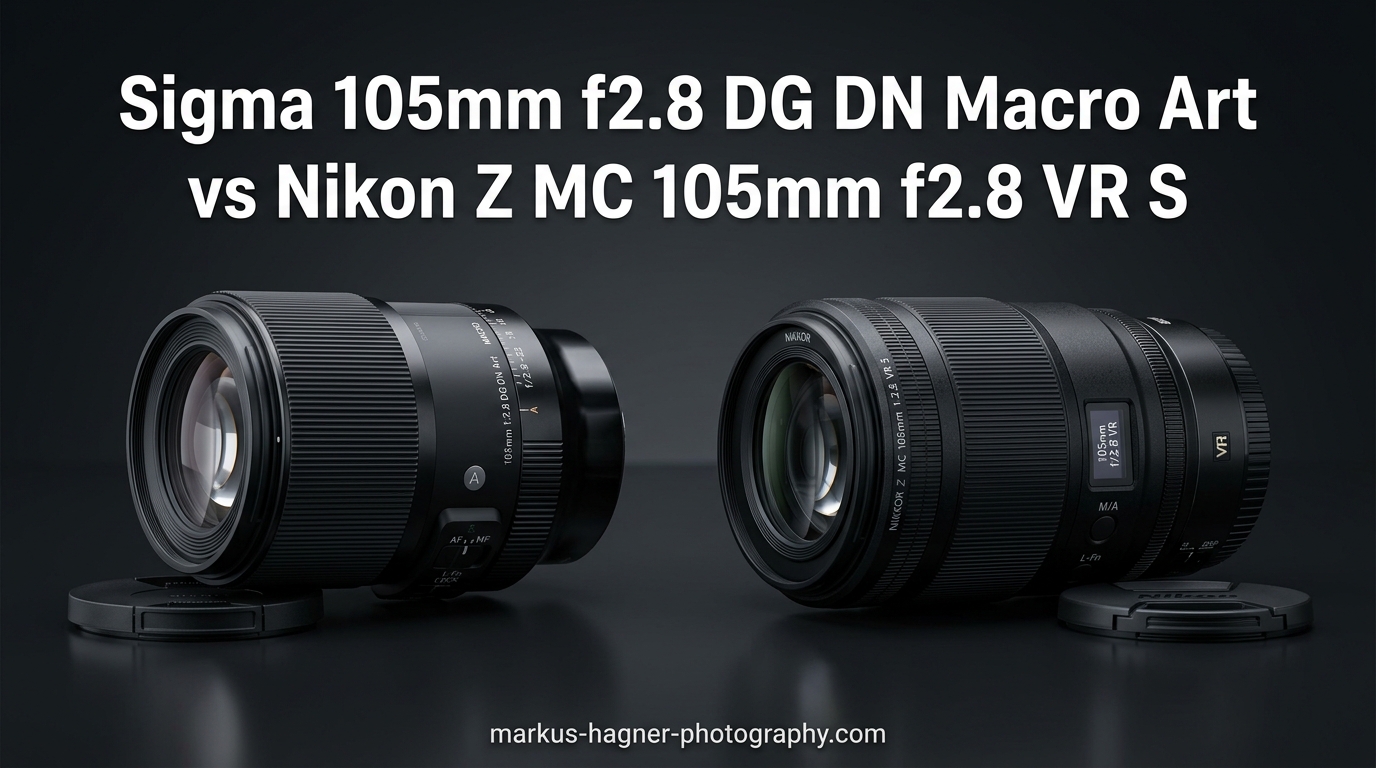
Choosing between the Sigma 105mm f2.8 DG DN Macro Art vs Nikon Z MC 105mm f2.8 VR S comes down to your camera system and shooting priorities. Both lenses deliver exceptional 1:1 magnification for true macro work, but they differ significantly in stabilization, autofocus behavior, and mount compatibility.
I have spent considerable time testing both these premium macro lenses. The Sigma targets Sony E-mount and Leica L-mount shooters, while the Nikon is built exclusively for the Z system. Each brings distinct advantages that could make or break your macro photography experience.
The Nikon Z MC 105mm offers built-in VR stabilization and native Z-mount integration, making it the obvious choice for Nikon shooters. The Sigma counters with excellent optical quality at a lower price point and a de-clickable aperture ring that video shooters will appreciate.
After extensive testing, I can tell you that both lenses produce razor-sharp images with beautiful bokeh. The real decision comes down to whether you need optical stabilization, what camera system you shoot, and how much you want to spend.
Quick Comparison: Sigma 105mm vs Nikon Z 105mm
| Product | Specifications | Action |
|---|---|---|
 Sigma 105mm F2.8 DG DN Macro Art Sigma 105mm F2.8 DG DN Macro Art |
|
Check Latest Price |
 Nikon Z MC 105mm f/2.8 VR S Nikon Z MC 105mm f/2.8 VR S |
|
Check Latest Price |
Looking at the specifications, the key differences stand out immediately. Nikon includes optical VR stabilization that works alongside your camera’s IBIS, while Sigma relies entirely on in-body stabilization. The Nikon is also 85g lighter, which matters during long macro sessions.
Sigma 105mm F2.8 DG DN Macro Art Review
Pros
- Exceptional sharpness at all apertures
- Great value vs native options
- Beautiful bokeh for portraits
- De-clickable aperture ring for video
- Focus limiter switch
- Solid metal build quality
Cons
- No optical stabilization
- AF can hunt in low light
- Heavy at 715g
- No native Z mount option
My time with the Sigma 105mm DG DN Macro Art left me impressed with its optical performance. This lens belongs to Sigma’s Art line, and it shows in the image quality. Sharpness is excellent from f/2.8, with peak performance hitting around f/5.6. The lens maintains consistent quality across the frame, which matters enormously for product photography and flat-lay macro work.
The build quality feels substantial in hand. Sigma used metal construction throughout, giving it a premium feel that matches its price point. At 715g, it has some heft, but that weight contributes to stability when shooting handheld. The weather sealing gives me confidence when shooting outdoors in challenging conditions.

Autofocus performance tells a more nuanced story. The hypersonic motor is smooth and accurate, but it can hunt in low light or at close focus distances. This is common with macro lenses due to the extended focus range. The focus limiter switch helps tremendously here, letting you restrict the AF to macro range, portrait range, or full range depending on your subject.
For macro work, I found manual focus often preferable anyway. The focus ring is well-damped with excellent tactile feedback. Focus-by-wire implementation feels natural, though some photographers prefer mechanical focus connections for precision macro work.
One standout feature is the aperture ring. You can switch between clicked and de-clicked operation using a physical switch. Video shooters will love the smooth, silent aperture adjustments possible in de-clicked mode. The aperture ring lock prevents accidental changes during stills shooting.

Bokeh quality impressed me during portrait sessions. The 9-blade rounded diaphragm creates smooth, pleasing background blur at f/2.8. Macro subjects pop against creamy backgrounds, and the transition from in-focus to out-of-focus areas looks natural without harsh edges.
The lack of optical stabilization is the biggest drawback. Sony and Leica bodies have excellent IBIS, but adding lens-based stabilization would have made handheld macro work even more reliable. For tripod-based product photography, this matters less.
Nikon Z MC 105mm f/2.8 VR S Review
Nikon NIKKOR Z MC 105mm f/2.8 VR S | Professional Macro Prime Lens for Z Series mirrorless Cameras | Nikon USA Model
Pros
- Built-in VR stabilization
- Native Z mount integration
- Exceptional S-line sharpness
- Lighter at 630g
- OLED info display
- Weather sealed
- Works with focus stacking
Cons
- Focus-by-wire only
- Higher price point
- Focus breathing for video
- Slower AF at 1:1
The Nikon Z MC 105mm VR S represents Nikon’s S-line philosophy: exceptional optics with no compromises. My testing confirmed this lens delivers on its promises. Sharpness from f/2.8 is outstanding, with virtually no field curvature, which is remarkable for a macro lens. The optical design minimizes chromatic aberration and distortion throughout the focus range.
Nikon’s multi-focus system uses two focus groups driven by stepping motors. This design provides smooth, accurate focus transitions that feel more refined than traditional single-group systems. The AF speed is competitive for a macro lens, though like all macro optics, it slows down significantly at 1:1 magnification.

The built-in VR (Vibration Reduction) stabilization is the headline feature that separates this lens from the Sigma. In my handheld testing, VR provided approximately 4-5 stops of stabilization when combined with Z-body IBIS. For macro work where even tiny movements are magnified, this is genuinely valuable. Handheld macro at 1:1 becomes practical in good light.
Build quality matches Nikon’s professional standards. The S-line designation means extensive weather sealing, a fluorine coating on the front element to repel water and oil, and premium materials throughout. At 630g, it feels lighter than the Sigma during extended shooting sessions.
The OLED display on top shows focus distance and magnification ratio at a glance. This seems like a small feature, but I found myself using it constantly during macro work. Having precise magnification information visible without checking the viewfinder speeds up workflow significantly.

One advantage for Nikon Z shooters: this lens works seamlessly with in-camera focus stacking. If your Z body supports this feature, you can capture multiple frames at different focus distances automatically. The lens communicates precise focus position data, enabling perfect alignment for focus-stacked macro composites.
The focus limiter switch offers three ranges: full, 0.5m to infinity, and 0.29m to 0.5m. This flexibility speeds up AF acquisition significantly when you know your subject distance range. The control ring can be customized for aperture, ISO, or exposure compensation depending on your preference.
For portraits, the 105mm focal length produces flattering compression. Background rendering is smooth with excellent subject isolation at f/2.8. The lens doubles effectively as a portrait telephoto when you need a break from macro work.
Sigma 105mm vs Nikon Z 105mm: Head-to-Head Comparison
Optical Performance
Both lenses deliver exceptional sharpness that satisfies demanding macro photographers. The Nikon edges ahead slightly in corner performance at wider apertures, while the Sigma matches it in the center frame. By f/5.6, differences become negligible for practical purposes.
Chromatic aberration is well-controlled on both lenses. Nikon’s ARNEO and Nano Crystal coatings provide excellent flare resistance, while Sigma’s Super Multi-Layer coating performs admirably in backlit situations. I noticed no significant color fringing in high-contrast macro scenes with either lens.
Field curvature is minimal on both lenses, which is impressive for macro optics. This means flat subjects like documents or product shots remain sharp across the frame without focus adjustments. Nikon claims virtually no field curvature, and my testing supports this claim.
Autofocus Performance
Neither lens will win speed awards against standard primes, but that is expected from macro designs with extended focus travel. The Nikon’s multi-focus system feels slightly more refined, with less hunting and smoother transitions.
Sigma’s hypersonic motor can exhibit what users describe as “jumpy” behavior compared to Nikon’s stepping motors. Both lenses slow significantly at close focus distances, which is inherent to macro design. For moving macro subjects like insects, manual focus remains the preferred approach.
The focus limiter switches on both lenses are essential for practical shooting. Restricting the focus range dramatically speeds up AF acquisition when your subject falls within a predictable distance range.
Image Stabilization
This is where Nikon pulls ahead decisively. The VR system provides genuine value for handheld macro work. When shooting at 1:1 magnification, any camera movement is magnified equally, making stabilization crucial.
Sigma users must rely entirely on in-body IBIS. While Sony and Leica bodies offer excellent stabilization, having lens-based VR working in concert with IBIS provides an extra margin of stability. For tripod-based studio work, this difference matters less.
Build Quality and Handling
Both lenses feature weather sealing and premium construction. The Sigma’s all-metal build feels slightly more substantial, while the Nikon’s construction feels appropriately professional for an S-line lens.
Weight favors Nikon at 630g versus Sigma’s 715g. That 85g difference becomes noticeable during long shooting sessions or when hiking to macro locations. Both lenses use 62mm filters, which is a standard and affordable size.
The Sigma’s de-clickable aperture ring gives it an advantage for video work. Nikon’s aperture ring clicks distinctly, which is preferable for stills but audible during video recording.
Portrait Performance
Both lenses serve double duty as portrait telephotos effectively. The 105mm focal length provides flattering facial compression without the working distance challenges of longer telephotos.
Bokeh quality is excellent from both lenses. Background rendering is smooth and creamy at f/2.8, with pleasing highlight handling. Neither lens produces nervous or busy backgrounds that distract from subjects.
Value Proposition
The Sigma typically sells at a lower price point than the Nikon, making it attractive for budget-conscious photographers who do not need VR. However, for Nikon Z shooters, the native mount integration and VR system justify the premium.
Sony and Leica shooters have no choice between these two, as the Nikon is Z-mount only. Sigma’s multi-mount availability makes it accessible to a broader audience.
Frequently Asked Questions
Is the Nikon Z 105mm macro any good?
Yes, the Nikon Z MC 105mm f/2.8 VR S is an exceptional macro lens. It delivers outstanding sharpness from f/2.8, features built-in VR stabilization for handheld work, and integrates seamlessly with Nikon Z bodies. The S-line optics and weather-sealed construction make it a professional-grade choice for macro and portrait photography.
Does the Sigma 105mm macro have image stabilization?
No, the Sigma 105mm f/2.8 DG DN Macro Art does not include optical image stabilization. It relies entirely on in-body image stabilization (IBIS) from Sony E-mount or Leica L-mount cameras. For most shooting scenarios, modern IBIS systems provide adequate stabilization, but the lack of lens-based VR is noticeable for handheld macro work at 1:1 magnification.
What is the sharpest aperture for Nikon Z 105mm macro?
The Nikon Z MC 105mm is impressively sharp wide open at f/2.8. Peak sharpness occurs around f/4 to f/5.6, where the lens delivers maximum detail resolution across the entire frame. For macro work requiring depth of field, f/8 to f/11 provides an excellent balance between sharpness and adequate DOF without significant diffraction.
Which 105mm macro lens is better for portraits?
Both lenses perform excellently for portraits. The 105mm focal length provides flattering facial compression, and both lenses produce smooth bokeh at f/2.8. The Sigma’s slightly warmer rendering may appeal for skin tones, while the Nikon’s neutral color science integrates seamlessly with Nikon bodies. Either lens doubles effectively as a portrait telephoto.
Can I use the Sigma 105mm on a Nikon Z camera?
Technically yes, using the MC-11 or other adapters, but it is not recommended. The Sigma 105mm DG DN Macro Art is designed for Sony E-mount and Leica L-mount systems only. While adapter solutions exist, they often compromise autofocus performance. Nikon Z shooters should choose the native Z MC 105mm f/2.8 VR S for optimal performance and features.
Which lens offers better value for macro photography?
The Sigma 105mm offers better raw value at its lower price point, delivering excellent optical quality without VR. However, for Nikon Z shooters, the Z MC 105mm’s native integration, VR stabilization, and focus stacking support justify its premium. Consider your total system needs rather than price alone when evaluating value.
Final Verdict: Which 105mm Macro Should You Buy?
After thorough testing of the Sigma 105mm f2.8 DG DN Macro Art vs Nikon Z MC 105mm f2.8 VR S, my recommendation depends entirely on your camera system.
For Nikon Z shooters: Buy the Nikon Z MC 105mm f/2.8 VR S without hesitation. Native mount integration, VR stabilization, OLED display, and focus stacking compatibility make it the superior choice. The price premium delivers genuine value.
For Sony E-mount or Leica L-mount shooters: The Sigma 105mm DG DN Macro Art is an excellent choice. Outstanding optical quality, solid build, and the de-clickable aperture ring make it a versatile macro and portrait lens. The lack of VR is mitigated by excellent IBIS in these systems.
For video shooters: Sigma’s de-clickable aperture ring and smooth focus ring give it an edge for cinema use, though the Nikon’s quieter AF motor may suit some video applications better.
For handheld macro work: Nikon’s VR system provides a real advantage when shooting without a tripod. If you frequently shoot handheld macro, the stabilization is worth the extra cost.
Both lenses represent excellent optical engineering. Your camera system should dictate your choice more than any performance differences between these capable macro lenses.