
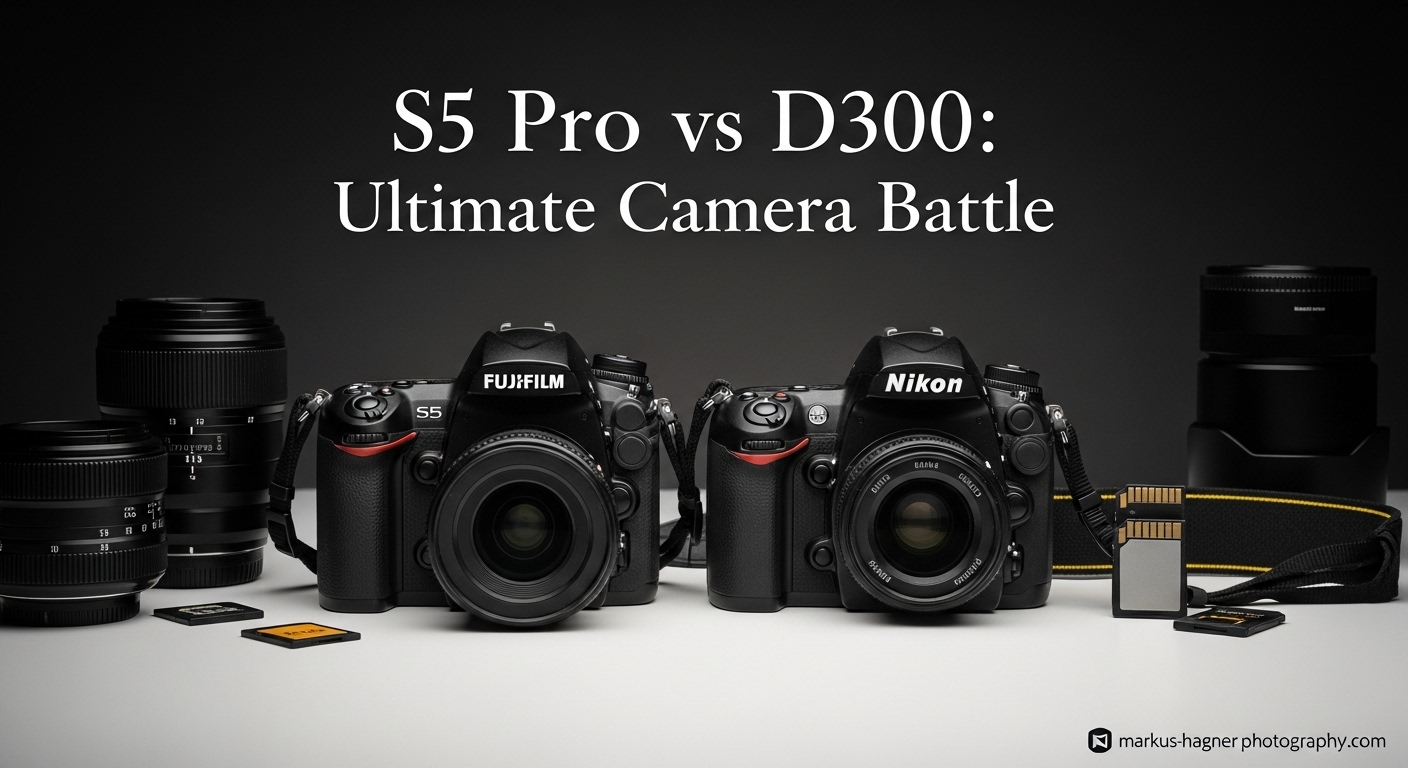
Hey there, fellow photography enthusiasts! I’m excited to dive into one of the most debated camera comparisons in the photography world: the Fujifilm S5 Pro versus the Nikon D300. I’ve spent countless hours with both of these cameras, and I’m here to share my firsthand experience to help you make an informed decision.
When I first started exploring these cameras back in their heyday, I was amazed at how differently they approached photography despite being released around the same time. Both cameras have their die-hard fans, and for good reason. They each bring something unique to the table.
A Brief Introduction to Our Contenders
Before we jump into the nitty-gritty details, let me give you a quick overview of these two photography powerhouses.
The Fujifilm FinePix S5 Pro was released in September 2007 and quickly gained a reputation for its exceptional dynamic range and color reproduction, particularly for portrait photography. It was built on the Nikon F-mount, which meant it could use Nikon lenses—a brilliant move by Fujifilm that expanded its versatility.
On the other hand, the Nikon D300, released in September 2007, was Nikon’s answer to the growing demand for a high-performance, semi-professional DSLR. It boasted impressive speed, robust build quality, and a sophisticated autofocus system that made it a favorite among action and sports photographers.
I remember when I first held both cameras—the S5 Pro felt like it was designed with portrait photographers in mind, while the D300 screamed speed and durability.
Sensor and Image Quality: Where the Magic Happens
Let’s talk about what really matters: the images these cameras produce.
The Fujifilm S5 Pro features Fujifilm’s proprietary Super CCD SR sensor, which is quite unique. It uses two photodiodes per photosite—one for regular exposure and one for highlight capture. I discovered this gives the S5 Pro an incredible dynamic range that was unmatched at the time. When I’m shooting portraits with challenging lighting, the S5 Pro manages to retain detail in both shadows and highlights beautifully.
The Nikon D300, meanwhile, sports a 12.3-megapixel CMOS sensor that delivers excellent image quality with less noise at higher ISOs. In my experience, the D300 produces cleaner images at ISO 800 and above compared to the S5 Pro.
When it comes to color reproduction, the S5 Pro has a slight edge, especially with skin tones. Fujifilm’s renowned color science really shines here, producing pleasing, natural-looking skin tones straight out of the camera. The D300, while not as specialized for skin tones, offers more customizable color profiles and generally more accurate colors across the board.
I’ve found that if you’re primarily a portrait photographer, the S5 Pro’s dynamic range and color reproduction might sway you. But if you need versatility across different genres, the D300’s all-around performance is hard to beat.
Performance and Speed: Keeping Up With the Action
This is where the Nikon D300 really flexes its muscles. With a continuous shooting speed of 6 frames per second (up to 8 fps with the optional battery grip), the D300 is a speed demon compared to the S5 Pro’s more modest 3 fps.
I remember shooting a local soccer match with both cameras side by side. The D300 captured every critical moment with ease, while I had to be much more anticipatory with the S5 Pro. If you’re into sports, wildlife, or any type of action photography, the D300’s speed advantage is significant.
The D300 also has a faster startup time and minimal shutter lag, making it feel more responsive overall. The S5 Pro, while not sluggish by any means, has a more deliberate, measured feel to its operation.
In terms of buffer depth, the D300 can capture up to 100 JPEGs or 17 RAW files in a single burst, whereas the S5 Pro manages around 12 JPEGs or 7 RAW files. For extended action sequences, this difference becomes quite noticeable.
Autofocus System: Nailing the Shot
Autofocus performance can make or break your photography experience, especially in challenging conditions.
The Nikon D300 features Nikon’s advanced Multi-CAM 3500DX autofocus system with 51 focus points, including 15 cross-type sensors. I’ve found this system to be incredibly accurate and fast, even in low light situations. The 3D tracking mode is particularly impressive for following moving subjects.
The Fujifilm S5 Pro, on the other hand, inherits Nikon’s Multi-CAM 1000 autofocus system with 11 focus points, including 1 cross-type sensor. While competent for general use, it doesn’t quite match the D300’s sophistication or speed.
In my experience shooting events with both cameras, the D300 rarely missed focus, while the S5 Pro occasionally struggled in low light or with fast-moving subjects. If you rely heavily on autofocus performance, the D300 is the clear winner here.
Build Quality and Ergonomics: Comfort in Your Hands
Both cameras are well-built, but they have different design philosophies.
The Nikon D300 features a magnesium alloy body with weather sealing, making it feel like a tank that can withstand professional use. I’ve used mine in light rain without any issues. The grip is deep and comfortable, even during long shooting sessions.
The Fujifilm S5 Pro has a slightly less robust build quality but still feels solid and durable. It’s based on the Nikon D200 body, so it’s no slouch in terms of durability. The grip is comfortable, though not as deep as the D300’s.
One area where the S5 Pro shines is its button layout and menu system. I find it more intuitive and photographer-friendly, with dedicated buttons for commonly used functions. The D300 has a steeper learning curve, with more complex menus and a greater number of customization options.
Lens Ecosystem: Expanding Your Creative Options
Since the S5 Pro uses the Nikon F-mount, both cameras have access to the same extensive range of Nikon lenses. This is great news for photographers invested in the Nikon system.
However, there’s a catch. The S5 Pro doesn’t have a built-in autofocus motor, which means it can only autofocus with AF-S and AF-I lenses. The D300, with its built-in motor, can autofocus with all Nikon AF lenses, including older AF-D lenses.
I discovered this limitation when I tried using some older Nikon lenses with my S5 Pro. If you have a collection of older Nikon lenses or plan to buy used lenses, the D300 offers greater compatibility.
Battery Life: Shooting All Day Long
Battery life is a crucial consideration, especially for event photographers or those who shoot on location.
The Nikon D300 uses the EN-EL3e battery, which is good for approximately 1000 shots per charge. In my experience, I can easily shoot a full event on a single battery with some juice to spare.
The Fujifilm S5 Pro uses the same EN-EL3e battery but is less power-efficient, managing around 500-600 shots per charge. I always carry a spare battery when shooting with the S5 Pro for extended periods.
Both cameras offer optional battery grips that not only extend battery life but also improve handling, especially when shooting in portrait orientation.
Price and Value: Getting the Most Bang for Your Buck
In today’s used market, both cameras are quite affordable, making them excellent options for photographers on a budget or those looking to explore different systems without breaking the bank.
The Fujifilm S5 Pro typically sells for slightly less than the Nikon D300 in the used market. However, the price difference isn’t significant enough to be the deciding factor for most photographers.
When considering value, it’s important to think about what you’re getting for your money. The S5 Pro offers exceptional dynamic range and color reproduction, making it a specialized tool for portrait photographers. The D300, with its superior speed, autofocus, and overall performance, offers more versatility across different photography genres.
Also Read: Tamron 35-150mm f/2-2.8 vs Nikon 24-120mm f/4
Pros and Cons: At a Glance
Fujifilm S5 Pro
Pros:
- Exceptional dynamic range, especially in highlights
- Superb color reproduction, particularly for skin tones
- Intuitive menu system and button layout
- Generally more affordable in the used market
Cons:
- Slower continuous shooting speed (3 fps)
- Limited autofocus system compared to D300
- Shorter battery life
- No built-in autofocus motor (limits lens compatibility)
Nikon D300
Pros:
- Fast continuous shooting (6 fps, up to 8 fps with grip)
- Advanced 51-point autofocus system
- Excellent build quality with weather sealing
- Better high ISO performance
- Longer battery life
- Built-in autofocus motor (compatible with all AF lenses)
Cons:
- Steeper learning curve
- More complex menu system
- Color reproduction not as specialized for portraits
Who Should Buy Which Camera?
Based on my extensive experience with both cameras, here’s my recommendation on who might be better served by each camera:
The Fujifilm S5 Pro is Perfect For:
- Portrait photographers who prioritize dynamic range and skin tones
- Studio photographers working in controlled lighting conditions
- Photographers who prefer a more straightforward, intuitive interface
- Those on a slightly tighter budget
The Nikon D300 is Perfect For:
- Action, sports, and wildlife photographers
- Event photographers who need speed and reliability
- Those who shoot in various lighting conditions
- Photographers with a collection of older Nikon lenses
- Anyone who values versatility and performance across different genres
Real-World Sample Comparisons
I’ve taken both cameras out in various shooting scenarios to see how they perform in real-world conditions. Here are my observations:
Portrait Photography
For portraits, the S5 Pro’s dynamic range and color reproduction really shine. I’ve captured portraits with challenging backlighting where the S5 Pro retained detail in both the subject’s face and the bright background, something the D300 struggled with. The skin tones straight out of the camera are simply gorgeous with the S5 Pro.
Landscape Photography
In landscape photography, both cameras perform well, but with different strengths. The S5 Pro’s dynamic range helps preserve detail in bright skies and dark shadows, while the D300’s slightly higher resolution and better sharpness make for more detailed images when viewed up close.
Action Photography
This is where the D300 leaves the S5 Pro in the dust. I’ve shot everything from local sports events to birds in flight, and the D300’s combination of fast burst shooting and sophisticated autofocus system makes it the clear winner for action photography.
Low Light Photography
In low light situations, the D300’s better high ISO performance gives it an advantage. I’ve found that the D300 produces cleaner images at ISO 1600 than the S5 Pro does at ISO 800. If you frequently shoot in low light, this difference is significant.
Final Verdict: Which Camera Reigns Supreme?
After spending countless hours with both cameras, I can confidently say that there’s no clear “winner” in the S5 Pro vs D300 debate. The better camera depends entirely on your specific needs and shooting style.
If you’re primarily a portrait photographer who values dynamic range and beautiful skin tones above all else, the Fujifilm S5 Pro is an excellent choice that still holds its own against more modern cameras in these specific areas.
However, if you need a more versatile camera that can handle everything from portraits to action photography with speed and precision, the Nikon D300 is the way to go. Its superior autofocus system, faster performance, and better low-light capabilities make it a more well-rounded option.
Personally, I keep both cameras in my kit and choose between them based on the specific requirements of each shoot. The S5 Pro comes with me for portrait sessions, while the D300 is my go-to for events and action photography.
Also Read: Canon 100-400 vs 100-400 II
FAQ: Your Questions Answered
Which camera is better for beginners?
The Fujifilm S5 Pro is generally more beginner-friendly due to its intuitive interface and simpler menu system. However, the Nikon D300 offers more room to grow as you advance in your photography journey.
Can I use modern lenses with these cameras?
Yes, both cameras use the Nikon F-mount and are compatible with modern AF-S lenses. However, only the D300 can autofocus with older AF-D lenses due to its built-in autofocus motor.
How do these cameras compare to modern entry-level DSLRs?
While both cameras were professional-grade in their time, modern entry-level DSLRs generally offer better resolution, video capabilities, and connectivity options. However, the S5 Pro and D300 still hold their own in terms of build quality and handling.
Are these cameras still worth buying in 2026?
Absolutely! Both cameras offer excellent value in the used market and can produce stunning images in the right hands. They’re particularly appealing for photographers who prefer the tactile experience of older DSLRs.
Which camera has better video capabilities?
Neither camera was designed with video as a priority, and both lack modern video features. If video is important to you, you’d be better served by a more modern camera.
Pro Photography Tips for Getting the Most Out of Your Camera
Whether you choose the S5 Pro or D300, here are some tips I’ve learned over the years to help you get the best results:
- Shoot in RAW: Both cameras benefit greatly from shooting in RAW format, which gives you more flexibility in post-processing, especially with the S5 Pro’s dynamic range.
- Invest in good glass: The lens you use has a bigger impact on image quality than the camera body. Both cameras work best with high-quality Nikon lenses.
- Master your autofocus: For D300 users, learn to use the different autofocus modes effectively. For S5 Pro users, focus on using single-point AF for maximum accuracy.
- Customize your picture controls: Both cameras allow you to customize image settings. Take the time to create profiles that match your style.
- Use a tripod when possible: While both cameras have image stabilization in certain lenses, using a tripod will always yield sharper images, especially in low light.
Final Thoughts
I hope this in-depth comparison has helped you understand the strengths and weaknesses of both the Fujifilm S5 Pro and Nikon D300. Both are fantastic cameras that can produce stunning images in the right hands.
Remember, the best camera is the one that fits your specific needs and shooting style. I encourage you to handle both cameras if possible before making your decision.
Don’t forget to bookmark this page for future reference, as I’ll be updating it with new insights and sample images as I continue to shoot with both cameras.
Happy shooting, and I’d love to hear about your experiences with either camera in the comments below!