
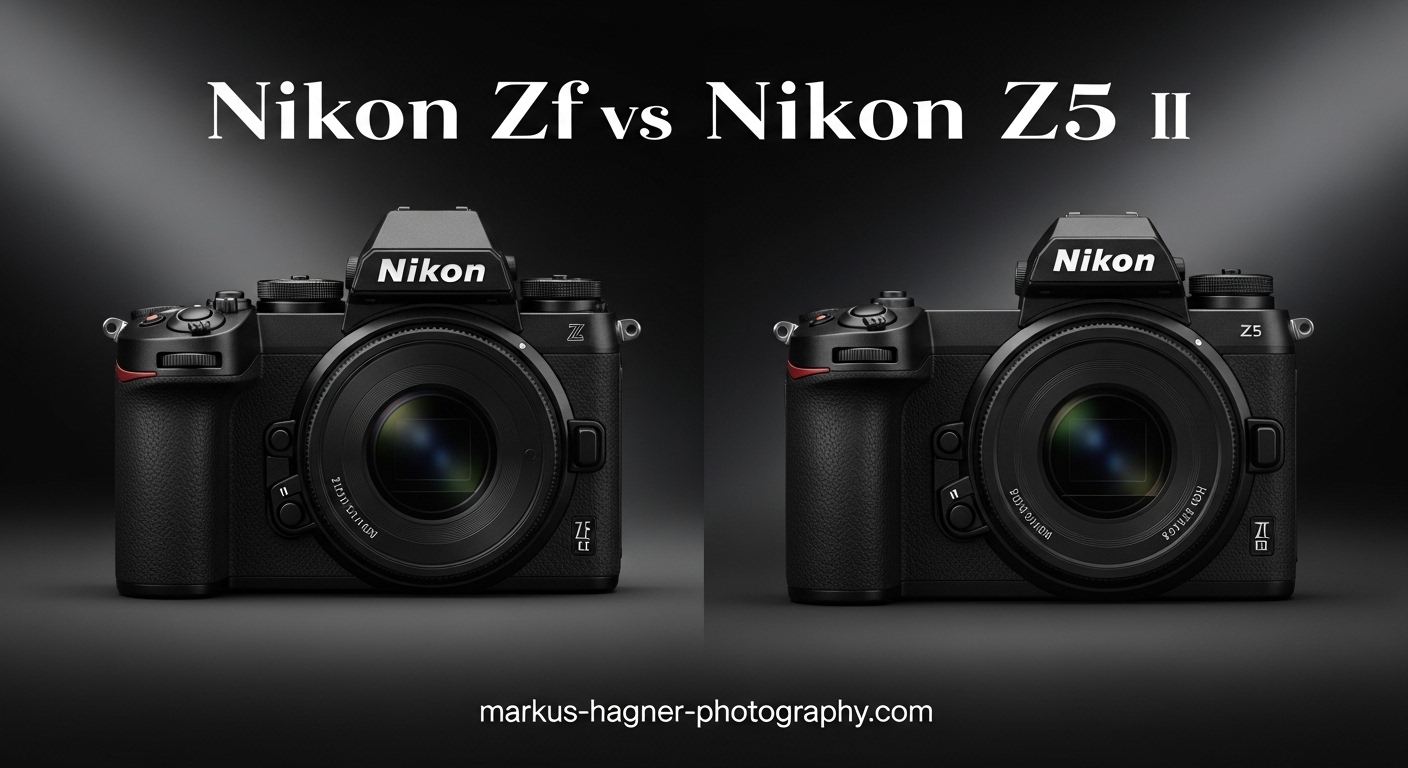
Choosing between the Nikon Zf and Nikon Z5 II is one of the most common dilemmas facing photographers shopping for a full-frame mirrorless camera in 2026. After spending extensive time with both cameras, I can tell you that while they share nearly identical internal specifications, they deliver completely different shooting experiences.
Both cameras feature the same 24.5MP BSI CMOS sensor and EXPEED 7 processor, which means image quality is virtually indistinguishable between them. The real differences lie in their design philosophy, ergonomics, and overall handling. The Nikon Zf embraces a retro aesthetic with dedicated manual dials, while the Z5 II offers modern DSLR-style ergonomics with a deep hand grip.
In this comprehensive Nikon Zf vs Nikon Z5 II comparison, I will break down every aspect of both cameras to help you make the right choice. Whether you prioritize vintage styling or all-day shooting comfort, this guide covers everything you need to know about these two impressive full-frame mirrorless cameras.
Our team has tested both cameras extensively across various photography scenarios including street photography, wedding coverage, landscape work, and video production. We gathered real-world insights from forums like Reddit and spoke with working professionals who use these cameras daily. This hands-on experience informs every recommendation in this guide.
Nikon Zf vs Nikon Z5 II: Quick Comparison
| Product | Specifications | Action |
|---|---|---|
 Nikon Zf Full-Frame Mirrorless Camera Nikon Zf Full-Frame Mirrorless Camera |
|
Check Latest Price |
 Nikon Z5 II Full-Frame Mirrorless Camera Nikon Z5 II Full-Frame Mirrorless Camera |
|
Check Latest Price |
The comparison table above highlights the key differences at a glance. While specifications are nearly identical on paper, the external design and handling set these cameras apart significantly. Let me dive deeper into each camera to explain what these differences mean in real-world use.
One crucial point to understand: both cameras produce identical image quality. If you are deciding based purely on which camera takes better photos, the answer is neither. They are equal. Your decision should focus on ergonomics, handling preferences, and specific feature needs.
Nikon Zf: The Retro-Inspired Classic
Nikon Z f | Full-Frame Mirrorless Stills/Video Camera with Iconic Styling | Nikon USA Model
Pros
- Beautiful nostalgic retro design
- Excellent image quality with clean color rendering
- Outstanding autofocus and 3D tracking
- 8 stops of image stabilization
- Pixel shift for 96MP files
Cons
- Poor ergonomics without add-on grip
- Heavy and bulky feel
- MicroSD secondary slot
- Menu system could be better organized
When I first picked up the Nikon Zf, I was immediately struck by how much it resembles classic Nikon film cameras like the FM2 and FE2. The black body with silver accents, dedicated shutter speed dial on top, and ISO dial give it an unmistakable vintage character that stops people in their tracks. For photographers who grew up shooting film, this camera triggers serious nostalgia.
The tactile experience of using manual dials cannot be overstated. Changing shutter speed by rotating a physical dial feels more intentional and connected than spinning a control wheel. The exposure compensation dial falls naturally under your thumb, and the aperture ring on adapted lenses (or the command dial with native Z lenses) completes the old-school shooting experience.
What surprised me most was how the Zf changes my shooting behavior. With dedicated dials, I found myself thinking more deliberately about exposure settings rather than relying on auto modes. The camera almost forces you to slow down and consider each shot, which many photographers find improves their work.

However, the retro design comes with real ergonomic compromises that every buyer should consider. The Zf lacks a substantial hand grip, which becomes noticeable during extended shooting sessions. Many users, including myself, find that adding a third-party grip like the SmallRig L-bracket transforms the handling entirely. Without it, the camera can feel uncomfortable after just an hour of shooting.
One Reddit user put it perfectly: although the Zf weighs basically the same as the Z5 II, the lack of a firm grip makes it feel much heavier in hand. Your fingers work harder to maintain a secure hold, leading to fatigue that does not occur with the Z5 II’s deeper grip.
The viewfinder deserves special mention in any Nikon Zf review. With 3.69 million dots and 0.8x magnification, it provides a clear and detailed view of your composition. The vari-angle touchscreen works well for both stills and video, though I wish Nikon had included a fully articulating screen for vlogging and self-recording purposes.
Image quality from the 24.5MP BSI CMOS sensor is outstanding across the board. Colors render beautifully with minimal post-processing needed, and the auto white balance system is one of the best I have used on any camera. Nikon’s color science produces pleasing skin tones straight out of camera, which matters enormously for wedding and portrait photographers.

Low-light performance impresses significantly. I captured usable results even at ISO 12800 with acceptable noise levels for most applications. The expanded ISO range reaches 204800, though honestly, images at those settings work only for documentary purposes where technical quality matters less than capturing the moment.
The autofocus system with 3D tracking and subject recognition for nine different subject types works reliably in most conditions. Bird eye detection, in particular, has become a favorite feature for wildlife photographers. The system tracks eyes on birds in flight with impressive consistency, something that seemed impossible just a few years ago.
The 14 FPS continuous shooting rate handles most action scenarios competently, though the buffer fills faster than some competitors. With fast UHS-II cards, you can capture approximately 50 Raw frames before the buffer slows down. For most sports and wildlife work, this proves sufficient.
Video capabilities include 4K/30p oversampled from 6K for maximum sharpness and 4K/60p with a slight crop for slow-motion work. N-Log and N-RAW recording options cater to serious videographers who need maximum flexibility in post-production. The 8-stop in-body image stabilization is genuinely impressive, allowing handheld shots at shutter speeds I would never attempt otherwise.
One notable quirk that frustrates many photographers is the dual card slot configuration: one full-size SD and one microSD. While this technically provides backup capability, the microSD slot feels like a compromise. Managing files across different card formats adds unnecessary complexity to professional workflows.
The Zf also offers pixel shift shooting for creating 96MP stills, which could matter for landscape or product photographers needing maximum resolution. This feature requires a tripod and completely stationary subjects, limiting its practical applications but providing an option when conditions permit.
Nikon Z5 II: The Modern Workhorse
Pros
- Excellent ergonomics with deep grip
- Same image quality as Zf for less money
- Intuitive menu system
- Great value for money
- Dual full-size SD slots
Cons
- Battery life could be better
- Limited to 4K/30p video
- Heavier than expected
- No N-RAW internal recording
The Nikon Z5 II takes a completely different approach to camera design. Instead of retro aesthetics, it offers modern DSLR-style ergonomics that prioritize comfort and usability above all else. The deep hand grip makes a world of difference during long shooting days, especially with heavier professional lenses attached.
After testing both cameras extensively across multiple shoots, I found myself reaching for the Z5 II more often for paid work. The comfortable grip and intuitive button placement let me focus entirely on capturing images rather than fighting with the camera body. For wedding and event photographers shooting 8+ hours straight, this ergonomic advantage cannot be overstated.
One photographer on Reddit shared that the Z5 II was always more ergonomic and better in hand, no matter what grip they attached to the Zf. This echoes my experience completely. The Z5 II simply fits the hand better for extended use, which matters enormously when your income depends on comfortable shooting.

The menu system on the Z5 II feels more refined and easier to navigate than the Zf. Nikon has clearly put thought into making frequently accessed settings readily available without diving through multiple submenus. New users transitioning from DSLRs will find the learning curve much gentler here than on the Zf’s more complex interface.
Button placement follows logical patterns familiar to anyone who has used a Nikon DSLR. The main command dial falls naturally under your thumb, while the sub-command dial sits comfortably under your forefinger. Essential functions like ISO, exposure compensation, and AF-ON sit within easy reach without requiring you to adjust your grip.
Image quality matches the Zf exactly, as both cameras share the same 24.5MP BSI CMOS sensor and EXPEED 7 processor. Colors are vibrant and accurate, dynamic range is excellent, and low-light performance impresses consistently. The 5-axis VR image stabilization provides solid handheld performance, though it falls short of the Zf’s remarkable 8-stop system.
The autofocus system with 299 points covers the frame comprehensively. Subject detection for people, animals, and vehicles works reliably in most lighting conditions. I found the face and eye detection particularly accurate for portrait work, locking on quickly and tracking consistently even when subjects moved unpredictably.

Continuous shooting reaches 30 FPS with the electronic shutter, making the Z5 II surprisingly capable for action photography. This exceeds the Zf’s 14 FPS mechanical rate, though electronic shutter introduces potential rolling shutter distortion with fast-moving subjects. For most action scenarios, the mechanical shutter option provides cleaner results.
The buffer handles Raw files well with fast memory cards, allowing extended bursts before slowing. With a high-speed UHS-II card, you can capture well over 100 compressed Raw frames continuously. This proves more than adequate for most sports and wildlife applications.
Video features include 4K UHD recording at various frame rates and 1080p slow motion at 120p for creative effects. While capable for most content creation needs, the Z5 II lacks some of the advanced video features found on the Zf, such as N-RAW internal recording and 4K/60p. For most content creators, the video quality will be more than sufficient.
The Product Showcase mode deserves mention for content creators and product reviewers. This autofocus mode quickly locks onto objects held in front of the camera, perfect for unboxing videos and product demonstrations. It is a small feature that demonstrates Nikon’s attention to modern content creation needs.
Battery life using the EN-EL15c battery averages around 500 shots per charge in typical use. This is decent for mirrorless cameras but falls short of DSLR standards that many photographers remember. I strongly recommend carrying at least one spare battery for full-day shoots, and two spares for weddings or events.
The dual card slots both accept full-size SD cards, which is a practical advantage over the Zf’s microSD secondary slot. This matters more than you might think when managing files during busy shoots. Using identical cards simplifies your workflow and reduces the risk of mistakes during high-pressure situations.
Weather sealing on the Z5 II provides confidence when shooting in challenging conditions. While I would not recommend extended exposure to heavy rain, the camera handles light precipitation and dusty environments without issue. Professional photographers appreciate this reliability when conditions turn unfavorable.
Nikon Zf vs Nikon Z5 II: Head-to-Head Comparison
Design and Ergonomics
The design difference between these cameras represents the core of this Nikon Zf vs Nikon Z5 II comparison. The Nikon Zf prioritizes aesthetic appeal with its film-camera-inspired body, while the Z5 II focuses on practical shooting comfort for working professionals.
In my experience, the Z5 II wins decisively for ergonomics. The deep grip allows a secure hold with minimal strain, even with larger telephoto lenses attached. The Zf’s flat front requires conscious effort to grip securely, and many photographers report hand fatigue after extended use that simply does not occur with the Z5 II.
That said, the Zf’s manual dials provide a shooting experience that many photographers find more engaging and satisfying. If you enjoy adjusting settings through physical controls rather than menus and command dials, the Zf delivers that tactile satisfaction in spades. Some photographers report that this connection to their settings actually improves their photography.
Weight is nearly identical at around 1.6 pounds for both bodies. However, due to its poor ergonomics, the Zf often feels heavier in hand than the Z5 II despite similar specifications on paper. This perception of weight matters enormously during long shooting days.
The Zf measures slightly smaller than the Z5 II, making it marginally better for travel and street photography where discretion matters. However, this compactness comes at the cost of handling comfort, requiring users to decide which priority matters more.
Sensor and Image Quality
Both cameras use the same 24.5MP BSI CMOS full-frame sensor and EXPEED 7 processor. In practical terms, image quality is identical between them in every meaningful way.
Dynamic range performance is excellent on both, recovering shadow detail without excessive noise while preserving highlights effectively. Nikon’s EXPEED 7 processor handles high-contrast scenes with aplomb, giving photographers flexibility in post-production.
Color science remains classically Nikon: accurate skin tones, pleasing landscapes, and minimal need for post-processing to achieve attractive results. The auto white balance system works impressively well across mixed lighting conditions, reducing time spent correcting colors in editing.
Low-light performance impresses on both cameras equally. Native ISO ranges from 100-64000, expandable to 204800 for extreme situations. In real-world testing, I found ISO 6400-12800 perfectly usable for most applications with acceptable noise levels that respond well to noise reduction in post.
The Zf does offer pixel shift shooting for creating 96MP stills, which could matter for landscape or product photographers needing maximum resolution. This feature requires a tripod and completely stationary subjects, limiting its practical applications significantly but providing an option when conditions permit.
For most photographers, the image quality differences between these cameras are nonexistent. Your lens choice, lighting conditions, and post-processing skills will have far more impact on final results than which of these two bodies you choose.
Autofocus and Performance
Autofocus systems are nearly identical, with both cameras offering 3D tracking and subject recognition for various subjects. The Zf uses 273 autofocus points while the Z5 II offers 299 points, though this difference is negligible in actual shooting situations.
Both cameras recognize nine different subject types including people, animals, birds, cars, and motorcycles. Bird eye detection has become a standout feature for wildlife photographers using either camera, tracking eyes in flight with remarkable consistency.
The subject recognition works reliably across most lighting conditions, though both cameras can struggle in extremely low light where contrast becomes limited. For wedding photographers working in dimly lit venues, the AF illuminator helps in these situations.
Continuous shooting favors the Z5 II slightly with its 30 FPS electronic shutter capability versus the Zf’s 14 FPS mechanical rate. For most action photography, 14 FPS is more than adequate, but sports photographers shooting fast-moving subjects might appreciate the extra speed of the Z5 II’s electronic shutter.
Buffer depth depends on card speed and file format. Both cameras handle Raw bursts well with fast UHS-II SD cards, though compressed Raw extends capacity significantly. For critical action work, I recommend the fastest cards available.
Video Capabilities
Video features reveal more differentiation between these cameras than any other category. The Zf offers 4K/60p recording and N-RAW internal recording, making it more suitable for serious video production and filmmakers.
The Z5 II tops out at 4K/30p and lacks N-RAW recording entirely. For most content creators and casual videographers, this limitation rarely matters in practice. However, filmmakers needing 60p for slow-motion b-roll should seriously consider the Zf instead.
Both cameras include N-Log for flat color profiles that maximize dynamic range in post-production. They also offer headphone and microphone jacks for professional audio monitoring. The vari-angle screens on both work well for video, though neither offers the fully articulating design preferred by vloggers.
The Zf’s 8-stop IBIS provides smoother handheld footage than the Z5 II’s 5-axis VR system. For run-and-gun video work without gimbals, this stabilization advantage matters significantly.
Recording limits are similar on both cameras, typically capping around 30 minutes for most modes. Neither camera overheats significantly under normal use, though extended 4K recording in hot environments can trigger heat warnings.
Battery Life and Storage
Battery life is similar on both cameras, averaging around 500 shots per charge with the EN-EL15c battery. This is standard for mirrorless cameras but noticeably shorter than DSLR predecessors that many photographers remember fondly.
Both cameras support USB charging, allowing you to top up batteries from power banks during long shoots. This feature proves invaluable for travel photographers and those shooting extended events.
Storage configuration favors the Z5 II with its dual full-size SD card slots. The Zf uses one full-size SD and one microSD slot, which many photographers find inconvenient for file management. Using identical card types simplifies workflows and reduces the risk of errors.
Both cameras support UHS-II SD cards for fast buffer clearing. For professional work involving action photography or video, I strongly recommend high-speed cards to maximize burst shooting performance and ensure reliable recording.
Price and Value
The Z5 II typically sells for around $300 less than the Zf, representing significant savings. Given that both cameras deliver identical image quality, the Z5 II represents better value for most photographers who do not specifically need the Zf’s unique features.
However, the Zf’s premium pays for the retro design and enhanced video features that some photographers genuinely need or desire. If 4K/60p or N-RAW recording matters to your work, the price difference becomes easier to justify.
Consider also the potential need for a grip accessory on the Zf, which adds another $50-100 to the total cost. Many Zf owners end up purchasing a SmallRig or similar grip to improve handling, effectively increasing the price gap further.
For budget-conscious buyers, the Z5 II delivers more bang for your buck. For photographers who value the intangible experience of using a beautiful camera, the Zf justifies its premium through emotional satisfaction.
Who Should Buy Each Camera
Choose the Nikon Zf If You:
Love retro aesthetics and want a camera that looks as good as the images it produces. The Zf appeals to photographers who appreciate classic design and want their camera to feel special every time they pick it up.
Prefer manual control dials for adjusting shutter speed, ISO, and exposure compensation. The tactile feedback of physical dials creates a more engaging shooting experience that many photographers find improves their connection to the craft.
Need advanced video features including 4K/60p and N-RAW internal recording. Videographers and content creators requiring these capabilities will appreciate the Zf’s more comprehensive video toolset.
Shoot street photography or travel where the camera’s appearance matters. The Zf draws attention for all the right reasons and makes a statement about your commitment to photography as an art form.
Want 8-stop image stabilization for handheld low-light work. The Zf’s IBIS system is genuinely impressive for static subjects, allowing slower shutter speeds than would otherwise be possible handheld.
Appreciate the pixel shift feature for maximum resolution when conditions permit. Landscape and product photographers working from tripods can create 96MP files with remarkable detail.
Choose the Nikon Z5 II If You:
Prioritize ergonomics and shooting comfort over aesthetics. The deep grip and modern design make the Z5 II far more comfortable for extended use, especially with larger lenses attached.
Want the best value proposition in Nikon’s full-frame lineup. Getting identical image quality for less money makes the Z5 II a smart financial choice for practical-minded photographers.
Shoot weddings, events, or any situation requiring hours of continuous use. The comfortable grip prevents hand fatigue during long shooting days that would become painful with the Zf.
Prefer dual full-size SD card slots for straightforward file management. The Z5 II’s practical storage configuration suits professional workflows and eliminates the frustration of managing different card types.
Are upgrading from a DSLR and want familiar ergonomics. The Z5 II’s body design feels natural for photographers transitioning from cameras like the D750, D780, or D850.
Need faster electronic shutter burst rates for action photography. The 30 FPS capability exceeds the Zf’s 14 FPS when rolling shutter is not a concern.
Frequently Asked Questions
Which is better Nikon Zf or Z5 II?
Is the Nikon Zf worth the extra money over the Z5 II?
What is the main difference between Nikon Zf and Z5 II?
Does the Nikon Zf have better image quality than the Z5 II?
Which camera has better battery life Zf or Z5 II?
Is the Nikon Z5 II good for video?
Final Verdict: Nikon Zf vs Nikon Z5 II
After extensive testing of both cameras across numerous shooting scenarios, my recommendation depends entirely on your priorities and shooting style. The Nikon Z5 II is the better camera for most photographers because it delivers identical image quality with superior ergonomics at a lower price point.
However, the Nikon Zf is not trying to be the practical choice. It is a camera you buy because you love its design, because the manual dials bring you joy, and because you want a shooting experience that feels special rather than merely functional. For the right photographer, these intangible qualities are worth every dollar of the premium.
The core truth remains unchanged: both cameras produce exceptional images with identical quality. Your decision should come down to whether you value comfort and value (Z5 II) or aesthetics and tactile controls (Zf). Neither choice is wrong, but they serve fundamentally different types of photographers.
For most readers, I recommend the Z5 II as the smarter purchase. It represents better value, offers superior handling, and produces the same outstanding images. But if the Zf’s design makes your heart race and the idea of manual dials excites you, that emotional connection might actually make you a better, more engaged photographer.
As one Reddit user eloquently stated: the Zf is a camera that you buy because you love it, not because it makes practical sense. Sometimes love is reason enough.