
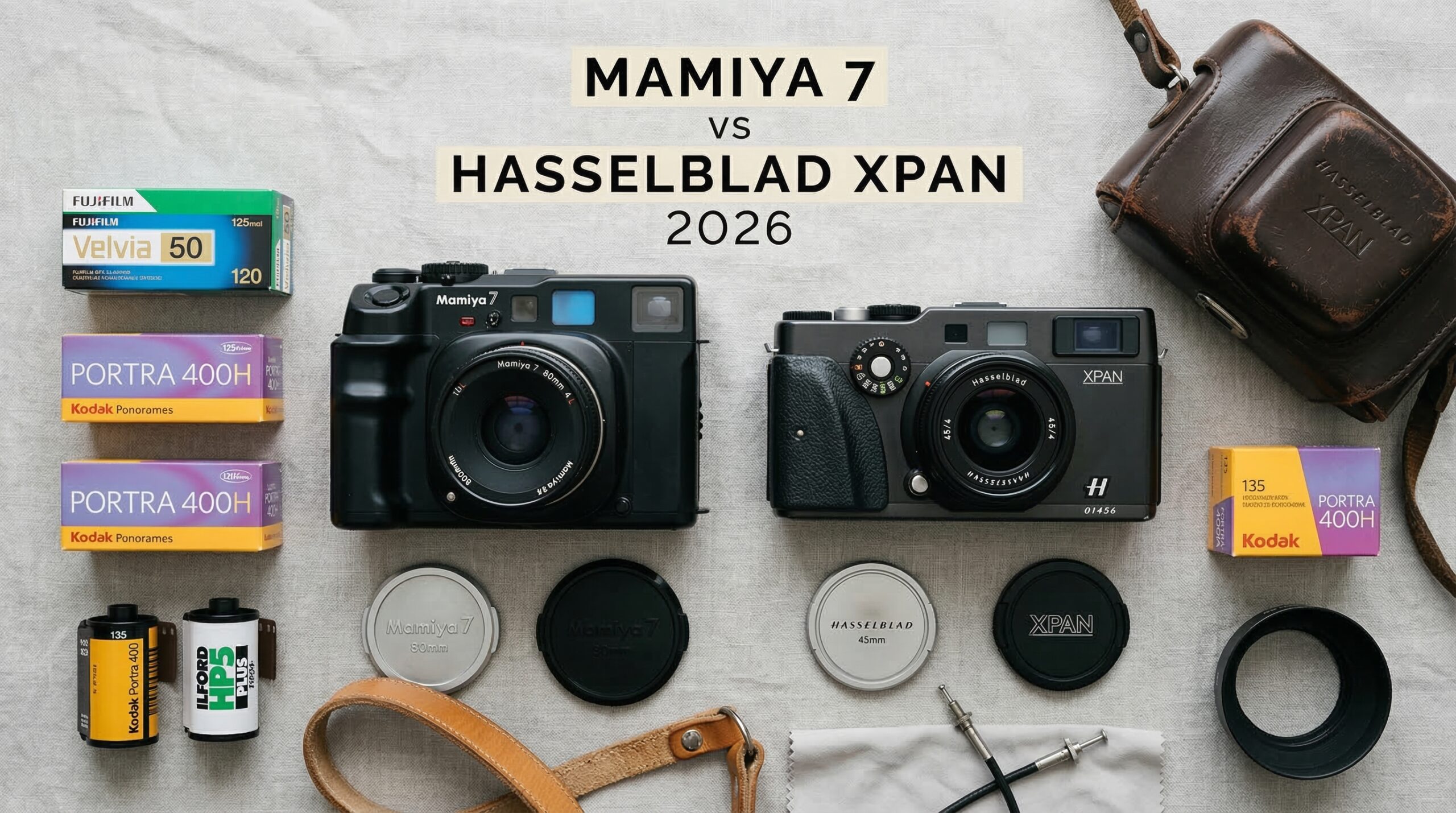
When film photographers start looking at premium rangefinder systems, two cameras consistently rise to the top: the Mamiya 7 and Hasselblad XPan. I’ve spent months shooting with both systems, and the decision between these two iconic cameras isn’t straightforward.
Both cameras command premium prices in today’s market and represent significant investments. They shoot completely different film formats, yet both attract photographers seeking something special that digital cameras can’t replicate.
The Mamiya 7 gives you massive 6×7 medium format negatives in a surprisingly portable rangefinder body. The XPan delivers stunning panoramic 35mm images with that classic cinematic aspect ratio. Your choice depends entirely on what you want to create and how you like to shoot.
In this comparison, I’ll break down the real-world differences between these two legendary cameras. No marketing fluff—just practical insights from actual shooting experience.
Table of Contents
Mamiya 7 vs Hasselblad XPan: Quick Comparison
Here’s how these two cameras stack up at a glance:
| Product | Specifications | Action |
|---|---|---|
 Mamiya 7 Mamiya 7 |
|
Check Current Options |
 Hasselblad XPan Hasselblad XPan |
|
Check Current Options |
Mamiya 7: The Medium Format Rangefinder
for Mamiya 7 Camera Case, BolinUS Handmade Genuine Real Leather Half Camera Case Bag Cover for Mamiya 7 Camera Bottom Opening Version + Hand Strap (Black)
Pros
- Massive 6x7 negatives
- Interchangeable lens system
- Auto and manual exposure
- Quiet leaf shutter operation
- Compact for medium format
Cons
- Plastic body components can crack
- Single strap lug
- Electronic components aging
- Panoramic adapter sold separately
The Mamiya 7 hits a sweet spot that few other cameras achieve. It pairs the massive image quality of 6×7 medium format with a rangefinder design that’s actually portable. I’ve carried this camera on week-long photography trips, and it’s one of the few medium format systems that won’t destroy your back or attract unwanted attention.
What makes the Mamiya 7 special starts with the negatives. At 6×7 centimeters, each frame gives you roughly four times the negative area of 35mm film. This translates to incredible detail, smooth tonality, and the ability to make enormous prints without losing quality. Every frame feels substantial in a way that 35mm never quite manages.
The rangefinder design makes it perfect for travel and street photography. It’s quiet—much quieter than an SLR—so you can shoot discreetly. The auto exposure system works beautifully, giving you perfect exposures even in tricky lighting conditions. I regularly shoot in aperture priority mode and let the camera handle the calculations while I focus on composition.
Lens selection sets the Mamiya 7 apart from the XPan. You get six superb lenses ranging from 43mm wide-angle to 210mm telephoto. Every lens features a leaf shutter that syncs flash at all speeds—brilliant for studio work or fill flash outdoors. The 80mm f/4 lens makes an excellent standard lens, while the 43mm captures breathtaking landscapes.
Build quality generates mixed feelings. The titanium top plate feels premium, but polycarbonate body coverings can crack over time. My Mamiya 7 developed hairline cracks in the plastic after five years of regular use. They don’t affect function, but they’re disappointing on a premium camera. The single strap lug on the left side also annoys me—why not include two?
Here’s where it gets interesting: the Mamiya 7 can shoot panoramic 35mm frames with an optional adapter kit. This isn’t as elegant as the XPan’s native panoramic mode—you waste more frames and the film loading process requires a dark bag. But it works, giving you 35x65mm frames that approximate the XPan experience.
The 35mm adapter costs extra and only gives you 15-16 panoramic frames per roll versus the XPan’s 21. The loading process involves taping 35mm film to 120 spools and manually resetting the frame counter. It’s fussy compared to the XPan’s straightforward film handling.
Investment value concerns many potential buyers. Mamiya 7 prices continue climbing, with clean bodies now selling for $2,500-$3,500. Lenses range from $800-$2,000 depending on focal length and condition. You’re buying into a system that’s already appreciated significantly, and parts availability could become problematic as electronic components age.
Hasselblad XPan: The Panoramic Specialist
Pros
- True panoramic format
- Superb build quality
- Excellent lens selection
- Simple film handling
- Strong investment value
Cons
- Only 3 lenses available
- Manual focus only
- No auto exposure
- Fixed panoramic format
- Limited versatility
The Hasselblad XPan takes a completely different approach. This camera shoots true panoramic 35mm film, exposing a 24x65mm frame that captures the world in that classic cinematic 2.7:1 aspect ratio. No adapters needed, no dark bag required—just load standard 35mm film and start shooting.
The XPan’s panoramic format transforms how you see and compose images. Landscapes stretch out before you with breathtaking scope. Environmental portraits gain context and storytelling power. Cityscapes feel immersive and grand. Every frame announces itself as something special.
Hasselblad built the XPan like a tank. Titanium and aluminum construction feels substantially more premium than the Mamiya’s mixed materials. The XPan II version improved reliability further, addressing electronic issues from the original model. My XPan II has traveled through deserts, rain forests, and Arctic conditions without missing a beat.
Lens selection frustrates some photographers. You only get three choices: 30mm f/5.6, 45mm f/4, and 90mm f/4. Thankfully, all three are exceptional performers with excellent sharpness and character. The 45mm serves as the standard lens, the 30mm captures vast landscapes, and the 90mm isolates subjects beautifully. But you can’t reach for a longer telephoto or ultra-wide option like you can with the Mamiya.
Manual focus defines the XPan experience. The rangefinder is bright and accurate, but there’s no auto focus or auto exposure. You set aperture, shutter speed, and focus manually for every shot. This slows you down and makes you more deliberate—some photographers love this ritual, others find it limiting.
The meter works well but only offers center-weighted averaging. You need to understand exposure and compensate for high contrast scenes. I often use an incident light meter or spot meter for critical work, treating the built-in meter as a rough guide.
Film handling couldn’t be simpler. Load any 35mm film, and you get 21 panoramic frames per roll. The camera rewinds automatically at the end. Switch to standard 35mm mode, and you get standard 24x36mm frames instead. This flexibility means you can shoot regular frames when panoramas don’t suit the subject.
Investment value strongly favors the XPan. Production numbers were limited—Hasselblad manufactured approximately 16,500 XPan bodies and 24,500 XPan II bodies. Demand continues growing while supply shrinks. Clean XPan II kits sell for $4,000-$6,000, sometimes more. The original XPan commands slightly lower prices but still appreciates steadily.
Service and repair remains possible through Hasselblad service centers, though costs reflect the premium nature of the brand. Electronic components remain available for now, but long-term repairability concerns any collector. The XPan II improved reliability over the original, making it the safer long-term investment.
Mamiya 7 vs Hasselblad XPan: Head-to-Head Comparison
Image Quality Showdown
Image quality comparisons favor different cameras depending on your priorities. The Mamiya 7’s 6×7 negatives contain vastly more information than the XPan’s panoramic 35mm frames. You get finer grain, smoother tonality, and more detail overall. A well-exposed Mamiya 7 negative can make stunning 40×50-inch prints without breaking down.
The XPan produces more characterful images in my experience. Something about the panoramic aspect ratio combined with Hasselblad lens quality creates images with tremendous presence. The prints have a cinematic quality that medium format can’t quite replicate. Resolution may be lower, but impact often feels higher.
Grain structure differs noticeably. XPan images shot on fine-grained films like Portra 160 or Ektar 100 show tight, pleasing grain patterns. Mamiya 7 negatives show less apparent grain due to the larger format, even when using faster films. Both cameras reward good technique with exceptional results.
Shooting Experience Compared
Quiet operation gives the Mamiya 7 an advantage for discreet shooting. The leaf shutter makes a soft “snick” sound compared to the XPan’s louder focal plane shutter. I feel more comfortable shooting street photography with the Mamiya 7 because it draws less attention.
Focus accuracy tips toward the Mamiya 7 as well. The rangefinder patch is bright and contrasty, making precise focus easier, especially in low light. The XPan’s rangefinder works fine but feels slightly less precise in comparison.
Auto exposure on the Mamiya 7 speeds up shooting significantly. You can work quickly in changing light without constantly adjusting settings. The XPan requires more conscious exposure decisions, which some photographers prefer for the control and deliberation it encourages.
Lens System Comparison
Versatility clearly favors the Mamiya 7. Six lenses from 43mm to 210mm give you options for any situation. Want to shoot environmental portraits with a 150mm? You can. Need an ultra-wide 43mm for architecture? It’s there. The system adapts to your vision rather than limiting it.
The XPan’s three-lens lineup covers most needs but lacks extremes. You can’t reach beyond 90mm, which limits portrait options. The 30mm wide-angle captures expansive views, but you won’t find anything equivalent to the Mamiya 7’s specialized lenses. What you get is superb quality, just less variety.
Lens character differs between systems. Mamiya lenses render beautifully but can feel slightly clinical—excellent for documentary work. XPan lenses have more distinctive character, producing images with slightly more contrast and presence straight out of camera.
Build Quality and Reliability
Build quality advantages lean toward the XPan. The titanium and aluminum construction feels more premium and has proven more durable over time. My XPan II shows minimal wear after heavy use, while my Mamiya 7 shows cosmetic issues despite less rigorous treatment.
Electronic reliability concerns both cameras as they age. The Mamiya 7 relies on electronics for shutter control, metering, and auto exposure. The XPan uses simpler electronics that seem more repairable long-term. Both cameras can develop issues, but the XPan appears to have fewer failure points.
Price and Value Analysis
Current market prices reflect the rarity and desirability of both cameras. Mamiya 7 bodies typically sell for $2,500-$3,500 depending on condition. Lenses add $800-$2,000 each, with the 80mm being most common and affordable. A complete three-lens kit might cost $5,000-$7,000 total.
XPan pricing runs higher due to rarity and demand. XPan II bodies command $4,000-$6,000. The three lenses add another $3,000-$5,000 depending on condition. Complete kits often exceed $8,000-$10,000, making the XPan a more substantial investment.
Value retention looks stronger for the XPan. Limited production numbers and continued demand suggest prices will keep climbing. The Mamiya 7 also appreciates but faces more competition from other medium format options. Both cameras represent solid investments, but the XPan offers more certainty.
Best Use Cases for Each Camera
Travel photography suits both cameras but in different ways. The Mamiya 7’s versatility lets you adapt to changing situations. One body with two lenses covers most travel scenarios. The XPan’s panoramic format creates distinctive travel images but requires more commitment to the panoramic vision.
Landscape photography advantages split between cameras. The Mamiya 7’s resolution and tonal range produce technically superior images. The XPan’s panoramic format captures the grandeur of landscapes in a way that standard formats can’t match. Many landscape photographers would benefit from owning both.
Street and documentary work favor the Mamiya 7. The quieter operation and auto exposure help you work quickly and discreetly. The XPan draws more attention and requires more deliberate shooting, though the results can be stunning for environmental documentary projects.
Panoramic Capabilities Compared
Native panoramic shooting belongs to the XPan. The camera was designed specifically for panoramic photography, and it shows in every aspect of the experience. Film handling is straightforward, frame spacing is perfect, and you get 21 panoramic frames per roll.
The Mamiya 7’s panoramic capability comes via adapter kits that let you shoot 35mm film in the 6×7 body. The official Mamiya adapter works well but costs extra. Cheaper third-party adapters exist but require loading film in a dark bag. You waste more frames, and the process feels clumsy compared to the XPan.
Panoramic image quality differs noticeably. XPan panoramic frames benefit from Hasselblad lens quality optimized for the format. Mamiya 7 panoramic shots use lenses designed for 6×7 format, which can cause slight optical compromises when shooting 35mm panoramic frames.
Verdict: Which Camera Should You Choose?
Choose the Mamiya 7 if you want maximum versatility and image quality. The interchangeable lens system adapts to any photographic situation. Auto exposure speeds up your workflow. Massive 6×7 negatives give you incredible detail and print quality. The ability to shoot both medium format and panoramic (with adapter) adds flexibility.
The Mamiya 7 excels for photographers who shoot various subjects and need a do-everything medium format system. Travel photographers, documentary shooters, and anyone wanting the best possible film image quality will love this camera. Just be prepared for the learning curve of medium format shooting and the investment in lenses.
Choose the Hasselblad XPan if panoramic photography excites you. The native panoramic format creates images with unique visual impact. Build quality inspires confidence. The shooting experience feels deliberate and intentional. Investment value looks strong for the future.
The XPan suits photographers committed to the panoramic vision. Landscape specialists, fine art photographers, and anyone wanting to create work that stands out from the crowd will appreciate what this camera offers. Accept the limitations of three lenses and manual everything as part of the experience.
If budget allows, consider owning both. They complement each other perfectly. Use the Mamiya 7 for general photography and situations requiring versatility. Pull out the XPan when you want to shoot panoramic specifically. Together they cover virtually any film photography need.
Your photography style should drive the decision. Environmental portrait specialists might prefer the Mamiya 7’s lens options and depth of field control. Landscape photographers who love panoramic compositions will gravitate toward the XPan. Street photographers who value discretion should lean Mamiya 7.
Investment considerations also matter. The XPan holds value better and seems more likely to continue appreciating. The Mamiya 7 also appreciates but faces more market competition. Buy either camera with confidence that you won’t lose money, but the XPan offers more certainty.
I use both cameras regularly and appreciate each for different reasons. The Mamiya 7’s versatility makes it my workhorse for travel and documentary projects. The XPan’s panoramic format creates my favorite landscape images and fine art work. They’ve both earned permanent spots in my camera collection.
Frequently Asked Questions
What makes the Mamiya 7 so special?
The Mamiya 7 combines massive 6×7 medium format negatives with a portable rangefinder design. It offers interchangeable lenses, auto exposure, and leaf shutter lenses that sync flash at all speeds. The camera delivers medium format image quality in a package that’s actually practical for travel and street photography.
What are the common problems with the Mamiya 7?
Common issues include cracking plastic body coverings, electronic failures as components age, and limited parts availability. The single strap lug on the left side annoys many users. Viewfinder flare can be problematic in bright light, and the battery door is fragile. Regular maintenance helps prevent issues.
Is the Mamiya 7 discontinued?
Yes, Mamiya discontinued the Mamiya 7 in the early 2000s after producing approximately 15,000 units. The Mamiya 7II improved upon the original with better electronics and minor cosmetic changes. Both models are now only available on the used market, with prices continuing to rise due to demand.
How many Hasselblad XPan were made?
Hasselblad produced approximately 16,500 original XPan bodies and 24,500 XPan II bodies between 1998 and 2002. The XPan II addressed electronic reliability issues from the original model. Limited production numbers contribute to strong value retention and rising prices on the used market.
Which camera is better for beginners?
Neither camera is ideal for beginners due to cost and complexity. The Mamiya 7’s auto exposure makes it slightly more approachable. The XPan’s manual everything requires more technical knowledge. Both cameras demand understanding of film photography fundamentals. Consider starting with a more affordable rangefinder before investing in either system.