
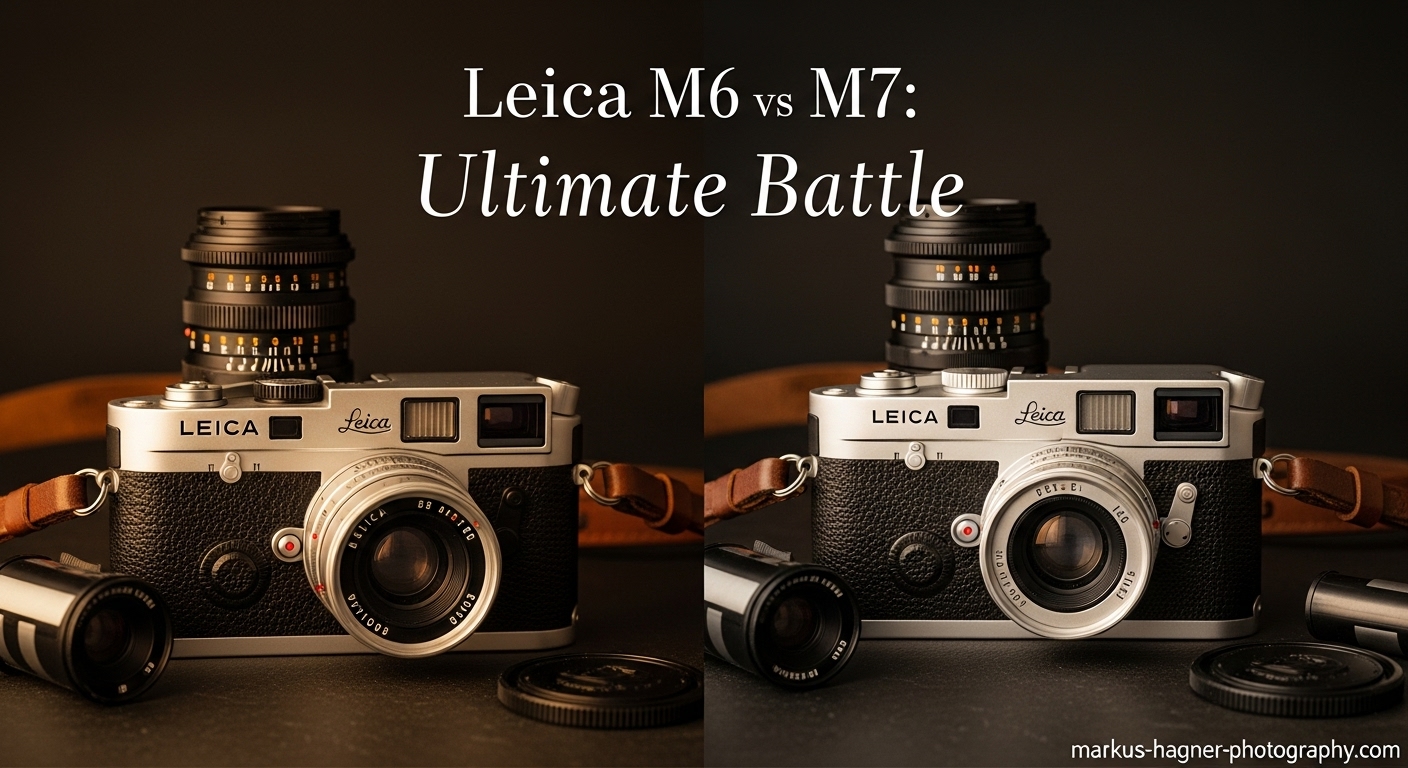
The Leica M6 and M7 represent two different philosophies in rangefinder camera design: the M6 is a purely mechanical camera with only a light meter requiring battery power, while the M7 introduces electronic aperture priority automation. This fundamental difference defines the shooting experience and practical use of each camera. As someone who has shot extensively with both models, I’m here to break down every aspect of these iconic cameras to help you decide which one deserves a place in your camera bag.
A Brief History of Leica M Cameras
Before diving into the specifics of each model, it’s worth understanding how these cameras fit into Leica’s prestigious history. The M series has been at the forefront of rangefinder photography since the introduction of the M3 in 1954, and both the M6 and M7 represent important milestones in this legacy.
The Leica M6: The Return of the Meter
Introduced in 1984, the Leica M6 was significant because it reintroduced a built-in light meter to the M series after a long absence. The M4-P, which preceded it, was a purely mechanical camera without a meter. The M6 combined the classic mechanical operation that Leica enthusiasts loved with the convenience of an integrated metering system.
I remember the first time I held an M6 – it felt like a perfect blend of tradition and practicality. The camera retained the classic M series styling and mechanical precision while adding just enough modern convenience to make it a practical tool for everyday photography.
The Leica M7: The Electronic Evolution
The M7, introduced in 2002, represented Leica’s first major foray into electronic automation in the M series. It retained the classic M form factor but added aperture priority auto-exposure, making it the first auto-exposure M camera since the ill-fated M5 of the 1970s.
When I first got my hands on an M7, I was struck by how familiar it felt despite its electronic nature. Leica had managed to incorporate modern technology without sacrificing the essential M shooting experience that photographers had come to love.
Key Differences Between M6 and M7
While these cameras look nearly identical at first glance, several important distinctions set them apart:
Exposure System
The most significant difference between the M6 and M7 is their exposure systems. The M6 is a fully manual camera with a match-needle metering system. You set both the aperture and shutter speed manually, and the camera’s meter helps you achieve the correct exposure.
The M7, on the other hand, offers aperture priority auto-exposure. You set the aperture on the lens, and the camera automatically selects the appropriate shutter speed. It can also be used in full manual mode like the M6.
I discovered this difference dramatically changes my shooting approach. With the M6, I’m fully engaged in every exposure decision, which slows me down and makes me more deliberate. With the M7, I can work more quickly when needed, letting the camera handle exposure while I focus on composition and timing.
Shutter Mechanism
The M6 features a mechanical shutter that operates at all speeds without battery power. Only the light meter requires batteries, and even then, the camera functions perfectly without them – you just need to use a separate light meter.
The M7 has an electronically controlled shutter that requires batteries to function at all speeds. If the batteries die, the camera is inoperable except at two mechanical backup speeds: 1/60 and 1/125 second.
This difference became apparent to me during a long trip when my M7 batteries died unexpectedly. I was limited to those two mechanical speeds until I could find replacements. With the M6, I would have been able to continue shooting at all speeds using sunny 16 or a handheld meter.
Shutter Speed Dial
The M6 has a traditional shutter speed dial with speeds from 1 second to 1/1000 second, plus Bulb mode. The dial moves smoothly and clicks positively into each position.
The M7’s shutter speed dial is different – it includes an “A” setting for aperture priority mode, and the dial itself has a different feel due to the electronic nature of the shutter. The dial turns more freely, and there’s a distinct detent at the “A” position.
I found that I needed to adjust my muscle memory when switching between the two cameras. With the M6, I can change shutter speeds by feel alone, but with the M7, I often need to look at the dial to ensure I’ve selected the right setting, especially when switching between auto and manual modes.
Viewfinder Display
The M6 uses a simple match-needle display in the viewfinder. Two arrows indicate over- or under-exposure, and a circle in the middle indicates correct exposure.
The M7 features a more sophisticated LED display with arrows for over- and under-exposure, plus a digital readout of the selected shutter speed in manual mode. In aperture priority mode, it shows the automatically selected shutter speed.
When I first used the M7, I appreciated the additional information provided by the digital display. However, I’ve come to prefer the simplicity of the M6’s match-needle system, which I find less distracting and more intuitive.
Battery Requirements
The M6 uses two SR44 or LR44 batteries, which power only the light meter. These batteries last a long time – I typically get six months to a year of regular use from a single set.
The M7 uses two DL1/3N batteries, which power both the meter and the electronic shutter. Battery life is shorter than in the M6, typically lasting two to three months with regular use.
I’ve learned to always carry spare batteries when shooting with the M7, especially on important assignments. With the M6, I’m less concerned about battery life since the camera will continue to function mechanically even if the batteries die.
Detailed Specifications Comparison
Let’s take a closer look at the specifications of both cameras side by side:
| Specification | Leica M6 | Leica M7 |
|---|---|---|
| Production Years | 1984-1998 (Classic), 1998-2002 (TTL) | 2002-Present |
| Exposure System | Manual, match-needle metering | Aperture priority and manual, LED display |
| Shutter Type | Mechanical | Electronically controlled |
| Shutter Speeds | 1-1/1000 sec + B | 8-1/1000 sec + B (auto), 1-1/1000 sec + B (manual) |
| Mechanical Shutter Speeds | All speeds | 1/60 and 1/125 sec (battery backup) |
| Metering System | Center-weighted, TTL | Center-weighted, TTL |
| Meter Range | EV 0 to EV 20 (ISO 100) | EV -2 to EV 20 (ISO 100) |
| Viewfinder | 0.72x magnification, 0.85x available | 0.72x magnification, 0.85x available |
| Frame Lines | Manually selected | Automatically selected with lens mounting |
| Flash Sync | 1/50 sec | 1/50 sec (1/250 sec with dedicated flash) |
| Battery Type | Two SR44 or LR44 | Two DL1/3N |
| Weight | 560g (without battery) | 610g (without battery) |
| Dimensions | 138 x 77.5 x 38mm | 138 x 79.5 x 38mm |
Build Quality and Design
Both the M6 and M7 share the exceptional build quality that has made Leica cameras legendary among photographers. These cameras are precision instruments built to last a lifetime.
Body Construction
The bodies of both cameras are crafted from solid brass with a durable chrome or black paint finish. The top plate is brass milled from a solid block, giving both cameras a substantial feel that’s immediately apparent when you pick them up.
I’ve owned examples of both cameras that have seen decades of use, and they still function perfectly. The build quality is simply exceptional – there’s no plastic here, just metal, glass, and leatherette.
Ergonomics and Handling
In terms of handling, both cameras are nearly identical. The controls are logically placed and easy to operate by feel alone. The film advance lever is smooth and positive, with a short throw that allows for rapid shooting when needed.
I’ve found that both cameras balance beautifully with a wide range of M-mount lenses. The weight distribution is excellent, making them comfortable to hold for extended shooting sessions.
Viewfinder
The viewfinders on both cameras are bright and clear, with 0.72x magnification as standard (0.85x was available as an option on both models). The main difference is in the display – the M6’s match-needle system versus the M7’s LED display.
When I’m shooting in bright conditions, I find the M6’s match-needle system easier to see than the M7’s LEDs. However, in low light, the M7’s LEDs have the advantage, being more visible in dim conditions.
Performance and Handling
While the specifications tell part of the story, real-world performance is what truly matters. Let’s examine how these cameras perform in practice.
Metering Accuracy
Both cameras feature center-weighted TTL metering that’s remarkably accurate in most situations. The M7 has a slightly wider metering range (EV -2 to EV 20 vs. EV 0 to 20 for the M6), making it slightly better in very low light conditions.
I’ve tested both cameras in a variety of lighting conditions and found the metering to be consistently reliable. The M7’s additional sensitivity in low light can be useful, but in practice, I rarely find myself shooting in conditions where the M6’s meter would struggle.
Shutter Performance
The M6’s mechanical shutter is whisper-quiet and virtually vibration-free. It’s one of the quietest shutters I’ve ever used, making it ideal for discreet photography.
The M7’s electronic shutter is also very quiet, though slightly more audible than the M6’s. The electronic control allows for more precise timing, which can result in more consistent exposures across the entire shutter speed range.
I’ve found that both cameras deliver excellent results, but there’s something special about the feel of the M6’s mechanical shutter. It has a tactile quality that’s missing from the M7’s electronic operation.
Film Transport
The film advance mechanism on both cameras is smooth and positive, with a short throw that allows for rapid shooting when needed. The film counter is mechanical and accurate, and the rewind crank is comfortable to use.
I’ve shot dozens of rolls through both cameras and have never experienced a film transport issue. The mechanism feels robust and precise on both models.
Image Quality
Since both cameras use the same lens mount and essentially the same body design, there’s no difference in image quality between them when using the same lens and film. The quality of your images will depend primarily on your lens choice, film selection, and technique.
Lens Compatibility
Both cameras are fully compatible with all Leica M-mount lenses, as well as many third-party M-mount lenses from manufacturers like Voigtländer and Zeiss. This gives you access to an enormous range of high-quality optics.
I’ve used everything from vintage Leica screw-mount lenses (with an adapter) to modern ASPH lenses on both cameras, and the results have been consistently excellent. The M-mount’s longevity is one of the reasons these cameras remain so popular today.
Film Performance
Both cameras handle all standard 35mm film formats, from ISO 25 to ISO 3200. The metering system works reliably across this range, though I’ve found that it’s most accurate with films in the ISO 100-400 range.
When shooting with slide film, which has less exposure latitude than negative film, I’ve learned to trust the meter but also to bracket important exposures. With negative film, I’ve found that both cameras deliver excellent results with minimal adjustments needed.
Also Read: Nikon 14-30 Vs 16-35
Practical Use in Modern Photography
Using these classic cameras in today’s digital world presents some unique considerations and opportunities.
Battery Availability
Both cameras use commonly available batteries, though the M7’s DL1/3N batteries are slightly less common than the M6’s SR44/LR44 batteries. Both types are readily available online and in most camera stores.
I always carry spare batteries when shooting with these cameras, though I’m less concerned about it with the M6 since it will continue to function mechanically even if the batteries die.
Maintenance and Repair
One of the great advantages of these cameras is their simplicity and durability. However, like any precision instrument, they may eventually need maintenance or repair.
I’ve found that both cameras are relatively easy to maintain for basic cleaning and care. For more serious repairs, there are still technicians who specialize in these models, though parts are becoming scarcer as time goes on.
Hybrid Shooting Approaches
Many photographers today use these cameras alongside digital systems. I often shoot with both my M6 and a digital camera, giving me the best of both worlds—the tactile experience and unique look of film combined with the convenience and immediacy of digital.
When I’m traveling, I sometimes carry just one of these cameras with a few rolls of film. The simplicity and reliability allow me to focus on making images rather than fussing with settings and gear.
Value and Collectibility
Both the M6 and M7 have become sought-after cameras on the used market, but their values differ based on several factors.
Current Market Values
As of 2026, the M6 typically commands higher prices than the M7, especially for early models and special editions. A clean, fully functional M6 might sell for $2,500-4,000, depending on the specific model and condition, while an M7 might fetch $2,000-3,000.
I’ve noticed that black paint versions of both cameras tend to be more valuable than chrome ones, and examples with original boxes, manuals, and paperwork command premium prices.
Investment Potential
Both cameras have proven to be good investments over time, with values steadily increasing as film photography experiences a resurgence. The M6, being purely mechanical, is often seen as more collectible, while the M7 is valued more for its practical features.
I’ve seen prices for both models rise over the past decade, and I believe this trend will continue as more photographers discover the joys of shooting with these remarkable cameras.
Future Collectibility
Looking ahead, both cameras are likely to remain desirable among film photography enthusiasts. The M6’s mechanical nature gives it a timeless appeal, while the M7 represents an interesting transition point in Leica’s history.
I’ve started to see early serial number M6 models command premium prices, suggesting that collectors are recognizing their historical significance. The M7, being more recent, may take longer to achieve similar collectible status, but its place in Leica’s history ensures it will always have value.
Personal Experience with Both Cameras
I’ve been shooting with Leica M cameras for over a decade, and both the M6 and M7 have spent considerable time in my camera bag. Here are some of my personal observations:
The M6 was my first Leica camera. I remember the feeling of pure mechanical precision when I first advanced the film and pressed the shutter button. There was something magical about the simplicity and directness of the experience. I used that camera primarily for street photography and portraits, and it never let me down.
A few years later, I added an M7 to my collection. At first, I was hesitant about the electronic components, but I quickly grew to appreciate the convenience of aperture priority mode. I found myself reaching for the M7 when I needed to work quickly, especially in changing light conditions.
One thing I’ve discovered is that both cameras encourage a more deliberate approach to photography. Without the convenience of autofocus or autoexposure (on the M6, at least), I find myself slowing down and thinking more carefully about each frame. This has improved my photography across all formats, not just film.
Which One Should You Choose?
The choice between the M6 and M7 ultimately comes down to your specific needs and preferences as a photographer.
Choose the Leica M6 if:
- You prefer a purely mechanical shooting experience
- You want a camera that will function without batteries
- You value simplicity and reliability over automation
- You’re a collector interested in historically significant cameras
- You primarily shoot in controlled conditions where you have time to set exposures manually
I’ve found that the M6 is perfect for street photography and landscape work where I can take my time with exposures. The mechanical nature gives me confidence that it will work in any conditions, from extreme cold to heat, without worrying about electronic failures.
Choose the Leica M7 if:
- You want the convenience of aperture priority auto-exposure
- You frequently shoot in changing light conditions
- You need to work quickly and don’t want to miss shots while adjusting settings
- You value the slightly more advanced metering system
- You don’t mind relying on batteries for camera operation
For documentary and event photography, the M7’s aperture priority mode can be a real advantage. I’ve used it for weddings and parties where lighting conditions change rapidly, and being able to set the aperture and let the camera handle the shutter speed allows me to focus on capturing moments.
Pro Tips for Using These Classic Cameras
After years of shooting with both the M6 and M7, I’ve learned some valuable lessons that can help you get the most out of these cameras:
Battery Management
Always carry spare batteries, especially if you’re shooting with an M7. I’ve learned the hard way that electronic cameras can fail at the most inconvenient times. With the M6, I’m less concerned, but I still carry spares for the meter.
Metering Techniques
Both cameras use center-weighted metering, which works well for many subjects but can be fooled by high-contrast scenes. I’ve learned to point the camera at a medium-toned area when metering, or to use the sunny 16 rule as a backup.
Focusing Tips
The rangefinder patch on both cameras is precise but small. I’ve found that adding a 1.25x magnifier can make focusing easier, especially with fast lenses. For critical focus, I sometimes use the focus recompose technique, focusing on a detail at the same distance as my subject.
Film Handling
When loading film, make sure the leader is properly secured on the take-up spool. I’ve missed the first few frames on more than one occasion by not being careful with this step. Also, avoid changing film in bright sunlight to prevent fogging.
Also Read: Sony A6600 vs A7IV
Lens Recommendations
Both cameras work beautifully with all M-mount lenses. I’ve found that the 35mm Summicron is an excellent all-around lens for street photography, while the 50mm Summilux is superb for low-light work. For portraits, the 90mm Elmarit is hard to beat.
FAQ
How can I tell if I have an M6 or M7?
The easiest way to identify your camera is to look for the “M7” marking on the front of the camera. The M7 also has an “A” setting on the shutter speed dial for aperture priority mode, which the M6 lacks. Additionally, the M7 has a different battery compartment on the bottom plate, designed for DL1/3N batteries rather than the SR44/LR44 batteries used in the M6.
Are these cameras suitable for beginners?
Both cameras can be excellent for beginners, but they require a solid understanding of photographic fundamentals. The M6, being fully manual, forces you to learn about exposure relationships, which can be educational but frustrating for some beginners. The M7’s aperture priority mode can be more forgiving while still teaching the importance of aperture control.
Can I use modern lenses with these cameras?
Yes, both cameras are compatible with all Leica M-mount lenses, including modern designs. They also work with many third-party M-mount lenses from manufacturers like Voigtländer and Zeiss. Additionally, with an appropriate adapter, you can use screw-mount lenses as well.
Do these cameras require batteries to operate?
The M6 can operate mechanically at all shutter speeds without batteries – only the light meter requires power. The M7 requires batteries to function at all shutter speeds except for two mechanical backup speeds (1/60 and 1/125 second).
Which camera is more reliable?
Both cameras are exceptionally well-built and designed to withstand years of heavy use. The M6’s mechanical nature makes it potentially more reliable in extreme conditions where electronic devices might fail. However, the M7’s electronic components are generally very reliable, and many have been in service for decades without issues.
Are parts still available for these cameras?
While some parts are becoming scarcer, many common replacement parts are still available. Leica still services both models, and there are independent technicians who specialize in repairing these cameras. However, as time goes on, finding certain parts may become more challenging.
Conclusion
The Leica M6 and M7 represent two different approaches to rangefinder camera design, each with its own strengths and appeal. The M6 offers the purity of a mechanical camera with only the essential convenience of a light meter, while the M7 introduces electronic automation with its aperture priority mode.
After extensive use of both models, I’ve come to appreciate each for what it offers. The M6 is a timeless classic that provides a direct, engaging shooting experience that’s hard to match. The M7, while more modern, retains the essential M character while adding features that can make it more practical for certain types of photography.
Ultimately, the choice between these two cameras comes down to your personal shooting style and preferences. If you value the tactile experience of mechanical photography and want a camera that will work in any conditions, the M6 is an excellent choice. If you prefer the convenience of aperture priority and don’t mind relying on batteries, the M7 might be the better option.
Regardless of which camera you choose, you’ll be joining a long tradition of photographers who have used Leica M cameras to create some of the most iconic images in photographic history. Both cameras are capable of producing exceptional results in the right hands, and either one can be a lifetime companion for your photographic journey.
I hope this comparison has helped you in your decision-making process. If you have any questions or experiences with these cameras that you’d like to share, please leave a comment below. And don’t forget to bookmark this page for future reference as you continue your film photography journey!
Looking for more classic camera comparisons? Check out my articles on Leica M3 vs M6 and Best Film Cameras for Street Photography for more insights into film photography equipment.
Want to stay updated on the latest film photography tips and reviews? Subscribe to my newsletter for monthly updates delivered straight to your inbox!