
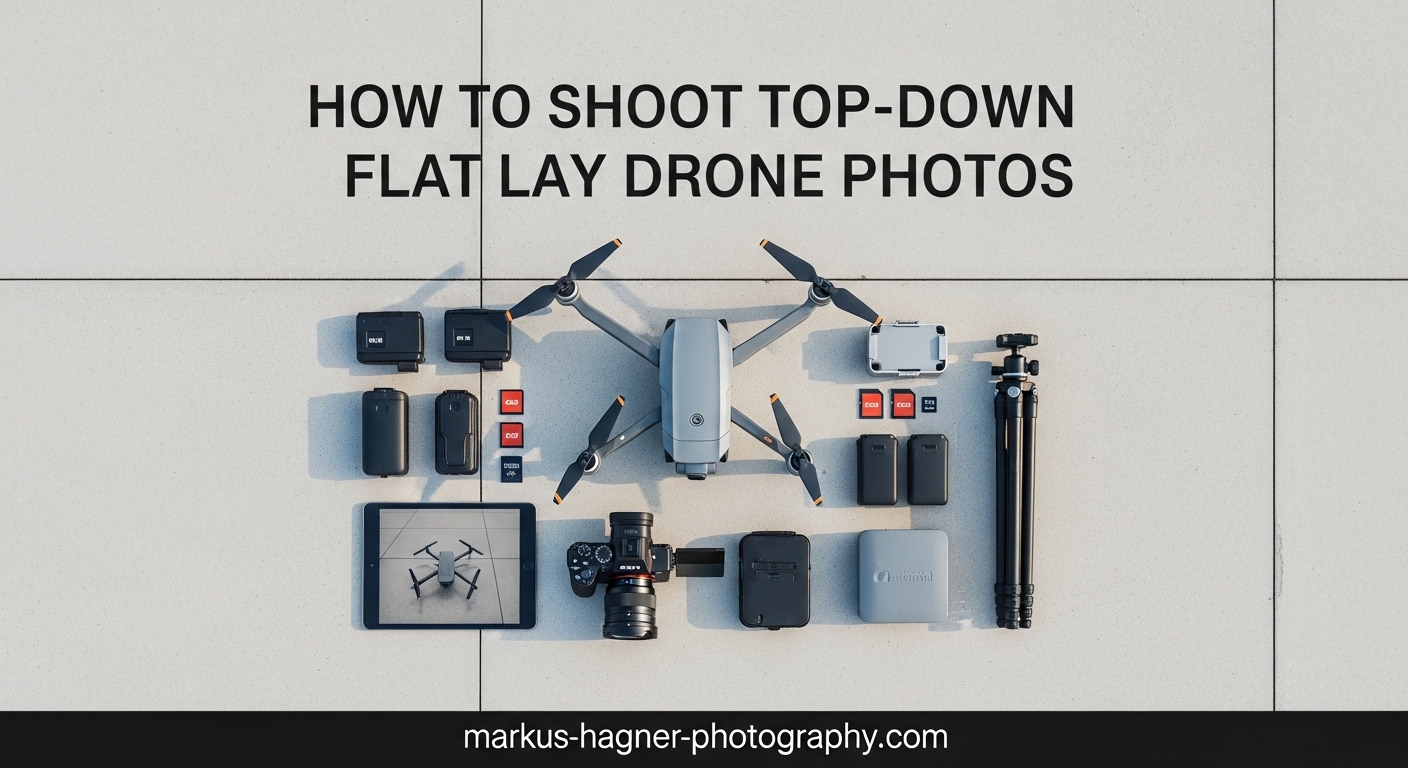
Top-down drone photography opens up a world most photographers never get to see — a clean, overhead perspective that turns ordinary scenes into striking geometric compositions. Whether you want to capture a coastal landscape, a winding road, or a styled product scene from the air, knowing how to shoot top-down flat lay drone photos with strong composition is the skill that separates forgettable aerials from images that genuinely stop people mid-scroll.
I’ve spent a lot of time experimenting with top-down shots — getting the altitude wrong, fighting harsh shadows, and slowly figuring out what actually makes these images work. This guide covers everything I’ve learned, from drone settings and gimbal angles to composition frameworks and lighting timing.
No matter if you’re flying a DJI Mini 4 Pro or a more advanced bird, the compositional principles here apply across the board. Let’s get into it.
What Is Top-Down Flat Lay Drone Photography?
Top-down drone photography — also called nadir photography or bird’s-eye view photography — is the practice of pointing your drone’s camera straight down (90 degrees) to capture images directly overhead. The camera looks at the world as if from a ceiling, flattening depth and revealing patterns, textures, and spatial relationships invisible from any other angle.
The term “flat lay” comes from studio photography, where objects are arranged on a flat surface and shot from above. When you take that concept into the air with a drone, you get flat lay drone photography: aerial scenes composed like a carefully arranged table spread, with roads, fields, rooftops, or water acting as the “background.”
The nadir view is distinct from a standard aerial shot at a 45-degree angle. At nadir, depth perception almost disappears — you lose the horizon, shadows become short and directional, and everything reads as shape and pattern first. That’s what makes it so visually powerful when the composition is right.
Equipment and Drone Settings for Top-Down Shots
Getting clean, sharp, well-exposed top-down drone photos depends less on having the most expensive gear and more on understanding how to configure what you already have. Here’s what matters.
Setting Your Gimbal to Nadir (Straight Down)
Most modern drones — DJI models in particular — allow the gimbal to tilt to -90 degrees, which is the true nadir or straight-down position. You’ll find this in your drone’s camera control panel, usually by either dragging a slider or using the physical gimbal wheel. Set it to exactly -90 degrees and double-check it before your flight, because even a few degrees off will introduce perspective distortion that’s hard to fix in post.
On some drones, you can lock the gimbal angle in place during flight so accidental stick inputs don’t shift the camera. Use that feature if it’s available. For panoramic top-down shots, many DJI drones also have a dedicated “Sphere” or “Vertical” panorama mode that automates the nadir capture sequence.
Camera Settings: Exposure, ISO, and Aperture
For static top-down shots, treat this like any landscape photography scenario. Shoot in RAW if your drone supports it — it gives you far more latitude in post-processing for recovering highlights and shadows. Keep your ISO as low as possible (ISO 100 or 200 in bright light) to minimize noise.
Aperture-wise, aim for f/2.8 to f/5.6 depending on your lens. Most drone cameras have small fixed focal lengths with deep depth of field, so you don’t need to worry much about focus at shooting altitude. Shutter speed should be fast enough to prevent motion blur: at least 1/640s or faster if there’s any wind. Use an ND filter in bright daylight to avoid having to push shutter speed too high relative to aperture.
For video-style top-down footage, apply the 180-degree shutter rule — set shutter speed to double your frame rate (1/50s at 25fps, 1/60s at 30fps) and use ND filters to manage exposure.
Using Grid Overlays and Focus Modes
Turn your grid overlay on before every top-down shoot. The rule-of-thirds grid becomes your real-time composition guide in nadir mode, helping you align roads, shorelines, or key subjects to the intersecting grid lines before you press the shutter.
Most drones use contrast-detect autofocus, which works well in bright daylight. For maximum sharpness, switch to single-point AF and place it over the most important element in your frame. If you’re shooting very close to the ground (under 20 meters), be aware that autofocus can struggle — consider using manual focus if your drone supports it.
How to Shoot Top-Down Flat Lay Drone Photos with Strong Composition
Composition is where top-down drone photography either succeeds or falls apart. Here are the core techniques I rely on for overhead shots that have real visual impact.
Rule of Thirds from Above
The rule of thirds works exactly the same from above as it does from the ground — divide your frame into a 3×3 grid and place your most important subject at one of the four intersection points, not dead center. From a nadir position, your “subject” might be a lone tree in a field, a boat on a river, or the peak of a rooftop pattern.
When you’re hovering and composing, physically fly the drone sideways or forward/backward to shift where your subject lands within the grid. Don’t rely on cropping in post to fix a compositional miss — get it right in the air.
Leading Lines and Visual Flow
Leading lines are one of the most powerful tools in aerial composition. Roads, rivers, fences, shorelines, shadows, and rows of crops all become strong directional lines from above. Arrange your drone’s position so these lines travel from a corner or edge of the frame toward your main subject, drawing the viewer’s eye through the image.
The most compelling overhead compositions use lines that converge, curve, or intersect — creating a sense of movement and depth even without a traditional foreground-to-background perspective. Diagonal lines carry more visual energy than horizontal or vertical ones, so when possible, fly to an angle that introduces a diagonal element into the frame.
Symmetry and Pattern Recognition
Top-down perspective is where symmetry truly shines. Harbors, roundabouts, agricultural fields, building facades, and even parking lots reveal perfect symmetry when viewed from directly above. Look for these repeating patterns during your pre-flight planning — they’re often invisible from ground level but become dominant compositional forces from the air.
When shooting symmetrical subjects, centering becomes intentional rather than lazy. The symmetry itself is the composition. Make sure your horizon is perfectly level and your gimbal is truly at -90 degrees, otherwise the symmetry breaks and the whole shot weakens.
Negative Space as a Compositional Tool
Negative space — the empty area surrounding your main subject — is one of the most underused tools in top-down drone photography. A single red kayak on dark blue water, or a lone figure walking across a snow field, gains enormous visual power from the emptiness around it.
From above, large areas of texture like sand, water, grass, or concrete become premium negative space backgrounds. When you find a single interesting subject surrounded by clean, consistent texture, position it off-center using the rule of thirds and let the background breathe. The resulting image reads as clean, modern, and intentional.
Layout Shapes: C, V, S, and Diagonal Arrangements
This technique comes directly from studio flat lay photography and translates beautifully to drone work. Rather than randomly placing subjects across the frame, arrange them (or position yourself above naturally occurring elements) in recognizable shapes.
A C-shaped layout wraps a curve of elements around negative space at the center — great for shorelines curving around a bay or a road bending through a valley. A V-shaped arrangement points toward a central subject like converging roads or rows of trees meeting at a building. An S-curve creates a flowing movement through the frame — rivers and coastlines naturally form S-curves when viewed from above, and they are almost always compelling.
For styled product-style top-down drone shots (think branded content), a diagonal arrangement of items at roughly 45 degrees creates dynamism and visual tension that purely horizontal or vertical layouts lack. This is worth practicing because it dramatically elevates content-focused aerial photography.
The Hero Item and Supporting Elements
In flat lay photography, every strong composition has a “hero item” — the dominant subject that everything else supports. From above, this might be a person, a vehicle, a building, or a specific landscape feature. Identify your hero before you fly and build your composition around placing it powerfully within the frame. Supporting elements (roads, shadows, secondary subjects) should lead to it, not compete with it.
Lighting for Top-Down Drone Photography
Lighting in top-down drone photography behaves differently than in standard aerial or ground shooting. Without a foreground-to-background depth relationship, shadows and highlights become the primary way the image communicates texture and dimension. Getting the light right is non-negotiable.
Best Time of Day: Golden Hour vs. Overcast Light
For top-down shots of organic subjects — landscapes, forests, coastlines — golden hour is exceptional. The low-angle sun throws long, directional shadows that reveal texture and add drama to what might otherwise be a flat-looking overhead view. The warm color cast also unifies the image and makes it feel intentional.
However, for styled top-down flat lay drone photos where you want clean, even illumination — think real estate rooftop shots or branded content photography — overcast light is actually preferable. Thick cloud cover acts like a giant softbox, eliminating harsh shadows and giving every element in the frame equal exposure. This is the same reason studio photographers use diffused lighting for product shots.
Avoid shooting top-down between 10am and 2pm in summer. The sun is directly overhead, shadows are minimal and fall directly beneath subjects, and the harsh contrast destroys texture. This is particularly problematic with white surfaces like sand or snow, which will blow out completely.
Planning and Managing Shadows
Shadows are a double-edged sword in overhead photography. Long shadows add depth and visual interest — a row of palm trees casting long parallel shadows on a beach at 7am is a classic top-down composition precisely because of those shadows. But unwanted shadows from buildings, your own drone, or nearby trees can ruin an otherwise clean shot.
I use sun position planning tools — PhotoPills is the industry standard — to preview where shadows will fall at a specific location and time before I even drive to the shoot. The “Planner” feature lets you simulate the sun angle and shadow direction for any date and time, so you can identify the 15-minute window where the light hits exactly how you need it.
Always check for your drone’s own shadow. At low altitudes (under 30 meters), it can appear in the bottom center of your frame. Fly slightly to the side of your subject so the drone’s shadow falls outside the composition, or shoot at an altitude where it becomes invisible.
Reflectors and Fill Light from Above
For close-range top-down drone shots (under 10 meters — think styled ground scenes or product flat lays being photographed with a drone instead of a tripod), you can use physical reflectors below the camera. White foam boards positioned around the subject bounce ambient light back upward and fill in shadows from below the lens.
This is a technique that forum photographers on Reddit’s drone photography communities swear by — propping a large white foam board at an angle next to the subject to brighten the near side and reduce shadow contrast. It sounds simple because it is, and it genuinely works.
Drone-Specific Tips for Flat Lay Aerial Shots
Beyond composition and lighting, there are a handful of operational considerations specific to flying a drone for top-down shots that can make or break your results.
Choosing the Right Altitude
Altitude changes everything in top-down photography. At 5-15 meters you’re effectively shooting an aerial flat lay of ground-level subjects — individual items, people, small scenes. At 30-80 meters you’re capturing building-scale patterns like rooftops, courtyards, and parking lots. At 100-200 meters the frame fills with district-scale patterns — neighborhoods, agricultural grids, river bends.
For most compositional top-down work, the sweet spot is 40-80 meters. This altitude gives you enough coverage to include compositional context without losing detail on individual elements. It also keeps most drones in a comfortable, stable flight envelope where wind drift is manageable and autofocus is reliable.
Shoot at multiple altitudes during a session. I’ll often do three altitude passes at the same location — 30m, 60m, and 100m — and the winning composition is rarely at the altitude I guessed in advance.
Planning Your Shot from Home
Planning top-down drone photos before you arrive at the location is not just convenient — it’s what separates deliberate, purposeful photography from aimlessly flying around hoping something looks good. Google Earth’s 3D view and satellite layer are your best pre-flight tools. Switch to the flat satellite view and identify geometric patterns, leading lines, interesting textures, and shadow-casting structures at your target location.
PhotoPills lets you simulate your shot with drone-mode previews, including sun position and shadow direction at your planned shoot time. You can pin the exact GPS location and see a simulation of the overhead view complete with predicted light angle. I’ve planned entire shoots this way and arrived knowing exactly where to position myself and what time the light would be right — saving hours of trial and error in the field.
Avoiding Distortion in Overhead Drone Shots
Distortion is one of the most common complaints from drone photographers shooting top-down — particularly barrel distortion at the edges of the frame when using wide-angle drone cameras. The wider the lens, the more subjects near the frame edges appear to curve outward.
There are three ways to deal with this. First, if your drone’s camera has a zoom function, use a slightly longer effective focal length (24-28mm equivalent instead of 12-16mm) to reduce barrel distortion. Second, compose important subjects in the center 60-70% of the frame and crop the distorted edges in post. Third, use your drone’s built-in lens correction profile if it exists, or apply the corresponding profile in Lightroom or Capture One during editing.
This is especially important for architecture and any subject where straight lines appear — a curved roofline or bowed road is immediately noticeable and makes the image look technically deficient even if the composition is strong.
Common Flat Lay Drone Photography Mistakes to Avoid
Most top-down drone photos that don’t work fall into a few predictable failure patterns. Here’s what to watch for:
- Not checking gimbal level. A camera that’s 2-3 degrees off from true nadir creates subtle perspective distortion and throws off any symmetric composition. Check it on every flight.
- Shooting in harsh midday sun. Overhead light at noon creates flat, blown-out images with no directional shadow to add texture or depth. Plan for golden hour or overcast conditions instead.
- No clear hero subject. A top-down shot needs an anchor point. Without a clear primary subject, the viewer’s eye wanders and the composition reads as chaotic rather than intentional.
- Too much visual clutter. Overhead perspectives reveal everything — including distracting cars, shadows from nearby objects, or people walking into frame. Scout the scene carefully and time your shot.
- Forgetting the drone’s shadow. At low altitudes your drone casts a shadow directly into the center of your frame. Offset your flight position or increase altitude to eliminate it.
- Not using RAW format. JPEG processing in-camera discards exposure data you’ll desperately want when recovering details in shadows and highlights during editing.
- Ignoring edge distortion. Wide-angle drone cameras distort subjects near the frame edges. Compose with key elements in the middle portion of the frame and crop aggressively if needed.
Frequently Asked Questions
How do you take good flat lay photos with a drone?
Position your gimbal at exactly -90 degrees (nadir), enable your grid overlay, and identify a clear hero subject before you fly. Use the rule of thirds to place the main subject at a grid intersection rather than the center. Shoot during golden hour or under overcast light for the most flattering overhead illumination, and always shoot in RAW to preserve editing flexibility.
What is the 20-60-20 rule in photography?
The 20-60-20 rule refers to a tonal balance guideline: roughly 20% of the frame should be your darkest tones (shadows and deep colors), 60% should be your midtones (the dominant background or surface), and 20% should be your lightest highlights. Applied to flat lay and top-down drone photography, it helps maintain tonal harmony — you avoid an image that is either too dark and muddy or too bright and washed out.
What are the most common flat lay photography mistakes?
The most common flat lay mistakes are: shooting in harsh midday light that creates flat, shadowless images; having no clear hero subject for the eye to land on; including too much visual clutter without a compositional framework; using JPEG instead of RAW and losing editing latitude; and not correcting for barrel distortion from wide-angle drone cameras, which bows straight lines near the frame edges.
What is the best focal length for flat lay drone photography?
A 24-28mm equivalent focal length is ideal for flat lay drone photography. This range minimizes barrel distortion compared to ultra-wide 12-16mm drone cameras while still giving you a wide enough field of view to capture the scene. If your drone has a zoom capability, avoid the widest setting and zoom in slightly. For very controlled, product-style top-down shots close to the ground, a 50mm equivalent works well.
Final Thoughts
Mastering how to shoot top-down flat lay drone photos with strong composition comes down to three habits: planning before you fly, understanding how light reads differently from above, and applying compositional frameworks deliberately rather than pointing straight down and hoping for the best.
Use your grid overlay every time. Learn to read scenes for their inherent lines, patterns, and symmetry from a bird’s-eye perspective. Shoot in golden hour light when you want drama, or overcast light when you want clean, even tones. Plan your shots in Google Earth and PhotoPills before you drive to the location — it genuinely changes the quality of what you bring home.
The photographers getting standout top-down drone images in 2026 are not necessarily flying more expensive gear. They’re flying with a clearer compositional vision. Build that vision through the techniques in this guide and your overhead shots will get stronger every time you’re in the field.