
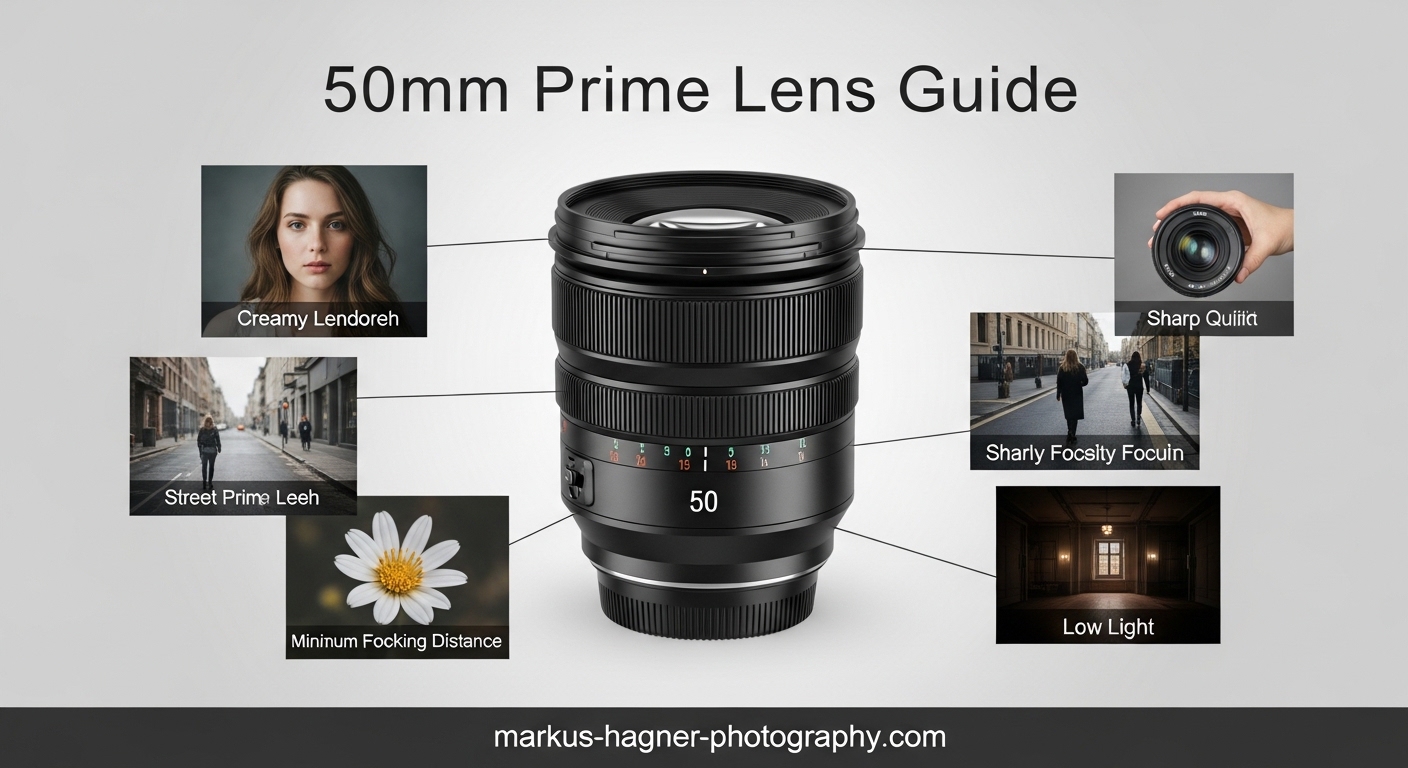
The 50mm prime lens, affectionately known as the “nifty fifty,” has earned its place in camera bags worldwide. I bought my first 50mm f/1.8 seven years ago, and it remains the lens I grab first for everyday photography. The combination of sharp optics, fast aperture, and affordable price point makes it an essential tool for photographers at every skill level.
In this comprehensive guide on how to get the most from a 50mm prime lens for everyday photography, I will share techniques I have learned through thousands of frames. Whether you are shooting portraits, street scenes, or family memories, these practical tips will help you maximize your nifty fifty’s potential.
Quick Tips for 50mm Success
Before diving into the details, here are the essential techniques that will immediately improve your 50mm photography:
1. Find the aperture sweet spot. Most 50mm lenses deliver maximum sharpness between f/4 and f/5.6. Reserve f/1.8 for situations where you truly need that shallow depth of field.
2. Respect the minimum focusing distance. Most 50mm lenses cannot focus closer than approximately 18 inches (45cm). If your autofocus hunts, step back.
3. Use single-point autofocus. This gives you precise control over exactly where focus lands, which becomes critical at wide apertures.
4. Maintain fast shutter speeds. Aim for at least 1/100 second to avoid camera shake, even if your camera has image stabilization.
5. Move your feet to zoom. Without a zoom ring, you become the zoom. This constraint actually improves your compositional skills.
6. Stop down for group portraits. At f/1.8, only one person will be sharp. Use f/4 or f/5.6 for groups to ensure everyone is in focus.
7. Practice the one-lens challenge. Commit to shooting with only your 50mm for 30 days. Your composition skills will develop dramatically through this focused practice.
Understanding Your 50mm Prime Lens
A prime lens has a fixed focal length, meaning you cannot rotate a zoom ring to bring your subject closer. This might seem limiting at first, but I have found that this constraint actually forces more thoughtful composition.
The 50mm focal length approximates human vision quite closely. When you look through the viewfinder, the scene appears natural and familiar. Objects appear at roughly the same distance and perspective as your eyes perceive them. This natural perspective makes composition intuitive and helps you anticipate how your final image will look.
Prime lenses also benefit from simpler optical designs compared to zoom lenses. With fewer glass elements, prime lenses typically deliver sharper images with less distortion and chromatic aberration. That simplicity allows for faster maximum apertures, which is why most 50mm lenses can open to f/1.8 or even f/1.4.
The “Nifty Fifty” Advantage
Photographers call the 50mm f/1.8 the “nifty fifty” for good reason. These lenses are typically lightweight, compact, and unobtrusive. I have found that smaller equipment draws less attention during street photography and everyday shooting.
The fast aperture opens creative possibilities that kit lenses cannot match. Shooting at f/1.8 lets you work in available darkness without flash. It creates that beautiful background blur, called bokeh, that makes subjects pop from their surroundings.
Perhaps best of all, 50mm prime lenses are affordable. You can pick up a quality 50mm f/1.8 for a fraction of the cost of most zoom lenses, making it an excellent first prime lens for photographers wanting to improve their skills.
Crop Sensor vs Full Frame Considerations
Your camera’s sensor size affects how your 50mm lens behaves. On an APS-C crop sensor camera, the crop factor (typically 1.5x or 1.6x) makes your 50mm behave like approximately 75mm or 80mm on a full frame camera.
This changes how you approach everyday photography. On crop sensor cameras, the 50mm becomes more of a short telephoto lens. It works beautifully for portraits but can feel tight for indoor scenes and street photography. You may need to step further back to capture environmental context.
For a true 50mm equivalent field of view on crop sensor, consider a 35mm lens instead. Conversely, if you want more reach for portraits without getting too close to subjects, the crop sensor actually works in your favor with a 50mm lens.
On full frame cameras, the 50mm delivers that classic, natural perspective that photographers have loved for decades. Street photography feels natural, portraits look flattering, and everyday scenes appear as your eyes see them.
How to Get the Most from a 50mm Prime Lens for Everyday Photography: Aperture Mastery
The aperture control is where your 50mm prime lens truly shines. Understanding when to shoot wide open and when to stop down represents the key to unlocking professional-looking results.
Finding the Sweet Spot Aperture
Every lens has a “sweet spot” aperture where it performs at its absolute best. For most 50mm lenses, this sweet spot falls between f/4 and f/5.6. At these apertures, edge softness disappears, chromatic aberration minimizes, and your images achieve that crisp, professional look across the entire frame.
That does not mean you should avoid shooting at f/1.8. Wide open shooting is perfect for low light situations and when you want maximum background separation. Just understand that you are trading some sharpness for that dreamy bokeh effect.
I use these aperture guidelines for everyday photography:
f/1.8 to f/2.8: Maximum background separation with soft, dreamy rendering. Some edge softness is visible. Best for individual portraits, low light photography, and artistic shallow depth of field images.
f/4 to f/5.6: Maximum sharpness across the entire frame. Best for landscapes, architecture, travel photography, and any situation where detail matters most.
f/8 to f/11: Increased depth of field while maintaining excellent sharpness. Best for group portraits, street photography where you want more context in focus, and scenes requiring front-to-back sharpness.
One experienced photographer from a forum put it perfectly: “If blur is what you want, shoot aperture priority and try it from wide open to f/3.5 to see the difference. The results might surprise you.”
Understanding Depth of Field
Depth of field refers to how much of your image appears sharp from front to back. At f/1.8, your depth of field might be only a few centimeters deep. At f/8, much more of your scene will be in focus.
Three factors control depth of field: aperture, distance to subject, and focal length. With your 50mm prime lens, you control aperture directly. The closer you are to your subject, the shallower your depth of field becomes at any given aperture.
This relationship is crucial for portrait photography. Position your subject farther from the background to maximize background blur at wide apertures. If your subject stands three feet from a wall, you will see minimal blur even at f/1.8. Move them 15 feet from the background, and that same aperture transforms the background into smooth color.
Shutter Speed Guidelines for Sharp Images
Proper shutter speed selection is essential for handheld photography with a 50mm lens. The traditional rule states you should use at least 1 divided by your focal length as your minimum shutter speed.
For a 50mm lens, that means 1/50 second minimum. However, I recommend 1/100 second or faster for consistently sharp results. Modern high-resolution cameras reveal even slight camera shake that would have remained invisible on older cameras.
As one experienced photographer noted in a forum discussion: “A 50mm lens is a mild telephoto length, so you need to hold still when you shoot in all lighting conditions. Lean on something or exhale through your nose rather than holding your breath.”
For action photography with your 50mm, you will need even faster shutter speeds. Running children, pets, or sports typically require 1/500 second or faster to freeze motion completely.
Aperture Priority Mode Recommendations
Aperture priority mode (labeled A or Av on your camera dial) works exceptionally well for everyday 50mm photography. You select the aperture for creative control, and the camera automatically determines the appropriate shutter speed.
Set your ISO to auto with a reasonable maximum limit, typically ISO 3200 or 6400 depending on your camera’s noise performance. This setup gives you creative control while letting the camera handle exposure calculations quickly.
Keep an eye on your shutter speed display in the viewfinder. If it drops below 1/100 second, consider raising your ISO or opening your aperture to maintain sharpness.
Focusing Techniques for Sharp Results
Focus accuracy becomes paramount with a 50mm prime lens, especially at wide apertures. At f/1.8, your depth of field might measure only a few centimeters. Miss focus slightly, and your subject will look unacceptably soft.
Single-Point Autofocus Explained
The single most important focusing technique I have learned is using single-point autofocus. Instead of letting your camera choose from multiple focus points, you manually select one specific point.
This approach gives you precise control over exactly where focus lands. For portraits, position the single point directly on your subject’s nearest eye. For street photography, pre-focus on the distance where you anticipate action occurring.
To enable single-point autofocus, look for the AF point selection button or menu option. Most cameras ship with all points active by default, which often results in the camera focusing on the wrong part of the scene.
Minimum Focusing Distance Explained
Every lens has a minimum focusing distance, and the 50mm is no exception. Most 50mm f/1.8 lenses focus down to approximately 18 inches (45cm) from the camera’s sensor plane.
If you attempt to focus closer than this distance, the autofocus will hunt and fail. I have watched many new photographers become frustrated, thinking their lens is malfunctioning when they are simply standing too close.
As one forum user shared from experience: “Keep in mind the minimum focus distance of your lens. You will need to keep about a foot and a half away from anything you are shooting. This limitation catches everyone by surprise at first.”
To find your specific lens’s minimum focus distance, check the markings on the lens barrel or consult your manual. When shooting close subjects, start at this distance and slowly move closer until focus locks.
Back-Button Focus Technique
Back-button focus separates the autofocus function from the shutter button by assigning focus to a button on the back of your camera. This technique requires some practice but offers significant advantages.
The primary benefit is that you can focus once, then recompose without the camera refocusing when you press the shutter. This proves especially useful for off-center compositions and when working with a tripod.
Setting up back-button focus varies by camera model, but it is usually found in the custom button assignments menu. Give it a try for a week—you might find it transforms your focusing accuracy.
Manual Focus for Specific Situations
Do not overlook manual focus capabilities. For static subjects, particularly in low light where autofocus struggles, manual focus using live view magnification often proves more accurate.
Some street photographers prefer manual focus entirely, pre-setting focus at a known distance and relying on depth of field to keep subjects sharp. This technique, called zone focusing, allows incredibly fast reaction times when street photography opportunities appear suddenly.
Portrait Photography with a 50mm Lens
The 50mm prime lens excels for portraiture, particularly on crop sensor cameras where it behaves like a 75mm or 80mm lens—a classic portrait focal length.
Ideal Working Distance for Portraits
For flattering portraits, position yourself approximately 6 to 10 feet from your subject. At this distance, facial features appear natural without the distortion that occurs when you are too close.
When you stand closer than 4 feet, faces begin to look distorted with enlarged noses and receding ears. This perspective distortion is generally unflattering for portraits.
When you stand farther than 12 feet, you lose the intimate connection that makes portraits compelling. You may also struggle with background separation at greater distances.
Creating Beautiful Background Separation
The fast aperture of a 50mm lens creates gorgeous background blur, known as bokeh. To maximize this effect, position your subject far from the background.
If your subject stands three feet in front of a wall, you will see minimal blur even at f/1.8. If they stand 15 feet from the background, that same aperture renders the background as a smooth wash of color.
This relationship works consistently: the greater the distance between your subject and background, the more background blur you achieve at any given aperture.
Best Aperture Settings for Portraits
For individual portraits, I typically shoot between f/2 and f/2.8. This aperture provides enough depth of field to keep the entire face sharp while still blurring the background attractively.
At f/1.8, you might find that the eyes are sharp but the nose and ears begin to soften. This can create a beautiful, artistic effect, but it is not always appropriate for every portrait situation.
For couples or small groups, stop down to f/4 or f/5.6 to ensure everyone is in focus. Remember the advice from an experienced photographer: “The closer you are to the subject, the shallower the depth of field becomes.”
For environmental portraits that show your subject in context, consider f/8 to include some background details while still maintaining subject separation.
Street and Everyday Photography Techniques
The 50mm lens has been a street photography favorite for generations. Its compact size remains unobtrusive, and the fast aperture handles the variable lighting you encounter in urban environments.
Foot Zoom: The Prime Lens Advantage
Without a zoom ring, you zoom with your feet. This technique, called foot zoom, fundamentally changes how you approach photography.
Instead of standing stationary and zooming, you physically move toward or away from your subject. This movement forces deeper engagement with your environment and often leads to more compelling compositions.
Moving your feet also changes perspective in ways zooming cannot. Zooming in from a distance compresses the visual elements of your scene. Walking closer creates a more intimate, dynamic perspective that draws viewers into your image.
The 50mm focal length rewards this active approach to composition. I have found that my best street photographs come when I am actively moving through the scene rather than planting myself in one location.
Candid Photography Approaches
For candid street photography, try pre-focusing at a set distance and waiting for subjects to enter your zone of sharp focus. This technique proves faster than continuous autofocus and remains less obtrusive.
Set your aperture to f/8 for greater depth of field, pre-focus at approximately 10 feet, and you will have a zone of acceptable sharpness from roughly 6 to 20 feet. Anything within this range will be reasonably sharp.
This approach allows you to work quickly and discretely, capturing genuine moments without drawing attention to yourself with obvious camera movements.
Working in Tight Indoor Spaces
On crop sensor cameras, 50mm can feel constraining indoors. You may need to step into doorways or shoot from corners to fit everything in the frame.
Embrace this creative constraint. It forces you to carefully consider what truly matters in the scene and exclude unnecessary elements. Many photographers find that their indoor shots become more intimate and focused when working with a 50mm lens.
For full frame shooters, 50mm works reasonably well indoors, though you may still need to be mindful of your positioning in smaller rooms.
Low Light Photography with Your 50mm
One primary reason photographers purchase a 50mm prime lens is for its low light capability. The fast aperture lets you capture images in situations where a kit lens would require flash or a tripod.
Essential Hand-Holding Techniques
In low light situations, your shutter speed inevitably drops. Good hand-holding technique becomes essential for capturing sharp images.
Brace yourself against walls, doorframes, or furniture whenever possible. Hold your breath momentarily as you press the shutter. Pull your elbows tight against your body for stability. These simple techniques can gain you one to two stops of effective stability.
Image stabilization helps compensate for camera movement, but remember that it cannot freeze subject motion. If your subject moves during a slow exposure, they will still appear blurred regardless of stabilization.
ISO Strategy for Low Light
Do not fear high ISO settings. Modern cameras produce remarkably clean images at ISO 3200 or even ISO 6400. A slightly noisy photograph is preferable to a blurry one.
Start at your camera’s base ISO (usually 100 or 200) and let it rise as needed. Most contemporary cameras handle high ISO noise better than cameras from even five years ago, and noise reduction software has improved dramatically.
Remember that some noise in low light images often feels natural and can even enhance the mood of night photography or available darkness shots.
The 500 Rule for Astrophotography
For night sky photography with your 50mm lens, use the 500 rule to avoid star trails appearing in your images. Divide 500 by your focal length to determine your maximum shutter speed before stars begin to streak.
For a 50mm lens on full frame: 500 divided by 50 equals 10 seconds maximum exposure.
On a crop sensor camera with a 1.5x factor: 500 divided by 75 (50 multiplied by 1.5) equals approximately 6.7 seconds.
This simple calculation keeps stars rendered as points of light rather than streaks across your night sky images, allowing you to capture the Milky Way or star fields effectively.
Beyond Portraits: Other Everyday Photography Uses
While portraits and street photography represent the most common uses for a 50mm lens, this versatile focal length serves many other photography genres well.
Landscape Photography with a 50mm
Many photographers associate wide-angle lenses with landscapes, but a 50mm lens can capture compelling landscape images. Its natural perspective matches how we perceive scenes in person.
For landscape work, stop down to f/8 or f/11 for maximum depth of field. Use a tripod to ensure sharpness, and consider incorporating foreground elements to create depth in your compositions.
The 50mm lens excels at extracting smaller details from larger scenes—intimate landscapes rather than sweeping vistas. This approach can yield more personal, unique images.
Travel Photography Applications
The 50mm prime lens makes an excellent travel companion. Its compact size saves weight and space in your bag, while its versatility handles most travel situations effectively.
Street scenes, environmental portraits, food photography, architectural details, and even night scenes all fall within the 50mm’s capabilities. The constraint of a single focal length can actually streamline your travel photography, allowing you to focus on moments rather than equipment decisions.
Food and Product Photography
The 50mm lens performs admirably for food and product photography. Its natural perspective renders appetizing food images without distortion, and the close focusing capability works well for small products.
For these subjects, use a tripod and aperture priority mode. Start around f/5.6 for good sharpness while maintaining some background separation. Good lighting becomes more important than equipment for food and product work.
Common Mistakes to Avoid
After years of shooting with 50mm lenses and reading countless forum discussions, these are the mistakes I encounter most frequently.
Shooting Everything Wide Open
The most common error is shooting everything at f/1.8. Yes, the wide aperture creates beautiful bokeh, but it also produces razor-thin depth of field. For many subjects, this results in important elements being unacceptably soft.
As one experienced photographer advised: “Don’t always shoot wide open. F/1.8 can mean shallow depth of field which can make it hard to keep everything in focus that you might want.”
Ignoring Minimum Focusing Distance
Attempting to focus too close causes constant frustration. The lens hunts, fails to lock focus, and photographers often assume something is wrong with their equipment.
Memorize your minimum focusing distance and respect it. For close-up work, consider a dedicated macro lens or extension tubes rather than fighting your 50mm’s limitations.
Using Insufficient Shutter Speed
The 50mm focal length is short enough that many photographers become casual about shutter speed. But camera shake still ruins images regardless of focal length.
Maintain at least 1/100 second for handheld shots. If your subject is moving, increase shutter speed accordingly. Motion blur cannot be corrected in post-processing.
Over-Reliance on Autofocus
In very low light or with low-contrast subjects, autofocus often struggles. Learning to use manual focus with live view magnification for these situations will save shots that autofocus would miss.
Many experienced photographers prefer manual focus for critical shots, precisely because it guarantees focus on exactly what they choose rather than what the camera decides.
Creative Exercises to Master Your 50mm
The most effective way to improve with any lens involves deliberate practice. These exercises specifically target skills that will help you master the 50mm prime lens.
The 30-Day One Lens Challenge
Commit to shooting with only your 50mm lens for 30 consecutive days. No zoom lenses, no switching, no cheating. This constraint forces creativity and builds muscle memory for the focal length.
After a month, you will intuitively understand where to stand for any composition. You will begin seeing 50mm frames before you even raise the camera to your eye.
I have completed this challenge twice, and both times my photography improved measurably. The constraint eliminated equipment decisions and let me focus entirely on seeing and composing.
One Subject, Ten Perspectives
Find one interesting subject and photograph it from ten completely different angles and distances. This exercise trains you to see beyond the obvious composition.
Move closer until you frame tightly on details. Step back and show the subject in context. Shoot from above, crouch low, walk around to find backlighting. The fixed focal length pushes exploration rather than lazy zooming.
Aperture Comparison Project
Photograph the same scene at every full aperture setting from f/1.8 to f/16. Study the images side by side on your computer to understand how depth of field and sharpness change.
This exercise builds intuition for which aperture to choose in any situation. You will learn to pre-visualize how different settings will render your scene before you even press the shutter.
Zone Focus Practice
Set your lens to manual focus, choose an aperture around f/8, and pre-focus at approximately 10 feet. Practice estimating distances and shooting without using autofocus.
This skill transforms your street photography, allowing you to capture moments instantly without waiting for autofocus confirmation. With practice, you will develop an intuitive sense of distances and depth of field.
Frequently Asked Questions
What is the best use for a 50mm prime lens?
A 50mm prime lens excels at portraits, street photography, everyday documentary work, and low light situations. Its natural field of view closely matches human vision, making composition intuitive. The fast aperture (typically f/1.8) performs exceptionally well in dim lighting and creates beautiful background blur for subject separation.
What is the sweet spot for a 50mm lens?
The sweet spot for most 50mm lenses falls between f/4 and f/5.6. At these apertures, the lens delivers maximum sharpness across the entire frame with minimal distortion and chromatic aberration. While f/1.8 produces beautiful bokeh, stopping down to the sweet spot yields the crispest, most detailed images for landscapes and architecture.
What is the 500 rule for 50mm lenses?
The 500 rule helps prevent star trails in astrophotography. Divide 500 by your focal length to calculate your maximum shutter speed. For a 50mm lens on full frame, 500 divided by 50 equals 10 seconds maximum exposure before stars streak. On a 1.5x crop sensor, the effective focal length becomes 75mm, giving you approximately 6.7 seconds maximum exposure time.
What is the 20-60-20 rule in photography?
The 20-60-20 rule suggests allocating 20% of your time to planning shots, 60% to actively shooting, and 20% to reviewing and learning from your images. This balanced approach improves your photography skills more effectively than shooting without purpose or over-analyzing without adequate practice.
Is 50mm good for street photography?
Yes, 50mm is an excellent focal length for street photography. Its compact size remains unobtrusive, the fast aperture handles variable lighting, and the natural perspective produces authentic-looking images. Many renowned street photographers have worked primarily with 50mm lenses throughout their careers.
Can you use 50mm for landscapes?
Absolutely. While wide-angle lenses are traditional for landscapes, a 50mm lens captures compelling landscape images with natural perspective. It excels at intimate landscapes and extracting smaller details from larger scenes. Stop down to f/8 or f/11 for maximum depth of field, and use a tripod for sharpest results.
Conclusion
The 50mm prime lens represents more than just affordable glass—it serves as a powerful teaching tool that will make you a better photographer. By forcing you to move your feet, think deeply about aperture selection, and nail focus precisely, it builds foundational skills that transfer to every other lens you will ever own.
Remember the key principles we have covered: find the sweet spot between f/4 and f/5.6 for maximum sharpness, respect the minimum focusing distance limitations, use single-point autofocus for precision control, and maintain shutter speeds of at least 1/100 second for sharp handheld images.
Most importantly, practice consistently with your 50mm prime lens for everyday photography. The more you shoot, the more intuitive the focal length becomes. Try the 30-day challenge and observe how much your photography improves when you commit to mastering one focal length.
Your nifty fifty is ready and waiting. Pick it up, get out there, and make some photographs that matter to you.