
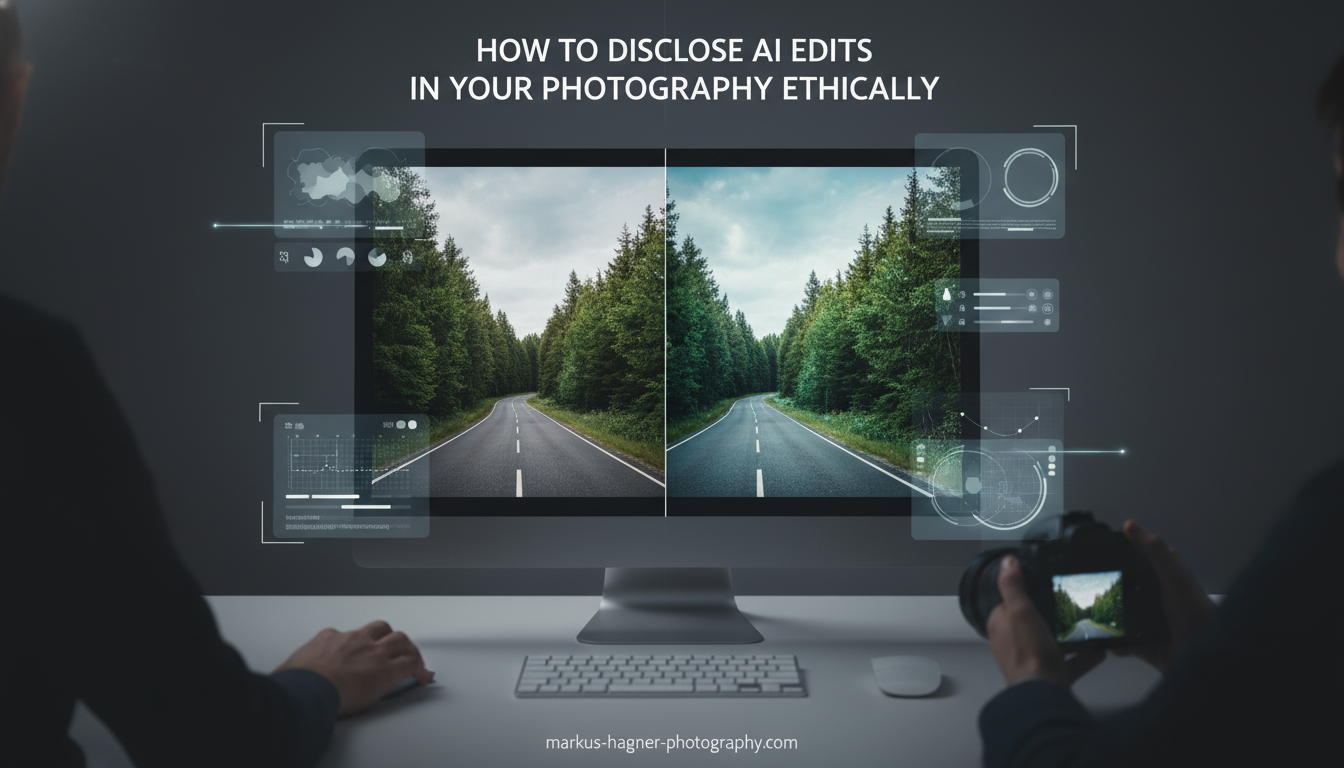
AI photo editing is ethical when used for enhancement rather than manipulation, and when photographers are transparent about their process. The key distinction lies in intent: adjusting exposure, reducing noise, or refining colors maintains the image’s authenticity, while adding or removing elements crosses into fabrication territory. Disclosure builds trust with clients and protects your professional reputation in an industry increasingly scrutinizing AI use.
As artificial intelligence transforms photo editing workflows, photographers face new ethical questions about transparency. Should you tell clients when AI helped cull 2,000 wedding images? Does AI noise reduction warrant the same disclosure as generative fill that adds clouds to a gray sky? These questions matter because your answer shapes client trust and professional integrity.
In this guide, I will walk you through exactly how to disclose AI edits in your photography ethically and transparently. You will learn which edits require disclosure, how to communicate with clients about AI, and practical templates you can start using today.
What AI Edits Require Disclosure?
Not all AI tools create the same ethical obligations. Understanding the difference between AI-assisted editing and AI-generated content helps you determine when disclosure becomes necessary.
AI-Assisted vs AI-Generated: The Key Distinction
AI-assisted editing uses machine learning to speed up traditional adjustments. Think noise reduction, exposure correction, or smart masking. These tools enhance what already exists in your image without creating new content.
AI-generated content creates or significantly alters image elements. This includes generative fill, sky replacement, background generation, or adding people who were not present. These tools fundamentally change what the photograph represents.
The ethical line runs between enhancement and creation. Enhancement respects the original scene; creation rewrites it.
Disclosure Requirements by Edit Type
Here is a practical breakdown of common AI edits and whether they typically require disclosure:
Generally No Disclosure Needed:
- AI noise reduction (standard algorithms)
- AI sharpening (edge enhancement)
- Automatic lens corrections
- AI-assisted culling and sorting
- Smart tone and color adjustments
- AI-powered face detection for focus
Disclosure Recommended:
- Sky replacement
- Background replacement or blur
- Object or person removal
- Generative fill or expand
- AI skin retouching (significant alteration)
- Virtual staging (real estate)
- Adding elements not in original scene
Context Matters:
The same edit might require different disclosure levels depending on your genre. AI skin smoothing in a beauty campaign? Expected and rarely needs disclosure. The same smoothing in documentary photography? Potentially deceptive without transparency.
When in Doubt, Disclose
If you are uncertain whether an edit warrants disclosure, err on the side of transparency. A brief mention costs nothing, but hiding AI manipulation can permanently damage client relationships and professional reputation.
Consider this practical test: Would the client feel surprised or misled if they learned about the edit later? If yes, disclosure is your ethical obligation.
How to Disclose AI Edits in Your Photography In 2026?
Knowing what to disclose is only half the equation. You also need practical methods for communicating AI use to clients, audiences, and industry organizations.
Step 1: Add Disclosure to Your Contracts
Your service agreement is the most reliable place for AI disclosure. Include a clear statement about your editing philosophy and AI tool usage. This ensures clients see the information before hiring you, eliminating surprises later.
Sample contract language: “I use AI-assisted editing tools to enhance image quality and streamline my workflow. These tools help with tasks like noise reduction, exposure adjustment, and culling. Any significant alterations to image content, such as background replacement or object removal, will be discussed with you beforehand.”
This approach normalizes AI use while maintaining transparency about its scope.
Step 2: Create a Dedicated Disclosure Statement
Develop a standard AI disclosure statement you can share in proposals, on your website, and during client consultations. This document explains your AI philosophy in accessible language.
Your statement should address what AI tools you use, why you use them, how they affect the final images, and what human oversight you maintain throughout the process. Keep it under one page and avoid technical jargon that might confuse non-technical clients.
Step 3: Discuss AI During Initial Consultations
Bring up AI editing naturally during client meetings. Frame it as part of your commitment to quality and efficiency. Explain that AI handles tedious tasks, freeing you to focus on creative decisions and client experience.
Most clients appreciate knowing you use modern tools to deliver better results faster. Few view AI as a negative when you present it confidently and transparently.
Step 4: Use Portfolio Captions for Specific Images
For portfolio pieces with significant AI manipulation, add brief captions noting the edits. This practice works particularly well for commercial and fine art work where creative manipulation is expected.
Example caption: “Background digitally replaced using AI tools to match creative brief.” This transparency demonstrates your technical skills while maintaining honesty about the image.
Step 5: Follow Social Media Best Practices
Platform-specific disclosure helps maintain consistency across your online presence. Consider adding a brief AI disclosure to your bio or using hashtags like #AIEnhanced or #AIEddited for images with significant AI manipulation.
Instagram allows link-in-bio tools where you can host a full AI disclosure statement. This approach keeps your posts clean while making detailed information accessible.
Step 6: Maintain Before and After Examples
Keeping before-and-after versions of your AI-edited work serves multiple purposes. It demonstrates your editing skills to potential clients, provides evidence of your transparency practices, and offers educational material for client consultations.
Share these examples selectively. Not every image needs public before-and-after documentation, but having them ready shows commitment to honesty.
Genre-Specific AI Disclosure Guidelines
Different photography genres carry different ethical obligations. What feels transparent in commercial advertising might violate standards in documentary photography.
Photojournalism and Documentary Photography
This genre demands the strictest AI disclosure standards. Photojournalism’s core value is truth-telling, and any AI manipulation beyond basic adjustments risks compromising that mission.
Most journalism organizations now prohibit AI-generated content entirely. The Associated Press, Reuters, and major newspapers have explicit policies against adding, removing, or significantly altering elements in news photographs.
If you work in documentary photography, limit AI use to noise reduction, exposure correction, and cropping. Disclose even these minor edits in captions or metadata. Your credibility depends on audience trust in your images’ accuracy.
Wedding Photography
Wedding clients typically expect polished, beautiful images rather than strict documentary accuracy. This gives wedding photographers more flexibility with AI tools, but transparency still matters.
Common AI practices in wedding photography include sky replacement for outdoor portraits, AI-assisted culling to handle thousands of images, and skin retouching for formal portraits. Most clients accept these practices when photographers explain them upfront.
Disclose AI use in your contract and initial consultation. Explain that AI helps you deliver more images faster while maintaining quality. Few wedding clients object to tools that improve their experience.
Real Estate Photography
Real estate photography faces increasing AI disclosure requirements. Virtual staging, sky replacement, and twilight conversion are common AI services, but they must be clearly labeled to avoid misleading potential buyers.
Many real estate markets now require disclosure of virtual staging in listing materials. The National Association of Realtors has issued guidelines recommending clear labeling of digitally altered property images.
If you offer virtual staging, create separate clearly labeled versions of images. Use watermarks or captions stating “Virtually Staged” on modified images. Provide agents with both original and edited versions for compliance purposes.
Portrait and Commercial Photography
Portrait and commercial work allows the most creative freedom with AI tools. Clients in these genres typically expect significant post-production and often request specific AI-driven edits.
Skin retouching, background replacement, and body shaping are standard commercial practices. Disclosure here focuses more on managing expectations than ethical obligation.
Discuss AI editing options during creative briefings. Show examples of your AI-enhanced work to set expectations. Commercial clients often view sophisticated AI editing as a value-add rather than a transparency concern.
Creating Your AI Disclosure Statement
A well-crafted disclosure statement serves as your ethical foundation and client communication tool. Here is how to build one that works for your photography business.
Essential Elements
Your AI disclosure statement should include several key components. First, clearly state which AI tools you use and for what purposes. Second, explain your human oversight process and creative control. Third, address how you handle client requests for AI editing. Finally, provide contact information for clients with questions.
Keep language accessible. Avoid technical terms that might confuse clients unfamiliar with photo editing. Focus on outcomes rather than processes.
Sample Disclosure Statement Template
Here is a template you can adapt for your photography business:
“At [Your Business Name], I believe in transparent communication about my editing process. I use AI-assisted tools to enhance image quality and streamline my workflow, allowing me to deliver exceptional results efficiently.
My AI editing philosophy: I use AI for enhancement, not fabrication. This means AI helps me reduce noise, correct exposure, and speed up image selection. I do not use AI to add or remove people, alter events, or misrepresent reality without client knowledge and consent.
For specialized edits like background replacement or creative compositing, I discuss options with you beforehand and document the process.
Questions about my AI practices? I welcome conversations about how I create your images. Contact me anytime.”
Contract Language Examples
Add specific clauses to your service agreements addressing AI use:
“AI Editing Disclosure: Photographer utilizes AI-assisted editing software to enhance image quality and efficiency. Standard editing includes noise reduction, exposure adjustment, and color correction using AI tools. Any significant content alterations will be discussed with Client prior to delivery.”
“Creative AI Services: For projects requiring advanced AI manipulation (sky replacement, background changes, virtual staging), Photographer will provide separate pricing and obtain written Client approval before proceeding.”
Building Client Trust Through AI Transparency
Many photographers fear that disclosing AI use will devalue their work or raise client concerns. The opposite is typically true. Transparency builds trust, and educated clients appreciate knowing your process.
Why Disclosure Strengthens Rather Than Weakens Your Position
Clients hire photographers for their vision, not their pixel-by-pixel manual labor. Explaining that AI handles tedious tasks while you make creative decisions positions you as an efficient professional rather than a technician.
Transparency also differentiates you from photographers who hide AI use. Clients increasingly understand AI’s role in creative industries. Your openness signals confidence and integrity.
Explaining AI to Non-Technical Clients
Use analogies clients understand. Compare AI editing to autocorrect in word processing or driver assistance in cars. The technology helps, but human judgment directs the final outcome.
Focus on results rather than processes. Instead of explaining neural networks, describe how AI helps you deliver 500 polished images instead of 200, or how it ensures consistent color across all photos from a multi-hour event.
Handling Client Objections
Occasionally, clients express concerns about AI editing. Listen to their specific worries and address them directly. Often, objections stem from misconceptions about what AI actually does to their images.
Offer to show before-and-after examples of your AI editing. Demonstrate that enhancement differs from manipulation. Most concerns dissolve when clients see the subtle, quality-improving nature of your AI use.
If a client requests no AI editing, accommodate if feasible. Some photographers now offer “AI-free” packages at premium rates, framing manual editing as a luxury service.
Frequently Asked Questions
Is AI photo editing ethical?
AI photo editing is ethical when used for enhancement rather than manipulation and when photographers are transparent about their process. Adjusting exposure, reducing noise, or refining colors maintains authenticity, while adding or removing elements crosses into fabrication. The key ethical consideration is transparency with clients about what tools you use and how they affect the final images.
Do I need to disclose AI photo enhancement?
Minor AI enhancements like noise reduction, exposure correction, and basic color adjustments generally do not require disclosure. However, generative changes that add or remove elements should always be disclosed. Context matters: photojournalism requires stricter disclosure than creative portraiture. When uncertain, disclose to maintain trust and professional integrity.
How do I tell clients about AI editing?
Start by including AI disclosure in your contracts and service agreements. Discuss AI tools during initial consultations, framing them as efficiency aids that improve quality and turnaround time. Create a simple disclosure statement for your website and proposals. Most clients appreciate transparency and view AI as a value-add rather than a concern when presented confidently.
What AI edits require disclosure?
Disclose AI edits that significantly alter image content: sky replacement, background changes, object or person removal, generative fill, and virtual staging. Basic enhancements like noise reduction, sharpening, and exposure adjustment typically do not require disclosure. Genre matters: real estate and photojournalism have stricter disclosure standards than commercial or portrait photography.
Moving Forward With Ethical AI Practices
AI transparency in photography is not about limiting your creative tools but about building sustainable client relationships based on trust. As AI editing becomes standard practice, photographers who embrace transparency will stand out for their integrity.
Start implementing disclosure practices today. Review your contracts and add clear AI language. Create a disclosure statement for your website. Discuss AI openly during client consultations. These small steps position you as a thoughtful professional in an industry navigating rapid technological change.
The photographers who thrive in 2026 and beyond will be those who view AI as a tool to enhance their vision rather than replace their judgment. Transparency is not a burden; it is your competitive advantage.