
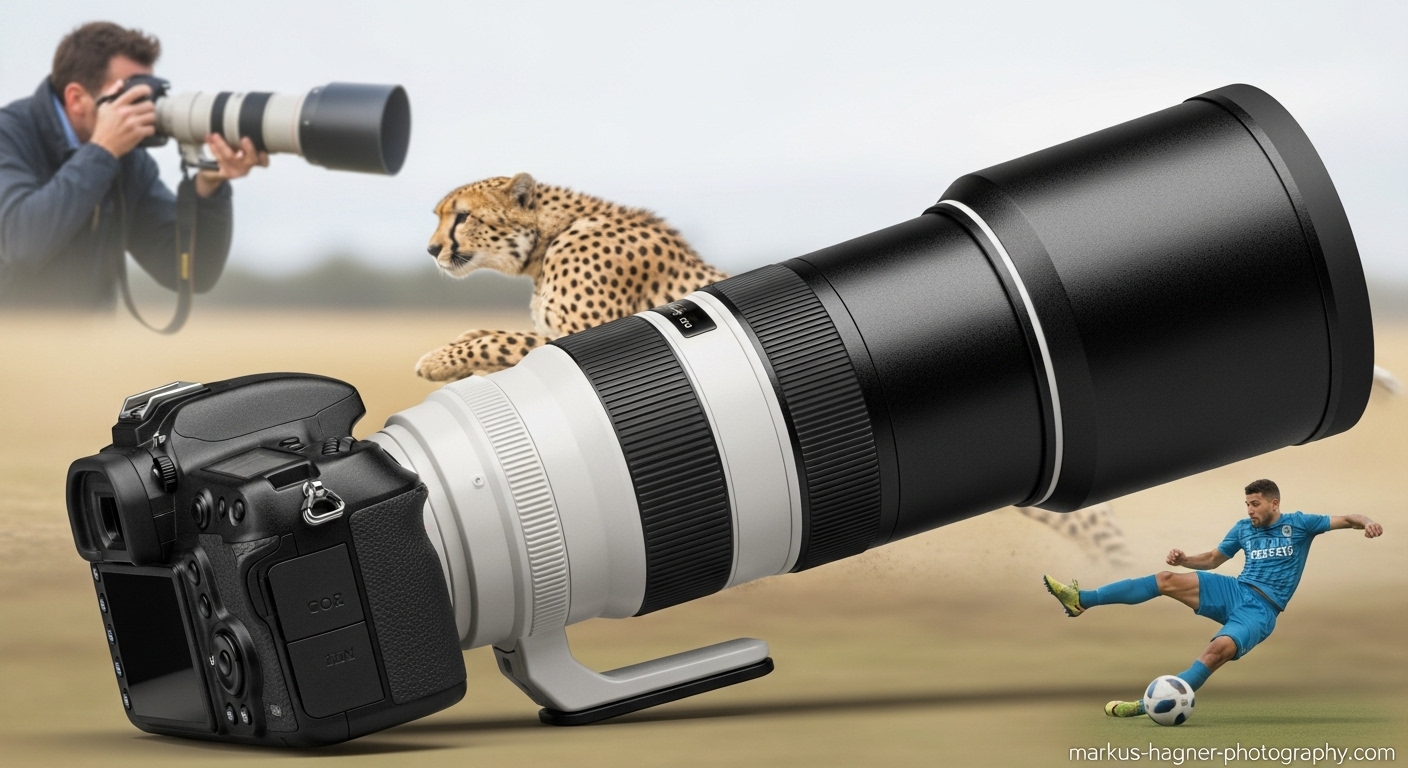
I’ve spent countless hours in the field chasing wildlife, capturing sports action, and creating stunning portraits with my telephoto lenses. Through trial and error, I’ve discovered that mastering these powerful tools can transform your photography from good to extraordinary. Today, I’m sharing everything I’ve learned about choosing, maintaining, and using telephoto lenses to help you avoid the mistakes I made and accelerate your learning curve.
Understanding Telephoto Lenses: The Foundation
When I first started photography, I was confused about what exactly makes a lens “telephoto.” Let me break it down for you in simple terms. A telephoto lens is any lens with a focal length longer than the standard lens for your camera format. For full-frame cameras, that typically means anything over 50mm, though most photographers consider lenses starting at 70mm as true telephotos.
What makes telephoto lenses special is their ability to magnify distant subjects while maintaining a relatively compact physical design. I remember the first time I used a 300mm lens and was amazed at how it brought distant wildlife right into my frame. It felt like having superpowers!
Telephoto lenses come in different categories:
- Short telephotos (70-135mm): Perfect for portraits and general photography
- Medium telephotos (135-300mm): Great for sports and wildlife
- Super telephotos (300mm+): Essential for serious wildlife and bird photography
The magic of telephoto lenses lies in their narrow angle of view. While a wide-angle lens might capture 90 degrees of a scene, a telephoto might only capture 25 degrees or less. This compression effect creates that beautiful background blur (bokeh) that makes your subject pop off the image.
How to Choose the Perfect Telephoto Lens?
Choosing the right telephoto lens can be overwhelming, especially with so many options available. I’ve made my share of mistakes, buying lenses that were either too heavy, too expensive, or simply wrong for my needs. Let me share what I’ve learned to help you make the right choice.
Focal Length: Your Most Important Decision
The first question I always ask myself is: “What do I want to photograph?” Your answer will determine the focal length you need. Here’s what I’ve discovered through experience:
- Wildlife photography: You’ll want at least 300mm, preferably 400mm or more
- Sports photography: 70-200mm is versatile, but you might need 300mm+ for field sports
- Portrait photography: 85-135mm is ideal for flattering perspective
- Landscape details: 70-200mm works great for isolating distant elements
I learned this lesson the hard way when I bought a 70-300mm lens for bird photography, only to realize I needed much more reach. Now I always consider my primary subject before making a purchase.
Aperture: Light Gathering Capability
The aperture (f-number) determines how much light your lens can gather and affects your ability to create background blur. I’ve found that:
- f/2.8 lenses: Heavy and expensive but incredible in low light
- f/4 lenses: Good balance of weight and performance
- f/5.6-6.3 lenses: Lightweight and affordable but challenging in low light
When I shot my first wedding with a telephoto lens, I quickly learned why professionals invest in f/2.8 lenses. The ability to shoot in dim church conditions without flash was worth every penny.
Prime vs. Zoom: The Eternal Debate
This is one of the most common questions I get from fellow photographers. Should you go for a prime (fixed focal length) or zoom lens? Here’s my take based on years of shooting:
Prime lenses offer superior image quality and wider apertures but lack flexibility. I love my 300mm f/4 prime for its sharpness, but I’ve missed countless shots because I couldn’t zoom in or out.
Zoom lenses provide versatility and convenience. My 70-200mm f/2.8 is probably my most-used lens because it adapts to so many situations. However, they’re typically heavier and may not be as sharp as primes.
For most photographers starting out, I recommend a good zoom lens. You can always add prime lenses later as you develop specific needs.
Image Stabilization: Non-Negotiable for Telephotos
I can’t stress this enough: image stabilization (IS) is essential for telephoto lenses. When I first started, I thought I could handhold my 300mm lens without IS. The results were disappointing – mostly blurry images from camera shake.
Modern IS systems can give you 3-5 stops of stabilization, meaning you can shoot at much slower shutter speeds. I’ve captured sharp images at 1/60s with my 400mm lens thanks to effective IS – something that would have been impossible before.
Build Quality and Weather Sealing
I’ve shot in rain, dust, and extreme temperatures, and I’ve learned that build quality matters. Professional-grade lenses with weather sealing have saved my gear multiple times. While they cost more, they’re worth it if you shoot outdoors regularly.
Weight and Portability
This is something I wish I’d considered more carefully early on. Carrying a heavy super-telephoto lens all day can be exhausting. I’ve since invested in lighter options for hiking and travel, even if they compromise slightly on image quality.
Maintaining Your Telephoto Lens: Protecting Your Investment
Telephoto lenses are significant investments, and proper maintenance will ensure they last for years. I’ve learned these lessons through experience, sometimes the hard way.
Daily Care Habits
The most important maintenance habit I’ve developed is simple: treat your gear with respect. I always:
- Use lens caps when not shooting
- Store lenses in a dry, dust-free environment
- Avoid touching the glass elements
- Use a UV filter for protection
I learned this lesson after scratching the front element of my first telephoto lens. Now, a UV filter is the first thing I put on any new lens.
Cleaning Techniques That Work
Cleaning telephoto lenses requires special care. Here’s my proven method:
- Use a rocket blower first to remove loose dust
- Brush gently with a soft lens brush
- Use lens cleaning solution and microfiber cloth for smudges
- Clean in circular motions from center to edges
- Never use household cleaners – they can damage coatings
I discovered this technique after ruining a lens coating with improper cleaning. Now, I’m meticulous about using proper cleaning products.
Storage Best Practices
How you store your telephoto lens matters more than you might think. I keep my lenses:
- In a climate-controlled room (40-50% humidity)
- In padded cases with silica gel packs
- Vertically to prevent lens creep
- Away from direct sunlight
I once stored a lens in a damp basement and came back to find fungus growing inside. That was an expensive lesson in proper storage!
Handling Large Telephoto Lenses Safely
Large telephoto lenses can be unwieldy and dangerous if not handled properly. I’ve developed these safety practices:
- Always support the lens, not just the camera
- Use a tripod collar for mounting
- Be careful when changing lenses outdoors
- Never force zoom or focus rings
I once dropped a lens while changing it too quickly. The repair cost was painful, but the lesson was valuable.
Long-Term Maintenance
For expensive telephoto lenses, I recommend professional servicing every 2-3 years. This includes:
- Internal cleaning
- Lubrication of moving parts
- Calibration checks
- Firmware updates
It’s an additional cost, but it’s much cheaper than replacing a damaged lens.
Mastering Telephoto Techniques: Getting the Shot
Now for the fun part – actually using your telephoto lens to create amazing images. I’ve spent years refining these techniques, and I’m excited to share them with you.
Handholding Techniques for Sharp Images
While tripods are ideal, sometimes you need to shoot handheld. Here’s what works for me:
- Elbows tucked in for stability
- Control your breathing – exhale slowly before shooting
- Use higher shutter speeds (1/focal length as minimum)
- Lean against solid objects when possible
- Use continuous shooting mode to increase chances of sharp shots
I discovered these techniques while shooting wildlife in situations where setting up a tripod would mean missing the shot. Practice these, and you’ll be amazed at how slow a shutter speed you can use handheld.
Tripod and Support Systems
For serious telephoto work, a good support system is essential. I’ve learned that:
- Sturdy tripods are worth the investment
- Gimbal heads are perfect for tracking moving subjects
- Monopods offer great mobility for sports
- Bean bags work wonderfully for car-based wildlife photography
I once tried to save money on a cheap tripod, only to have it collapse with my expensive lens attached. Now, I invest in quality support systems.
Mastering Focus with Telephoto Lenses
Getting sharp focus with telephoto lenses can be challenging. Here are my proven techniques:
- Use back-button focus for better control
- Select single-point AF for precise focusing
- Use continuous AF for moving subjects
- Focus manually in low contrast situations
- Check focus zoom on critical shots
I struggled with focus accuracy until I switched to back-button focus. It transformed my success rate with moving subjects.
Exposure Techniques for Telephoto Lenses
Telephoto lenses require special exposure considerations:
- Use spot metering for small subjects
- Be aware of exposure compensation needs
- Watch for highlights that can blow out easily
- Use exposure bracketing for critical shots
- Understand how distance affects exposure
I learned this the hard way when I shot a whole series of backlit wildlife photos only to find they were all underexposed. Now, I always check my histogram.
Creative Composition Techniques
Telephoto lenses offer unique creative possibilities:
- Use compression to create layered effects
- Isolate subjects with shallow depth of field
- Shoot through objects for creative framing
- Use panning for motion blur effects
- Experiment with perspective compression
One of my favorite techniques is using telephoto compression to make distant mountains appear closer and more dramatic. It creates a surreal effect that wide-angle lenses simply can’t achieve.
Specialized Applications: Wildlife, Sports, and Portraits
Different subjects require different approaches. Let me share what I’ve learned in various photography genres.
Wildlife Photography with Telephoto Lenses
Wildlife is where telephoto lenses truly shine. Here’s what I’ve discovered:
- Early morning and late afternoon provide the best light
- Use camouflage to get closer without disturbing animals
- Learn animal behavior to anticipate action
- Be patient – great shots take time
- Respect wildlife and maintain safe distances
I once spent three days waiting for a particular bird to appear in the perfect light. When it finally happened, the shot was worth every minute of waiting.
Sports Photography Techniques
Sports photography requires quick reflexes and the right techniques:
- Use fast shutter speeds (1/1000s or faster)
- Pre-focus on where action will occur
- Use continuous high-speed shooting
- Follow the action smoothly
- Anticipate peak moments
Covering my first marathon taught me the importance of anticipation. By learning the race route and knowing where the best action would occur, I captured images that told the complete story.
Portrait Photography with Telephoto Lenses
Many photographers don’t realize how great telephoto lenses can be for portraits:
- 85-135mm is the ideal range
- Use wide apertures for beautiful bokeh
- Maintain distance for natural expressions
- Use compression to flatter features
- Fill the frame for intimate portraits
I discovered this when I started using my 70-200mm for portraits. The compression effect and beautiful background blur transformed my portrait work.
Landscape Photography with Telephoto Lenses
While wide-angle lenses are more common for landscapes, telephotos offer unique possibilities:
- Isolate distant elements for abstract compositions
- Use compression to layer mountains or clouds
- Capture details that tell a larger story
- Shoot panoramas for high-resolution images
- Use atmospheric conditions creatively
Some of my most compelling landscape images were captured with a telephoto lens, isolating a single tree against a misty mountain backdrop.
Also Read: Mamiya RB67 vs RB67 Pro S
Common Problems and Solutions
Even experienced photographers face challenges with telephoto lenses. Let me share solutions to common problems I’ve encountered.
Dealing with Camera Shake
Camera shake is the enemy of sharp telephoto images. Here’s how I combat it:
- Use faster shutter speeds than the reciprocal rule
- Enable image stabilization properly
- Improve your handholding technique
- Use proper support systems
- Burst shoot to increase sharp image chances
I used to struggle with blurry images until I mastered these techniques. Now, I can consistently get sharp shots even at slower shutter speeds.
Managing Depth of Field
Telephoto lenses have very shallow depth of field, which can be challenging:
- Use smaller apertures when you need more depth
- Focus stack for maximum sharpness
- Understand hyperfocal distance for landscapes
- Use focus peaking if available
- Practice focus accuracy regularly
I learned this when shooting group portraits with my 85mm f/1.2. Initially, only one person would be sharp. Now, I know exactly where to focus and what aperture to use.
Handling Low Light Situations
Telephoto lenses struggle in low light, but there are solutions:
- Use higher ISO (don’t be afraid of noise)
- Shoot in RAW for better post-processing
- Use image stabilization effectively
- Consider faster lenses for low light work
- Use artificial light when appropriate
I once missed an entire event because I was afraid to increase my ISO. Now, I embrace higher ISO values and clean up the noise in post-processing.
Weather and Environmental Challenges
Shooting outdoors means dealing with weather:
- Use weather-sealed gear when possible
- Protect your equipment from rain and dust
- Shoot in golden hours for best light
- Handle temperature changes carefully
- Be prepared for changing conditions
I’ve shot in rain, snow, and extreme heat. Being prepared and knowing how to protect my gear has saved countless shoots.
Advanced Techniques for Professional Results
Once you’ve mastered the basics, these advanced techniques will take your telephoto photography to the next level.
Using Teleconverters Effectively
Teleconverters can extend your reach but come with trade-offs:
- 1.4x converters lose 1 stop of light
- 2x converters lose 2 stops of light
- Use with fast lenses for best results
- Expect some image quality loss
- Manual focus may be necessary in low light
I use a 1.4x converter with my 300mm f/2.8 for bird photography. The combination gives me 420mm f/4, which is perfect for most situations.
Focus Stacking for Maximum Sharpness
Focus stacking combines multiple images for incredible depth of field:
- Use a tripod for precise alignment
- Focus incrementally through the scene
- Use focus bracketing if available
- Stack in post-processing with specialized software
- Practice to master the technique
This technique revolutionized my macro photography with telephoto lenses, allowing me to get everything in sharp focus from front to back.
Creative Panning Techniques
Panning creates dynamic motion blur:
- Use shutter speeds between 1/30s and 1/125s
- Follow the subject smoothly
- Use continuous autofocus
- Practice the motion repeatedly
- Try different speeds for varied effects
I spent an entire afternoon practicing panning at a racetrack. The results were worth it – I now capture dynamic action shots that stand out from the crowd.
Astrophotography with Telephoto Lenses
Telephoto lenses are great for astrophotography:
- Use fast apertures for star brightness
- Track the sky to avoid star trails
- Shoot in dark locations away from light pollution
- Use high ISO for star visibility
- Stack multiple exposures for better results
My first attempt at astrophotography with a 200mm lens was disappointing. After learning proper techniques, I now capture stunning images of the Milky Way and star clusters.
Also Read: Hasselblad vs Mamiya Lenses
Pro Tips from the Field
After years of shooting with telephoto lenses, I’ve gathered these pro tips that I wish I’d known earlier:
Gear Recommendations
- Start with a 70-200mm f/2.8 – it’s the most versatile telephoto
- Add a 1.4x converter before buying a longer lens
- Invest in quality support – cheap tripods cost more in the long run
- Use lens coats for protection in harsh conditions
- Carry spare batteries – telephoto lenses drain power faster
Shooting Techniques
- Shoot in RAW always – you’ll thank yourself in post-processing
- Use back-button focus – it’s a game-changer
- Learn your gear’s limits – don’t push beyond what works
- Practice regularly – skills atrophy without use
- Study the work of masters – learn from the best
Post-Processing Tips
- Sharpen carefully – telephoto images need different treatment
- Reduce noise effectively – high ISO is often necessary
- Crop thoughtfully – telephoto images have lots of resolution
- Adjust perspective – compression effects can be enhanced
- Create presets – streamline your workflow
FAQ: Answering Your Telephoto Lens Questions
What makes a lens truly telephoto?
A telephoto lens has a focal length longer than standard and uses a special optical design that keeps the physical length shorter than the focal length. Typically, anything over 70mm is considered telephoto for full-frame cameras.
How do I know if I need image stabilization?
If you shoot handheld at all, you need image stabilization. It’s especially crucial for focal lengths over 200mm. I’ve found that IS can make the difference between getting the shot and missing it entirely.
Can telephotos work for beginners?
Absolutely! Start with a versatile 70-200mm or 70-300mm zoom. These lenses are forgiving and teach you the fundamentals of telephoto photography without overwhelming you.
What’s the best focal length for birds?
For serious bird photography, you’ll want at least 400mm, preferably 500mm or 600mm. I use a 400mm f/5.6 with excellent results, but many professionals prefer even longer lenses.
How often should I clean my lens?
Clean your lens only when necessary. Over-cleaning can damage coatings. I clean my front element every few weeks with regular use, but I blow off dust daily.
Prime or zoom for travel?
For travel, I recommend a zoom lens for versatility. My 70-200mm f/4 is perfect – light enough to carry all day but covers a useful range.
Do teleconverters degrade quality?
Yes, teleconverters reduce image quality and light transmission, but modern 1.4x converters have minimal impact. I use them regularly when I need extra reach.
Telephoto versus long lens—difference?
Technically, all telephoto lenses are long lenses, but not all long lenses are telephoto. Telephoto refers to the optical design, while long refers to focal length.
How to avoid lens creep in zooms?
Lens creep (zoom sliding under its own weight) can be prevented by using the zoom lock if available, or by storing the lens vertically. Some lenses have tension adjustments.
Best storage for humidity?
Store lenses in a climate-controlled environment with 40-50% humidity. Use silica gel packs in your camera bag and consider a dry cabinet for expensive gear.
Conclusion: Your Telephoto Journey Begins
I hope this guide helps you on your telephoto lens journey. Remember, mastering these lenses takes time and practice. I’m still learning new techniques and discovering new possibilities with my telephoto lenses.
Start with the basics, practice regularly, and don’t be afraid to experiment. The most important thing is to get out there and shoot. Every frame you capture teaches you something new.
If you found this guide helpful, be sure to bookmark it for future reference. I’ll be updating it regularly with new tips and techniques as I discover them. And don’t forget to check out my other photography guides for more expert advice.
Happy shooting, and may your telephoto lenses bring you countless amazing images!