
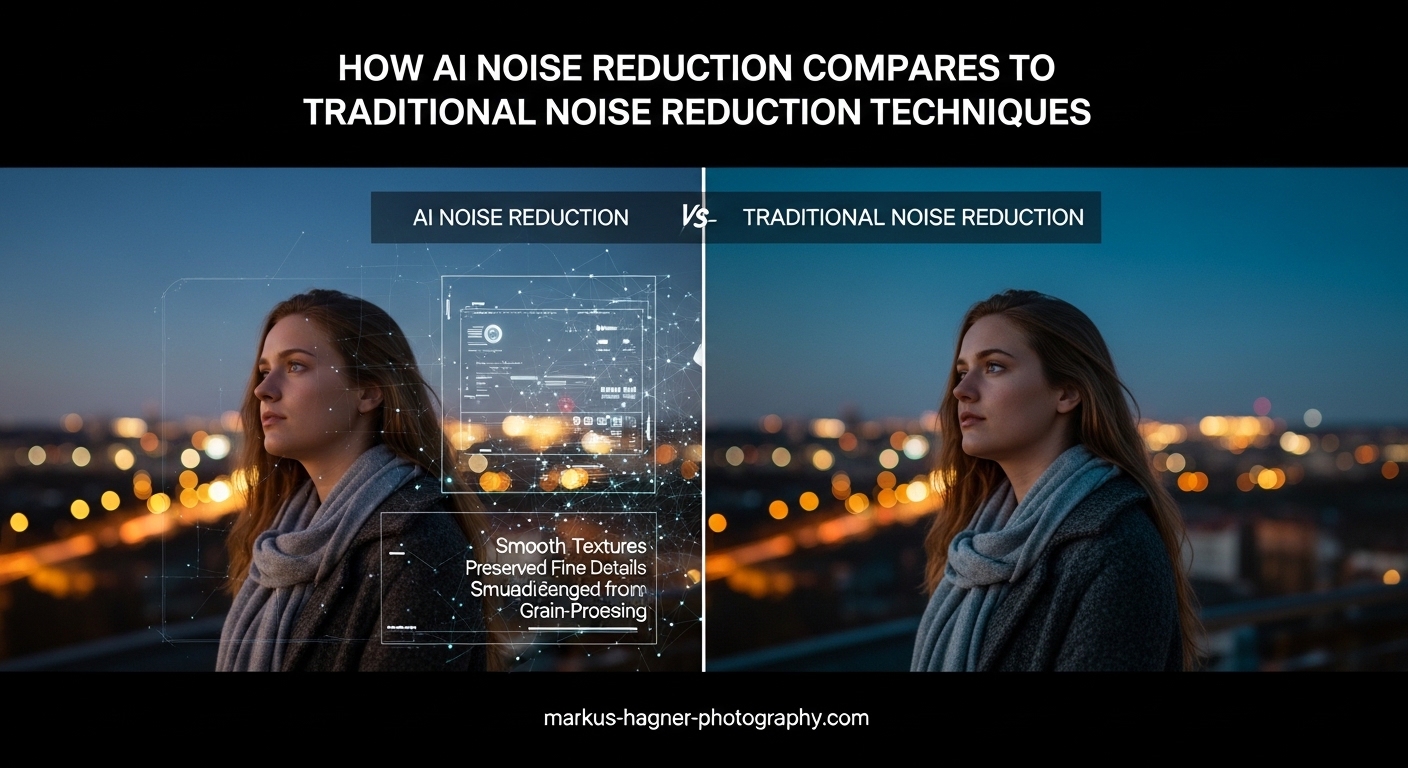
If you’ve ever shot photos at high ISO settings, you know the frustration of digital noise. Those grainy specks and color blotches can ruin an otherwise great shot. But here’s the good news: noise reduction technology has evolved dramatically in recent years. The debate between AI noise reduction vs traditional noise reduction techniques has become central to modern photography workflows.
As someone who has processed thousands of images using both approaches, I can tell you that each method has distinct advantages. Traditional noise reduction relies on subtractive algorithms that remove noise frequencies from your image. AI noise reduction takes a fundamentally different approach, using neural networks to generate cleaner versions of your photos by predicting what each pixel should look like without noise.
In this guide, I’ll break down exactly how each approach works, when to use each method, and which tools deliver the best results. Whether you’re a wildlife photographer dealing with high ISO shots or a landscape photographer pushing exposure limits, understanding these techniques will transform your post-processing workflow in 2026.
Understanding Noise in Digital Photography
Before diving into reduction techniques, let’s understand what we’re fighting against. Digital noise appears as random variations in brightness and color that weren’t present in the original scene. Think of it like static on an old TV, but scattered across your photograph.
What Causes Digital Noise
Noise originates from your camera’s image sensor. When you increase ISO sensitivity, you’re essentially amplifying the electrical signal from the sensor. This amplification boosts both the actual image data and the random electronic noise inherent in any circuit. The result is visible grain, especially in shadow areas where the signal-to-noise ratio is lowest.
Several factors contribute to noise levels in your images:
- ISO setting – Higher ISO values produce more noise
- Exposure time – Very long exposures introduce thermal noise
- Sensor size – Smaller sensors typically show more noise
- Temperature – Hotter sensors generate more noise
- Underexposure – Boosting exposure in post increases visible noise
Types of Noise: Luminance vs Color
Not all noise looks the same. Understanding the difference between luminance noise and color noise helps you choose the right reduction approach.
Luminance noise appears as grainy monochrome speckles across your image. It affects brightness values while preserving color accuracy. This type of noise often looks similar to film grain and can sometimes be aesthetically pleasing in small amounts. Luminance noise is generally easier to reduce without destroying detail.
Color noise (also called chroma noise) shows up as random colored pixels scattered throughout your image. These blotchy red, green, blue, or purple specks are particularly visible in smooth areas like skies or skin tones. Color noise is more destructive to image quality and typically requires stronger reduction, though it responds well to chroma-based noise reduction algorithms.
When Noise Becomes Problematic
Not every photo needs noise reduction. At lower ISOs (100-800), most modern cameras produce remarkably clean images. Noise typically becomes problematic at ISO 1600 and above, though this threshold varies by camera. Professional full-frame cameras might stay clean until ISO 3200, while smaller sensors show noise much earlier.
The key is recognizing when noise detracts from your image rather than adding character. For documentary or journalistic work, some grain often feels appropriate. For commercial product photography or portraits, you’ll want cleaner results.
Traditional Noise Reduction Techniques
Traditional noise reduction has been around since the early days of digital photography. These methods use mathematical algorithms to identify and remove noise patterns from your images. The fundamental approach is subtractive: the software analyzes noise characteristics and subtracts them from the image data.
How Traditional Methods Work
Traditional noise reduction operates on signal processing principles developed long before AI existed. The software examines pixel neighborhoods, looking for variations that represent noise versus genuine image detail. When noise is detected, it gets smoothed or averaged out.
Several classic algorithms power traditional noise reduction:
Spectral subtraction analyzes the frequency components of your image. Noise typically occupies different frequency ranges than image detail. By identifying and removing noise frequencies while preserving detail frequencies, spectral subtraction reduces visible grain. This approach works particularly well for consistent noise patterns.
Wiener filtering uses statistical methods to estimate the original clean image from noisy data. It calculates optimal filter coefficients based on the signal-to-noise ratio in different image regions. Wiener filtering adapts its strength based on local noise levels, applying more reduction in obviously noisy areas.
Spatial filtering examines neighboring pixels to determine whether a particular pixel represents noise or detail. Common approaches include median filtering, which replaces each pixel with the median value of its neighbors, effectively removing outlier noise pixels. Gaussian blur represents another spatial approach, though it sacrifices detail along with noise.
Bilateral filtering improves upon simple blurring by considering both spatial distance and color similarity. Pixels that are spatially close but color-distant (like edge details) get preserved, while similar adjacent pixels get averaged to reduce noise. This edge-aware approach maintains more detail than simple blur methods.
Popular Traditional Noise Reduction Tools
Several software packages have dominated traditional noise reduction for years:
Neat Image has been a staple since the early 2000s. It builds noise profiles from your specific camera and ISO combination, then applies customized reduction. The profiling approach delivers consistent results tailored to your equipment.
Noiseware from Imagenomic offers real-time noise analysis without requiring camera profiles. Its adaptive algorithms adjust reduction strength automatically based on image content. Many portrait photographers prefer Noiseware for its skin tone preservation.
Noise Ninja pioneered the noise profiling approach and remains popular for its speed and effectiveness. It excels at batch processing large numbers of images with consistent results.
Capture One and other raw converters include built-in traditional noise reduction that integrates directly into your editing workflow. These tools offer convenience though sometimes sacrifice the fine control of dedicated noise reduction software.
Strengths of Traditional Methods
Traditional noise reduction offers several advantages that keep it relevant:
Speed is perhaps the biggest advantage. Traditional algorithms process images in seconds rather than minutes. When you’re editing hundreds of photos from a wedding or sports event, this speed difference matters enormously.
Predictability means you know exactly what you’ll get. Traditional methods apply consistent, mathematically defined operations. There’s no mystery about how the algorithm will affect your image.
Lower hardware requirements make traditional tools accessible to everyone. You don’t need a powerful GPU or massive RAM to run Neat Image effectively.
Fine control over luminance versus chroma noise lets you target specific noise types. You can reduce color noise while preserving luminance detail, or vice versa.
Limitations of Traditional Methods
Despite their strengths, traditional approaches have significant limitations:
The subtractive nature means they can only remove information. When noise and detail overlap in frequency or spatial characteristics, traditional methods must choose between leaving noise or destroying detail. This trade-off becomes increasingly problematic at high ISO levels where noise overwhelms fine detail.
Aggressive traditional noise reduction creates a characteristic “plastic” look. Surfaces become unnaturally smooth, losing texture and dimension. Skin tones turn waxy, fabric loses weave patterns, and natural elements appear artificial.
Detail recovery is impossible with traditional methods. Once detail has been blurred away, it’s gone forever. You cannot reconstruct information that was removed during noise reduction.
AI Noise Reduction Explained
AI noise reduction represents a fundamental shift in how we approach the noise problem. Rather than subtracting noise from images, AI systems generate new pixel values based on learned patterns. This generative approach can achieve results that traditional methods simply cannot match.
How AI Noise Reduction Works
At its core, AI noise reduction uses deep learning neural networks trained on millions of image pairs. Each training pair consists of a noisy image and its clean counterpart. Through this training, the network learns to recognize the difference between noise patterns and genuine image detail.
When you process a photo with AI noise reduction, the system doesn’t analyze and remove noise frequencies. Instead, it examines each region of your image and predicts what that area should look like without noise. This prediction is based on patterns learned during training, allowing the AI to essentially reconstruct clean details that were obscured by noise.
The key innovation is pattern recognition. Traditional algorithms follow fixed mathematical rules. AI systems learn adaptive rules from data. A neural network might recognize that a particular texture pattern represents bird feathers rather than noise, preserving detail that traditional methods would blur away.
Training Neural Networks for Denoising
The training process for AI denoising models is fascinating. Developers start with clean, high-quality images. They then artificially add noise to these images using models that simulate real sensor noise at various ISO levels. This creates perfect training pairs where the AI always knows the correct answer.
Modern AI denoising models often use convolutional neural networks (CNNs) designed specifically for image processing. These networks analyze images at multiple scales simultaneously, capturing both fine local detail and broader contextual information. This multi-scale approach helps distinguish between noise and genuine image structure.
Some advanced models incorporate attention mechanisms that allow the network to focus on the most relevant image features. Others use generative adversarial networks (GANs) where one network denoises images while another tries to detect artificial-looking results. This competition drives the denoising network toward more natural outputs.
Popular AI Noise Reduction Tools
Several AI-powered tools have transformed noise reduction workflows:
Topaz DeNoise AI pioneered consumer AI denoising and remains among the most powerful options. It excels at recovering detail from extremely noisy images, making it popular with wildlife and astrophotographers. The software offers multiple AI models optimized for different noise levels and image types.
DxO PureRAW integrates AI denoising directly into raw processing. It applies noise reduction during demosaicing, before traditional editing begins. Many photographers find this workflow integration more convenient than standalone tools. PureRAW consistently delivers excellent results across camera brands.
Lightroom Denoise AI (introduced in 2026) brought AI noise reduction to Adobe’s ecosystem. For photographers already committed to Lightroom workflows, this integration eliminates the need for external software. Results compare favorably with dedicated AI tools for most situations.
Capture One has also introduced AI-powered noise reduction in recent versions. Their implementation balances noise reduction with the color accuracy professionals demand.
Computational Requirements
AI noise reduction demands significantly more computing power than traditional methods. Processing a single image might take 30 seconds to several minutes depending on your hardware and image size. This computational cost stems from the millions of calculations required for neural network inference.
GPU acceleration dramatically improves performance. Without a dedicated graphics card, AI denoising becomes impractically slow for high-resolution images. Even with good hardware, batch processing hundreds of images requires patience.
Memory requirements also increase substantially. Large neural networks may require 8GB or more of VRAM for optimal performance. Photographers working with high-resolution files from 40+ megapixel cameras need particularly capable hardware.
Strengths of AI Methods
AI noise reduction delivers capabilities that traditional methods cannot match:
Detail preservation at high noise levels represents the most significant advantage. AI can maintain feather detail, fabric texture, and subtle gradations even when noise is severe. The generative approach allows reconstruction of detail that traditional methods would destroy.
Superior results at extreme ISO settings make previously unusable shots viable. Images shot at ISO 12,800 or higher that would have been discarded can now produce acceptable prints. This capability extends the effective range of your camera equipment.
Natural-looking results avoid the plastic appearance of aggressive traditional noise reduction. AI tends to preserve natural texture and dimensionality even when applying strong denoising.
Intelligent noise recognition means AI distinguishes between noise and genuine detail more accurately than mathematical algorithms. The learned patterns enable context-aware processing that adapts to image content.
Limitations of AI Methods
Despite impressive capabilities, AI noise reduction has drawbacks:
Processing time remains the primary practical limitation. When you need to deliver 500 edited images quickly, AI processing becomes a bottleneck. Many photographers reserve AI denoising for their best shots while using traditional methods for routine work.
AI artifacts can appear at high denoise settings. These include unnatural smoothing in some areas, halos around high-contrast edges, and occasionally “hallucinated” details that weren’t present in the original scene. Learning to recognize and avoid these artifacts takes practice.
Over-smoothing risk exists when pushing AI denoise too aggressively. While generally more natural than traditional smoothing, extreme AI settings can still produce artificial-looking results.
Hardware dependency limits accessibility. Photographers without modern computers with capable GPUs may find AI denoising impractically slow or entirely unavailable.
AI vs Traditional Noise Reduction: Direct Comparison
The fundamental difference between these approaches comes down to subtractive versus generative processing. Traditional methods subtract noise frequencies from your image. AI methods generate new pixel values based on learned patterns. This distinction affects everything from results to workflow.
Subtractive vs Generative Approaches
Traditional noise reduction works like erasing smudges from a drawing. You remove unwanted marks, but you cannot restore what was underneath. If noise has obscured fine detail, traditional methods can only blur that area, losing both noise and detail together.
AI noise reduction works more like having an artist repaint the noisy areas based on understanding what should be there. The AI doesn’t erase noise; it reconstructs what it believes the clean image should look like. This generative approach can recover detail that traditional methods would sacrifice.
Consider a photograph of bird feathers shot at high ISO. Traditional noise reduction might blur the fine barb structure along with the noise. AI denoising can recognize the feather pattern and reconstruct clean barb detail, producing a sharper final image.
Head-to-Head Comparison
Here’s how the two approaches compare across key factors:
- Processing Speed: Traditional methods process images in seconds; AI requires 30 seconds to several minutes per image.
- Hardware Requirements: Traditional tools work on any computer; AI requires modern GPU with substantial VRAM.
- Detail Preservation: Traditional methods blur detail along with noise; AI preserves and can reconstruct detail.
- Extreme ISO Performance: Traditional methods struggle above ISO 6400; AI remains effective at ISO 12,800 and beyond.
- Consistency: Traditional results are predictable; AI can vary slightly between runs.
- Cost: Traditional tools often cost less; AI software typically commands premium pricing.
- Learning Curve: Traditional methods require understanding of parameters; AI is often nearly automatic.
When Traditional Methods Excel
Despite AI’s advantages, traditional noise reduction remains the better choice in several scenarios:
High-volume workflows benefit enormously from traditional speed. Wedding photographers delivering hundreds of images cannot afford minutes per photo for AI processing. Traditional methods handle batch processing efficiently.
Moderate noise levels respond well to traditional techniques without requiring AI’s power. At ISO 1600-3200 on modern cameras, traditional methods often produce results nearly indistinguishable from AI.
Documentary authenticity concerns favor traditional approaches. Some photographers prefer knowing their processing simply removed noise rather than generated new pixel values, even if those values are AI-predicted.
Older hardware makes traditional methods the practical choice. Not every photographer wants to upgrade their computer just for noise reduction.
When AI Clearly Wins
AI noise reduction dominates in specific situations:
Extreme high ISO shooting is where AI truly shines. Wildlife photographers working at dusk, indoor sports photographers, and astrophotographers all benefit enormously from AI’s ability to recover usable images from severely noisy captures.
Underexposed images that require significant brightening benefit from AI’s superior noise handling. Pushing exposure in post amplifies noise; AI can handle the resulting noise levels better than traditional methods.
Fine detail preservation matters most for certain subjects. Bird feathers, animal fur, fabric textures, and landscape details all retain more character with AI denoising.
Large prints from cropped images demand the best possible quality. When you’re pushing pixels to their limits, AI’s superior detail preservation becomes visible in the final output.
Practical Applications and Workflow Recommendations
Understanding theory helps, but practical application matters more. Here’s how to integrate both approaches into an effective photography workflow.
When to Apply Noise Reduction
For most photographers, noise reduction works best after basic raw processing but before local adjustments. Apply lens corrections, white balance, and exposure adjustments first. Then address noise before dodging, burning, or applying creative effects.
However, AI noise reduction in raw converters like DxO PureRAW works differently. These tools apply denoising during demosaicing, before any other adjustments. This early intervention can produce superior results because the AI works with unprocessed sensor data.
Photography Genre Recommendations
Different photography genres have distinct noise reduction needs:
Wildlife photography almost always benefits from AI denoising. The combination of high ISO, long lenses, and the need to preserve feather and fur detail makes AI the clear choice. Reserve traditional methods for well-lit wildlife shots at lower ISOs.
Astrophotography presents unique challenges. Long exposures introduce thermal noise alongside high ISO noise. AI handles these combined noise sources effectively, though image stacking remains the gold standard for noise reduction in astrophotography.
Portrait photography requires careful balance. Skin texture preservation is critical, and both traditional and AI methods can produce unnatural results if pushed too far. Many portrait photographers prefer moderate traditional noise reduction for its predictability.
Event and wedding photography often demands traditional methods for volume reasons. Use AI selectively on key images where quality justifies the processing time.
Combining Both Approaches
The best workflows often incorporate both methods. Consider applying light traditional noise reduction during raw processing to handle color noise, then using AI for luminance noise on problematic images. This hybrid approach leverages the strengths of each method.
Another strategy uses AI for your selects (the best images requiring maximum quality) while processing supporting images with traditional methods. This approach optimizes both quality and efficiency.
Ethical Considerations Around AI Noise Reduction
The photography community has engaged in vigorous debate about AI noise reduction ethics. Understanding these concerns helps you make informed decisions about your workflow.
Is AI Noise Reduction Cheating?
Most photographers conclude that AI noise reduction is simply another editing tool, no different from dodging, burning, or color correction. It doesn’t add content that wasn’t in the original scene; it reveals detail that noise obscured. The consensus on photography forums suggests AI denoise crosses no ethical lines for general photography.
However, photojournalism raises different concerns. Some news organizations prohibit AI noise reduction because the generative nature technically creates pixel values that didn’t exist in the original capture. If documentary accuracy is paramount, traditional methods or no noise reduction may be appropriate.
Authenticity in the AI Era
The broader question of authenticity deserves consideration. AI tools are becoming ubiquitous in photography, from autofocus to noise reduction to subject selection. Drawing lines between acceptable and unacceptable AI assistance becomes increasingly arbitrary.
My perspective: use the tools that serve your artistic vision and meet your audience’s expectations. If your clients expect clean, detailed images, AI noise reduction helps you deliver. If you value a more traditional aesthetic or documentary purity, traditional methods remain viable.
Frequently Asked Questions
Which is better, ANC or AI noise cancellation?
ANC (Active Noise Cancellation) and AI noise cancellation serve different purposes. ANC uses microphones and speakers to cancel external sounds in real-time, primarily for headphones. AI noise cancellation uses machine learning to remove noise from recorded audio or images during processing. For photography, AI noise reduction is the relevant technology and generally produces superior results to traditional subtractive methods, especially at high ISO settings.
Is AI noise reduction good?
Yes, AI noise reduction is highly effective for most photography applications. It preserves detail better than traditional methods, handles extreme ISO settings well, and produces natural-looking results. However, it requires more processing time and hardware resources than traditional noise reduction. For high-volume workflows or older computers, traditional methods may remain practical choices.
What are the different types of noise reduction?
The main types include: (1) Traditional subtractive methods using spectral subtraction, Wiener filtering, and spatial filtering; (2) AI-based generative methods using neural networks and deep learning; (3) Hardware-based approaches like sensor noise reduction and in-camera processing. In photography, the choice typically comes down to traditional algorithms versus AI-powered denoising tools.
Does noise reduction use AI?
Modern noise reduction increasingly uses AI, though traditional non-AI methods remain available. Tools like Topaz DeNoise AI, DxO PureRAW, and Lightroom Denoise AI use neural networks trained on millions of images to identify and remove noise. Traditional tools like Neat Image and Noiseware use mathematical algorithms without AI. Both approaches have valid applications depending on your needs.
Conclusion
The comparison between AI noise reduction vs traditional noise reduction techniques reveals two complementary approaches rather than a clear winner. Traditional methods offer speed, predictability, and accessibility that keep them relevant for many workflows. AI delivers unprecedented detail preservation and extreme ISO performance that can rescue previously unusable images.
For most photographers in 2026, a hybrid approach works best. Use traditional noise reduction for high-volume work and moderate noise levels. Reserve AI denoising for challenging shots where maximum quality matters. As hardware improves and AI models advance, the balance may shift further toward AI methods, but traditional techniques will remain valuable tools in any photographer’s arsenal.
Start by experimenting with both approaches on your own images. You’ll quickly develop intuition for which method suits each situation. The investment in understanding these techniques will pay dividends in consistently better final images.