
If you have ever shopped for a camera, you have probably encountered the confusing world of sensor sizes. Full frame, APS-C, Micro Four Thirds – what do these terms actually mean for your photography? I spent years shooting with all three formats, and I can tell you that understanding these differences will save you money and help you choose the right gear for your needs.
The full frame vs APS-C vs Micro Four Thirds sensor sizes debate often gets oversimplified online. Some claim full frame is always better, while others defend smaller formats with equal passion. The truth is more nuanced. Each format has genuine advantages depending on what, how, and where you shoot.
In this guide, I will break down exactly what each sensor format offers. You will learn the physical size differences, how crop factor affects your lenses, and which format makes the most sense for different photography styles. By the end, you will have a clear answer for which system fits your needs – and why the “best” format depends entirely on your specific situation.
Sensor Size Basics: What You Need to Know
Before diving into comparisons, let me explain what camera sensors actually do. Your sensor is the digital equivalent of film – it captures light and converts it into an image. The physical size of that sensor affects everything from image quality to depth of field to what lenses you can use effectively.
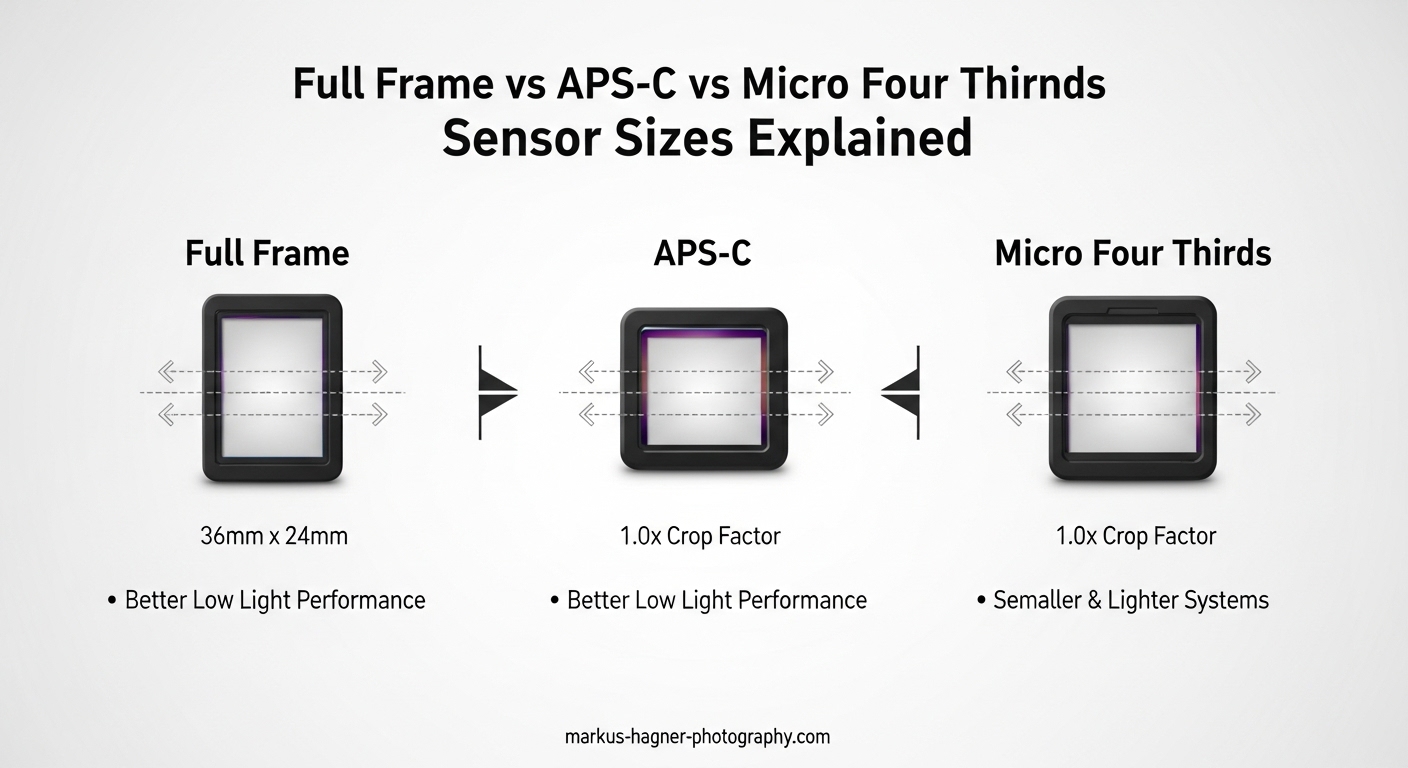
Here are the exact dimensions of each format:
- Full Frame: 36 x 24mm (864mm2 area) – This matches the size of 35mm film and represents the largest common consumer format.
- APS-C: Approximately 23.5 x 15.6mm (367mm2 area) for Nikon/Sony, or 22.2 x 14.8mm (329mm2) for Canon – About 43% the area of full frame.
- Micro Four Thirds: 17.3 x 13mm (225mm2 area) – The smallest of the three, at about 26% of full frame area.
Think of sensor sizes like window sizes. A larger window lets in more light, giving you a brighter view. Similarly, a larger sensor captures more total light, which generally means cleaner images, especially in challenging conditions.
The aspect ratio also differs between formats. Full frame and APS-C use a 3:2 ratio (same as 35mm film), while Micro Four Thirds uses 4:3. This affects how you compose images – 3:2 is wider and more panoramic, while 4:3 is slightly taller and can work better for portraits and certain subjects.
Crop Factor Explained: The 1x, 1.5x, and 2x Multipliers
Crop factor is perhaps the most misunderstood concept in photography. Yet it directly affects how your lenses perform on different sensor formats. Let me make this simple.
Crop factor compares the field of view of any sensor to full frame (which has a crop factor of 1x). When you attach a lens to a smaller sensor, you only use the center portion of what that lens would project onto a full-frame sensor. This “crops” the image, making it appear more zoomed in.
Here are the crop factors for each format:
- Full Frame: 1x crop factor – What you see is what you get. A 50mm lens behaves like a 50mm lens.
- APS-C (Nikon/Sony): 1.5x crop factor – A 50mm lens behaves like a 75mm lens on full frame.
- APS-C (Canon): 1.6x crop factor – A 50mm lens behaves like an 80mm lens on full frame.
- Micro Four Thirds: 2x crop factor – A 50mm lens behaves like a 100mm lens on full frame.
This is why many wildlife and sports photographers prefer smaller sensors. A 300mm lens on Micro Four Thirds gives you the equivalent reach of a 600mm lens on full frame – at a fraction of the size, weight, and cost.
However, crop factor works both ways. While telephoto reach comes easier on smaller sensors, getting wide-angle views becomes more challenging. That 24mm wide-angle lens behaves like a 36mm on APS-C (1.5x) or 48mm on Micro Four Thirds (2x) – no longer very wide at all.
Focal Length Equivalence: Same Lens, Different View
Let me show you how one lens behaves across all three formats. This practical example makes focal length equivalence crystal clear.
Imagine mounting a 50mm lens (a classic “nifty fifty”) on each format:
- Full Frame: 50mm x 1 = 50mm equivalent – Classic normal lens, natural perspective.
- APS-C: 50mm x 1.5 = 75mm equivalent – Short telephoto, great for portraits.
- Micro Four Thirds: 50mm x 2 = 100mm equivalent – Medium telephoto, compressed perspective.
Same lens, three completely different uses. On full frame, you get a versatile walk-around lens. On Micro Four Thirds, that same 50mm becomes a portrait telephoto.
This equivalence works in reverse too. To match the field of view of a 50mm lens on full frame, you would need approximately 33mm on APS-C (50 / 1.5) or 25mm on Micro Four Thirds (50 / 2).
I bring this up because it affects your lens buying strategy. If you love the 35mm focal length on full frame, you need about 23mm on APS-C or 17mm on Micro Four Thirds to get that same perspective. Always think in equivalent focal lengths when comparing systems or shopping for lenses.
Image Quality: Low Light, Dynamic Range, and Detail
Now we get to the question everyone asks: does sensor size affect image quality? The short answer is yes – but the practical answer is more complicated.
Larger sensors generally offer three main advantages:
1. Better Low Light Performance: Because full-frame sensors have larger individual pixels (assuming similar megapixel counts), each pixel captures more light. This translates to cleaner images at high ISO settings. When I shoot wedding receptions at ISO 6400, my full-frame files show noticeably less noise than APS-C files from similar-era cameras.
2. Greater Dynamic Range: Larger sensors typically capture more stops of dynamic range – the range between the darkest shadows and brightest highlights a sensor can record simultaneously. This gives you more flexibility in post-processing, especially for landscape and architectural photography.
3. Shallower Depth of Field Potential: We will cover this in detail shortly, but larger sensors make it easier to achieve that blurry background look many photographers love.
However, these advantages are not as dramatic as some suggest. Modern APS-C and Micro Four Thirds cameras have improved tremendously. A current APS-C camera often matches or exceeds the low-light performance of a full-frame camera from five years ago.
Also consider pixel density. A 24-megapixel Micro Four Thirds sensor packs those pixels much more tightly than a 24-megapixel full-frame sensor. This can actually work in your favor when you need reach – more pixels on your subject means more detail, assuming your lens can resolve it.
For most photographers shooting in decent light and not making massive prints, the image quality differences between formats are surprisingly hard to spot in final images.
Depth of Field: Background Blur Differences
Sensor size directly affects depth of field – that beautifully blurry background (or not) behind your subject. Understanding why helps you make intentional creative choices.
Here is the physics: to get an equivalent field of view on a smaller sensor, you use a shorter focal length lens. Shorter focal lengths naturally produce more depth of field at the same aperture. This means full-frame cameras can achieve shallower depth of field more easily.
Let me illustrate with an example:
- Full Frame: 85mm f/1.8 – Very shallow depth of field, creamy background blur.
- APS-C: 56mm f/1.8 (equivalent to 85mm) – Similar framing but slightly more depth of field.
- Micro Four Thirds: 42.5mm f/1.8 (equivalent to 85mm) – Same framing again, but even more depth of field.
Notice all three are shot at f/1.8, but the background blur differs. This leads to the concept of “equivalent aperture.” To match the depth of field of that 85mm f/1.8 on full frame, you would need roughly f/1.2 on APS-C or f/0.9 on Micro Four Thirds.
Is shallower always better? Absolutely not. Macro photographers often want more depth of field to keep their tiny subjects sharp. Landscape photographers frequently want front-to-back sharpness. Video shooters may prefer deeper focus for easier focusing while recording.
The depth of field difference is real and matters for certain styles – particularly portraiture and subject isolation work. But for many photography genres, having more depth of field available is actually an advantage.
Size, Weight, and System Cost
This is where smaller formats truly shine. The physical differences between systems add up quickly when you carry gear all day.
Full-frame cameras require larger lenses to cover their bigger sensors. A 70-200mm f/2.8 for full frame weighs around 3 pounds. An equivalent 35-100mm f/2.8 for Micro Four Thirds weighs about 1 pound. Same reach, same aperture, one-third the weight.
Camera bodies follow the same pattern. A typical full-frame mirrorless body weighs 1.5-2 pounds. Many APS-C bodies weigh under 1 pound. Micro Four Thirds bodies can weigh as little as 14 ounces.
For travel, hiking, or street photography, these weight savings compound across your entire kit. I have carried full-frame systems on long hikes and wished for something lighter. I have also carried Micro Four Thirds gear all day without fatigue.
Cost follows a similar pattern. Full-frame lenses typically cost 50-100% more than equivalent-quality lenses for smaller formats. This is not just about the sensor – larger glass elements require more materials and more precise manufacturing.
Consider a complete kit comparison:
- Full Frame: Body ($2,000) + standard zoom ($1,200) + portrait prime ($600) + telephoto zoom ($1,500) = $5,300+
- APS-C: Body ($1,000) + standard zoom ($600) + portrait prime ($350) + telephoto zoom ($800) = $2,750+
- Micro Four Thirds: Body ($800) + standard zoom ($500) + portrait prime ($300) + telephoto zoom ($600) = $2,200+
These are rough estimates, but the pattern holds. You can build a complete, high-quality Micro Four Thirds system for roughly half the cost of an equivalent full-frame setup.
Which Sensor Format Should You Choose?
Enough theory. Let me help you pick the right format for your photography. I will break this down by common use cases.
Best for Landscape Photography
Full frame traditionally leads here for its dynamic range and wide-angle lens selection. However, modern APS-C cameras offer excellent dynamic range, and Micro Four Thirds systems have some superb wide-angle lenses. If you make very large prints or need maximum shadow recovery, full frame has the edge. For online sharing and moderate print sizes, any format works beautifully.
Best for Portrait Photography
Full frame excels when you want maximum background blur and subject separation. The shallower depth of field at equivalent settings creates that dreamy portrait look. APS-C works very well too, especially with fast prime lenses. Micro Four Thirds can produce lovely portraits, though achieving maximum blur requires faster (and more expensive) lenses.
Best for Wildlife and Sports
This might surprise you: smaller sensors often win here. The crop factor gives you extra reach without buying massive telephoto lenses. A 100-400mm lens on Micro Four Thirds behaves like a 200-800mm on full frame. Many professional wildlife photographers use APS-C or Micro Four Thirds specifically for this reach advantage. The smaller, lighter telephoto lenses also make handholding more practical.
Best for Travel and Street Photography
Smaller formats dominate this category. Carrying a compact APS-C or Micro Four Thirds kit all day beats lugging a heavy full-frame system. The deeper depth of field at wider apertures also helps for street photography, where you often want context in your backgrounds. Many street photographers prefer the slightly deeper focus of smaller sensors.
Best for Video
All three formats now produce excellent video. Micro Four Thirds offers some unique advantages including more zoom range with standard lenses and deeper focus for easier focusing while recording. Full frame excels for low-light video and shallow depth of field cinematic looks. APS-C provides a nice middle ground with reasonable low-light performance and manageable size.
Budget Considerations
If budget is tight, start with APS-C or Micro Four Thirds. You can build a more complete lens collection for the same money. Quality glass matters more than sensor size for most photography, and investing in good lenses for a smaller format beats compromising on lenses for full frame.
Frequently Asked Questions
Is Micro Four Thirds bigger than APS-C?
No, Micro Four Thirds is smaller than APS-C. M43 measures 17.3x13mm while APS-C measures approximately 23x15mm. The APS-C sensor area is about 1.6 times larger than Micro Four Thirds, making APS-C the middle option between M43 and full frame.
What size sensor is Micro Four Thirds vs full-frame?
Micro Four Thirds sensors measure 17.3x13mm with an area of 225mm2, while full-frame sensors measure 36x24mm with an area of 864mm2. A full-frame sensor is approximately 3.8 times larger in total area than a Micro Four Thirds sensor.
What is APS-C vs full-frame vs Micro Four Thirds?
These are the three main consumer camera sensor formats. Full-frame (36x24mm) matches 35mm film size with a 1x crop factor. APS-C (approximately 23x15mm) has a 1.5-1.6x crop factor and represents the middle ground. Micro Four Thirds (17.3x13mm) is the smallest with a 2x crop factor. Each format offers different tradeoffs between image quality, size, weight, lens selection, and cost.
Is full frame better than APS-C for beginners?
Not necessarily. APS-C offers an excellent balance of image quality, manageable size, reasonable cost, and extensive lens selection. Most beginners do not need the additional capabilities of full frame. A camera you will actually carry and use regularly produces better results than a heavier, more expensive system that stays at home. Many professionals continue using APS-C happily for years.
Does sensor size affect image quality?
Yes, sensor size affects image quality, but not as dramatically as many believe. Larger sensors generally offer better low-light performance, more dynamic range, and easier shallow depth of field. However, lens quality, photographer skill, lighting, and post-processing often have more visible impact on final images than sensor size alone. Modern smaller-sensor cameras produce excellent results for most applications.
Conclusion: Making Your Choice
After years of shooting all three formats, I can confidently say this: there is no universally “best” sensor size. Each format represents a different set of compromises and strengths.
Full frame delivers maximum image quality, dynamic range, and shallow depth of field potential. Choose it if you shoot primarily in low light, make large prints, or need that full-frame look for portraits. Accept that you will carry more weight and spend more money.
APS-C offers the best balance for most photographers. You get very good image quality in a more portable, affordable package. The lens selection from major manufacturers is extensive. This format makes sense for enthusiasts who want quality without the full-frame commitment.
Micro Four Thirds excels for travel, wildlife, and anyone who values portability. The 2x crop factor turns modest telephoto lenses into serious reach machines. The system remains vibrant with excellent lenses from Olympus (now OM System), Panasonic, and third parties. Do not let anyone tell you M43 is “dead” – it continues to serve a passionate community of photographers.
The full frame vs APS-C vs Micro Four Thirds sensor sizes question ultimately comes down to your specific needs. Consider what you photograph, how much gear you want to carry, and what you can afford. Then pick the system that removes barriers between you and great images.
My best advice? Spend less time worrying about sensor size and more time actually photographing. A smaller-sensor camera you use constantly will produce better work than a full-frame system that sits in a bag. The format wars online are mostly noise – all three systems are capable of stunning results in the right hands.