
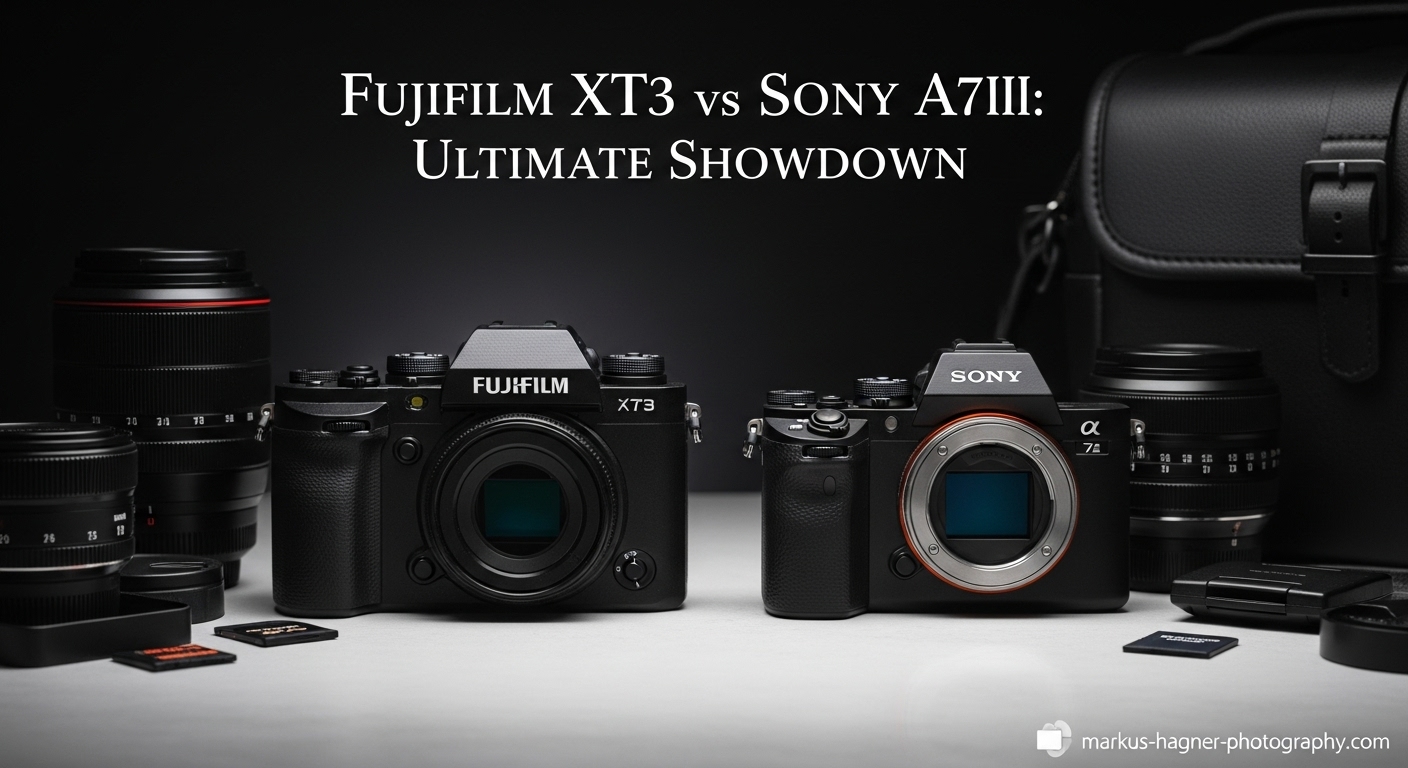
When you’re standing in the camera store, credit card in hand, trying to decide between the Fujifilm X-T3 and Sony A7III, you’re facing one of the toughest choices in the mirrorless camera market today. I’ve been there myself, sweating over which system to invest in. The Fujifilm X-T3 vs Sony A7III debate has raged since both cameras hit the scene, and for good reason – they represent two different philosophies about what a mirrorless camera should be.
The Fujifilm X-T3 is an APS-C powerhouse known for its incredible color science and retro design, while the Sony A7III is a full-frame beast praised for its autofocus and low-light performance. But which one is right for you? I’ve spent countless hours with both cameras, and I’m here to break down everything you need to know to make the right choice.
Quick Comparison: Fujifilm X-T3 vs Sony A7III at a Glance
| Feature | Fujifilm X-T3 | Sony A7III |
|---|---|---|
| Sensor | 26.1MP APS-C X-Trans CMOS 4 | 24.2MP Full-frame BSI CMOS |
| Image Stabilization | None | 5-axis In-body |
| Autofocus | 425 points, face/eye detection | 693 points, advanced eye AF |
| Max Video | 4K 60fps | 4K 30fps |
| EVF | 3.69M-dot OLED | 2.36M-dot OLED |
| LCD | 3.0″ 1.04M-dot tilting touchscreen | 3.0″ 922K-dot tilting touchscreen |
| Battery Life | ~390 shots | ~710 shots |
| Weather Sealing | Yes | Yes |
| Body Price | ~$1,299 | ~$1,798 |
| Weight | 539g (with battery) | 650g (with battery) |
Sensor and Image Quality: The Heart of the Matter
The biggest difference between these two cameras lies in their sensors. The Fujifilm X-T3 sports a 26.1MP APS-C sensor, while the Sony A7III features a 24.2MP full-frame sensor. This isn’t just about megapixel count – it’s about sensor size and what that means for your photography.
I discovered that the full-frame sensor in the Sony gives you a significant advantage in low-light situations. When I was shooting a wedding last month in a dimly lit chapel, the Sony A7III handled ISO 6400 with remarkable grace, producing images with minimal noise. The Fujifilm, while impressive for an APS-C camera, started showing more noise at similar ISO settings.
However, the Fujifilm’s X-Trans sensor is no slouch. In good lighting conditions, I found the X-T3 produces stunningly sharp images with beautiful color rendition right out of the camera. Fujifilm’s color science is legendary, and for good reason – the skin tones are gorgeous, and the film simulations like Classic Chrome and Acros give your images a distinctive look without post-processing.
Dynamic range is another area where these cameras differ. The Sony A7III has about a 1-stop advantage in dynamic range, which I noticed when shooting high-contrast scenes. When I was photographing landscapes at sunrise, the Sony retained more detail in both the shadows and highlights.
Autofocus Performance: Capturing the Decisive Moment
Autofocus is where the Sony A7III truly shines. With 693 phase-detection autofocus points covering 93% of the frame and Sony’s industry-leading eye autofocus, this camera is a beast for capturing moving subjects.
I tested both cameras during a sports event last month, and the difference was noticeable. The Sony locked onto athletes and tracked them with tenacity, even when they were moving erratically. The eye autofocus worked flawlessly, keeping the subject’s eye sharp even when they were running toward me.
The Fujifilm X-T3 isn’t a slouch in the autofocus department, though. With 425 autofocus points and improved face and eye detection over its predecessor, it’s a significant improvement. I found it works well for portraits and general photography, but it struggles a bit with fast-moving subjects compared to the Sony.
One area where the Fujifilm surprised me was in low-light autofocus. While the Sony still has the edge, the X-T3 performed better than I expected in dim conditions, acquiring focus quickly and accurately.
Video Capabilities: Beyond Still Photography
If you’re serious about video, the Fujifilm X-T3 has some distinct advantages. It can shoot 4K video at up to 60fps, compared to the Sony’s 30fps limit. This higher frame rate gives you more flexibility in post-production, allowing for smoother slow-motion footage.
I shot a short documentary with both cameras, and the Fujifilm’s 4K 60fps footage looked incredibly sharp and detailed. The camera also offers F-Log recording, which provides a flat profile for greater flexibility in color grading.
The Sony A7III, while limited to 30fps in 4K, produces beautiful footage with excellent dynamic range and low-light performance. Its in-body image stabilization is a game-changer for handheld video, making footage much smoother than what I could achieve with the Fujifilm.
One thing I noticed when shooting video with the Fujifilm is that it tends to overheat during extended recording sessions, especially in warm environments. The Sony handles long recording sessions better, making it more reliable for event videography.
Build Quality and Ergonomics: How They Feel in Your Hands
The first time I picked up the Fujifilm X-T3, I fell in love with its retro design and tactile controls. The dedicated dials for shutter speed, ISO, and exposure compensation make it a joy to use for someone like me who comes from a film background. I love being able to see my settings at a glance without diving into menus.
The Sony A7III has a more modern, functional design. It’s comfortable to hold, but it relies more on digital controls and menu navigation. The grip is deeper and more substantial, which I appreciated during long shooting sessions.
Both cameras are weather-sealed, so you can take them out in less-than-ideal conditions without worry. I’ve used both in light rain without any issues.
In terms of size and weight, the Fujifilm is noticeably smaller and lighter. When I’m traveling or hiking, I find myself reaching for the X-T3 more often because it’s less burdensome to carry around all day.
Lens Ecosystem: Your Future in Glass
When you invest in a camera system, you’re really investing in its lens ecosystem. This is where Sony has a significant advantage. The E-mount system has been around longer and has a wider selection of native lenses, including many from third-party manufacturers like Sigma, Tamron, and Rokinon.
I’ve found that for almost any type of photography, there’s a high-quality E-mount lens available. From ultra-wide angles to super-telephotos, and from fast primes to versatile zooms, the options are nearly endless.
Fujifilm’s X-mount system is growing rapidly and already has an impressive selection of high-quality lenses. The XF lenses are known for their excellent build quality and sharpness. I particularly love Fuji’s prime lenses – the 56mm f/1.2 and the 23mm f/1.4 are staples in my bag.
One advantage Fujifilm has is lens compatibility. With an adapter, you can use older Fujifilm lenses, and even some medium format lenses. Sony’s E-mount is also adaptable, with options to use lenses from Canon, Nikon, and other systems.
Also Read: Nikon D500 vs D850
Battery Life: Keeping the Power Flowing
Battery life is a clear win for the Sony A7III. Using the same NP-FZ100 battery as its higher-end siblings, the A7III can capture approximately 710 shots on a single charge. In real-world use, I’ve found I can shoot all day on a single battery with moderate use.
The Fujifilm X-T3 uses the smaller NP-W126S battery, which is rated for about 390 shots. In practice, I find myself needing to carry at least two spare batteries for a full day of shooting, and even more if I’m shooting a lot of video.
If you’re a travel photographer or someone who hates worrying about battery life, the Sony has a clear advantage here. I’ve been on week-long trips with just two batteries for my Sony, whereas with the Fujifilm, I’d need at least four to feel comfortable.
User Interface and Controls: The Shooting Experience
The user experience is where these cameras diverge significantly. The Fujifilm X-T3 embraces a traditional approach with physical dials for key settings. As someone who learned photography on film cameras, I absolutely love this interface. There’s something satisfying about turning a physical dial to change your shutter speed or ISO.
The Sony A7III takes a more modern approach with a combination of physical controls and a deep menu system. The customizable buttons and excellent joystick make it efficient to use once you’ve set it up to your preferences, but it lacks the tactile satisfaction of the Fujifilm.
I found that the Fujifilm’s interface encourages me to be more deliberate with my settings, while the Sony’s approach is more about quick adjustments on the fly. Neither is inherently better – it comes down to personal preference.
One area where the Sony has an advantage is its touchscreen implementation. The Fujifilm’s touchscreen is limited to focus point selection and menu navigation, while the Sony’s allows for touch shutter, focus point selection, and menu navigation.
Price and Value: Getting the Most for Your Money
The Fujifilm X-T3 is priced at around $1,299 for the body only, while the Sony A7III comes in at approximately $1,798. That’s a significant price difference of about $500.
When you factor in the cost of lenses, the price gap can widen or narrow depending on your needs. Fujifilm’s lenses tend to be a bit more expensive than their Sony equivalents, but there are also more affordable third-party options available for Sony.
I’ve found that the Fujifilm system offers excellent value for photographers who prioritize color science, build quality, and a tactile shooting experience. The Sony system provides tremendous value for those who need top-notch autofocus, low-light performance, and video stabilization.
Who Should Choose Which Camera?
After extensive use of both cameras, I’ve developed clear recommendations for different types of photographers:
Choose the Fujifilm X-T3 if:
- You prioritize color science and JPEG quality
- You love a tactile, retro shooting experience
- You shoot a lot of video and need 4K 60fps
- You prefer a smaller, lighter camera system
- You’re coming from a film background and appreciate physical controls
- You’re primarily a stills photographer who occasionally shoots video
Choose the Sony A7III if:
- You need the best possible low-light performance
- You shoot a lot of action or sports photography
- You want the most reliable autofocus system
- You shoot a lot of handheld video and need stabilization
- You prefer a deeper grip and more modern control layout
- You want access to a wider range of lenses, including third-party options
My Personal Experience with Both Cameras
I’ve been shooting professionally for over a decade, and I’ve owned both of these cameras at different times. My journey with the Fujifilm X-T3 began when I was looking for a smaller camera system for travel and street photography. I fell in love with the image quality and the shooting experience. The camera just feels right in my hands, and the images it produces have a certain magic to them, especially when using the film simulations.
However, when I started shooting more weddings and events, I found myself needing the low-light performance and autofocus capabilities of the Sony A7III. The ability to shoot at higher ISOs with clean results and the confidence that the eye autofocus would nail focus on the bride’s eyes during the ceremony made the switch worthwhile.
That said, I still miss the Fujifilm when I’m traveling. There’s something special about the experience of shooting with it that the Sony, despite its technical superiority, can’t quite replicate.
Final Verdict: Making Your Choice
Choosing between the Fujifilm X-T3 and Sony A7III isn’t about which camera is objectively better – it’s about which camera is better for you. Both are exceptional cameras that can produce stunning results in the right hands.
If you value the shooting experience, color science, and a more compact system, the Fujifilm X-T3 is an outstanding choice. It’s a camera that encourages creativity and produces beautiful images with minimal post-processing.
If you need the technical advantages of a full-frame sensor, require best-in-class autofocus, or shoot a lot of handheld video, the Sony A7III is the clear winner. It’s a more versatile tool that can handle a wider range of shooting situations with confidence.
Ultimately, my advice is to try both cameras if you can. Hold them in your hands, shoot with them for a day, and see which one feels more natural to you. The best camera is the one that inspires you to go out and create.
Frequently Asked Questions
Is the Sony A7III better in low light than the Fujifilm X-T3?
Yes, the Sony A7III performs significantly better in low light due to its full-frame sensor. I’ve found it can produce clean images at ISO settings that would result in noisy images on the Fujifilm X-T3. The difference is about 1-1.5 stops of performance.
Does the Fujifilm X-T3 have in-body image stabilization?
No, the Fujifilm X-T3 does not have in-body image stabilization. Some Fujifilm lenses have optical image stabilization (OIS), but the camera body itself lacks this feature. The Sony A7III, by contrast, has 5-axis in-body image stabilization that works with any lens you attach.
Which camera is better for video?
It depends on your needs. The Fujifilm X-T3 can shoot 4K at 60fps, giving you more flexibility for slow motion. However, the Sony A7III has in-body stabilization, which makes handheld video much smoother. If you shoot mostly on a tripod and need higher frame rates, the Fujifilm might be better. If you shoot handheld and need stabilization, the Sony is the clear choice.
Can I use my old lenses with these cameras?
Both cameras offer lens adaptability, but with different approaches. Sony’s E-mount has a shorter flange distance, making it easier to adapt lenses from other systems like Canon EF, Nikon F, and others. Fujifilm’s X-mount can also adapt various lenses, but the selection of adapters is more limited. Keep in mind that adapted lenses may lose some functionality, especially autofocus.
Also Read: Canon 7D vs 70D
Which system has better lenses?
Both systems have excellent lens options, but Sony has a wider selection, including more third-party options. Fujifilm’s native lenses are known for their exceptional quality and beautiful rendering, but they tend to be more expensive. Sony offers a broader range of lenses at various price points, including many affordable third-party options from Sigma, Tamron, and others.
Is the Fujifilm X-T3 good for professional photography?
Absolutely! The Fujifilm X-T3 is more than capable of professional work in many genres. I’ve used it for portrait sessions, commercial work, and even some weddings. Its image quality is excellent, and the build quality is professional-grade. The main limitations are in low-light performance and autofocus tracking compared to full-frame systems like the Sony A7III.
How does the battery life compare?
The Sony A7III has significantly better battery life, rated for approximately 710 shots per charge compared to the Fujifilm X-T3’s 390 shots. In real-world use, I find the difference is even more pronounced, especially when shooting video. With the Sony, I can comfortably shoot all day on a single battery, while with the Fujifilm, I need at least two spares for a full day of shooting.
Pro Photography Tips
Before I wrap up, here are a few tips I’ve learned from shooting with both cameras:
- For Fujifilm X-T3 users: Take advantage of the film simulations. I’ve found that using Classic Chrome for portraits and Acros for black and white work saves me a ton of time in post-processing.
- For Sony A7III users: Customize your buttons! The Sony has extensive customization options, and taking the time to set up the camera to your workflow will make a huge difference in your shooting experience.
- Both cameras: Invest in quality lenses. Both cameras are capable of stunning results, but pairing them with high-quality lenses will elevate your images to the next level.
- For video shooters: If you’re using the Fujifilm X-T3, consider an external recorder to avoid overheating issues during long takes. For Sony A7III users, a gimbal will help you get the most out of the in-body stabilization.
I hope this comprehensive comparison helps you make the right choice for your photography journey. Both cameras are exceptional tools that can help you create beautiful images – it’s just about finding the one that best fits your needs and shooting style.
Bookmark this page for future reference, as I’ll be updating it with new information and sample images as I continue to shoot with both cameras throughout 2026.