
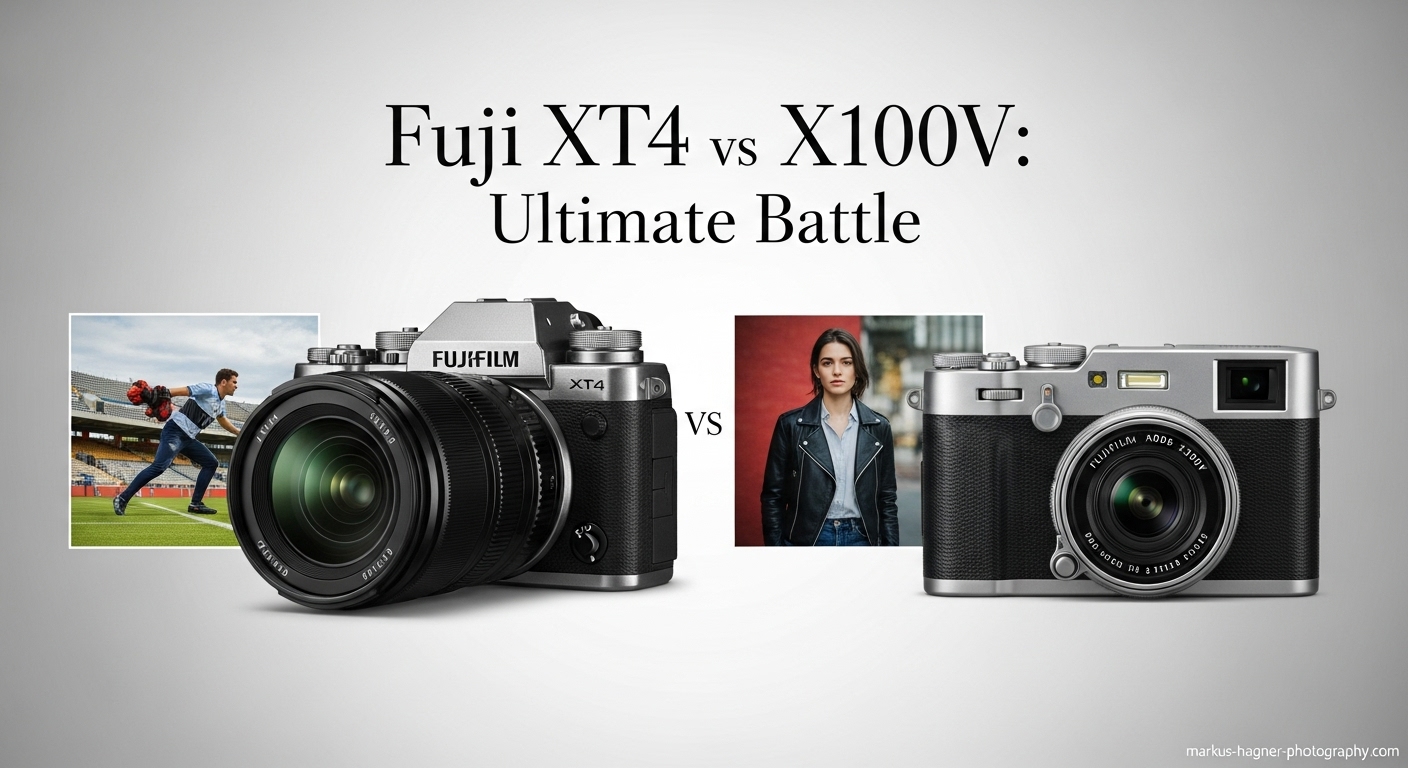
If you’re trying to decide between the Fujifilm XT4 and X100V, you’re facing a classic photographer’s dilemma. Both cameras represent Fujifilm’s commitment to exceptional image quality and retro-inspired design, but they serve fundamentally different purposes. As someone who has shot extensively with both cameras, I can tell you that choosing between them isn’t about which is “better” overall—it’s about which is better for YOU.
The Fujifilm XT4 is a versatile mirrorless camera with interchangeable lenses, while the X100V is a premium fixed-lens compact camera. Both released in 2020, they’ve gained loyal followings for different reasons. I’ve spent countless hours with both cameras in various shooting conditions, from street photography to landscape work, and I’m here to share everything you need to know to make the right choice.
Quick Comparison: Fuji XT4 vs X100V at a Glance
| Feature | Fujifilm XT4 | Fujifilm X100V |
|---|---|---|
| Sensor | 26.1MP APS-C X-Trans CMOS 4 | 26.1MP APS-C X-Trans CMOS 4 |
| Lens | Interchangeable (X-mount) | Fixed 23mm f/2 (35mm equivalent) |
| Image Stabilization | In-body (IBIS), 5-axis | None |
| Autofocus | 425 points, -6EV | 425 points, -5EV |
| LCD Screen | 3.0″, 1.62M dots, fully articulating | 3.0″, 1.62M dots, tilting |
| Viewfinder | 3.69M-dot OLED EVF | 3.69M-dot OLED EVF/OVF hybrid |
| Video | 4K/60p, F-Log, 10-bit | 4K/30p, F-Log, 10-bit |
| Battery | NP-W235 (approx. 500 shots) | NP-W126S (approx. 420 shots) |
| Dimensions | 135 x 91 x 64 mm | 128 x 75 x 53 mm |
| Weight | 607g (body) | 478g |
| Weather Sealing | Yes | Yes |
| Price (approx.) | $1,699 (body only) | $1,399 |
Understanding the Cameras: What They Really Are
Fujifilm XT4: The Versatile Workhorse
The Fujifilm XT4 is the flagship of Fujifilm’s X-T series, representing the pinnacle of their APS-C mirrorless lineup. When I first picked up the XT4, I was immediately impressed by its solid build quality and satisfying tactile controls. This camera feels substantial in your hands, with that perfect balance of weight and ergonomics that serious photographers appreciate.
What makes the XT4 special is its versatility. It’s designed to be a do-it-all camera that can handle everything from street photography to portraits, landscapes to sports. The addition of in-body image stabilization (IBIS) was a game-changer for the X-T series, allowing me to get sharp handheld shots at slower shutter speeds than ever before.
I’ve used the XT4 for professional assignments, and it never disappoints. The dual UHS-II SD card slots give me peace of mind when shooting important events, and the improved battery life means I can shoot all day without worrying about power. The fully articulating screen is fantastic for both video work and creative angles in still photography.
Fujifilm X100V: The Photographer’s Companion
The X100V, on the other hand, is in a class of its own. As the fifth iteration of Fujifilm’s beloved X100 series, it refines a formula that has won the hearts of street photographers, travel shooters, and photography enthusiasts worldwide. When I carry the X100V, I barely notice it’s there—it’s that compact and lightweight.
What makes the X100V special is its simplicity and focus. The fixed 23mm f/2 lens (equivalent to 35mm on full-frame) forces you to zoom with your feet, which I’ve found actually improves my composition over time. The hybrid viewfinder, which lets you switch between an optical viewfinder (OVF) and electronic viewfinder (EVF), is pure genius and something I wish more cameras had.
I’ve taken the X100V on countless trips, and it’s become my go-to camera for personal work and documentary projects. There’s something liberating about not having to decide which lens to bring—you just grab the camera and go, knowing you’re prepared for most situations you’ll encounter.
Head-to-Head Comparison: Fuji XT4 vs X100V
Design and Build Quality
Both cameras feature Fujifilm’s signature retro design, but with distinct approaches:
Fujifilm XT4: The XT4 follows the classic SLR-inspired design of the X-T series, with dedicated dials for shutter speed, ISO, and exposure compensation. I love this tactile approach—it lets me make adjustments without taking my eye from the viewfinder. The camera is weather-sealed, which I’ve tested in light rain without issues. At 607g (body only), it’s substantial but not overly heavy for a camera of its capabilities.
Fujifilm X100V: The X100V has a rangefinder-style design that’s more compact and discreet. It features similar physical controls but in a more streamlined package. The build quality is exceptional, with the entire camera now weather-sealed (a first for the X100 series). At 478g, it’s significantly lighter than the XT4, making it perfect for all-day carry.
Winner: It depends on your needs. The XT4 feels more professional and robust, while the X100V excels in portability and discretion.
Sensor and Image Quality
Both cameras use the same 26.1MP APS-C X-Trans CMOS 4 sensor and X-Processor 4, so you might expect identical image quality. However, there are subtle differences:
Fujifilm XT4: With interchangeable lenses, the XT4’s image quality can vary based on your lens choice. I’ve found that pairing it with high-quality primes like the 23mm f/1.4 or 56mm f/1.2 yields stunning results with beautiful bokeh. The IBIS system also contributes to sharper images in low light, allowing me to shoot at lower ISOs.
Fujifilm X100V: The X100V’s fixed lens is specifically designed for its sensor, resulting in excellent sharpness across the frame. The new lens design includes two aspherical elements to combat distortion and aberrations. In my testing, I’ve found that the X100V produces slightly more consistent corner-to-corner sharpness at wider apertures compared to the XT4 with similar focal length lenses.
Winner: Tie for sensor quality, but the X100V has a slight edge in lens-sensor optimization, while the XT4 offers more versatility.
Lens Options vs. Fixed Lens
This is perhaps the most significant difference between the two cameras:
Fujifilm XT4: The XT4 uses Fujifilm’s X-mount, giving you access to over 35 native lenses (plus more with adapters). I’ve built a collection of primes and zooms that cover every focal length I need, from ultra-wide to telephoto. This versatility is invaluable for professional work or specialized photography. I can switch from a 16mm f/1.4 for astrophotography to a 90mm f/2 for portraits in seconds.
Fujifilm X100V: The X100V has a fixed 23mm f/2 lens (35mm equivalent). While this might seem limiting, I’ve found that working within this constraint has actually improved my photography. The 35mm equivalent focal length is incredibly versatile for street, documentary, and everyday photography. The lens is exceptionally sharp, even wide open, and renders beautiful out-of-focus areas when needed.
Winner: XT4 for versatility, X100V for simplicity and optimization. This really comes down to your shooting style and needs.
Autofocus Performance
Both cameras feature advanced autofocus systems, but with some differences:
Fujifilm XT4: The XT4 boasts 425 phase-detection autofocus points covering nearly the entire frame. I’ve found its AF to be fast and reliable in most situations. The low-light performance is impressive, with sensitivity down to -6EV. The subject tracking works well for moving subjects, and face/eye detection is highly accurate for portraits.
Fujifilm X100V: The X100V uses the same 425-point phase-detection AF system but with slightly different low-light performance (-5EV). In real-world use, I’ve found the autofocus to be just as competent as the XT4 for most situations. The fixed lens means no focus breathing or calibration issues, resulting in consistently accurate focus.
Winner: XT4 has a slight edge in low-light AF and tracking performance, but both are excellent for their intended uses.
Video Capabilities
For videographers, there are clear differences between these cameras:
Fujifilm XT4: The XT4 is a powerhouse for video, offering 4K recording at up to 60fps, 10-bit 4:2:0 internally (or 4:2:2 externally), and F-Log gamma for greater dynamic range. The IBIS is incredibly effective for handheld video, and the fully articulating screen is perfect for vlogging or monitoring yourself. I’ve used the XT4 for professional video work, and it delivers footage that can easily intercut with more expensive cinema cameras.
Fujifilm X100V: The X100V offers 4K recording at up to 30fps, with the same 10-bit and F-Log capabilities as the XT4. However, it lacks IBIS, which makes handheld video more challenging. The tilting screen is less versatile than the XT4’s fully articulating one. That said, the fixed lens is parfocal (maintains focus while zooming digitally), which is a nice touch for video.
Winner: XT4 is clearly the better choice for serious video work, thanks to IBIS, higher frame rates, and more flexible screen.
Also Read: Ilford XP2 vs HP5
Battery Life
Battery performance is an important consideration for all-day shooting:
Fujifilm XT4: The XT4 uses the larger NP-W235 battery, which CIPA rates for approximately 500 shots per charge. In my experience, I can easily get through a full day of shooting with moderate use of the EVF and some video. The battery life is a significant improvement over previous X-T series cameras.
Fujifilm X100V: The X100V uses the smaller NP-W126S battery, rated for approximately 420 shots per charge. In real-world use, I find myself needing to carry a spare battery for long days, especially if I’m shooting a lot of video or using the EVF extensively.
Winner: XT4 has better battery life, which is important for extended shooting sessions.
Special Features
Each camera has unique features that set it apart:
Fujifilm XT4:
- In-body image stabilization (5-axis, up to 6.5 stops)
- Fully articulating touchscreen LCD
- Dual UHS-II SD card slots
- Higher burst rate (15 fps with mechanical shutter, 30 fps with electronic shutter)
- More extensive video options (4K/60p, 1080p/240p slow motion)
- Better grip for extended shooting sessions
Fujifilm X100V:
- Hybrid optical/electronic viewfinder
- Built-in 4-stop ND filter
- More compact and discreet form factor
- Classic rangefinder styling
- Fixed lens optimized for the sensor
- Lower overall system cost (no need to buy additional lenses)
Winner: Depends on your priorities. The XT4 offers more professional features, while the X100V excels in portability and unique viewing options.
Price and Value
Price is always a consideration when investing in camera gear:
Fujifilm XT4: At approximately $1,699 for the body only, the XT4 represents a significant investment. However, when you factor in the cost of lenses (which can range from $200 to $2,000+ each), the total system cost can become quite high. I’ve spent over $5,000 building my XT4 system with a selection of quality lenses.
Fujifilm X100V: At approximately $1,399, the X100V is less expensive than the XT4 body alone. Since it comes with a high-quality lens, there are no additional purchases required to start shooting. This makes it a more affordable entry into Fujifilm’s premium camera lineup.
Winner: X100V offers better value for photographers who don’t need interchangeable lenses, while the XT4 provides more long-term versatility at a higher initial cost.
Real-World Usage: Which Camera Excels Where?
Street Photography
Both cameras are excellent for street photography, but in different ways:
The X100V is practically purpose-built for the streets. Its compact size doesn’t intimidate subjects, and the silent electronic shutter allows for discreet shooting. I love using the hybrid viewfinder for street work—I can see outside the frame lines to anticipate action, then switch to EVF for precise composition. The 35mm equivalent field of view is perfect for environmental portraits and general street scenes.
The XT4 is also capable for street photography, especially with a prime lens like the 23mm f/2 or 35mm f/1.4. The IBIS helps in low light, and the faster autofocus can capture fleeting moments. However, it’s larger and more conspicuous, which can make subjects more aware of being photographed.
Winner: X100V for its discretion, portability, and purpose-built design.
Travel Photography
For travel, both cameras have their strengths:
The X100V is my go-to travel camera. It fits easily in a small bag or even a large pocket, and I never have to worry about which lens to bring. The weather sealing gives me confidence in changing conditions, and the battery life is sufficient for a full day of sightseeing. I’ve taken it on trips across multiple continents, and it has never let me down.
The XT4 offers more versatility for travel photography, especially if you need different focal lengths. I can pack a wide-angle for landscapes and a telephoto for wildlife, all in one system. The better battery life is also appreciated when you’re away from power sources all day. However, the size and weight can be burdensome when traveling light.
Winner: X100V for lightweight travel, XT4 for versatility-focused trips.
Portrait Photography
For portraits, the differences become more pronounced:
The XT4 excels in portrait photography. I can pair it with beautiful portrait lenses like the 56mm f/1.2 or 90mm f/2, which create gorgeous background separation and flattering perspective. The eye-detection autofocus is incredibly accurate, and the IBIS helps when shooting in natural light with slower shutter speeds. I’ve used the XT4 for professional portrait sessions with excellent results.
The X100V can certainly take nice portraits, especially environmental ones. The 35mm equivalent field of view works well for full-body and environmental portraits, but it’s not ideal for tight headshots due to distortion and lack of compression. You’ll need to get quite close to your subject, which can be uncomfortable for both parties.
Winner: XT4 is clearly superior for dedicated portrait work.
Landscape Photography
For landscape photography, both cameras can deliver excellent results:
The XT4 offers more flexibility for landscapes. I can use ultra-wide lenses like the 10-24mm f/4 for expansive vistas or telephotos for compressed landscapes. The IBIS is invaluable for sharp handheld shots at dawn and dusk, and the higher resolution EVF helps with critical focus. I’ve printed landscape images from the XT4 at large sizes with stunning detail.
The X100V is capable for landscape work, though the fixed 35mm equivalent field of view can be limiting. However, I’ve found that this constraint often leads to more thoughtful compositions. The lens is exceptionally sharp across the frame, and the compact size makes it perfect for hiking and backpacking where weight is a concern.
Winner: XT4 for versatility, X100V for lightweight landscape excursions.
Event Photography
For events like weddings, parties, or concerts:
The XT4 is my choice for professional event work. The dual card slots provide backup security, the excellent autofocus can track moving subjects, and the interchangeable lenses allow me to adapt to changing situations quickly. The improved battery life means I can shoot an entire event without worrying about power.
The X100V can work for more casual events or as a second camera. Its discretion is valuable in situations where you don’t want to be obtrusive, and the image quality is certainly sufficient. However, the lack of IBIS, single card slot, and more limited battery life make it less ideal for critical event work.
Winner: XT4 is the clear choice for professional event photography.
Who Should Buy Which Camera?
The Fujifilm XT4 Is For You If:
- You need the flexibility of interchangeable lenses
- You shoot a variety of subjects and styles
- Video is an important part of your work
- You need professional features like dual card slots and extensive controls
- You shoot in low light frequently and need IBIS
- You’re building a system for professional work
- You don’t mind carrying a larger camera for additional capabilities
I recommend the XT4 to serious enthusiasts and professionals who need a do-it-all camera that can adapt to any situation. It’s the camera I reach for when I’m shooting paid gigs or when I need maximum creative control.
The Fujifilm X100V Is For You If:
- You value portability and discretion above all else
- You primarily shoot street, travel, or documentary photography
- You prefer a simpler, more focused shooting experience
- You want excellent image quality without the complexity of multiple lenses
- You appreciate the rangefinder-style shooting experience
- You want a camera that’s always with you
- You’re looking for a more affordable entry into premium Fujifilm cameras
I recommend the X100V to photographers who want to simplify their gear and focus on composition and moment. It’s the camera I grab when I’m traveling light or when I want to enjoy photography without the burden of gear decisions.
Also Read: Nikon 18 300 Vs Tamron 16 300
Pro Tips for Getting the Most From Your Camera
Fujifilm XT4 Pro Tips:
- Take advantage of the IBIS: Don’t be afraid to lower your shutter speed. I regularly get sharp shots at 1/15s or slower, which opens up creative possibilities in low light.
- Customize your function buttons: The XT4 has numerous customizable buttons. I’ve set mine for quick access to AF modes, white balance, and film simulations based on how I shoot.
- Use the electronic shutter for silent shooting: The XT4’s electronic shutter is completely silent, perfect for weddings, events, or wildlife where noise would be disruptive.
- Experiment with F-Log for video: If you’re serious about video, shooting in F-Log gives you maximum flexibility in post-production. Pair it with a monitor for best results.
- Invest in quality lenses: The XT4 is only as good as the glass in front of it. I’ve found that Fujifilm’s prime lenses offer the best balance of quality and value.
Fujifilm X100V Pro Tips:
- Master the hybrid viewfinder: Switch between OVF and EVF based on your needs. I use OVF for street photography to see outside the frame and EVF for precise composition.
- Use the built-in ND filter: The 4-stop ND filter is perfect for using wide apertures in bright light or for long exposures during the day. I keep mine set to auto for convenience.
- Try the digital teleconverter: In the menu, you can enable digital teleconverters that crop the image to 50mm or 75mm equivalents. It’s a great way to change perspective without changing lenses.
- Customize the film simulations: The X100V has Fujifilm’s excellent film simulations. I’ve customized several with specific tweaks for different shooting scenarios.
- Consider the TCL-X100 and WCL-X100 converters: These optional optical converters give you 50mm and 28mm equivalent fields of view, adding versatility to the fixed lens system.
Frequently Asked Questions
Is the XT4 better than the X100V?
Neither camera is objectively “better”—they’re designed for different purposes. The XT4 is more versatile with interchangeable lenses and professional features, while the X100V excels in portability and simplicity. The better camera depends entirely on your needs and shooting style.
Can the X100V replace the XT4?
For some photographers, yes. If you primarily shoot at a 35mm equivalent focal length and value portability over versatility, the X100V could replace an XT4 system. However, if you need different focal lengths, shoot a lot of video, or require professional features like dual card slots, the X100V would be a complement rather than a replacement.
Which camera has better image quality?
Both cameras use the same sensor and processor, so base image quality is very similar. The XT4 can potentially produce higher quality images with premium lenses, while the X100V’s fixed lens is optimized specifically for its sensor, resulting in excellent consistency.
Is the XT4 too big for everyday carry?
The XT4 is larger than the X100V, but it’s still relatively compact for a camera with its capabilities. Whether it’s “too big” depends on your preferences. I find it comfortable for all-day use, but I prefer the X100V when I need maximum portability.
Does the X100V have image stabilization?
No, the X100V does not have in-body image stabilization. This is one of the significant differences between it and the XT4. However, the fixed lens is relatively bright at f/2, which helps in low light situations.
Can I use the XT4 with vintage lenses?
Yes, the XT4 can be adapted to use vintage lenses from various systems including Leica M, Nikon F, Canon FD, and others. This is one of the advantages of its interchangeable lens system.
Is the X100V good for beginners?
The X100V can be excellent for beginners who want to learn photography fundamentals. The fixed lens forces you to focus on composition rather than gear, and the physical controls make it easy to understand exposure settings. However, its price point might be high for some beginners.
Which camera is better for video?
The XT4 is significantly better for video work, offering 4K/60p recording, in-body stabilization, and a fully articulating screen. The X100V can record good quality 4K/30p video but lacks stabilization and has a less flexible screen.
How do the viewfinders compare?
The XT4 has a high-quality electronic viewfinder (EVF), while the X100V has a hybrid viewfinder that can switch between optical (OVF) and electronic modes. The X100V’s hybrid system is unique and offers advantages for certain types of photography, particularly street shooting.
Which camera has better battery life?
The XT4 has better battery life, rated for approximately 500 shots per charge compared to the X100V’s 420 shots. In real-world use, I find the difference noticeable during long shooting days.
Final Thoughts: Making Your Decision
Choosing between the Fujifilm XT4 and X100V ultimately comes down to your priorities as a photographer. After extensive time with both cameras, I can say that each has earned a permanent place in my camera bag for different reasons.
The XT4 is the camera I choose when I need maximum versatility and professional capabilities. It’s the workhorse that never lets me down, whether I’m shooting portraits, landscapes, or events. The ability to change lenses and the excellent in-body stabilization make it a true all-rounder that can handle virtually any photographic challenge.
The X100V, on the other hand, is the camera that brings joy back to photography. Its simplicity forces me to focus on seeing and composing rather than gear decisions. It’s the camera I grab when I want to travel light, shoot discreetly, or simply enjoy the process of making images without complications.
If you’re still struggling to decide, ask yourself this: Do you value versatility above all else, or do you prefer a more focused, simplified shooting experience? Your answer will point you toward the XT4 or X100V.
Whichever you choose, you’re getting an exceptional camera that will serve you well for years to come. Both represent Fujifilm’s commitment to image quality, build quality, and the pure joy of photography.
Did you find this comparison helpful? Bookmark this page for future reference as camera models and prices may change. For more in-depth camera reviews and photography tips, check out our other articles on [markus-hagner-photography.com].
What are your thoughts on the Fuji XT4 vs X100V debate? Do you own either camera? Share your experiences in the comments below!