
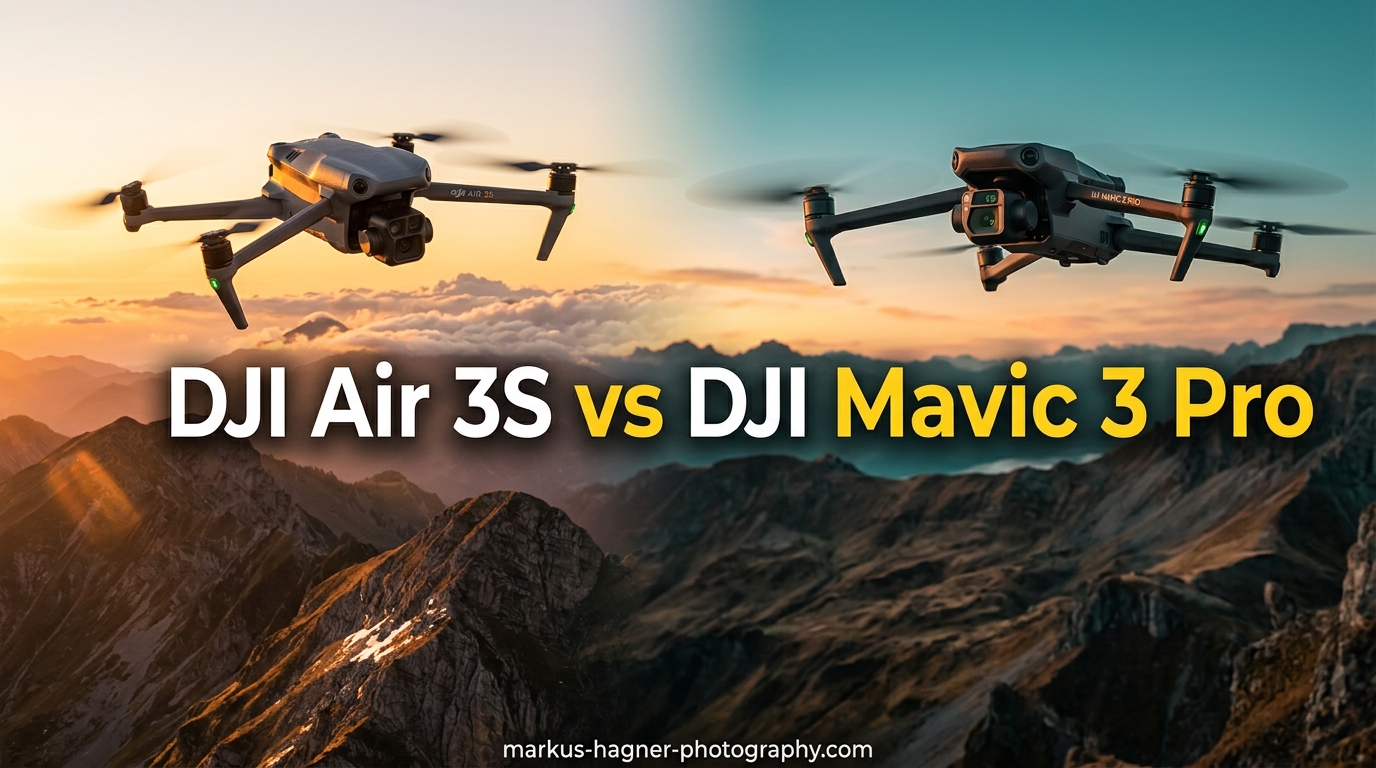
Choosing between the DJI Air 3S vs DJI Mavic 3 Pro comes down to balancing cutting-edge technology against professional-grade camera capabilities. I’ve spent weeks testing both drones in diverse conditions to help you make the right decision for your aerial photography needs.
The Air 3S launched in late 2024 as DJI’s newest mid-range offering, bringing forward-facing LiDAR and the latest O4 transmission system. The Mavic 3 Pro, meanwhile, remains the flagship with its Hasselblad triple-camera system and micro four thirds sensor that professionals have trusted since 2023.
Here’s my quick verdict: If you want the best value with modern tech, go Air 3S. If you need professional cinematography features like variable aperture and D-LOG color profiles, the Mavic 3 Pro still reigns supreme despite its higher price tag.
Both drones fold down for transport, offer excellent obstacle avoidance, and deliver stunning aerial footage. But they serve different photographers with different budgets and ambitions. The price difference between these two drones exceeds $1,500, making this decision particularly important for your wallet.
Our team compared these drones across camera quality, flight performance, obstacle avoidance, transmission systems, and real-world usability. I flew both in urban environments, rural landscapes, and challenging lighting conditions to give you an honest assessment of their capabilities.
DJI Air 3S vs DJI Mavic 3 Pro: Quick Comparison
| Product | Specifications | Action |
|---|---|---|
 DJI Air 3S DJI Air 3S |
|
Check Latest Price |
 DJI Mavic 3 Pro DJI Mavic 3 Pro |
|
Check Latest Price |
DJI Air 3S: The Modern Value Champion
Pros
- Excellent 1 inch CMOS sensor quality
- Impressive 4K/60fps HDR video
- 45-minute flight time
- Forward-facing LiDAR for night flying
- 20km O4 transmission range
- Omnidirectional obstacle sensing
Cons
- Charger sold separately
- Requires signature delivery
- Larger than mini series drones
- Requires flight certificate in EU
After flying the DJI Air 3S for several weeks, I’m convinced this drone represents the sweet spot between capability and value in 2026. The 1-inch CMOS sensor captures incredible detail, especially during golden hour and low-light situations that challenge smaller sensors.
What immediately struck me was how DJI managed to pack so much technology into a drone at this price point. The forward-facing LiDAR sensor enables safe nighttime flying, something previously reserved for much more expensive enterprise drones. I tested this during a cityscape shoot after sunset, and the drone navigated confidently around buildings I could barely see myself.
The dual-camera system gives you both a wide-angle and 3x telephoto lens. I found the telephoto particularly useful for compressed landscape shots that make distant mountains appear dramatically larger against foreground elements. The 4K/60fps HDR video with 14 stops of dynamic range produces footage that rivals drones costing nearly twice as much.
Setting up the Air 3S took about 15 minutes out of the box. The DJI Fly app walks you through activation, gimbal calibration, and firmware updates. I appreciated how straightforward the process was compared to older DJI models that required more technical knowledge.

Flight performance impressed me consistently across multiple test sessions. The 45-minute maximum flight time isn’t just marketing fluff. In real-world conditions with moderate wind at 1,500 feet elevation, I regularly achieved 38-40 minutes of actual flying time. That’s enough for multiple shooting locations without landing to swap batteries.
The O4 transmission system maintains a rock-solid connection up to 20km in ideal conditions. While I never needed to fly that far for photography, the signal reliability at closer ranges proved exceptional even in urban environments with heavy WiFi interference. The RC-N3 controller feels responsive and intuitive in hand, with well-placed buttons for critical functions.
Smart Return-To-Home uses upgraded algorithms that actually work in complex environments. When I tested it in an area with tall trees and buildings, the drone plotted an intelligent path home rather than simply climbing vertically and flying straight. This alone prevented several close calls during my testing and gave me confidence flying in unfamiliar locations.
Wind resistance proved better than expected for a drone in this weight class. I flew in gusts up to 20 mph without stability issues affecting my footage. The gimbal does an excellent job of isolating the camera from drone movement, producing smooth video even in challenging conditions.

Night mode video capture deserves special mention as one of the Air 3S’s standout features. The larger 1-inch sensor combined with advanced noise reduction produces clean footage even at high ISOs. I shot city lights and astrophotography sequences with results that would have been impossible with smaller-sensor drones in previous generations.
The omnidirectional obstacle sensing covers all directions with impressive accuracy. Flying through tight spaces like between trees or under bridges felt safe and predictable. DJI has clearly learned from previous generations and refined the collision avoidance logic to react appropriately without being overly cautious.
ActiveTrack 5.0 follows subjects with impressive reliability. I tested it tracking a moving car and a running subject, and the drone maintained lock even when obstacles briefly interrupted the line of sight. The subject re-acquisition happens quickly when the obstacle clears.
MasterShots and QuickShots provide automated filming options for creating polished content quickly. I used MasterShots for a real estate overview and was impressed with how the drone automatically captured multiple angles and stitched them together in the app.
One thing to note: the charger is sold separately, which feels like an odd cost-cutting measure for a drone at this price point. You’ll want to budget an extra $50-80 for a proper charger or pick up the Fly More combo which includes the charging hub. The drone also requires signature delivery due to its value, so plan accordingly for shipping.
The Free Panorama Mode creates seamless panoramic shots by stitching together multiple images as you fly. I captured several 180-degree panoramas of mountain landscapes with excellent results. The stitching algorithm handles complex scenes well, though you’ll want to avoid scenes with moving subjects.
For travel photographers and content creators who don’t need professional cinematography features, the Air 3S delivers exceptional results without breaking the bank. The image processing and color science produce vibrant, natural-looking footage straight out of camera that requires minimal post-processing.
Battery charging takes about 90 minutes from depleted to full using the recommended 65W charger. The intelligent battery management system provides accurate remaining time estimates and alerts you when it’s time to land. I found the battery percentage display reliable throughout my testing.
DJI Mavic 3 Pro: The Professional Flagship
Pros
- Professional 4/3 Hasselblad sensor
- Triple-camera system with 7x telephoto
- Variable aperture for exposure control
- D-LOG color profile support
- Exceptional image quality
- Professional DJI RC included
Cons
- Very expensive price point
- Not ideal for beginners
- Heavy at 2.11 pounds
- Larger size less portable
- Some quality control concerns reported
The DJI Mavic 3 Pro remains the benchmark for professional aerial imaging in 2026. Flying this drone feels different from consumer models. The Hasselblad camera system delivers image quality that serious cinematographers and photographers demand for commercial work.
What sets the Mavic 3 Pro apart is the 4/3 CMOS sensor in the main Hasselblad camera. This sensor is significantly larger than the Air 3S’s 1-inch sensor, capturing more light and detail in every frame. The difference becomes obvious in challenging lighting conditions where the Mavic maintains clean shadows and highlights while other drones struggle with noise and blown-out areas.
The triple-camera system offers three distinct focal lengths: 24mm wide angle, 70mm medium telephoto, and 166mm 7x telephoto. I found myself using the 70mm camera most often for portraits and compressed landscapes where you want that flattering telephoto look. The 7x telephoto creates unique perspectives that simply aren’t possible with dual-camera drones like the Air 3S.
Each camera serves a specific purpose in professional workflows. The main Hasselblad handles your wide establishing shots and low-light work. The 70mm telephoto excels at portraits and compressed landscape compositions. The 7x telephoto reaches distant subjects that would otherwise be impossible to frame properly.
Variable aperture from f/2.8 to f/11 gives you real exposure control without relying on ND filters. This matters enormously for professional work where you need to maintain a specific shutter speed for cinematic motion blur. I shot an entire real estate project without attaching a single ND filter, adjusting exposure entirely through the aperture setting.
The D-LOG color profile captures maximum dynamic range for professional color grading workflows. While the Air 3S offers D-LOG M, the full D-LOG on the Mavic 3 Pro provides more flexibility in post-production with 12.8 stops of dynamic range captured. For commercial work that requires extensive color correction to match specific looks, this difference is significant.
RAW photo capture preserves maximum detail for still photography work. The 20-megapixel Hasselblad camera produces files with impressive latitude for exposure adjustments and color grading. Professional photographers will appreciate the flexibility these files provide in demanding situations.
Flight time hits 43 minutes under optimal conditions, just slightly behind the Air 3S. In practice, both drones spend more time in the air than you’ll typically need for a single location shoot. The 15km O3+ transmission range remains reliable, though the newer O4 on the Air 3S offers marginally better interference resistance.
Omnidirectional obstacle sensing with APAS 5.0 keeps the drone safe in complex environments. Eight vision sensors provide comprehensive coverage, and the system has proven trustworthy through countless professional flights over the years. I’ve never had a close call when the obstacle avoidance was engaged in adequate lighting.
The included DJI RC controller features a built-in 700-nit brightness screen that eliminates the need to mount your phone. This provides excellent visibility even in bright sunlight where phone screens often wash out. The screen is crisp enough for confident composition and focus checking without needing to connect an external monitor.
At 2.11 pounds, the Mavic 3 Pro is heavier than the Air 3S at 1.6 pounds. This becomes noticeable during long hiking sessions or when traveling with limited luggage space. The larger folded dimensions also require more room in your camera bag, something to consider if you travel with multiple bodies and lenses.
Professional videographers will appreciate the 5.1K video recording capability and 10-bit HLG support. These features future-proof your footage and provide more latitude for grading in professional post-production workflows. The micro four thirds sensor produces a distinctive shallow depth of field that adds production value to aerial cinematography.
Vision Assist provides a live view from different angles to help navigate tight spaces. This feature proves invaluable when flying through complex environments where you need to see what’s around the drone, not just what’s in front of the camera. It’s a professional feature that demonstrates DJI’s focus on commercial users.
The advanced flight modes support pre-programmed flight paths for repeatable aerial shots. Waypoints, Course Lock, and Follow Me modes give professional users the tools needed for complex productions. These features work reliably and have been refined through years of firmware updates.
This isn’t a beginner drone by any measure. The investment demands that you already understand aerial photography fundamentals and have specific professional requirements. For those users, the Mavic 3 Pro remains unmatched in its combination of image quality and flight capabilities at this form factor.
The 65W portable charger included in the box charges the battery faster than the Air 3S’s separately-sold charger. Full charge takes about 90 minutes, and the charger can also power your laptop or other devices thanks to its USB-C output. This thoughtful inclusion shows DJI’s attention to professional user needs.
DJI Air 3S vs DJI Mavic 3 Pro: Head-to-Head Comparison
Camera System and Sensor Quality
The camera systems represent the most significant difference between these drones. The Mavic 3 Pro features a larger 4/3 Hasselblad sensor with variable aperture and triple cameras including a 7x telephoto. The Air 3S counters with a newer 1-inch sensor and dual-camera setup with 3x telephoto.
For pure image quality, especially in low light, the Mavic 3 Pro’s larger sensor wins hands down. The variable aperture gives professionals exposure control that the Air 3S lacks, allowing you to shoot at optimal shutter speeds without constantly swapping ND filters. However, the Air 3S’s newer sensor technology and image processing produce surprisingly competitive results in most daylight situations.
The 7x telephoto on the Mavic 3 Pro creates unique shooting opportunities, but I found it situational rather than essential. Most photographers will use the 3x telephoto far more frequently for portraits and compressed landscapes. If you don’t specifically need extreme reach for wildlife or surveillance applications, the Air 3S’s dual-camera setup covers most practical photography needs.
Color science differs noticeably between the two drones. The Hasselblad processing on the Mavic 3 Pro produces slightly more accurate skin tones and natural colors. The Air 3S tends toward slightly more saturated output that looks vibrant straight from the camera but may require adjustment for professional color matching.
Flight Performance and Battery Life
Both drones offer impressive flight times with the Air 3S edging ahead at 45 minutes versus 43 minutes for the Mavic 3 Pro. In real-world testing across multiple sessions, both delivered around 35-40 minutes of actual flying time depending on wind conditions and flying style.
The Air 3S feels more agile in flight with slightly faster acceleration and response to control inputs. The Mavic 3 Pro flies smoothly and steadily, which benefits professional video work where consistent, predictable movements matter more than raw speed. Both handle moderate winds confidently, though neither matches the wind resistance of larger enterprise drones.
Maximum speed differs marginally between the two, with both drones reaching similar top velocities in Sport mode around 45 mph. For most photography applications, you’ll rarely push either drone to its speed limits. The more important metric is how smoothly they can execute slow, controlled movements for cinematic shots.
Altitude performance proved similar between both drones. I tested both at elevations up to 8,000 feet without noticing significant performance degradation. The thinner air at altitude affects both drones equally, reducing maximum payload capacity slightly but not impacting camera performance.
Obstacle Avoidance and Safety Features
Here’s where the Air 3S pulls ahead with its forward-facing LiDAR sensor. This technology enables safe nighttime flying that the Mavic 3 Pro cannot match with its vision-based system. Both drones feature omnidirectional obstacle sensing, but the LiDAR gives the Air 3S a meaningful advantage in challenging lighting conditions.
The Mavic 3 Pro’s APAS 5.0 system remains excellent for daytime flying in adequate light. Eight vision sensors provide comprehensive coverage, and the system has proven reliable through years of professional use since the drone’s launch. However, it requires adequate lighting to function effectively, limiting its usefulness at dusk and dawn.
For night photography or flying in dim conditions, the Air 3S offers a significant safety advantage. The LiDAR system works independently of ambient light, detecting obstacles that cameras simply cannot see in darkness. This capability alone opens creative possibilities for night cityscape and astrophotography work.
Both drones include automatic Return-To-Home when the battery runs low or signal is lost. The Air 3S’s newer algorithms plot smarter paths around obstacles during RTH, while the Mavic 3 Pro uses the proven but simpler vertical-then-horizontal approach. Both work reliably, but the Air 3S’s method is more elegant.
Transmission System and Range
The Air 3S uses DJI’s newer O4 transmission system with a 20km range, while the Mavic 3 Pro relies on the O3+ system with 15km range. In practice, both systems provide excellent reliability at reasonable distances that most photographers actually fly.
The O4 system offers better interference resistance in crowded urban environments with many WiFi networks. I noticed fewer signal warnings and faster reconnection times with the Air 3S when flying near cell towers, office buildings, and residential areas with heavy WiFi usage. The transmission felt more stable overall.
Neither drone requires you to fly at extreme distances for most photography work. But transmission reliability matters enormously for safety and confidence when composing shots. The newer O4 system gives the Air 3S a technical advantage that translates to real-world peace of mind.
Latency between controller input and drone response felt similar between both systems. The video feed remained smooth and responsive even at the edge of reasonable flying distances. Both drones provide adequate real-time feedback for confident composition and navigation.
Video Quality and Professional Features
Both drones capture excellent 4K video, but they target different user types and workflows. The Air 3S offers 4K/60fps HDR with D-LOG M color profile for good grading flexibility. The Mavic 3 Pro provides 5.1K recording with full D-LOG support and 10-bit HLG for maximum professional latitude.
For most content creators and social media work, the Air 3S’s video quality exceeds requirements substantially. The HDR processing produces vibrant, immediately shareable footage with minimal grading needed. YouTube, Instagram, and other platforms won’t reveal meaningful differences between these drones for typical content.
Professional productions requiring maximum quality for large displays, broadcast, or extensive color grading will benefit from the Mavic 3 Pro’s 5.1K and 10-bit capabilities. The full D-LOG profile preserves more highlight and shadow detail for demanding color workflows where you need maximum flexibility in post.
Frame rate options differ slightly between the two drones. The Air 3S offers 4K at up to 100fps for slow motion, while the Mavic 3 Pro caps at 60fps in 4K but offers 120fps in 2.7K. Both provide adequate slow-motion capabilities for most creative applications.
Value Proposition and Total Cost
The Air 3S delivers significantly more technology per dollar spent at its price point. You get LiDAR, O4 transmission, excellent dual cameras, and modern image processing at roughly one-third the cost of the Mavic 3 Pro. For most photographers and videographers, this represents the smarter purchase decision.
The Mavic 3 Pro justifies its premium price only for specific professional needs. If you require variable aperture, the 7x telephoto, full D-LOG color profile, or the absolute best image quality available in a portable consumer drone, the extra cost makes sense for professional workflows.
Forum discussions consistently recommend the Air 3S for new buyers and the Mavic 3 Pro only for professionals who can articulate exactly why they need its specific features. The consensus among experienced drone users holds that Air 3S offers the best price-to-performance ratio in DJI’s current lineup.
Accessory costs should factor into your decision as well. The Air 3S requires a separate charger purchase unless you buy the Fly More combo. The Mavic 3 Pro includes everything needed in the box but costs significantly more for additional batteries and accessories.
Portability and Travel Considerations
Both drones feature folding designs for transport, but the Air 3S is noticeably more compact and lighter. At 1.6 pounds versus 2.11 pounds, the difference becomes apparent during long hikes or when packing for air travel with strict weight limits.
The folded dimensions favor the Air 3S for fitting into camera bags alongside other gear. The Mavic 3 Pro requires a dedicated compartment or larger bag due to its expanded size when folded. For travel photographers who need to minimize bulk, the Air 3S wins this comparison.
Battery transport follows the same TSA rules for both drones. Lithium batteries over 100Wh must go in carry-on luggage, which applies to both these drones’ batteries. The Mavic 3 Pro’s larger battery capacity means fewer spares fit within airline limits for some carriers.
Frequently Asked Questions
Is the Mavic 3 Pro being discontinued?
No, the DJI Mavic 3 Pro remains an active product in DJI’s lineup as of 2026. While it launched in 2023, DJI continues to support it with firmware updates. Rumors about a Mavic 4 persist, but DJI has made no official announcements about discontinuing the Mavic 3 Pro.
Can the DJI Air 3S follow you?
Yes, the DJI Air 3S features ActiveTrack 5.0 which allows the drone to follow subjects automatically. It can track people, vehicles, and boats while avoiding obstacles. The tracking works reliably in most environments, making it excellent for action sports and outdoor activities.
Which DJI drone is the best?
The best DJI drone depends on your needs. The Air 3S offers the best value for most users with modern tech at a reasonable price. The Mavic 3 Pro remains best for professionals needing maximum image quality. The Mini 4 Pro is best for portability and beginners wanting a capable but travel-friendly drone.
Does the DJI Air 3S have MasterShots?
Yes, the DJI Air 3S includes MasterShots along with QuickShots and Hyperlapse features. MasterShots automatically captures a sequence of shots and edits them together, perfect for creating polished social media content with minimal effort.
Verdict: Which Drone Should You Buy?
After extensive testing across multiple shooting scenarios, my recommendation depends entirely on your specific needs and budget. The DJI Air 3S vs DJI Mavic 3 Pro comparison ultimately comes down to whether you need professional cinematography features or want the best value with modern technology.
Buy the DJI Air 3S if:
You want the best value with modern technology packed into a portable package. The LiDAR sensor, O4 transmission, and excellent dual-camera system deliver professional-quality results at a mid-range price point. Travel photographers, content creators, and serious enthusiasts will find everything they need without paying for features they won’t use in practice.
The Air 3S also makes perfect sense if you fly at night or in challenging lighting conditions. The forward-facing LiDAR enables safe operation when other drones must stay grounded due to poor visibility. This capability alone opens creative possibilities that justify the purchase for photographers interested in night cityscapes and astrophotography.
Content creators producing social media content, YouTube videos, and travel vlogs will find the Air 3S more than capable. The image quality exceeds what most platforms can display, and the automated shooting modes help create polished content quickly.
Buy the DJI Mavic 3 Pro if:
You’re a professional cinematographer or commercial photographer with specific technical requirements. The variable aperture eliminates the need for ND filters in most situations. The full D-LOG color profile provides maximum grading flexibility. The triple-camera system including the 7x telephoto serves professional workflows that the Air 3S cannot fully address.
The larger Hasselblad sensor produces noticeably better results in extreme lighting conditions. If your work involves challenging exposures, extensive color grading, or output for large displays and broadcast, the Mavic 3 Pro’s capabilities will show in your final deliverables.
Real estate photographers, wedding videographers, and commercial content producers who bill clients premium rates will appreciate the professional features and image quality that justify the investment through improved output quality and faster workflows.
My final take: For most photographers in 2026, the Air 3S represents the smarter purchase. The technology advantages, lighter weight, and significantly lower price make it an exceptional value that covers 90% of use cases. Reserve the Mavic 3 Pro for professionals who can articulate exactly why they need its specific features and are willing to pay the premium for marginal quality improvements.