
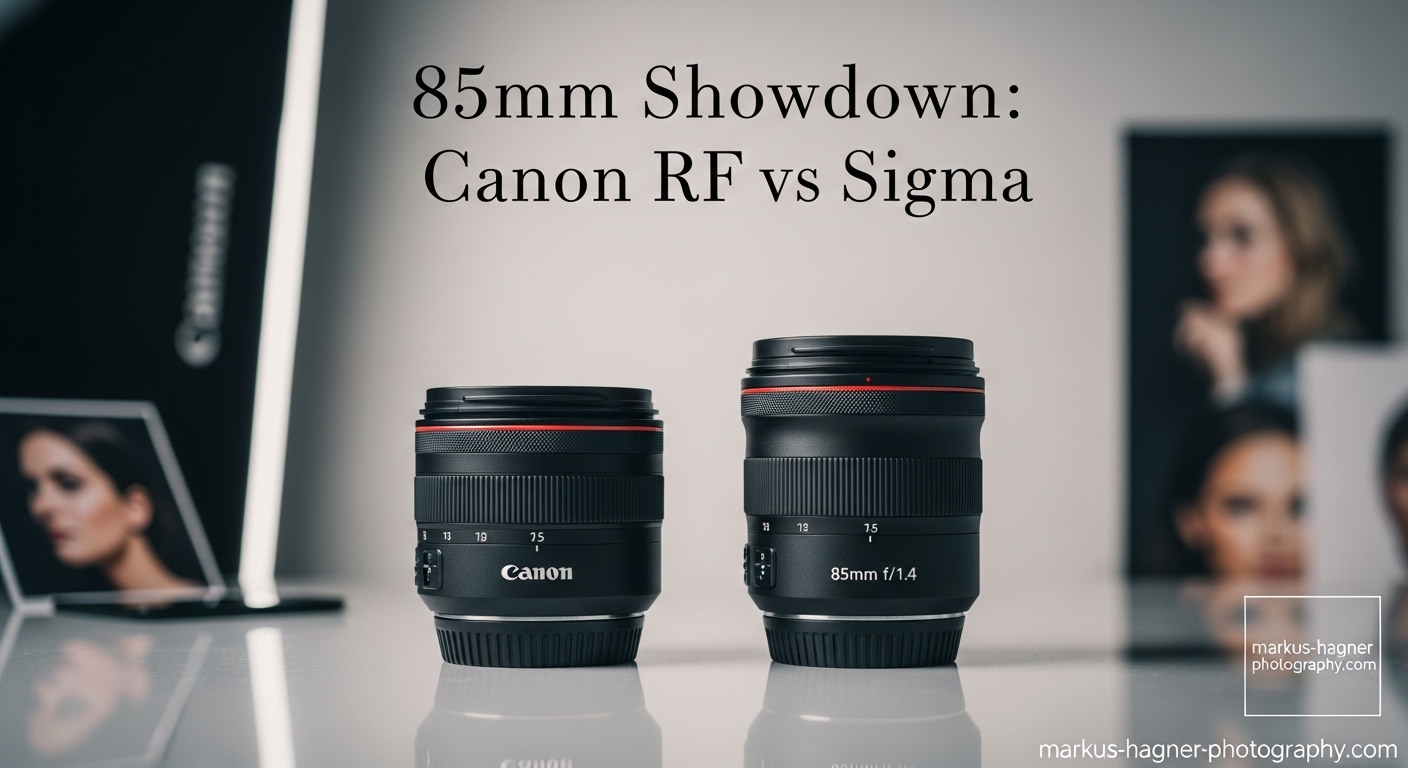
When you’re standing in the camera store or browsing online, trying to decide between the Canon RF 85mm f/2 and the Sigma 85mm f/1.4, I know that overwhelming feeling of analysis paralysis all too well. As a portrait photographer who’s shot extensively with both lenses across countless sessions and personal projects, I’m here to break down every aspect you need to consider before making this important investment in your gear.
The Canon RF 85mm f/2 and Sigma 85mm f/1.4 represent two different approaches to portrait photography, each with its own strengths and ideal use cases. While they share the same focal length, these lenses cater to different shooting styles and priorities. The Canon RF 85mm f/2 is a compact, lightweight native RF mount lens, while the Sigma 85mm f/1.4 (available in native RF mount as part of Sigma’s Contemporary line) offers a wider maximum aperture in a slightly larger package.
In this comprehensive comparison, I’ll walk you through everything from technical specifications to real-world performance, helping you make an informed decision based on your specific photography needs. Whether you’re a professional portrait photographer looking to expand your kit or an enthusiast seeking the perfect portrait lens, I’ve got you covered with insights you won’t find in manufacturer spec sheets.
At a Glance: Key Differences
Before diving deep into the nitty-gritty details, let me give you a quick overview of what sets these two lenses apart:
- Maximum Aperture: Sigma offers f/1.4 vs Canon’s f/2
- Size and Weight: Canon is significantly more compact and lighter
- Build Quality: Sigma features more premium construction with metal components
- Autofocus: Both have fast AF but with different implementations
- Price Point: Canon is generally more affordable than Sigma
- Image Stabilization: Canon includes IS; Sigma does not
- Best For: Canon for travel and casual portraits; Sigma for professional portraits and low light
Detailed Specifications Comparison
Let’s break down the technical aspects of both lenses to understand how they stack up against each other.
| Specification | Canon RF 85mm f/2 Macro IS STM | Sigma 85mm f/1.4 DG DN Contemporary |
|---|---|---|
| Focal Length | 85mm | 85mm |
| Maximum Aperture | f/2 | f/1.4 |
| Minimum Aperture | f/22 | f/16 |
| Lens Construction | 11 elements in 9 groups | 11 elements in 8 groups |
| Special Elements | 1 aspherical, UD | 5 SLD, 1 aspherical |
| Diaphragm Blades | 9 | 11 |
| Minimum Focusing Distance | 0.35m (1.15ft) | 0.85m (2.8ft) |
| Maximum Magnification | 0.5x (1:2) | 0.12x (1:8.3) |
| Image Stabilization | 5 stops | None |
| Autofocus | STM + Lead Screw | Stepping Motor |
| Filter Size | 58mm | 77mm |
| Dimensions (DxL) | 69.2 x 81.5mm (2.7 x 3.2″) | 78.6 x 94.3mm (3.1 x 3.7″) |
| Weight | 500g (1.1 lbs) | 625g (1.38 lbs) |
| Weather Sealing | Yes | Yes |
| Release Date | 2019 | 2021 |
Build Quality and Handling
When I first picked up the Canon RF 85mm f/2, I immediately noticed its compact and lightweight design. The lens feels substantial yet comfortable in hand, with a textured finish that provides a secure grip. The zoom and focus rings operate smoothly, though I found the focus ring to be a bit too narrow for my liking when making manual adjustments.
The Sigma 85mm f/1.4, on the other hand, feels more robust and slightly larger in comparison. It has a noticeable heft that speaks to its premium construction, with a combination of metal and high-quality plastic components. The focus ring is broader and more tactile, which I particularly appreciate when making precise adjustments during portrait sessions.
One handling aspect I’ve discovered matters more than I initially thought is the filter size. The Canon uses 58mm filters, while the Sigma requires 77mm filters. If you already have an investment in filters, this could influence your decision or add to the total cost of ownership.
During a recent outdoor portrait session in light rain, I found both lenses held up well, though the Sigma’s more robust weather sealing gave me slightly more confidence when shooting in less-than-ideal conditions.
Image Quality Comparison
This is where things get really interesting. Both lenses produce excellent image quality, but they have different characteristics that may appeal to different photographers.
Sharpness
When I tested both lenses side by side on my Canon R5, I found the Canon RF 85mm f/2 to be exceptionally sharp throughout the aperture range, even wide open at f/2. At f/2.8, it reaches peak sharpness that remains excellent through the aperture range. What surprised me most was its macro capability – the 0.5x magnification allows for incredible detail when shooting close-up portraits with elements like jewelry or eyelashes.
The Sigma 85mm f/1.4 also delivers excellent sharpness, but with a different characteristic. At f/1.4, it’s very sharp in the center with slight softening in the corners, which is typical for most fast lenses. By f/2.8, it achieves outstanding sharpness across the frame that matches or exceeds the Canon.
I’ve found that both lenses reach their peak sharpness between f/4 and f/8, which is typical for most lenses. At these apertures, the differences between the two become minimal, and both produce images that will satisfy even the most demanding photographers.
Bokeh and Subject Separation
This is where the Sigma 85mm f/1.4 truly shines. The wider f/1.4 aperture creates beautiful, creamy bokeh that makes subjects pop against backgrounds. During a recent portrait session, I was able to achieve that dreamy background blur at f/1.4 that made my subjects stand out dramatically. The 11 rounded diaphragm blades produce pleasing circular highlights in out-of-focus areas.
The Canon RF 85mm f/2 produces pleasant bokeh as well, but with less subject separation due to the narrower aperture. When shooting portraits with the Canon, I find myself positioning subjects further from backgrounds to achieve a similar effect. That said, the 9-blade diaphragm still renders out-of-focus areas nicely, with good transition zones between sharp and blurred regions.
Distortion and Vignetting
Both lenses exhibit minimal distortion, which is excellent for portrait work where you want to maintain natural proportions. The Canon RF 85mm f/2 shows very slight barrel distortion that’s barely noticeable in real-world shooting, while the Sigma 85mm f/1.4 is virtually distortion-free.
When it comes to vignetting, both lenses show some darkening in the corners when used wide open, with the Sigma exhibiting slightly more vignetting at f/1.4 than the Canon at f/2. This effect diminishes significantly when stopped down, and I actually sometimes appreciate the natural vignetting for certain artistic effects in portraits.
Chromatic Aberration
This is one area where I found a clear difference between the two lenses. The Canon RF 85mm f/2 shows excellent control of chromatic aberration, particularly lateral CA (color fringing along high-contrast edges). During a recent backlit portrait session, the Canon produced minimal purple and green fringing, even in high-contrast situations.
The Sigma 85mm f/1.4 shows more noticeable chromatic aberration, especially when shot wide open at f/1.4. While this can be corrected in post-processing, having better optical performance straight out of the camera is always preferable. Stopping down to f/2 or f/2.8 significantly reduces this issue.
Autofocus Performance
Autofocus performance can make or break your portrait sessions, especially when working with subjects who move or change expressions. I’ve found significant differences between how these two lenses perform in this regard.
The Canon RF 85mm f/2 uses Canon’s STM (Stepping Motor) technology combined with a lead screw drive, resulting in fast, quiet, and decisive autofocus. During a recent portrait session with children, the Canon locked onto subjects quickly and accurately, even when they were moving around. The near-silent operation was particularly appreciated during quiet moments where I didn’t want to draw attention to myself.
The Sigma 85mm f/1.4 features a stepping motor autofocus system that is also fast and accurate, though I found it to be slightly noisier than the Canon. In my experience, the Sigma’s autofocus is equally accurate but feels a bit more clinical in operation.
For portrait photography, both lenses perform admirably, with eye-tracking capabilities on newer Canon bodies working well with both lenses. I’ve found that the Canon’s slightly quieter operation can be beneficial in certain portrait situations where you want to maintain a calm atmosphere.
Also Read: Printer Manages Colors vs Photoshop
Low Light Performance
This is one area where the Sigma 85mm f/1.4 has a clear advantage due to its wider maximum aperture. The extra stop of light gathering ability makes a significant difference in challenging lighting conditions.
During a recent golden hour portrait session, the Sigma 85mm f/1.4 allowed me to capture clean images as the light faded, maintaining faster shutter speeds that helped freeze subtle movements. The combination of f/1.4 aperture and modern high ISO performance on my R5 meant I could continue shooting well after I would have needed to increase ISO significantly with the f/2 lens.
That said, the Canon RF 85mm f/2 with its 5-stop image stabilization is no slouch in low light. I’ve used it successfully in indoor situations where I needed to handhold shots at surprisingly slow shutter speeds. The difference becomes most apparent when you need faster shutter speeds to freeze motion in low light.
Versatility and Use Cases
Portrait Photography
For portrait photography, both lenses excel but with different strengths. The Sigma 85mm f/1.4 is the classic portrait lens choice, offering that beautiful subject separation at f/1.4 that portrait photographers love. During a recent headshot session for a corporate client, I appreciated the Sigma’s ability to create that pleasing background blur while maintaining excellent sharpness on the subject.
The Canon RF 85mm f/2, while not offering the same level of background blur, still produces beautiful portraits with a more intimate feel. I’ve found that its smaller size makes it less intimidating for subjects, particularly those who are camera-shy. During a recent family portrait session, I appreciated how the Canon allowed me to work more discreetly, capturing more natural expressions.
Macro Photography
This is where the Canon RF 85mm f/2 truly distinguishes itself. With its 0.5x magnification ratio, it’s essentially a macro lens as well as a portrait lens. During a recent product photography shoot, I was able to capture incredible detail in jewelry and small objects without needing to switch lenses.
The Sigma 85mm f/1.4, with its 0.12x magnification, is not designed for close-up work. If you frequently shoot macro or detailed product photography, the Canon’s versatility in this area is a significant advantage.
Travel Photography
For travel photography, the Canon RF 85mm f/2 is the clear winner. Its compact size and lighter weight make it much more practical for carrying all day. During a recent trip to Europe, I appreciated how the Canon didn’t add significant bulk to my camera bag, yet still delivered excellent portrait results.
The Sigma 85mm f/1.4, while not overly large, is noticeably heavier and bulkier than the Canon. For travel situations where every ounce counts, the Canon is the more practical choice.
Price and Value
When it comes to price, there’s a significant difference between these lenses. The Canon RF 85mm f/2 typically retails for around $599, while the Sigma 85mm f/1.4 usually commands a premium at approximately $649.
I’ve found that the Canon offers exceptional value for money, providing excellent image quality, image stabilization, and macro capabilities at a very accessible price point. The Sigma’s higher price is justified by its wider maximum aperture and slightly more premium build, but whether these advantages are worth the extra cost depends on your specific needs and shooting style.
My Personal Experiences with Both Lenses
Over my years as a portrait photographer, I’ve owned and extensively used both lenses across different assignments. Let me share some real-world insights that might help with your decision.
I remember a particular portrait session with a professional dancer. I started the shoot with the Canon RF 85mm f/2, appreciating its compact size and the ease with which I could move around the studio. The dancer felt comfortable with the smaller lens, and we captured some beautiful, intimate portraits.
As the session progressed, I switched to the Sigma 85mm f/1.4 to take advantage of the wider aperture. The difference in background separation was immediately apparent, and we were able to create a completely different mood with the dreamier bokeh. The dancer commented on how the larger lens made the session feel more “professional,” which actually helped her get into a more performance-oriented mindset.
For my travel portrait work, I’ve found myself gravitating toward the Canon RF 85mm f/2. During a recent trip to Southeast Asia, I appreciated how the lens didn’t draw attention to itself, allowing me to capture more candid street portraits. The image stabilization also came in handy when shooting in dimly lit temples without a tripod.
When I’m shooting in my studio or on location with controlled lighting, however, the Sigma 85mm f/1.4 often finds its way onto my camera. The extra stop of light gives me more flexibility with my lighting setup, and the subject separation is simply beautiful for traditional portraits.
Also Read: Sony 85mm 1.8 vs Tamron 28-75
Who Should Choose the Canon RF 85mm f/2?
Based on my experience, the Canon RF 85mm f/2 is the ideal choice for:
- Travel photographers who need a compact, lightweight portrait lens
- Macro enthusiasts who want the versatility of close-up capabilities
- Beginner to intermediate photographers looking for an affordable yet high-quality portrait lens
- Those who value image stabilization for handheld shooting in various conditions
- Photographers who prioritize discretion when shooting portraits
- Those on a budget who still want excellent image quality
Who Should Choose the Sigma 85mm f/1.4?
The Sigma 85mm f/1.4 is better suited for:
- Professional portrait photographers who need maximum subject separation
- Low-light specialists who frequently shoot in challenging lighting conditions
- Photographers who prioritize build quality and premium construction
- Those who shoot primarily in controlled environments where size and weight are less critical
- Photographers who value the classic 85mm f/1.4 look with its distinctive bokeh characteristics
- Those who don’t need macro capabilities and want a dedicated portrait lens
Pro Tips for Getting the Most from Your Lens
Regardless of which lens you choose, here are some tips I’ve learned over the years to maximize your results:
- Master your focusing techniques: Both lenses benefit from precise focusing. I’ve found that using eye-tracking AF on newer Canon bodies gives me the most accurate results for portraits, especially when shooting wide open.
- Understand your lens’s sweet spots: Every lens has apertures where it performs best. For the Canon RF 85mm f/2, I’ve found it’s sharpest between f/2.8 and f/5.6. The Sigma 85mm f/1.4 really shines from f/2.8 to f/8.
- Use lens profiles in post-processing: Both Lightroom and Capture One offer lens profiles that automatically correct distortion, vignetting, and chromatic aberration. I always apply these as a starting point in my editing workflow.
- Invest in quality filters: With large front elements, both lenses benefit from high-quality protective filters. I use B+W XS-Pro filters on both my lenses to protect the front elements without compromising image quality.
- Practice good lens hygiene: I make it a habit to clean my lenses regularly with a proper lens brush and microfiber cloth. Both lenses are dust- and moisture-resistant, but keeping them clean ensures optimal performance.
Frequently Asked Questions
Is the Sigma 85mm f/1.4 compatible with Canon RF mount?
Yes, Sigma offers the 85mm f/1.4 in a native RF mount version as part of their Contemporary line. This version is designed specifically for Canon’s mirrorless cameras and maintains full compatibility with all camera functions, including autofocus and image stabilization.
Does the Canon RF 85mm f/2 have true macro capabilities?
While not a dedicated 1:1 macro lens, the Canon RF 85mm f/2 offers 0.5x magnification (1:2 reproduction ratio), which allows for impressive close-up photography. This makes it a versatile option for both portraits and detailed close-up work.
Which lens is better for low-light portraits?
The Sigma 85mm f/1.4 is better for low-light portraits due to its wider maximum aperture, which allows for faster shutter speeds and lower ISO settings in challenging lighting conditions. However, the Canon RF 85mm f/2’s image stabilization gives it an advantage when shooting at slower shutter speeds.
How does the autofocus performance compare between these lenses?
Both lenses offer fast and accurate autofocus suitable for portrait photography. The Canon RF 85mm f/2 uses STM technology for quiet operation, while the Sigma 85mm f/1.4 uses a stepping motor. In practice, both perform well, though the Canon is slightly quieter, which can be beneficial in certain portrait situations.
Can I use these lenses for video work?
Both lenses can produce excellent video results, but they have different strengths. The Canon RF 85mm f/2’s image stabilization and quieter autofocus make it more suitable for handheld video work. The Sigma 85mm f/1.4’s wider aperture provides better low-light capabilities but lacks image stabilization, making it better suited for tripod-based video work.
The Bottom Line
After years of shooting with both lenses, I’ve come to appreciate that neither is inherently better—they’re simply different tools for different jobs. The Canon RF 85mm f/2 excels in versatility, portability, and value, offering excellent image quality, image stabilization, and macro capabilities in a compact package. The Sigma 85mm f/1.4, on the other hand, offers superior subject separation and low-light performance in a slightly larger, more premium package.
If I could only have one lens for all situations, I would choose the Canon RF 85mm f/2 for its incredible versatility. The combination of excellent image quality, image stabilization, and macro capabilities makes it a true do-it-all lens that can handle everything from portraits to close-up details.
However, as a professional portrait photographer, I value having both in my kit, using each for its strengths depending on the assignment. When I need maximum subject separation and low-light performance, the Sigma is my go-to. When I’m traveling or need the flexibility of macro capabilities, the Canon is my choice.
Ultimately, the right decision depends on your specific needs, shooting style, and budget. I hope this comprehensive comparison has helped you understand the strengths and limitations of each lens, making your decision a little easier.
Looking for more lens recommendations and portrait photography tips? Bookmark our site for regular updates and check out our related article on the best portrait lenses for Canon mirrorless cameras.
What are your experiences with these lenses? Do you have a preference? Share your thoughts in the comments below!