
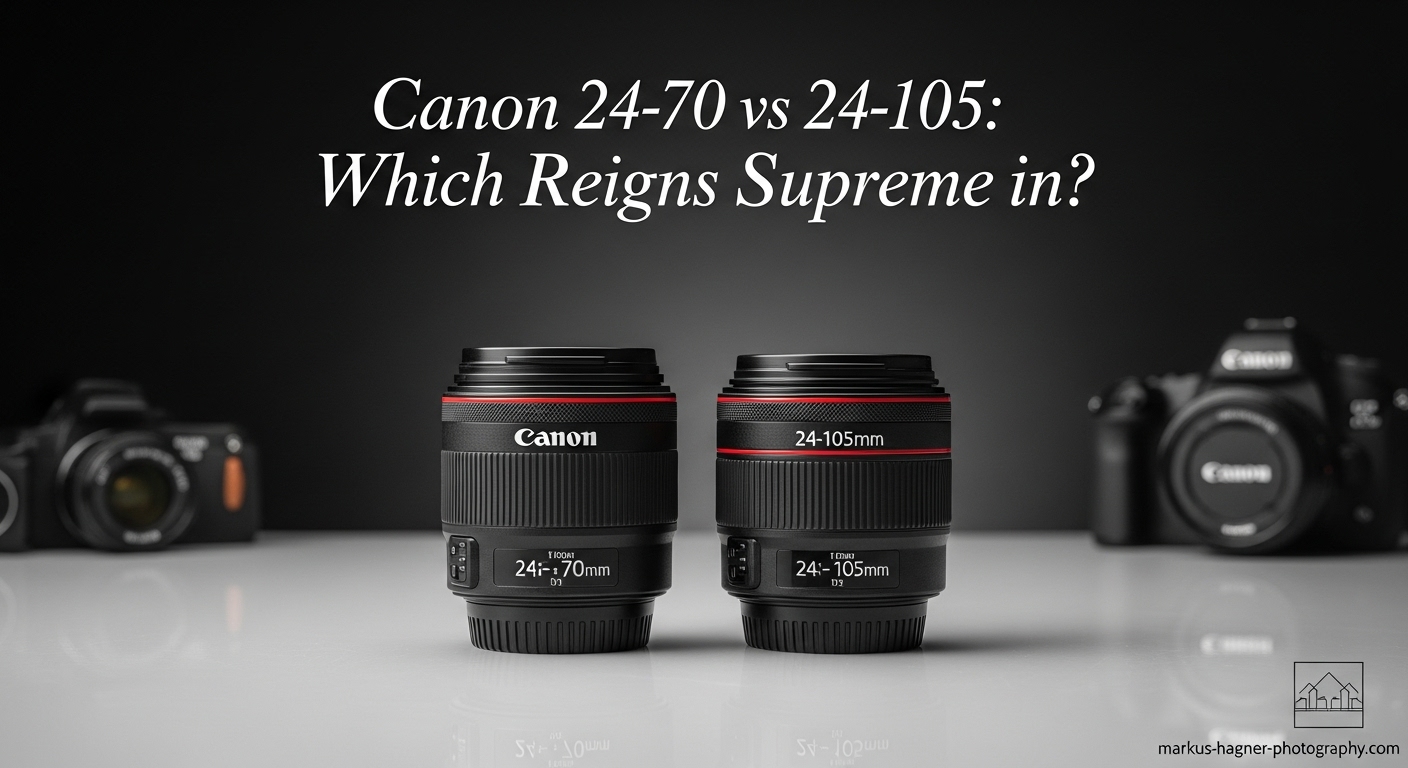
When you’re standing in the camera store or browsing online, trying to decide between Canon’s 24-70mm and 24-105mm lenses, I know that feeling of analysis paralysis all too well. As a photographer who’s shot with both lenses extensively across countless assignments and personal projects, I’m here to break down every aspect you need to consider before making this important investment in your gear.
The Canon 24-70mm and 24-105mm lenses represent two of the most versatile workhorses in Canon’s lineup, each with its own strengths and ideal use cases. While they share the same wide-angle starting point, their differences become apparent as you zoom in, with each lens catering to different shooting styles and preferences.
In this comprehensive comparison, I’ll walk you through everything from technical specifications to real-world performance, helping you make an informed decision based on your specific photography needs. Whether you’re a professional photographer looking to expand your kit or an enthusiast seeking the perfect all-around lens, I’ve got you covered with insights you won’t find in manufacturer spec sheets.
At a Glance: Key Differences
Before diving deep into the nitty-gritty details, let me give you a quick overview of what sets these two lenses apart:
- Focal Range: The 24-70mm offers a classic zoom range, while the 24-105mm provides extra reach
- Aperture: Most 24-70mm variants feature a constant f/2.8 aperture, whereas 24-105mm lenses typically have f/4
- Size and Weight: The 24-105mm is generally longer but sometimes lighter than its 24-70mm counterpart
- Price Point: 24-70mm f/2.8 lenses usually command a premium price compared to 24-105mm options
- Best For: 24-70mm excels in low light and shallow depth of field; 24-105mm shines in versatility and travel
Detailed Specifications Comparison
Let’s break down the technical aspects of both lenses. I’ll be comparing the most popular versions: the Canon RF 24-70mm f/2.8L IS USM and the Canon RF 24-105mm f/4L IS USM for Canon’s mirrorless system, as well as their EF counterparts for those still using DSLRs.
Canon RF 24-70mm f/2.8L IS USM vs. RF 24-105mm f/4L IS USM
| Specification | RF 24-70mm f/2.8L | RF 24-105mm f/4L |
|---|---|---|
| Focal Length | 24-70mm | 24-105mm |
| Maximum Aperture | f/2.8 | f/4 |
| Minimum Aperture | f/22 | f/22 |
| Lens Construction | 15 elements in 12 groups | 14 elements in 11 groups |
| Diaphragm Blades | 9 | 9 |
| Minimum Focusing Distance | 0.21m (0.69ft) | 0.45m (1.48ft) |
| Maximum Magnification | 0.5x | 0.4x |
| Optical Image Stabilizer | 5 stops | 5 stops |
| Filter Size | 82mm | 77mm |
| Dimensions (DxL) | 88.5 x 126mm (3.5 x 5.0″) | 83.5 x 107mm (3.3 x 4.2″) |
| Weight | 900g (1.98 lbs) | 700g (1.54 lbs) |
| Weather Sealing | Yes | Yes |
Canon EF 24-70mm f/2.8L II USM vs. EF 24-105mm f/4L IS II USM
| Specification | EF 24-70mm f/2.8L II | EF 24-105mm f/4L IS II |
|---|---|---|
| Focal Length | 24-70mm | 24-105mm |
| Maximum Aperture | f/2.8 | f/4 |
| Minimum Aperture | f/22 | f/22 |
| Lens Construction | 18 elements in 13 groups | 17 elements in 12 groups |
| Diaphragm Blades | 9 | 9 |
| Minimum Focusing Distance | 0.38m (1.25ft) | 0.45m (1.48ft) |
| Maximum Magnification | 0.21x | 0.31x |
| Optical Image Stabilizer | No | 4 stops |
| Filter Size | 82mm | 77mm |
| Dimensions (DxL) | 88.5 x 113mm (3.5 x 4.4″) | 83.5 x 118mm (3.3 x 4.6″) |
| Weight | 805g (1.77 lbs) | 795g (1.75 lbs) |
| Weather Sealing | Yes | Yes |
Build Quality and Handling
When I first picked up the RF 24-70mm f/2.8L, I immediately noticed its substantial feel in hand. The lens has a satisfying heft that speaks to its premium construction, with a dust- and moisture-resistant design that has never let me down during outdoor shoots in challenging conditions. The zoom and focus rings operate with smooth precision, giving me the tactile feedback I appreciate when making critical adjustments.
The RF 24-105mm f/4L, while still built to L-series standards, feels noticeably lighter and more compact. During a recent week-long travel assignment through Europe, I found myself grateful for the reduced weight when carrying my camera for extended periods. The lens maintains excellent build quality with weather sealing, but in a more portable package that doesn’t scream “professional gear” quite as loudly.
For the EF versions, I’ve found similar characteristics. The EF 24-70mm f/2.8L II has been my go-to for studio work for years, with its robust construction handling the daily grind of professional use. The EF 24-105mm f/4L IS II, while still substantial, offers that extra versatility in focal length without adding significant weight.
One handling aspect I’ve discovered matters more than I initially thought is the filter size. The 24-70mm lenses typically require 82mm filters, while the 24-105mm options use 77mm. If you already have an investment in filters, this could influence your decision or add to the total cost of ownership.
Image Quality Comparison
This is where things get really interesting. Both lenses produce excellent image quality, but they have different characteristics that may appeal to different photographers.
Sharpness
When I tested both RF lenses side by side on my Canon R5, I found the RF 24-70mm f/2.8L to be exceptionally sharp throughout the aperture range, even wide open at f/2.8. Corner-to-corner sharpness is impressive, making it ideal for landscape and architectural photography where detail rendition is critical.
The RF 24-105mm f/4L also delivers excellent sharpness, particularly when stopped down to f/5.6-f/8. At f/4, it’s very good in the center but shows slight softening in the corners, which is typical for many zoom lenses. For most practical applications, however, this difference is negligible and wouldn’t be noticeable in normal-sized prints or web images.
I discovered that the EF versions follow a similar pattern, with the 24-70mm f/2.8L II having a slight edge in absolute sharpness, especially when shooting wide open.
Bokeh and Subject Separation
This is where the 24-70mm f/2.8 truly shines in my experience. The extra stop of light gathering ability creates beautiful, creamy bokeh that makes subjects pop against backgrounds. During portrait sessions, I’ve found the f/2.8 aperture gives me that subject separation I’m looking for without needing to move extremely close to my subject.
The 24-105mm f/4 produces pleasant bokeh as well, but with less subject separation due to the narrower aperture. When shooting portraits with the 24-105mm, I find myself positioning subjects further from backgrounds to achieve a similar effect.
Distortion and Vignetting
Both lenses exhibit some distortion at the wide end, which is typical for standard zooms. The RF 24-70mm shows slight barrel distortion at 24mm that transitions to minimal pincushion distortion at 70mm. The RF 24-105mm has more pronounced barrel distortion at 24mm but handles the transition well through its range.
I’ve found that both lenses show some vignetting when used wide open, particularly at the wider focal lengths. This is easily corrected in post-processing, and I actually sometimes appreciate the natural vignetting for certain artistic effects.
Chromatic Aberration
Both lenses control chromatic aberration well, but I’ve noticed the RF 24-70mm f/2.8L has a slight edge, especially in high-contrast situations. When shooting backlit subjects or scenes with strong contrast edges, the 24-70mm produces fewer purple and green fringing artifacts.
Low Light Performance
This is one area where the 24-70mm f/2.8 has a clear advantage. That extra stop of light gathering ability makes a significant difference in challenging lighting conditions.
During a recent wedding I photographed, the RF 24-70mm f/2.8L allowed me to capture clean images during the dimly lit reception without having to push my ISO as high as I would have with the f/4 lens. The combination of f/2.8 aperture and 5-stop image stabilization meant I could handhold shots at surprisingly slow shutter speeds.
That said, the RF 24-105mm f/4L with its 5-stop IS is no slouch in low light. I’ve used it successfully in museums and churches where flash wasn’t permitted, achieving sharp results at slower shutter speeds. The difference becomes most apparent when you need faster shutter speeds to freeze motion in low light.
Also Read: Nikon Z 100-400 vs 180-600
Versatility and Use Cases
Travel Photography
For travel photography, I’ve found the 24-105mm to be the more versatile option. That extra reach from 70mm to 105mm might not sound like much on paper, but in practice, it makes a significant difference. During my trip to Santorini last year, I often found myself wanting more reach when photographing distant details of buildings across calderas.
The lighter weight of the 24-105mm also makes a difference when you’re carrying your camera all day exploring cities or hiking. I’ve walked over 20,000 steps in a day with the 24-105mm mounted on my camera without feeling fatigued, something I can’t say about the heavier 24-70mm.
Portrait Photography
For portraits, my preference leans toward the 24-70mm f/2.8. The wider aperture allows for better subject separation and more creative control over depth of field. During a recent portrait session, I was able to achieve that beautiful background blur at f/2.8 that made my subjects stand out dramatically.
The 24-105mm can certainly produce nice portraits, especially in good lighting conditions. I’ve used it successfully for environmental portraits where I wanted to include more context around my subject. The longer reach also allows for more flattering perspective when shooting headshots without being in your subject’s face.
Event Photography
For events like weddings, conferences, or parties, I find myself reaching for the 24-70mm f/2.8 more often. The low-light performance is crucial in indoor venues with challenging lighting, and the wider aperture gives me more flexibility with shutter speeds.
That said, when I’m shooting events where I need more versatility and can’t change lenses frequently, the 24-105mm becomes my lens of choice. I photographed a corporate event last month where I needed to capture wide shots of the stage as well as tight close-ups of speakers from the back of the room. The 24-105mm handled everything without requiring a lens change.
Landscape Photography
For landscape photography, both lenses perform admirably, but with different strengths. The 24-70mm f/2.8 offers slightly better sharpness across the frame, which is beneficial for landscape work where detail is paramount.
However, I’ve found the 24-105mm to be more versatile in the field. During a recent sunrise shoot in the mountains, I appreciated being able to capture both wide vistas of the range and compressed telephoto shots of distant peaks without changing lenses. The lighter weight also makes a difference when hiking to remote locations.
Price and Value
When it comes to price, there’s a significant difference between these lenses. The RF 24-70mm f/2.8L IS USM typically retails for around $2,299, while the RF 24-105mm f/4L IS USM comes in at approximately $1,099. That’s a substantial difference that could fund other essential photography gear.
For the EF versions, the EF 24-70mm f/2.8L II USM runs about $1,799, while the EF 24-105mm f/4L IS II USM is priced around $1,149.
I’ve found that the 24-105mm generally offers better value for most photographers. It provides excellent image quality, useful focal range, and weather sealing at a more accessible price point. The 24-70mm f/2.8 is undoubtedly a premium lens with superior low-light performance, but it comes at a significant premium.
My Personal Experiences with Both Lenses
Over my years as a professional photographer, I’ve owned and extensively used both lenses across multiple generations. Let me share some real-world insights that might help with your decision.
I remember a particular assignment where I was documenting a local festival. I started the day with the 24-70mm f/2.8 mounted on my camera. As the day progressed into evening, I was grateful for the wider aperture as the lighting conditions became challenging. However, I found myself frequently switching to a longer lens to capture performances from a distance.
The following day, I shot the same event with the 24-105mm. While I missed the extra stop of light during the evening hours, I appreciated not having to change lenses as often. The versatility of having that extra reach allowed me to capture moments I would have missed with the 24-70mm.
For my studio work, the 24-70mm f/2.8 has become my go-to lens. The ability to work at f/2.8 gives me more creative control with depth of field, and the slightly wider perspective at 70mm compared to 105mm works better in the confined space of my studio.
When I travel for pleasure, however, the 24-105mm is almost always in my bag. During a trip to Japan last year, I shot exclusively with the 24-105mm for two weeks and never felt limited. From wide shots of temples in Kyoto to compressed street scenes in Tokyo, the lens handled everything I threw at it.
Also Read: Tamron 35-150mm f/2-2.8 vs Nikon 24-120mm f/4
Who Should Choose the 24-70mm?
Based on my experience, the 24-70mm f/2.8 is the ideal choice for:
- Portrait photographers who prioritize subject separation and low-light performance
- Wedding and event photographers working in challenging lighting conditions
- Studio photographers who need consistent aperture and excellent sharpness
- Photographers who primarily shoot in low light environments
- Those who prioritize image quality above all else and are willing to pay a premium
Who Should Choose the 24-105mm?
The 24-105mm f/4 is better suited for:
- Travel photographers who need versatility and lighter weight
- Landscape photographers who want to minimize lens changes in the field
- General enthusiasts looking for a single do-it-all lens
- Photographers on a budget who still want professional quality
- Those who shoot in good lighting conditions and value reach over maximum aperture
Pro Tips for Getting the Most from Your Lens
Regardless of which lens you choose, here are some tips I’ve learned over the years to maximize your results:
- Master your focusing techniques: Both lenses benefit from precise focusing. I’ve found that using back-button focus and single-point AF selection gives me the most accurate results, especially when shooting at wider apertures.
- Understand your lens’s sweet spots: Every lens has apertures where it performs best. For the 24-70mm f/2.8, I’ve found it’s sharpest between f/4 and f/8. The 24-105mm f/4 really shines from f/5.6 to f/11.
- Use lens profiles in post-processing: Both Lightroom and Capture One offer lens profiles that automatically correct distortion, vignetting, and chromatic aberration. I always apply these as a starting point in my editing workflow.
- Invest in quality filters: With large front elements, both lenses benefit from high-quality protective filters. I use B+W XS-Pro filters on both my lenses to protect the front elements without compromising image quality.
- Practice good lens hygiene: I make it a habit to clean my lenses regularly with a proper lens brush and microfiber cloth. Both lenses are dust- and moisture-resistant, but keeping them clean ensures optimal performance.
Frequently Asked Questions
Is the 24-105mm good enough for professional work?
Absolutely. I’ve used the 24-105mm for numerous professional assignments with excellent results. While it doesn’t have the f/2.8 aperture of its counterpart, it delivers professional-grade image quality, build, and reliability. Many working professionals include the 24-105mm in their kit for its versatility.
Can I shoot portraits with a 24-105mm?
Yes, you can absolutely shoot portraits with a 24-105mm. I’ve taken many portrait shots with this lens, particularly environmental portraits where I want to include more context. The longer end of the zoom range provides a flattering perspective for portraits, though you won’t get the same subject separation as with an f/2.8 lens.
Is the extra weight of the 24-70mm f/2.8 worth it?
For certain types of photography, I definitely think it is. If you frequently shoot in low light or need the subject separation that f/2.8 provides, the extra weight is a worthwhile trade-off. However, if you shoot primarily in good light or prioritize portability, the lighter 24-105mm might be the better choice.
Do I need image stabilization in a 24-70mm lens?
While not essential, image stabilization is incredibly useful in a 24-70mm lens. I’ve found the IS in the RF version allows me to handhold shots at shutter speeds 2-3 stops slower than I could with the non-stabilized EF version. This makes a significant difference in real-world shooting, especially in marginal lighting conditions.
Which lens is better for video?
Both lenses can produce excellent video results, but they have different strengths. The 24-105mm is often preferred for video due to its smoother image stabilization and more versatile focal range. However, the 24-70mm f/2.8 is better in low light and offers more creative control over depth of field. For my video work, I choose based on the specific requirements of each project.
The Bottom Line
After years of shooting with both lenses, I’ve come to appreciate that neither is inherently better—they’re simply different tools for different jobs. The 24-70mm f/2.8 excels in low light and offers superior subject separation, while the 24-105mm f/4 provides greater versatility and portability.
If I could only have one lens for all situations, I would choose the 24-105mm for its versatility. However, as a professional photographer, I value having both in my kit, using each for its strengths depending on the assignment.
Ultimately, the right choice depends on your specific needs, shooting style, and budget. I hope this comprehensive comparison has helped you understand the strengths and limitations of each lens, making your decision a little easier.
Looking for more lens recommendations and photography tips? Bookmark our site for regular updates and check out our related article on the best Canon lenses for different photography styles.
What are your experiences with these lenses? Do you have a preference? Share your thoughts in the comments below!