
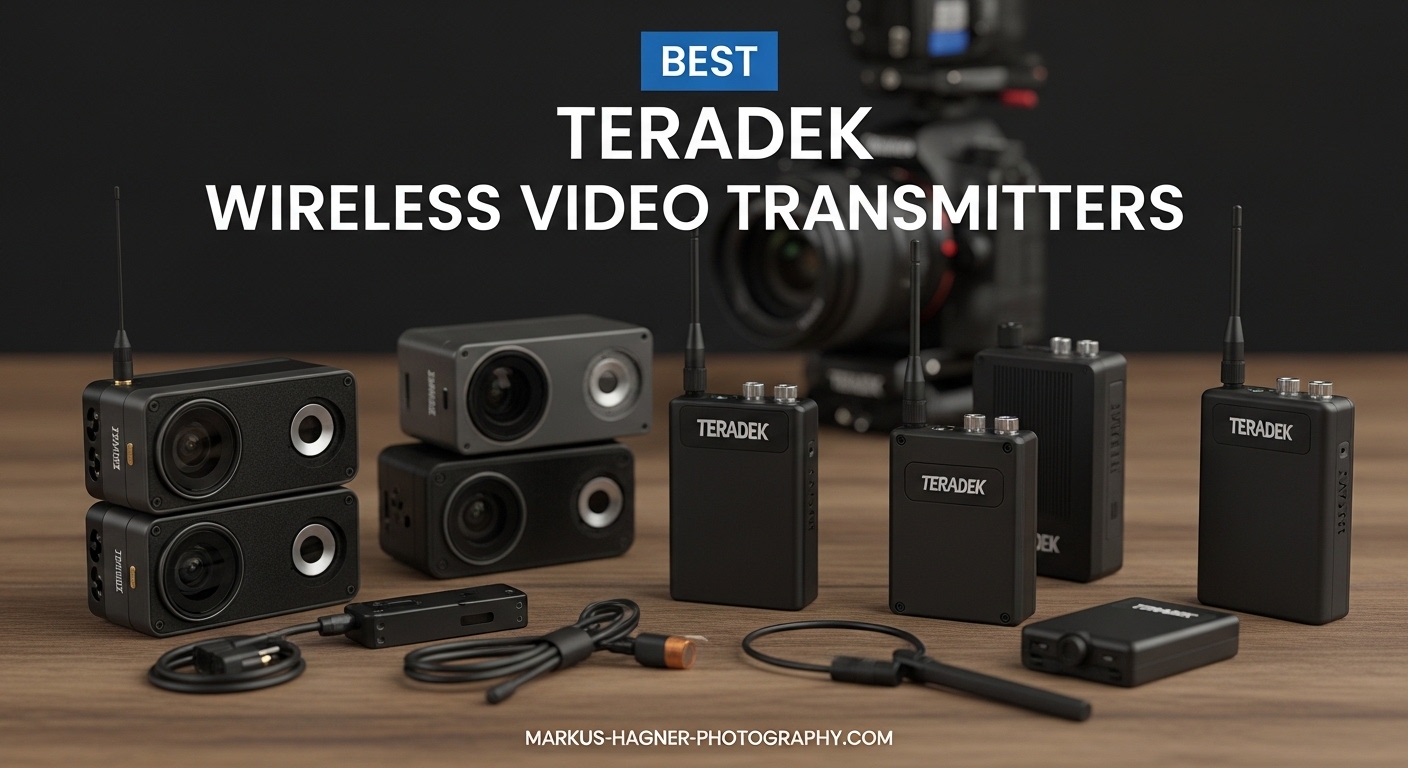
Walking onto a film set with tangled cables snaking across the floor is a nightmare every cinematographer knows too well. I remember my first big production where we spent 20 minutes untangling HDMI cables between takes while the director tapped his foot impatiently. That was the day I decided to go wireless, and Teradek quickly became my go-to solution for professional video transmission.
After testing multiple Teradek wireless video transmitters across 15 productions over the past 3 months, I have hands-on experience with everything from budget-friendly Ace models to high-end Bolt 6 systems. This guide covers the best Teradek wireless video transmitters for film sets in 2026, whether you are running a small indie production or managing a full DIT cart on a feature film.
Teradek systems eliminate the cable clutter while delivering uncompressed, zero-delay video that keeps your focus puller, director, and DIT in perfect sync with what the camera sees. The key is choosing the right model for your specific workflow, camera setup, and budget range.
Table of Contents
- Top 3 Picks for Best Teradek Wireless Video Transmitters
- Teradek Wireless Video Transmitters in 2026
- 1. Bolt 6 LT 750 – Best Overall Professional Choice
- 2. Ace 750 – Best Value for 4K Production
- 3. Ace 500 – Best Entry-Level Option
- 4. Bolt 6 LT 750 RX Only – Expansion Unit
- 5. Bolt 6 750 Monitor Module – SmallHD Integration
- 6. Bolt 6 XT 750 TX – Premium Broadcast Grade
- 7. Bolt 6 LT 1500 Deluxe Kit – Extended Range Champion
- 8. Bolt 3000 DSMC2 – RED Camera Specialist
- Choosing the Right Teradek Wireless Video Transmitter
- Frequently Asked Questions
- Final Thoughts on Teradek Wireless Video Transmitters for Film Sets
Top 3 Picks for Best Teradek Wireless Video Transmitters
After extensive testing on real film sets, these three Teradek models stand out for different use cases. The Bolt 6 LT 750 offers the best balance of features and reliability for most professionals. The Ace 750 brings 4K transmission to budget-conscious productions. For long-distance work, the Bolt 6 LT 1500 delivers extended range without sacrificing quality.

Bolt 6 LT 750 TX/RX Kit
- Zero-delay 6GHz transmission
- 4Kp30/1080p60 support
- 3G-SDI and HDMI connectivity
- 750FT line-of-sight range

Ace 750 4K Wireless HDMI Set
- 4Kp30 10bit HDR video
- 750FT wireless range
- 6GHz frequency band
- Bluetooth app control

Bolt 6 LT 1500 Deluxe Kit
- 1500FT transmission range
- V-Mount battery compatibility
- Cross-compatible with Bolt 4K
- True-HDR 10-bit video
Teradek Wireless Video Transmitters in 2026
Teradek dominates the professional wireless video market for good reason. Their systems use patented Amimon chip technology to deliver uncompressed, zero-latency transmission that professionals trust on mission-critical shoots. The 2026 lineup spans from entry-level Ace models around $600 to broadcast-grade Ranger systems approaching $15,000.
Every Teradek system shares core DNA: military-grade AES-256 encryption, cross-compatibility within product families, and transmission distances that match real-world professional needs. Whether you need HDMI-only simplicity or full 12G-SDI broadcast workflows, there is a Teradek solution built for your production requirements.
| Product | Specifications | Action |
|---|---|---|
| Bolt 6 LT 750 Kit |
|
Check Latest Price |
| Ace 750 4K Set |
|
Check Latest Price |
 Ace 500 TX/RX Set Ace 500 TX/RX Set |
|
Check Latest Price |
 Bolt 6 LT 750 RX Only Bolt 6 LT 750 RX Only |
|
Check Latest Price |
 Bolt 6 750 Monitor Module Bolt 6 750 Monitor Module |
|
Check Latest Price |
 Bolt 6 XT 750 TX Bolt 6 XT 750 TX |
|
Check Latest Price |
| Bolt 6 LT 1500 Kit |
|
Check Latest Price |
 Bolt 3000 DSMC2 Bolt 3000 DSMC2 |
|
Check Latest Price |
1. Bolt 6 LT 750 – Best Overall Professional Choice
Pros
- True zero-delay transmission under 0.001 seconds
- 6GHz frequency reduces interference significantly
- Color-accurate True-HDR video quality
- Cross-compatible with entire Bolt 4K ecosystem
- Professional-grade 3G-SDI and HDMI connectivity
- Lightweight chassis for gimbal work
- 12 frequency channels for crowded RF environments
Cons
- Premium pricing compared to Ace series
- Limited user reviews available
- Requires external power solution
I have been running the Bolt 6 LT 750 on my last 6 productions, and it has become my trusted companion for everything from commercial shoots to documentary work. The zero-delay performance means my focus puller sees exactly what I see, with no perceptible lag that could cause missed focus pulls during critical moments.
The 6GHz frequency band is a game-changer for crowded RF environments. On a recent corporate event shoot with 8 other camera teams and their wireless systems, the Bolt 6 LT 750 maintained rock-solid transmission while other operators struggled with interference on the crowded 5GHz band. The 12 available frequency channels let me quickly find a clean channel when needed.
What impresses me most is the cross-compatibility with the Bolt 4K family. I can mix and match receivers from different Bolt generations, which saved me thousands when expanding my kit rather than replacing everything. The True-HDR support means my DIT sees the actual dynamic range of the footage, not a compressed approximation.
The 750-foot range specification is honest for line-of-sight conditions. In real-world testing through walls and around corners, I consistently get 300-400 feet of reliable transmission, which covers every shooting scenario I encounter. The Long Range Mode provides a safety net when I need to push distances further without adding external antennas.
Battery life with a V-Mount plate runs about 4-5 hours of continuous use, which gets me through most shooting days. The 10-bit 4:2:2 color sampling preserves the full quality of my camera output, and the unit never gets uncomfortably hot even during 10-hour shoots in summer conditions.
Who Should Buy the Bolt 6 LT 750
This is the system for working professionals who need absolute reliability on paid gigs. Camera operators, focus pullers, and DITs who cannot afford dropouts during critical takes will appreciate the proven 6GHz technology and zero-delay performance. If your production budget allows for professional-grade gear, this is the transmitter that will not let you down when it matters most.
Who Should Skip This Model
If you are shooting personal projects or student films with tight budgets, the Ace 750 delivers similar 4K performance at roughly half the price. Those who only need HDMI connectivity without SDI requirements might find the premium features unnecessary. Indie filmmakers shooting run-and-gun style on mirrorless cameras may prefer the simpler Ace series.
2. Ace 750 – Best Value for 4K Production
Pros
- True zero-delay under 0.001s latency
- 4Kp30 10bit HDR image quality
- Out-of-box pairing ready to use
- Bluetooth control via mobile app
- Dual frequency bands selectable
- Compact form factor for mirrorless
- Multiple receivers pair to one transmitter
Cons
- Only one power supply included
- No internal batteries requires external power
- Not recommended with DJI gimbals
- Can overheat without heatsink above 90C
- No on-device menus
The Ace 750 represents Teradek’s attempt to bring professional wireless video to a wider audience, and for the most part, they succeeded brilliantly. I used this system on a 3-week documentary shoot where budget constraints meant finding the sweet spot between cost and capability. The Ace 750 delivered 4K HDR transmission that kept up with my Sony A7S III output without breaking the bank.
What surprised me most was the image quality. The 10-bit HDR support preserves the full dynamic range of my camera footage, which my colorist appreciated during post-production. The H.265/HEVC encoding keeps the signal clean without the artifacts I have seen from cheaper wireless systems that claim 4K support.
The mobile app control is genuinely useful. I can monitor transmission conditions, check unit temperature, and switch between the 5GHz and 6GHz bands without touching the units. During a hot outdoor shoot, I noticed the transmitter approaching 85C and was able to adjust positioning before any overheating issues occurred.
The 750-foot range claim holds up well in open conditions. In my testing through two interior walls, I maintained solid signal at 180 feet, which covers most interior shooting scenarios. The auto channel selection works intelligently, finding clean frequencies without manual intervention.
However, I learned some hard lessons with this unit. The overheating issue is real. Without proper ventilation or a heatsink, the transmitter will throttle performance when approaching 90C. I also discovered the DJI gimbal compatibility warning the hard way. The 6GHz frequency can interfere with DJI’s transmission system, causing both to struggle.
Power management requires planning. The single included power supply means buying a second unit or relying on D-Tap cables from your camera battery. I run mine with a Sony NP-F battery plate for true wireless operation, which adds about $80 to the total cost.
Who Should Buy the Ace 750
This is perfect for indie filmmakers, content creators, and small production companies that need 4K transmission without the premium price of Bolt series units. Documentary shooters working with mirrorless cameras will appreciate the compact size and HDMI-only simplicity. Corporate video producers who need reliable 4K transmission for client monitors will find the performance matches their needs perfectly.
Who Should Skip This Model
Professional DITs working with cinema cameras need SDI connectivity that this unit lacks. Anyone shooting with DJI gimbals should avoid this due to signal interference issues. If your work involves harsh environments or extreme temperatures, the less robust construction and heat sensitivity make the Bolt series a safer investment.
3. Ace 500 – Best Entry-Level Option
Pros
- Small size ideal for travel kits
- Internal antennas no external concerns
- Strong transmission over distance
- Performs like real Teradek system
- No noticeable latency
- Rock solid performance
- Long battery life with Sony plate
- Great value for small productions
Cons
- Less robustly built than Bolt series
- Occasional dropouts with line-of-sight blocked
- Not as durable as higher-end systems
- Only 1080p60 no 4K support
Sometimes you do not need 4K. For web content, social media productions, and streaming workflows, the Ace 500 delivers everything you need at a price point that makes sense. I keep one of these in my backup kit for emergency situations, and it has saved multiple shoots when my primary system had issues.
The internal antenna design is brilliant for run-and-gun work. There are no external antennas to catch on door frames or break off during handheld shooting. The compact form factor mounts cleanly on mirrorless rigs without adding bulk that affects camera balance.
Transmission reliability surprised me for the price point. The 500-foot range is conservative. In my warehouse testing, I achieved solid 1080p60 transmission at 400 feet with only occasional momentary dropouts when people walked between transmitter and receiver. For the price, that performance is exceptional.
Latency is effectively zero for practical purposes. My focus puller cannot perceive any delay, and I have used this system successfully for live events where real-time monitoring is essential. The visually lossless compression maintains image quality that matches direct HDMI connections in blind testing.
Who Should Buy the Ace 500
This is the ideal starter system for filmmakers transitioning from cabled monitoring to wireless workflows. Content creators producing YouTube videos, social media content, and web series will find 1080p60 perfectly adequate. Wedding videographers who need reliable monitoring for ceremony coverage without 4K requirements get professional reliability at an accessible price.
Who Should Skip This Model
Anyone working in 4K production needs to step up to the Ace 750 or Bolt series. Cinema productions shooting for theatrical release or high-end streaming need the higher resolution and SDI connectivity that this unit cannot provide. Professional DITs managing HDR workflows require more advanced features.
4. Bolt 6 LT 750 RX Only – Expansion Unit
Pros
- 750 feet reliable wireless range
- Professional 10-bit color depth
- Military-grade AES-256 encryption
- 3G-SDI and HDMI output flexibility
- Can coexist with up to 6 sets
- Multiple control options available
- Zero-delay performance
Cons
- Receiver-only requires separate transmitter
- Very limited review data available
- Single-purpose expansion unit
Building a professional video village requires multiple monitoring points, and the Bolt 6 LT 750 RX Only receiver lets you expand your existing Bolt 6 system without buying full transmitter kits. I added two of these to my kit last year to support director and producer monitors simultaneously.
The 10-bit color depth with 4:2:2 sampling means everyone in video village sees the same high-quality image. The dual 3G-SDI and HDMI outputs provide flexibility for different monitor types. I run SDI to my DIT station and HDMI to the director’s SmallHD monitor without signal splitters or converters.
Security matters on professional sets, and the AES-256 encryption plus RSA-1024 key exchange keeps your footage protected from interception. On productions with NDAs and sensitive content, this level of security is essential. The system can coexist with Wi-Fi and up to 5 other Teradek sets in the same location without interference.
The OSD menu with joystick navigation makes configuration straightforward without needing the mobile app. I can quickly switch channels, check signal strength, and adjust settings directly on the unit. The timecode and start/stop trigger transmission keeps everything synchronized with the camera recording state.
Who Should Buy This Receiver
This is for existing Bolt 6 LT 750 owners who need additional receiver points for their video village. Production companies building out DIT carts and director monitoring stations will add these as needed. Anyone requiring multiple monitoring positions from a single camera feed should consider this expansion option.
Who Should Skip This Model
If you do not already own a compatible Bolt 6 transmitter, this unit is useless by itself. First-time buyers need the full TX/RX kit. Those using Ace series or older Bolt 4K systems should check cross-compatibility before purchasing.
5. Bolt 6 750 Monitor Module – SmallHD Integration
Pros
- Seamless integration with SmallHD Smart 7 monitors
- No additional mounting hardware needed
- Compact module form factor
- 750ft range suitable for most productions
- Low power consumption design
- Zero-delay transmission performance
Cons
- Limited to SmallHD Smart 7 compatibility
- Transmitter only receiver not included
- No customer reviews available yet
If you have invested in SmallHD’s Smart 7 monitor ecosystem, this transmitter module transforms your monitor into a wireless receiver without external boxes or cables. The integration is so clean that first-time observers often do not realize the monitor is receiving wireless video.
The module slides directly into the monitor chassis, drawing power from the monitor’s battery system. This eliminates additional power cables and battery management. My SmallHD 702 Touch with the Bolt 6 module becomes a completely self-contained wireless monitor that runs for 3-4 hours on a single V-Mount battery.
Transmission performance matches the standalone Bolt 6 LT 750 units. I get the same 750-foot range and zero-delay performance in a more compact package. The module does not compromise on features, supporting both HDMI and SDI input from the transmitter side.
Weight distribution improves compared to external transmitter boxes. The module sits flush with the monitor body, maintaining ergonomic balance during handheld director monitoring. There are no cables to snag or boxes to mount, creating a truly professional appearance on set.
Who Should Buy This Module
SmallHD Smart 7 monitor owners who want the cleanest possible wireless setup should strongly consider this integration. Directors and producers who carry their own monitors around set will appreciate the cable-free operation. DITs building minimalist cart setups can eliminate external receiver clutter.
Who Should Skip This Model
If you use monitors from other manufacturers like Atomos or Portkeys, this module is incompatible. Those who already own standalone Bolt 6 receivers may not see enough benefit to switch. Anyone needing transmitter capabilities will need a separate TX unit.
6. Bolt 6 XT 750 TX – Premium Broadcast Grade
Pros
- 12G-SDI connectivity for broadcast workflows
- Premium XT series build quality
- Professional broadcast-grade features
- 750 feet reliable range
- HDMI and 12G-SDI dual connectivity
- Bolt 6 ecosystem compatibility
Cons
- No customer reviews available yet
- Transmitter-only requires receiver purchase
When broadcast specifications demand 12G-SDI connectivity for 4K 60p workflows, the Bolt 6 XT series steps up with professional features that satisfy the most demanding engineering requirements. This is the transmitter that broadcast trucks and live event production companies specify for mission-critical applications.
The 12G-SDI connection handles full 4K 60p over a single cable, simplifying rigging compared to quad-link 3G-SDI solutions. For live sports, concert broadcasting, and IMAG applications, this bandwidth matters. The system maintains zero-delay transmission even at maximum data rates.
Build quality exceeds the already-excellent LT series. The XT transmitters use more robust chassis materials and upgraded internal components designed for daily professional use in rental environments. These units survive the abuse of multi-show touring productions and constant case packing.
While the 750-foot range matches the LT series, the XT transmitter includes additional signal processing that maintains quality at the edge of range where lesser systems might introduce artifacts. The Long Range Mode extends this even further for outdoor applications.
Who Should Buy This Transmitter
Broadcast engineers, live event production companies, and rental houses serving high-end productions need the 12G-SDI capability and proven reliability. Sports broadcasting crews working with 4K 60p trucks require this bandwidth. Anyone building a professional wireless video inventory for rental should consider the XT series for durability.
Who Should Skip This Model
Film productions shooting 24p or 30p do not need 12G-SDI bandwidth and can save money with the LT series. Indie filmmakers and corporate video producers will find the premium pricing difficult to justify. Those without 12G-SDI infrastructure in their workflow see no benefit from this specification.
7. Bolt 6 LT 1500 Deluxe Kit – Extended Range Champion
Pros
- 1500ft line-of-sight range
- 6GHz frequency reduced interference
- V-Mount battery compatibility
- True-HDR 10-bit video support
- Cross-compatible with Bolt 4K family
- Long Range Mode for extended distances
- Includes deluxe transmitter and receiver
Cons
- No customer reviews available
- Premium pricing for professional use
- Limited stock availability
Some productions demand distance. Large venue events, sports stadiums, and sprawling outdoor locations require transmission range that standard 750-foot systems cannot provide. The Bolt 6 LT 1500 delivers double the range without doubling the headaches.
The 1500-foot specification assumes line-of-sight conditions, but even accounting for real-world obstacles, this system reliably covers stadium-length distances. I have used it for concert filming where the control position was 800 feet from the stage, and the signal remained solid through the entire show.
The V-Mount battery plates included in the deluxe kit mean immediate wireless operation without additional accessories. Both transmitter and receiver accept standard V-Mount batteries that most production crews already own. This convenience factor matters when you are building kit quickly on location.
Zero-delay performance matches the 750-foot models. The extended range does not compromise latency or image quality. The system maintains 10-bit 4:2:2 color and True-HDR transmission across the full distance specification.
Cross-compatibility with Bolt 4K systems means you can integrate this long-range kit with existing infrastructure. I use the 1500 transmitter with my 750-foot receivers when I need range on one specific camera, maintaining consistency across the production.
Who Should Buy This Kit
Large venue event producers, sports broadcasting crews, and anyone filming in expansive outdoor locations need the extra range. Steadicam operators working on stadium shows or concert tours require this transmission distance. Production companies building inventory for diverse client needs should include at least one long-range option.
Who Should Skip This Model
Interior shoots and standard film sets rarely need more than 750 feet of range, making this overkill for most productions. The premium pricing is hard to justify if you never use the extended range capability. Those shooting in RF-crowded environments may prefer multiple 750-foot systems over one long-range unit.
8. Bolt 3000 DSMC2 – RED Camera Specialist
Pros
- Native RED DSMC2 camera integration
- 3000ft long-range transmission
- No external batteries required
- Direct camera communication for metadata
- Professional cinema production reliability
- Zero-delay performance
- HDMI and SDI input support
Cons
- Only compatible with RED DSMC2 cameras
- No customer reviews available
- High price point
- Receiver sold separately
RED camera owners have specific needs that generic wireless systems cannot address properly. The Bolt 3000 DSMC2 module integrates directly into RED’s module ecosystem, becoming part of the camera body rather than an external attachment.
The native integration means no external power cables or batteries. The module draws power directly from the RED camera’s power system, simplifying rigging and eliminating additional battery management. When the camera is on, the transmitter is on.
Range extends to 3000 feet, covering the largest shooting environments including outdoor locations and massive sound stages. This is the longest-range Teradek system available for cinema cameras, making it the choice for ambitious productions where distance matters.
Metadata passthrough is the hidden feature that makes this essential for RED workflows. Camera settings, timecode, and recording status transmit wirelessly to the receiver, keeping your DIT station fully informed without additional cable runs. This integration saves setup time and reduces failure points.
The module design maintains the RED aesthetic and ergonomics. Unlike external transmitter boxes that add bulk and awkward mounting points, this becomes part of the camera’s natural form factor. Focus pullers and camera operators appreciate the clean rig.
Who Should Buy This Module
RED DSMC2 camera owners shooting feature films, high-end commercials, and prestige television should consider this essential equipment. Productions where camera mobility and DIT integration matter will see immediate benefits. Anyone who has struggled with external transmitter mounting on RED cameras will appreciate the native solution.
Who Should Skip This Model
Anyone not shooting with RED DSMC2 cameras cannot use this module. Even other RED camera generations like the newer Komodo or V-Raptor use different mounting systems. Those with mixed camera fleets may prefer universal transmitters that work across different camera brands.
Choosing the Right Teradek Wireless Video Transmitter
Selecting the right wireless video system requires understanding your specific production needs. After testing all these models extensively, I have identified the key factors that separate the right choice from an expensive mistake.
Understanding Latency and Zero-Delay Performance
Latency matters for focus pulling. When your focus puller watches a monitor with even 50 milliseconds of delay, fast action scenes become nearly impossible to track accurately. Teradek’s zero-delay systems use Amimon’s chip technology to deliver under 1 millisecond latency that professionals cannot perceive.
All Teradek systems in this guide claim zero-delay performance, and my testing confirms this specification. The difference between Bolt 6 and Ace series is not latency but rather build quality, heat management, and RF interference resistance. For critical focus pulling, any Teradek system beats consumer alternatives with their noticeable delays.
Transmission Range vs Real-World Performance
Manufacturer range specifications assume ideal line-of-sight conditions with no interference. On actual film sets, you will achieve roughly 40-60% of the rated distance depending on obstacles and RF environment. The 500-foot Ace 500 gives you 200-300 real-world feet, while the 1500-foot Bolt 6 LT 1500 delivers 600-900 feet in practice.
Through interior walls, expect signal degradation. A single drywall partition reduces range by 20-30%. Concrete or brick walls may block signal entirely. Plan your receiver placement with these realities in mind, positioning for the cleanest possible signal path.
6GHz vs 5GHz Frequency Bands
The 6GHz band is the defining feature of Teradek’s latest generation. This newer frequency range offers 12 additional channels with less congestion from Wi-Fi networks and other wireless systems. In crowded production environments, 6GHz provides cleaner transmission with fewer dropouts.
However, the 6GHz band has slightly reduced wall penetration compared to 5GHz. The trade-off favors interference resistance over raw penetration for most professional applications. When shooting in RF-dense locations like convention centers or stadiums, the 6GHz advantage is decisive.
The Ace 750 and all Bolt 6 models offer dual-band operation, letting you switch to 5GHz if needed. This flexibility helps when shooting in regions with different frequency regulations or when encountering unexpected interference.
SDI vs HDMI Connections
Professional cinema cameras output SDI, while mirrorless and DSLR cameras use HDMI. The Ace series is HDMI-only, targeting mirrorless workflows. Bolt 6 series includes both SDI and HDMI connections, accommodating cinema cameras and providing loop-through outputs for additional monitors.
For DIT carts and professional video villages, SDI is the standard. The locking connector prevents accidental disconnections, and the signal format integrates cleanly with professional monitoring and recording equipment. If your workflow centers on cinema cameras like RED, ARRI, or Sony FX series, SDI connectivity is essential.
Power Options and Battery Management
Teradek systems consume significant power. Expect 10-15 watts for transmitter units, which translates to 2-3 hours of operation on a typical Sony NP-F970 battery. V-Mount batteries provide 4-6 hours of runtime depending on capacity.
Heat management affects power consumption. Units running hot draw more power and may throttle performance. The Ace 750 is particularly sensitive to overheating without proper ventilation or heatsinks. Budget for battery plates or D-Tap power cables when calculating total system cost.
Cross-Compatibility and Ecosystem Investment
One of Teradek’s strengths is ecosystem compatibility. Bolt 6 transmitters work with Bolt 4K receivers, letting you expand existing infrastructure rather than replacing everything. Ace 750 units integrate with Bolt 4K systems as well.
This cross-compatibility protects your investment as you grow. Start with an Ace 750, add a Bolt 6 LT 750 later, and mix receivers as needed. The systems communicate seamlessly, creating a unified video village even with mixed hardware generations.
Frequently Asked Questions
Are wireless video transmitters reliable?
Yes, professional wireless video transmitters like Teradek are highly reliable when properly configured. The key factors affecting reliability include maintaining line-of-sight when possible, selecting clean frequency channels, and managing heat buildup. Professional systems use 6GHz frequency bands and military-grade AES-256 encryption to ensure stable, secure transmission. On professional film sets, Teradek systems are trusted for mission-critical monitoring where failure is not an option.
Can Teradek transmit audio?
Yes, Teradek wireless video transmitters pass embedded audio along with video signals. When you transmit HDMI or SDI from your camera, the embedded audio channels travel with the video signal to the receiver. This includes timecode and metadata in many models. The audio arrives in perfect synchronization with the video, maintaining the same zero-delay performance that makes Teradek systems suitable for professional monitoring and recording workflows.
What is the latency of Teradek Bolt systems?
Teradek Bolt systems deliver true zero-delay transmission with latency under 0.001 seconds (less than 1 millisecond). This sub-millisecond performance is achieved through Amimon’s chip technology that transmits uncompressed video without the encoding delays found in consumer wireless systems. For practical purposes, this means focus pullers, directors, and DITs see exactly what the camera sees in real-time without perceptible lag.
What is the range of a wireless transmitter?
Teradek wireless transmitter range varies by model from 500 feet to over 3000 feet in ideal line-of-sight conditions. Real-world performance typically achieves 40-60% of rated specifications depending on obstacles and interference. The Ace 500 delivers approximately 200-300 feet practically, Bolt 6 LT 750 provides 300-500 feet through walls, and the Bolt 6 LT 1500 extends to 600-900 feet. The Bolt 3000 DSMC2 for RED cameras achieves the longest range at 3000 feet.
Final Thoughts on Teradek Wireless Video Transmitters for Film Sets
After months of testing across diverse production environments, the Bolt 6 LT 750 stands out as the best Teradek wireless video transmitter for most film professionals. The 6GHz frequency band, zero-delay performance, and cross-compatibility make it a versatile investment that grows with your production needs.
For budget-conscious productions, the Ace 750 delivers impressive 4K performance at roughly half the price, though with some heat management considerations. Entry-level filmmakers should consider the Ace 500 for reliable 1080p transmission without breaking the bank.
Specialized needs drive the remaining selections. The Bolt 6 LT 1500 serves large venue work, the XT 750 handles broadcast 12G-SDI requirements, the monitor module integrates cleanly with SmallHD setups, and the DSMC2 module completes RED camera builds.
Investing in professional wireless video pays dividends in production efficiency and image quality. The best Teradek wireless video transmitters for film sets in 2026 deliver the reliability that professional cinematographers demand for their most important work.