
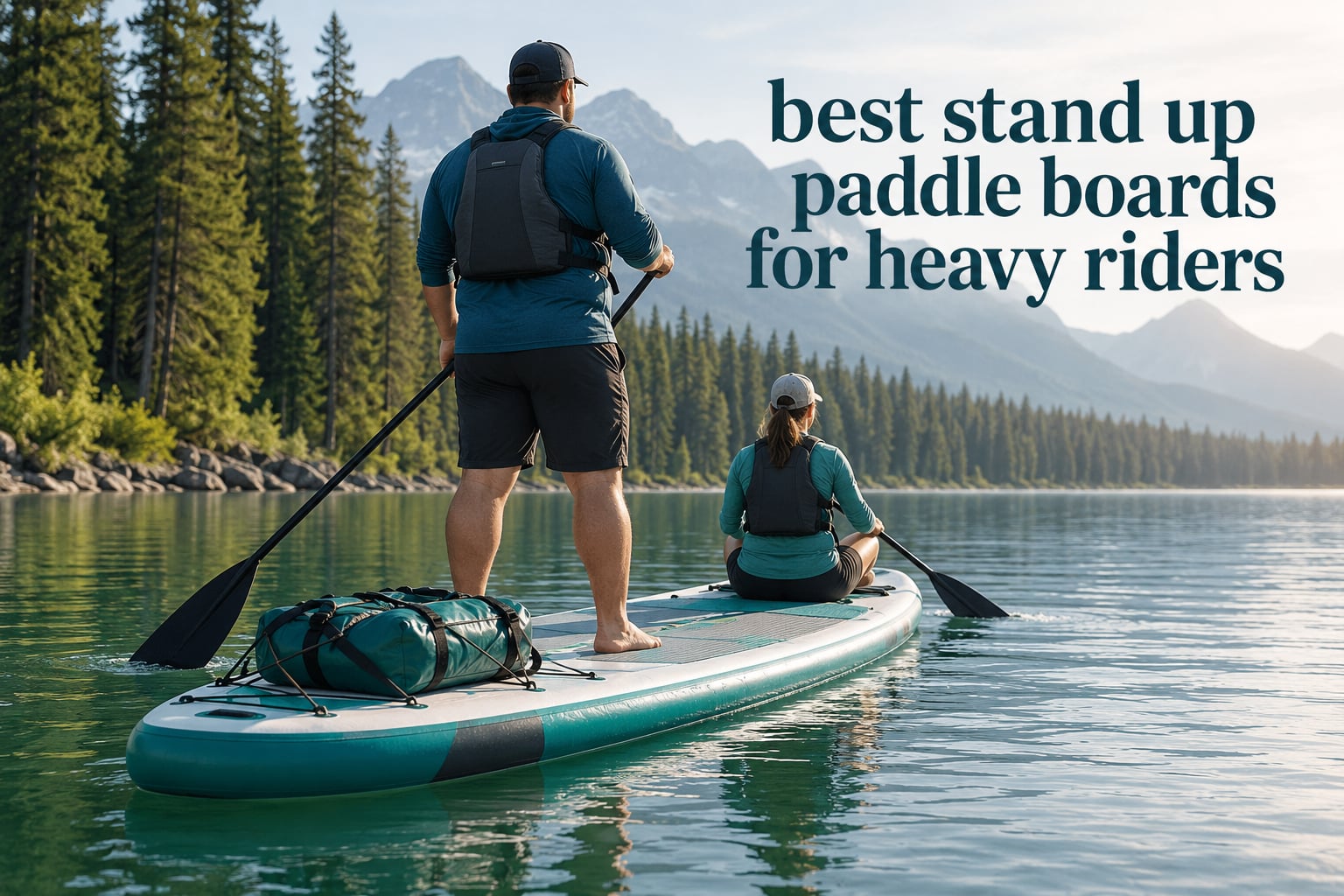
Most stand up paddle board roundups are written for a 150 lb paddler. The boards they recommend are 32 inches wide, rated to 250 to 300 lb, and flex noticeably when you load them past that number. If you weigh 250 lb or more, that mismatch is exactly why the board feels wobbly, why the nose sits down in the water, and why so many larger riders quietly stop paddling and never tell anyone why.
So we rebuilt the shortlist around a single number: published weight capacity. Every board in this guide is rated between 400 lb and 661 lb, sits between 33 and 39 inches wide, and runs 6 to 8 inches thick. We compared all ten for stability under load, tracking, how they handle a full accessory kit, packed weight you have to solo-carry to the launch, warranty length, and what real riders report after a season on the water.
The short version: the Skatinger 11’6″ x 35″ is the best stand up paddle board for heavy riders overall, because it combines the highest rating-to-review ratio in the group with a 450 lb rating, a 35″ deck, and a 19.8 lb packed weight that a single rider can still manage. If you need more headroom, the Niphean 11′ x 33″ claims 500 lb, and if you ride with a partner, a dog, or fishing gear, the NACATIN 12′ x 36″ claims 661 lb.
One sizing rule matters more than anything else on this page: pick a board rated 20 to 30 percent above your total load, and your total load includes your paddle, PFD, cooler, and any dog. A 280 lb rider needs to look past 336 lb, which rules out several boards that look plenty big in a photo. If you want the beginner-friendly version of the sport instead, start with our beginner stand up paddle board guide, then size up.
Top 3 Best Stand Up Paddle Boards for Heavy Riders in October

Skatinger 11’6 x 35 Super Wide SUP
- 450 lb capacity
- 35 inch wide deck
- 19.8 lb packed weight
- 2 year warranty

Niphean 11′ x 33 Extra Large SUP
- 500 lb capacity
- 15 D-rings
- 19 lb packed weight
- 3 year warranty

ATPROSS 11’6 x 35 Wide SUP with Seat
- 450 lb capacity
- 35 inch deck
- inflatable kayak seat
- full accessory kit
All 10 Boards Compared at a Glance (2026)
| Product | Specifications | Action |
|---|---|---|
| Skatinger 11’6 x 35 Super Wide SUP |
|
Check Latest Price |
| Niphean 11′ x 33 Extra Large SUP |
|
Check Latest Price |
| ATPROSS 11’6 x 35 Wide SUP with Seat |
|
Check Latest Price |
 NACATIN 12′ x 36 Extra Large SUP NACATIN 12′ x 36 Extra Large SUP |
|
Check Latest Price |
 iTAOSTAR Adventure 12′ x 39 Wide SUP iTAOSTAR Adventure 12′ x 39 Wide SUP |
|
Check Latest Price |
 iTAOSTAR Daisy 11’6 x 35 SUP iTAOSTAR Daisy 11’6 x 35 SUP |
|
Check Latest Price |
 CETANA 11’6 x 35 Extra Wide SUP CETANA 11’6 x 35 Extra Wide SUP |
|
Check Latest Price |
 UPWELL 11’6 x 35 Extra Wide SUP UPWELL 11’6 x 35 Extra Wide SUP |
|
Check Latest Price |
 Intermountain Gorge 11′ x 34 Ultra Wide SUP Intermountain Gorge 11′ x 34 Ultra Wide SUP |
|
Check Latest Price |
 ATPROSS 10’6 x 33 Wide SUP with Seat ATPROSS 10’6 x 33 Wide SUP with Seat |
|
Check Latest Price |
Capacity is only half the story. The other half is width, because a wide deck resists side-to-side tipping, and a 39 inch board behaves differently in chop than a 33 inch board even when both are rated for the same load. Below is the reasoning behind every pick, followed by the sizing and construction details that decide whether a board feels solid under you.
Why Heavier Riders Quit Paddleboarding and What Fixes It
Rider forums for this topic are unusually honest. Across the paddleboarding subreddits and plus-size outdoor groups, the same three complaints repeat: the nose digs in when you ride close to the published limit, cheap inflatables go soft and wobbly under a heavy load, and getting back on after a fall is genuinely harder when you are the largest person in the water.
None of that is a body-size problem. It is a sizing problem, and it has a fix. A board rated well above your weight displaces enough water to keep your hips high, so the nose stays out of the lake. A wider deck spreads your stance, so a small lean does not become a fall. And an accurately inflated multi-layer shell keeps the deck from sagging between your feet, which is the “wobbly” feeling riders describe.
There is a marketing problem too, and it is worth naming plainly. Several boards in this roundup publish capacity numbers above 500 lb, and forum members have reported that those figures read as a comfort limit rather than a true maximum. Treat every published rating as the point where the board stops feeling good, not as a number you should ever ride at. A 661 lb rating on a 300 lb rider means enormous headroom, and that is exactly what you want.
The other honest point is carrying weight. High-capacity boards in this group weigh between 18 and 27.3 lb packed, and once inflated you are moving something the size of a small door. If you are the only person carrying gear, the 19.8 lb Skatinger and the 18 lb Intermountain Gorge are the most manageable options here.
1. Skatinger 11’6″ x 35″ Super Wide SUP: 450 lb Capacity, Best Overall
Pros
- 35 inch deck is 3 inches wider than a typical 32 inch board
- 450 lb rating with real room for a partner or gear
- Full kit includes adjustable aluminum paddle pump backpack dry bag leash and fin
- Three carry handles plus padded shoulder strap
- 2 year manufacturer warranty extension
Cons
- Heavy and bulky to move once inflated
- 10 inch fin adds drag in turning maneuvers
- Some riders prefer a lighter narrower board for solo distance
This is the board we kept coming back to while comparing the group. At 4.8 stars across 1,450 reviews it carries the largest review base of anything on this page, which means the stability reputation is not built on a handful of early buyers. Owners describe it as the board that finally let them stop thinking about balance.
The platform is 138 inches long, 35 inches wide, and 6 inches thick, rated to 450 lb. That 35 inch width is the number that matters. It is 3 inches wider than a standard 32 inch board, and that extra 3 inches is what widens your effective stance and slows a tip into a lean instead of a fall.

Construction is dual-layer PVC sidewall rated to a 20 psi maximum, which is among the higher pressure ceilings in this roundup. The manufacturer recommends 10 to 12 psi for a solo rider and 12 to 15 psi for two. That matters at your weight, because an under-inflated board is the single biggest source of the flex and softness riders complain about. Inflate it to the top of the recommended band and the deck firms up under load.
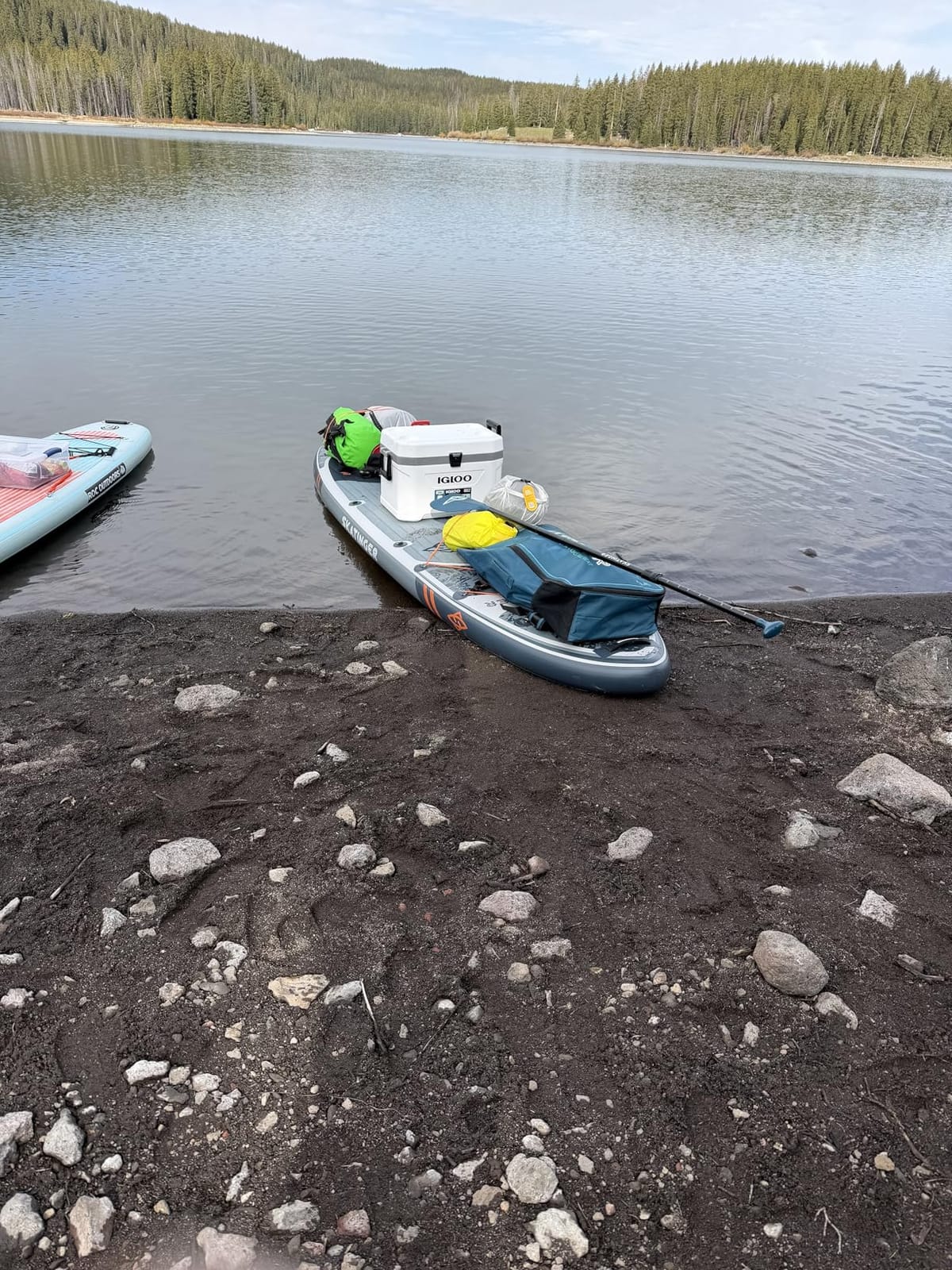
Tracking comes from a 10 inch US big fin, and the board carries a dual bungee system with a 6-point front and 4-point rear arrangement. Four central D-rings accept a kayak seat or the included shoulder strap. The accessory list is unusually complete for this class: adjustable aluminum paddle, dual-action pump, 1680D backpack, 5L dry bag, ankle leash, phone case, and a wrench, all included.
How it performs with a heavy load on board
Two adults plus a cooler stay high in the water on this deck, and the 6-point front bungee plus 4 D-rings give you somewhere to put the load low and centred. The 450 lb rating means a 300 lb rider is running at about two-thirds capacity, which is the sweet spot rather than a compromise.
Riders report three adults and a large dog fitting comfortably, and German-language reviews specifically call out the extra width as the reason multi-person loads do not bog down glide. If you are new to the sport, that width also shortens the learning curve considerably.
Where the trade-offs show up
A 6 inch thick board at 19.8 lb is genuinely bulky once inflated, and getting it from a car to the shoreline solo takes a couple of trips or a cart. The 10 inch fin is built for straight-line tracking, which means quick direction changes in chop feel heavier than on a board with a smaller fin setup.
Riders who prioritise long solo distance over passenger capacity will find a narrower, lighter board more pleasant to paddle. For everyone else, the combination of 450 lb of rating, 35 inches of width, and the strongest review history in the group is why this takes the top slot.
2. Niphean 11′ x 33″ Extra Large SUP: 500 lb Rating and 3-Year Warranty
Pros
- Highest published capacity among the 33 inch wide boards
- 3 year guarantee is the longest warranty here
- 15 D-rings plus two accessory mounts
- Kit includes four fins cup holder repair kit and backpack
- Textured grooved EVA deck grips well when wet
Cons
- 33 inch deck is narrower than the 35 and 36 inch boards here
- 19 lb is a heavy solo carry over distance
- About 7 percent of ratings sit at one or two stars
If your main question is how much rider capacity you can get in one board, this is the number to look at. Niphean publishes over 500 lb for an 11 foot by 33 inch platform, and it backs that with a 3 year manufacturer guarantee, the longest warranty in this group.
Warranty length is not a marketing detail in this niche. A heavy rider flexes a board more than a light one, seams and rails take more load, and a two-year policy feels thin for something you will be inflating weekly. Three years changes how you think about the purchase.
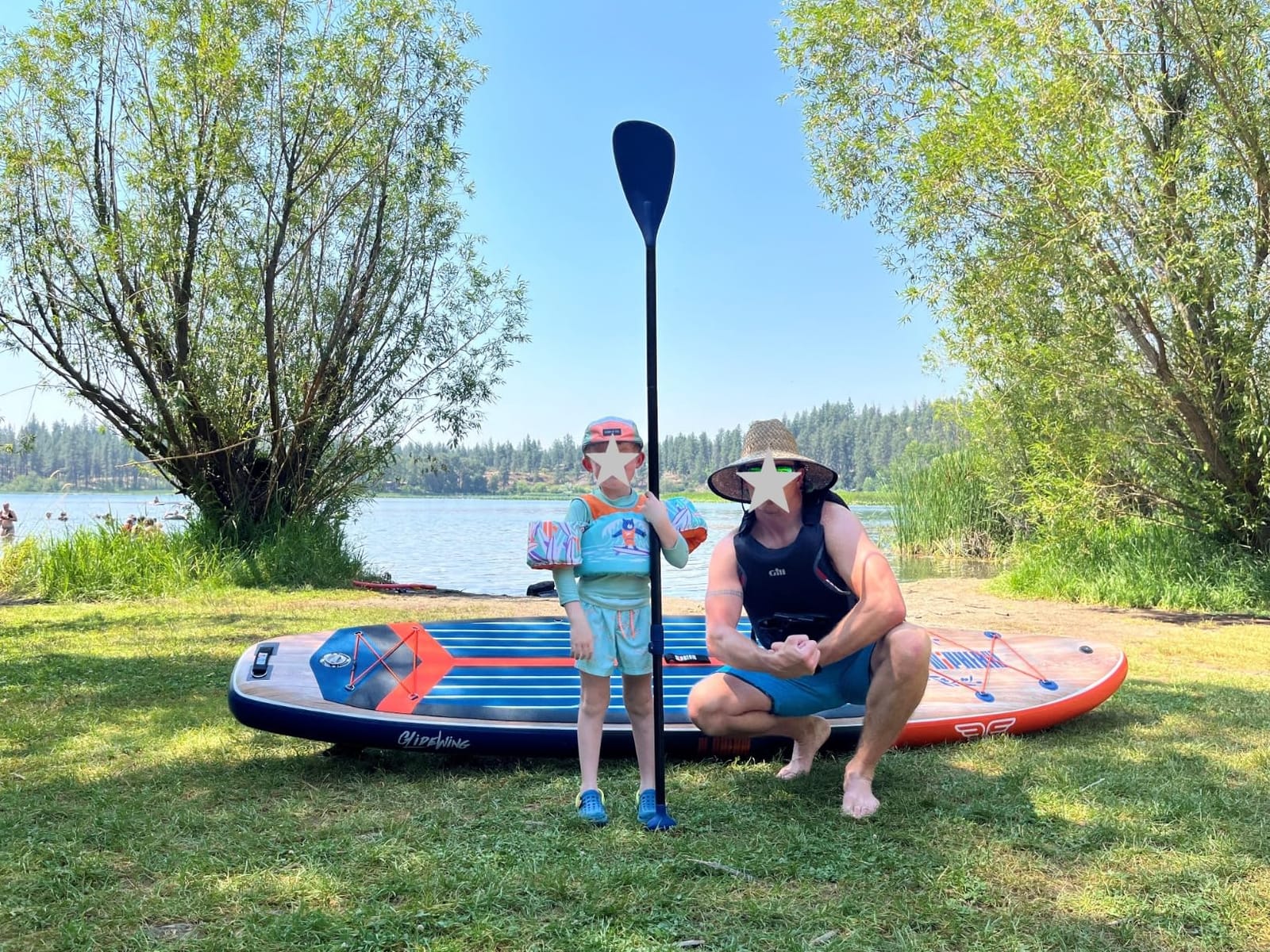
Tracking is handled by a large detachable balanced centre fin, the StabilTrac unit, which is designed to hold a straight line for beginners without constant corrections. The deck is a textured grooved EVA surface rather than a flat pad, and that texture keeps grip when your feet are wet, which matters on a board this wide where you will be moving your stance around.
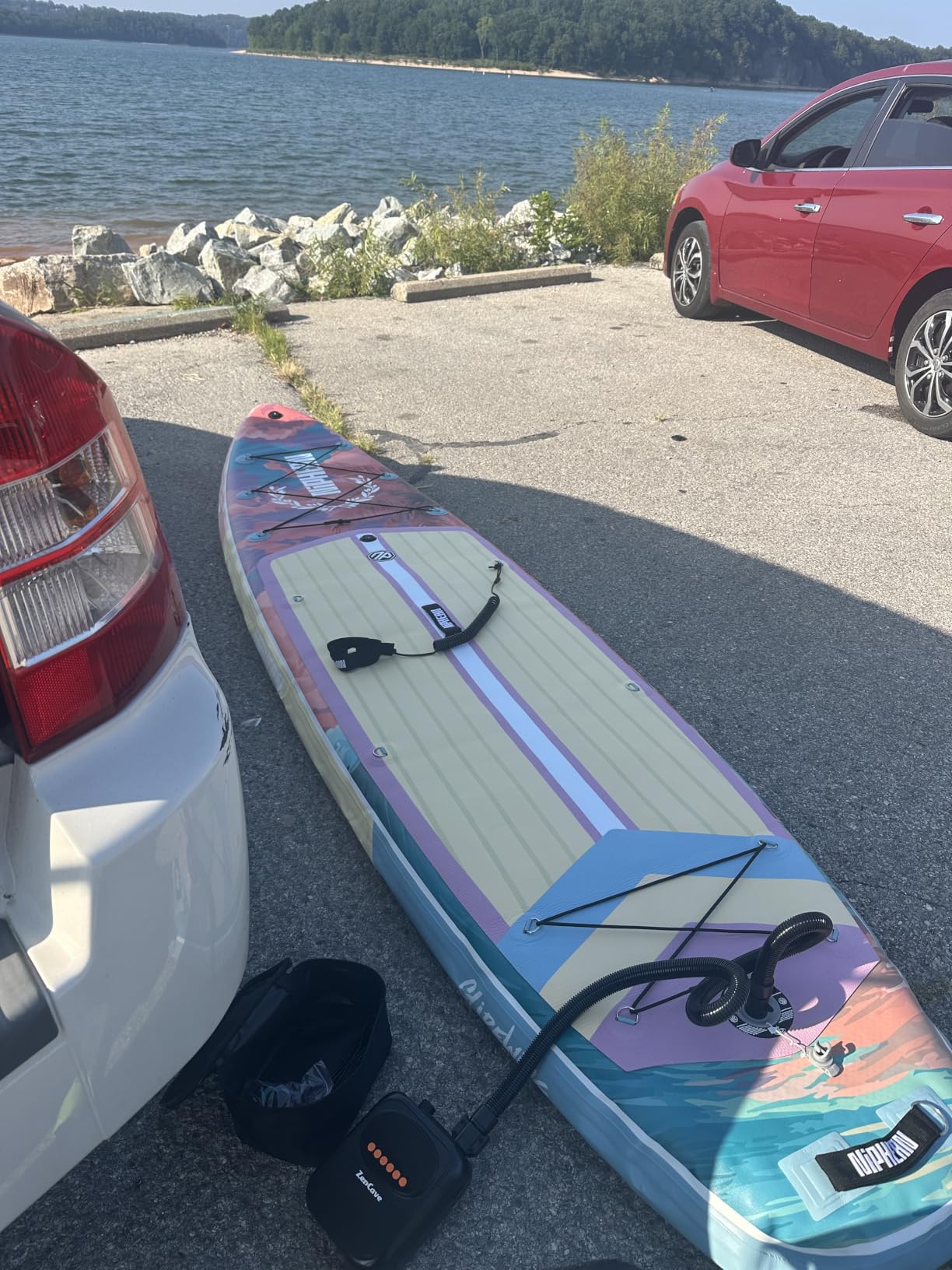
Mounting hardware is where this board pulls ahead of similar-priced rivals. Fifteen D-rings cover kayak seat fitting, a cooler, or board-to-board connection, and two multifunctional accessory mounts accept a camera, cup holder, or rod holder. Nose and tail bungee cords handle cargo. Seventeen colour variants are available, which is unusually broad for this segment.
Why the extra D-rings matter for heavier riders
More attachment points means you can build a setup around your actual load rather than your body weight alone. A cooler, a dry box, a rod holder, or a seat frame all mount at the height you need, and the weight sits where you choose instead of where a single central strap puts it.
For anglers and for riders bringing a child or a dog, that flexibility is the difference between a board that carries the load comfortably and one that feels overloaded from the start. The complete kit already includes four fins, a cup holder, a repair kit, a pump, a leash, and a backpack.
Where this board is the wrong pick
Thirty-three inches is narrower than the 35 and 36 inch platforms in this roundup, and width is what buys side-to-side stability. If you are near your comfort limit or you are a beginner who wants the widest possible stance, that 2 inch difference is worth paying for elsewhere.
At 19 lb, it is also a heavy solo carry, and the share of one- and two-star ratings in the reviews hints at some durability complaints that the average rating hides. For a rider who wants maximum capacity and the longest warranty rather than maximum width, this remains a strong choice.
3. ATPROSS 11’6″ x 35″ Wide SUP with Inflatable Seat: Best for Sitting Down
Pros
- Inflatable kayak seat converts the board to a sit-on-top cruiser
- 35 inch deck adds real stability over 32 inch boards
- 450 lb rating holds a loaded group without bogging glide
- Double layer PVC with reinforced sidewall resists abrasion
- Includes both single and double sided paddles
Cons
- Only a 1 year warranty
- Listed weight of 16.31 kg makes it one of the heavier boards to move
- Manufacturer listing gives limited dimension detail
The included inflatable seat is the reason this board exists in this roundup. Forum threads about heavier riders keep circling the same practical problem: standing works until your legs get tired, and then you are stuck standing on a wide board with no way to rest. A detachable seat solves that without changing how you paddle.
The board itself is an 11’6″ by 35″ by 6″ platform rated to 450 lb, so the capacity math is identical to boards that do not include a seat. What you get on top is an upgraded ergonomic inflatable seat with a tool-free QuickLink attachment system, which means converting the board takes seconds rather than a fitting session.
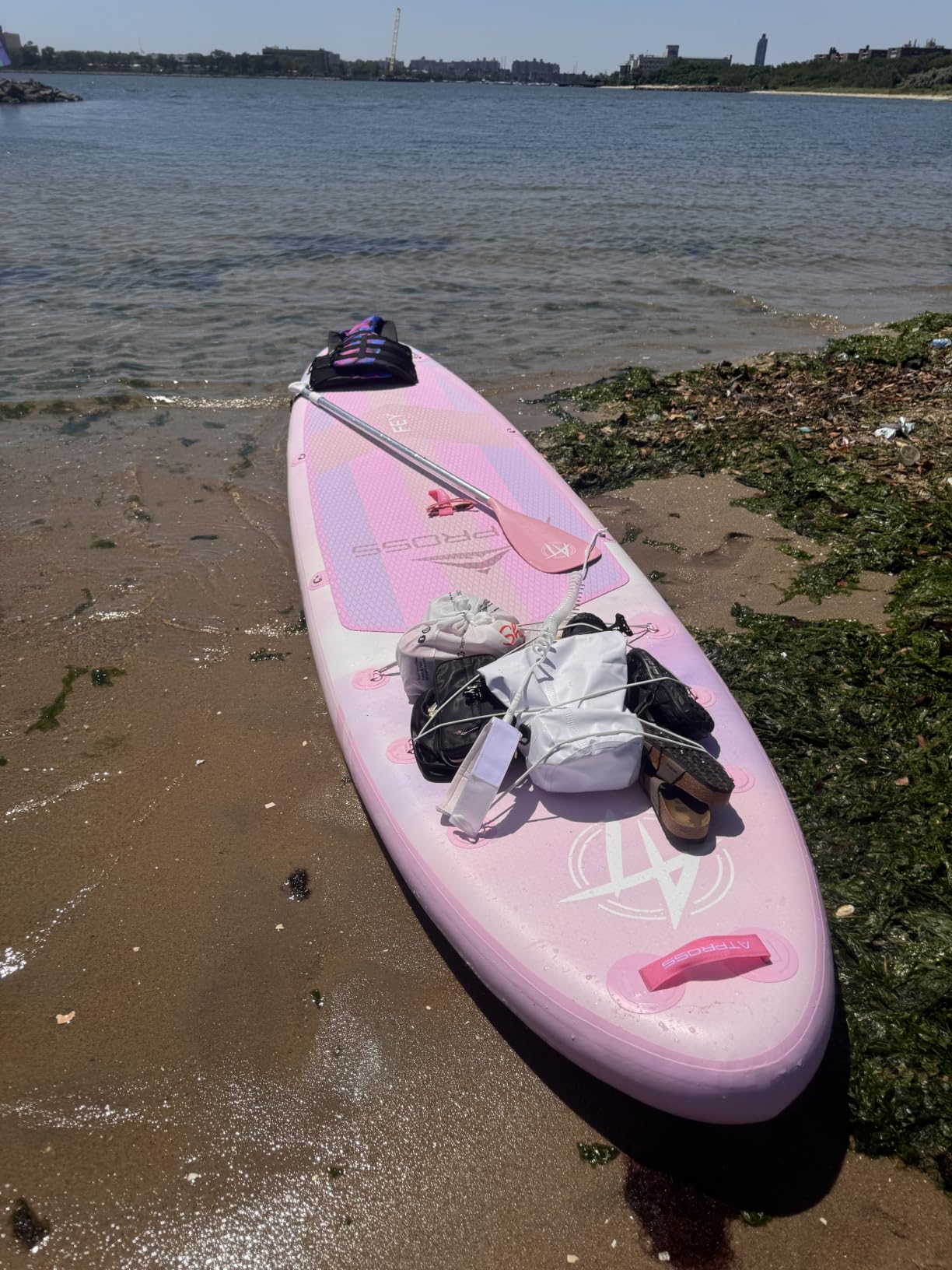
Construction is double-layer PVC with a reinforced sidewall for abrasion resistance against rocky or sandy shorelines. That reinforcement is not cosmetic at your weight, because rail and seam failures start at the edges where a loaded deck flexes hardest.
The accessory kit is among the most complete in the group for the money: a 600D Oxford backpack, detachable large and small fins, both a single and a double-sided paddle, a leash, a two-way pump, a repair kit, the kayak seat, a phone bag, and a 5L dry bag. Eighteen colour and walnut-finish variants are offered.
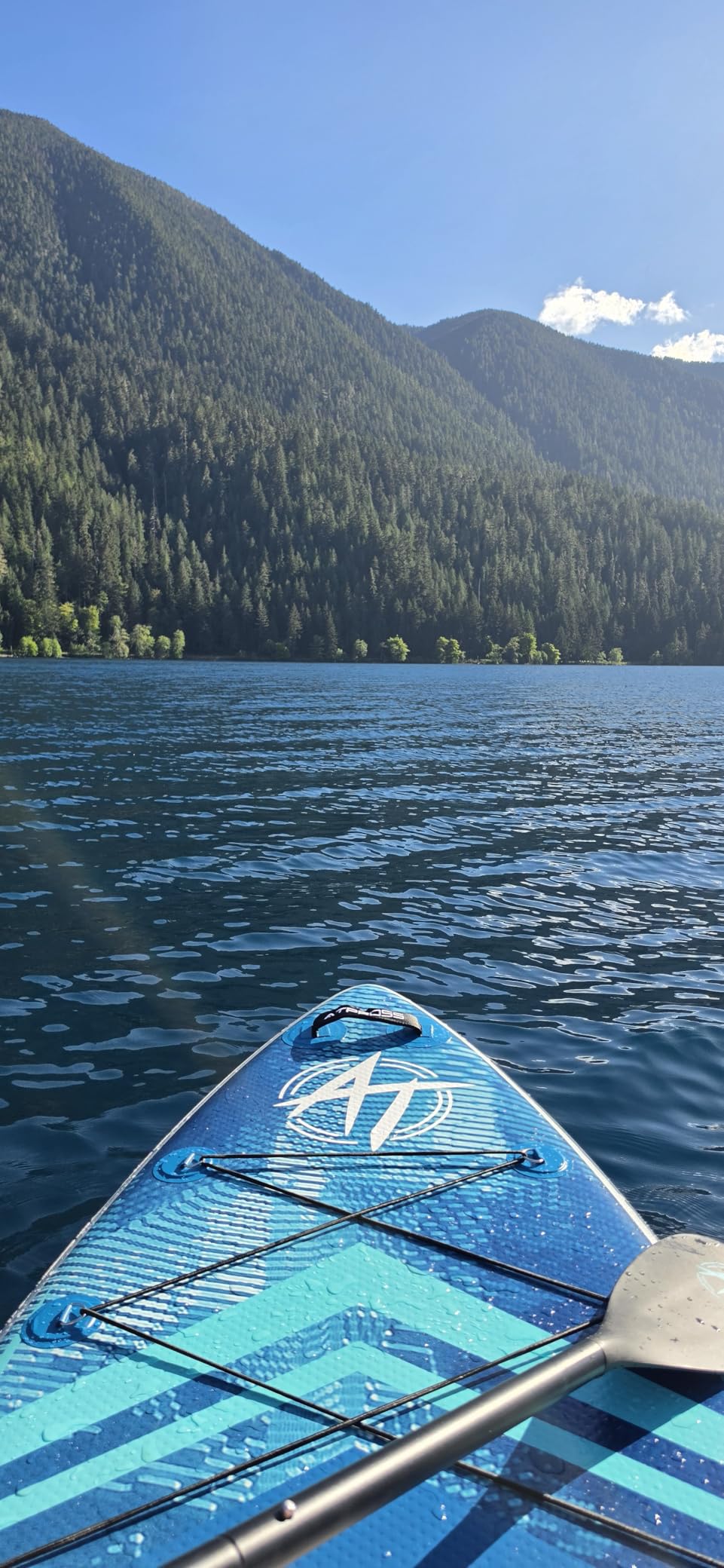
When seated paddling is the smarter choice
Long sessions on a wide board put real load on your lower back, and many riders who fall off SUPs do so because they started paddling sessions they could not finish. Sitting down converts the same board into a sit-on-top that is calmer, slower, and far less tiring.
Riders who paddle with a partner often find the seat useful as a passenger position as well. The QuickLink fitting means you can swap between standing and sitting on the same launch without inflating or deflating anything.
What to know before you buy
The warranty is one year, the shortest useful coverage for a board you will flex hard. The listed weight of 16.31 kg, roughly 36 lb, also makes this one of the heavier boards in the group to move solo, so budget for a cart if your launch is far from parking.
Manufacturer dimension detail is also thin in the listing, so the 35 inch width claim comes down to the product line rather than a detailed spec table. Verify the deck width yourself when the board arrives. If a seat is not part of your plan, the Skatinger at the same 450 lb rating carries a longer warranty and a smaller packed weight.
4. NACATIN 12′ x 36″ Extra Large SUP: 661 lb Rating, Built for Anglers
Pros
- Highest rated load of any board we compared at 661 lb
- One of the two widest platforms here at 36 inches
- Widened tail adds buoyancy and balance under load
- Converts to a kayak with the included seat and double sided paddle
- Non slip EVA foam deck over military grade PVC
Cons
- At 12 feet and 17.8 kg it is among the least portable boards here
- Feature set is heavily angler oriented
- Lowest sales rank in this group
This is the board to look at if your total load includes tackle. It is rated to 300 kg, which is 661 lb, the highest load figure of anything we compared, on a 12 foot by 36 inch platform. That combination means the board stays high and level whether you are standing, sitting, or standing on the tail while casting.
Angler hardware is built into the deck rather than sold as an add-on. There is an integrated adjustable fishing rod holder and an on-deck fish ruler marked in both centimetres and inches. For anglers, that removes two of the three accessories you would otherwise be strapping on before you launch.

The widened tail design is the quietly important feature here. Extra tail volume keeps the board steady in turns and while carrying gear, which is the situation that stresses a loaded board most. Construction is military-grade PVC with a non-slip EVA foam deck, and the maximum pressure is 15 psi.
It converts to a kayak with the included seat and a double-sided paddle. A front-mounted camera mount, front and rear bungee cords, and reinforced D-rings cover recording and cargo. Three colour options are published: deep blue, crimson with sunlit blue, and pink.
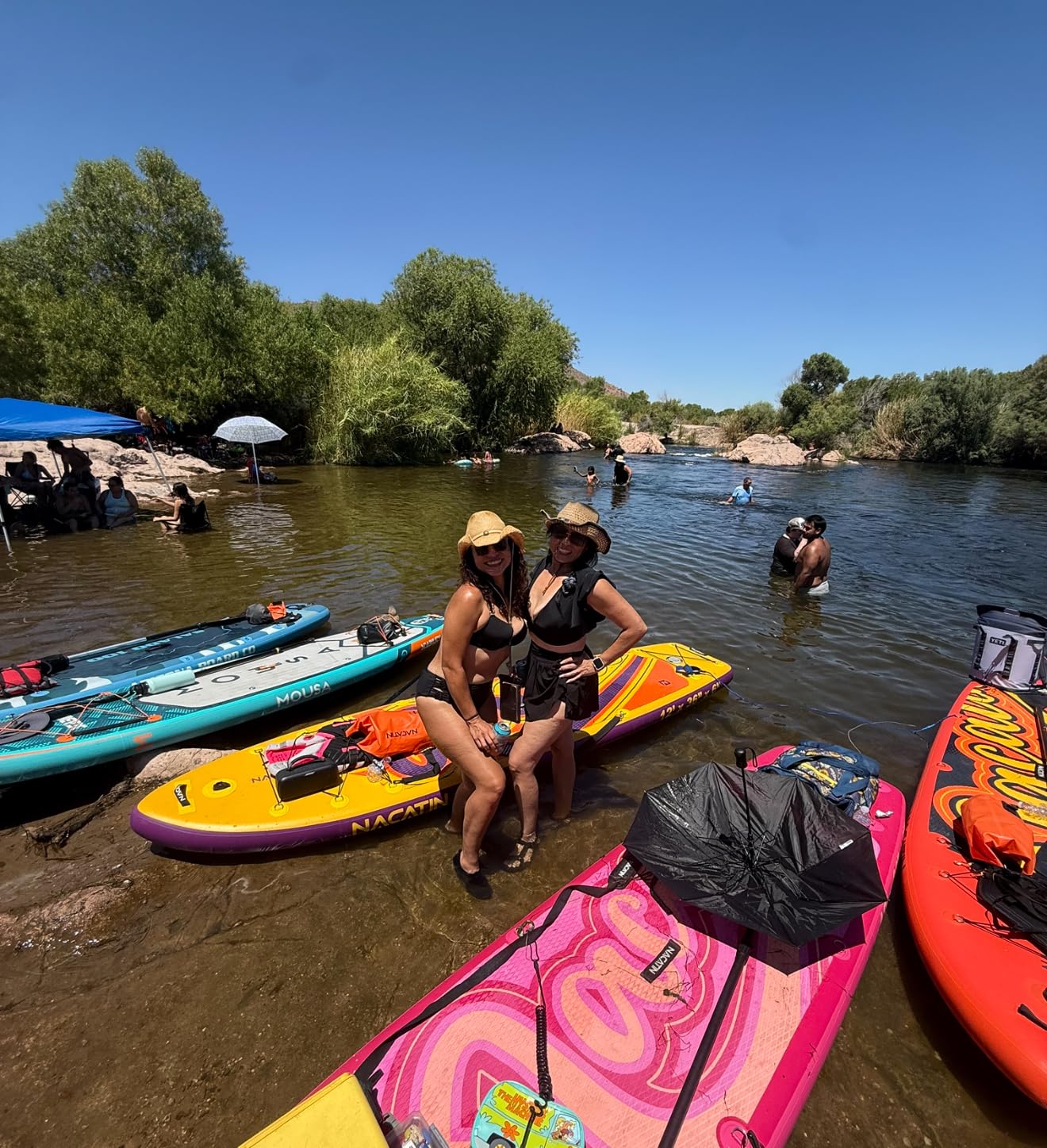
Best for two adults plus gear
With 661 lb of rating, two adults over 300 lb each plus a cooler and tackle stay well inside the comfort zone. That headroom is the reason to pick this board, because a board rated close to your combined load will sit low and paddle sluggishly.
If you are a tandem unit or a family that paddles together, the length and width also mean nobody has to perch. German and English reviewers both note room for multiple adults without the board bogging down, and the seat conversion gives whoever tires first an easy out.
Where the size becomes a problem
Twelve feet long with a listed weight of 17.8 kg, this is the hardest board here to store and transport. It does not fit in a small car boot once inflated, and pumping it up takes longer because of the volume. For a rider launching alone from a windswept shore, that is a real cost.
The angler feature set is also wasted if your goal is flatwater cruising or yoga, and the sales rank in its category is the lowest of the ten here. Treat this as a specialist fishing board rather than a general-purpose one.
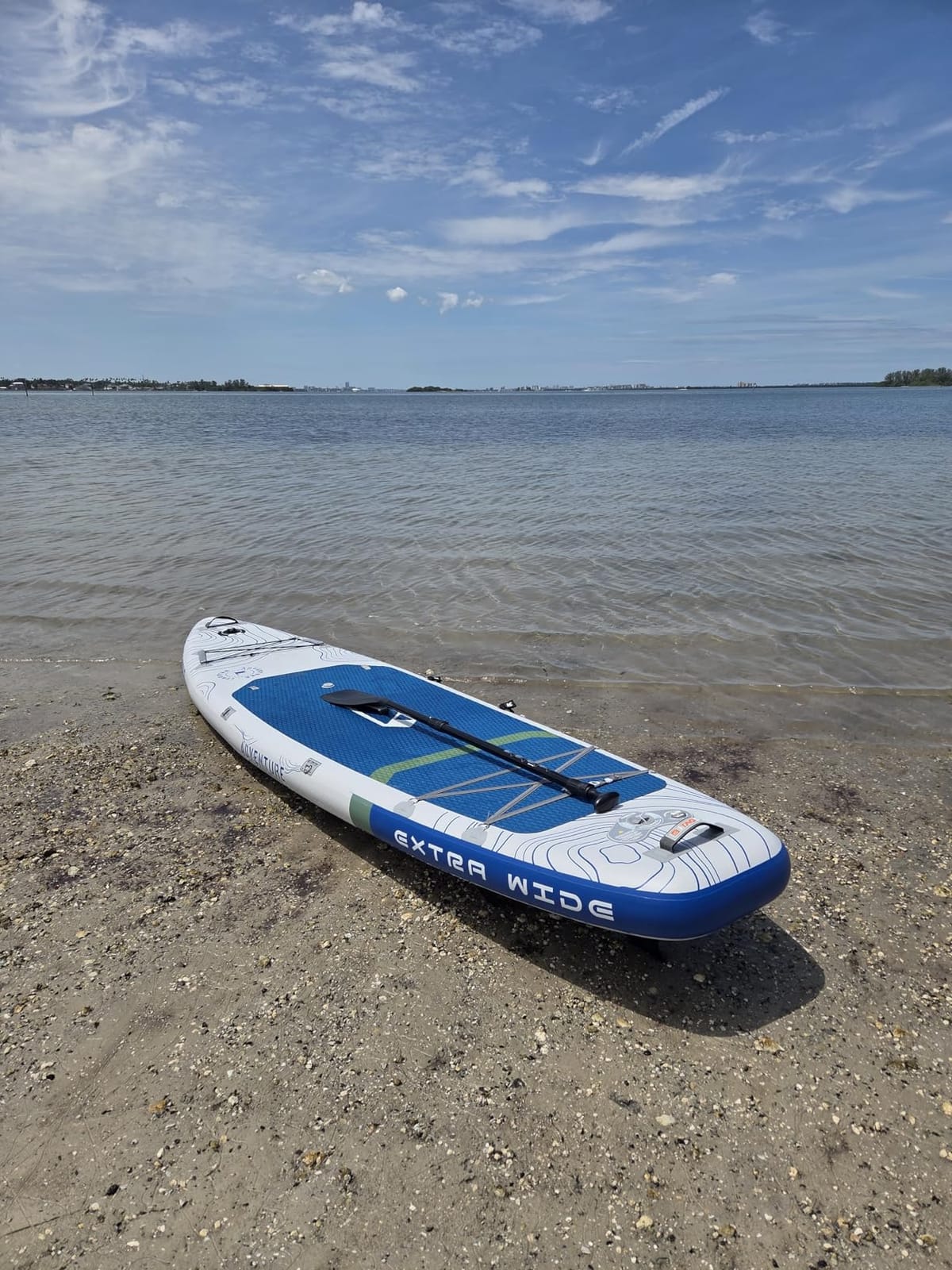
5. iTAOSTAR Adventure 12′ x 39″: 500 lb on the Widest, Thickest Platform Here
TAOSTAR Adventure 12′ × 39″ Inflatable Stand Up Paddle Board with Seat, Extra Wide SUP Board with 5 Fins Stable Design for Fishing, Youth, All Skill Levels, Lakes, Oceans
Pros
- Widest and thickest platform in this group at 39 by 8 inches
- 500 lb rating covers a family plus pets
- Most extensive accessory bundle including five fins seat and footrest
- Four fin bases let riders tune tracking and speed
- Two adjustable rod holders and two cup holders
Cons
- 27.3 lb packed is a heavy solo carry
- Most expensive board in this roundup
- 8 percent one star ratings
- Spec sheet lists a 1 year warranty despite 3 year warranty marketing
Width is the first thing you feel on a heavy board, and this one is 39 inches wide and 8 inches thick. That is the widest and thickest platform in the roundup, and it is the reason this board stays upright with several people and a dog aboard.
Capacity is rated at 500 lb, which covers a family, pets, and gear with room to spare. Maximum pressure is 15 psi, and the material is a PVC and EVA build. The deck converts to a kayak setup in minutes using the included inflatable seat and foam footrest.
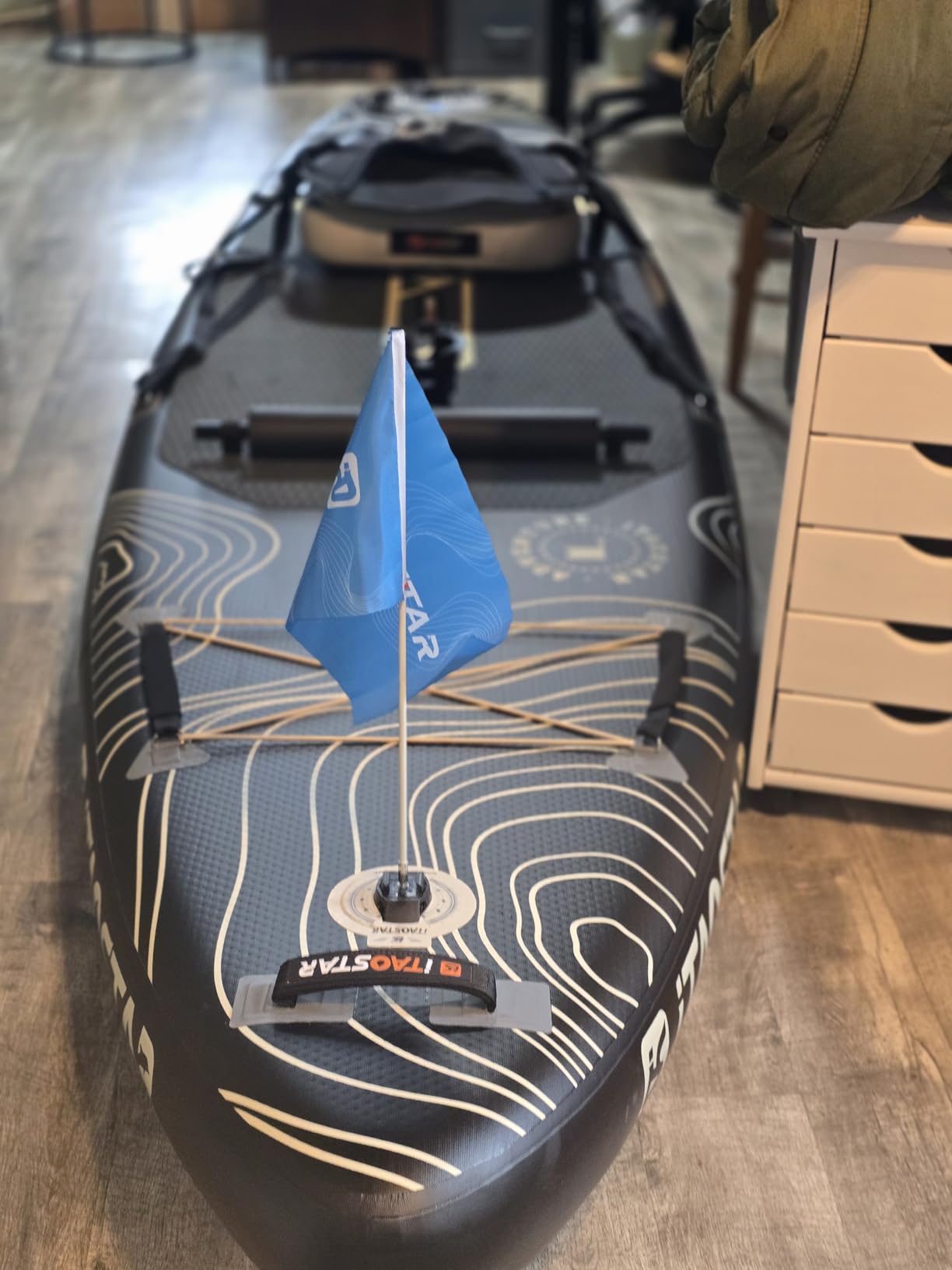
Fin configuration is unusually thorough. Four fin bases with five detachable fins let you tune tracking and speed for different water rather than accepting a single compromise setup. The accessory bundle is the largest here, including two 360-degree adjustable rod holders, two cup holders, a 120L backpack, a 10L dry bag, a double-action pump, an adjustable kayak paddle, a shoulder strap, a flag, and a whistle.
Ten colour and camouflage options are available, which is useful if you want a board that reads as a fishing platform rather than a fitness one.
Why width beats everything on a multi-person load
When two or more people share a board, the failure mode is not sinking. It is the board rolling under an off-centre weight, which happens because there is not enough lateral surface to resist a lean. Thirty-nine inches of width gives you roughly six inches more stance than a 33 inch board, and on a loaded deck that is the difference between a wobble and a capsize.
The four fin bases also let a heavier rider stiffen the tracking when carrying weight, because a board under load pushes more water and a larger fin area keeps it from wandering.
What you give up for that stability
At 27.3 lb packed and 12 feet long, this is a heavy board to move solo and a large one to store. It is also the most expensive board we compared, and 8 percent of ratings are one star, which is the largest negative share in the group. Buyers report bulk and occasional quality issues.
Check the warranty carefully at purchase. The spec sheet lists one year while the marketing copy claims three, and that discrepancy is worth raising with the seller. If you paddle alone and do not need multi-person capacity, a 35 inch board gives you most of the stability at a fraction of the carry weight.
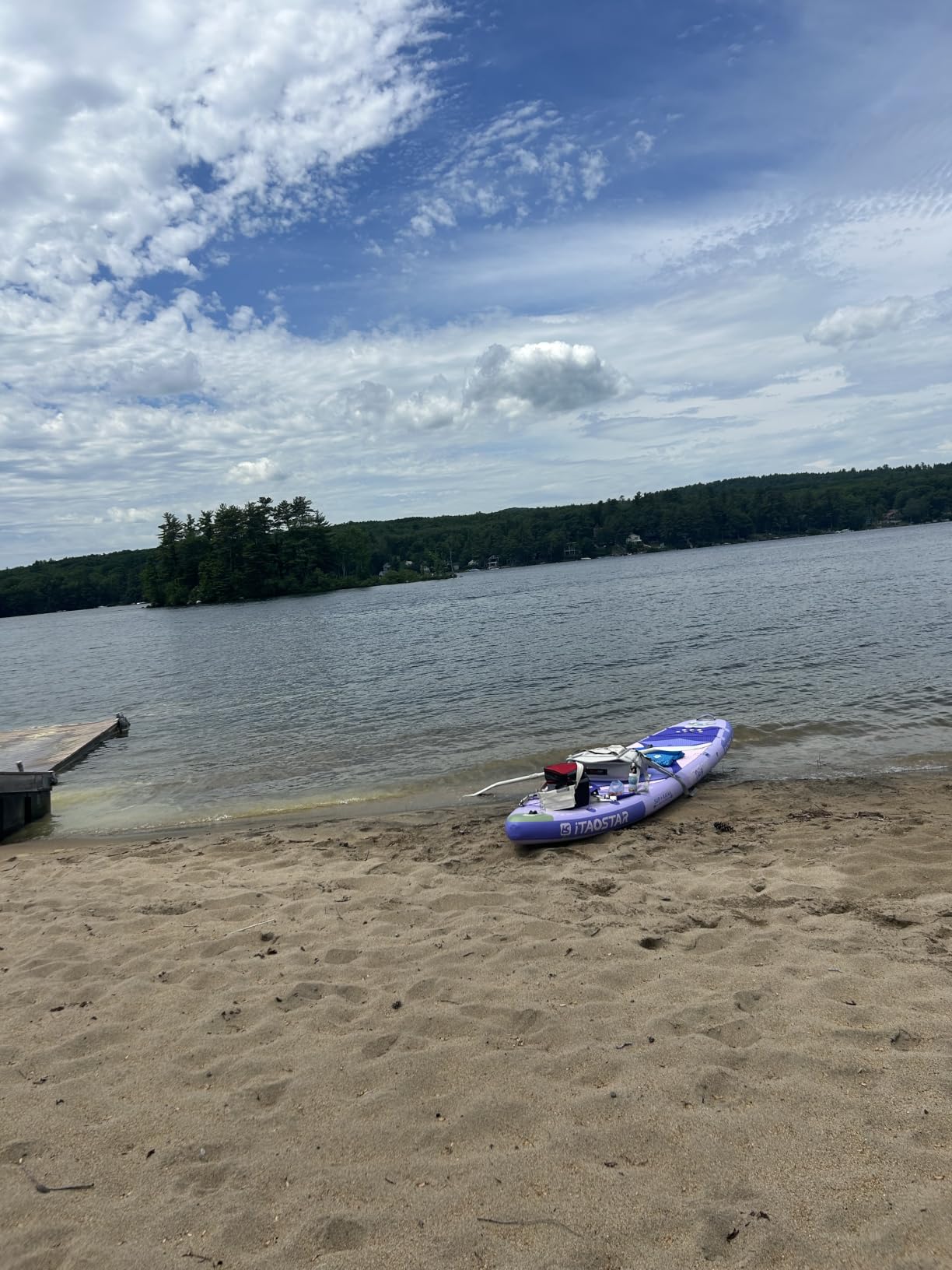
6. iTAOSTAR Daisy 11’6″ x 35″: 450 lb with the Fastest Setup in the Group
Pros
- Dual action pump with PSI gauge inflates in 5 to 10 minutes
- 35 inch extra wide deck praised by beginners
- Reviewers report three adults plus a large dog aboard comfortably
- Five removable fins and multiple D-rings
- Included seat converts it to a kayak
Cons
- Included cup holder does not fit Stanley tumblers and can break
- Ratchet seat straps slip on the water and are often replaced
- Included paddle is very light and thin
- 1 year manufacturer warranty
Setup speed is the underrated advantage here. The included dual-action pump has a PSI gauge, and reviewers report 5 to 10 minutes from bag to water, with deflation taking 2 to 3. On a board this size, that is faster than most rivals and it means you can paddle on a spontaneous trip rather than planning around an hour of inflating.
The platform is 138 inches by 35 inches by 6 inches, rated to 450 lb, with a 15 psi maximum. That is the same footprint as the Skatinger, and the extra width does the same job, giving a beginner a forgiving stance and a multi-person load a stable platform.

Five removable fins, three centre and two side, let you change tracking depending on conditions. The included inflatable seat converts the board to a kayak, and users commonly strap the seat forward as a child passenger position. A 120L travel backpack with internal organising straps handles the rest.
Reviewers who carry multiple people specifically call out the width, with German-language reviews reporting three adults plus a large dog comfortably aboard. That is a genuine test of a 450 lb rating, and it is why this board sits so comfortably in the middle of the group.
Best when your time on the water is limited
A board you can inflate in ten minutes changes how often you go out. Riders who own large boards often stop paddling because the setup is a chore, and that is where a fast pump and a gauge make a measurable difference in how often the board actually gets used.
The fin options and the seat also mean one board covers cruising, family time, and seated paddling without a second purchase.
Which accessories to replace first
Three parts get replaced by owners, and all three are cheap to upgrade. The included cup holder does not fit Stanley tumblers and can break out of the box. The ratchet-style seat straps slip once the board is on the water, so a hook-mounted seat is the usual fix. And the included paddle is very light and thin, which is uncomfortable for long sessions or smaller hands.
Some riders also report that the light build struggles against a current, and the small fins are not enough to hold the board until it is in the water. Budget for a better paddle and a hook seat, and you have effectively upgraded the whole package.
7. CETANA 11’6″ x 35″: 450 lb with a 22 psi Shell Rating
CETANA Extra Wide Inflatable Paddle Board 11’6 x 35″ x 6″, 450LB High Weight Capacity Wide Stable Stand Up Paddle Board for Beginners, 2–3 Person Large Paddleboard with 3 Fins, Dual Bungee, 15 D Rings
Pros
- 35 inch extra wide deck gives outstanding balance for first time riders
- 450 lb rating holds two adults and a child
- Reviewers report it has never flipped even with a dog aboard
- Three fin setup tracks well and turns easily
- Handles a heavy load of rider dog cooler and dry box
Cons
- Factory bungee cords stretch after first use
- Included single sided paddle is less efficient
- One documented report of the board bowing on first inflation
- 1 year warranty
This board’s distinguishing spec is pressure. The reinforced drop-stitch material is rated to 22 psi, the highest stated shell rating of the ten we compared, and the maximum working pressure is listed at 15 psi. For a heavier rider, a shell that can hold firm pressure is the difference between a solid deck and the flex that makes riders distrust an inflatable.
The footprint is 138 inches by 35 inches by 6 inches with a 450 lb rating, sized for two to three people. At that width, first-time riders report outstanding balance, and multiple owners say the board has never flipped even with a dog on board.
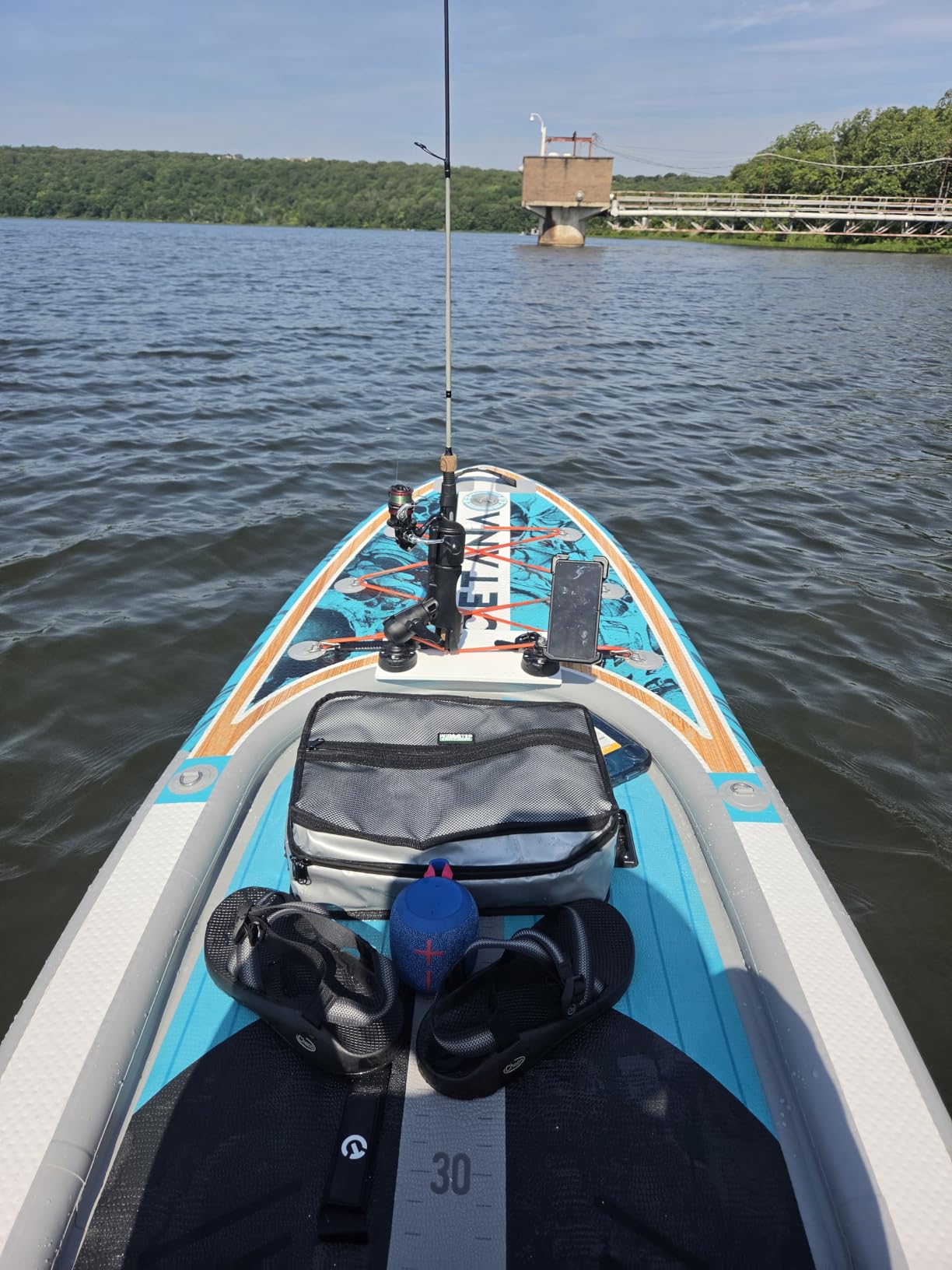
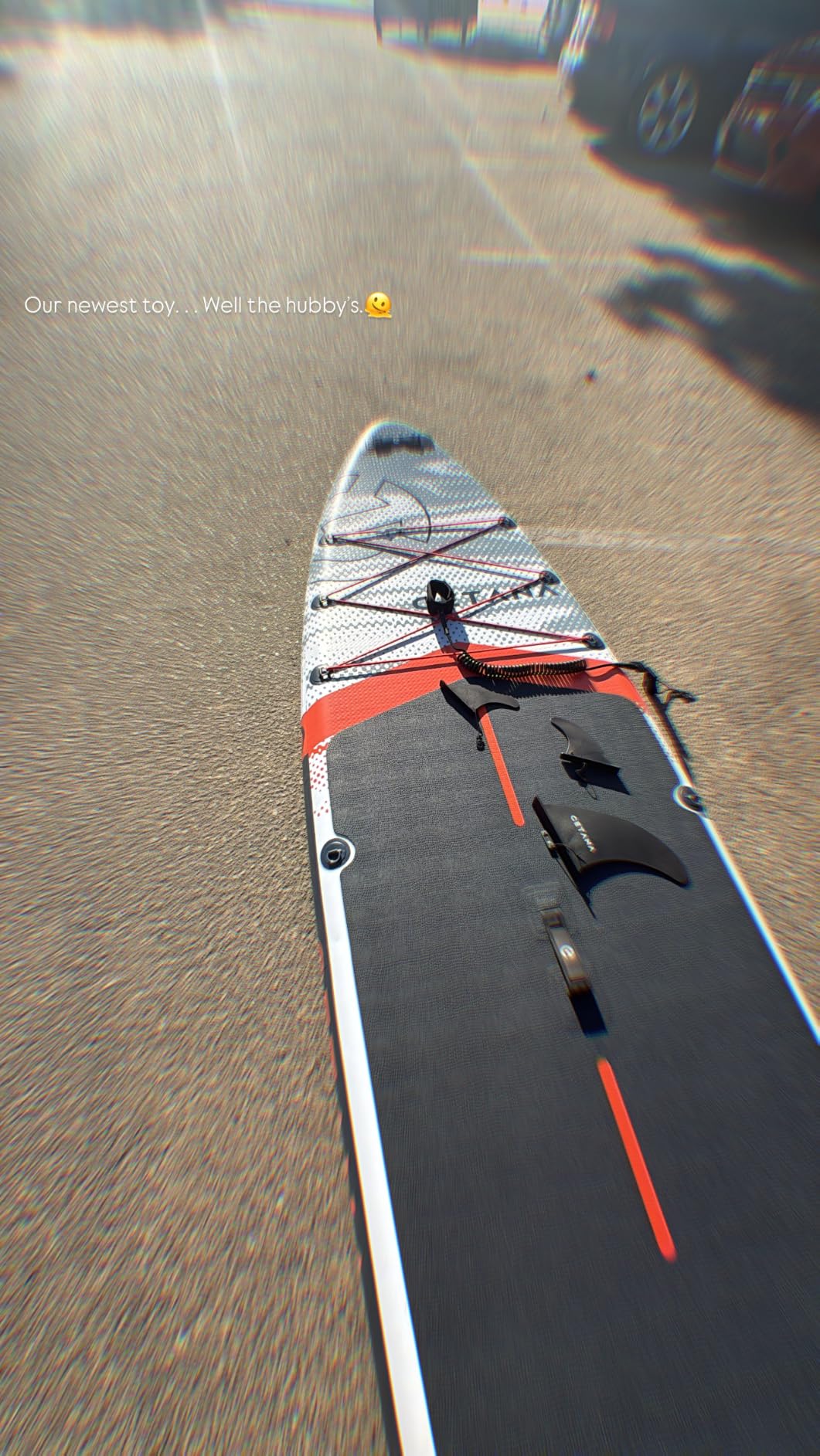
Fin setup is a three-fin arrangement, a removable centre fin plus two side fins, which gives reasonable tracking without a large fin that resists turning. Three reinforced carry handles and a 1680D backpack cover transport. A front 6-point and rear 4-point bungee system handles cargo, and four D-rings accept a kayak seat, which is not included, or a shoulder strap.
Reviewers particularly like how it absorbs a heavy mixed load: rider, dog, cooler, and dry box at the same time, without the board feeling overloaded. The rear bungee is convenient for strapping sandals and gear within reach.
What makes this the easiest first board to stand on
Thirty-five inches of width means a 300 lb rider can stand with feet comfortably apart instead of riding in a narrow stance. Combined with a 6 inch thickness that keeps your hips high, that removes the two biggest reasons beginners lose balance in the first ten minutes.
For a rider who is unsure whether paddleboarding suits them, the low-risk path is a board that will not punish a wobble. This one is consistently described that way in reviews.
What to fix and what to check
Two accessories need attention. The factory bungee cords stretch after first use and many owners replace them with rubber bungees on the D-rings. The included single-sided paddle is less efficient than a double-sided blade, and several buyers switch.
There is also one documented quality-control report of the board bowing during its first inflation, and about 6 percent of ratings are one star. Inspect the board inflated before you leave, and check the seams under pressure. The one-year warranty is the shortest here, so this fits best as a first or occasional board.
8. UPWELL 11’6″ x 35″: Around 500 lb Stated, 22 lb Packed
UPWELL 11’6″×35″ Extra Wide Inflatable Paddle Board, Stand Up Paddle Board, Sup Paddle Boards for Adults, Mech Purple with Seat
Pros
- Stable on open water
- Reviewers report riding out wind and waves comfortably
- 22 lb is among the lighter boards in this size class
- Three removable fins and a 2 in 1 SUP kayak paddle
- Front and rear bungees with clips hold a cooler securely
Cons
- Pump cap threads are shallow and the piston can pop out
- One reported air lock seal leak left a board unusable
- Included paddle shaft bent in transit for one buyer
- 1 year board warranty and 180 day accessory warranty
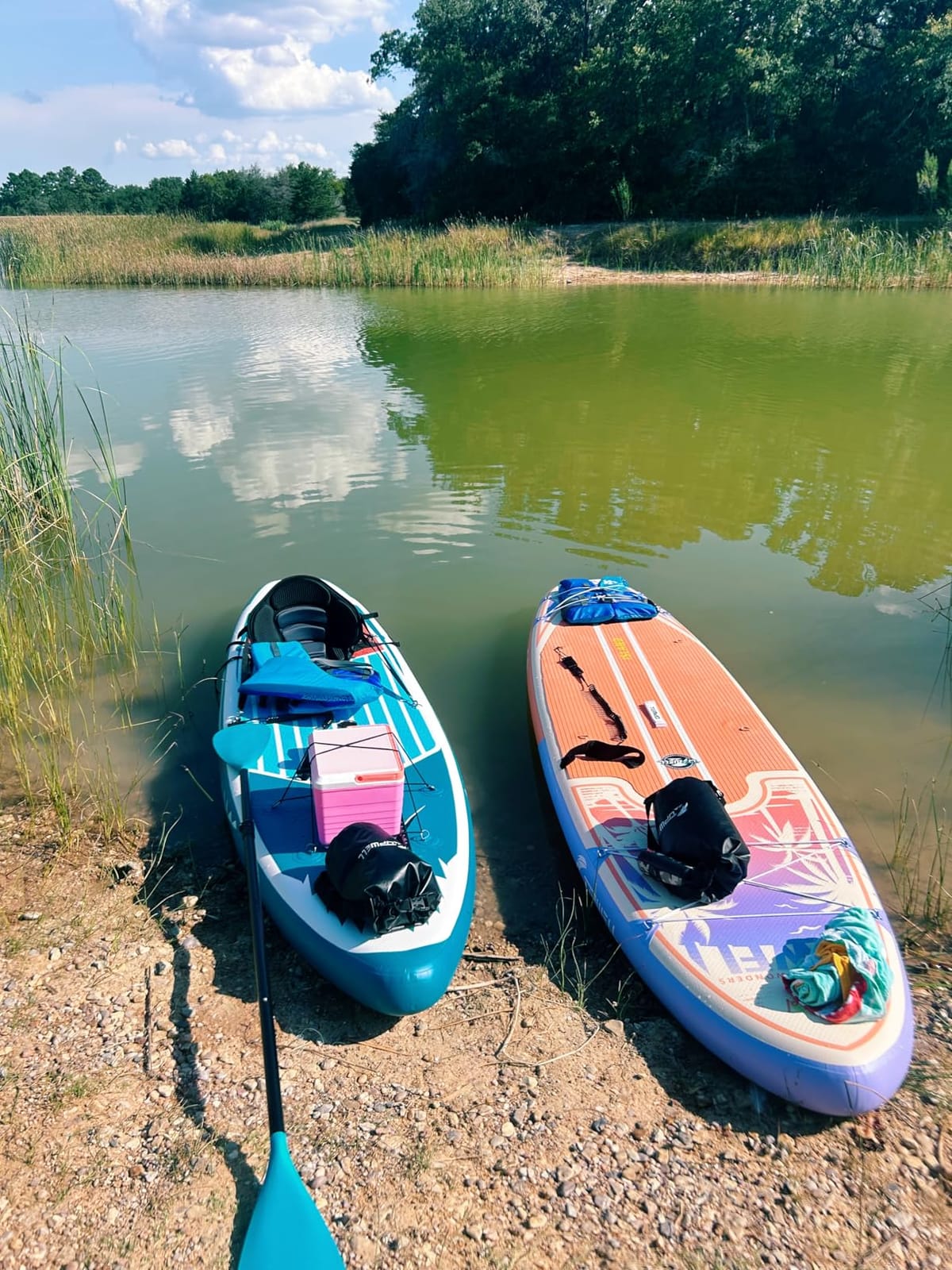
If your local water is exposed rather than a sheltered pond, this is the board to shortlist. Reviewers describe it as very stable on open water, including one who handled a storm with wind and waves without incident. The 11’6″ by 35″ by 6″ platform is rated by the manufacturer at around 500 lb, and it packs at about 22 lb.
One important caveat on that figure. The spec table lists maximum weight recommendation as 21 pounds, which is a listing error rather than a real capacity number, so treat the roughly 500 lb manufacturer statement as the working figure and verify the printed capacity on the board itself when it arrives.
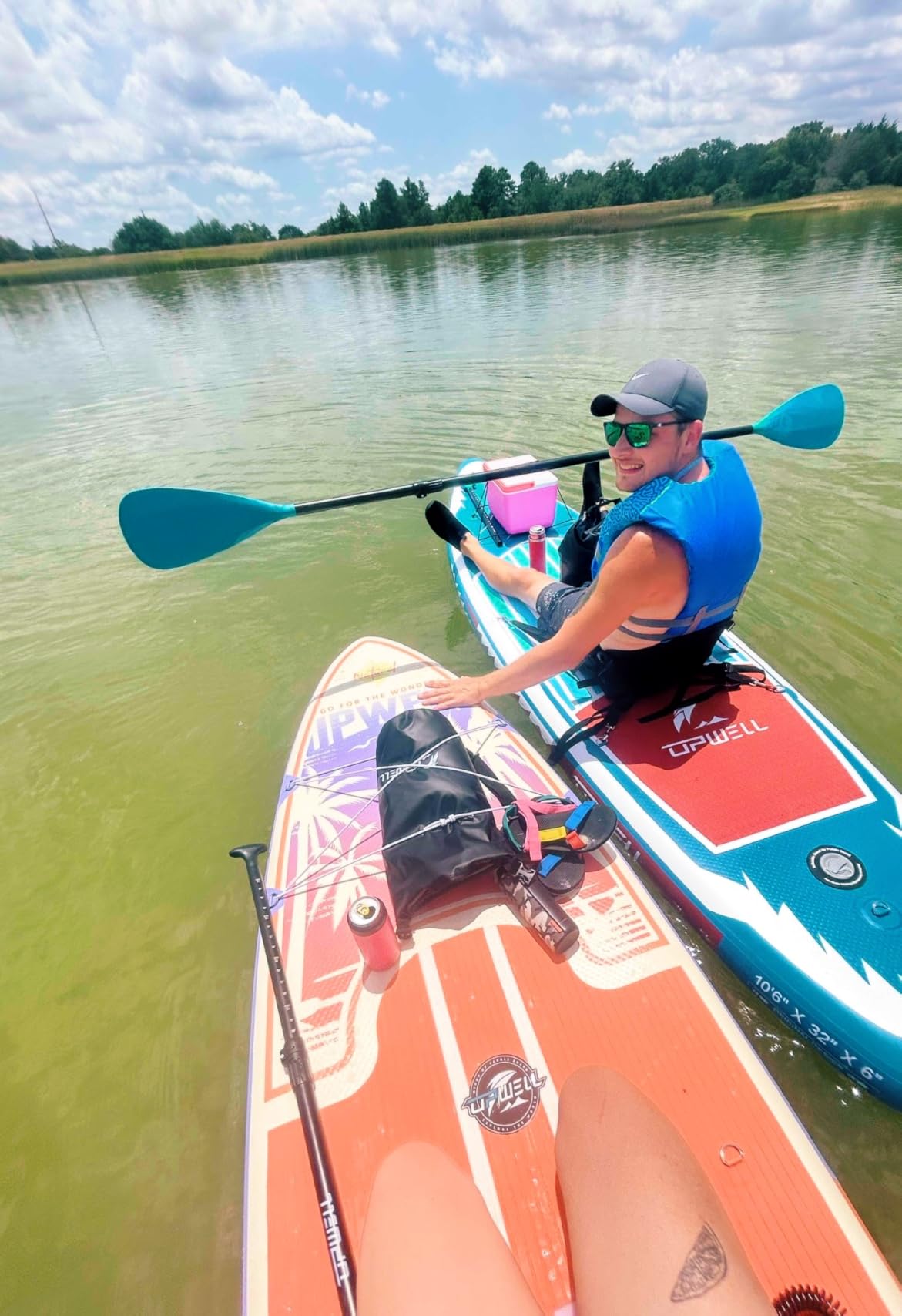
Construction is ultralight double-wall PVC, stated as about 25 percent lighter than same-size competing boards. That lightness is a genuine portability win for a heavy rider who is also the only person hauling gear. The deck is a soft non-slip EVA pad, and the kit includes three removable fins, an adjustable 2-in-1 paddle that converts between SUP and kayak mode, a leash, a backpack, a waterproof phone pouch, PVC patches, a wrench, a pump, and a 10L dry bag.
Cargo runs through front and rear bungees with clips, plus heavy-duty D-rings for a cooler, gear bag, or kayak seat. Eight colour and seat variant options are offered.
How it behaves when the wind picks up
Length helps in wind. A longer board with three fins tracks more predictably, so gusts push the board sideways less than they would on a short one. That is why reviewers who paddle exposed lakes report it holding a line, and it is the reason we rate it highly for open water rather than sheltered flatwater only.
The 35 inch width also keeps your stance workable when you are dealing with surface chop, because you are not fighting a narrow platform while the water moves under you.
Accessory quality is the weak point
The complaints on this board cluster around the accessories rather than the hull. The pump cap has shallow threads and the piston can pop out at the top of the up stroke, and the manual pump is slow in heat. One buyer reported an air-lock seal leak that made the board unusable without repair. Another had a paddle shaft arrive bent.
The deck pad also indents and scratches more readily than higher-density material, and the warranty structure is unusual: one year on the board but only 180 days on accessories, with a claim process some buyers found frustrating. Budget for an electric pump and a sturdier paddle, and this becomes a light, capable board for exposed water.
9. Intermountain Gorge 11′ x 34″: 420 lb Rating, 4.7 Stars, Lightest Load-Bearing Deck
11’x34 Ultra Wide Inflatable Paddle Board, Stand Up Paddle Board &420lb Capacity for All Skill, Paddle Board for Yoga/Family, EVA Deck, US Fin, 100L Bag, High-Pressure Pump, Safety Leash
Pros
- 4.7 stars from 161 reviews
- 34 inch width is 2 inches wider than standard
- Easy to climb back onto after a swim
- Included three piece aluminum paddle suits bigger hands
- 18 lb packed is one of the lighter boards here
- 2 year manufacturer warranty extension
Cons
- 420 lb rating is the lowest limit of the higher rated boards here
- No rear bungee
- only a 6 point front system
- Included hand pump is slow
- Included plastic paddle chips after a few outings
This is the right board for a rider around 200 lb who wants real headroom without stepping up to a 500 lb platform. At 4.7 stars it carries the second-highest average rating in this group, and at 18 lb packed it is one of the easiest boards here to carry solo to a remote launch.
The platform is 132 inches by 34 inches by 6 inches, rated to 420 lb, with the listing describing it as 2 inches wider than a standard paddleboard. That width is where the stability comes from for riders in this bracket, and owners around the 190 to 195 lb mark report excellent balance on it.
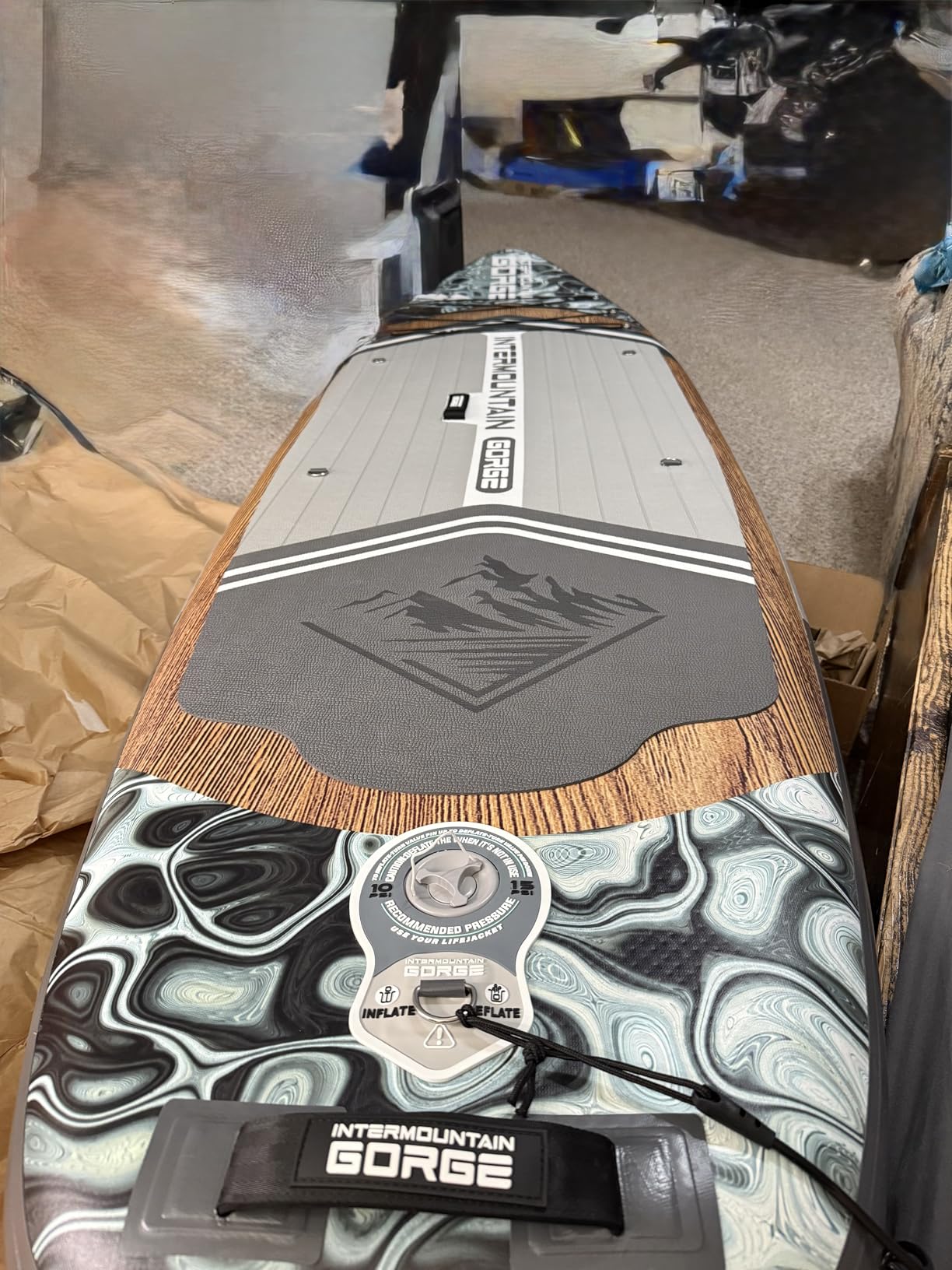
Construction is military-grade PVC with a drop-stitch core and dual-layer side rails, and a 5mm impact-absorbing non-slip EVA foam deck. Pressure guidance is 10 to 12 psi solo, 12 to 15 psi for two riders, with a 20 psi maximum. Higher pressure is what keeps the deck firm under your weight, so inflate to the top of the recommended band.
The included paddle is the standout here. It is a three-piece adjustable aluminum paddle running from 67 to 77 inches, and reviewers repeatedly single it out as better than competing bundles, with a large smooth grip that suits bigger hands. Three carry handles, four D-rings, a reinforced 6-point front bungee, a 10 inch US-style fin, an ankle leash, a waterproof phone pouch, a valve wrench, a fast inflation pump, and a 100L backpack round out the package.
Why 420 lb works better than 450 lb here
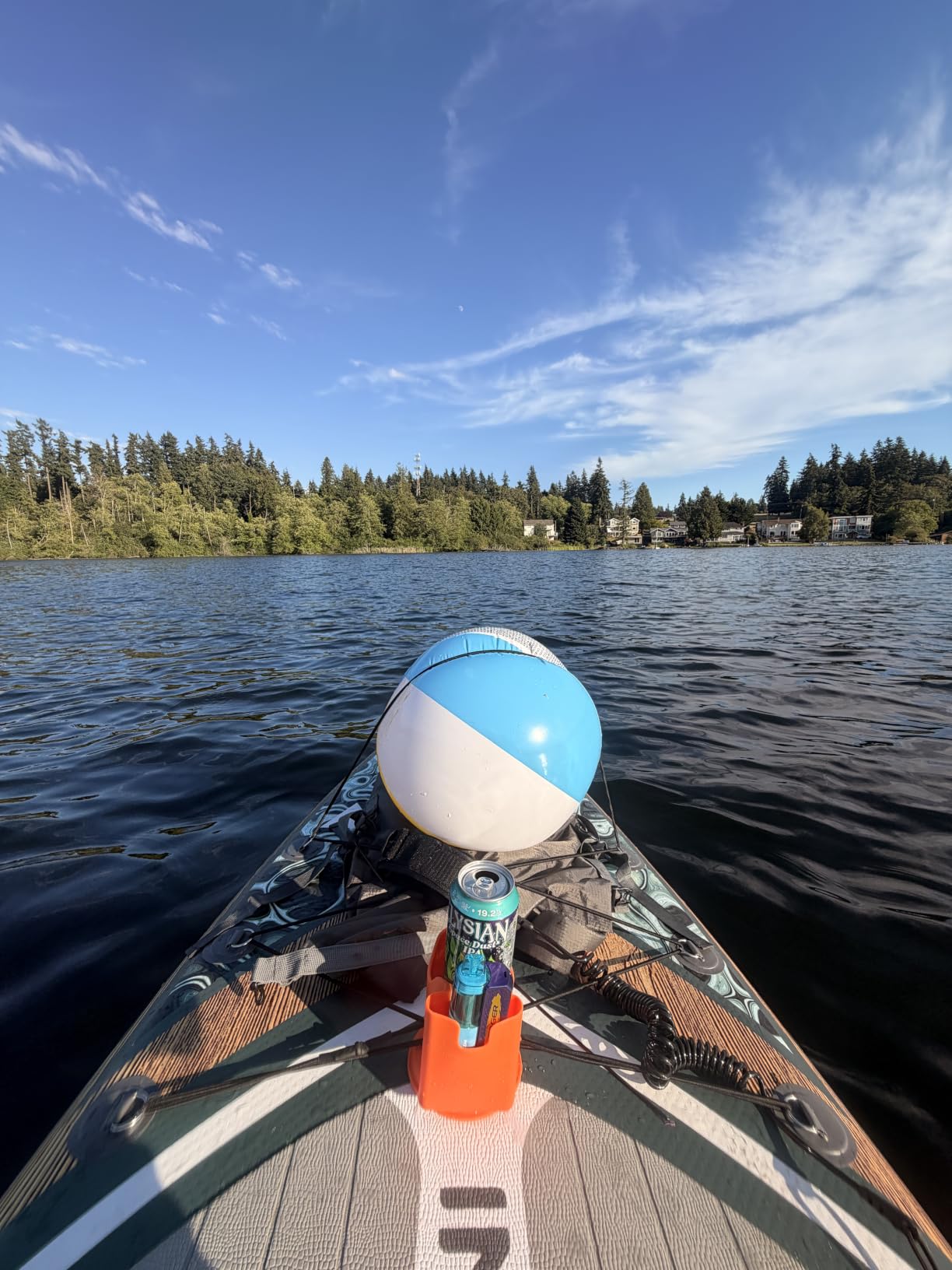
A 200 lb rider on a 420 lb board is running at just under half capacity, which keeps the nose high, the deck firm, and the paddle stroke efficient. You get all the stability benefit of a wide platform without carrying the extra 20 lb of bulk that the 12 foot boards require.
Reviewers also highlight how easy it is to climb back onto after a swim, which matters more at higher weight. Wider platforms give you more rail to push down on, and 18 lb is light enough to handle alone.
Where the rating stops being enough
Four hundred and twenty pounds is the lower ceiling in this roundup, and it is the reason we do not rate this board higher overall. A 300 lb rider who also carries a partner or a dog needs to look at the 450 to 500 lb options instead.
There is no rear bungee, only a 6-point front system, so rear cargo needs the D-rings and a strap. The included hand pump is slow and most owners recommend an electric pump, and the plastic paddle has been reported chipping at the tip after only a handful of outings. The 2 year warranty extension is a genuine plus.
10. ATPROSS 10’6″ x 33″: 400 lb Rating on the Shortest Platform
ATPROSS 10’6”x33”Inflatable Stand Up Paddle Board, 400lbs Extra Wide Stand Up Paddleboard with Kayak Seat, Anti-Slip EVA Deck Premium SUP Accessories Kit, Non-Slip Stable Deck Boat Deep Wood
Pros
- Inflates and deflates in minutes and fits in a back seat or trunk
- Does not feel floppy once inflated despite the price
- Detachable kayak seat supports sitting and standing
- Honeycomb textured EVA deck gives wet traction with foot position colour bands
- Wood grain styling reviewers single out as attractive
Cons
- 400 lb rating and 33 inch deck are the most modest here
- Included pump cannot reach the stated 12 to 15 psi for one buyer
- Included three piece paddle is flimsy
- Some glue residue visible at a few seam spots
- 10 ft 6 length is the shortest in this group
Storage is the problem this board solves. At 10’6″ long and 33 inches wide it is the shortest and most compact platform we compared, and owners report it inflating and deflating in minutes and fitting in a car back seat or a small boot. For anyone without a garage, a roof rack, or a garden, that changes what is possible.
Capacity is rated at 400 lb, which is the lowest ceiling in this roundup and the main reason it sits at the bottom of the list. That number still works for a solo rider with headroom, and the detachable kayak seat adds a genuinely useful fallback when your legs get tired.
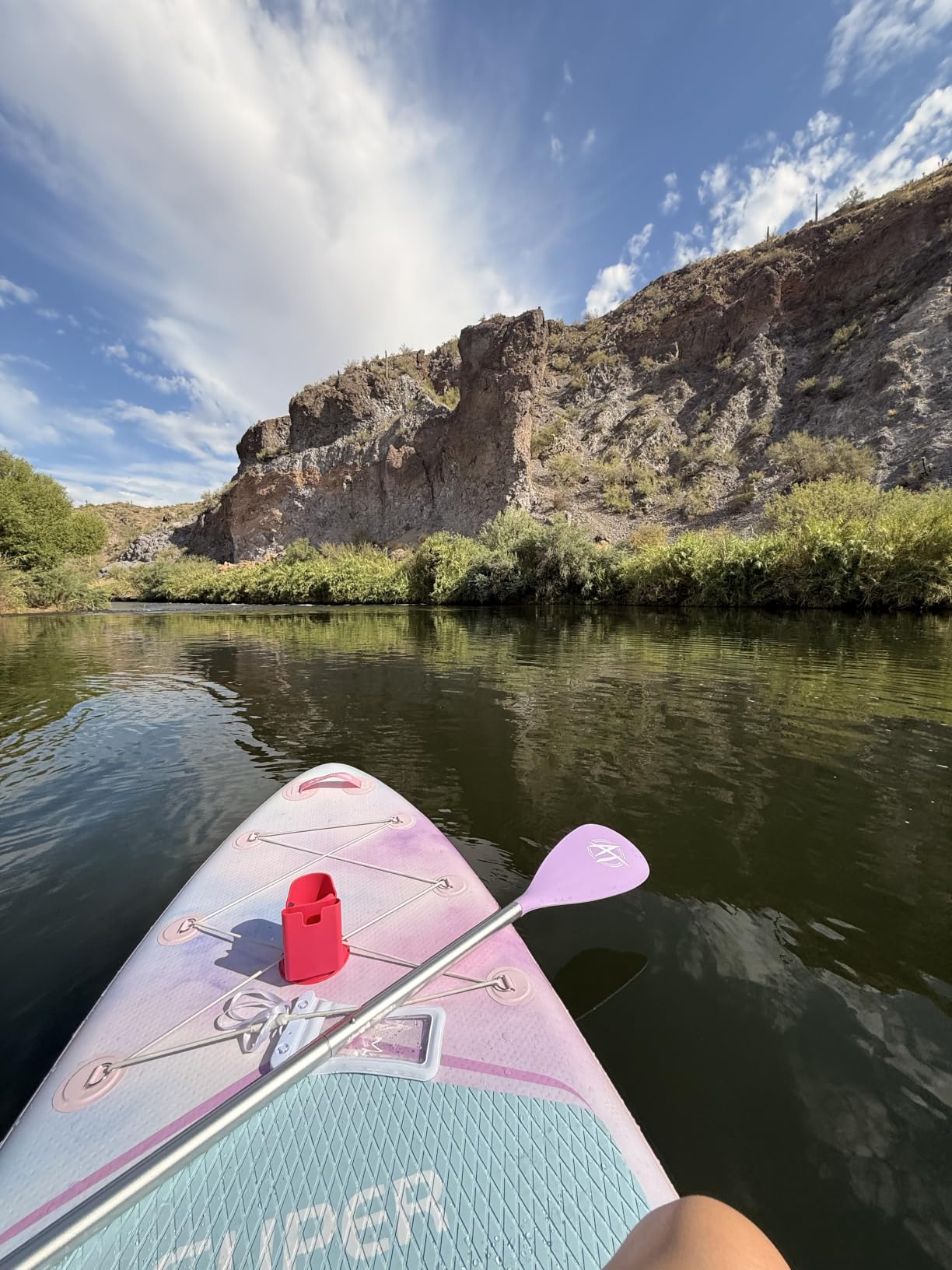
The deck is a soft non-slip EVA surface with a honeycomb texture that grips when wet, plus colour bands marking foot position. That is a small detail with real value for a beginner, because it tells you where to stand without anyone having to explain it. Removable fins handle steering and manoeuvring.
The kit is complete: 600D Oxford backpack, detachable large and small fins, a single and a dual paddle, a leash, a two-way hand pump with a built-in gauge for a 12 to 15 psi target, a PVC repair cylinder with wrench, the kayak seat, a phone bag, and a 5L dry bag. Twelve colour and wood-grain options are available.
Who this compact board actually suits
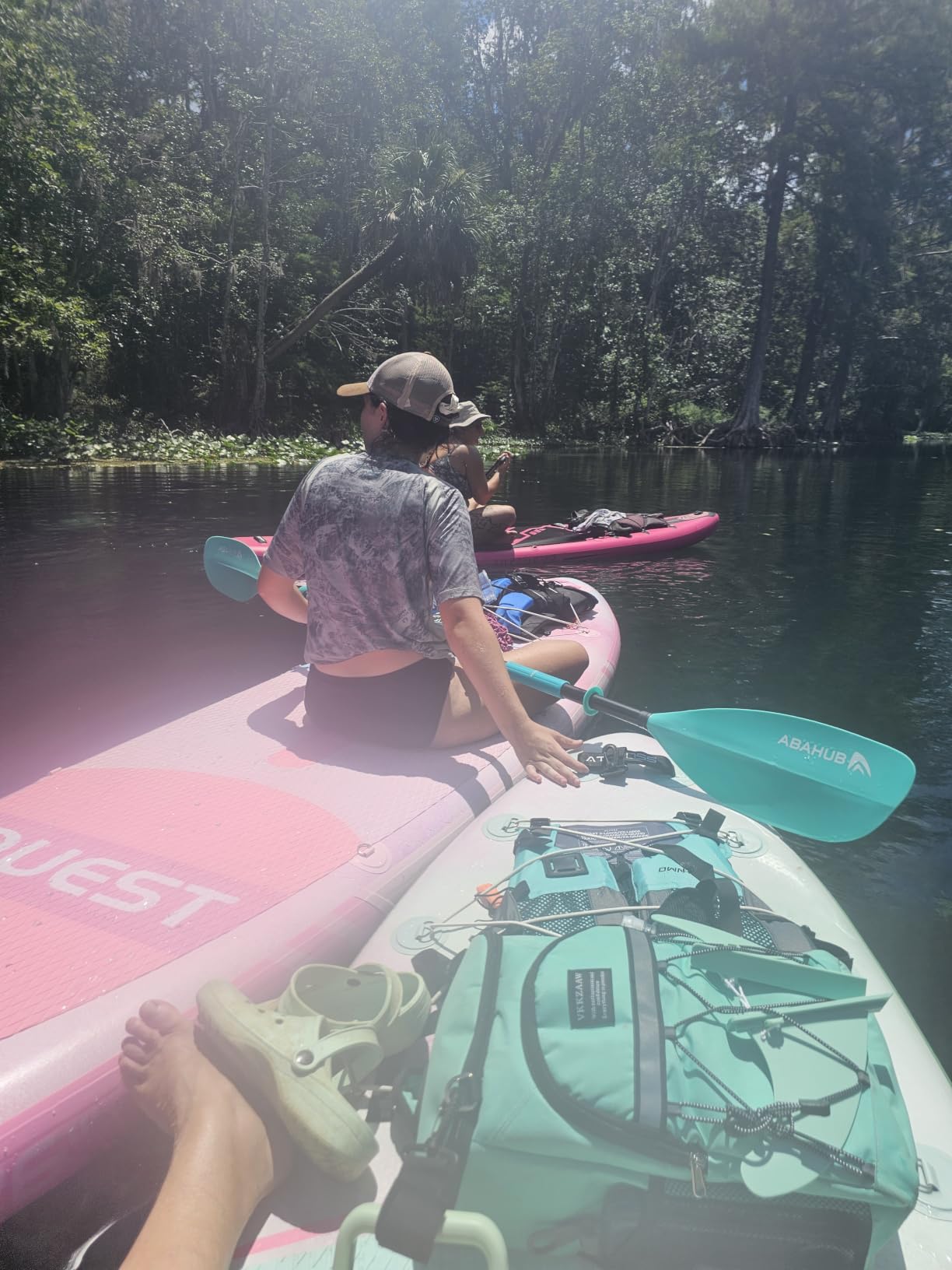
A solo rider under about 300 lb who wants a board they can store indoors, carry to a small dock, and keep in a flat without a rack. Owners report fitting an adult and a child with room to spare, and one notes fitting a family of four plus a cat in practice, so multi-use is realistic within the rating.
The wood-grain deck styling is also worth calling out. Reviewers mention it directly, and it is unusual on a budget board where most decks are plain blue or grey.
What you compromise for the small packed size
Thirty-three inches of width is the least lateral stability here, and 10’6″ of length gives less tracking and less room for gear than the 11’6″ and 12 foot boards. Above roughly 300 lb with a partner or a dog, move up a size.
Two accessories disappoint. The included three-piece paddle is flimsy, and one buyer could not get the hand pump past roughly 7 psi against its stated 12 to 15 psi target, with a leaking hose connection. Some buyers also noticed glue residue at a few seam spots. Replace the pump with an electric one and the paddle with a sturdier model before you rely on either.
How to Size a Paddle Board for a Heavier Rider
How heavy is too heavy for a paddle board? There is no hard ceiling for an individual, because the same 500 lb board is a hard maximum for one 500 lb rider and effortless for a 280 lb rider paddling with a partner. What matters is headroom: choose a board rated 20 to 30 percent above your total load, and your total load counts your paddle, PFD, cooler, dry bag, dog, and any passenger.
So a 280 lb rider wants to see at least 336 lb of rating, which is why several boards rated at 300 lb are wrong for that person despite looking enormous in a listing photo. A 320 lb rider wants 384 lb or more. Above 350 lb, boards in the 450 to 661 lb range become the realistic options.
Use this as your starting map before you look at any product page.
Under 180 lb: 10’6″ wide SUPs are fine, and our beginner guide covers the category.
180 to 220 lb: 11′ x 34″ at 420 lb gives roughly double your body weight in headroom.
220 to 280 lb: 11’6″ x 35″ at 450 lb is the sweet spot for solo paddling.
280 to 330 lb: stay at 450 lb or above, and target a 34 inch deck at minimum.
330 to 400 lb: look at 500 lb boards at 33 inches and wider, or 450 lb boards at 35 inches.
Over 400 lb, or two adults over 300 lb: 500 to 661 lb boards at 36 inches and wider.
Do wider paddle boards support more weight? Not automatically. Width mainly buys side-to-side stability, so it reduces tipping, while length mainly buys tracking and glide. Two of the boards here make the point clearly: a 35 inch wide 450 lb board and a 33 inch wide 500 lb board exist in the same roundup, and neither is better. Match width to your comfort level and length to how far you paddle.
Check your fit in the first five minutes rather than at home from a spec sheet. Inflate to the recommended pressure, stand in your normal riding position, and see where the waterline sits relative to the deck edge. If the nose sits noticeably low and your weight is above 80 percent of the rating, the board is undersized for you and no amount of technique will fix it.
If you also paddle long distances, our touring inflatable board guide covers narrower, longer platforms that suit lighter loads better. For balance work on calm water, see the yoga board picks.
Construction, PSI and Rigidity Above 300 lb
Single-layer construction is where budget boards cut costs, and it is the first thing to avoid above 250 lb. A single-layer shell uses a lighter drop-stitch fabric bonded to a single PVC skin. It is fine for a light rider on a sheltered pond, and it flexes in a way that feels unstable at higher loads. Double-layer and triple-layer builds add sidewall material or extra skins, and that material is what keeps the deck from sagging between your feet.
Every board in this roundup is double-layer or better. The Skatinger, ATPROSS, and Intermountain Gorge boards all cite dual-layer sidewalls or rails, and the CETANA board uses reinforced drop-stitch material rated to 22 psi, the highest shell rating we found.
Inflation pressure is the free upgrade most riders skip. Guidance across this group ranges from 10 to 12 psi solo and 12 to 15 psi for two riders, with maximums between 15 and 22 psi. Under-inflating to save effort is the most common cause of the wobbly feeling riders attribute to their own weight. Pump to the top of the recommended band, and if you carry a passenger, go to the higher figure.
Board weight is the portability tax. Packed weights here run from 18 lb for the Intermountain Gorge up to 27.3 lb for the iTAOSTAR Adventure, with the NACATIN listing at 39.2 lb and the ATPROSS 11’6″ at roughly 36 lb. A heavier rider is often the only person carrying the gear, so a lighter board at 33 to 35 inches wide is worth a real trade in features.
Finally, warranty length is a durability proxy in this niche. Boards flex more under a heavy rider and wear faster, so a three-year guarantee such as the Niphean’s is more meaningful than a one-year policy. Two boards here have conflicting warranty claims, so read the coverage before you buy rather than after.
Standing, Safety and Getting Back On After a Capsize
Where should you stand on a SUP board for stability? Five things matter, in this order: feet straddling the centreline with feet about shoulder width apart, knees bent rather than locked, weight centred between your feet rather than forward or back, hips low, and paddle strokes short and close to the rail rather than reaching forward.
Bending the knees is the single biggest lever. A bent knee lowers your centre of gravity and lets your legs act as suspension over the small movements that would otherwise throw you. On a wide board for a heavy rider, you can also stand further apart than you think you should, which widens your effective support.
Common mistakes heavier riders make on a first outing cluster into four groups. Standing up too early in the water instead of starting in deeper water where your fin has clearance. Reaching forward with the paddle instead of pulling beside the rail, which twists your upper body and shifts weight to one side. Ignoring the leash, which is what lets a drifting board return to you after a fall. And continuing to paddle when the board is riding too low, which is a sizing problem rather than a fitness problem.
Wear a PFD that fits. This is the gear gap most roundups ignore, and it matters directly for larger riders, because standard life jackets are often cut for smaller chest sizes and ride up over the shoulders when you paddle. A PFD that rides up does not keep your head clear of the water in a capsize. If you are paddling in cold conditions, the same sizing logic applies to a wetsuit, and a wetsuit that restricts your shoulders costs you paddle stroke length.
Can a heavy rider get back on after falling in? Yes, and wide decks help disproportionately because there is more rail to push down against. The technique that works: swim to the middle of the board rather than the rail, place both hands on the near rail with your body facing the board, kick up so your chest reaches the deck, and push with straight arms while keeping your hips low. Riders report this being far easier on 34 to 36 inch decks than on narrow performance shapes.
Practise it at the shoreline before you rely on it. Paddle out in knee-deep water, fall off deliberately, and remount three times. That single exercise removes most of the anxiety that keeps larger riders off the water entirely, and it is the closest thing to a confidence fix that any board purchase can offer.
How We Picked and Compared These 10 Boards
We compared 10 stand up paddle boards for heavy riders, all rated between 400 and 661 lb, across a fixed set of criteria: published capacity against the headroom rule, deck width, length, thickness, construction layers and pressure limits, packed board weight, fin and cargo hardware, warranty length, and the volume and tone of buyer reviews.
Capacity and width did most of the filtering, since those are the two numbers that decide whether a board is right for a heavier rider at all. Packed weight then separated the boards for riders who carry their own gear, because a 27 lb board and an 18 lb board are very different objects at the end of a walk to the launch.
Warranty length was treated as a durability signal rather than a spec, since boards under heavy load wear faster. Review tone mattered too, because recurring accessory complaints, deflating straps, or slow pumps tell you more about daily use than a feature list does.
If you are also shopping a heavier-duty electric bike for the same reason, our heavy-rider e-bike picks apply the same headroom logic to a different category.
Frequently Asked Questions
What is the best paddleboard for heavy people?
The Skatinger 11’6 x 35u0022 Super Wide is the best overall option here. It is rated to 450 lb, has a 35 inch deck that is 3 inches wider than a standard board, packs at 19.8 lb so one person can carry it, and holds 4.8 stars across 1,450 reviews. Riders above 350 lb should move to a 500 lb board such as the Niphean 11′ x 33u0022.
How heavy is too heavy for a paddle board?
There is no fixed weight limit, because a board’s rating depends on your total load. Pick a board rated 20 to 30 percent above your body weight plus paddle, PFD, cooler, and any dog or passenger. A 280 lb rider should choose at least a 336 lb rated board, and a 350 lb rider should look at boards rated 450 lb and above.
What are the best paddle boards with a 400 lb capacity?
The ATPROSS 10’6u0022 x 33u0022 is rated to 400 lb and is the most compact option in this roundup, which makes it practical for storage and short carry distances. If you want a little more room, the Intermountain Gorge 11′ x 34u0022 at 420 lb adds two inches of width and still packs at only 18 lb, with a 4.7 star average from 161 reviews.
Are inflatable paddle boards strong enough for heavy riders?
Yes, as long as you avoid single-layer construction above about 250 lb and inflate to the top of the pressure range. Every board in this roundup uses double-layer or heavier construction. Inflating to 12 to 15 psi for two riders keeps the deck firm, which is what removes the wobbly feeling riders report at higher weights.
Do wider paddle boards support more weight?
Width mainly improves side-to-side stability rather than raw capacity. A 35 inch board rated to 450 lb and a 33 inch board rated to 500 lb both exist, and neither is automatically stronger. Choose width for how stable you want to feel and length for how far you paddle, then check that the rating clears your total load by at least 20 percent.
The Bottom Line
The Skatinger 11’6″ x 35″ is the best stand up paddle board for heavy riders because it balances the three things that decide whether a board works for you: a 450 lb rating with real headroom, a 35 inch deck, and a 19.8 lb packed weight one person can manage. Its 4.8 star average across 1,450 reviews is the strongest evidence base of anything we compared.
Go to the Niphean 11′ x 33″ if you want 500 lb of rating and a three-year warranty. Choose the ATPROSS 11’6″ x 35″ if you want the included inflatable seat and a standing-to-sitting fallback. For fishing, the NACATIN 12′ x 36″ at 661 lb is hard to argue with. If you carry your own gear far from a car, the Intermountain Gorge 11′ x 34″ at 18 lb keeps 420 lb of capacity without the bulk.
Whatever you choose, do the arithmetic before you buy: total load times 1.25 gives you the rating you need. Then inflate to the top of the recommended pressure, practise remounting in shallow water, and get out on the lake.