
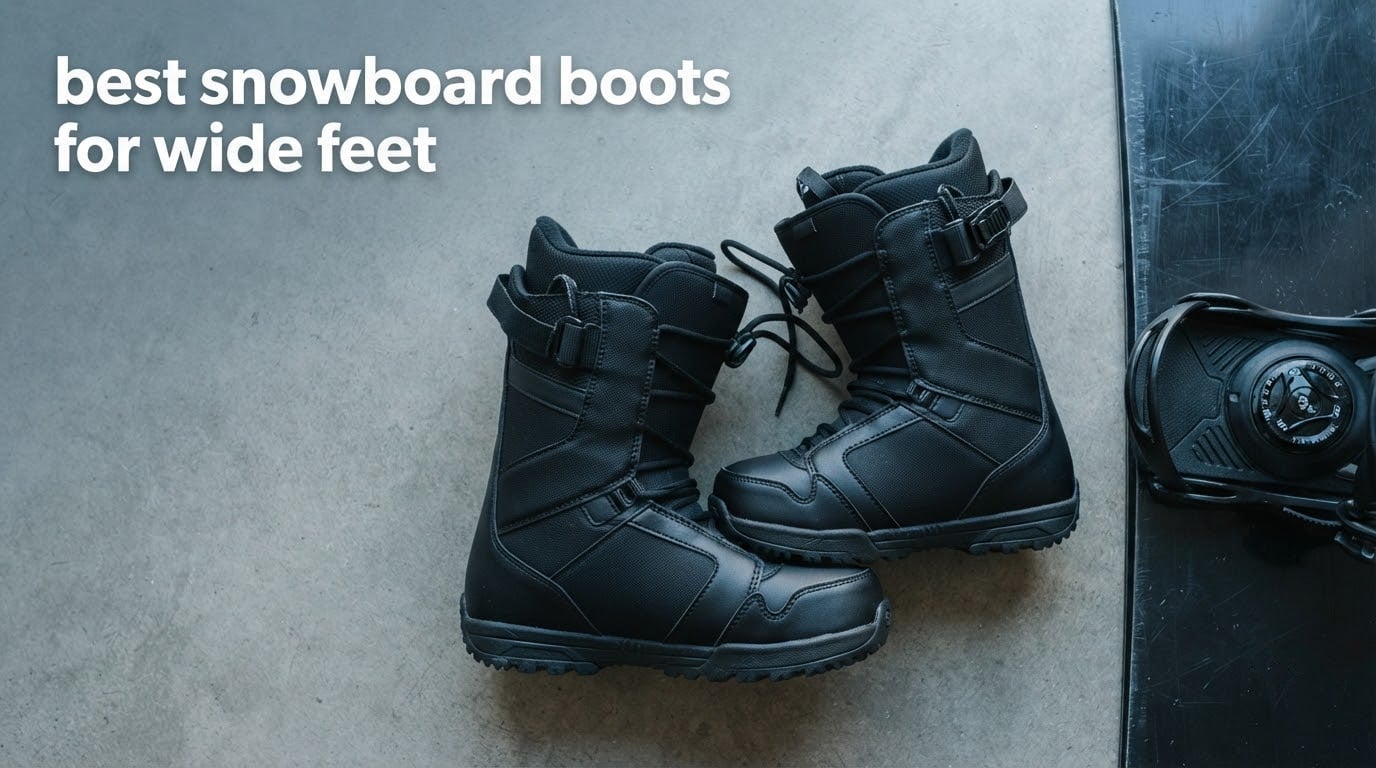
Most snowboard boot problems that riders blame on the boot are width problems. If your toes touch the front of the shell by the first lift, if the fifth toe sits on top of the footbed instead of on it, or if a full day ends with numbness across the ball of your foot, sizing up a standard boot will not fix it. Length added without width added just gives you a boot your toes swim around in.
That is what the best snowboard boots for wide feet actually solve. A genuine wide last is physically wider across the forefoot and midfoot, while the heel area stays narrow enough that a power strap, a BOA dial or a speed lace can still pull your heel down onto the footbed. Room where you need it, lockdown where response comes from. Those two qualities together are the only criteria that matter, and everything else on this list is a preference on top of them.
We went through the whole market to build this one. Six models are genuinely sold as wide fit right now, and they are the six below. Everything else marketed as wide for snowboarding is a standard last in a wider colourway, a size listing of one of these six, or winter footwear that was never built for a binding. In 2026 that is a genuinely short list, and it is a more useful one than a padded twelve-pick roundup would be.
Every boot here was checked against the same questions: is the shell actually wider than standard, does the closure system pull the heel down without squeezing the forefoot, is the liner heat-moldable, and does it work with the binding setup you already own. We also cross-checked sizing behaviour against what riders report on snowboarding forums, because brand-to-brand width consistency is the single most common complaint in this category.
If you are still narrowing things down, our general snowboard boot roundup covers all-mountain and narrow-fit options in more depth, and our snowboard binding guide is worth a look if you are deciding between Step On and strap.
Top 3 Best Snowboard Boots for Wide Feet in 2026


Burton Photon Step On Wide
- Step On compatible
- Snugger Strap heel hold
- Dual-zone BOA
- Imprint 3 liner

Burton Highshot X Step On Wide
- Step On compatible
- Lightweight at 2.9 lbs
- No break-in
- Imprint 3 liner
The Ruler Boa Wide is the one we would put a wide-footed rider in first. It is strap-binding compatible, so it drops into the setup most people already own, and its dual-zone BOA lets you loosen the forefoot without losing tension up top.
The Photon Step On Wide is the pick if you have committed to Step On bindings, because the Snugger Strap builds heel hold into the outside of the shell where a two-piece rear entry cannot reach. The Highshot X Step On Wide is the lighter, stiffer option in the same ecosystem, and it needs no break-in at all.
All 6 Wide Fit Snowboard Boots Compared in October
| Product | Specifications | Action |
|---|---|---|
| Burton Ruler Boa Wide |
|
Check Latest Price |
| Burton Photon Step On Wide |
|
Check Latest Price |
| Burton Highshot X Step On Wide |
|
Check Latest Price |
 K2 Maysis Double BOA Wide K2 Maysis Double BOA Wide |
|
Check Latest Price |
 thirtytwo TM-2 Wide DB thirtytwo TM-2 Wide DB |
|
Check Latest Price |
 thirtytwo Lashed Wide DB thirtytwo Lashed Wide DB |
|
Check Latest Price |
Two things stand out in that table. Three of the six are Step On only, which means if you have traditional two-piece strap bindings you are choosing from three options, not six. And the two thirtytwo models are the only traditional-lace wide boots in the entire category right now, which is why riders who hate dial tension keep ending up on them.
1. Burton Ruler Boa Wide Fit – Best All-Round Wide Boot
Pros
- Dual-zone BOA adjusts forefoot and cuff independently
- Heat-moldable liner for a custom fit
- B3 Gel sole stays damped in cold snow
- EST midsole lowers the centre of gravity
- Snow-proof internal gusset keeps feet dry
Cons
- Insole feels thin to some riders
- BOA dial durability over a decade of use
- Only 19 reviews for this wide SKU
The Ruler is the boot we keep coming back to because it solves the wide-foot problem without creating a new one. Burton’s standard lasts run narrow through the midfoot, so the Wide version here is a meaningful step up rather than a cosmetic relabel. If you have been demoing standard Rulers and getting numb toes, this is the same ride with the forefoot opened up.
What makes it work is the dual-zone BOA. There is one dial at the lower shell and one at the cuff, and they tension independently. That means you can pull the upper down hard for heel hold and leave the forefoot dial a quarter turn looser, which is exactly the adjustment pattern a wide foot needs. Most single-zone closures force you to choose between a tight cuff and a squeezed toe box.
The liner is a heat-moldable Imprint 2, so a bootfitter can bake your foot into the foam and the shape will hold for the rest of the season. Burton pairs it with a Level 2 molded EVA footbed and a snow-proof internal gusset. In practice that combination keeps toes warm through a full day rather than giving up warmth by lunch.
Underfoot is a B3 Gel sole on an EST Optimized midsole, which is the part of this boot we like most for wide feet specifically. The EST midsole drops the foot closer to the board and softens the ride, so a longer, wider shell does not feel like it is dragging. The flex is medium stiff, which suits a progressing intermediate who wants response without a punishing ramp.
What wide feet will notice first
The forefoot. This is the boot where the toe box sits where it should, with the fifth toe resting on the footbed rather than riding up over the edge of it. Riders moving up from a standard-last Burton usually describe the first session as feeling like the boot finally stopped arguing with them.
Heel hold is the second thing. The dual-zone setup plus the cuff dial gives a secure pull on the heel without needing to overtighten the lower dial. That matters most on the days you are linking turns at speed, where a lifting heel breaks down edge pressure before you feel it happening.
Where it falls short
The footbed is the weak point. Several riders describe it as thin relative to the shell quality, and if you already use a full aftermarket insole you may be paying twice for the same job. Ask your bootfitter to check it before you commit.
The review base is genuinely thin at nineteen ratings, which is normal for a wide SKU and means we are leaning more on the build than on crowd consensus. The other long-term concern is BOA dial longevity. A decade of daily use can dry the dial out, and replacement is easy but not free.
2. Burton Photon Step On Wide – Best Wide Boot for Step On Riders
Pros
- Snugger Strap adds heel hold a rear-entry cannot reach
- Step On entry removes lace and dial time
- Dual-zone BOA for zoned tension
- Imprint 3 liner with power panels
- Wide fit works with standard bindings
Cons
- Requires Burton Step On bindings
- Only 4 ratings to judge it by
- Listed weight of 8 lb is heavy
- Hook and loop liner closure wears over time
If you ride Step On, the heel hold problem gets harder before it gets easier. A two-piece rear entry pulls from the front and the sides, so wide feet tend to lift out of the shell exactly where you need them planted. The Photon Step On Wide is built to answer that directly rather than leaving you to solve it with technique.
The Snugger Strap is the answer. It runs across the outside of the boot and anchors into the shell, adding a lateral pull that a rear-entry cage physically cannot generate. Wide riders who switch to this from a lace-up Step On boot usually notice the difference in the first hour on the hill.
Everything else is familiar Burton territory. Dual-zone BOA handles zonal tension, the Imprint 3 liner uses a hook-and-loop closure with lightweight power panels for support, and the shell is listed as waterproof. It still works with standard binding compatibility in the sense that it accepts the same mounting geometry, but the Step On mechanism itself is the point of the boot.
One number to keep in mind: this model is listed at 8 pounds, which is on the heavy side for a snowboard boot. That figure is the packaged or shipping weight rather than a clean per-boot measurement, so treat it as a rough signal rather than a precise one. Either way, do not expect this to be the lightest boot in the lineup.
What wide feet will notice first
The Snugger Strap, immediately. On a wide foot the heel is the part that moves first, and this strap is the mechanism designed to keep it down. If heel lift was your main complaint with your old wide boots, this is where you will feel the difference.
The second thing is entry speed. There is nothing to lace and only two dials, so a long day with a wide foot that needs frequent re-adjustment gets much less annoying. Riders with bunions in particular tend to re-tension throughout the day, and that is where dial systems earn their keep.
Where it falls short
It only works with Burton Step On bindings. That is a real ecosystem decision, not a preference, and if your current bindings are strap you cannot use this boot at all. Check your binding brand before you fall in love with the heel hold.
The rating here comes from four reviews, so treat that 5.0 as a promise rather than a track record. The hook-and-loop liner closure is also the piece we would watch, since it is the first thing on the boot to lose grip once the boot has been heat molded a few times.
3. Burton Highshot X Step On Wide – Lightest Wide Boot on the List
Pros
- Lightest boot here at 2.9 lb
- No break-in period needed
- Independent BOA zones for precise control
- Step On entry and exit
- Built for strong support at speed
Cons
- No customer ratings yet
- Water resistant rather than waterproof
- Requires Step On bindings
- Newer model with less field history
The Highshot X is the option for a wide-footed rider who has stopped cruising. At 2.9 pounds it is roughly a third of what the other Step On wide boot on this list weighs as a packaged unit, and the build is aimed squarely at riders who want firm support rather than a soft ride.
The wide last here is genuinely roomy, and Burton pairs it with the same Imprint 3 liner found higher up. The marketing line is that it needs no break-in, which is a claim about the shell and liner combination being usable from the first session. Wide feet benefit from that more than average, because a boot that is tight on day one is a boot you will not keep wearing.
Independent BOA zones are the feature to pay attention to if you have never used them. You can dial the lower shell snug across the forefoot without pulling the cuff down hard, or reverse that depending on what your riding wants that day. For a wide foot this is the same logic that makes the Ruler work, applied to a stiffer, more aggressive boot.
The honest caveat is that we are working from the spec sheet here. This model has no customer ratings yet, so everything above comes from the published construction rather than from season-long feedback. That does not make it a bad boot, but it does mean you should treat it as the newest entry in the category rather than a proven one.
What wide feet will notice first
Weight, and it matters more than the spec sheet suggests. On a long day with a wide foot, lighter boots mean less fatigue in the lower legs, and fatigue is what makes riders loosen their closure by mid-afternoon and lose the fit they worked for at breakfast.
The no-break-in promise is the second thing. If you have been putting off new boots because you dread the tight first week, this removes that objection. Ride it hard in a shop for twenty minutes before you leave, per the advice that comes up constantly on snowboarding forums.
Where it falls short
It is water resistant, not waterproof. In a category where several competing wide boots claim a waterproof shell, that is a real difference on a wet day, and it is worth factoring into your decision if you ride coastal mountains or deep spring snow.
It also shares the Step On restriction and carries no ratings, so you are buying on construction alone. If you want a proven wide boot with user history behind it, the Ruler Boa Wide is the safer position and the two are not close in weight class.
4. K2 Maysis Double BOA Wide – Strongest Heel Hold
Pros
- Conda BOA liner lacing gives exceptional heel hold
- Intuition Control Foam 3D liner is heat-moldable
- Flex 6 suits all-mountain riding
- Articulating cuff with Endo 30 resists distortion
- Internal and external J-bars with cored ankle pockets
Cons
- No customer ratings yet
- 8 lb listed weight is heavy
- Water repellent shell rather than waterproof
- Hybrid lace and BOA layout takes adjusting to
K2 is one of the two brands riders consistently name when wide feet are the problem, and the Maysis is the reason. Thirtytwo is the other. K2 lasts generally run roomier through the midfoot, so the Wide version here starts from a friendlier baseline than a Burton does.
The heel hold is what separates this boot. Conda is a proprietary liner lacing system, combined with BOA in the liner itself, that pulls the liner around the foot and ankle independently of the shell. On a wide foot that matters because the shell and the foot can move out of sync, and Conda is designed to stop that happening.
Flex is rated 6 out of 10, which puts it squarely in all-mountain territory. That is the right stiffness for most riders who want a wide boot, because anything much softer will feel vague once your toes stop fighting the shell and anything much stiffer starts working against you in powder.
The liner is an Intuition Control Foam 3D, heat-moldable with medium and high-density foam. Intuition liners are considered among the most moldable in the sport, which matters if your width is not even across the foot. They will hold the shape of a wide forefoot and a normal instep, which is a combination mass-produced lasts rarely get right.
What wide feet will notice first
The liner, honestly. An Intuition foam liner heat molded to a wide foot gives you a genuinely custom interior, and if you have spent years in boots that pressed on your bunion or the ball of your foot, that difference shows up within the first few minutes on snow.
The J-bars and cored ankle pockets do the supporting work. Internal and external bars lock the liner around the ankle while the cored pockets soften the pressure points that wide feet hit first, so you get support without the bruising that usually comes with it.
Where it falls short
There are no customer ratings on this model, so the heel hold story is built from K2’s Conda system rather than from wide-foot rider feedback. Ask a bootfitter how they have fitted it, because that experience matters more here than the spec sheet.
The listed weight of 8 pounds is heavy, and the shell is water repellent rather than waterproof. The hybrid closure also takes a session to understand: you have traditional shell lacing plus two BOA systems working in different places, which is powerful once you have it and confusing before that.
5. thirtytwo TM-2 Wide DB – Best Wide Boot for Traditional Laces
thirtytwo TM-2 Wide DB Men’s Boot, All-Mountain, lace-up, Cushioned – 95 – Black 2026
Pros
- Traditional laces give even tension you control
- Articulated spine flexes naturally
- Reinforced heel counter holds shape
- Heat-moldable anatomical liner
- Two-year manufacturer warranty
Cons
- No customer ratings yet
- Water resistance rating conflicts with waterproof shell claim
- No BOA option for quick adjustment
- Limited size variants in this listing
The TM-2 Wide DB is the one to look at if dial systems make you uncomfortable. Traditional laces give you total control over tension distribution, and for a wide foot that is worth more than convenience. You can pull tension where you want it and leave it alone where you do not.
Thirtytwo builds around a snowboard-specific last with an articulated spine, which is how the boot flexes without twisting out of shape. For a wide foot this matters because stiff, unarticulated shells tend to distort at the forefoot under pressure. This one is designed to bend rather than warp.
The reinforced heel counter is doing the same job as a BOA dial would, just mechanically. It holds the rear of the shell in shape so your heel stays planted under load, and the anatomical liner with heat-moldable foam handles the interior fit. The liner is warm and moldable, which is what makes it worth the two minutes a bootfitter needs.
Outsole is tuned for board feel and walkability, so you get some grip walking through a car park without giving up the connection to the board that most performance outsoles sacrifice. The two-year manufacturer warranty is also the longest in this group, and thirtytwo is the only brand here offering it.
What wide feet will notice first
The lace tension control. You can pull the forefoot tight and leave the instep loose, or run a lower wrap across the fifth toe without the whole boot tightening. On a wide foot that ability to distribute tension is worth more than fast entry, and it is the reason laces keep coming back in this category.
The snowboard-specific last is the second thing. thirtytwo makes wide lasts that are genuinely roomy rather than merely lengthened, so your toes should sit forward in the boot rather than at the end of a longer standard last with space behind them.
Where it falls short
Speed is the honest trade-off. Lacing takes noticeably longer than two dials, and if you are the kind of rider who re-tensions mid-run you will feel it. Nothing here is wrong, it is just not the fast option.
This listing also has no customer ratings and only a handful of size variants, which makes ordering confidently harder. If you are between sizes, get fitted or buy from a place with a forgiving return window, since forum advice consistently is to wear new boots indoors for twenty minutes or more before you commit.
6. thirtytwo Lashed Wide DB – Best Value Wide Boot
thirtytwo Lashed Wide DB Men’s Boot, All-Mountain, lace-up, Cushioned – 120 – Black/Gum 2026
Pros
- Lowest entry point of the six wide models
- Same core wide last and liner technology
- Reinforced heel counter and articulated spine
- Traditional laces for even tension
- Two-year warranty and more size variants
Cons
- No customer ratings yet
- Water resistance rating conflicts with shell description
- Traditional laces only
- Black and gum colourway is the only option
The Lashed Wide DB is the TM-2 Wide DB at the entry level, and for a first pair of wide boots that is genuinely the smart move. It carries the same snowboard-specific last, the same articulated spine, the same reinforced heel counter and the same heat-moldable anatomical liner. You give up some of the refinement, not the fit.
That matters because the whole point of a wide boot is that the last works for your foot. The fit properties are not where a cheaper model should be compromised, and here they are not. Reinforced heel counter still holds the rear shape, the spine still articulates, and the liner still molds.
What you do give up is the warmer, more nuanced ride you get further up the range. For a rider on their first or second season with wide feet, spending less and putting the savings toward a bootfitter appointment is a better allocation than buying the top model badly fitted.
It also has more size variants in this listing than the TM-2, which is a quiet advantage for anyone who lands between sizes. A wider size range means a better chance of landing on a clean fit without having to size up and deal with the length problem that wide-foot riders are trying to avoid.
What wide feet will notice first
The same roomy last as the TM-2, which is the entire point. Riders switching from standard-l thirtytwo models consistently describe the wide version as a different boot rather than a longer one, because the volume difference is right across the forefoot.
The lacing does what laces do. You get even, controlled tension with no dial to over-tighten, and for a foot that needs pressure managed differently across the instep and the toes, that is a real advantage rather than nostalgia.
Where it falls short
There are no customer ratings, so we are again reading construction rather than feedback. If that bothers you, the K2 Maysis Wide and the two Burton Step On models all have the same issue, and honestly the entire wide category is thin on public reviews.
The single colourway is another limit. It is a practical boot rather than a fashionable one, and if you ride somewhere with a lot of walking in the car park you will appreciate the walkability of the tuned outsole. Just do not expect a choice of finishes.
How We Picked Wide Fit Snowboard Boots
We filtered the market on one criterion first: is the shell built on a wider last, or is this a standard boot with a wide label. That filter is what produced the six boots here and what removed most of the market. Several boots marketed as wide turned out to be standard lasts in extended sizing.
From there we scored each boot on the things a wide foot actually feels. Does the forefoot have real volume, or extra length. Does the closure system allow zonal tension so the heel can be tight while the toes stay loose. Is the liner heat-moldable. Does it fit the binding system you already own. And does the flex rating match the riding style it is aimed at.
We also weighted longevity and warranty, because a boot you replace every two seasons is not a bargain no matter what it costs the first time. The thirtytwo pair carries a two-year manufacturer warranty, the Burton models carry one year, and that difference is worth noting if you are on a wide-fit boot that gets more wear because you work it harder.
Where customer feedback was thin, we said so rather than filling the gap. Five of these six models have very few or no customer ratings, which is a category-wide issue rather than a research failure. Treat our reading of those spec sheets as informed inference and confirm with a bootfitter.
How to Measure Your Foot and Pick the Right Size
Get your foot measured with a Brannock device rather than guessing from your street shoe size. This is the single most useful thing you can do before buying wide boots, and it takes five minutes in any decent shop. The Brannock device gives you two numbers that matter: the Mondo point length and the width letter.
Those two numbers are different from each other and different from your shoe size. US snow boot sizes run roughly half a size up from street shoe sizes, and Mondopoint is a millimetre measurement of foot length with no letter or half-size system attached. Width comes on its own scale, from narrow D through E and 2E up to the widest, which is where wide snowboard fits usually sit.
Measure both feet, at the end of the day, in the socks you will actually ride in. Feet swell over the course of a day and most riders have one foot slightly larger than the other. Buy for the larger foot. A rider on snowboarding forums who measured at two different shops came back with a left foot at 11.0 in 2E and a right foot at 11.8 in E, which is exactly the kind of asymmetry wide fit is supposed to solve.
On size, do not size up to solve width. This is the recurring mistake. A boot one size longer on a standard last gives your toes somewhere to go but leaves you with a boot that feels loose and unpredictable, and loose boots are worse than tight ones on a snowboard because you cannot feel the edge. If you need width, buy width. Your last should be wide and your size should be correct.
If you fall between two sizes, take the smaller one and let heat molding solve the rest. A moldable liner closes a half size of gap far more reliably than a too-long shell does.
Which Brands Actually Run Wide
The short version: thirtytwo and K2 run wide, Burton runs narrow. This is repeated consistently across rider experience and it is the most useful cross-brand fact in this whole category, because it means a size in one brand does not transfer to another.
If you wear a size 9 in a Burton, you should not assume a size 9 in thirtytwo or K2 gives you the same volume. Riders moving between brands commonly report needing to adjust. When in doubt, measure the actual model on your foot in the shop rather than converting from a size number.
Burton’s narrow bias is worth stating clearly because it is the source of most disappointment. If you have been fitting in standard Burton lasts and squeezing, the Wide versions here are a bigger jump than the same upgrade would be in another brand. They may feel almost loose to you, and that is the correct outcome.
Our broader wide hiking boot guide covers the same brand-width logic for a different kind of footwear, and the principle transfers. Wide is not a size, it is a last, and lasts are not comparable across manufacturers.
Wide Calves, High Instep and Bunions Are Different Problems
Most wide SKUs solve the forefoot and stop there. If your problem is actually above the ankle, a wide toe box will not fix it, and buying a bigger boot because of it is how riders end up with a size that does not work anywhere.
Wide calves are a shell-height and tongue-volume issue. A mid-calf boot with a stretch panel or a wrap-around tongue handles a larger calf far better than a taller, stiffer boot does. Riders who describe themselves as short and large-calved often get more out of the Burton Ruler than from a high cuff model, because the cuff gives the calf somewhere to expand.
A high instep is a midfoot volume issue rather than a width issue at the toes. It is solved by stretch in the instep and by lacing choices, which is one more argument for the traditional lace boots on this list: a crossed lace pattern lets you skip over the instep and pull tension around it, which a straight-over BOA path cannot do.
Tailor’s bunion and plantar fasciitis are the reason most riders end up here, and they are not the same as a wide foot. A bunion changes the shape of the forefoot asymmetrically, and what helps is volume and a liner that does not press on the joint. Intuition and control foam liners on the K2 are the strongest choice for this, because they mold to an uneven shape rather than assuming a symmetric one. A rider who switched all their footwear to wide reported finally being pain free, and that is the outcome to aim for.
If you are still short after all of this, a custom molded boot is a real option rather than a defeat. Our wide running shoe roundup covers the same last-shape logic that decides whether custom is worth it, and the honest advice from experienced riders is consistent: a good bootfitter matters more than the brand on the box.
Closure Systems and Flex Matched to Your Riding
Closure choice on a wide boot is about tension distribution, not convenience. Dual BOA and dual-zone systems give you independent control of the forefoot and the cuff, which is exactly what a wide foot needs. Traditional laces give you finer control still, at the cost of speed. There is no wrong answer here, only a different trade.
On flex, the rule of thumb is straightforward. A flex rating of 1 to 2 is soft and forgiving for beginners and for anyone learning on a wider, less precise platform. A 5 to 6 is all-mountain, which is where most wide boots sit and where most riders should sit. A 9 to 10 is big mountain and firm, and it demands a precise fit that a wide foot struggles to get without a bootfitter involved.
The K2 Maysis Wide is rated 6 out of 10 and the Burton Ruler is described as medium stiff, so those two bracket the sweet spot for most riders. If you ride park and want something softer to twist on, look for a wide boot with more articulation rather than simply a lower number, because articulation and softness are not the same thing.
Zonal tension deserves one more note because it is the feature wide-foot riders should insist on. Zonal systems let you secure the cuff hard while leaving the forefoot softer, which prevents the toe-box pressure that ends a day early. If a boot has a single closure point that tightens everything at once, it will eventually press on your widest point.
Step On compatibility is a hardware decision rather than a fit one, but it interacts with wide feet more than it gets credit for. Three of our six are Step On only. If your bindings are strap, start from the three that are not.
Heat Molding, Liners and Pack-Out
Heat molding is what converts a good last into your boot. A moldable liner goes on a warming machine, you step in while it is soft, and the foam sets to the shape of your foot. On a wide foot this is where the difference between roomy and genuinely comfortable happens, because it fills the volume in the shape you actually occupy.
All six boots here have heat-moldable liners, which is not a given across the wider snowboard market. When you get a pair fitted, ask for a full mold rather than a quick one. The liner should be worked across the forefoot and around the heel, and it takes a few heat cycles to set fully.
Pack-out is the part nobody warns you about. As liners wear and compress over a season, the boot gets looser, and a boot that fit at purchase can feel loose by late 2026. thirtytwo liners in particular are reported to pack out noticeably, so if you are buying wide boots for multi-season use, keep that in mind for the second year adjustment.
Give new boots twenty minutes indoors before you take them outside. This advice comes up constantly from riders who got a hot spot on their first lift, and with wide feet it is more important rather than less, because the pressure points you are looking for are wider and easier to miss.
Frequently Asked Questions
How do I know if I need wide snowboard boots?
You need a wide last if your toes touch the front of the shell when you stand, if your fifth toe rides up over the footbed, or if you feel pressure across the ball of your foot after a session. Sizing up does not solve it, because it adds length rather than volume. Get measured with a Brannock device and check the width letter before buying.
What size snowboard boot should a wide foot get?
Buy the size that matches your measured foot length, not a size up. Wide solves width, so adding length leaves your toes swimming and makes the boot unpredictable on the edge. US snow boot sizes run roughly half a size up from street shoe sizes, and Mondopoint gives you a millimetre length independent of any letter system.
Which snowboard boot brands run wide?
thirtytwo and K2 are the two brands riders most consistently report as running wide, while Burton is repeatedly described as running narrow. That means a size does not transfer between brands. Measure the specific model on your foot rather than converting from a size number, and expect Burton Wide versions to feel roomier than the equivalent standard boot.
Do wide snowboard boots work with regular bindings?
Yes, with two-piece strap bindings. A wide boot changes the shell volume, not the mounting geometry, so it works with any standard binding. Step On boots are a separate category and only pair with Step On bindings. Three of the six boots in our roundup are Step On only, so check your binding brand before choosing one.
Are wide snowboard boots less responsive?
They can feel less precise at first, usually because a longer shell delays edge response, not because a wide last is inherently vague. Boots with an articulated spine and a stiffening midsole counter this well. The Burton Ruler and K2 Maysis Wide both use designs aimed at keeping a wide shell from feeling loose or floppy.
Can I heat mold snowboard boots to widen them?
Heat molding only changes the shape of the liner to match your foot, it does not add width to the shell. If your standard boots press on your toes, molding will not fix that. It is genuinely useful for filling a half size of gap when you land between sizes, and it works well on bunion-shaped feet where the liner should follow an uneven outline.
Final Verdict on Wide Fit Snowboard Boots
The Burton Ruler Boa Wide is the best snowboard boot for wide feet for most riders, because it combines a genuinely wider last with dual-zone tension and works with the strap bindings you probably already own. Ride Step On and want heel hold that a rear entry cannot deliver? The Photon Step On Wide is built for exactly that. Budget riders with traditional-lace preference should look at the thirtytwo Lashed Wide DB.
Whatever you choose, get measured rather than guessing, and wear it indoors for twenty minutes before you commit. Our snowboard binding guide is the other half of the decision if you are still setting up a new kit for 2026.