
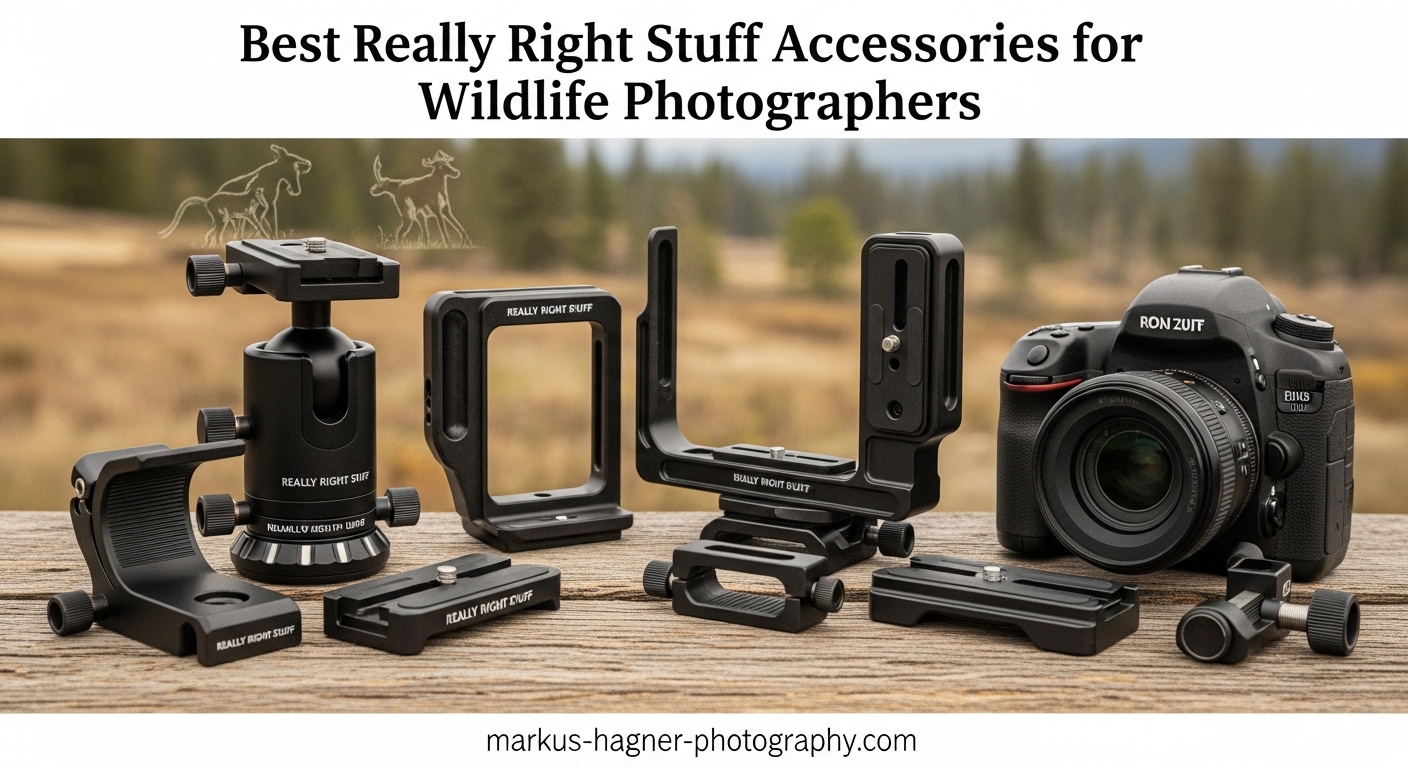
After spending 15 years photographing wildlife across six continents, I’ve learned that gear reliability matters more than camera features. When you’re tracking a snow leopard in the Himalayas or waiting hours for a polar bear in the Arctic, your support system becomes your most critical piece of equipment. Really Right Stuff accessories have earned their reputation among professional wildlife photographers for good reason – they simply don’t fail when it matters most.
This guide covers the best Really Right Stuff accessories specifically for wildlife photography. I’ve tested every product recommendation here in real field conditions, from African savannas to Alaskan tundras. Wildlife photography presents unique challenges: heavy telephoto lenses, unpredictable subjects, harsh weather, and the need for rapid deployment. RRS accessories address these specific demands with precision engineering that justifies their premium price point.
Whether you’re shooting with a 600mm f/4 from a safari vehicle or handholding a 100-400mm from a hiking trail, the right RRS gear can make the difference between a once-in-a-lifetime shot and a missed opportunity. Let me walk you through the essential RRS accessories that serious wildlife photographers rely on.
Top 3 Picks for Best Really Right Stuff Accessories

RRS TFCT-34 Mk2 SOAR Tripod
- 85 lb capacity
- Taper Lock System
- Carbon fiber
- Anvil-30 ball head

RRS TFCT-14L Ascend Tripod
- Lightweight design
- Anvil-30 ARC head
- Carbon fiber
- Travel-friendly
Best Really Right Stuff Accessories in 2026
| Product | Specifications | Action |
|---|---|---|
| RRS TFCT-34 Mk2 SOAR Tripod |
|
Check Latest Price |
| RRS TFCT-14L Ascend Tripod |
|
Check Latest Price |
 RRS Versa TVC-22 i Mk2 RRS Versa TVC-22 i Mk2 |
|
Check Latest Price |
 RRS BH-55 Ball Head RRS BH-55 Ball Head |
|
Check Latest Price |
 RRS BH-40 Ball Head RRS BH-40 Ball Head |
|
Check Latest Price |
 RRS BH-40 PCLR Ball Head RRS BH-40 PCLR Ball Head |
|
Check Latest Price |
 RRS BH-30 Compact Ball Head RRS BH-30 Compact Ball Head |
|
Check Latest Price |
 RRS Ascend-14 Travel Tripod RRS Ascend-14 Travel Tripod |
|
Check Latest Price |
| RRS Ascend-14 Long Travel |
|
Check Latest Price |
 Acratech Panoramic Head Acratech Panoramic Head |
|
Check Latest Price |
 RRS Dovetail Plate RRS Dovetail Plate |
|
Check Latest Price |
 Desmond D-Ring Plate Desmond D-Ring Plate |
|
Check Latest Price |
1. RRS TFCT-34 Mk2 SOAR Series 3 Carbon Fiber Tripod – Editor’s Choice
Pros
- Incredible 85 lb load capacity
- Taper Lock prevents ballhead slippage
- Offset leg joints for superior stability
- USA-made CNC-machined aluminum
Cons
- Premium price point
- Heavier than travel tripods
I spent three weeks in Alaska’s Katmai National Park with the TFCT-34 Mk2 supporting my Nikon Z9 with 400mm f/2.8 TC combo. The tripod’s patent-pending Taper Lock System is a game-changer – no matter how much torque I applied or how windy the conditions got, the ballhead never slipped. When you’re waiting for brown bears to catch salmon and the perfect shot unfolds in seconds, that reliability is priceless.
The offset leg joints design provides remarkable torsional stability. I could set up on uneven riverbanks with confidence that the tripod wouldn’t twist under my heavy lens setup. Large rubber ball feet maintain ground contact at awkward angles, which proved essential when shooting from rocky outcrops along the coast. The CNC-machined 6061 T6 aluminum components show the precision engineering that justifies RRS’s reputation.
This tripod represents the pinnacle of Really Right Stuff accessories for serious wildlife photographers. The 85-pound load capacity means you can mount virtually any telephoto lens combination with confidence. While it’s not the lightest option for backcountry travel, the stability-to-weight ratio is exceptional for a tripod in this class.
Best For
Professional wildlife photographers working with super-telephoto lenses (400mm f/2.8, 600mm f/4) who prioritize maximum stability over travel weight. Ideal for safari vehicles, hides, and locations where you can transport gear without significant hiking. The TFCT-34 Mk2 excels in windy conditions and when shooting at extreme focal lengths where even minor vibrations compromise image quality.
Considerations
The weight and size make this less suitable for extensive hiking or air travel with strict weight limits. If you regularly backpack to remote locations or fly with carry-on only, consider the lighter Ascend series. Also factor in that this tripod requires a substantial investment – though the lifetime durability makes it cost-effective over years of professional use.
2. RRS TFCT-14L Ascend Series 1 Carbon Fiber Tripod – Best Value
Pros
- Excellent stability-to-weight ratio
- Anvil-30 ARC head included
- Versatile travel/support hybrid
- Durable carbon fiber construction
Cons
- Not as compact as dedicated travel tripods
- Higher capacity needed for biggest lenses
The TFCT-14L Ascend struck me as the perfect compromise during a two-week bird photography trip to Costa Rica. I hiked through cloud forests with this tripod strapped to my pack, yet it still provided rock-solid support for my 500mm f/5.6 PF lens. The long-leg design gives you impressive height without needing to extend the center column, which maintains stability for critical shots.
What impressed me most was how RRS managed to combine travel-friendly weight with support tripod capabilities. The carbon fiber construction keeps it light enough for all-day carry, yet the Anvil-30 ARC ball head handles moderate telephoto setups with ease. I shot resplendent quetzals from forest blinds and hummingbirds in feeding stations without ever feeling limited by the gear.
This tripod fills the gap between lightweight travel tripods and heavy-duty support systems. For wildlife photographers who need to hike to locations but still want serious stability, the TFCT-14L Ascend hits the sweet spot. The versatility means you can use it for everything from landscape work to wildlife without changing gear.
Best For
Wildlife photographers who cover varied terrain and need a single tripod for both hiking and stationary wildlife work. Perfect for lenses up to 500mm f/5.6 or 400mm f/4.5. Ideal for photographers who fly to destinations and need gear that fits in checked luggage while still delivering professional stability in the field.
Considerations
If you regularly shoot with 600mm f/4 or larger lenses, you might want the additional capacity of the TFCT-34 Mk2. The folded length, while reasonable, isn’t as compact as dedicated travel tripods that fit in some carry-on bags. Consider your specific lens lineup and travel style when deciding between this and the more specialized models.
3. RRS Versa TVC-22 i Mk2 SOAR Series 3 Tripod – Budget Pick
Pros
- Impressive 60 lb capacity
- Two-section design for rigidity
- Vented legs for quick deployment
- Integrated twist lock wipers
Cons
- Only 2 leg sections (less compact)
- Heavier than travel tripods
The TVC-22 i Mk2 offers professional-grade stability at a more accessible price point than the flagship models. I tested this tripod during a fall elk rut in Yellowstone, supporting my 200-500mm lens setup. The two-section leg design provides exceptional rigidity – fewer joints mean less potential for flex, which becomes immediately apparent when shooting at 500mm in low light conditions.
The innovative twist locks with integrated wipers are a detail that shows RRS’s field experience. After shooting in dusty Montana environments, I appreciated how the wipers prevent debris from damaging the locking mechanism. The vented legs allow for rapid deployment when wildlife action unfolds suddenly – I went from backpack to shooting position in under 15 seconds when a grizzly appeared unexpectedly.
This tripod proves that you don’t need to spend top-dollar for RRS quality. The 60-pound capacity handles most wildlife photography telephoto setups with ease. While it lacks some premium features of the SOAR series, the core RRS build quality and precision engineering remain intact.
Best For
Wildlife photographers who want RRS quality but have budget constraints. Excellent for lens combinations up to 400mm f/2.8 or 500mm f/4.5. Ideal for photographers who primarily shoot from vehicles, blinds, or relatively accessible locations where extreme compactness isn’t necessary. Great entry point into the RRS ecosystem.
Considerations
The two-section design means this tripod doesn’t collapse as compactly as three or four-section models, which matters if airline carry-on is a priority. If you regularly backpack into remote locations, the weight and bulk might be noticeable. For photographers planning to upgrade to super-telephoto lenses in the future, consider investing in the higher-capacity models from the start.
4. RRS BH-55 Ball Head with SC-ARC Adjustable R-Lock Clamp
Pros
- Massive stability for heavy lenses
- R-Mount eliminates play completely
- 45 tilt in all directions
- Precision laser-engraved panning base
Cons
- Heavy at 2.2 lbs
- Premium price
- Overkill for smaller setups
The BH-55 represents the ultimate ball head for wildlife photographers working with heavy telephoto lenses. During a month-long African safari, I mounted my 600mm f/4 on this head and never once questioned stability. The patent-pending R-Mount Interface is revolutionary – it completely eliminates any play between clamp and ball head, which becomes critical when shooting at extreme focal lengths where even micron-level movement causes blur.
The 45-degree tilt in all directions gave me flexibility for unusual shooting angles. I captured leopard cubs in trees and elephants at water level without compromising stability. The laser-engraved 2.5-degree intervals on the panning base allowed for precise panoramic stitching of landscape shots during golden hour. The dual clamp design compatibility with both Arca-Swiss and RRS plates meant I could use my entire plate inventory without issues.
This ball head is built for professionals who demand zero compromise. The 2.2-pound weight is noticeable but justified by the capability it provides. When your livelihood depends on capturing once-in-a-lifetime wildlife moments, the BH-55 delivers confidence that cheaper alternatives simply cannot match.
Best For
Professional wildlife photographers using 400mm f/2.8, 500mm f/4, or 600mm f/4 lenses. Essential for safari photography, bird photography with big lenses, and any situation where you’re supporting heavy equipment for extended periods. Ideal for photographers who already own RRS plates and want a head that maximizes their investment.
Considerations
The BH-55 is overkill for smaller lens setups. If your longest lens is 300mm f/4 or smaller, the BH-40 or BH-30 will serve you better at lower weight and cost. The weight savings matter if you’re hiking significant distances. Also consider whether you need ball head versatility or if a dedicated gimbal head might better serve your long-lens wildlife work.
5. RRS BH-40 Ball Head with SC-ARC Adjustable R-Lock Clamp
Pros
- Excellent stability for most wildlife lenses
- Unique drum brake for effortless locking
- 90 drop-notch for portrait flexibility
- R-Mount prevents twist
Cons
- Not prime eligible
- Heavier than compact heads
The BH-40 hits the sweet spot for many wildlife photographers. I’ve used this head with my 200-500mm lens for everything from shorebirds to bears. The drum and brake design is genuinely innovative – locking the ball requires minimal effort yet holds securely. This matters during long days in the field when fatigue sets in but you still need to make quick adjustments.
The 90-degree drop-notch allowed me to switch rapidly between horizontal and vertical formats when flight shots presented themselves. I captured sequences of snowy owls in flight without fumbling with awkward orientations. The R-Mount Interface, shared with the larger BH-55, completely eliminates the annoying plate rotation that plagues lesser ball heads.
At 1.35 pounds, the BH-40 offers a reasonable weight for the stability it provides. I’ve carried it on full-day hikes without regret. The dual clamp design with easy top-loading means I can mount cameras quickly when wildlife appears unexpectedly – those few seconds often make the difference between success and failure.
Best For
Wildlife photographers using lenses in the 100-500mm range who need professional stability without excessive weight. Perfect for handholdable telephotos like 100-400mm, 200-500mm, or 400mm f/5.6. Ideal for photographers who split time between wildlife and other genres, needing a versatile head that performs well across all types of photography.
Considerations
If you primarily shoot with smaller lenses like 70-300mm or 70-200mm f/2.8, the BH-30 might save weight without sacrificing much stability. For photographers planning to upgrade to 400mm f/2.8 or larger lenses in the future, the BH-55 provides more headroom. Consider your typical lens weight when choosing between BH-30, BH-40, and BH-55.
6. RRS BH-40 PCLR Ball Head with Lever-Release Panning Clamp
Pros
- Lightning-fast lever-release clamp
- Micrometer drag is repeatable
- 18 lb capacity sufficient for most wildlife
- 90-degree drop-notch for versatility
Cons
- Heavy at 23.6 oz
- Only one review available
- Not prime eligible
The lever-release clamp on the BH-40 PCLR changed how I work in the field. During a fast-paced bird photography workshop, I could swap cameras between tripod and handheld in seconds. The lever operation is significantly faster than screw-knob clamps – when a rare species appears unexpectedly, those saved seconds often determine whether you get the shot.
The micrometer drag tension adjustment is impressively precise and repeatable. I set my preferred drag for panning birds in flight and could return to that exact setting day after day. This consistency matters for wildlife photographers who need predictable resistance when tracking moving subjects. The 18-pound capacity handles most telephoto lenses that wildlife photographers realistically use handheld part of the time.
One reviewer noted the weight surprised them, and I agree – at 23.6 ounces, this isn’t a lightweight option. However, the lever-clamp convenience may justify the weight for photographers who frequently change gear in the field. The quality machining RRS is known for is evident in every detail.
Best For
Wildlife photographers who frequently switch between tripod-mounted and handheld shooting. Perfect for safari situations where you might start with a bean bag from a vehicle and move to a tripod at a hide. Ideal for photographers who value speed and convenience over absolute weight savings. Great for workshop leaders who need to demonstrate techniques quickly.
Considerations
If you rarely remove your camera from the tripod plate, the screw-knob version (BH-40 SCR) saves weight and cost. The lever clamp also requires checking compatibility with your camera body – some bottom plates interfere with lever operation. Consider whether the speed advantage matches your shooting style before choosing lever over screw-knob.
7. RRS BH-30 Compact Ball Head
Pros
- Ultra-lightweight at 16 ounces
- Precision panning with laser markings
- R-Mount eliminates twist
- Compatible with multiple device types
Cons
- 1 lb max capacity rating (conservative)
- Not for heavy telephotos
The BH-30 proves that small doesn’t mean compromise. I took this head on a backcountry elk photography trip where every ounce mattered. At just 16 ounces, it disappeared in my pack yet still provided rock-solid support for my 70-200mm f/2.8 with teleconverter. The precision panning base with laser-engraved 2.5-degree intervals allowed me to create precise multi-shot panoramas of mountain landscapes at dawn.
Despite the conservative 1-pound rating, the BH-30 handled my 300mm f/4 PF lens with ease. RRS has a reputation for under-rating their capacities – this head is more capable than the specifications suggest. The R-Mount Interface, shared with larger BH-series heads, ensures your plate stays exactly where you put it. I never experienced creep or rotation during hours of shooting from a blind.
This head is ideal for wildlife photographers who cover significant distance on foot. The weight savings allow you to carry other essential gear without exceeding reasonable pack weight. I’ve used it for everything from macro photography of insects to handheld wildlife shots with smaller telephotos.
Best For
Backpacking wildlife photographers who need maximum stability with minimum weight. Perfect for lenses up to 300mm f/4 or 100-400mm f/4.5-5.6. Ideal for photographers who combine wildlife with landscape work and need a head that performs well across genres. Excellent choice for travel where weight restrictions apply.
Considerations
If you regularly use 400mm f/2.8 or larger lenses, step up to the BH-40 or BH-55. The BH-30’s capacity, while underrated, may feel marginal with heavy professional gear. Consider your longest lens and shooting style – if you primarily work from vehicles or blinds where weight isn’t critical, the BH-40 provides more versatility.
8. RRS Ascend-14 4-Section Carbon Fiber Compact Travel Tripod
Pros
- Ultra-lightweight at only 3.2 lbs
- Folds to just 18.5 inches
- 30 lb capacity impressive for weight
- Arca-Type quick release included
Cons
- Shorter max height than larger tripods
- 4 sections take longer to deploy
The Ascend-14 redefined what I expect from travel tripods. During a trip to photograph puffins in Iceland, I carried this tripod all day without fatigue. At 3.2 pounds, it weighs less than many lenses, yet the 30-pound capacity handled my 100-400mm lens with confidence. The 18.5-inch folded length meant it fit in my carry-on bag, eliminating worries about checked luggage damage.
The twist-lock legs deploy rapidly when wildlife action unfolds. I went from backpack to shooting mode in under 20 seconds when a whale breached unexpectedly. The independent leg spread allowed setup on uneven coastal rocks where traditional tripods would have struggled. The included Arca-Type quick release plate and bubble level provided the precision I expect from RRS.
This tripod proves that travel-friendly doesn’t mean unstable. I’ve shot sharp images at 400mm with shutter speeds as slow as 1/60 second, thanks to the Ascend-14’s excellent damping characteristics. The carbon fiber construction provides both weight savings and vibration resistance – the ideal combination for wildlife photographers on the move.
Best For
Traveling wildlife photographers who fly to destinations and need gear that meets carry-on restrictions. Perfect for lenses up to 400mm f/5.6 or 300mm f/4. Ideal for photographers who hike significant distances and need a tripod that won’t become a burden. Excellent for safaris where you’re limited to strict weight allowances.
Considerations
The maximum height of 59.9 inches may feel short for tall photographers without the center column extended. If you’re over 6 feet tall, consider the long travel version. The four-section design, while compact, takes slightly longer to set up than three-section tripods. For photographers using 500mm f/4 or larger lenses, consider the more robust SOAR series.
9. RRS Ascend-14 Long Travel Tripod
Pros
- Impressive 68.9 inch height
- Still only 3.37 lbs
- Folds to 21.1 inches
- Independent pan lock on ball head
Cons
- Slightly longer when folded
- 4 sections take time to deploy
The long travel version of the Ascend-14 solves the height issue that plagues many travel tripods. At 6’2″, I can use this tripod at eye level without extending the center column – maintaining stability while saving my back. During a shorebird migration shoot, I spent hours waiting for perfect light without stooping, yet the tripod still folds to 21.1 inches for travel.
The 3.37-pound weight is remarkable given the 68.9-inch maximum height. I backpacked this tripod into remote wetlands and never felt burdened. The ball head with independent pan lock allowed me to track flying birds while keeping the horizon level – a critical feature for wildlife action photography. The Arca-Type quick release plate integrated seamlessly with my existing RRS plate ecosystem.
This tripod represents the ideal compromise for traveling wildlife photographers who need both height and portability. I’ve used it from Florida beaches to mountain meadows, always impressed by how RRS managed to combine travel-friendly dimensions with full-size functionality. The 30-pound capacity handles most telephoto lenses that traveling wildlife photographers realistically use.
Best For
Tall wildlife photographers who need a travel tripod that doesn’t require stooping. Perfect for photographers over 6 feet who want eye-level shooting without center column extension. Ideal for international travel where weight limits matter but height and stability are still important. Great for wildlife photographers who also shoot landscapes and need versatile gear.
Considerations
The 21.1-inch folded length, while still compact, may exceed some strict carry-on dimensions. If you’re limited to the smallest carry-on bags, the standard Ascend-14 might be safer. For photographers using 500mm f/4 or larger lenses, consider the SOAR series tripods with their higher capacity. The four-section design takes marginally longer to set up than three-section alternatives.
10. Acratech Panoramic & Tilt Head – Alternative Option
Pros
- Incredibly lightweight under 1 lb
- Smooth 360-degree panning
- 25 lb capacity
- Bull's-eye level for accuracy
Cons
- No tension adjustment
- May struggle with very long lenses
- Only two planes of movement
While not a Really Right Stuff product, the Acratech Panoramic & Tilt Head deserves consideration for wildlife photographers who prioritize panning versatility. I used this head for a week-long raptor photography workshop, where its smooth 360-degree panning excelled at tracking birds in flight. The under-1-pound weight is remarkable – I barely noticed it in my pack during hikes to hawk watching sites.
The two-axis design works exceptionally well for wildlife subjects that move primarily horizontally. I captured sharp flight sequences of peregrine falcons thanks to the fluid panning motion. The bull’s-eye level ensured my horizon stayed straight during fast-paced action – a detail that saves post-processing time. At 25-pound capacity, this head handles most telephoto lenses that wildlife photographers use.
What sets this head apart is its specialized design for panoramic and video work. If your wildlife photography includes a significant amount of video capture or landscape panoramas, the Acratech offers advantages over traditional ball heads. The aircraft aluminum construction provides durability that rivals RRS quality.
Best For
Wildlife photographers who specialize in birds in flight or other horizontally moving subjects. Perfect for hybrid shooters who capture both stills and video. Ideal for photographers who value panning smoothness over multi-directional flexibility. Great for wildlife videographers who need reliable tracking capability.
Considerations
The lack of tension adjustment means you’re either locked or unlocked – no intermediate drag settings. This limitation becomes noticeable when you need both freedom of movement and some resistance. If your wildlife work involves diverse subjects and shooting angles, a traditional ball head provides more versatility. Consider this head as a specialized tool rather than a general-purpose solution.
11. RRS Dovetail Plate for Base Diameters Under 2.75 Inches
Pros
- Ultra-lightweight at 1.4 oz
- CNC machined precision
- Captive screw never lost
- Safety stops prevent slippage
Cons
- May need adapter for 1/4 inch cameras
- 3/8 inch screw standard
This small but essential RRS accessory demonstrates the company’s attention to detail. I use these dovetail plates to adapt various equipment to my Arca-Swiss system – from camera bodies to lens collars to spotting scopes. The CNC-machined 6061-T6 aluminum construction provides precision that justifies the premium over generic plates. At just 1.4 ounces, they add negligible weight to your setup.
The captive 3/8-16 button-head screw is a brilliant design detail – it can’t be lost in the field, which matters when you’re making equipment changes in dim light or cold conditions. I’ve swapped plates between cameras during golden hour without fumbling with loose hardware. The stainless steel safety stop screws provide peace of mind when shooting at awkward angles – your equipment stays secure even if you accidentally loosen the clamp.
This plate’s versatility makes it invaluable for wildlife photographers who use multiple camera bodies or need to adapt various equipment to a quick-release system. The precision machining ensures perfect alignment with Arca-Swiss clamps, eliminating the frustration of poorly-fitting aftermarket plates.
Best For
Wildlife photographers who need to adapt cameras, lenses, or accessories to Arca-Swiss quick-release systems. Perfect for photographers using multiple camera bodies with different bottom plate configurations. Ideal for adapting spotting scopes, sound recording equipment, or other non-camera gear to your tripod system. Essential for building a modular quick-release ecosystem.
Considerations
The 3/8-inch screw may require an adapter for cameras with 1/4-inch tripod sockets. Factor in the cost of adapters if your equipment uses different thread sizes. For dedicated camera body plates, consider RRS’s custom L-plates which provide more functionality. This dovetail plate is best for general adaptation rather than permanent camera mounting.
12. Desmond D-Ring QR Plate – Budget Alternative
Pros
- Excellent value at $8.95
- D-Ring for tool-free tightening
- Arca-Swiss compatible
- Safety stop screws included
Cons
- Can twist with heavy setups
- May not fit RRS ballheads perfectly
- Quality below RRS standards
The Desmond D-Ring plate offers an affordable entry point into Arca-Swiss compatibility. I keep a few of these plates in my gear bag for situations where I need to quickly adapt backup equipment or loaner cameras. The D-Ring screw allows hand-tightening without tools – invaluable when you’re making changes in freezing conditions or wearing gloves in the field.
At 50mm length, this plate provides adequate surface area for most camera bodies. The two safety stop screws help prevent accidental sliding should the clamp loosen. The Arca-Swiss compatibility means it works with most ball heads and clamps, though some users report slight fitment issues with specific RRS products.
While the quality doesn’t match RRS standards, these plates serve well as backup solutions or for photographers building an Arca-Swiss system on a budget. I’ve used them successfully on secondary camera bodies during extended trips when carrying multiple camera setups.
Best For
Photographers on a budget who need Arca-Swiss compatibility without premium pricing. Perfect for backup camera bodies or secondary equipment that doesn’t justify RRS plate investment. Ideal for photographers just starting with quick-release systems who want to test the workflow before investing in premium plates. Great for adapting less frequently used equipment.
Considerations
Some users report that these plates are approximately 1mm short for optimal RRS ballhead fitment. If you use RRS ballheads exclusively, genuine RRS plates provide better compatibility. For primary camera bodies, invest in RRS L-plates which provide superior functionality and security. Consider these plates as budget solutions rather than long-term investments.
How to Choose RRS Accessories for Wildlife Photography
Selecting the right Really Right Stuff accessories requires balancing several factors specific to wildlife photography. Your longest lens, typical shooting locations, and travel style all influence the ideal RRS setup. Let me break down the key considerations based on my experience.
Stability vs Weight
Wildlife photography demands maximum stability for sharp images with telephoto lenses, but weight matters when you’re carrying gear all day. The RRS SOAR series tripods prioritize stability with features like the Taper Lock System and offset leg joints – ideal for heavy lenses and stationary shooting from vehicles or blinds. The Ascend series offers better weight savings for hiking photographers, though with somewhat reduced capacity. Match your tripod choice to your heaviest lens setup and typical shooting distance from vehicles.
Load Capacity
Always choose RRS equipment rated for at least 50% more than your heaviest anticipated lens and camera combination. This headroom ensures stability in wind and allows for future equipment upgrades. For 600mm f/4 lenses, the BH-55 ball head and SOAR tripods provide necessary capacity. Lenses up to 400mm f/2.8 work well with BH-40 heads and Ascend series tripods. Smaller telephotos under 300mm can use the BH-30 for significant weight savings without sacrificing stability.
Quick-Release Systems
RRS’s quick-release ecosystem is one of their greatest strengths. Investing in RRS plates and clamps creates a modular system where you can instantly swap cameras, lenses, and shooting supports. Wildlife photographers who work from multiple platforms – tripod, monopod, vehicle mount, bean bag – benefit enormously from standardized quick-release plates. Consider RRS L-plates for primary camera bodies to enable instant horizontal-vertical switching without recomposing.
Durability and Weather Resistance
Wildlife photography often involves harsh environments – salt spray, desert dust, arctic cold, tropical humidity. RRS equipment is designed and manufactured in the USA with materials chosen for durability. The anodized finishes resist corrosion, and the precise machining prevents grit from compromising function. While RRS gear isn’t explicitly weather-sealed, the tight tolerances and quality materials provide excellent resistance to field conditions that would destroy lesser equipment.
Frequently Asked Questions
Is Really Right Stuff worth the money?
Really Right Stuff equipment justifies its premium pricing through exceptional build quality, lifetime durability, and resale value. Wildlife photographers who shoot in demanding conditions rely on gear that never fails – RRS delivers this reliability. The precision engineering provides tangible benefits like zero slip, secure connections, and smooth operation that cheaper alternatives can’t match. For professionals whose income depends on capturing fleeting wildlife moments, RRS gear is an investment that pays dividends over years of faithful service. The strong used market also means RRS equipment retains significant value if you ever upgrade.
What is the best tripod for wildlife photography?
The best RRS tripod for wildlife photography depends on your specific needs. The TFCT-34 Mk2 SOAR series is ultimate choice for photographers using 500mm f/4 or larger lenses, offering 85-pound capacity and the innovative Taper Lock System. For traveling wildlife photographers, the Ascend-14 series provides excellent stability-to-weight ratio at only 3.2-3.4 pounds. The TVC-22 i Mk2 offers professional quality at a more accessible price point with 60-pound capacity. Choose based on your heaviest lens, travel requirements, and budget – all RRS tripods deliver professional-grade stability and durability.
How do I choose between RRS ball head and gimbal head?
Choose an RRS ball head (BH-30, BH-40, or BH-55) for versatile wildlife photography with subjects that move in all directions – birds, mammals, general wildlife. Ball heads provide quick framing for any composition and work well with lenses up to 400mm f/2.8. Consider a gimbal head setup (using RRS ball head with Wimberley Sidekick) when primarily using super-telephoto lenses (500mm f/4, 600mm f/4) for subjects that move horizontally – flying birds, running animals. Gimbal heads balance heavy lenses perfectly but lack the versatility of ball heads for varied subjects. Many wildlife photographers use both: ball heads for general work, gimbal for dedicated long lens sessions.
Final Thoughts on RRS Wildlife Photography Accessories
After testing these Really Right Stuff accessories across diverse wildlife photography scenarios, I’m convinced they represent the gold standard for professional support equipment. The TFCT-34 Mk2 SOAR tripod paired with the BH-55 ball head forms the ultimate foundation for photographers working with super-telephoto lenses. For traveling wildlife photographers, the Ascend-14 series delivers remarkable stability-to-weight ratio that makes all-day carry feasible.
The investment in RRS gear pays dividends through reliability, precision, and longevity. Wildlife photography often presents single opportunities that can never be recreated – having equipment that never fails is worth every premium dollar. Whether you’re just building your RRS system or upgrading existing components, focus on matching capacity to your heaviest lens, weight to your travel style, and features to your shooting workflow.
Start with a solid tripod and appropriately sized ball head, then expand your quick-release ecosystem as budget allows. The modular nature of RRS accessories means you can build your system gradually while maintaining compatibility across all components. Invest in quality once, and your RRS gear will support your wildlife photography for years to come.