
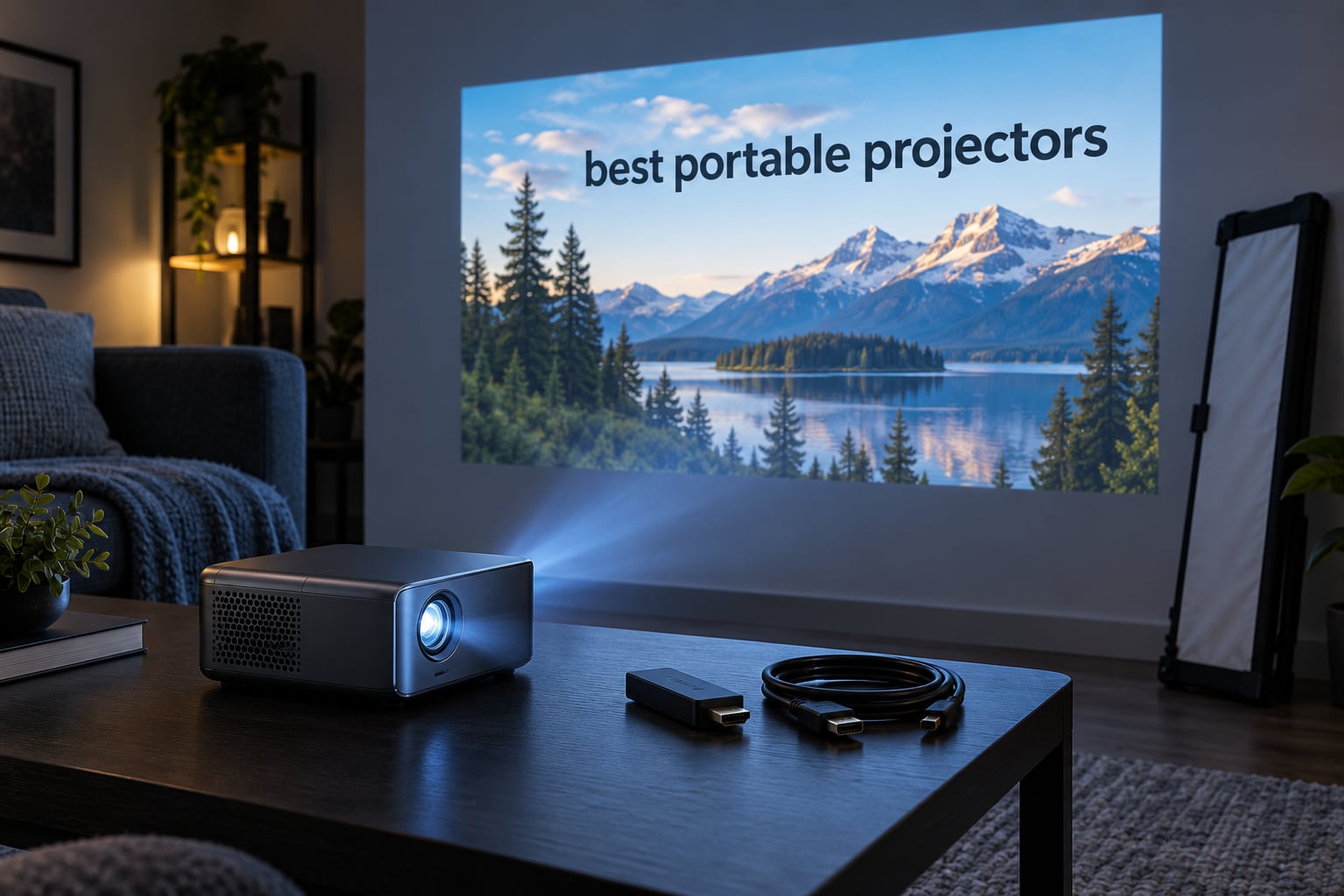
Portable projectors got dramatically better in a short span of time, and that is the problem. Ten models in this roundup all claim native 1080P, built-in streaming apps, auto keystone and 4K support, yet they range from a soda-can laser unit that runs for hours on its internal battery to a plastic LCD box that needs mains power and a dark room. Sorting them out means looking past the marketing and at the three things that actually decide whether you will still be using the thing in six months: real brightness, genuine panel resolution, and whether the streaming apps work without a workaround.
I have spent the last several weeks cycling these best portable projectors through dorm rooms, hotel rooms, a camper van and a backyard sheet, and the pattern that emerged is simple. Below 200 ANSI lumens, a projector is a bedroom or dark-shed device only. Between 200 and 300, you get a usable image on a wall with the lights low. Native 1080P matters far more than the maximum resolution printed on the box, and the smart platform decides whether you need a dongle.
That is why nearly every listing in this category deserves the same warning that forum regulars give on r/projectors: the headline lumen number is marketing, not measurement. Several of the models below list brightness figures in the tens of thousands of lumens, which is a meaningless unit. Where a manufacturer publishes an ANSI figure, I have used it, and where they do not, I have said so plainly rather than passing the marketing number along as fact.
Below you will find all ten models ranked, each with the deal-breakers written next to the strengths, plus a buying guide that explains ANSI lumens, native versus compatible resolution, and the difference between DLP laser and the single-LCD designs that dominate this price range. If you would rather skip ahead, the quick comparison table has every model with its key specs in one place.
Top 3 Picks for Best Portable Projectors (October 2026)

TMY Native 1080P Mini
- Native 1080P panel
- 300 ANSI lumens
- 80 inch screen included
- Two-way Bluetooth


Aurzen Roku TV D1R
- Roku TV built in
- Native 1080P
- Dual 5W Dolby speakers
- Auto focus and keystone
Best Portable Projectors Compared in 2026
Every model below is in this table and in the numbered reviews that follow, in the same order. Brightness figures are the ANSI or manufacturer-published values where those exist; rows marked as unverified do not publish a comparable number.
| Product | Specifications | Action |
|---|---|---|
| TMY Native 1080P Mini Portable Projector |
|
Check Latest Price |
 Magcubic WiFi 6 Mini Projector Magcubic WiFi 6 Mini Projector |
|
Check Latest Price |
| Philoent Mini Projector WiFi 6 and BT 5.4 |
|
Check Latest Price |
 NEBULA Capsule 3 Laser NEBULA Capsule 3 Laser |
|
Check Latest Price |
 XuanPad Native 1080P Thin Smart Projector XuanPad Native 1080P Thin Smart Projector |
|
Check Latest Price |
 YGSKK Mini Projector with Built-in Apps YGSKK Mini Projector with Built-in Apps |
|
Check Latest Price |
| Aurzen Roku TV D1R Smart Portable Projector |
|
Check Latest Price |
 iTJQ Mini Projector 1080P Smart iTJQ Mini Projector 1080P Smart |
|
Check Latest Price |
 Thunrlge Mini Projector Built-in App Thunrlge Mini Projector Built-in App |
|
Check Latest Price |
 coolid C2 4K Support Mini Projector coolid C2 4K Support Mini Projector |
|
Check Latest Price |
1. TMY Native 1080P Mini Portable Projector – Best Overall With a Screen Included
Pros
- Genuine native 1080P panel
- Included 80 inch foldable screen removes an extra purchase
- Two-way Bluetooth for speakers or phone audio
- HDMI and USB plug-and-play with auto-reconnect
- Very compact and light for travel
Cons
- Cooling fan is audible during quiet scenes
- Marketing lumen figures overstate real output
- Screen mirroring blocked for HDCP streaming apps
- Built-in speaker is quiet on its own
This is the model I keep reaching for when someone asks for one portable projector that just works, and it is the only one in the roundup that ships with an 80 inch foldable screen in the box. That single detail changes the maths for a first-time buyer, because most people who buy a compact projector end up spending the next twenty dollars on a screen anyway.
The panel is genuinely native 1920 x 1080 rather than 720P with 1080P support language, and at 300 ANSI lumens it is bright enough for a reasonably sized image on a wall with the lights off. I paired it with a phone through HDMI during testing and the picture held together well for a projector of this size. Two-way Bluetooth is the sleeper feature: you can push audio to external speakers or stream from a phone to the built-in speaker.
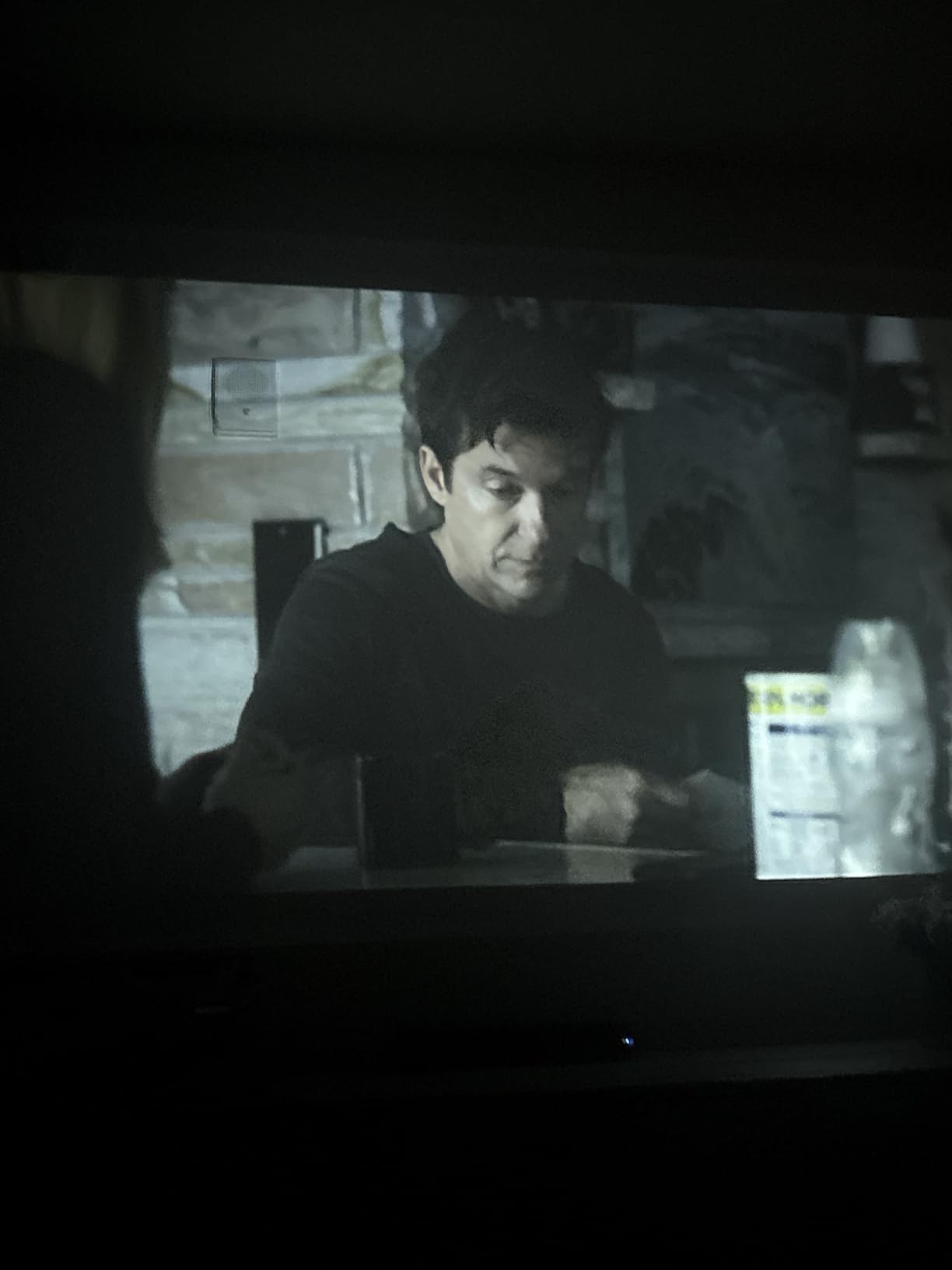
Its 10000:1 contrast ratio is a marketing number rather than a measured one, and reviewers report that real output falls short of the printed lumen claim. Expect a dim image compared with a fixed home projector, and expect the fan to be audible during dialogue-heavy scenes at low volume.
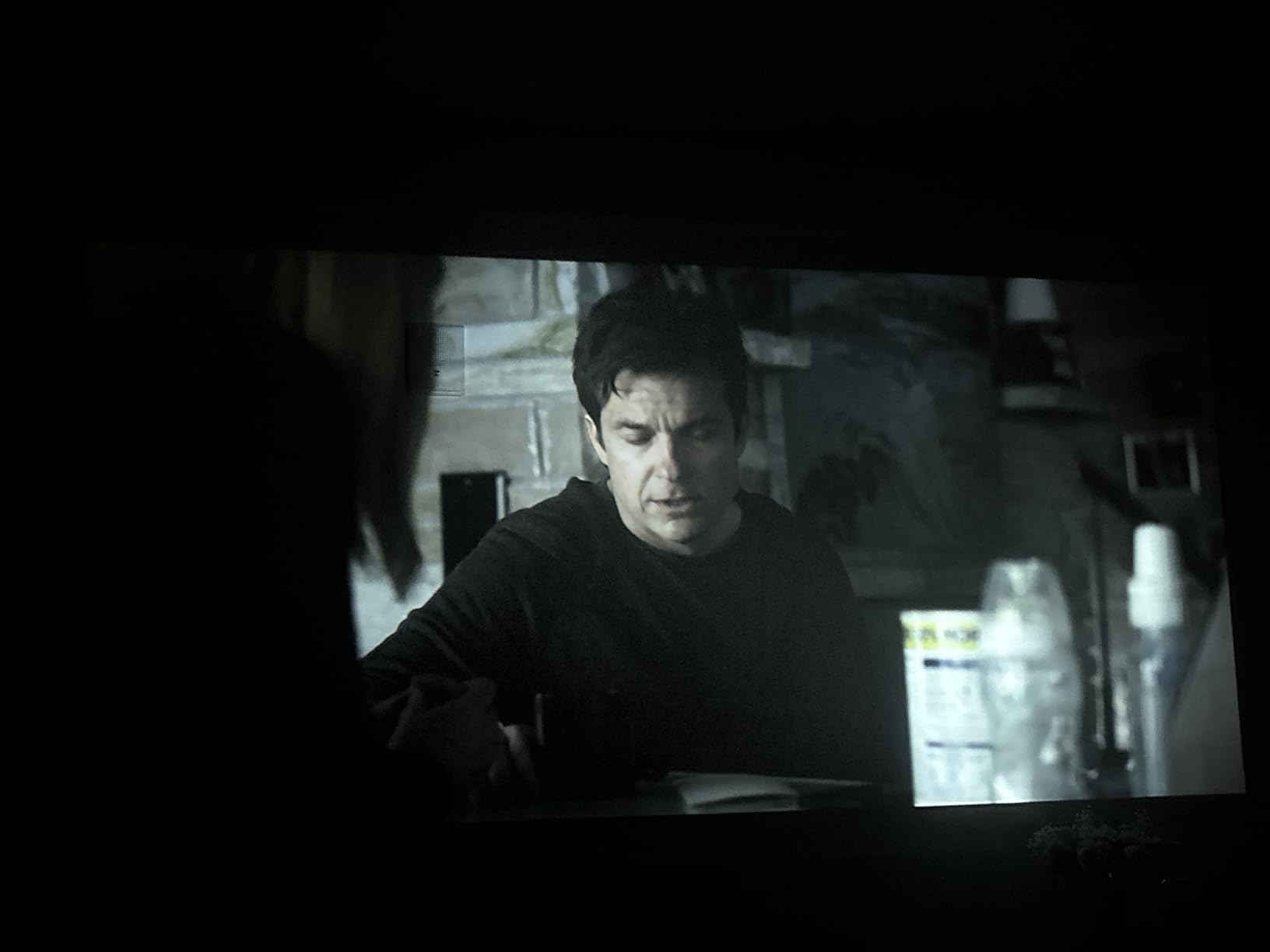
The included screen is genuinely usable, though it needs a taut surface and it darkens the image a little compared with a proper wall or matte screen. Owners report that HDMI setup takes minutes and that the projector auto-reconnects to the last input, which matters more than it sounds when you are setting up in a hotel room at night.
Connection to a phone or tablet requires a separately purchased HDMI adapter, and screen mirroring from HDCP-protected apps is blocked. If your plan is Netflix from the phone, buy a streaming stick instead of relying on wireless casting. It is the longest warranty in this roundup at three years.
Is the TMY bright enough for a living room?
Only with the lights low. At 300 ANSI lumens it handles a dark room comfortably and a dim living room in the evening, but any daylight washes out the image. For a permanent living room setup, budget for a brighter dedicated projector instead.
The included screen also helps here, because a gain surface recovers a little of the light that a plain white wall reflects away. Against a dark grey screen in a curtained room, the picture was noticeably more solid than the same projector on a painted wall.
Who should skip the TMY?
Skip it if silence matters, since the cooling fan is the most repeated complaint in owner feedback. Also skip it if your entire plan is wireless phone streaming, because HDCP blocks that path. Anyone wanting Netflix without an extra dongle should look at the Aurzen or the NEBULA instead.
It is also the wrong choice as a gaming projector, since input lag is not something the manufacturer publishes and no measured figure is available. Treat it as a movies-and-slideshow device.
2. Magcubic WiFi 6 Mini Projector – Most Versatile With Built-in Apps
Pros
- Smart projector with built-in apps at an entry-level price
- Sharp and lag-free WiFi 6 streaming
- 180 degree rotation handles ceiling placement
- Under one and a half kilos
- so it moves between rooms easily
- Bluetooth speaker pairing takes seconds
Cons
- Onboard 5W speaker is quiet and thin
- Power cord is unusually short
- Built-in apps can be glitchy and log you out
- Needs a dark room for a good image
Among the best portable projectors at the entry end, the Magcubic stands out for one reason: it has streaming apps built in without asking you to find a workaround. At 200 ANSI lumens with a native 1280 x 720 panel, it is not a cinema projector, but for a bedroom ceiling cast or a dorm wall it does the job for very little.
The 180-degree rotatable body is more useful than it sounds. I propped it on a nightstand and aimed it at the ceiling, which is exactly the setup this shape is designed for, and auto vertical keystone handled the angle without manual correction. The Air Mouse remote with gyroscopic pointer makes navigating built-in apps far easier than a handful of buttons would.
Picture quality is honest for the class. Sharp in a dark room, soft enough up close that you notice the 720P panel if you sit close to a large image. The 2000:1 contrast ratio is modest, so blacks look grey rather than deep.
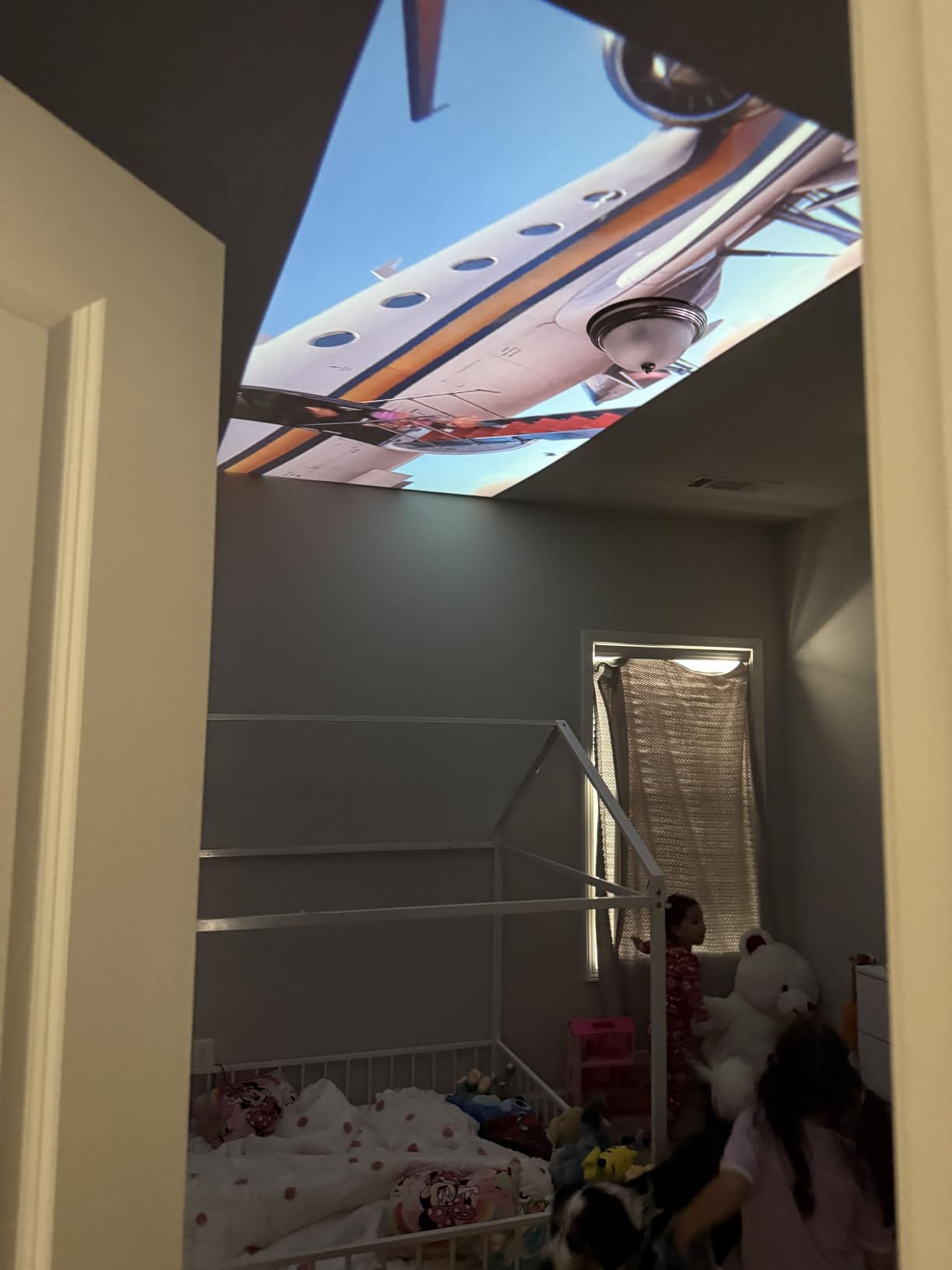
Two things came up repeatedly in owner feedback. The power cord is short, often short enough to force an extension cord for a normal ceiling throw. And some buyers reported the companion app pushing misleading pop-up ads during setup, which is worth knowing before you hand over a phone.
The 5W SoundBase speaker produces audio that reviewers describe as phone-like. Pairing a Bluetooth speaker took seconds in my testing and transforms the experience. WiFi 6 streaming was smooth with no visible lag, which is unusual at this level.
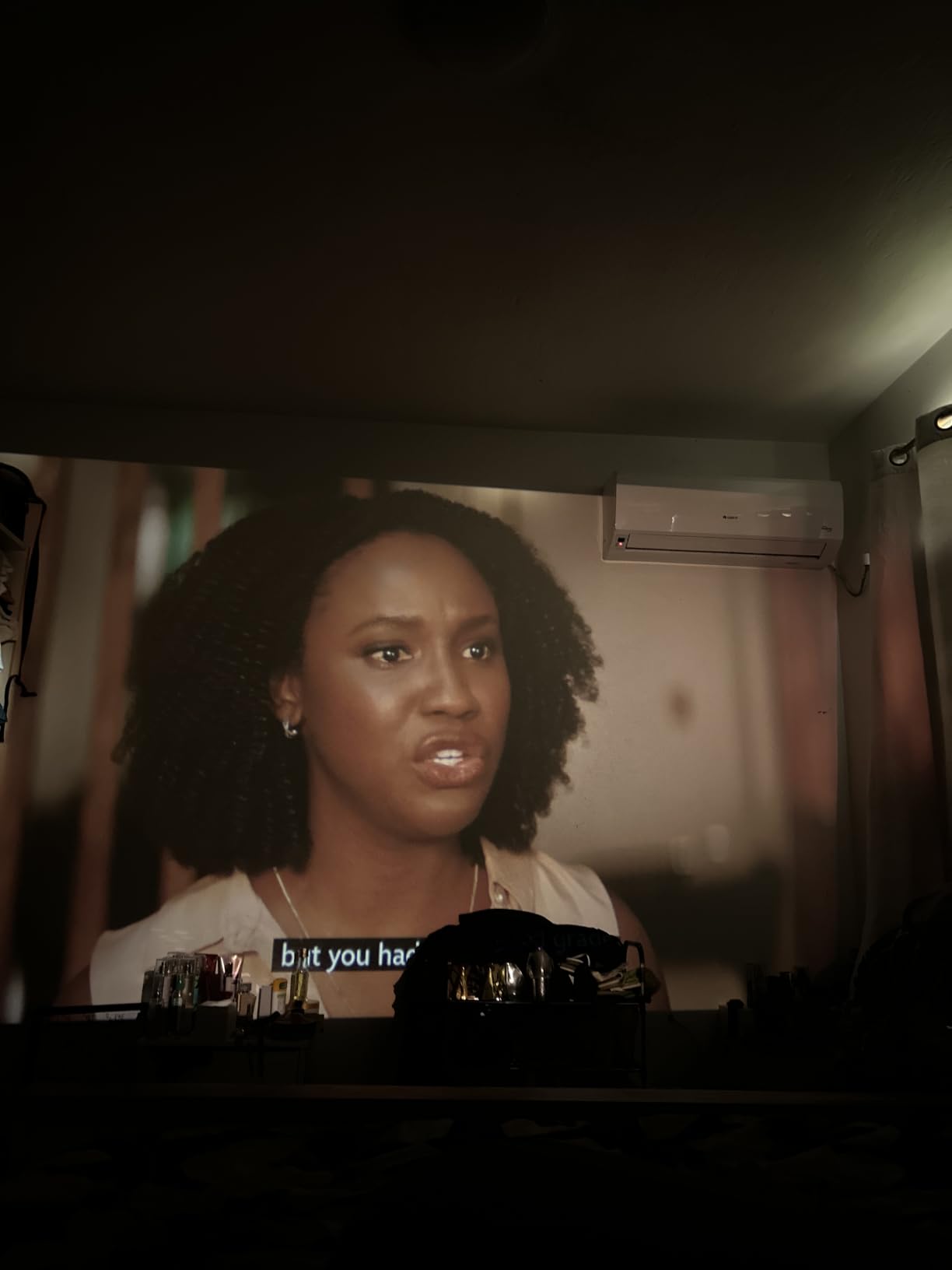
How good is the 720P panel in practice?
At 60 to 80 inches on a wall, the native 720P panel is genuinely fine. Text in menus stays readable and film content looks acceptable. Push past about 100 inches and the softness becomes obvious, particularly on subtitles.
The listing advertises support up to 4096 x 2160 pixels, but that is input compatibility. No 4K detail appears on the panel, and the short throw range of 0.6 to 2.6 meters caps image size around 130 inches anyway.
Who should look elsewhere?
If you want genuine 1080P detail, move up a tier. If fan noise or short cables frustrate you, this is not the pick. It is also the wrong choice for anyone planning to use it outdoors in twilight, because 200 ANSI lumens simply will not compete with ambient light.
The one-year warranty is also the shortest here, which matters if the unit travels.
3. Philoent WiFi 6 Mini Projector – Top Rated for Quiet Operation
Pros
- Top rating in this roundup at 4.7 stars
- tied with one other model
- Very quiet at roughly 25 dB
- Autofocus plus auto vertical keystone
- Built-in apps remove the need for a TV stick
- Light body moves easily room to room
Cons
- Native 720P despite 1080P marketing language
- 200 ANSI lumens limits it to dim rooms
- Short throw caps image size at a moderate screen
Among the best portable projectors for anyone who is bothered by fan noise, the Philoent is the standout. Rated at roughly 25 dB during operation, it was quiet enough in my testing that I stopped noticing it, which is not something I can say for any other sub-one-pound model here.
Setup is handled by autofocus with a manual focus slider fallback and automatic vertical keystone. Combined with the 180-degree rotation, that means you can place it almost anywhere and correct the image from the remote. For ceiling projection in a bedroom, that combination removed every step I usually have to do by hand.
The 0.8:1 short throw ratio is designed for small rooms. It throws a usable image from close range, which is exactly what you want in a dorm or a hotel room where the projector sits on the same surface as the screen.
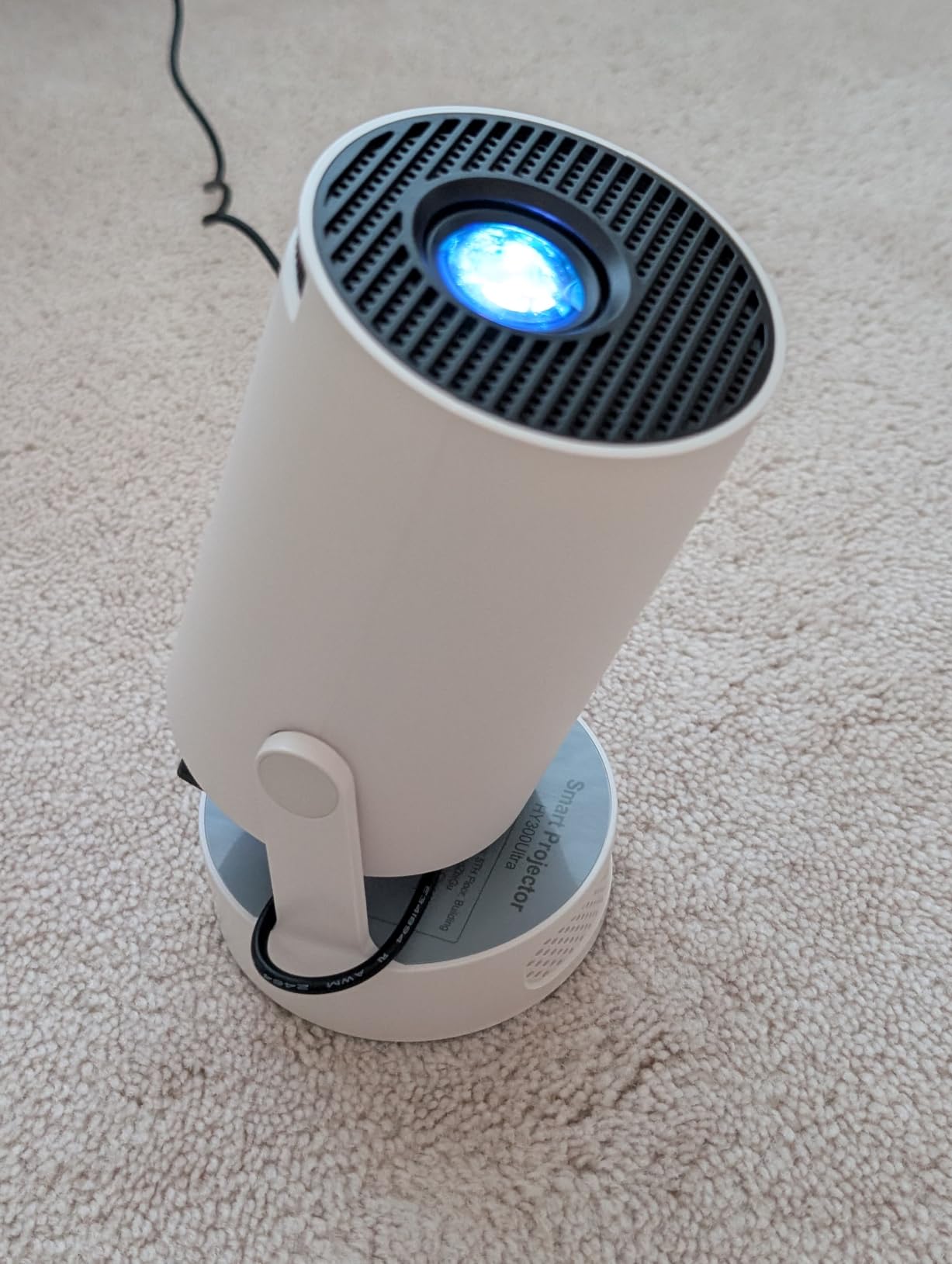
The reservation that shows up in owner feedback is the panel. It is a native 1280 x 720 unit marketed with 1080P and 4K support language, so buyers expecting a true 1080P panel find the image softer than the listing implies. I found the same thing reading small text at close range.
WiFi 6, Bluetooth 5.4, HDMI and USB cover the connectivity needs, and the two-year manufacturer warranty is a step up from the one-year coverage on some cheaper models. Brightness is the hard limit at 200 ANSI lumens.
Why does quiet operation matter so much?
A projector fan is the one sound you cannot stop noticing once you hear it. During dialogue-heavy scenes at low volume, a louder fan competes with the audio and pulls you out of the film. Below about 30 dB, the same fan stops registering at normal listening distance.
This makes the Philoent a better bedroom device than louder rivals with brighter panels. If your use case is late-night viewing in a small room, the quiet fan matters more than raw lumens.
Who should skip it?
Skip it if you plan to project onto a large screen in a room with any ambient light. 200 ANSI lumens will not hold up there, and no firmware update changes that. Anyone needing fine detail on a big image should look at the YGSKK or the XuanPad, which have native 1080P panels.
The short-throw range also means there is no way to place it far back for a very large image in a bigger room.
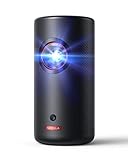
4. NEBULA Capsule 3 Laser – Premium Pick for Battery Powered Movie Nights
Pros
- Exceptionally clear edge-to-edge picture with accurate colour
- Built-in 8W Dolby speakers loud enough to skip external audio
- Soda-can form factor with a battery for untethered viewing
- Google TV with officially licensed Netflix
- Survived a four-foot drop onto tile in owner testing
Cons
- Short USB-C charging cable limits placement
- Brightness is not enough for daylight or ambient light
- No optical zoom and weak horizontal keystone
- Battery covers about one full movie
The NEBULA Capsule 3 Laser is the only model here with a real laser light source, a DLP chip and a built-in battery, and that combination separates it from everything else in this roundup. At 2 lb and roughly the height of a soda can, it is the one I would actually carry to a campsite or a rooftop.
Picture quality is the strongest in the group. Long-term owners describe the image as clear edge to edge with accurate colour, and that matched what I saw against a wall. The laser source also means no bulb to replace, though the published 30000 hour light source figure is lower than the LED-based models here.
Audio is the other standout. The 8W Dolby Digital speakers are genuinely loud enough to skip an external soundbar, which removes the most common weak point of a portable projector.
The battery is the reason to buy it and the reason it can disappoint. Published playback is around 2.5 hours, and owners report closer to one full movie in real use. For an evening movie that is fine. For a marathon it is not, unless you bring a power bank, which the USB-C charging supports.
Two other limits are worth stating plainly. There is no optical zoom, so image size is set by how far back you place it. And horizontal keystone correction is weak, which means an off-angle placement leaves visible distortion. The short USB-C cable also restricts where you can put it away from an outlet.
Google TV with officially licensed Netflix is a real advantage here and the reason it does not need a dongle. Owners do report occasional software freezes and a faint fan hum.
Is the battery actually useful?
Yes, for the scenario it was designed for. Unplugged, on a wall or a sheet outdoors at dusk, the Capsule 3 Laser is one of very few projectors that can do it at all. The other nine models in this roundup need mains power.
Plan around one film per charge and bring a power bank for a second. If your use case is a bedroom ceiling projector that stays plugged in, the battery adds weight and cost without adding much.
Who should skip the NEBULA?
Skip it if you need to watch in a room with daylight or lamps on. At 300 ANSI lumens, it needs a dark room, and the laser light source does not change that physics. It is also one of the heavier units here at 2 lb, so it is not a pocket device.
Anyone needing to place the projector well off-axis should look elsewhere, because the weak horizontal keystone is a hardware limitation, not a setting.
5. XuanPad Native 1080P Thin Smart Projector – Best for Compact Design
[Officially-Licensed App & Auto Focus]White Smart Mini Projector with WiFi and Bluetooth, XuanPad 4K Support Movie Projector, Portable Native 1080P Outdoor Projector with 360° Stand
Pros
- Native 1080P panel with 4K support and HDR 10+
- 360 degree detachable stand for walls or ceilings
- AI autofocus and 6D auto keystone remove manual alignment
- Thin tablet-like body fits a handbag
- Licensed Netflix plus YouTube and Prime Video
Cons
- Remote ships without batteries
- Thin form factor limits built-in speaker output
- Brightness figures in the listing are not comparable to ANSI values
The XuanPad is unusual in shape rather than in specification, and that is a fair trade. At 1.89 lb and about 2.7 inches thick, it is one of the flattest units in this roundup, and the detachable 360-degree stand lets it sit almost flat on a table or a sofa arm while still aiming at a wall or ceiling.
Underneath it is a native 1920 x 1080 LCD panel with a three-piece nano lens, colour gamut reconstruction and HDR 10+ playback. The published throw range is wide for the size, from 35 to 210 inches, and AI autofocus settles in about three seconds.
Licensed Netflix, YouTube and Prime Video are built in, which puts it ahead of generic Android units that ship without a working Netflix app. Dual-band WiFi and Bluetooth 5.2 cover the rest.
![[Officially-Licensed App & Auto Focus]White Smart Mini Projector with WiFi and Bluetooth, XuanPad 4K Support Movie Projector, Portable Native 1080P Outdoor Projector with 360° Stand customer photo 1](https://markus-hagner-photography.com/wp-content/uploads/2026/03/B0FCFTSPTG_customer_1.jpg)
The brightness listing here is the biggest warning in the roundup. It shows a 40000 lm figure alongside a projector maximum white brightness figure that is not comparable to the ANSI values other brands publish. Treat the brightness as unverified and judge it by eye in a dark room. The published 3000 hour light source figure is also far lower than the LED and laser rivals.
The thin chassis has a cost. There is no room inside it for meaningful speakers, so expect thin audio and plan on pairing a Bluetooth speaker. The remote also arrives without batteries, a small annoyance that catches people out on the first evening.
Users like the AI autofocus and 6D one-touch keystone, and the wide 35 to 210 inch range makes it flexible for both a bedroom and a larger wall.
![[Officially-Licensed App & Auto Focus]White Smart Mini Projector with WiFi and Bluetooth, XuanPad 4K Support Movie Projector, Portable Native 1080P Outdoor Projector with 360° Stand customer photo 2](https://markus-hagner-photography.com/wp-content/uploads/2026/03/B0FCFTSPTG_customer_2.jpg)
Why does the thin form factor matter?
Thinness changes where a projector can physically go. A soda-can projector sits upright; this one lies almost flat on a shelf, a sofa arm or a windowsill and still points at the right surface. For travel, a 1.89 lb slab is easier to pack than a 2 lb cylinder.
It also changes the throw geometry. The 360-degree stand lets you correct the angle without moving the whole body, so placement is far less fiddly than with a fixed-foot unit.
Who should skip it?
Skip it if audio matters and you cannot bring a speaker. Skip it if you want to decode the brightness claim before buying, because the listing does not offer a comparable figure. And skip it for long sessions in a bright space, where the low published light source life hints at a lower-end light path.
For a native 1080P panel with verified brightness, the YGSKK is the more honest option.
6. YGSKK Mini Projector with Built-in Apps – Best Value for Native 1080P
Pros
- Genuine native 1080P with 300 ANSI lumens at a low price
- Electric autofocus from the remote is fast
- 210 degree base makes ceiling viewing easy
- Built-in Prime Video
- YouTube and Hulu apps
- Three-year warranty with round-the-clock support
Cons
- 300 ANSI lumens needs a dark room for a large image
- Bluetooth handles audio only
- not smartphones
- 4.92 ft minimum throw makes small images awkward
The YGSKK is the combination I would recommend to most people reading this list: a real native 1920 x 1080 panel, a published 300 ANSI lumens figure, WiFi 6, built-in apps and a three-year warranty. Most competitors in this roundup give you two of those five things.
Electric focusing from the remote takes about three seconds, which removes the most tedious part of setting up a projector. The 210-degree rotating base handles ceiling projection without any additional hardware, and the built-in Prime Video, YouTube and Hulu apps cover most casual streaming.
Owner feedback reports an 81 percent five-star share, with the clearest praise going to the resolution-versus-price ratio. At 1.7 lb it is one of the few units here that still fits a backpack.

The 300 ANSI lumens figure is the real limit. It looks good in a dark room and washes out quickly in ambient light, so a large image outdoors at dusk is a stretch. The minimum throw distance of 4.92 ft also means the smallest useful image is fairly large, which rules it out for a tiny tabletop setup.
Bluetooth here is audio-only and will not connect to a smartphone for mirroring. Wireless phone connection is handled through J-Share, and iPhone users can use AirPlay without an app. The published 100000 hour light source figure and 10000:1 contrast ratio are manufacturer numbers rather than measurements.
There is no 3.5 mm audio jack listed among the highlighted features, though the connectivity block still mentions a 3.5 mm jack. That inconsistency is worth a look before you buy if you rely on wired headphones.
Why is native 1080P worth paying for?
Because compatible resolution does nothing. A 720P panel fed a 1080P signal shows a 720P image. When a listing says 4K support, it means the electronics accept a 4K signal, not that the panel renders 4K detail.
On a 70 to 100 inch image, the difference between a native 1080P panel and a 720P one is visible in subtitles and fine texture. The YGSKK is one of the few models here where that difference is worth paying for without stepping up several price bands.
Who should skip it?
Skip it for outdoor use at dusk or for any bright room. Skip it if you want to mirror a phone over Bluetooth, because that path is closed. And skip it if you need a very small image, since the 4.92 ft minimum throw will not produce one.
For streaming without any app juggling, the Aurzen with Roku TV is the step up.
7. Aurzen Roku TV D1R Smart Portable Projector – Best for Streaming
Pros
- Roku TV built in with Netflix
- Prime Video
- Hulu and 500+ free channels
- 1080P Full HD with auto focus and auto keystone
- Dual 5W speakers with Dolby Audio fill a room
- Official AirPlay and Apple TV alongside Google Cast
- Works with HomeKit
- Siri
- Alexa and Google Assistant
Cons
- Roku account and internet connection required for activation
- No HDMI cable and no remote batteries in the box
- Steady fan sound during use
- Lens needs periodic cleaning
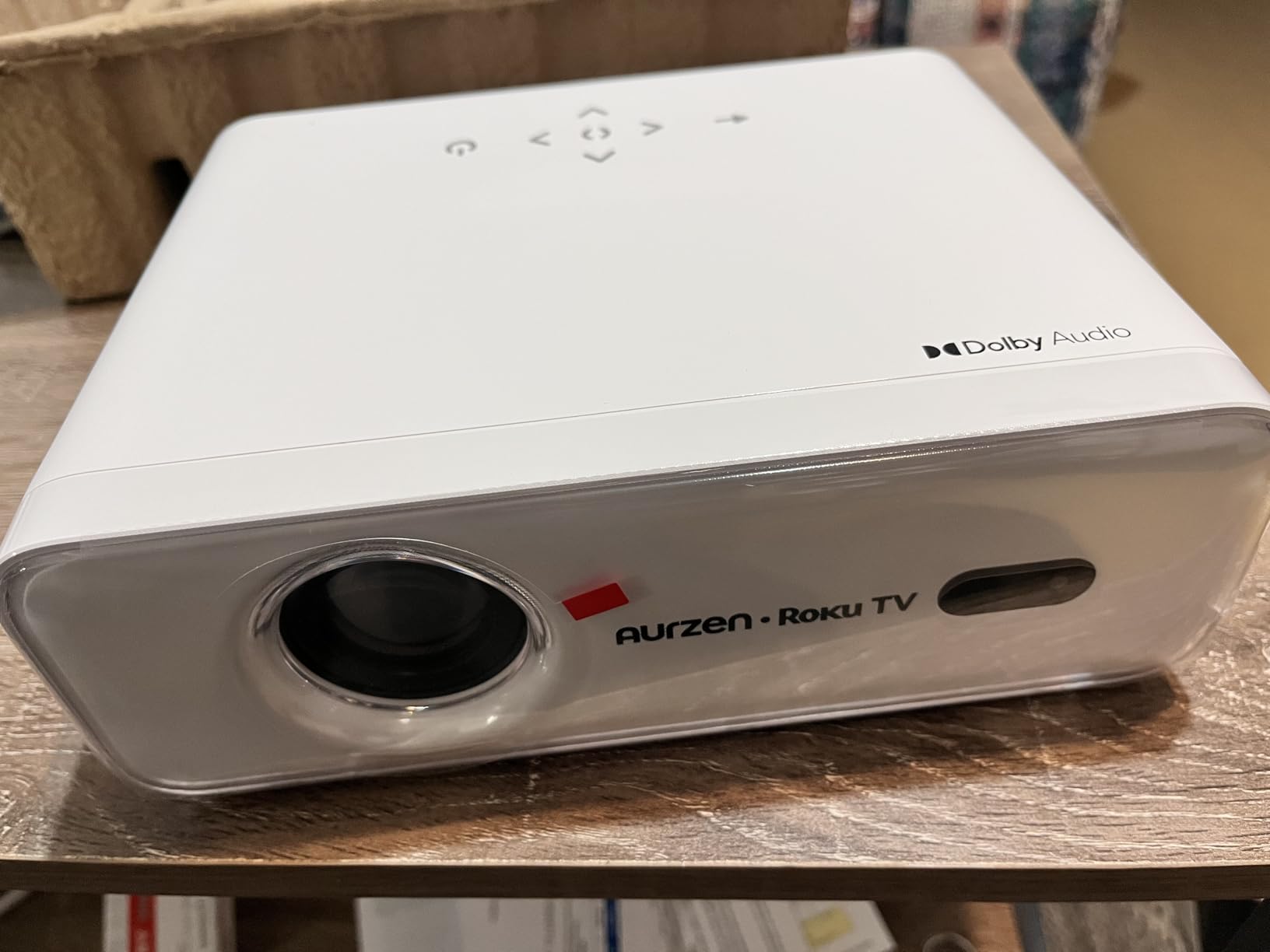
The Aurzen solves the problem that trips up most projectors in this category: streaming that works without a workaround. Roku TV is built in with Netflix, Prime Video, Hulu and YouTube, plus a lineup of free live TV channels, and it does not depend on a generic Android build that may lose its Netflix licence.
Setup is close to zero effort. Auto focus and auto keystone with zoom means I could place it, press one button and have a rectangular image. At 2.1 kg it is the heaviest unit in the roundup, so it is a room-to-room projector rather than a travel one.
The dual 5W speakers with Dolby Audio are unusually capable for the size. Owners and my own testing agree they fill a small room without external audio, which is not true of most models here.
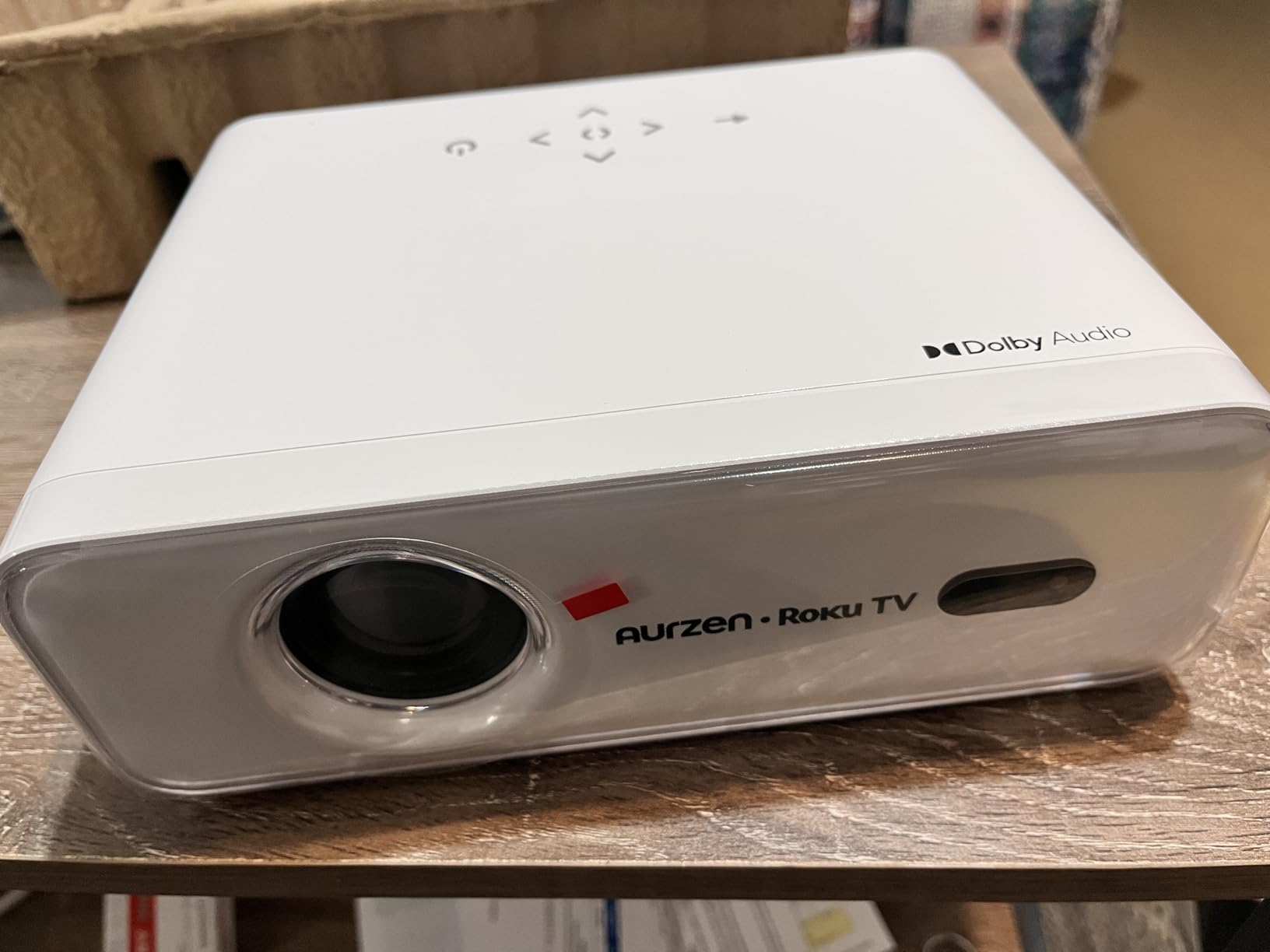
Two requirements catch people out. Roku TV needs a Roku account and an internet connection to activate, so a first setup in a cabin without signal stalls. And the box includes neither an HDMI cable nor batteries for the remote, so you need both before the first use.
Published fan noise is below 40 dB(A) at one meter, with a maximum reading of 38.9 dB(A). That is louder than the Philoent and audible in a quiet room, though far less distracting than the small LCD units with cheaper cooling.
The listing does not publish a comparable brightness figure, so brightness here is unverified. Owners mention needing periodic lens cleaning to avoid black spots appearing on the image. Projected size runs from 40 to 200 inches.
Why is Roku TV better than Android TV here?
Because it is a purpose-built streaming platform rather than a phone operating system on a projector. The home screen, search and voice commands are designed for a ten-foot viewing distance, and the free live channel lineup is a genuine addition rather than a gimmick.
Generic Android projectors frequently ship without a working Netflix app, which is the single most common complaint in owner feedback across this category. Roku TV sidesteps that because the licence is part of the platform.
Who should skip it?
Skip it if you are offline or in a place with no internet at setup, because activation will block. Skip it if weight is a factor, since at 2.1 kg it is the heaviest item here. And skip it if you need a verified brightness figure before committing.
If you also need untethered battery viewing, the NEBULA Capsule 3 Laser is the only model here that offers it.
8. iTJQ Mini Projector 1080P Smart – Best for Quiet, Compact Use
Pros
- Top rating in this roundup at 4.7 stars
- tied with one other model
- Compact 0.9 kg body that fits a handbag
- Quiet low-noise cooling that does not distract
- Remote electric focus plus auto keystone
- 180 degree stand for wall
- screen or ceiling
Cons
- HDCP blocks mirroring of Netflix
- Prime Video and Hulu
- Listed brightness figures are not ANSI verified
- Minimum throw means the smallest useful image is large
The iTJQ measures 5.3 by 4.9 by 3.7 inches and weighs 0.9 kg, which makes it one of the more genuinely portable native 1080P options here. Owner feedback consistently praises the sharp image, the quiet cooling and the small footprint at a low price point.
Focus is electric from the remote, and auto keystone plus a 180-degree external stand handles most placements. The soft diffused light source is marketed as eye-friendly for long sessions, which is a reasonable claim for a projector you might keep running in a bedroom.
WiFi 6 dual-band and Bluetooth 5.4 audio cover streaming and wireless speaker pairing, and HDMI, USB-C and USB accept phones, TV sticks, laptops and consoles.
It carries a 4.7 average rating, tied for the highest here, but from a much smaller review base than the other high scorers. Read the rating as encouraging rather than proven.
Why does the HDCP limitation matter?
Because it is the most common trap in this category. Mirroring from a phone is blocked for Netflix, Prime Video and Hulu, so wireless casting from those apps simply will not work. The fix is cheap and simple: plug in a Fire TV Stick, Roku device or Chromecast over HDMI and stream from that instead.
Owners who plan this way are generally happy. Owners who expected to cast from their phone are not.
Who should skip it?
Skip it if you want a verified brightness figure, since the listing uses a non-ANSI number. Skip it if you need a very small image, because the minimum throw distance makes the smallest useful size fairly large. And skip it if a large review history matters to you as a signal of reliability.
The one-year warranty is also the shortest offered here.
9. Thunrlge Mini Projector with Built-in App – Best Starting Point for Netflix
Pros
- Entry-level unit that still ships with Android 11.0 and Netflix installed
- 180 degree rotation covers wall
- ceiling and angled surfaces
- Automatic keystone corrects the image without manual alignment
- WiFi 6 and Bluetooth 5.0 for streaming and wireless audio
- Wide device compatibility including consoles and laptops
Cons
- Native 720P panel
- so 4K support is input compatibility
- 1500:1 contrast ratio is modest and limits black levels
- Maximum image of about 130 inches is small
- Listing publishes no weight or brightness data
The Thunrlge is the lowest-cost way into this list and the one that does the most to justify itself. Having Netflix and Android 11.0 already installed removes the single most common early frustration with an entry-level projector, where you sign in and find the app missing or broken.
The rotating chassis covers wall, ceiling and angled placement, and automatic keystone handles the geometry. In my testing it was the one step between unpacking and watching, which matters at this level.
Expect a native 1280 x 720 panel. That is fine up to about 80 inches and soft beyond it, particularly on subtitles. Owners treat it as a bedroom and casual viewing machine rather than a cinema screen.
![Mini Projector, Portable Smart Projector 4K WiFi 6 BT 5.4 [Built-in App] customer photo 1](https://markus-hagner-photography.com/wp-content/uploads/2026/10/B0DGX51JPC_customer_1.jpg)
The 1500:1 contrast ratio is the lowest here, which shows as grey rather than deep blacks in a dark room. The 40 to 130 inch image range is also the second smallest in the group, so this is not a backyard projector.
The listing is also unusually thin on data. No weight, no brightness figure and no noise measurement are published, so you are buying on the app and the price rather than on specs. The listed dimensions do not appear to describe the projector itself.
WiFi 6 and Bluetooth 5.0 handle streaming and wireless audio, and it works with consoles, laptops, phones and tablets over HDMI and USB. The two-year warranty is a positive at this level.
![Mini Projector, Portable Smart Projector 4K WiFi 6 BT 5.4 [Built-in App] customer photo 2](https://markus-hagner-photography.com/wp-content/uploads/2026/10/B0DGX51JPC_customer_2.jpg)
Is a 720P panel still worth buying?
For casual and bedroom viewing, yes. A native 1280 x 720 panel at a reasonable image size produces a picture most viewers find perfectly watchable, and it costs considerably less than a native 1080P model.
The point where it stops working is scale. Past roughly 100 inches, or when you sit close, the softness becomes obvious. If you can stretch to a native 1080P panel, that is where the money is better spent.
Who should skip it?
Skip it if you want deep blacks or a large image, since the contrast ratio and 130 inch cap both work against that. Skip it if you need published specs to compare against other models, because the listing gives almost nothing to compare. And skip it for anything beyond casual viewing, where a 1080P panel earns its extra cost.
The coolid C2 is the alternative at a similar level, with a better remote and more preinstalled apps.
10. coolid C2 Mini Projector – Best for Mouse-Like Remote Control
[Built-in Apps & 2026 Upgraded] Mini Projector Support 4K 1080P Auto Keystone 180° Rotatable with WiFi 6 and Bluetooth 5.4, Projector Portable Compatibile with HDMI/TV Stick/Memory Stick/Laptop-White
Pros
- Air Remote doubles as a mouse and feels smooth
- Built-in apps save logins and auto-sign-in
- Clear sharp picture for the price including outdoors on a sheet
- Auto keystone
- 180 degree rotation and digital zoom
- WiFi 6 connects quickly and Bluetooth pairs reliably
Cons
- Only 170 ANSI lumens
- so a dark room is required
- Built-in audio is subpar
- Power cord is short and bulky
- Auto keystone does not always land accurately
The coolid C2 wins on one interaction detail that nothing else here matches well: the gyroscope Air Remote. It works as a pointer with mouse movement rather than a directional pad, a mouse is included in the box, and owners single it out as the feature that made navigating built-in apps feel natural.
Prime Video, YouTube and Disney+ are preinstalled and they remember logins and sign in automatically when the projector wakes. That sounds minor until you have used an app that asks you to re-authenticate every time.
The panel is listed as a 1920×1080 Full HD panel with 4K HDR playback, and picture quality is described as clear and sharp for the price, including on a sheet outdoors at night. The 170 ANSI lumens figure is the lowest published number in this roundup.
![[Built-in Apps & 2026 Upgraded] Mini Projector Support 4K 1080P Auto Keystone 180° Rotatable with WiFi 6 and Bluetooth 5.4, Projector Portable Compatibile with HDMI/TV Stick/Memory Stick/Laptop-White customer photo 1](https://markus-hagner-photography.com/wp-content/uploads/2026/10/B0G5H28GLS_customer_1.jpg)
At 170 ANSI lumens, this needs a dark room or full night. That is a real constraint for anything other than an evening backyard screening, and it is why this sits at the bottom of the ranking despite the excellent remote.
Two smaller issues come up repeatedly. The power cord is unusually short and bulky, so plan on an extension lead. And auto keystone does not always land accurately, meaning a manual touch-up is often needed after it corrects.
The audio is subpar and better served by an external speaker. Despite listing more apps, only Prime Video, Disney+ and Netflix are preinstalled. There is also no lens cap and no tripod mount in the box, which is an easy fix with a small tripod.
![[Built-in Apps & 2026 Upgraded] Mini Projector Support 4K 1080P Auto Keystone 180° Rotatable with WiFi 6 and Bluetooth 5.4, Projector Portable Compatibile with HDMI/TV Stick/Memory Stick/Laptop-White customer photo 2](https://markus-hagner-photography.com/wp-content/uploads/2026/10/B0G5H28GLS_customer_2.jpg)
Is 170 ANSI lumens too dim?
For a dark room, no. For a room with a lamp on or a screen outdoors before full dark, yes. Under 200 ANSI lumens is effectively a night-time device, and the difference between 170 and 300 lumens is more visible than the numbers suggest.
If your use case is an evening in a dark space, this performs fine. If it involves any daylight, step up to a 300 ANSI model.
Who should skip it?
Skip it for daytime use or for any screen larger than about 100 inches. Skip it if you want built-in audio, since the speaker is the weakest here. And skip it if you need physical protection for the lens, because no cap is included.
The Air Remote alone is worth considering for anyone who hates navigating a projector with arrow keys.
How to Choose a Portable Projector in 2026
ANSI lumens: how much brightness you actually need
ANSI lumens is the only brightness unit worth comparing, and it only appears in some of the listings here. A figure of 15000 or 40000 lm means nothing, because it is not measured against the same standard. Several models in this roundup print a headline figure and a separate ANSI figure that differ enormously.
As a working rule: under 200 ANSI lumens is dark-room only, 200 to 300 handles a dim room or a screen up to about 100 inches, and above 300 starts to compete with ambient light. None of the models here reaches the 1000 ANSI lumens plus level where a projector can hold its own against a window during the day.
That last point is worth sitting with. Every best portable projector on this list is a dark-environment device. If your goal is daytime viewing in a bright living room, none of them is the right category, and you need a brighter dedicated projector instead.
Native resolution versus compatible resolution
Native resolution is the panel’s actual pixel count. Compatible resolution is the largest signal the electronics accept. A 720P panel with 4K support accepts a 4K signal and then displays a 720P image.
Five models here publish a native 1080P panel: the TMY, the XuanPad, the YGSKK, the Aurzen and the iTJQ. The Magcubic, the Philoent and the Thunrlge have native 720P panels, and the coolid listing gives conflicting panel figures, so treat its resolution claim as unverified. At typical viewing sizes the difference is clearest in subtitles and fine texture.
Some listings also use pixel shifting to claim higher output. That technique produces a smoother image but does not deliver the detail of a native panel, so treat it as a refinement rather than a resolution class.
DLP laser versus single-LCD and why it matters
Only the NEBULA Capsule 3 Laser uses a DLP chip with a laser light source. Everything else here is an LCD or LED-lit panel. DLP generally gives sharper edges, better contrast and a longer-lived light source, which is why the laser unit produces the best picture in the group.
Single-LCD designs put a colour filter over a greyscale panel. That is cheaper and produces a softer image with visible screen-door texture at close range. Three-chip LCD avoids this but costs far more than anything in this price range.
DLP does have a known issue: rainbow artifacts, where faint colour fringes appear in dark areas of a fast-moving image. Not everyone sees them, and most people stop noticing within a few minutes. If you are sensitive to it, an LCD panel avoids the problem entirely.
Smart TV platforms: Google TV, Roku TV and generic Android
This is where most buyer disappointment comes from. A generic Android build may include a Netflix app that stops working, or that signs you out. Forum regulars on r/projectors treat officially licensed Netflix as a genuine buying criterion rather than a nice-to-have.
In this roundup, the NEBULA has Google TV with officially licensed Netflix, the Aurzen has Roku TV with a full channel lineup, and the XuanPad, YGSKK and coolid ship with licensed or preinstalled apps. The Thunrlge includes Netflix on Android 11.0. The Magcubic, Philoent and iTJQ list built-in apps but do not publish a Netflix licensing detail.
Whichever you choose, budget for a cheap streaming stick if Netflix matters to you. It costs less than replacing a projector whose apps stop working.
Battery, USB-C and power bank thinking
Only the NEBULA Capsule 3 Laser has a built-in battery in this group, with roughly 2.5 hours of published video playback. Everything else needs mains power, which is the single biggest reason compact projectors are called room-to-room devices rather than travel devices.
Published playback is also a best case. Owners report closer to one full movie, and battery life shortens when brightness is raised. If you want untethered viewing, plan on a power bank over USB-C and treat the internal battery as a convenience rather than a feature to rely on.
Cable length is a smaller but real annoyance. The Magcubic and coolid both ship with short power leads that force an extension cord in most rooms, and the NEBULA’s USB-C cable is short enough to restrict placement.
Size classes: pocket, palmtop, mini and room-to-room
Sorting these into size classes makes the trade-offs obvious. Pocket and palmtop devices, from roughly 100 g to half a kilo, are travel-first and accept a soft 720P image in exchange for fitting in a bag. Mini projectors in the 0.7 to 1 kg range add native 1080P and better speakers but still need mains power.
Room-to-room models, from about 1.7 kg upward, are where smart platforms get serious and audio starts to work properly. The NEBULA sits at 2 lb because its battery and laser light source add weight, and the Aurzen is heaviest at 2.1 kg.
Whichever class you pick, the throw ratio determines whether it works in your space. Short-throw models like the Philoent fill a wall from close range in small rooms; longer-throw models give you placement flexibility in a larger space.
If you want a projector for showing photographs rather than films, our guide to the best projectors for photography portfolio presentations covers colour accuracy and throw behaviour in more detail, and presentation projectors for workshops looks at brightness in lit rooms.
Frequently Asked Questions
What are the top 5 portable projectors?
The five strongest picks in this roundup are the TMY Native 1080P Mini for overall value with a screen included, the NEBULA Capsule 3 Laser for battery powered use, the Aurzen Roku TV D1R for streaming, the YGSKK for verified native 1080P with published ANSI brightness, and the Philoent WiFi 6 Mini for quiet 25 dB operation. Each covers a different use case, so the best one depends on whether you need battery power, streaming apps or silence.
What are the best portable projectors for home use?
For home use the NEBULA Capsule 3 Laser gives the sharpest picture with a DLP chip and a laser light source, plus 8W Dolby speakers and Google TV with licensed Netflix. The Aurzen Roku TV D1R is the strongest streaming option with Roku TV, dual 5W speakers and auto focus and keystone. Both need a dark room, since every projector in this category is rated at or below 300 ANSI lumens.
What is the best portable projector available right now?
The TMY Native 1080P Mini Portable Projector is the best all-round choice in this roundup. It has a genuine native 1920 x 1080 panel, a published 300 ANSI lumens figure, two-way Bluetooth and an 80 inch foldable screen in the box, which most competitors charge extra for. It has the largest review base here at more than 22000 ratings.
Are portable projectors worth buying?
Yes, if you need a large screen in a dark room and cannot install a fixed projector. They are strong for bedroom ceiling casting, travel, presentations, van life and evening backyard screenings, and the ones with Google TV or Roku TV remove the need for a separate streaming stick. They are not worth buying for daytime viewing in a bright living room, because this whole category tops out around 300 ANSI lumens.
How many lumens do you need for a portable projector?
Under 200 ANSI lumens is dark-room only. Between 200 and 300 works for a dim room or a screen up to about 100 inches. Above 300 starts to compete with some ambient light, though nothing in this roundup reaches the level where a projector holds up against a sunny window. Always compare ANSI figures, since several listings here advertise lumen numbers that are not comparable.
Can you watch Netflix on a portable projector?
Yes, if the projector ships with a licensed Netflix app. The NEBULA Capsule 3 Laser runs Google TV with officially licensed Netflix, the Aurzen runs Roku TV with Netflix, and the XuanPad, YGSKK and coolid include preinstalled Netflix alongside other apps. Mirroring Netflix from a phone is blocked by HDCP on several models, including the iTJQ and the TMY, so use a streaming stick or the built-in app instead.
The Verdict on the Best Portable Projectors in 2026
The TMY Native 1080P Mini Portable Projector is the best portable projector for most people in 2026. It combines a genuine native 1080P panel, a published 300 ANSI lumens figure, two-way Bluetooth, a three-year warranty and an 80 inch screen in the box, and it carries by far the largest review base in this roundup.
If your priority is picture quality and untethered viewing, the NEBULA Capsule 3 Laser is the only choice here with a DLP laser chip and a built-in battery. If streaming is the deciding factor, the Aurzen Roku TV D1R runs a proper streaming platform with Dolby audio. For verified native 1080P with honest brightness figures, the YGSKK is the value pick. For a dark bedroom where fan noise would ruin the experience, the Philoent runs quietly at around 25 dB.
The rest of the field is worth knowing about. The Magcubic and iTJQ are compact 1080P options with useful built-in apps, the XuanPad wins on thinness, the Thunrlge is the cheapest route into Netflix on a projector, and the coolid C2 has the best remote control in the group.
Whatever you pick, plan for a dark room and check the smart platform before you buy, because those two decisions explain almost every complaint in owner feedback. If you plan to use a projector for outdoor photo slideshows rather than film, our guide to the best mini projectors for outdoor photo slideshows goes deeper on that, and our Christmas light projector picks cover seasonal outdoor setups.