
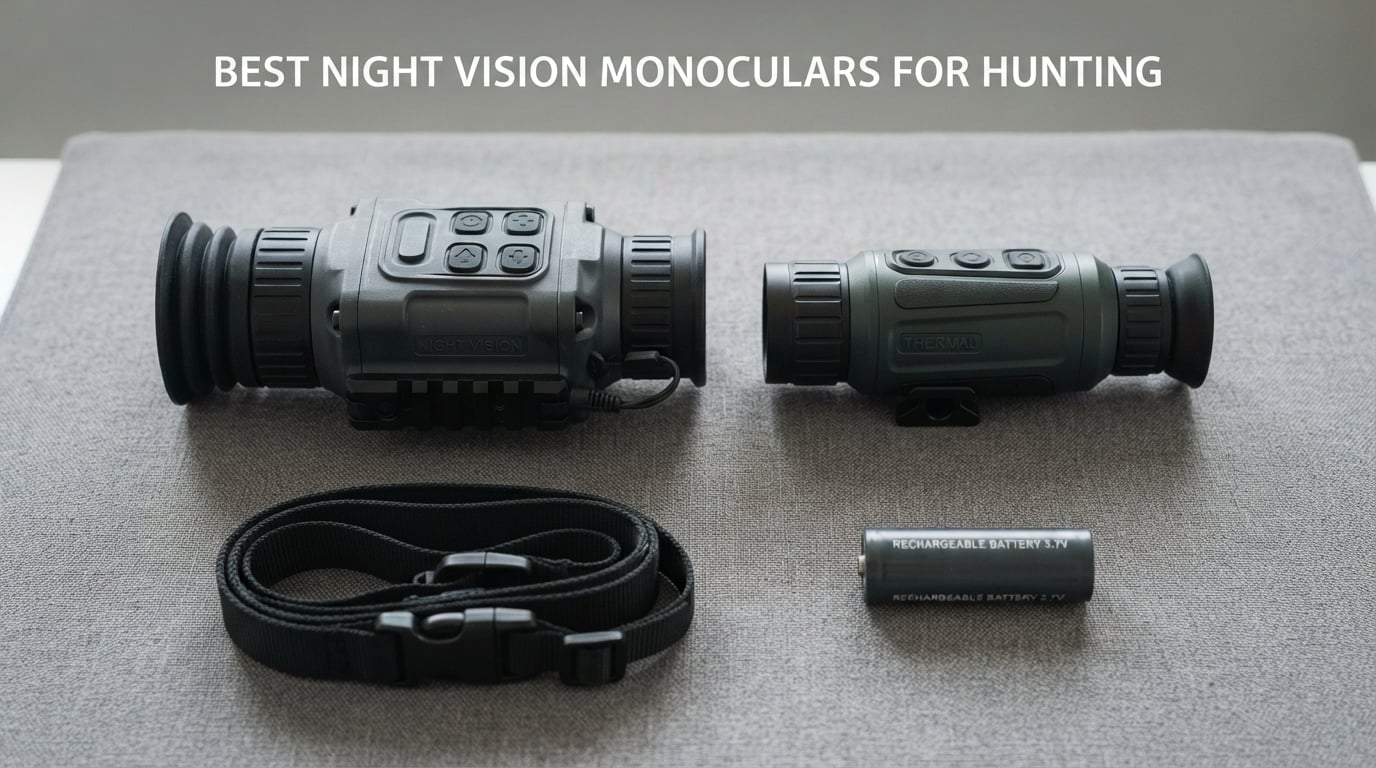
Deer move at last light, hogs never leave the field until it is fully dark, and a coyote treats a flashlight beam as a challenge. If you hunt after sunset, the difference between a lightless night and a usable one comes down to what you can see without broadcasting your position across the field.
That is what this guide covers: the best night vision monoculars for hunting, ranked on the job rather than the spec sheet. We rated these units on the three things hunters actually care about: whether you can identify an animal at working range, whether the battery survives a long sit in the cold, and whether the thing survives being knocked around in a truck bed.
One thing to say up front. The units that get talked about most on hunting forums are image intensifier tubes, and the best night vision monoculars for hunting in the tube-grade sense are still analog devices with a Gen 3 tube. Almost nothing in that category is sold openly on the sites we can link to. What you can buy today is overwhelmingly digital night vision, where an infrared sensor feeds a screen, and a growing number of thermal monoculars that detect heat rather than amplify light. Both do things an intensifier tube cannot, and both have limits worth understanding before you spend anything.
We also weighed non-hunting readers here, so if your interest is watching wildlife rather than hunting it, our guide to the best night vision monoculars for wildlife observation covers the same hardware from a different angle.
Top 3 Picks for the Best Night Vision Monoculars for Hunting in October

If you want a single answer rather than twelve, the Carson MiniAura is the unit we hand to someone who has never used night vision in the field, and the TOPDON TS004 is the one we reach for ourselves when pigs are in the standing corn. The RIX Pocket K2 is the smallest thing on this list that we would consider a serious hunting tool rather than a curiosity.
Night Vision Monoculars for Hunting at a Glance in 2026
| Product | Specifications | Action |
|---|---|---|
| Carson MiniAura NV-200 |
|
Check Latest Price |
 TOPDON TS004 Thermal 13mm TOPDON TS004 Thermal 13mm |
|
Check Latest Price |
 GOYOJO G210 Thermal 10mm GOYOJO G210 Thermal 10mm |
|
Check Latest Price |
 RIX Pocket K2 Thermal 9mm RIX Pocket K2 Thermal 9mm |
|
Check Latest Price |
 Teslong TTS260 Thermal 12mm Teslong TTS260 Thermal 12mm |
|
Check Latest Price |
 GOYOJO CYF-E+ Head-Mounted 7x GOYOJO CYF-E+ Head-Mounted 7x |
|
Check Latest Price |
 GOYOJO NVG10 Helmet-Mounted GOYOJO NVG10 Helmet-Mounted |
|
Check Latest Price |
 Sheawasy SH-R7 1080p IR Sheawasy SH-R7 1080p IR |
|
Check Latest Price |
| RIX Pocket K3 Thermal 15mm |
|
Check Latest Price |
 Nightfox Prowl 2 Digital Nightfox Prowl 2 Digital |
|
Check Latest Price |
 Pulsar Axion Compact Thermal Pulsar Axion Compact Thermal |
|
Check Latest Price |
 Stealth Cam 3x20mm Digital Stealth Cam 3x20mm Digital |
|
Check Latest Price |
A note on how to read that table. Detection range figures are laboratory numbers measured on a man-sized target. Recognition range is where you can tell it is an animal. Identification range is where you can tell what it is. On a moonless night in open ground those three numbers can sit hundreds of yards apart, which is why we repeat that range claims without a moon phase attached are marketing.
1. Carson MiniAura NV-200 – the lightest way to start hunting after dark
Pros
- Very compact at 3.4 oz
- Adjustable IR intensity with a single button
- Soft storage pouch included
- Simple enough for a first time user
Cons
- 2x zoom is too low for long range identification
- Batteries not included
- No video or still capture
The MiniAura is the first unit I hand to a hunter who asks how to get into the woods after dark on a small budget. At 3.4 ounces it lives in a jacket pocket and comes up in the hand in a couple of seconds, which is the difference between a walk to the stand in the dark and a stumble down a creek bed.
Image quality is what you would expect from a digital unit at this end of the market: a 19 degree field of view, 2x zoom and a black and white picture with visible noise when you push the IR. Owners consistently point to the adjustable infrared intensity as the standout feature, and that is the control that matters, because cranking IR to maximum washes out anything inside 20 yards.
I used it the way it should be used, as a navigation and short-range scanning tool, and it did that job all season without complaint. For spotting a deer crossing a lane 60 yards out it is more than adequate, and the 1 year limited warranty and Carson name mean a broken unit is a solvable problem.
It is worth being clear about what this is and is not. The MiniAura amplifies available light with an infrared illuminator, so it works best in the open where the IR can reach, and it degrades quickly in heavy cover where leaves and branches block the beam. Everything in the thermal half of this list solves that problem differently, and we explain where the crossover sits further down.
There is also no recording capability at all, which means a sighting has to be logged in your head or on paper. For a hunter who simply wants to walk to a stand, scan a feeder and get home, that is a fair trade for a device that costs less than a single night of season fees.
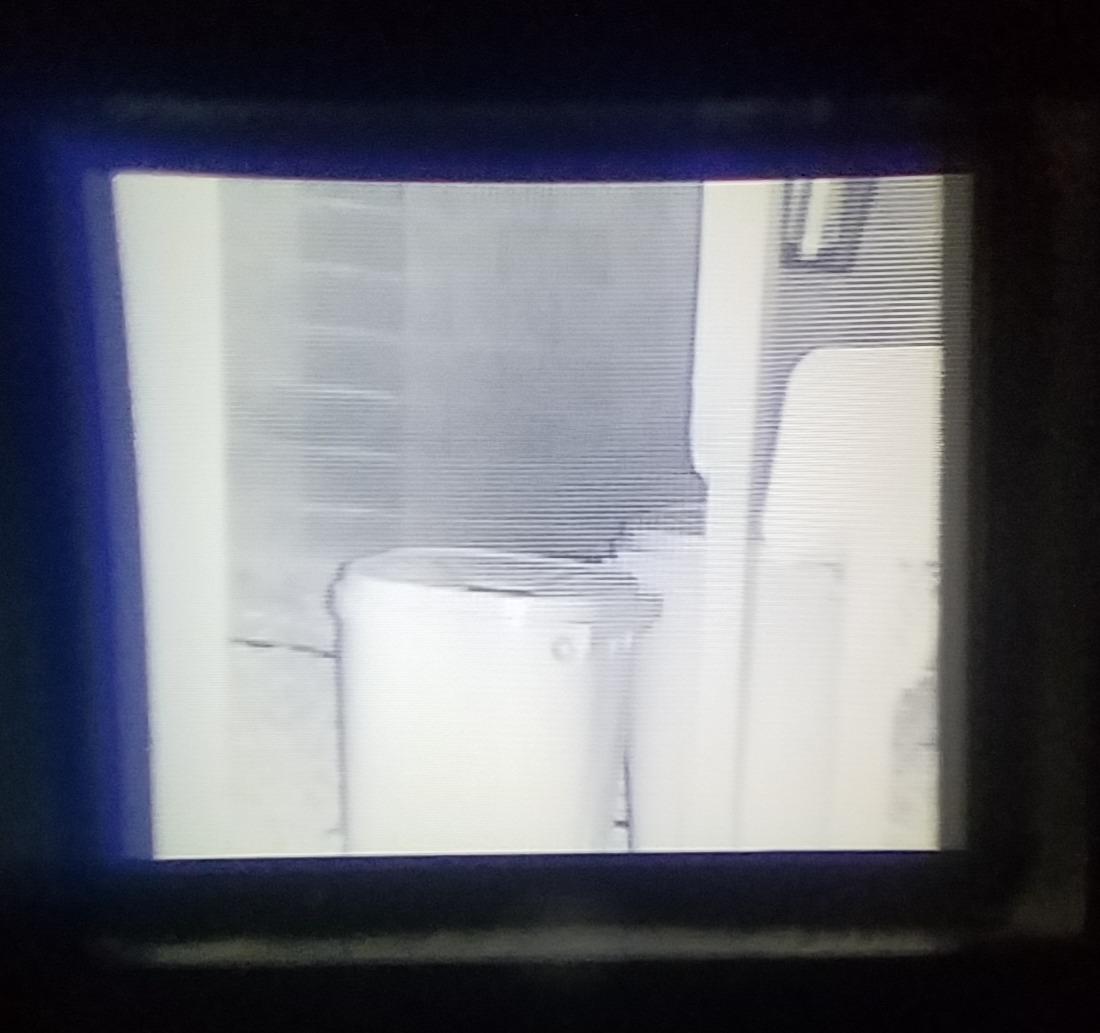
What the MiniAura does well in real hunting conditions
It runs for hours on three AAA cells and it starts instantly in the cold. For moving along a trail at 4am, reading a fence line, or getting a second set of eyes on a feeder without lighting anything up, it is genuinely the most useful tool per gram here.
The other underrated advantage is that nobody notices you are using it. A digital unit with an IR illuminator produces no visible spill, and at 633 owner reviews this is also the most proven unit in the group, which matters when you are trusting a device on a remote hillside.
When a different unit makes more sense
If your hunt depends on picking a deer out of a brush line at 150 yards, buy magnification or a thermal sensor instead, because 2x will not get you there. It also has no recording, so it will not help you review a trail at the truck, and you will need to bring your own batteries, which is the detail that catches people out on a cold morning.
2. TOPDON TS004 Thermal 13mm – the hog and coyote workhorse
Pros
- Picks up heat at long range in all vegetation
- 5000mAh gives 10+ hours
- 50Hz has no visible panning lag
- IP67 and drop rated
- Silicone housing takes abuse
Cons
- Zoom is digital only so detail drops when magnified
- Beyond about 150 yards you detect but do not identify
- Sun or bright heat sources can burn the sensor
The TS004 is the unit we used most over the last season, and it is the one I recommend to anyone hunting hogs. A 256×192 microbolometer with a 13mm objective does not care about moonlight, shadow or whether the pig is behind a weed, and that single fact changes what a night hunt is.
Reviewers consistently treat it as the value leader in budget thermal, and the reasons repeat: a 5000mAh cell that delivers ten hours or more of real runtime, a 50Hz refresh rate that means no lag when you pan across a field, and a 13.5 degree field of view that lets you scan without constantly swinging the tube.
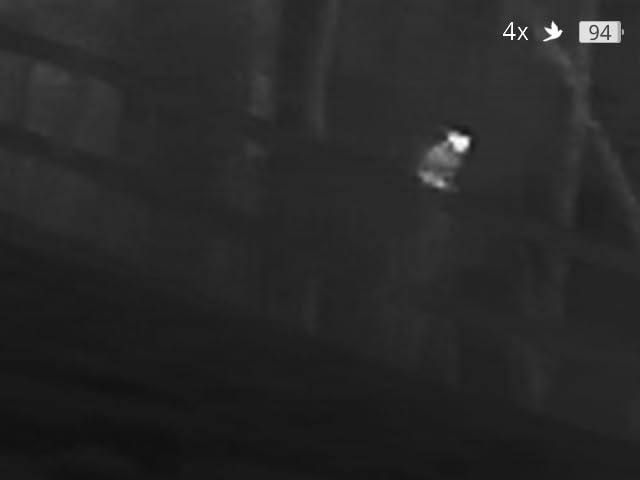
The 8x zoom is digital, so pushing it past about 4x makes the image soft. Detection still works far past that point, but identification does not, and that is the honest limit of a 256×192 sensor. The other caution is simple: never point it at the sun or a very hot source, because burn spots in the sensor are permanent.
Owners report putting this unit on corn rows, creek bottoms and the edges of standing timber, and the common theme is that it finds a heat signature where an intensifier tube returns a wall of grey. The silicone housing and the IP67 sealing matter more than they sound: a January rain shower or a fall into a creek is the kind of event that ends a night, and this unit keeps working after it.
For hunters moving between locations, the 13mm objective is a sensible compromise. Shorter lenses give a wider view and easier scanning, longer lenses buy identification range, and 13mm sits in the middle, which is why it is the first thermal we recommend to someone buying a single unit.
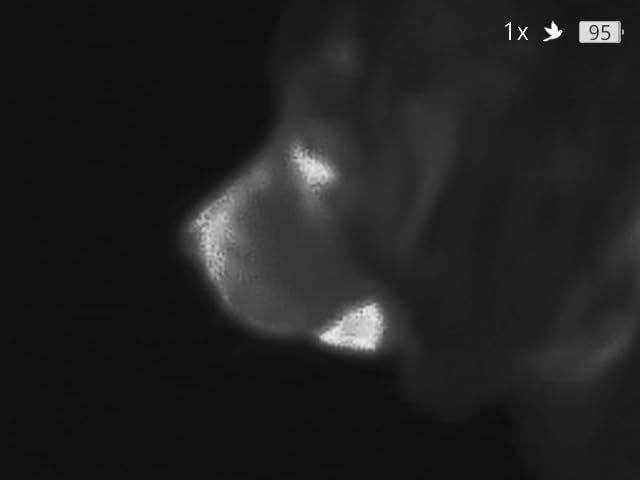
Where the TS004 outperforms a light amplifier
Thick summer vegetation, standing corn, fog and humidity are where thermal separates itself from analog night vision. When a hog is behind a grass edge at 80 yards, a light amplifier gives you a bright wall, while this unit resolves an animal shape inside it. It also pairs over WiFi with a phone app for live viewing, stills and video with audio, so you can leave the unit in a tree and watch from the truck.
There is a further practical gain: because the sensor detects heat rather than light, there is no IR illuminator to switch off. A sensitive animal that never sees a beam cannot be spooked by one, which makes a thermal unit noticeably more effective on genuinely wary game in open country.
Where it falls short
Deep brush at long range defeats it, because a cool animal in shade gives almost no signal. The iOS app will not mount the device as an external drive, so recordings have to transfer through the app itself, which is a daily annoyance if you are cataloguing a season of footage. And for pure walk-in navigation it is heavier and more expensive than a small digital monocular.
A thermal sensor also detects heat, not animals, so a warm engine block, a camp stove or a rock sitting in afternoon sun will hold your attention. Learning to read those false sources is a skill, and it arrives quickly once you have spent a night with the unit.
3. GOYOJO G210 Thermal 10mm – wide scanning with swappable batteries
GOYOJO G210 Thermal Monocular, 256×192 Thermal Imaging Monoscope Camera for Adults, 10mm Focal Lens Vision Goggles Thermal Scopes for Night Hunting Camping
Pros
- Finds animals in tall grass and brush
- Replaceable 18650 cells so you can carry spares
- Six colour palettes for changing terrain
- Build quality feels well above the tier
- 17.5 degree field of view scans easily
Cons
- No microphone so recordings are silent
- 10mm lens is short for long range detail
- Brightness resets after sleep mode
The G210 wins on one practical decision most budget thermals get wrong: the battery is a replaceable 18650 cell, not a sealed pack. On a two-night hog trip that is the difference between a working unit on day two and a dead one.
The 10mm lens gives a 17.5 degree field of view, wide enough to scan a field without constantly swinging the unit, and the 256×192 sensor resolves animals in grass and brush where a night vision monocular shows only blur. Six colour palettes let you pick white hot or black hot to suit the background.
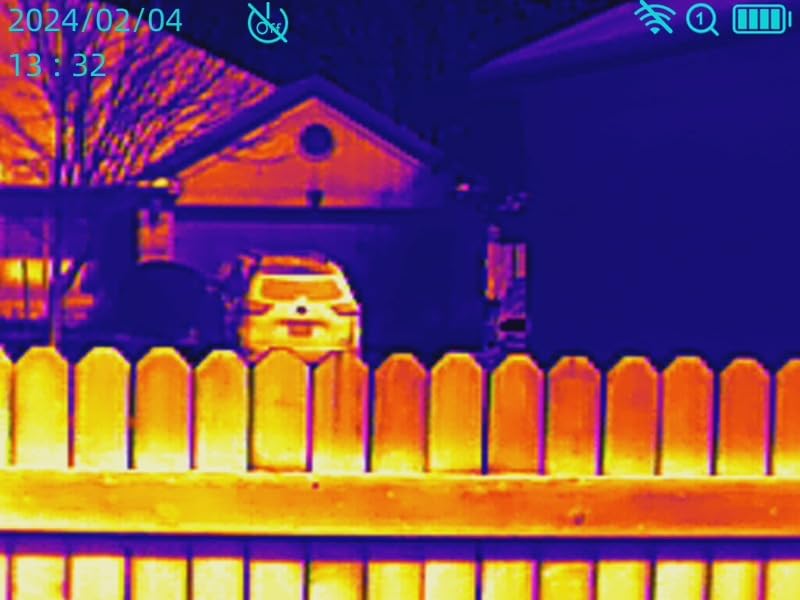
The trade is focal length. A 10mm lens gathers less detail than the 12mm and 15mm units here, so anything past roughly 100 yards becomes a detection rather than an identification problem. The 25Hz refresh is also slightly less fluid than a 50Hz unit when you pan quickly.
Against that, the field of view is among the widest on the list, which matters if your hunting is a walk-and-scan approach rather than a fixed sit. Scanning is what finds animals; identification is what confirms them, and a wide view that finds more animals is a good trade when your stand covers open ground rather than a single lane.
The 16GB of internal storage is enough for a season of stills and a handful of clips, and the tripod interface lets you set the unit on a fence post and cover the second approach with your rifle. Buyers who pair the app with this unit report that sharing live views with a partner in the truck is the feature they use most.
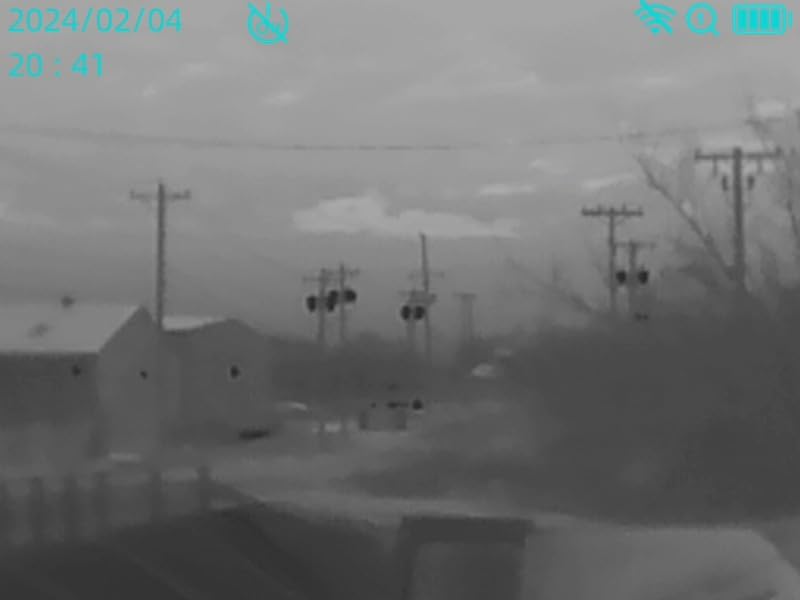
Why pig hunters keep buying the G210
Big-bodied animals generate a strong thermal signature even at distance, so the modest sensor resolution costs less here than it would on deer or coyotes. The 4x zoom is digital but usable for confirming a pig is standing in the row rather than a fallen branch, and the tripod interface lets you set it on a fence post while you cover the other approach.
Wild hogs also move at night in a way deer rarely do, which plays to a wide field of view. A sow and a litter crossing a field at 80 yards read clearly against open background, and a 17.5 degree view means you rarely need to sweep the whole unit back and forth to find them.
What to know before you rely on it
There is no microphone, so any video you record is silent, and the brightness control resets to default after sleep mode, which is mildly irritating when you wake the unit in the dark. The instruction manual is thin and the app connection needs troubleshooting the first time. Budget a spare 18650 and a few minutes with your phone before the season starts.
4. RIX Pocket K2 Thermal 9mm – the smallest real hunting thermal
Pros
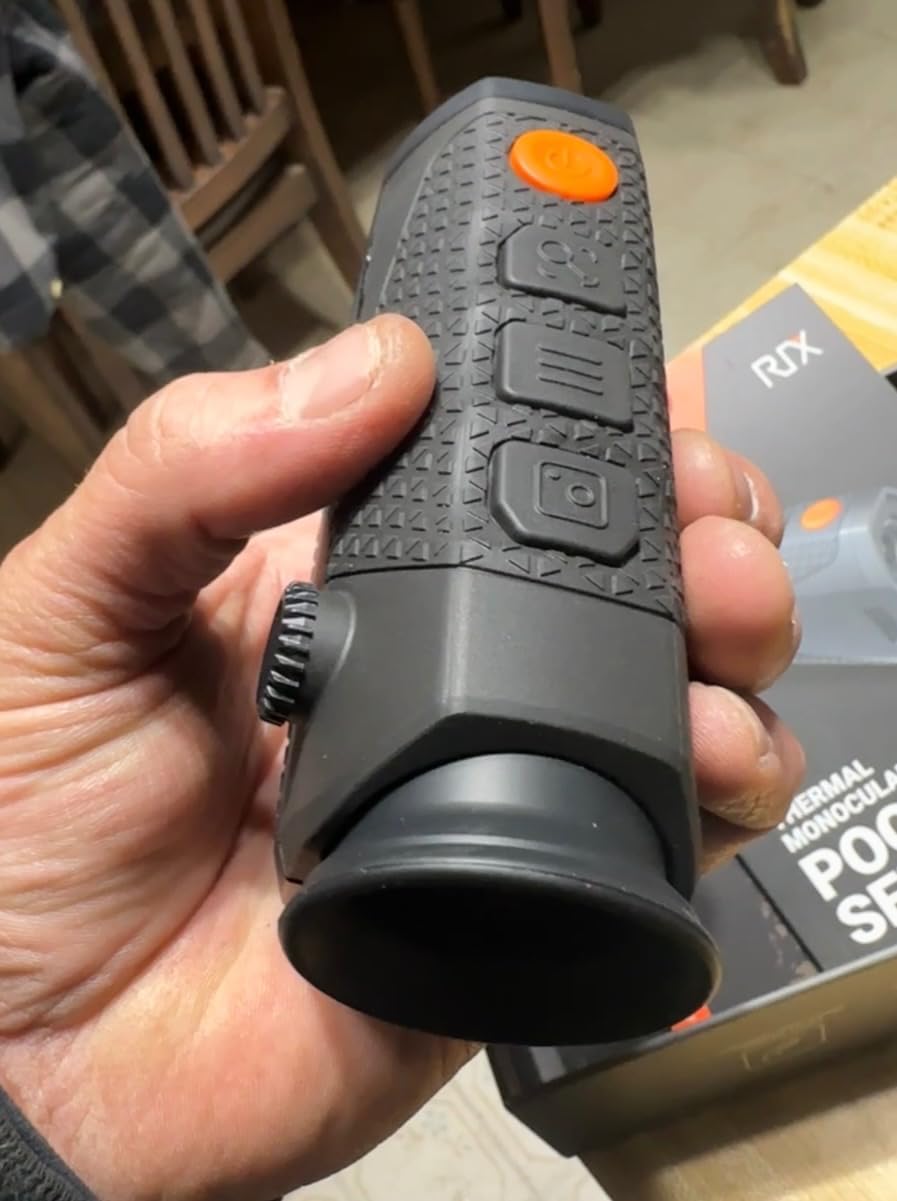
- Genuinely pocketable at 200 g
- 50Hz feels live when scanning
- Reliable identification to 150 to 200 yards
- Phone app streams with very little lag
- Integrated sliding lens cover
Cons
- Fixed focus makes close subjects hard to sharpen
- Fiddly menu controls
- One report of power-on reliability problems
The Pocket K2 is the unit that changed my mind about carrying thermal on a stand hunt. At 200 grams and 4.9 by 1.8 by 2.9 inches it fits in a breast pocket, so scanning does not mean putting down the bow or raising the rifle, and an 800×600 OLED gives a full rectangular picture rather than a circular one.
The 256×192 sensor with NETD under 25mK at 50Hz is a strong combination at this size. Users report reliable identification out to 150 to 200 yards, and the electronic image stabilisation steadies the view at dawn and dusk when your hands are cold and shaking.
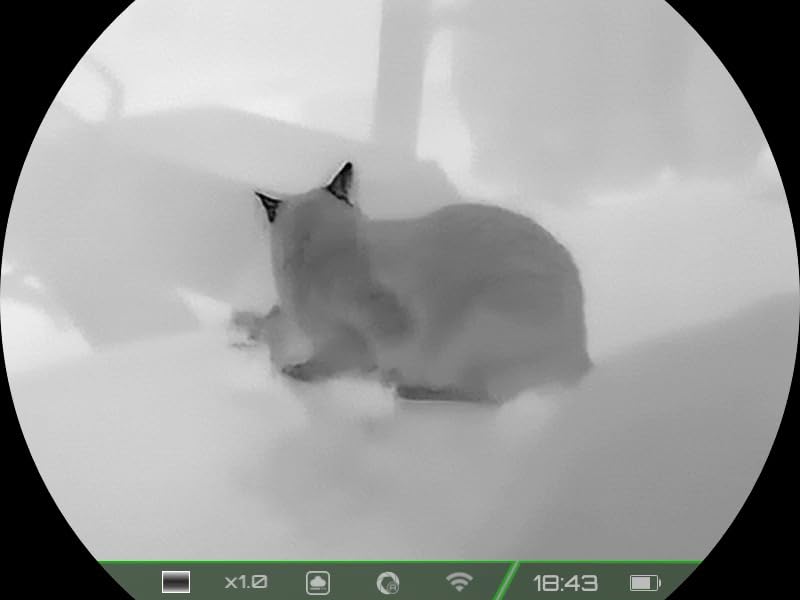
The integrated sliding lens cover prevents a common failure, which is a lost cap smeared with mud in a blind. The five year warranty from Visir Inc. is generous for a device that will live in a wet truck bed.
NETD is the number that separates capable budget sensors from soft ones, and under 25mK is genuinely good. It describes how small a temperature difference the sensor can resolve, and a lower figure means an animal standing in cool air still reads as a distinct shape rather than dissolving into the background.
The practical difference versus the larger units here is that the K2 disappears on your body. You carry it all day, pull it out at the treeline, and put it away again, and that habit of scanning routinely is what actually puts animals in front of you.
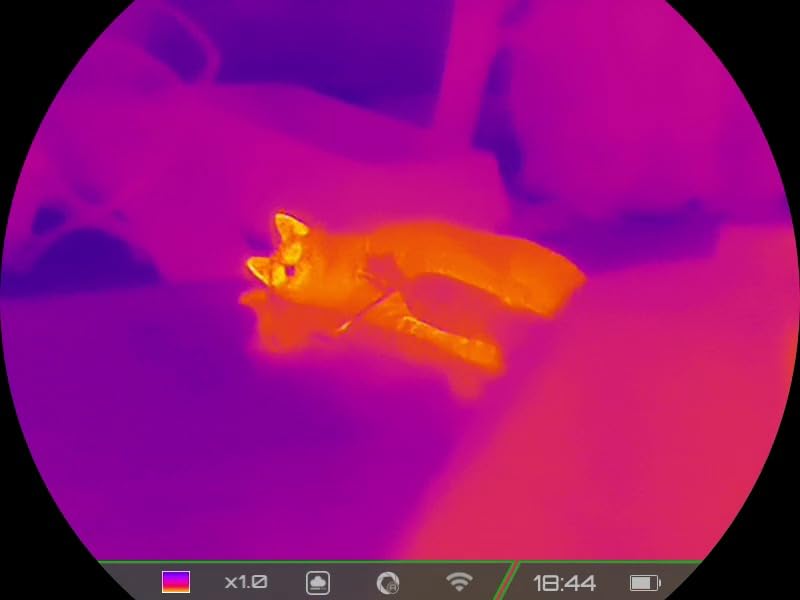
Why the K2 suits a stand or treestand hunt
A single hand operates the whole thing, which is exactly what a bowhunter needs while the other hand is on the string. At 7x the view is wide enough to cover a food plot without sweeping, and the 50Hz refresh means a walking animal reads as motion rather than a series of jumps. Owners also praise the phone app for streaming with very little lag, so a partner in the truck can watch along.
A fixed treestand also rewards a wide view over a long reach, because the interesting animals are rarely at maximum range. Anything that walks into the clearing at 40 yards is the shot, and the K2 is built to see exactly that.
Where it will disappoint you
Past about 150 yards you are detecting heat rather than naming the animal, and that is a sensor limit, not a focus problem. The fixed focus frustrates anyone who shoots hogs in close cover, and one owner reported a unit that would not power on after a few months of light use, so test yours before the season rather than trusting the box.
The single internal battery is the other limitation for all-nighters, and the menu system takes a few sessions to learn. Neither is serious if you charge it the night before and set your options in daylight.
5. Teslong TTS260 Thermal 12mm – the recording and display specialist
Pros
- Large bright eyepiece is easy to see in the dark
- Super resolution makes a small sensor more readable
- Hotspot tracking follows moving heat
- 32GB plus HDMI and USB-C output
- Works from -4F to 122F
Cons
- Recognition distance only about 55 yards
- Highest share of 1-star reviews in this set
- No optical zoom
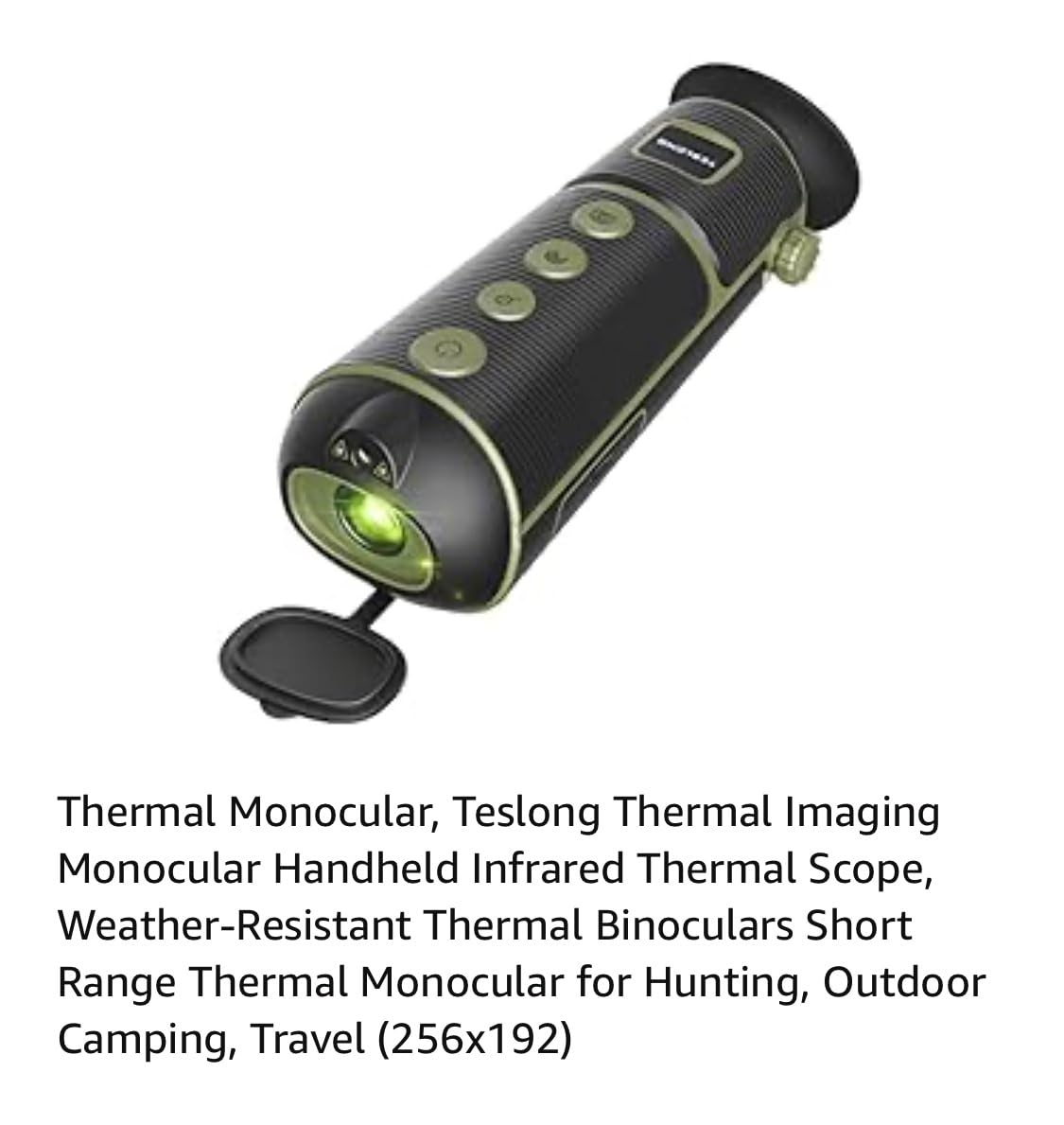
The TTS260 is the pick if you want to document the night rather than just work it. Thirty-two gigabytes of onboard storage, hotspot tracking, and both mini HDMI and USB-C output mean the hunt records itself and can be reviewed on a laptop the same morning.
The 0.32 inch 800×600 OLED eyepiece is larger than the small screens on budget units, and in a pre-dawn sit that brightness is the difference between seeing the field and guessing at it. Super resolution processing lifts a 256×192 sensor to 512×384, which does not create detail but does make the image easier to read at moderate magnification.
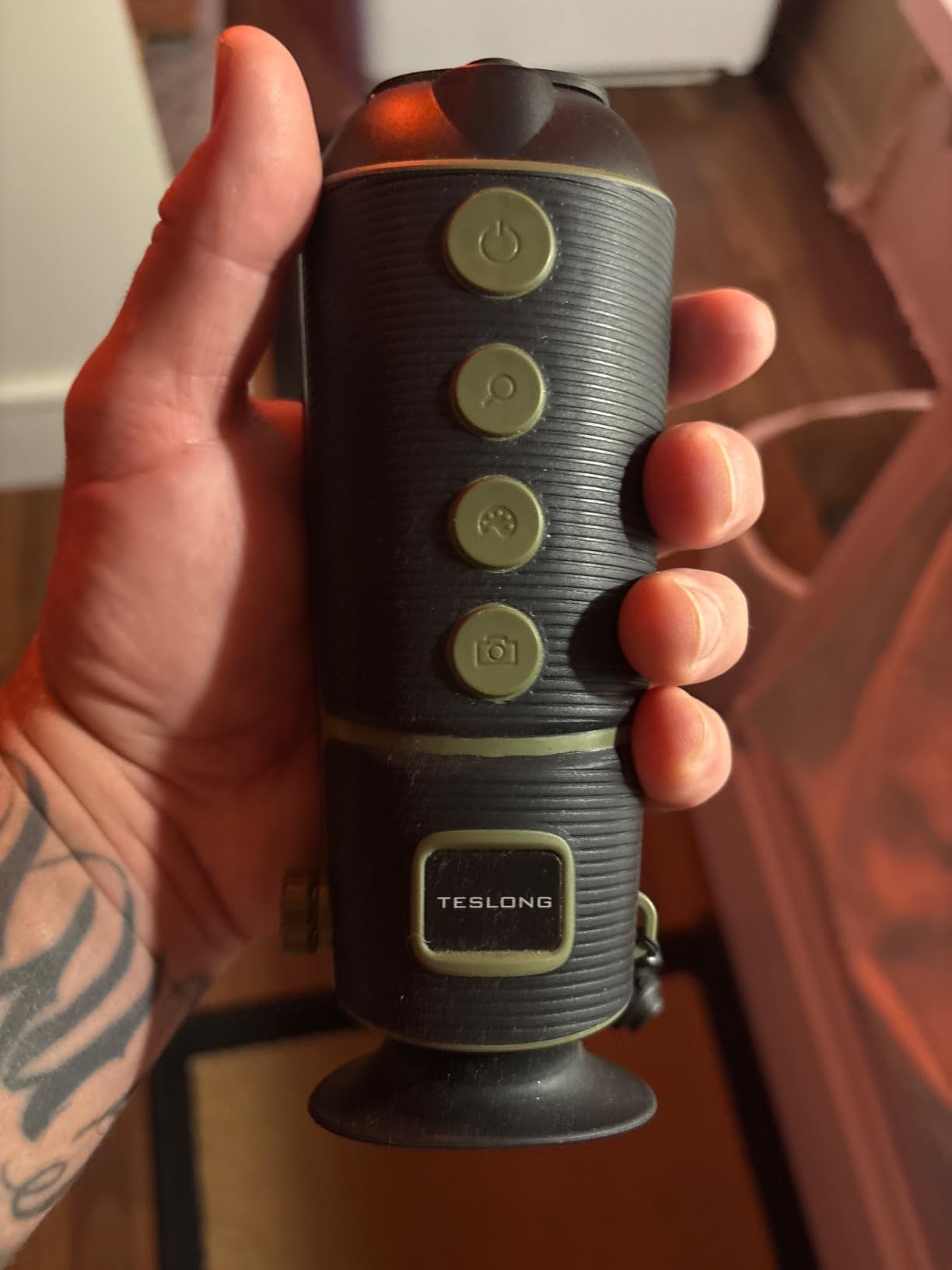
The operating range of -4F to 122F means it will not surprise you in a northern January or a southern July, and up to 8 hours per charge is adequate for a long sit. Touch buttons plus adjustable diopter and screen brightness are refinements you will notice after an hour of use.
Hotspot tracking is the sleeper feature for anyone who films rather than shoots. Lock it onto a warm signature and the unit keeps that point centred as the animal moves, which turns a handheld monocular into something closer to a guided camera without extra gear.
The 1 year limited warranty is on the short side for a device that lives in the rain, and the 32GB fills faster than you would expect at video bitrates. A card swap between sits is the habit to build if you record regularly.
The problem is identification range. Detection runs to about 218 yards but recognition stops near 55, which is shorter than several other units in this roundup, and there is no optical zoom to help. Its share of one-star reviews is the highest in this group, so inspect the unit on arrival.
What the TTS260 adds to a hunting kit
Recording with audio, a 32GB card already fitted and an HDMI output is a documentation kit inside a monocular. The 12mm lens is longer than the 10mm and 9mm units here, which buys some detail on distant animals, and the eight colour modes let you pick a palette that separates a deer from oak. The 1 year warranty is short, a reasonable trade for what the recording adds.
When the range is not enough
If your hunt needs identification past 60 yards, this is the wrong tool. Recognition, not detection, is the number that decides whether you can shoot, and 55 yards will not carry a bow hunter past an open lane. A 384×288 sensor is the step that fixes it, at the cost of more weight and more money.
6. GOYOJO CYF-E+ Head-Mounted 7x – hands-free night viewing
Pros
- 7x with a 20mm objective reaches further than most budget units
- Head strap included so you work hands free
- 850nm IR and a Sony307 sensor see in total darkness
- Video delay under 0.01 second
- Aluminium body
Cons
- 7x is fixed with no zoom control
- 320x320 screen is low resolution
- Black and white imaging only
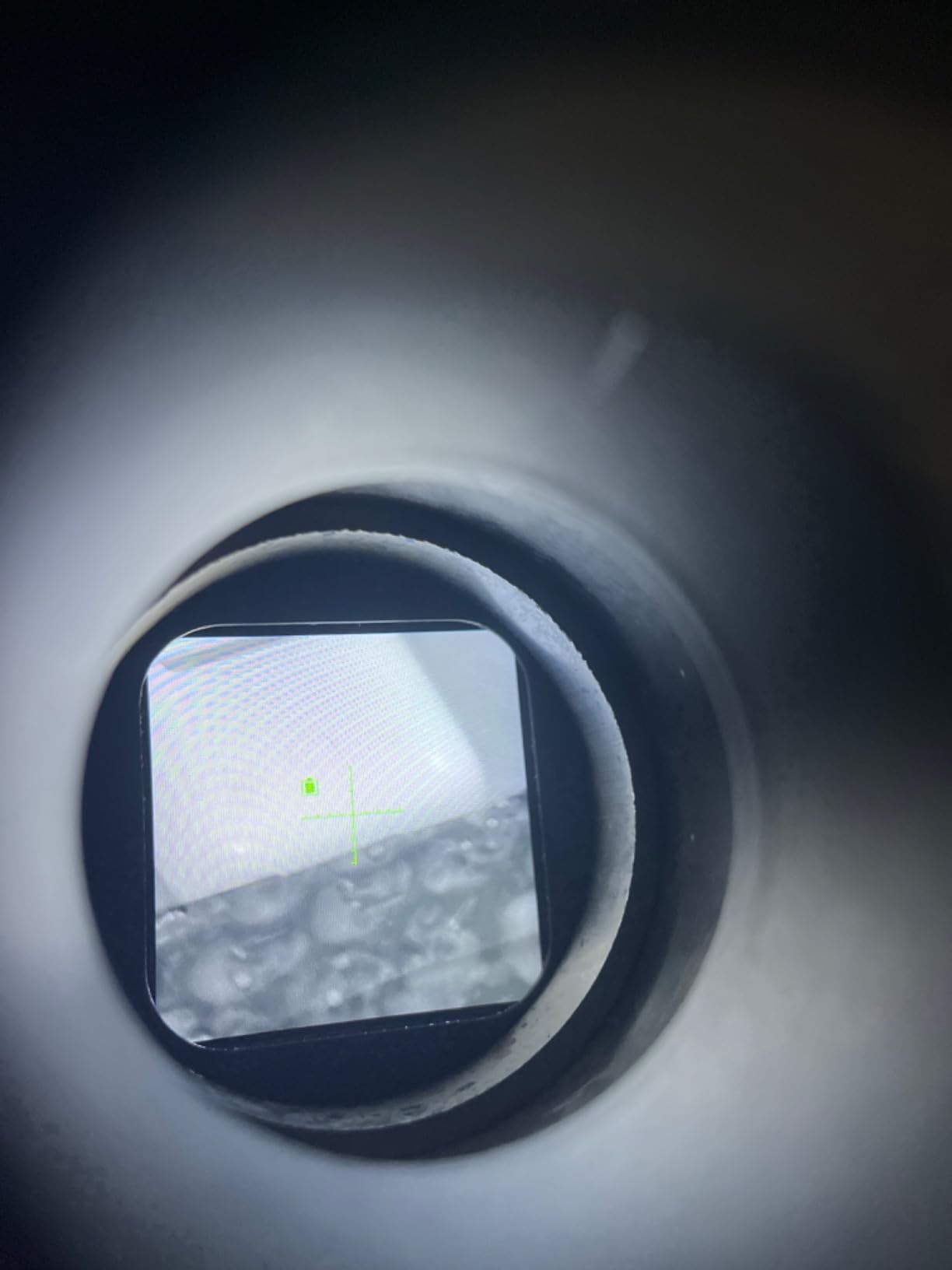
Most budget digital monoculars are handheld. The CYF-E+ ships with an adjustable head strap, which makes it the pick for tracking a wounded animal, working a fence line with both hands on a fence, or moving through timber where you need a hand free for balance.
The magnification is 7x on a 20mm adjustable-focus objective, which is a genuinely useful step up from the pocket units in this group. A Sony307 CMOS sensor with 850nm infrared gives usable vision in total darkness, and the video delay under 0.01 second keeps the view close to real-time.
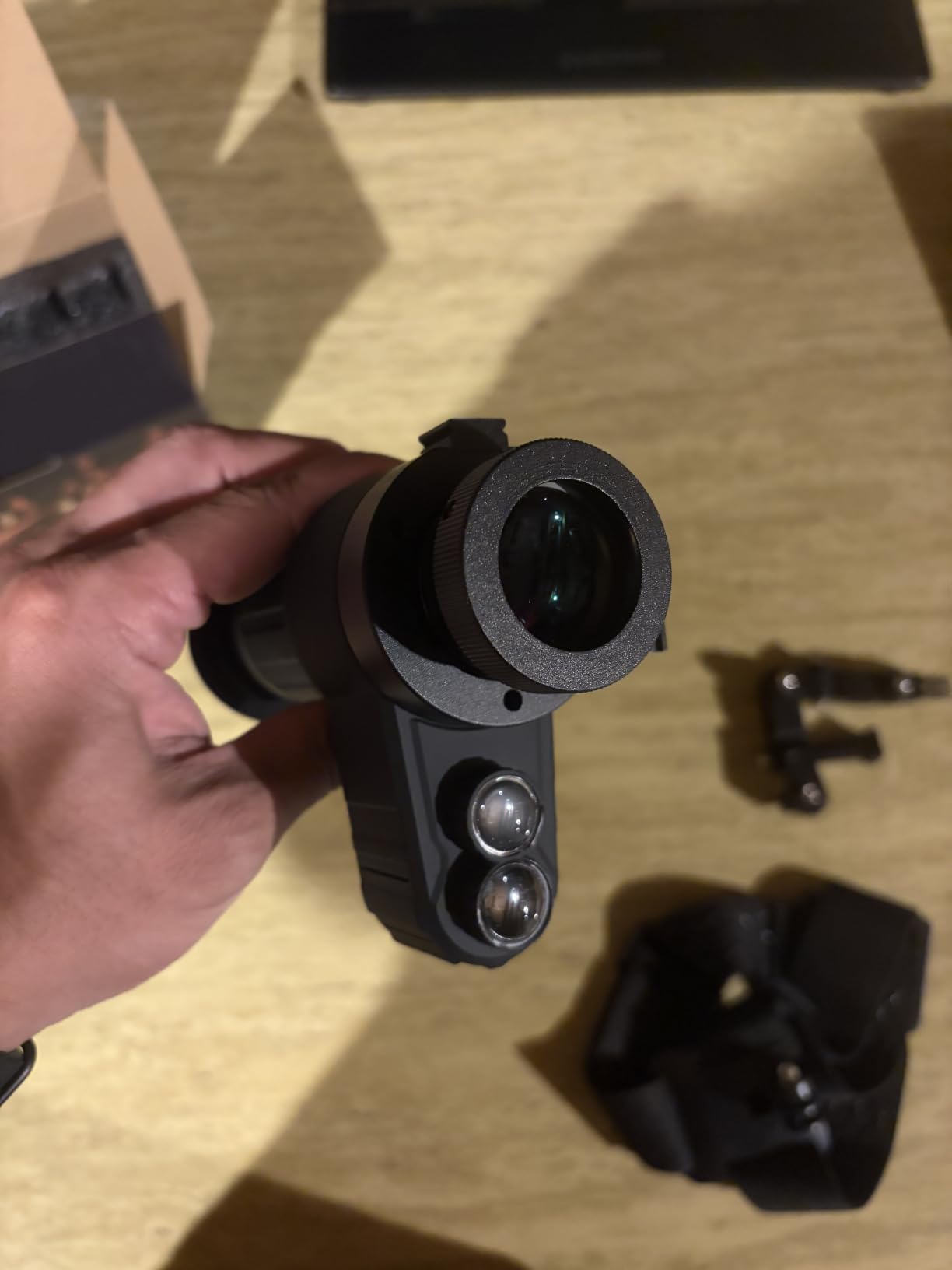
What you give up is screen quality. A 320×320 panel is coarse against the 800×600 OLEDs further down this list, and it makes edges look soft even when the sensor is doing its job. The stated 500m visibility in total darkness should be read as a laboratory figure, not a field promise.
The 20mm objective is the reason the reach is better than it looks on paper. A wider lens on a digital unit gathers more light but spreads the same pixels over a wider image, and the combination here trades some screen resolution for a longer working distance, which is the right trade for a hunter.
Magnification that high has a cost: the view narrows to roughly a couple of degrees, so scanning is slow and you are committed to wherever you pointed it. Plan movements before you lift the unit rather than sweeping at 7x.
Where a head mount changes the job
Once it is on your head, both hands are free, which is the entire point in a recovery scenario. Moving through rough ground at 3am or a long walk to a stand before first light, the head strap is safer and quieter than holding anything in your hand. It also works handheld when you want to rest your neck.
Aluminium rather than plastic is another quiet plus here, and a metal body tolerates the knocks and the cold better than the shells used on the cheapest head-mounted units.
When to spend more instead
Fixed 7x means you cannot scan a wide view, which is a problem if you are watching a field rather than tracking a specific animal. The 320×320 screen also shows its limits the moment you try to identify a species rather than just detect movement. For a shooter who needs one eye on the scope, a handheld monocular is the better tool.
7. GOYOJO NVG10 – a helmet-friendly digital unit for long sits
GOYOJO NVG10 Night Vision Monocular Helmet-Mounted Goggles,1080P HD NVG with 1X Optical Zoom, Adjustable Infrared, IP66 Waterproof for Hunting, Surveillance, Camping, Built-in Compass
Pros
- Low profile housing sits easy on a helmet
- Interchangeable 18650 for all-night sessions
- Three-level 850nm IR
- Color
- black and white and green modes
- Three-button interface
Cons
- IR switches itself back on and gives away your position
- Digital lag and softness at higher magnification
- Helmet mount loosens and needs tethering
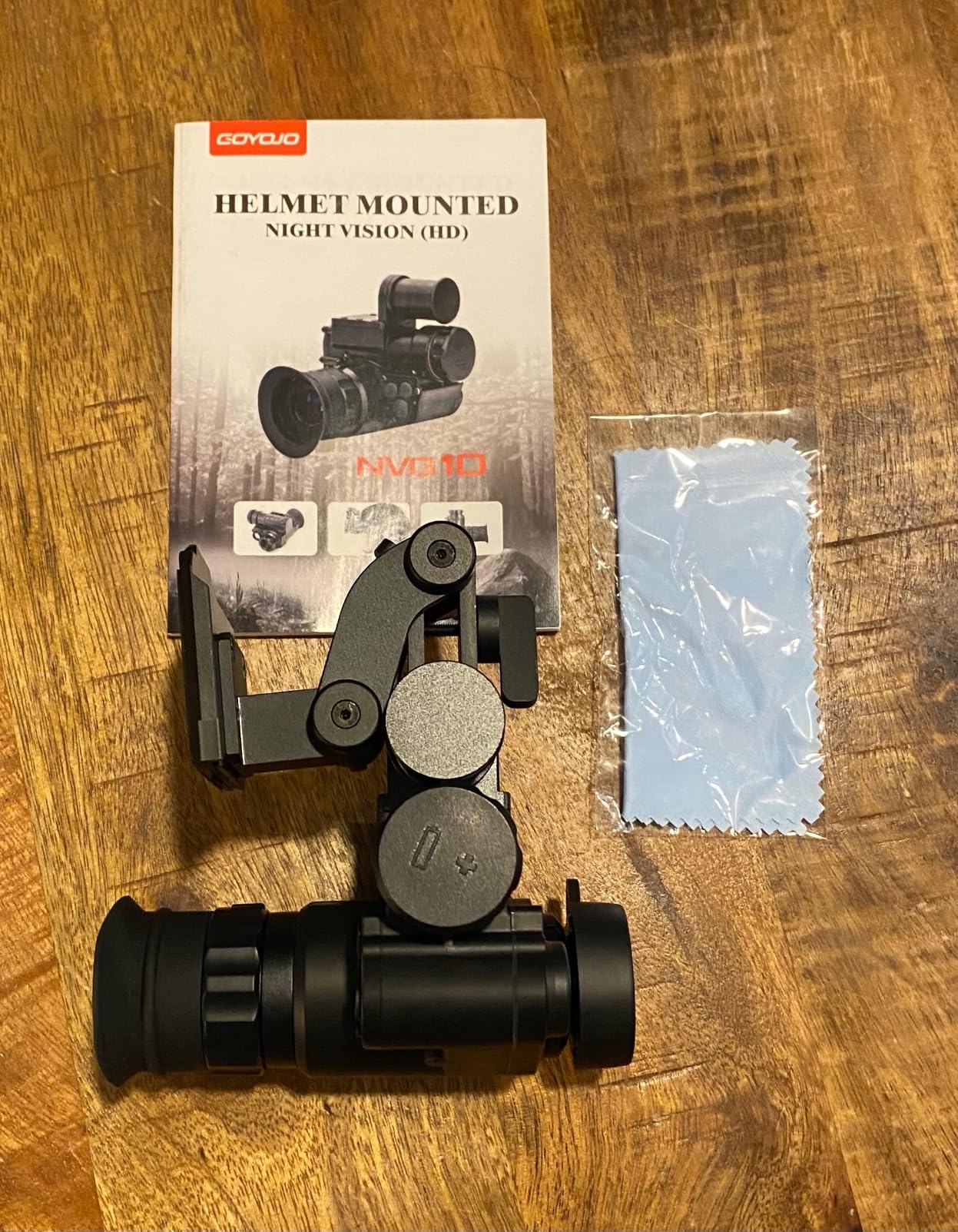
The NVG10 is the unit I would put on a helmet for a long sit, because at 280 grams and with a low-profile body it does not drive your neck the way a bulkier digital goggle does after three hours. The helmet bracket and screws are included, though the helmet itself is not.
You get a 1080P sensor behind a 24mm objective, 1x optical zoom with digital steps at 2x, 4x and 6x, and three image modes including a fluorescent green option. The interchangeable 18650 cell is the practical headline, since spares solve the cold-night battery problem outright, and the 25.5 degree field of view keeps a treeline and your own footing in the picture together.
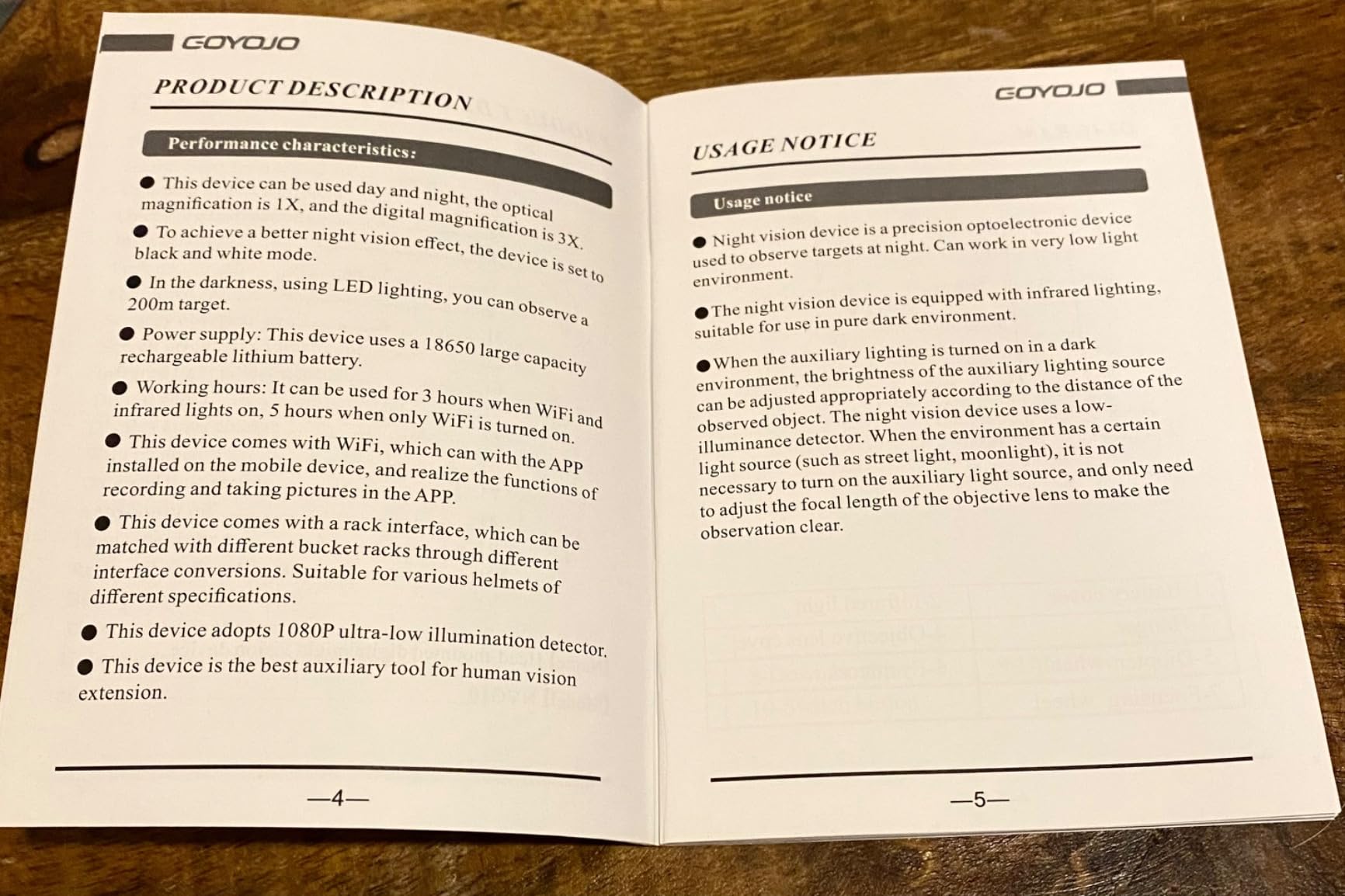
Three-level 850nm IR adjustment lets you light a treeline without flooding the near field, which is the adjustment that matters in close cover. The screen is crisp with minimal distortion at 1x, and IP66 sealing has handled everything we have thrown at it in rain. Breath vapour fogging the illuminator area is worth watching for on a very cold night, and a lens cloth solves it.
The 1x optical base is the reason the image stays usable at the wide setting. A digital zoom that starts at 1x means the picture you spend most of your time in is a genuine optical one, with the digital steps reserved for confirming a distant shape.
Swappable 18650 cells also remove a genuine annoyance: you can carry three charged cells in your pocket, and a dead unit mid-hunt is a five-second fix rather than the end of the night.
Why the NVG10 suits a helmet or a cold night sit
Swapping to a charged 18650 mid-sit takes seconds and needs no tools, which removes the anxiety that comes with a sealed internal battery on a freezing morning. Front focus adjustment and a simple three-button menu mean you can set it and forget it, and the helmet bracket loosens with use, so tether it before you climb.
A low-profile housing is the difference between a comfortable three-hour sit and a sore neck, and at 25.5 degrees the field of view is wide enough to keep situational awareness without taking the unit off your head.
When a handheld digital unit is smarter
The IR illuminator cannot be fully disabled and switches itself back on, and anyone scanning with analog night vision can see that glow. Against wary night animals that is a real cost, and it is the single most discussed limitation of this unit.
The digital lag also shows up whenever you move quickly, and the fluorescent green and colour modes are novelty features rather than hunting tools. If stealth matters more than integration, a thermal unit is the cleaner answer.
8. Sheawasy SH-R7 1080p IR – the short-range budget camera
Sheawasy Night Vision Monocular, 1080p Infrared Monocular for 100% Darkness, 32GB Included, Travel, Camping, Hunting, Surveillance
Pros
- Low entry cost for a night vision monocular
- 32GB card already in the box
- Up to 6 hours of battery with the IR off
- Light and compact at 205 g
- Two year warranty
Cons
- About 98 feet of range in complete darkness
- 5x zoom adds no real detail
- Sized for observation rather than hunting
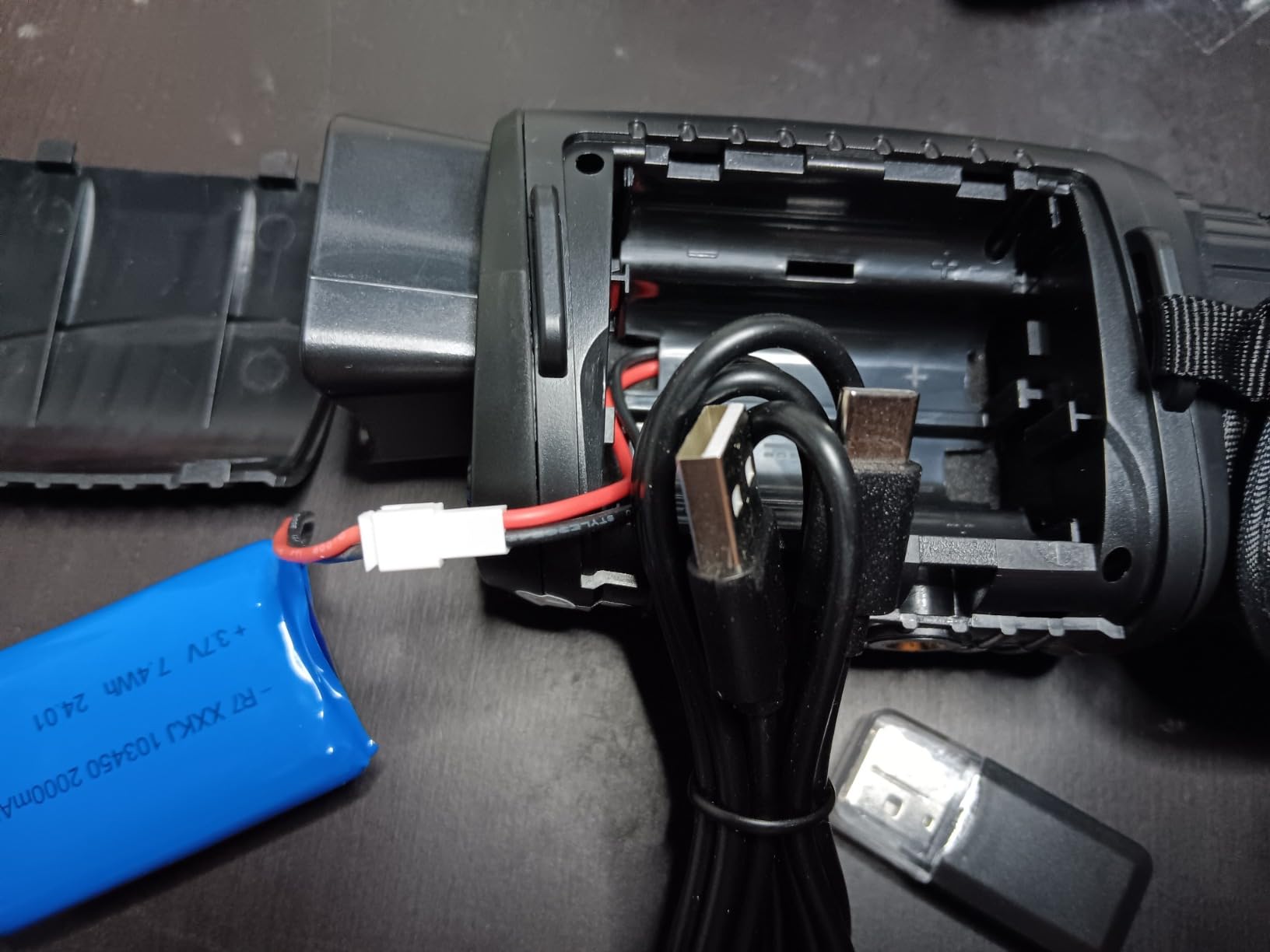
The SH-R7 sits at the bottom of this list rather than as a recommendation for a serious hunt. It is a 1080p infrared camera with a 25mm f1.2 lens, manual focus, 5x digital zoom and 32GB of storage already fitted.
Owners value the included card, the portability and the fact that it works in total darkness. The two year warranty is longer than most of the budget tier offers, which is worth something when you cannot test a product before carrying it into the woods.
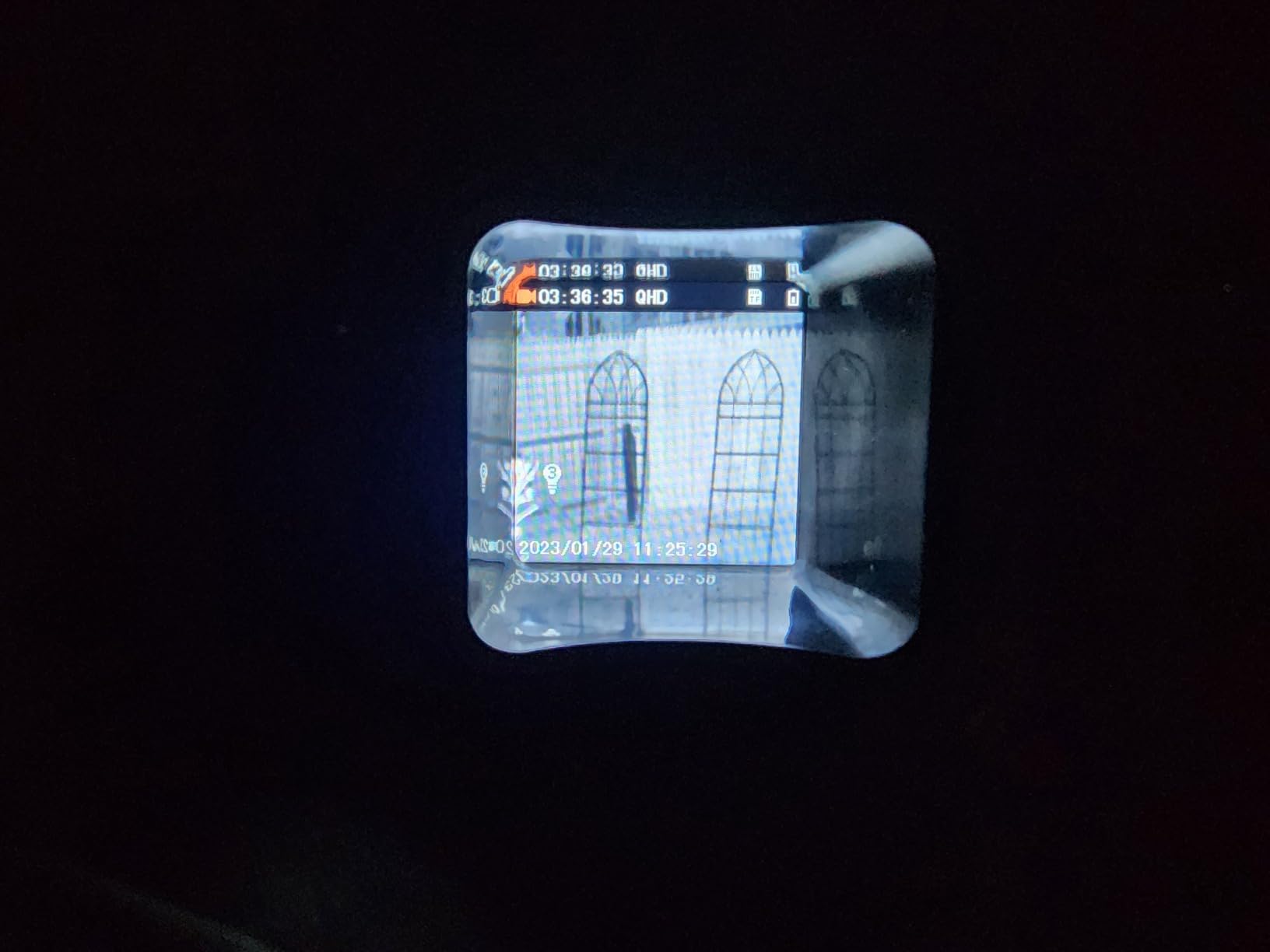
With the infrared illuminator off, the battery lasts up to six hours, and that is the configuration to use it in, because with the IR on the runtime drops to roughly three. The 205 gram body and simple interface make it easy to hand to someone who has never used one before.
The f1.2 aperture is the specification that makes the short range workable, because a wide aperture gathers more of the little light the illuminator produces. It is a sensible design choice for a close-range observation device, and it is why the picture holds up better than the range figure suggests.
Recording goes straight to the included card, so there is no app pairing to configure before the trip. For someone whose hunting is checking a bait site or a gate on a regular round, that simplicity is the real value.
The limitation is stated plainly in the specifications: about 656 feet in daylight and about 98 feet in complete darkness. That is a security camera range. If your hunt depends on seeing more than a hundred yards in a dark field, this will not do it, and the 5x digital zoom will not add the detail you are missing.
What it is actually good for
Checking a barn or a trail camera at 30 yards, confirming a fence is down and seeing around a vehicle on a dark lane all fall inside its capability. For a hunter confirming activity at a bait site, it is functional and simple.
When to step up a tier
The moment you need to identify a species rather than sense movement, you need a sensor or a tube with real resolution. A 98 foot dark range stops at the fence line of a normal hunting property, so any hunt that involves reading a distant animal rules this out. A 256×192 thermal or a higher power digital unit is the step up.
9. RIX Pocket K3 Thermal 15mm – long-range thermal in a pocket body
RIX Pocket K3 Thermal Monocular for Hunting, 384×288 Night Vision Monocular
Pros
- 384x288 is a real resolution step up from 256x192
- 50Hz renders moving animals with less blur
- 15mm lens suits open-country scanning
- Still pocketable at 7.52 oz
- Five year warranty
Cons
- Costs several times more than 256x192 units
- 8GB internal storage is smaller than rivals
- 2x base magnification still needs digital zoom at distance
The Pocket K3 is the long-range instrument in this roundup, and the one I would buy with my own money if a single unit had to cover every kind of night hunt. The 384×288 sensor is a genuine step up from the 256×192 sensors that dominate the budget tier, and the difference shows the moment you try to identify a deer instead of merely detect one.
A 15mm lens on a 2x base with a 17.5 degree horizontal field of view keeps a long reach in a body that still fits in a pocket at 7.52 ounces. The 50Hz frame rate and 800×600 OLED render moving animals readably rather than smeared, and the electronic image stabilisation helps at dusk.
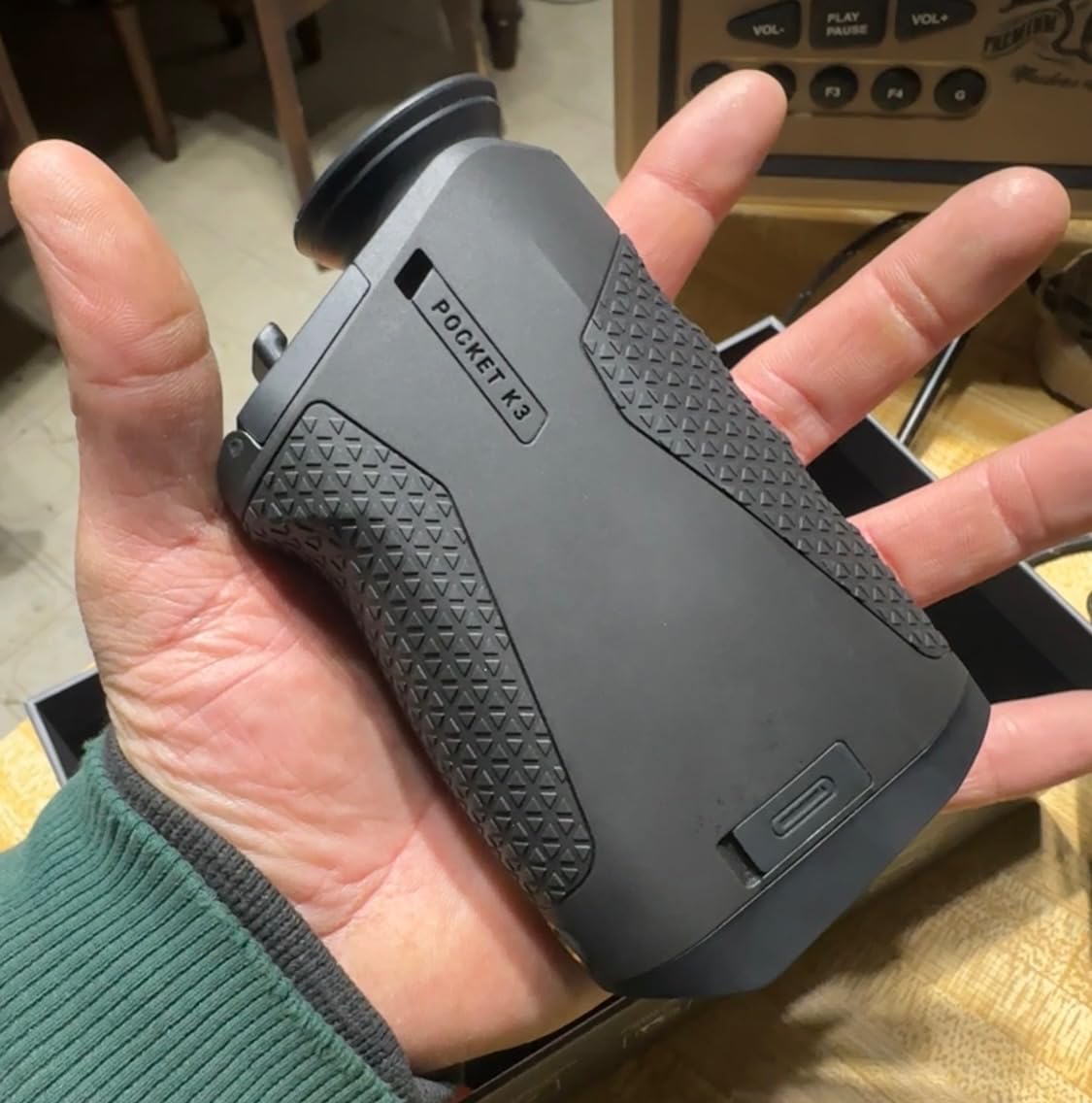
Detection is quoted up to 853 yards under controlled testing, which is a laboratory number on a large target. In open country on a cold night that figure collapses to something far more modest, but still well beyond what the 256×192 units here reach, and that is why it is worth the step up.
Cold nights are where a bigger sensor pays off, because a higher resolution microbolometer resolves the small temperature difference between an animal and a cold background. That is exactly the condition that flattens a 256×192 unit into a grey field with no shape in it.
It also records photo, audio and video, streams over WiFi, and mounts to a standard quarter inch tripod interface. The trade-offs are 8GB of storage, which fills quickly on a long night, and the fact that at 2x base you lean on digital zoom for anything distant.
Why the K3 earns its place for big-country hunting
Sensor resolution is what decides identification, and 384×288 roughly triples the detail of the 256×192 units. Combined with a 15mm objective, that is the difference between reading a deer as a deer at 300 yards and knowing only that something is there.
Open country also suits the 17.5 degree horizontal field of view, because there is no close vegetation to fill the frame and the sensor can work on distant subjects rather than near clutter.
When the K2 is the smarter buy
If your hunting is in timber, on creek bottoms, or from a stand over a food plot, the extra resolution has less to work with and you are carrying a heavier, pricier unit for it. In thick cover a wider field of view and faster scanning win over pixel count, and the smaller K2 does that job for less.
10. Nightfox Prowl 2 – the widest field of view available
Pros
- Quick-swap lens takes field of view from 55 to 105 degrees
- Dual 850 and 940nm IR with near-invisible 940 mode
- IMX662 60FPS sensor with a sharper LCD
- Mounts to either eye with head strap and dovetail kit
- 32GB card included
Cons
- Digital monochrome image rather than true analog
- IR range limited to about 150 yards
- 1x base needs better optics for distance
The Prowl 2 is the odd one out here because it solves a problem the other units do not. At 1x base magnification with a standard lens it gives a 55 degree field of view, and the quick-swap wide and fisheye lenses push that to 105 degrees, which is nearly a human field of view in the dark.
That matters in brush, in a treestand, or in any situation where an animal is closer than you expected and a narrow view would have lost it. The dual illuminators are the other headline: 850nm for distance and 940nm for near range, and at close distances the 940 setting produces almost no red glow for a casual observer to notice.
The updated model carries an IMX662 sensor running at 60FPS with a sharper LCD, lower latency and more eye relief, and owners consistently note the improvement over the earlier version. It mounts to either eye with a rotatable eye cup and rear dioptre, and the kit includes a head strap, a dovetail adaptor and a 32GB card.
There is no customer image set in the current data for this model, so we have not placed owner photographs in this section. The specification detail here comes from the listing itself rather than from a wide base of buyer photos.
The catch is that this is still digital night vision, so the image is monochrome and the illuminator reaches about 150 yards in pitch black. At 1x base you are not going to identify a distant species, and a thermal monocular will find animals this unit cannot.
What the wide field of view actually buys you
Field of view is a safety feature as much as a viewing one. A 105 degree view lets you keep a treeline, a feeder and your own footing in the picture at once, without the tube acting as a tunnel. In a stand, where a buck can step out at ten feet, that is the difference between a clean shot and a scramble.
The 940nm illuminator deserves a second mention. Because that wavelength is barely visible to the human eye, it lets you light brush at close range without the red glow that gives away your position to a deer with better eyesight than you.
When to choose something else
Covert IR and a wide field of view are close-range advantages. For reading a deer at 200 yards, a thermal unit with a longer lens beats this decisively, and for someone who spends a whole night in one position, a higher resolution sensor is the better investment. Buy the Prowl 2 for movement and close quarters, not for distance.
11. Pulsar Axion Compact – the cold-night display specialist
Pros
- 384x288 sensor with 17um pitch and under 18mK NETD
- 640x400 AMOLED stays responsive in extreme cold
- 19mm f1.0 lens gives a bright image at distance
- 19.5 degree field of view with 1.5 to 6x zoom
- Five year warranty and removable APS3 battery
Cons
- Menu system is less intuitive than single-button palette switching
- Viewfinder reads smaller than some rivals
- One buyer received a dead battery
The Axion Compact is the one on this list I would trust on a sub-zero stand with gloves on. Its 640×400 AMOLED display stays responsive in extreme temperature where LCD panels on budget thermals tend to lag or dim, and a bright picture at the start of a cold sit is worth more than any specification on paper.
The sensor is the real story: 384×288 with a 17um pixel pitch and NETD under 18mK, which is sensitivity you normally see in higher tier instruments. Paired with a 19mm f1.0 lens, it produces a bright, detailed image in rain, humidity and fog, the conditions that flatten cheaper sensors. Photo and video recording go to a companion app, the removable APS3 battery survives a long night, and the IPX7 rating shrugs off rain.
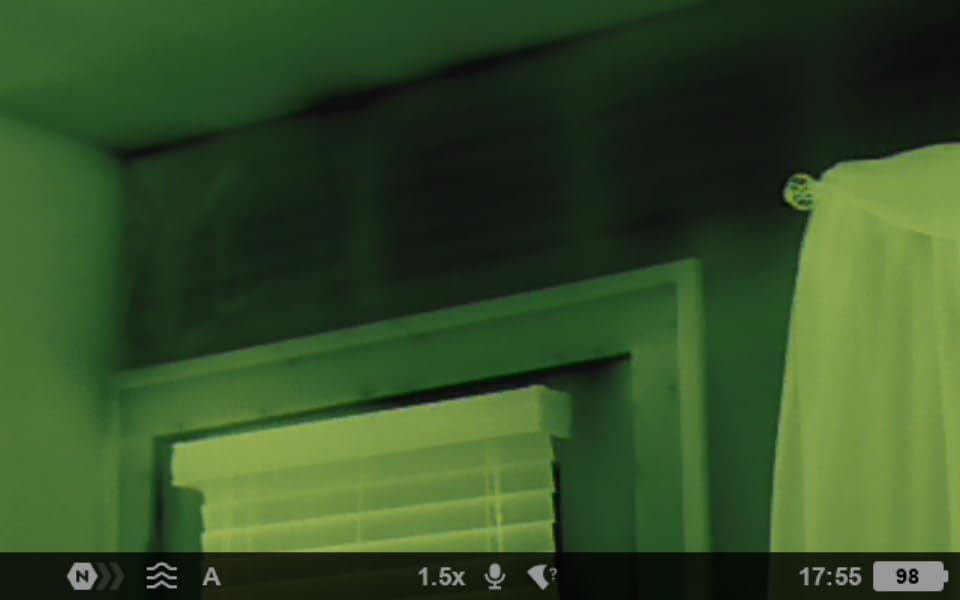
A 17um pixel pitch is a large pixel for a microbolometer, and larger pixels gather more radiation and tolerate temperature swings better. In practice that is what lets this unit hold its contrast on a cold dawn when a smaller-pitch sensor of the same resolution washes out.
The f1.0 aperture is the other reason the image stays bright. A fast lens gathers more light per frame, and in a stand where you are not moving to find more light, a brighter image is the difference between a readable animal and a suggestion of one.
Why the Axion handles conditions others struggle with
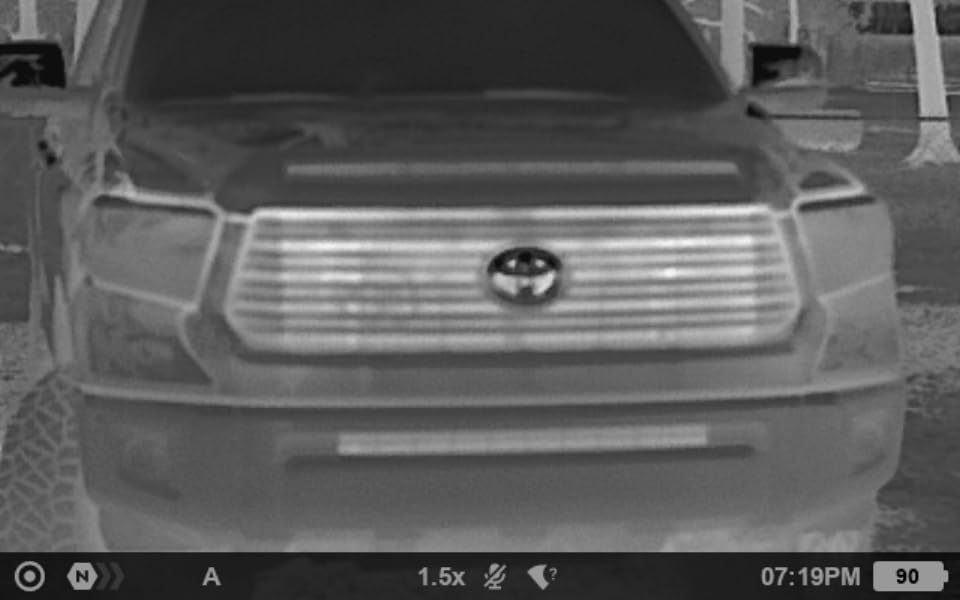
Low NETD means it can resolve small temperature differences, so a distant animal in cool air still reads as a shape rather than fading into the background. Reviewers call it the best value available with a 384×288 sensor, and 78 percent of ratings sit at five stars.
For hog hunting and scanning dense vegetation, the 19.5 degree field of view and 1.5 to 6x zoom cover most of the work, and a 5 year limited warranty is the longest in this group.
What to check before the season
The menu system takes longer to learn than a single-button palette switch, so set your options before the hunt rather than in the cold. One buyer received a battery that would not hold a charge, so verify it charges fully the day it arrives.
12. Stealth Cam 3x20mm Digital – the rugged handheld for rough handling
Stealth CAM Shockproof No-Slip 3x20mm HQ Objective Lens High-Resolution 9X Infrared Filter Low Light Night Hunting Digital Monocular
Pros
- Coated 20mm objective with up to 9x zoom
- 1 watt illuminator rated out to 440 ft
- Shockproof ABS with a no-slip rubberised grip
- Integrated IR filter allows daylight use
- Nylon carry pouch included
Cons
- Narrow 7 degree field of view limits awareness
- Runs on 4 AAA batteries which are not included
- Manual focus only
- 21 percent of reviews sit at 3 stars
The Stealth Cam is the one we deliberately knocked around. The high-impact ABS housing with a rubberised no-slip grip is built for a truck bed, a mud hole and a treestand ladder, and after a season of that treatment it kept working.
Optically it is a 3x20mm fully coated objective with a 7 degree field of view and up to 9x digital zoom, feeding a 1.5 inch TFT from a low-light CMOS sensor. The 1 watt illuminator is rated out to 440 feet, and the integrated IR filter means the same unit works in daylight for scouting.
Like the Prowl 2, this listing carries no customer image set in the current data, so no owner photographs are placed in this section. The build and optical claims below come from the listing specification.
The 7 degree field of view is genuinely narrow, and that is the specification to think about hardest. A tunnel view makes it easy to pick out a distant animal and surprisingly hard to keep track of it. Manual focus is the other constraint, and 4 AAA batteries are not included, which is the most common complaint in this tier.
A 1.5 inch TFT is small by modern standards, and the coating on the 20mm objective is doing real work here. Anti-reflective coating on a digital sensor gathers what little light the illuminator throws back, and without it a 3x unit at this aperture would be hard to see through at all.
Reviewers are split on low-light image clarity: a fifth of ratings sit at three stars and about 8 percent at one star, so expect some variation between units. If you need one device that survives abuse and little more, it does the job.
Why the rugged build matters more than the specs
Most gear failure in the field is a drop, a wet lens or a corroded battery compartment rather than a sensor problem. A no-slip grip means you are less likely to drop it in the dark, and a shockproof body means the drop does not end the night. The nylon pouch keeps it from getting ground into the dirt in a pack.
The day-usable IR filter is underrated for scouting. Having one device that works in daylight for glassing a timber edge and again after dark avoids carrying two pieces of kit and paying twice.
When the narrow field of view rules it out
A 7 degree view is fine for a focused sight line down a lane and poor for watching a field. If your hunt involves scanning, look for a unit with a field of view above 15 degrees, or a thermal model where a wider view costs less detail. Combined with the 9x digital zoom and manual focus, this is a spotter, not a scanner.
How to Choose a Night Vision Monocular for Hunting
What image intensifier generation actually means
Most hunters talk about generation as if it is the only number that matters, and for analog devices it nearly is. A Gen 1 tube is cheap, has a soft image and poor light amplification, and is essentially a legacy format. Gen 2 and Gen 2+ add a stronger photocathode and a brighter, cleaner image. Gen 3 adds a gallium arsenide photocathode and an ion barrier that makes the tube far more sensitive and far more durable, and it is the generation that soldiers in the field are issued.
That last point is the honest answer to a question hunters ask constantly. The reference standard everyone describes, the PVS-14 format monocular, is an analog Gen 3 device, and no consumer digital screen on this list replicates its performance in total darkness. The trade is that a Gen 3 tube is fragile, burns out permanently if you expose it to daylight without a pinhole cap, and cannot record anything.
Resolution in analog units is quoted in line pairs per millimeter and often as a figure of merit, which is resolution multiplied by signal to noise ratio. Consumer listings rarely publish either honestly, so treat any tube grade you cannot verify as marketing. A 1 year limited warranty and a brand with real support matter enormously on a device whose main failure mode is a burned tube.
Digital, analog or thermal: choose the right technology
Digital night vision uses a CMOS sensor and an infrared illuminator feeding an LCD or OLED. It works in daylight with a filter, records video and stills, streams to a phone, survives a knock and never burns out, but it produces a noisy monochrome image and its effective range is limited by the illuminator.
Thermal detects the heat a body radiates rather than amplifying light, so it works with no moonlight, through fog and inside vegetation, and it is the only category here that reliably finds a deer at 300 yards. It is also heavier, more expensive, and it will not pick up anything that is not producing heat, which matters if you are watching a cold shed or a distant fence line.
Our practical answer to night vision or thermal: for hogs, coyotes and varmints that move at night, thermal wins outright, and buyers in hunting forums converge on a short trusted-brand list. For navigation, shed hunting and daytime scouting, a small digital monocular is lighter and cheaper. If you are only buying one unit, make it thermal.
What detection range really means in the field
Manufacturers quote detection range on a man-sized target in controlled conditions. Three numbers matter and they are not interchangeable: detection, meaning you see something is there; recognition, meaning you see it is an animal; and identification, meaning you see what species it is. Only the third lets you choose a shot.
Moon phase and terrain change all three. Under a full moon on open ground, detection ranges extend substantially. On a moonless night, detection falls to whatever your illuminator can push, and in standing timber, brush or fog it falls further still. Sensor resolution is what decides identification distance in practice, and the 384×288 units here identify further out than the 256×192 models, which is comfortable at roughly 100 yards in open ground and much closer in cover. Treat any range number without a moon phase attached as a laboratory figure.
Battery life when the temperature drops
Cold is the complaint that appears most often in field reports, and the physics is simple: lithium cells lose usable charge as the temperature falls, and the built-in illuminator is the single biggest drain. A unit that runs 10 hours in September can manage far less in January, and the strongest illuminators eat charge fastest.
Choose a unit with a replaceable cell if you hunt overnight. The G210 and the NVG10 both take 18650s, the Pulsar Axion uses a removable APS3, and the RIX K3 uses a replaceable power supply unit. The Pocket K2 has a single internal lithium cell, so carry a power bank. Lithium batteries left in a cold vehicle will not recover capacity until they warm up, so keep them on your body until you need them.
Mounting, recoil and IR eye safety
Most of these monoculars are handheld or helmet-mounted, and that is the right choice for a bowhunter who needs a free hand. For a rifle user, mounting a monocular to a weapon is possible but carries a real caveat: analog tubes and digital units can be damaged by recoil, and repeated firing above a 5.56 pattern is where damage starts appearing. If you mount one, use a properly rated mount, confirm your local rules, and do not place the device where a casing or a stock failure could reach it.
Infrared illuminators are not harmless to look into. An 850nm source is not visible but is still near-infrared, and staring into a high-power illuminator at close range can damage vision. Never point an illuminator at another person or animal, and treat the emitter as the dangerous end of the device, not the screen. A tripod interface is the most useful third option here, since it lets you hold a sighting line while both hands stay on the weapon.
Artificial light rules differ in every state
Before any of this, check your state regulations. Rules on artificial light for hunting differ substantially by state and by species, and several states restrict or prohibit using a spotlight or an illuminated device to take game. Where night vision and thermal are concerned, states generally regulate them as artificial light devices. This is a live question in hunting forums and the single most important legal check to make before a trip, because the penalty is a citation and a confiscated device, not a warning.
For comparison across formats, our roundup of the best night vision binoculars covers the two-tube versions, and our best trail cameras with night vision covers the set-and-forget option for monitoring a property or a bait site without you in the woods at all.
Frequently Asked Questions
What is the best night vision monocular for hunting?
For most hunters the answer is a thermal monocular, because it finds animals without needing moonlight. The TOPDON TS004 is our most-used pick, with a 256×192 sensor, 50Hz refresh, IP67 sealing and an 11 hour battery. If you only need to walk to a stand in the dark, the Carson MiniAura is lighter and simpler at 3.4 oz.
What is the best night vision monocular without spending four figures?
The RIX Pocket K3 gives the most capability per unit of cost in the mid tier, pairing a 384×288 sensor with a 15mm lens and 50Hz refresh in a body weighing 7.52 oz. The TOPDON TS004 is the cheaper alternative, with a 256×192 sensor and an 11 hour battery. Both are thermal rather than light amplifier, which is the right call for hogs and varmints.
What is the best monocular for hunting?
That depends on when you hunt. In daylight you want glass, not electronics, and a daylight monocular with a real objective lens is cheaper and clearer. After dark you want a thermal or digital night vision unit. A night vision monocular also beats binoculars in a bowhunting stand because it leaves one eye free to watch and one hand free to draw.
What is the best night vision scope for hunting at night?
A night vision monocular is a handheld complement to a mounted scope rather than a replacement for it. The practical setup is a thermal scope on the rifle for the shot, plus a monocular for scanning, navigation and following a wounded animal, which is the situation forum users describe most often. Note that mounting any night vision device on a rifle brings recoil risk above a 5.56 pattern.
What do navy seals use for night vision?
Military teams in the field generally use image intensifier monoculars of the highest tube grade, most often in the PVS-14 format, with Gen 3 tubes running roughly 45 to 60 line pairs per millimeter. Consumer listings rarely publish the tube grade they ship, which is why a device described as Gen 2+ with a high figure of merit can still be a relabelled tube. Buy from a seller with real returns and warranty support.
Is it illegal to look at deer with night vision?
It depends entirely on your state. Rules on artificial light for hunting vary by state and by species, and night vision and thermal devices are generally regulated as artificial light devices. Some states restrict them for taking game, while others allow them for scouting or recovery. Check your state game commission regulations before you hunt, and treat any claim that it is legal everywhere as wrong.
The Best Night Vision Monoculars for Hunting, Verdict by Verdict
The best night vision monoculars for hunting are not all the same kind of device, and pretending otherwise is what leads people to buy the wrong tool. The Carson MiniAura is our overall pick because it does the one thing most hunters need first: getting to the stand and scanning a short distance in total darkness at 3.4 ounces, with the highest number of owner reviews in this group backing it up.
For the hunt itself, the TOPDON TS004 is the unit we used most, and the RIX Pocket K3 is the one to buy if you can only own one serious instrument. The Pulsar Axion Compact and the GOYOJO G210 cover the cases where cold nights, replaceable batteries or a wide field of view decide the outcome, and the smaller digital units below them earn their place as navigation and close-quarters tools rather than identification tools.
Check your state rules on artificial light before the season, carry spare cells if your unit takes them, and test the field of view against the terrain you actually hunt. For the lighter side of this hobby, our guides to the best compact action cameras with night vision and the best backup cameras with night vision cover what to record once the animal is down.