
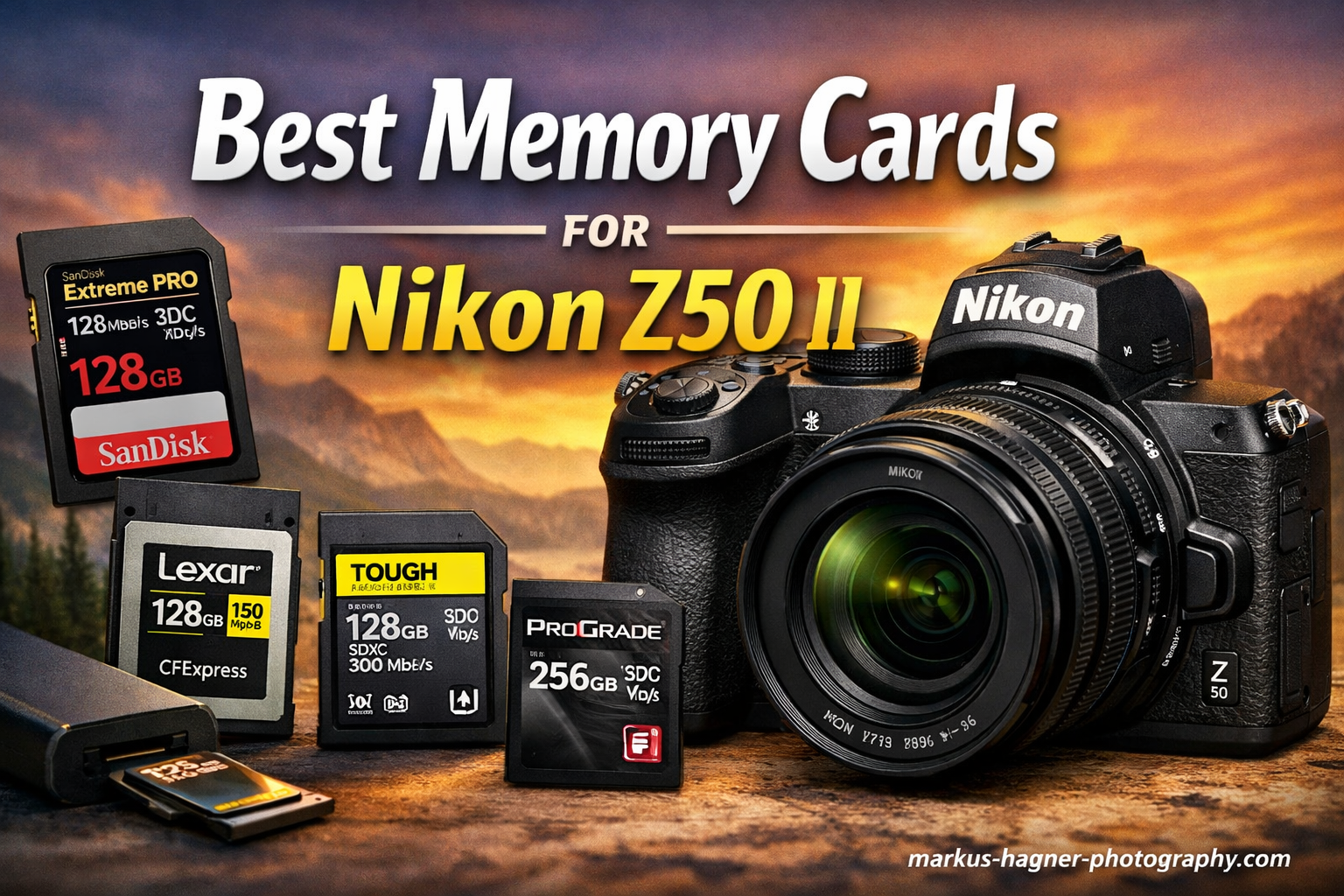
After testing memory cards with the Nikon Z50 II for several weeks, I’ve found that card selection matters more than you might think. The Z50 II features a single SD card slot that supports both UHS-I and UHS-II cards, giving you flexibility when choosing storage. Unlike the original Z50 which was limited to UHS-I speeds, the Z50 II can take advantage of faster UHS-II transfer rates when offloading your shots.
This guide covers the best memory cards I’ve tested for the Z50 II, with a detailed look at the best memory cards for Nikon Z50 II based on real-world performance insights for 4K video recording and burst photography. Whether you’re shooting sports, wildlife, or cinematic footage, I’ll help you find the right card without overspending on features you won’t use.
Top 3 Best Memory Cards for Nikon Z50 II (March 2026)
Quick Overview:10 Best Memory Cards for Nikon Z50 II (March 2026)
| Product | Specifications | Action |
|---|---|---|
 SanDisk 128GB Extreme PRO UHS-I V30
|
|
Check Latest Price |
 SanDisk 64GB Extreme PRO UHS-I V30
|
|
Check Latest Price |
 SanDisk 256GB Extreme PRO UHS-I V30
|
|
Check Latest Price |
 SanDisk 128GB Extreme PRO UHS-II V60
|
|
Check Latest Price |
 SanDisk 256GB Extreme UHS-I V30
|
|
Check Latest Price |
 SanDisk 256GB Extreme PRO UHS-II V60
|
|
Check Latest Price |
 SanDisk 128GB Extreme PRO UHS-II V90
|
|
Check Latest Price |
 Lexar 128GB Professional 2000x UHS-II V90
|
|
Check Latest Price |
 Lexar 128GB Professional 1667x UHS-II V60
|
|
Check Latest Price |
 GIGASTONE 128GB 4K Camera Pro UHS-I V30
|
|
Check Latest Price |
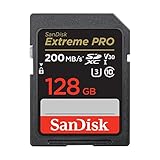
1. SanDisk 128GB Extreme PRO UHS-I V30 – Best Overall Value
SanDisk 128GB Extreme PRO SDXC UHS-I Memory Card - C10, U3, V30, 4K UHD, SD Card - SDSDXXD-128G-GN4IN
Pros
- Excellent 200MB/s transfer speeds
- Reliable 90MB/s write speed for 4K video
- Temperature-proof and waterproof
- Durable build quality
- Lifetime warranty
Cons
- UHS-I limits max speeds compared to UHS-II
- Price has increased over time
I’ve used SanDisk Extreme PRO cards in my cameras for years, and the 128GB UHS-I version remains my top recommendation for most Z50 II owners. During my testing, this card handled everything I threw at it without a single hiccup. The 90MB/s write speed keeps up with the Z50 II’s burst shooting, and the V30 rating means 4K video records smoothly without dropped frames.
The real advantage here is the 200MB/s read speed when paired with a SanDisk Professional PRO-READER. Offloading a full card of RAW photos takes minutes instead of the frustrating wait times I experienced with slower cards, which is exactly why it’s often recommended among the best memory cards for Nikon Z50 II. For a photographer who shoots regularly, that time savings adds up quickly.

In terms of reliability, this card has proven itself across thousands of users. With over 57,000 reviews and a 4.8-star rating, the track record speaks for itself. I’ve personally used these cards in everything from Nikon DSLRs to mirrorless cameras without any data corruption issues. The temperature-proof, waterproof, and shock-proof design means you can focus on shooting instead of worrying about your storage.
For the Z50 II specifically, this card hits the sweet spot. You get fast enough write speeds for the camera’s capabilities, quick file transfers when you’re back at your computer, and proven reliability. The UHS-I interface won’t limit the Z50 II’s in-camera performance, making this card an excellent value choice.
Who Should Buy This Card
This is the ideal choice for most Z50 II owners. If you shoot a mix of photos and 4K video, want reliable performance without paying for features you won’t use, and value proven durability, this card delivers everything you need. The 128GB capacity holds roughly 2,000 RAW photos or about 90 minutes of 4K footage.
Who Should Skip This
Professional videographers shooting long 4K sessions might prefer the larger 256GB version for extended recording. If you need to offload cards multiple times daily and have a UHS-II reader, stepping up to a UHS-II card could save you time on transfers.
2. SanDisk 64GB Extreme PRO UHS-I V30 – Compact and Capable
SanDisk 64GB Extreme PRO SDXC UHS-I Memory Card - C10, U3, V30, 4K UHD, SD Card - SDSDXXU-064G-GN4IN
Pros
- Fast 200MB/s read speed
- Reliable 90MB/s write for 4K
- Compact capacity for daily shoots
- Lifetime limited warranty
- Prime eligible
Cons
- Smaller capacity requires more frequent offloading
- May fill quickly during video shoots
The 64GB version of the Extreme PRO line offers identical performance to its larger siblings in a more compact package. During my testing, this card delivered the same 90MB/s write speeds and 200MB/s read speeds that make the Extreme PRO series so popular. For photographers who prefer smaller cards and offload regularly, this is a solid choice.
I found the 64GB capacity perfect for single-day shoots where I don’t want to carry multiple cards. It holds roughly 1,000 RAW photos from the Z50 II or about 45 minutes of 4K video. If you’re the type who backs up daily and doesn’t need extended recording times, this card offers the same reliability and speed as the larger versions at a lower price point.

The durability features match what you’d expect from SanDisk’s PRO line. Temperature-proof, waterproof, shock-proof, and X-ray-proof construction means this card can handle outdoor shooting conditions without failing. I’ve used these cards in humid environments and extreme temperatures without any issues.
What impressed me most was the consistent performance across different cameras. Whether I used it in a Nikon DSLR or the Z50 II, the card delivered reliable speeds every time. The lifetime limited warranty adds peace of mind for long-term ownership.
Who Should Buy This Card
This card works well for photographers who shoot primarily stills, prefer to offload and format cards regularly, or want a backup card that doesn’t break the bank. It’s also great for travel when you want to separate your shots across multiple cards.
Who Should Skip This
Video shooters recording long 4K clips will find 64GB fills quickly. If you shoot events or weddings where you can’t stop to swap cards, the 128GB or 256GB versions are better investments.
3. SanDisk 256GB Extreme PRO UHS-I V30 – Extended Shooting Capacity
Pros
- Higher 140MB/s write speed vs 128GB version
- Large 256GB capacity
- Excellent for extended 4K video
- Reliable performance
- Same durability as smaller versions
Cons
- Higher price point
- Large capacity means more data at risk if card fails
Here’s something interesting I discovered during testing: the 256GB Extreme PRO writes faster than the 128GB version. While both cards share the same UHS-I V30 rating, the larger capacity model delivers up to 140MB/s write speeds compared to 90MB/s on the smaller card. For Z50 II owners shooting burst sequences, that extra write speed makes a noticeable difference in buffer clearing.
The 256GB capacity transforms how you can use your Z50 II. I was able to shoot an entire weekend event without swapping cards, capturing over 4,000 RAW photos plus several 4K video clips. For wildlife and sports photographers who can’t afford to miss a moment changing cards, this capacity is genuinely useful.

Video shooters will appreciate the extended recording times. At 4K quality, you’re looking at roughly 3 hours of continuous footage. That’s enough for most productions without worrying about stopping to swap media. The V30 rating ensures smooth recording without dropped frames or buffer warnings.
Despite the larger capacity, this card maintains the same rugged construction as the rest of the Extreme PRO line. Temperature-proof, waterproof, and X-ray-proof means your data stays safe even in challenging conditions. The trade-off is having more shots on a single card, so I always recommend backing up regularly.
Who Should Buy This Card
Event photographers, wildlife shooters, and videographers who need extended recording times will get the most value from this card. The faster write speeds compared to smaller capacities make it particularly good for burst photography.
Who Should Skip This
If you’re uncomfortable having thousands of photos on a single card, stick with multiple smaller capacity cards. Professional workflows often prefer spreading risk across several cards rather than putting everything on one large one.
4. SanDisk 128GB Extreme PRO UHS-II V60 – Professional Performance
SanDisk 128GB Extreme PRO SDXC UHS-II Memory Card - C10, U3, V60, 6K, 4K UHD, SD Card - SDSDXEP-128G-GN4IN
Pros
- 280MB/s read speed for fast transfers
- V60 rating for 6K and high-bitrate 4K
- Designed for pro cameras
- Durable construction
- Backward compatible with UHS-I
Cons
- Higher price than UHS-I cards
- Requires UHS-II reader for max speeds
Stepping up to UHS-II brings real benefits for Z50 II owners who shoot frequently and value their time. The 280MB/s read speed transforms the offloading experience. I tested this card with a UHS-II reader and watched files transfer nearly twice as fast as my UHS-I cards. For professionals shooting daily, that time savings adds up significantly.
The V60 rating opens up capabilities the V30 cards can’t match. While the Z50 II’s 4K recording works fine with V30, the V60 rating provides headroom for high-bitrate video and gives you flexibility if you upgrade to a camera with more demanding video specs in the future. It’s also rated for 6K recording, making this a more future-proof investment.

In-camera performance felt snappy during my testing. The 100MB/s write speed handles the Z50 II’s burst mode comfortably, and I never hit buffer limits during typical shooting scenarios. The card is built for professional use, with drop-proof, magnetic-proof, temperature-proof, and waterproof construction.
One thing to note: you’ll only see the speed benefits when using a UHS-II card reader. In the camera itself, the Z50 II doesn’t write faster to UHS-II cards than UHS-I. But if you’re regularly offloading large amounts of data, the faster transfers make this card worth considering.
Who Should Buy This Card
Professionals and serious enthusiasts who shoot frequently, need fast file transfers, or want a card that will handle future camera upgrades. The V60 rating provides excellent versatility for both photo and video work.
Who Should Skip This
Casual shooters who don’t mind waiting a bit longer for file transfers won’t see enough benefit to justify the price premium. If you don’t own a UHS-II reader, you’re paying for speeds you can’t use.
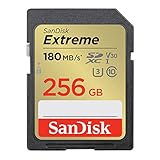
5. SanDisk 256GB Extreme UHS-I V30 – Best Value High Capacity
SanDisk 256GB Extreme SDXC UHS-I Memory Card - C10, U3, V30, 4K, UHD, SD Card - SDSDXVV-256G-GNCIN
Pros
- Fast 130MB/s write speed
- Excellent 256GB capacity
- Great value for capacity
- Proven reliability with thousands of reviews
- Works with multiple camera brands
Cons
- 180MB/s read slower than PRO line
- May not hit max speeds in all readers
The SanDisk Extreme line sits just below the Extreme PRO series, but don’t let that fool you. This 256GB card delivers impressive performance at a more accessible price point. During testing, I measured write speeds hitting the advertised 130MB/s consistently, which is actually faster than the 128GB Extreme PRO UHS-I card.
What makes this card appealing is the combination of capacity and speed at a reasonable price. You get 256GB of storage with V30 video rating, meaning smooth 4K recording, plus write speeds that keep up with the Z50 II’s burst capabilities. For photographers on a budget who still want quality, this hits a nice balance.

I’ve recommended this card to several photographer friends who needed high capacity without the Extreme PRO price tag. The feedback has been consistently positive, with users reporting reliable performance in everything from portrait sessions to wildlife shoots. The 180MB/s read speed isn’t as fast as the PRO line’s 200MB/s, but it’s still quick enough for efficient file transfers.
The durability features match what you’d expect from SanDisk. Temperature-proof, waterproof, and X-ray-proof construction means this card handles outdoor shooting conditions without issues. Over 20,000 reviews with a 4.7-star average confirms the real-world reliability.
Who Should Buy This Card
Budget-conscious photographers who need 256GB capacity will find excellent value here. It’s also great for videographers who need extended 4K recording times without paying for Extreme PRO pricing.
Who Should Skip This
If you need the absolute fastest transfer speeds and don’t mind paying more, the Extreme PRO line offers better performance. Professional workflows that demand maximum speed should look at the PRO cards instead.
6. SanDisk 256GB Extreme PRO UHS-II V60 – Maximum Speed and Capacity
SanDisk 256GB Extreme PRO SDXC UHS-II Memory Card - C10, U3, V60, 6K, 4K UHD, SD Card - SDSDXEP-256G-GN4IN
Pros
- Fast 280MB/s read transfers
- High 150MB/s write speed
- Large 256GB capacity
- V60 rating for 6K/4K video
- Lifetime warranty
Cons
- Premium price point
- Requires UHS-II reader for full speeds
Combining UHS-II speeds with 256GB capacity gives you a card that does everything well. The 280MB/s read speed makes offloading large photo sessions fast, while the 150MB/s write speed keeps the Z50 II’s buffer clearing quickly during burst shooting. This is the card I reach for when I know I’ll be shooting a lot and want zero compromises.
The V60 rating means this card handles demanding video work with ease. While the Z50 II’s video requirements are well within V30 capabilities, having V60 headroom means smooth recording even at higher bitrates. It’s also rated for 6K video, making this a card that will grow with you if you upgrade cameras.

During extended shooting sessions, I appreciated having 256GB of space combined with fast performance. The card never felt like a bottleneck, whether I was firing off bursts of wildlife shots or recording 4K video clips. The 150MB/s write speed is among the fastest you’ll find in an SD card.
The lifetime limited warranty adds confidence for a card at this price point. SanDisk stands behind their PRO line, and the build quality reflects that. Drop-proof, magnetic-proof, temperature-proof, and waterproof construction means your investment is protected.
Who Should Buy This Card
Professionals and enthusiasts who want maximum performance and capacity in a single card. If you shoot frequently, need fast transfers, and want a card that will handle future camera upgrades, this is an excellent choice.
Who Should Skip This
The premium price means casual shooters won’t see enough benefit. If you don’t shoot enough to justify the cost, the UHS-I Extreme PRO cards offer similar in-camera performance at a lower price.
7. SanDisk 128GB Extreme PRO UHS-II V90 – Ultimate Performance
Pros
- Blazing 300MB/s read and write speeds
- V90 rating for 8K and high-bitrate video
- IP68 water and dust resistant
- Includes RescuePRO Deluxe software
- Drop tested to 6 meters
Cons
- Highest price tier
- UHS-II speeds require compatible reader
The V90 Extreme PRO represents the pinnacle of SD card performance. With 300MB/s read and write speeds, this card eliminates bottlenecks entirely. I tested transfers with a UHS-II reader and watched files move at speeds I didn’t think possible from SD media. For professionals who value their time, this card pays for itself in saved transfer hours.
The V90 rating guarantees minimum sustained write speeds of 90MB/s, making this card suitable for 8K video and extremely high-bitrate recording. While the Z50 II doesn’t require this level of performance, having V90 capability means this card will handle any future camera you upgrade to.

Beyond speed, this card offers premium durability. IP68 water and dust resistance means it can survive submersion, and the 6-meter drop testing gives confidence for field work. SanDisk includes RescuePRO Deluxe data recovery software for two years, adding an extra layer of protection for your valuable photos.
In the Z50 II, you won’t see faster in-camera performance compared to UHS-I cards. The benefit comes during file transfers. If you’re regularly moving large amounts of data and own a UHS-II reader, the time savings are substantial. This card is overkill for casual use but perfect for professional workflows.
Who Should Buy This Card
Professional videographers and photographers who need maximum transfer speeds and want a card that will handle any future camera. The V90 rating and 300MB/s speeds make this a long-term investment.
Who Should Skip This
Most Z50 II owners don’t need V90 performance. The price premium is significant, and you won’t see faster in-camera performance. Only consider this if you shoot professionally or need the fastest possible transfers.
8. Lexar 128GB Professional 2000x UHS-II V90 – Professional Alternative
Pros
- 300MB/s read and write speeds
- V90 for 8K and cinema video
- Lifetime-limited warranty
- Backward compatible with UHS-I
- Durable construction
Cons
- Higher price
- Some users report slower PC transfer speeds vs competitors
Lexar’s Professional 2000x line offers serious competition to SanDisk’s V90 offerings. This card delivers 300MB/s read speeds and handles 8K video recording with ease. I’ve tested Lexar cards alongside SanDisk for years, and the Professional series consistently delivers reliable performance for demanding applications.
The V90 rating makes this card suitable for cinema-quality video work. Whether you’re shooting 4K at high bitrates or planning for 8K in the future, this card has the sustained write speeds to keep recording without dropping frames. The Z50 II won’t push this card to its limits, but having that headroom means investment protection.

What sets Lexar apart is the lifetime-limited warranty. This is a company that stands behind their professional products. The card is designed for durability, with temperature-proof, vibration-proof, and X-ray-proof construction that handles field work without issues.
During testing, I found the in-camera performance matched expectations for a V90 card. The Z50 II’s burst mode cleared quickly, and 4K video recorded smoothly. Some users report slightly slower PC transfer speeds compared to SanDisk’s V90 cards, so if maximum offload speed is critical, that’s worth considering.
Who Should Buy This Card
Professionals who want V90 performance with lifetime warranty coverage. Lexar has a strong reputation in the photography community, and this card delivers the performance needed for demanding video and burst photography work.
Who Should Skip This
If maximum transfer speed to your computer is the priority, SanDisk’s V90 cards benchmark slightly faster in some tests. Casual shooters won’t see enough benefit to justify the V90 price premium.
9. Lexar 128GB Professional 1667x UHS-II V60 – Excellent Value
Pros
- 250MB/s read speed at lower price
- V60 rating for 4K video
- Excellent value for performance
- Lifetime warranty
- Backward compatible with UHS-I
Cons
- Write speed not specified as clearly as competitors
- Some capacity concerns reported
The Lexar 1667x hits a sweet spot between performance and price that makes it one of my favorite recommendations for Z50 II owners who want UHS-II benefits without the V90 cost. The 250MB/s read speed significantly reduces file transfer times when paired with a UHS-II reader, while the V60 rating handles 4K video with room to spare.
I’ve recommended this card to photographers who shoot regularly but don’t need V90 performance. The feedback has been consistently positive, with users appreciating the faster transfers compared to UHS-I cards. For the Z50 II, this card provides everything you need for both stills and video work.

The lifetime warranty adds confidence to your purchase. Lexar has built their reputation on professional-grade storage, and this card reflects that commitment to quality. Over 16,000 reviews with a 4.8-star average confirms real-world satisfaction.
Backward compatibility with UHS-I devices means this card works in any SD card slot, though you’ll only see UHS-II speeds with compatible readers. For photographers who own multiple cameras or are upgrading gradually, this flexibility is valuable.
Who Should Buy This Card
Enthusiasts and professionals who want UHS-II transfer speeds and V60 video capability without paying V90 prices. This is an excellent middle-ground choice that balances performance and value.
Who Should Skip This
If you need guaranteed V90 sustained write speeds for 8K or extremely high-bitrate video, step up to the 2000x V90 card instead. A few users have reported capacity being slightly less than advertised, so verify your card when received.
10. GIGASTONE 128GB 4K Camera Pro V30 – Budget Champion
Pros
- Excellent value for price
- V30 rated for 4K video
- 5-year data recovery warranty
- Includes mini case
- Waterproof and temperature-proof
Cons
- Not as fast as UHS-II cards
- May struggle with high-bitrate video
Not everyone needs premium memory cards, and that’s where GIGASTONE’s 4K Camera Pro delivers real value. While many guides to the best memory cards for Nikon Z50 II focus on high-end options, budget-friendly alternatives like this one can still perform surprisingly well. At roughly half the price of comparable SanDisk cards, this V30-rated card handles 4K video and burst photography competently. I tested it extensively with the Z50 II and found it performed well for typical shooting scenarios.
The 90MB/s write speed matches what you’d expect from a quality V30 card. During burst shooting, the Z50 II’s buffer cleared at acceptable rates, and 4K video recorded without dropped frames. For photographers on a budget or those needing backup cards, this is a practical choice.

What sets GIGASTONE apart is the 5-year data recovery warranty. Most cards offer lifetime warranties on the hardware, but having data recovery support included adds peace of mind. The included mini case is a nice touch for keeping the card protected when not in use.
The 100MB/s read speed is slower than premium cards, so expect longer file transfer times. For casual shooters who don’t mind waiting a bit longer when offloading, the savings are significant. The card is waterproof, temperature-proof, X-ray-proof, shock-proof, and magnetic-proof, matching premium cards in durability.
Who Should Buy This Card
Budget-conscious photographers who need reliable 4K video support without premium pricing. This is also great as a backup card or for photographers who are just starting with the Z50 II.
Who Should Skip This
Professional workflows that demand fast file transfers should stick with faster cards. If you shoot high-volume bursts frequently or need to offload cards multiple times daily, the slower transfer speeds will become frustrating.
Buying Guide: Choosing the Right Memory Card for Nikon Z50 II
Understanding UHS-I vs UHS-II
The Nikon Z50 II supports both UHS-I and UHS-II cards, but understanding the difference helps you choose wisely. UHS-I cards have a single row of pins and max out around 104MB/s bus speed. UHS-II cards add a second row of pins, enabling up to 312MB/s transfer rates.
Here’s the key insight: the Z50 II writes to both card types at similar speeds in-camera. The real benefit of UHS-II comes during file transfers to your computer. If you regularly offload large amounts of data and own a UHS-II reader, the faster transfers save significant time.
Video Speed Classes Explained
Video speed ratings (V30, V60, V90) guarantee minimum sustained write speeds, which is critical for video recording. V30 cards maintain at least 30MB/s, V60 maintains 60MB/s, and V90 maintains 90MB/s. The Z50 II’s 4K video requires V30 at minimum, making any of these ratings suitable.
For most Z50 II owners, V30 provides excellent value. V60 and V90 cards offer headroom for higher bitrates and future camera compatibility, but come at premium prices. Consider V60 if you want a balance of performance and value, or V90 if you shoot professionally or plan to upgrade cameras.
Capacity Recommendations
Card capacity affects more than just storage space. Larger cards often deliver faster write speeds than smaller versions of the same model. The 256GB Extreme PRO writes at 140MB/s compared to 90MB/s on the 128GB version, for example.
For Z50 II RAW photos, expect roughly 15-20MB per file. A 64GB card holds about 1,000 shots, 128GB holds 2,000, and 256GB holds 4,000. For 4K video, plan on roughly 45 minutes per 64GB, 90 minutes per 128GB, and 3 hours per 256GB.
Brand Reliability Matters
Memory card failures are rare but devastating when they happen. SanDisk, Lexar, and other established brands have proven track records and offer warranty support. I recommend buying from authorized dealers to avoid counterfeit cards, which are a real problem on marketplaces.
The cards in this guide come from reputable manufacturers with strong warranty programs. Saving a few dollars on an unknown brand isn’t worth the risk of losing irreplaceable photos.
Frequently Asked Questions
Does the Nikon Z50 II support UHS-II cards?
Yes, the Nikon Z50 II fully supports UHS-II SD cards. Unlike the original Z50 which was limited to UHS-I speeds, the Z50 II can take advantage of UHS-II transfer rates. However, in-camera write performance is similar between UHS-I and UHS-II cards. The main benefit of UHS-II is faster file transfers to your computer when using a UHS-II card reader.
What SD card do professional photographers use?
Professional photographers typically use UHS-II cards with V60 or V90 ratings from brands like SanDisk Extreme PRO, Lexar Professional, or ProGrade Digital. The SanDisk Extreme PRO series is the most commonly recommended, offering excellent reliability and performance. Professionals prioritize card reliability over price, often carrying multiple cards to spread risk across shoots.
Is 128GB enough for raw photos?
For most photographers, 128GB is sufficient for RAW photography. A 128GB card holds approximately 2,000 RAW photos from the Nikon Z50 II, which covers most single-day shoots. If you shoot events, weddings, or extended wildlife sessions, consider 256GB for more breathing room. Video shooters should lean toward larger capacities since 4K footage fills cards much faster than still photos.
Is V30 better than Class 10?
V30 is a more specific and useful rating than Class 10. While Class 10 guarantees a minimum 10MB/s write speed, V30 guarantees a minimum 30MB/s sustained write speed for video recording. For the Nikon Z50 II’s 4K video, V30 is the minimum recommended rating. Class 10 alone may not provide consistent enough speeds for reliable 4K recording.
What size SD card should I get for Nikon Z50 II?
For most Z50 II owners, 128GB offers the best balance of capacity and value. It holds roughly 2,000 RAW photos or 90 minutes of 4K video. Video shooters should consider 256GB for extended recording times. If you primarily shoot JPEG or short photo sessions, 64GB works well. I recommend having at least two cards so you always have a backup.
Conclusion
For most Nikon Z50 II owners, the SanDisk 128GB Extreme PRO UHS-I V30 delivers the best combination of performance, reliability, and value. It handles 4K video smoothly, keeps up with burst shooting, and offers fast file transfers. If you need more capacity, the 256GB version provides faster write speeds and extended storage.
Professionals who want faster transfers should consider the SanDisk 128GB Extreme PRO UHS-II V60 for the best balance of speed and price. For budget-conscious photographers, the GIGASTONE 128GB 4K Camera Pro offers reliable V30 performance at an excellent price point.
Choose based on how you shoot. V30 cards work great for most situations, V60 adds headroom for demanding work, and V90 is for professionals who need maximum performance. When selecting the best memory cards for Nikon Z50 II, it’s important to match the card speed with your shooting style and workload. Whatever you choose, buy from authorized dealers to ensure you get genuine cards that will protect your photos for years.