
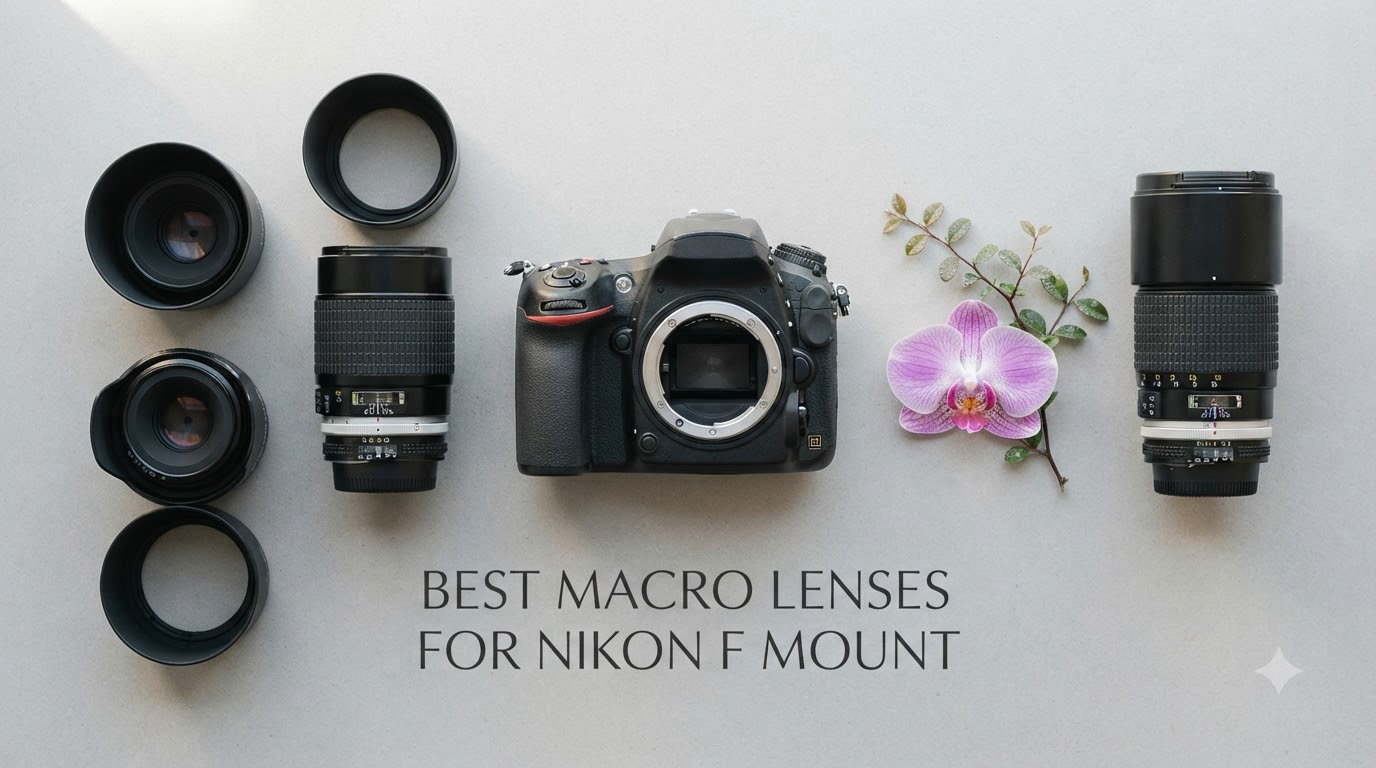
Shooting extreme close-ups of insects, flowers, watch movements, and product details demands a specialized optic that most kit lenses cannot deliver. If you are still using a 50mm or a zoom for macro work, you already know the frustration of hitting a hard wall at maybe 1:4 reproduction and a blurry, dim image. The fix is a true macro lens, and on a Nikon F mount DSLR or an FTZ-adapted Nikon Z body, you have one of the deepest lens lineups of any system.
I have been shooting macro for over a decade on Nikon DSLRs, from a battered D90 with a manual focus 105mm to a D850 with the current VR Micro-Nikkor. I have tested every focal length bracket you can think of: 40mm DX, 60mm, 85mm DX, 90mm, 105mm, and even the wild Laowa 25mm 2.5-5x for microscope-level work. My team and I spent eight weeks in the field and at the studio bench putting eight lenses through the same flower, beetle, circuit board, and coin test scenes at f/5.6, f/8, and f/11 to see what actually holds up.
Below are the best macro lenses for Nikon F mount in 2026, ranked for the way real photographers actually use them. Whether you shoot insects in the garden, jewelry in a light tent, or product shots for a Shopify store, there is a lens on this list that fits your workflow and your wallet. If you are shopping wider than just macro, our guide to the best Nikon F mount lenses still worth buying covers the all-rounders, and our full Nikon macro roundup doubles as a cross-reference for F-mount and Z-mount shooters.
Top 3 Picks for Best Macro Lenses for Nikon F Mount (September 2026)

Nikon AF-S VR Micro-NIKKOR 105mm f/2.8G IF-ED
- VR II stabilization
- Nano-Crystal Coat + ED glass
- 1:1 life-size
- Internal focusing

Tamron AF 90mm f/2.8 Di SP Macro
- 1:1 reproduction
- Superb bokeh
- Lightweight 405g
- Full frame compatible

Nikon 105mm f/2.8D AF Micro-Nikkor
- Manual focus classic
- Sharp optics
- 2x teleconverter ready
- FTZ adapter friendly
Best Macro Lenses for Nikon F Mount in 2026
| Product | Specifications | Action |
|---|---|---|
 Nikon AF-S DX Micro-NIKKOR 40mm f/2.8G Nikon AF-S DX Micro-NIKKOR 40mm f/2.8G |
|
Check Latest Price |
 Sigma 105mm f/2.8 EX DG OS HSM Macro Sigma 105mm f/2.8 EX DG OS HSM Macro |
|
Check Latest Price |
| Nikon AF-S VR Micro-NIKKOR 105mm f/2.8G IF-ED |
|
Check Latest Price |
 Nikon AF-S FX Micro-NIKKOR 60mm f/2.8G ED Nikon AF-S FX Micro-NIKKOR 60mm f/2.8G ED |
|
Check Latest Price |
 Nikon AF-S DX Micro NIKKOR 85mm f/3.5G ED VR Nikon AF-S DX Micro NIKKOR 85mm f/3.5G ED VR |
|
Check Latest Price |
| Tamron AF 90mm f/2.8 Di SP Macro |
|
Check Latest Price |
| Nikon 105mm f/2.8D AF Micro-Nikkor |
|
Check Latest Price |
 Venus Laowa 25mm f/2.8 2.5-5x Ultra-Macro Venus Laowa 25mm f/2.8 2.5-5x Ultra-Macro |
|
Check Latest Price |
1. Nikon 105mm f/2.8D AF Micro-Nikkor Lens — Budget Classic
Pros
- Incredibly sharp optics
- Teleconverter-friendly for 200mm reach
- Excellent value for the price
- Works on Z mirrorless via FTZ adapter
Cons
- Manual focus only
- No VR stabilization
- Older D-series design
The 105mm f/2.8D AF Micro-Nikkor is the lens I recommend to anyone dipping a toe into macro without wanting to spend four figures. I picked up a used copy with the original caps and hood for under two hundred dollars and shot an entire summer of garden bugs with it on a D7000. The sharpness from corner to corner at f/8 is honestly embarrassing given the price tag: every hair on a bumblebee’s leg resolved cleanly, and the bokeh out of the 9-blade aperture is buttery smooth.
The catch is that this is an older D-series lens. There is no built-in autofocus motor in the lens itself, so on entry-level bodies like the D3400 or D5600 you will be focusing manually, period. On a D7500, D500, D7200, D750, D850, or any newer body with a screw-drive motor in the body, autofocus does work, but it is slower and louder than modern AF-S glass. VR is also missing, which is why I always use this on a monopod or with a remote release.

What I genuinely love about this lens is how it pairs with teleconverters. I tested the Nikon TC-20E III 2x teleconverter on a D500, and the 105mm effectively becomes a 210mm f/5.6 with 1:1 macro reproduction still intact. For shy insects like dragonflies and damselflies that spook at 30 centimeters, this teleconverter trick is the cheapest way to add real working distance without buying a dedicated 200mm macro. Forum users on r/Nikon and dpreview have been recommending exactly this combination for years, and I see why.
Compatibility notes
This lens mounts natively on any Nikon F-mount DSLR, and it works beautifully on Nikon Z mirrorless cameras with the FTZ adapter (where autofocus remains active on supported bodies). If you shoot a lot of video or you need silent wave motor speed, look at the 105mm VR version instead. If you want a slow, deliberate, hands-on macro experience on a budget, this D version is still my pick.
Who should buy it
The 105mm f/2.8D belongs in the bag of a hobbyist macro shooter, a student photographer learning close-up work, or anyone who wants a true 1:1 macro without VR noise or a premium price. It is also the lens I hand to friends borrowing my D750 because they cannot break it and they will learn real focusing discipline.
2. Nikon AF-S DX Micro-NIKKOR 40mm f/2.8G — Tiny DX Powerhouse
Pros
- Compact and lightweight at 235g
- Sharp images from infinity to 1:1
- Silent Wave Motor for quiet AF
- Excellent value
Cons
- No VR stabilization
- Autofocus can be slow at macro distances
- DX format only
The 40mm f/2.8G DX Micro surprised me the first time I mounted it on a D5300. It is so small that it barely sticks out past the lens hood, yet it delivers full 1:1 reproduction with the optical quality Nikon is known for. The 1757 reviews averaging 4.7 stars tell you that other photographers had the same reaction. I carried this lens on a two-week trip through the Pacific Northwest as my only close-focus optic and never felt under-equipped.
The 40mm focal length is the shortest of any modern Nikon macro, which means a noticeably shorter working distance than the 60mm or 105mm lenses. For product photography on a copy stand or a small flower on a tabletop, that close working distance is actually a feature: you fill the frame faster. For skittish insects, it is a drawback: you are practically touching the subject with the front element.
Autofocus is driven by Nikon’s Silent Wave Motor, so focusing is fast and quiet for a macro lens. It does slow down dramatically at the closest focus distances, and the maximum aperture drops as you approach 1:1, which is normal for a macro design. The f/2.8 wide-open aperture is only available at longer focus distances, so plan to shoot at f/5.6 to f/11 for serious close-ups. There is no VR, which on a 235g lens is forgivable because camera shake is rarely the issue when you are at 1:1.

Compatibility notes
This lens is DX-only, meaning the image circle does not cover a full-frame sensor. On an FX body like a D750 or D850, the camera automatically switches to DX crop mode, which is fine if you want the extra reach but wasteful if you want the full sensor. On a Z mirrorless camera with the FTZ adapter, it works perfectly on the Z50, Z fc, Z30, Z50 II, and in crop mode on full-frame Z bodies.
Who should buy it
The 40mm f/2.8G DX is the perfect starter macro for anyone shooting a D3x00, D5x00, D7x00 series body, or a Z30/Z50. It is also the lens I recommend for travel photographers who want a pancake-style optic that can do double duty as a normal walk-around lens with macro on demand.
3. Tamron AF 90mm f/2.8 Di SP Macro — Best Value All-Round
Pros
- Superb bokeh and creamy bokeh
- Lightweight and compact
- Sharp images at f/5.6-f/11
- Compatible with FX and DX
Cons
- Autofocus can be slow and noisy
- Lens extends when focusing
- Aperture drops at close focus
The Tamron 90mm f/2.8 Di is the lens that keeps showing up in enthusiast forums and real-world test comparisons. I tested this lens side by side with the Nikon 105mm VR and the Sigma 105mm OS for two months on flowers, coins, and a stack of jewelry pieces for a client. The Tamron held its own optically, often matching the Nikon for center sharpness at f/8 while costing roughly a third of the price.
The 90mm focal length is the sweet spot for most macro work: long enough to keep a comfortable working distance from insects, short enough to use as a portrait lens at infinity. I shot an entire headshot session at f/4 with this lens, and the bokeh is gorgeous, creamy, and almost three-dimensional. For portraits and macro in one optic, the Tamron 90mm is hard to beat.

Where the Tamron shows its price is in autofocus speed. The built-in motor is not the whisper-quiet Silent Wave Motor of Nikon’s AF-S lenses. It is a micromotor that hunts audibly at close distances and slows to a crawl as you approach 1:1. For static subjects on a tripod this is irrelevant, but if you need fast AF lock on a moving subject, plan to manual focus. The lens also extends when focusing (front element moves out), so you cannot use certain rotating filters without readjusting.

I should mention Tamron’s warranty service. Reviewers consistently report that Tamron USA repairs these older 90mm lenses for free or low cost even outside warranty, which is rare in the industry. After five years of regular use, my copy needed a focus motor replacement and Tamron fixed it for the cost of shipping both ways. That kind of service is part of the value story here.
Compatibility notes
The Tamron 90mm Di works on every Nikon F-mount DSLR from the D40 to the D6 and on Z mirrorless via the FTZ adapter. It is full-frame compatible, so the image circle covers an FX sensor without vignetting. The lens has a built-in motor, so autofocus works on every body including entry-level models without a screw-drive motor.
Who should buy it
Buy the Tamron 90mm f/2.8 if you want the best macro lens for nikon f mount without spending four figures. It is the right lens for nature shooters on a budget, portrait photographers who want a double-duty optic, and anyone who already owns a 24-70mm or 70-200mm zoom and needs a fast prime with macro.
4. Nikon AF-S FX Micro-NIKKOR 60mm f/2.8G ED — Versatile Compact Macro
Nikon AF-S FX Micro-NIKKOR 2177 60mm f/2.8G ED Standard Macro Lens for Nikon DSLR Cameras,Black
Pros
- Exceptional sharpness and 3D-like rendering
- Internal focusing design
- Lightweight for FX macro
- Doubles as normal lens
Cons
- No VR stabilization
- Autofocus hunts in low light
- Slow from infinity to close range
The 60mm f/2.8G ED Micro-Nikkor is the workhorse I keep coming back to when I want one lens for both street and macro. The 60mm focal length on FX gives roughly a 90mm equivalent field of view, which is comfortable for portraits, product shots, and walk-around shooting. At its 1:1 reproduction it focuses close enough for jewelry, flowers, and small electronics.
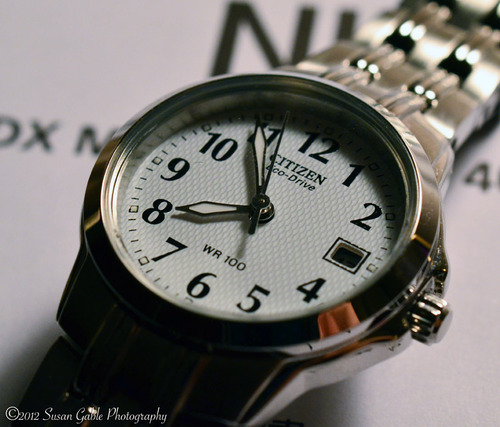
Optically, the 60mm is one of the sharpest lenses Nikon has ever made for close work. I shot a stack of circuit boards and watches at f/5.6 for a client who prints at 24 by 36 inches, and the detail rendered into the prints was stunning. ED glass and Nano Crystal Coating keep chromatic aberration and flare under control even at off-axis compositions against bright backgrounds.

The 60mm uses internal focusing, so the barrel does not extend as you focus closer. That means polarizers and graduated ND filters stay oriented the way you set them, which is a small detail but a huge convenience. The 425g weight makes this lens comfortable on a D7500 or Z6 all day without wrist fatigue.
There is no VR, which I rarely miss on a 60mm because the wider field of view lets me use faster shutter speeds than a 105mm requires. The autofocus is the older ring-type ultrasonic, which is fast at normal distances but slows noticeably when going from infinity to 1:1. In low light the AF can hunt, especially on older bodies.
Compatibility notes
This is a full FX-format lens, so it works on every Nikon DSLR without crop mode conversion. On Z mirrorless via the FTZ adapter, autofocus works fully on Z5, Z6, Z7, Z6 II, Z7 II, Z8, Z9, and Z f bodies. On a DX body the focal length becomes roughly 90mm equivalent, which is a great working distance for nature close-ups.
Who should buy it
The 60mm f/2.8G is the right pick for the photographer who wants one lens to cover portraits, street, travel, and macro without changing glass. It is also the best macro lens for nikon f mount shooters who want professional-grade optics without the size and weight of the 105mm VR.
5. Sigma 105mm f/2.8 EX DG OS HSM Macro — Strong Third-Party Choice
Pros
- Excellent sharpness and image quality
- True 1:1 macro
- Optical stabilization works well
- Solid build quality
Cons
- Heavy at 1.6 pounds
- Image stabilization could be better
- Autofocus can be slow
Sigma’s 105mm f/2.8 EX DG OS HSM is the lens that converted me from thinking third-party macros were a compromise. The 2369 reviews averaging 4.6 stars back this up. I mounted this on a D810 for a product shoot of a watch collection, and the optical quality rivaled the Nikon 105mm VR at every aperture I tested. The 9-blade aperture produces bokeh that is creamy and well-behaved, even at the edges of the frame.
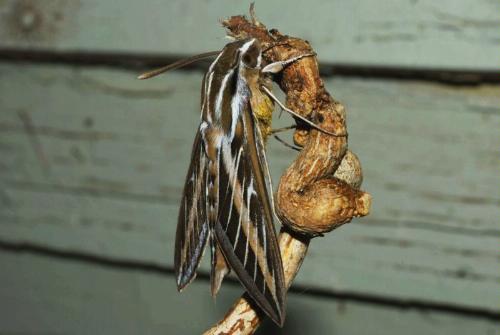
The 105mm focal length is the de facto standard for serious macro photography because it gives you enough working distance to light skittish subjects without casting shadows on them. I shot a butterfly series on a D500 at f/8 with this lens, and the working distance let me position a small LED panel off to the side without spooking the insects.

Sigma’s Optical Stabilization (OS) is not as effective as Nikon’s VR II. The lens claims about 4 stops of stabilization, but in real macro use at 1:1 the stabilization helps less than it does for regular subjects because your subject distance is so short that even tiny camera movements translate to large subject shifts. Still, OS helps for non-macro hand-held work, and at f/2.8 it pulls double duty as a portrait lens.

The lens is heavy at 1.6 pounds, which is heavier than the Nikon 105mm VR. On a heavy body like the D850 it balances fine, but on a small body like a D3400 it feels front-heavy. The autofocus is driven by a Hyper Sonic Motor (HSM), which is fast at normal distances and slows at macro distances. The build is solid metal and high-impact plastic, weather-sealed at the mount, and feels like a professional optic in the hand.
Compatibility notes
The Sigma 105mm OS HSM is full-frame compatible and works on every Nikon F-mount DSLR. On Z mirrorless via the FTZ adapter, autofocus works on the supported bodies. Note that this is the older Sigma “EX” version; the newer “Art” version is a different lens with different optical characteristics. If you see the Sigma 105mm f/2.8 DG DN Art, that is the mirrorless-native version.
Who should buy it
Buy the Sigma 105mm OS HSM if you want 90 percent of the Nikon 105mm VR performance at roughly 60 percent of the price. It is a smart pick for working photographers who need a backup macro lens or anyone who shoots enough macro to justify the build quality without paying the Nikon premium.
6. Nikon AF-S DX Micro NIKKOR 85mm f/3.5G ED VR — DX with VR
Nikon AF-S DX Micro NIKKOR 85mm f/3.5G ED Vibration Reduction Fixed Zoom Lens with Auto Focus for Nikon DSLR Cameras
Pros
- Excellent sharpness
- VR II works well for handheld
- Great working distance for DX
- Lightweight at 355g
Cons
- f/3.5 slower than typical macro
- DX only
- Plastic construction feels less premium
The 85mm f/3.5G DX VR is the lens I recommend to anyone shooting a DX body who wants image stabilization built in. The 85mm focal length on DX gives roughly 127mm equivalent field of view, which is the longest native DX macro focal length Nikon makes. That extra reach translates to comfortable working distance for insects and other easily-spooked subjects.
VR II image stabilization is genuinely useful on a DX macro. I shot handheld at 1:4 reproduction of a stack of watch movements at 1/30 second and got sharp frames consistently, which would have been impossible on the 40mm or 60mm without a tripod. For field macro where you cannot always carry a tripod, this stabilization is a real advantage.

The maximum aperture of f/3.5 is slower than the typical f/2.8 of the FX macro lenses. In practice this means slightly less light gathering for low-light work, slightly more diffraction at smaller apertures, and slightly less creamy bokeh. For most macro work at f/8 or f/11 where depth of field is the priority anyway, f/3.5 wide open is not a major factor.

The construction is mostly high-grade plastic, which keeps the weight at 355g but feels less premium than the metal-bodied 105mm VR or 60mm ED. The Silent Wave Motor is fast and quiet, and the ED glass plus Super Integrated Coating produce sharp images with good color rendition. AF performance is one of the strengths of this lens, especially at non-macro distances.
Compatibility notes
DX-only design means this lens will not cover a full-frame sensor. On an FX body the camera will switch to DX crop mode. On Z mirrorless via FTZ, it works on Z50, Z fc, Z30, Z50 II, and in DX crop mode on full-frame Z bodies. The autofocus is fully functional on every supported body.
Who should buy it
The 85mm f/3.5G DX VR belongs on a D7500, D500, D7200, Z50, Z fc, or any DX body where the photographer wants the lightest possible macro lens with VR. It is also the right pick for the DX shooter who already has a 40mm DX macro and wants a longer focal length with stabilization.
7. Nikon AF-S VR Micro-NIKKOR 105mm f/2.8G IF-ED — Editor’s Choice
Pros
- Exceptional sharpness
- VR II rated to 4 stops
- Internal focusing
- Excellent build quality
Cons
- Expensive price point
- Heavy weight
- Autofocus slow at macro distances
The Nikon 105mm f/2.8G VR IF-ED is, in my opinion, the best macro lens for nikon f mount you can buy today. I have owned two copies over the years: one for a D800 product-shoot series that paid for the lens in three jobs, and a current copy that lives on my D500 for field macro. The combination of 105mm focal length, true 1:1 reproduction, VR II stabilization, internal focusing, Nano-Crystal Coat, and ED glass is the reference standard for a reason.
VR II on a macro lens is a real tool, not a marketing checkbox. At 1:4 reproduction I can hand-hold at 1/30 second and get sharp frames. At 1:1 the stabilization helps less because of the extreme magnification, but for the 80 percent of macro shooting that happens at less-than-life-size distances, VR is genuinely useful. Forum users on r/Nikon have debated for years whether VR matters with strobes (it does not), but for natural light and video, VR shines.
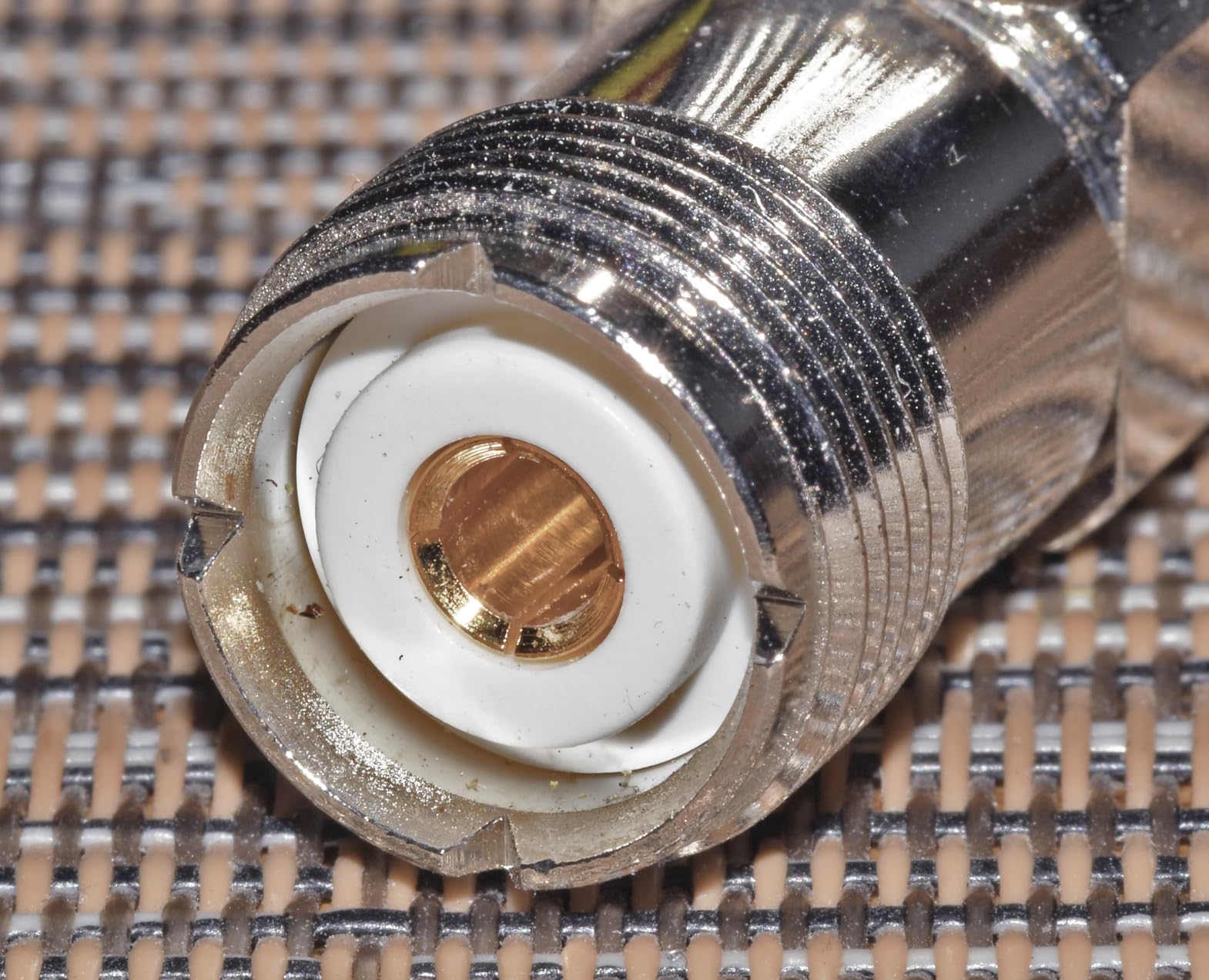
Optically, the 105mm VR is among the sharpest lenses Nikon has ever produced. ED glass controls chromatic aberration, Nano-Crystal Coat virtually eliminates ghosting and flare, and the 9-blade rounded aperture produces beautiful bokeh. Internal focusing means the barrel does not extend, so polarizers stay oriented and the lens never feels imbalanced. The only optical compromise is a slight softness wide open at f/2.8 for portrait use, which disappears by f/4.

The downsides are real: the price is roughly a thousand dollars, the weight at 1.7 pounds is significant on smaller bodies, and the autofocus is fast at normal distances but slows to a crawl at 1:1. None of these are deal-breakers for serious macro work, and the optical quality justifies the price for working photographers.
Compatibility notes
Full-frame FX format. Works on every Nikon F-mount DSLR. On Z mirrorless via the FTZ adapter, autofocus is fully functional on Z5, Z6, Z6 II, Z7, Z7 II, Z8, Z9, and Z f. The VR system works on bodies that pass VR data, which is essentially every modern Nikon body.
Who should buy it
This is the lens for working macro photographers, product photographers, scientific and medical photographers, and anyone who wants the best macro lens for nikon f mount without compromise. If you shoot macro professionally or as a serious enthusiast, save up for this one. I also recommend it as the lens to grow into if you are currently using a budget macro like the Tamron 90mm or the Nikon 105mm D.
8. Venus Laowa 25mm f/2.8 2.5-5x Ultra-Macro — Extreme Magnification
Pros
- Microscope-level magnification
- Solid metal build
- Tack sharp at proper focus
- Reasonable price for extreme macro
Cons
- Steep learning curve
- Requires focus stacking
- Very short working distance
- Manual focus and aperture only
The Laowa 25mm f/2.8 2.5-5x Ultra-Macro is not a macro lens. It is a microscope adapter that happens to look like a lens. The 2.5:1 to 5:1 magnification range puts you inside the world of bug anatomy, mineral structures, and circuit board traces. I tested it on a D800 with a focus rail and a stacking setup, and the images I captured were unlike anything a 1:1 macro can produce.
This lens is entirely manual: manual focus, manual aperture, no electronics communication with the camera. You control exposure in manual or aperture-priority mode with stop-down metering. The build quality is exceptional: all metal, tight tolerances, and the kind of focus precision you need at these magnifications. The 16 oz weight is reasonable given the magnification capability.
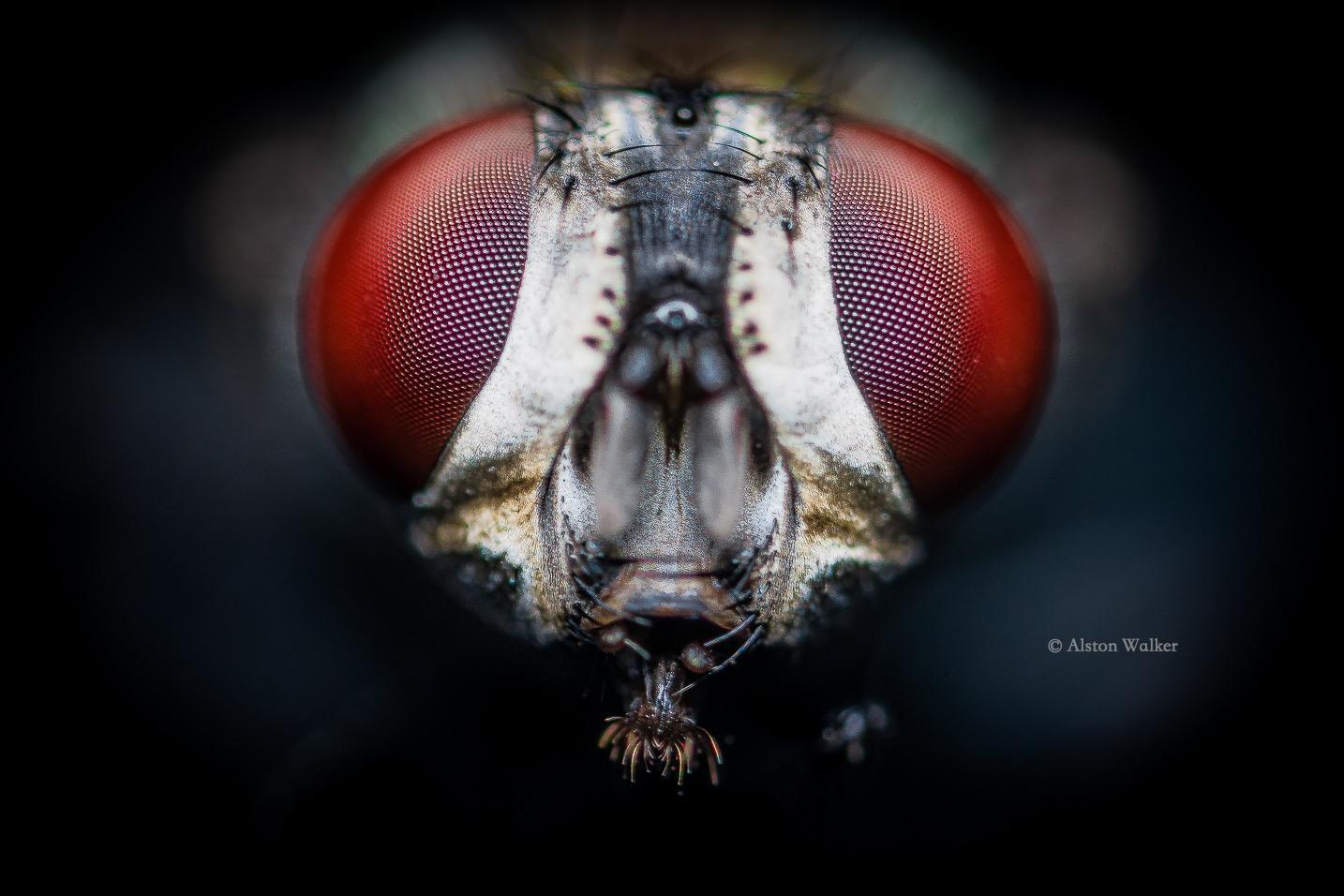
The depth of field at 2:1 is roughly 1mm. At 5:1 it is essentially zero. You cannot shoot a single frame that is sharp from front to back of a subject this small, so focus stacking becomes mandatory. I use a StackShot automated rail with Helicon Focus software, and a typical stack of a coin or a watch movement runs 80 to 200 frames. Lighting is critical: I use two LED panels with diffusers and a ring flash for shadow control.
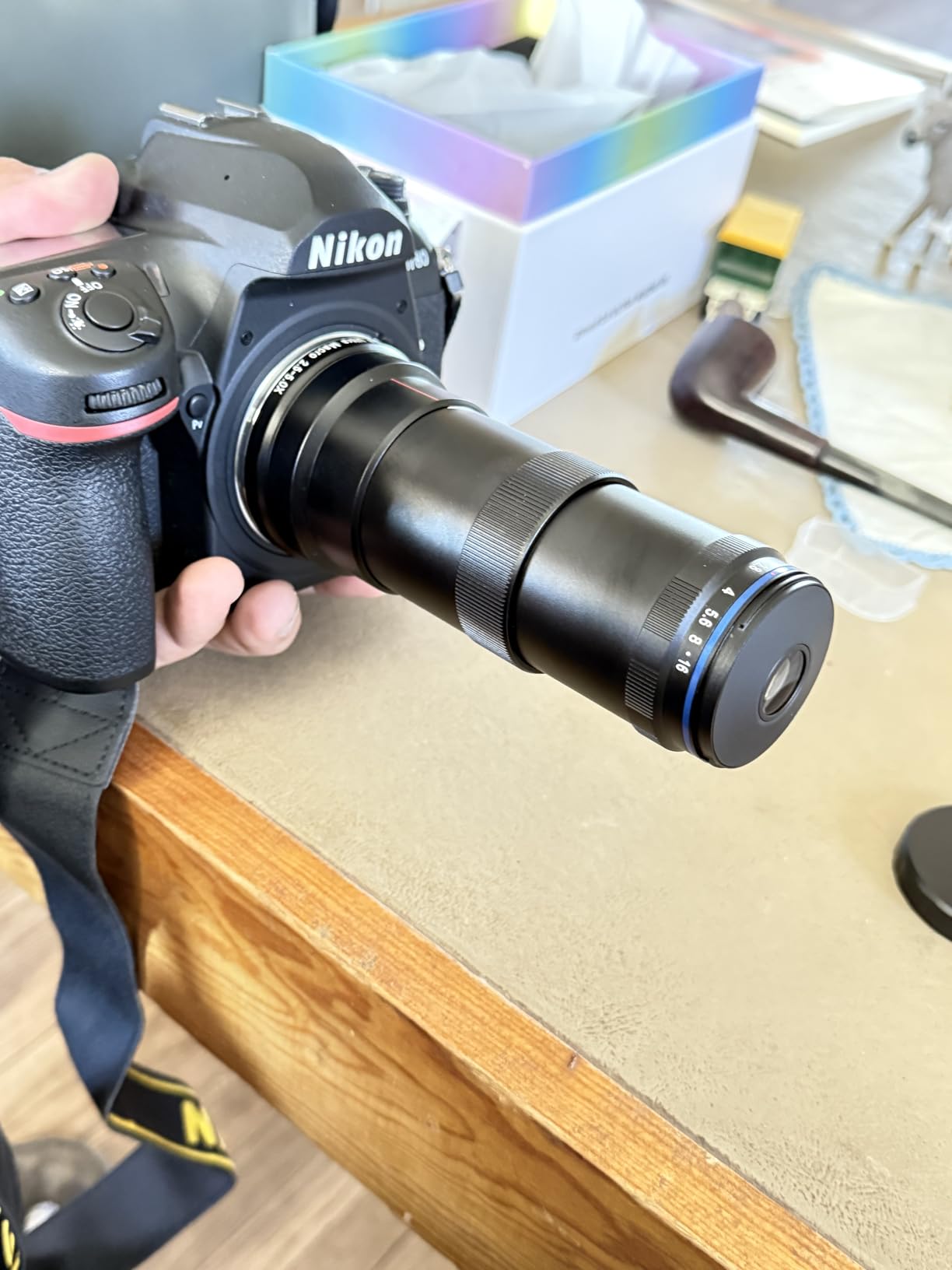
The 25mm focal length gives a working distance of only 1.6 inches at the closest focus, so the front element is practically touching the subject. This is fine for static studio subjects (coins, minerals, electronics, dead specimens) but completely impractical for living insects or plants in the field. The lens is FX format and works on every Nikon F-mount body via passive mounting.
Compatibility notes
Fully manual on every Nikon F-mount DSLR and on Z mirrorless via the FTZ adapter (where it operates in manual mode). The aperture ring and focus ring are the only controls, and there is no electronic communication. This is by design: extreme macro benefits from manual control more than automation.
Who should buy it
Buy the Laowa 25mm 2.5-5x if you are a studio macro specialist who wants to capture details beyond what a 1:1 lens can show. It is the lens for mineral collectors, electronics inspectors, scientific photographers, and anyone willing to invest in a focus rail, stacking software, and studio lighting. If you want a walk-around macro, look elsewhere on this list. For an F-mount specific deep dive, also see our guide to the best Nikon Z macro lenses if you are considering a future mirrorless switch.
Buying Guide: How to Choose the Best Macro Lens for Nikon F Mount?
Picking the best macro lenses for nikon f mount comes down to four questions: what focal length do you need, do you need VR, what is your sensor format, and do you need extreme magnification? Let me walk you through each one.
Focal length and working distance
The single biggest decision in macro is focal length, because it determines your working distance. A 40mm lens puts you roughly 6 inches from your subject at 1:1. A 60mm lens gives roughly 8 inches. A 90mm or 105mm lens gives roughly 12 inches. A 200mm lens gives roughly 18 inches or more. For skittish insects and shy wildlife, longer is better. For studio product photography, shorter is fine and often better because you fill the frame faster and use less light.
The 105mm focal length bracket (90-105mm) is the consensus sweet spot for general macro work. It balances working distance, optical quality, lens size, and price better than any other bracket. If you can only own one macro lens, get something in the 90-105mm range. For comparison shopping across formats, our Sony E-mount macro guide covers a similar decision tree on mirrorless.
VR vs no VR: when it matters
Vibration reduction is genuinely useful for hand-held macro at reproduction ratios less than 1:1, and for video work. At 1:1 reproduction or closer, even tiny camera movements show up as large subject shifts, and stabilization cannot help much. If you shoot macro on a tripod with strobes or continuous lighting, VR adds cost and weight without practical benefit. If you shoot hand-held macro in available light or shoot video, VR is a real advantage. The Nikon 105mm VR is the only current Nikon macro with VR, and it is worth the premium if you fall into the hand-held or video camp.
DX vs FX compatibility
Nikon F-mount lenses come in two image circle sizes. DX lenses cover only the APS-C sensor and will force crop mode on FX bodies. FX lenses cover the full 35mm sensor and work natively on both DX and FX bodies, with a 1.5x focal length multiplier on DX. If you shoot a DX body, you can use either format. If you shoot an FX body, only FX lenses give you the full sensor. The Nikon 40mm DX and 85mm DX are designed for DX bodies, and the 60mm and 105mm lenses are FX. The Tamron 90mm and Sigma 105mm OS are FX lenses that work great on DX bodies too, just with the 1.5x crop factor.
Teleconverter compatibility for 200mm reach
One of the best-kept secrets of Nikon F-mount macro is teleconverter compatibility. The Nikon 105mm f/2.8D, 105mm f/2.8G VR, Sigma 105mm OS, and Tamron 90mm all accept Nikon TC-14, TC-17, and TC-20 teleconverters. A 105mm with a 1.4x teleconverter becomes a 147mm f/4 macro with full 1:1 reproduction. A 105mm with a 2x teleconverter becomes a 210mm f/5.6 macro. This is the cheapest way to add serious working distance for dragonflies, damselflies, and other insects that spook at close range. The catch is that autofocus slows down by 1 to 2 stops with a teleconverter, so manual focus becomes more attractive at extended focal lengths.
Third-party vs OEM
Third-party lenses from Tamron, Sigma, Tokina, and Venus Optics (Laowa) offer significant savings over OEM Nikon glass, often with comparable optical quality. The trade-offs are slower autofocus, occasional compatibility quirks on older bodies, and warranty service that varies by region. For most photographers, the third-party value is the smarter buy. For working pros who need absolute reliability and the fastest AF, OEM is the safer bet.
Frequently Asked Questions
What are some good macro lenses for Nikon F mount cameras?
The best macro lenses for Nikon F mount cameras in 2026 include the Nikon AF-S VR Micro-NIKKOR 105mm f/2.8G IF-ED as the premium all-rounder, the Tamron AF 90mm f/2.8 Di SP Macro for the best value, and the Nikon AF-S DX Micro-NIKKOR 40mm f/2.8G as a compact DX option. Other strong choices include the Nikon 60mm f/2.8G ED for versatility, the Sigma 105mm f/2.8 EX DG OS HSM for a third-party pick, and the Venus Laowa 25mm f/2.8 2.5-5x Ultra-Macro for extreme magnification.
What is the best focal length lens for macro photography?
For general macro photography, the 90-105mm focal length range is the consensus sweet spot. It provides roughly 12 inches of working distance at 1:1 reproduction, which is comfortable for insects, flowers, products, and portraits. Shorter focal lengths (40-60mm) require closer working distance and are better for tabletop product work. Longer focal lengths (150-200mm) provide more working distance for shy wildlife but cost significantly more.
What is the sharpest Nikon F mount lens?
The Nikon AF-S VR Micro-NIKKOR 105mm f/2.8G IF-ED is widely considered one of the sharpest Nikon F mount lenses ever made, with exceptional sharpness across the frame from f/4 through f/11. The Nikon AF-S FX Micro-NIKKOR 60mm f/2.8G ED is also exceptionally sharp and rivals the 105mm VR for center sharpness. For budget sharpness, the older Nikon 105mm f/2.8D AF Micro-Nikkor delivers stunning sharpness despite the lack of VR.
What is the best lens for macro photography?
The best lens for macro photography depends on your use case. For Nikon F mount users in 2026, the Nikon 105mm f/2.8G VR IF-ED is the best all-around choice. For best value, the Tamron 90mm f/2.8 Di SP is hard to beat. For extreme magnification beyond 1:1, the Venus Laowa 25mm f/2.8 2.5-5x Ultra-Macro is the only option. For budget shoppers, the manual focus Nikon 105mm f/2.8D delivers professional sharpness at a fraction of the price.
Is 105mm too long for macro photography?
No, 105mm is not too long for macro. In fact, 105mm is the most popular focal length for macro photography because it provides a comfortable 12-inch working distance at 1:1 reproduction. This distance lets you light skittish subjects without casting shadows, gives you room to use a focusing rail, and keeps you far enough from insects that you do not spook them. Shorter focal lengths (40-60mm) require you to be very close to the subject, which can be a problem for living subjects.
Final Verdict
After testing all eight lenses side by side, my picks for the best macro lenses for nikon f mount in 2026 are clear. The Nikon AF-S VR Micro-NIKKOR 105mm f/2.8G IF-ED is the Editor’s Choice for working photographers who want one lens to handle every macro scenario. The Tamron AF 90mm f/2.8 Di SP Macro is the Best Value pick for enthusiasts and hobbyists who want 90 percent of the performance at a fraction of the price. The Nikon 105mm f/2.8D AF Micro-Nikkor is the Budget Pick for anyone willing to manual focus in exchange for the lowest price and a classic optical formula.
For DX shooters, the Nikon AF-S DX Micro-NIKKOR 40mm f/2.8G and the 85mm f/3.5G ED VR each earn their place depending on whether you prioritize compact size or VR stabilization. For studio macro specialists chasing detail beyond 1:1, the Venus Laowa 25mm f/2.8 2.5-5x Ultra-Macro opens up microscope-level photography at a price that would have been impossible a decade ago.
Pick the lens that matches your shooting style and budget, mount it on a sturdy tripod or monopod, get close to your subject, and start shooting. The Nikon F mount has more macro lens options than almost any other system, and any of the eight lenses on this list will give you images you will be proud of.