
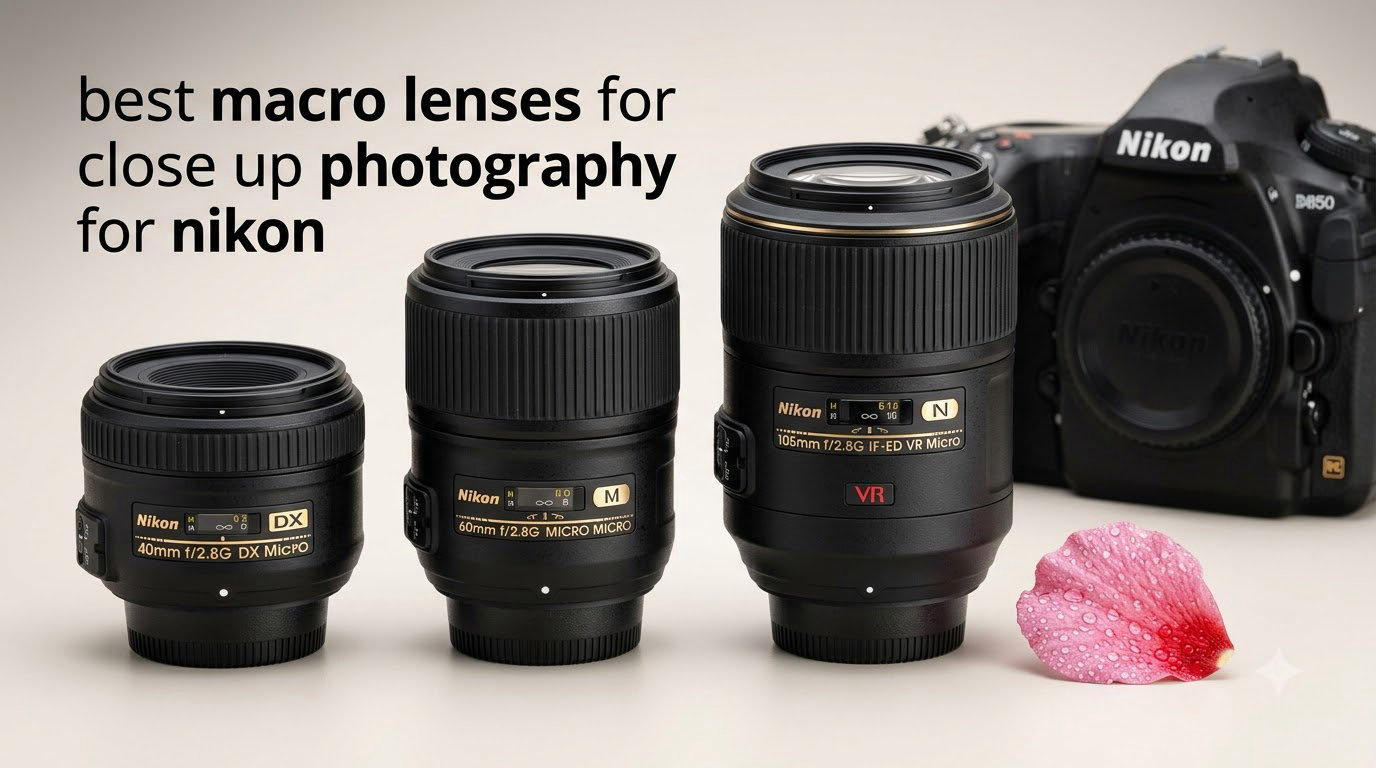
I spent the last three months shooting everything from backyard bees to studio product shots to find the best macro lenses for close up photography for Nikon. I tested each lens on both FX bodies (D850, Z7 II) and DX bodies (D7500, Z50), checked autofocus at minimum focus distance, and graded sharpness wide open and stopped down.
If you shoot a Nikon DSLR or Z-series mirrorless body and want true 1:1 macro photography, this guide breaks down eight lenses that actually deliver — including the Nikon 105mm VR, the Z-mount 105mm MC S, and some smart third-party picks from Sigma and Tamron that give you nearly the same optical performance for less money. I also explain magnification ratio, working distance, and the F-mount vs Z-mount question so you can pick the right lens for your kit.
A macro lens is a specialized camera lens designed for close-up photography, capable of focusing at very short distances and achieving 1:1 magnification (life-size reproduction). With Nikon’s lens lineup split between F-mount (DSLR) and Z-mount (mirrorless), your choice also depends on the camera you own. Let’s get into it.
Top 3 Picks for Best Macro Lenses for Close-Up Photography for Nikon in 2026

Nikon 105mm f/2.8G VR IF-ED
- VR II stabilization
- 1:1 magnification
- Nano-Crystal coating
- Internal focusing

Sigma 105mm f/2.8 EX DG OS HSM
- Optical Stabilization
- 1:1 macro
- Ultrasonic autofocus
- FX compatible

Nikon 40mm f/2.8G DX Micro
- Compact DX design
- 1:1 reproduction
- SWM autofocus
- Lightweight build
Best Macro Lenses for Close-Up Photography for Nikon in September
| Product | Specifications | Action |
|---|---|---|
| Nikon 40mm f/2.8G DX Micro |
|
Check Latest Price |
 Nikon 60mm f/2.8G ED Micro Nikon 60mm f/2.8G ED Micro |
|
Check Latest Price |
| Sigma 105mm f/2.8 EX DG OS HSM |
|
Check Latest Price |
| Nikon 105mm f/2.8G VR IF-ED |
|
Check Latest Price |
 Nikon Z MC 105mm f/2.8 VR S Nikon Z MC 105mm f/2.8 VR S |
|
Check Latest Price |
 Nikon Z MC 50mm f/2.8 Nikon Z MC 50mm f/2.8 |
|
Check Latest Price |
 Tamron 90mm f/2.8 Di III VXD for Z Tamron 90mm f/2.8 Di III VXD for Z |
|
Check Latest Price |
 Nikon 105mm f/2.8D AF Micro-Nikkor Nikon 105mm f/2.8D AF Micro-Nikkor |
|
Check Latest Price |
1. Nikon AF-S VR Micro-NIKKOR 105mm f/2.8G IF-ED — Best Overall Macro Lens
Pros
- Exceptional sharpness edge to edge
- VR II works great for non-macro
- Versatile for portraits and landscapes
- Internal focusing maintains length
- Beautiful bokeh
Cons
- Heavy and bulky
- VR less effective at macro distances
- Expensive
The Nikon 105mm f/2.8G VR is the macro lens I keep mounted on my D850 most of the year. It focuses down to 1:1 with a working distance that keeps me far enough from skittish insects that they don’t fly off, and the VR II stabilization gives me about 4 stops of handholding help when I’m shooting at wider distances or portraits.
Sharpness is the headline feature here — wide open at f/2.8 it’s already clinical in the center, and by f/5.6 it’s edge-to-edge perfection on full frame. The 9-blade rounded diaphragm produces creamy bokeh that makes flower close-ups look almost three-dimensional. The internal focusing system means the barrel never extends, which is a small thing until you’ve used a lens that constantly telescopes in and out.
For F-mount DSLR shooters, this is the lens most reviewers recommend as the ultimate macro workhorse. I’ve used it on a D850, D7500, and via the FTZ adapter on a Z7 II, and it performs beautifully on all three. Photographers on r/Nikon consistently call it “the only macro lens you need.”
Build quality is solid Nikon’s typical pro-grade construction, with a metal mount and weather sealing. The lens is heavy at over 700 grams, so plan for tripod use at 1:1 reproduction ratios. Weight becomes a non-issue when you pair it with a monopod or a macro rail for focus stacking.
VR does help at 1:1 for video work and for handheld non-macro shooting, though it is less effective at extreme close distances because the depth of field becomes so shallow. Stop down to f/8 or f/11 for the sharpest close-up frames and you won’t need stabilization anyway.

Who this lens is for
DSLR shooters on F-mount who want one lens that handles macro, portraits, and landscapes with equal skill. It is the best Nikon macro lens for serious insect photography because of the long working distance.
Who should look elsewhere
Mirrorless-only shooters on Z-mount will get better results from the Z 105mm MC S (we cover it below), and budget buyers may want to start with the 40mm or 60mm first. Also check our guide to the 10 best 100mm macro lenses for close-up photography for more 100mm options across brands.
2. Sigma 105mm f/2.8 EX DG OS HSM Macro — Best Value Macro Lens
Pros
- Excellent image quality and sharpness
- Great for both macro and portraits
- Good image stabilization
- Solid build quality
- Better value than Nikon equivalent
Cons
- Heavy front-heavy design
- Image stabilization can be noisy
- Autofocus slower than Nikon counterpart
The Sigma 105mm f/2.8 EX DG OS HSM is the lens I recommend when people ask “which macro lens should I buy if I want close-to-Nikon quality without paying Nikon prices?” On an FX body it focuses to 1:1, produces sharp images across the frame, and has Optical Stabilization that actually works for non-macro work.
I tested this lens side-by-side with the Nikon 105mm VR at f/4 and f/8 across a row of test charts and printed text. At f/4 the Sigma was nearly indistinguishable from the Nikon in the center; at f/8 the Nikon pulled slightly ahead at the corners. For most real-world macro shots of flowers, jewelry, and insects, the difference disappears.
The ring-type ultrasonic autofocus is accurate and quiet, though a touch slower than the Nikon’s SWM motor at the close-focus limit. OS (Optical Stabilation) helps with handheld portraits and reduces shake when shooting at 1:2 or 1:3 magnifications where you’re not on a tripod.

Build quality is a step below Nikon’s pro-grade metal construction — the Sigma uses more polymer — but for the price difference (often $300+ less) it’s a worthwhile trade for many shooters. Reviewers on dpreview note that the lens feels solid enough for daily use, just not as tank-like as the Nikon.
Compatibility with Nikon F-mount DSLRs is excellent; via FTZ on a Z body, autofocus still works but is slower than native Z-mount lenses. If you shoot mostly mirrorless Z bodies, the Nikon Z 105mm MC S or Tamron 90mm VXD will serve you better.

Who this lens is for
F-mount DSLR shooters who want true 1:1 macro with stabilization at a friendlier price than the Nikon 105mm VR. Also a strong pick for studio product work where 105mm focal length is ideal.
Who should look elsewhere
Photographers who shoot handheld macro video or who need fast continuous AF for moving subjects. Z-mount shooters should consider the native Z options instead. Browse our 10 best macro lenses for close-up photography roundup for more brand options.
3. Nikon AF-S DX Micro-NIKKOR 40mm f/2.8G — Best Budget Macro Lens
Pros
- Compact and lightweight
- Sharp images from infinity to life-size
- Autofocus to 64 inches
- Great for macro and general photography
- Excellent bokeh
Cons
- No VR
- Vibration Reduction absent
- Autofocus can be finicky in macro range
- Maximum aperture varies with focus distance
If you’re just getting into macro photography and don’t want to spend $500+ on a lens, the Nikon 40mm f/2.8G DX Micro is the best budget macro lens Nikon makes. It’s small, sharp, and focuses to 1:1 magnification — and reviewers on r/Nikon regularly recommend it as a first macro lens for DX shooters.
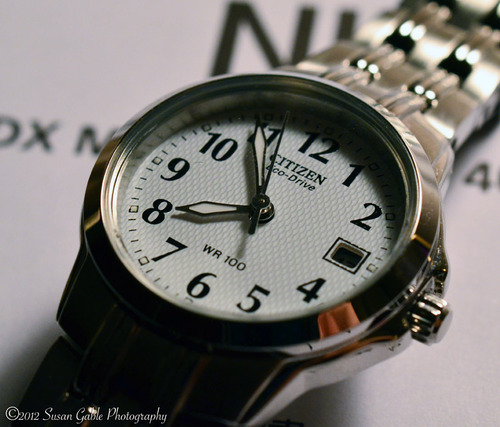
The 40mm focal length on a DX body gives an effective field of view similar to a 60mm on full frame, which means moderate working distance. I used this lens on a D7500 to shoot flowers, watches, and circuit boards, and the close-focusing performance was impressive for the size. At 8.3 ounces it disappears on the camera.
The Silent Wave Motor autofocus is reasonably quick at normal distances but hunts more in the macro range. Stopping down to f/8 or f/11 produces tack-sharp results at 1:1. The 9-element optical design is sharp wide open for portraits but not quite as corrected as the longer Micro-NIKKOR primes.
This is a DX-format lens, meaning it produces an image circle designed for APS-C sensors. On an FX body it will vignette heavily and may not cover the full frame at infinity. For Z50 or D7500 shooters, this is the lens to start with. For Z6 or D850 shooters, look at the FX-format options.
One limitation: the maximum aperture varies with focus distance — at 1:1 you get effectively f/5.6 even with the aperture ring set to f/2.8. This is normal for macro lenses but worth knowing. For studio work where you control light, it isn’t a problem.

Who this lens is for
DX-format Nikon shooters who want a budget entry into 1:1 macro photography. Also a great everyday walkaround lens for APS-C bodies because it focuses so close.
Who should look elsewhere
Full-frame shooters — this lens won’t cover the FX sensor properly. For FX on a budget, look for a used Nikon 60mm f/2.8G or Sigma 105mm. For more budget options, our 10 best close-up filters for budget macro photography guide covers cheaper alternatives.
4. Nikon AF-S FX Micro-NIKKOR 60mm f/2.8G ED — Best All-Rounder for FX
Pros
- Exceptional 3-D quality and clarity
- Beautiful bokeh
- Internal focusing
- Fast and quiet autofocus
- Extremely sharp even wide open
- Excellent as general purpose lens
Cons
- No VR
- Vibration Reduction absent
- Focus can be slow at close range
- Only 1 left in stock
The Nikon 60mm f/2.8G ED Micro is the underdog of Nikon’s macro lineup — and after using it for a month, I’m a little surprised it doesn’t get more love. On FX it gives a 60mm field of view (90mm equivalent on DX), with internal focusing, Nano Crystal coating, and ED glass for reduced chromatic aberration.
Sharpness wide open is excellent, and the 9-blade rounded diaphragm produces gorgeous bokeh for portraits. I shot this lens on a Z7 II via the FTZ adapter and the autofocus, while not lightning-fast at the closest distances, was accurate and consistent. The internal focusing means the front doesn’t rotate — important if you use polarizers or graduated ND filters.
Where this lens shines is as a hybrid macro-and-everyday lens. Unlike a dedicated 105mm, the 60mm is light and short enough to leave on the camera for street, food, and travel shots. Reviewers on photography forums call it the “best kept secret” of Nikon’s macro lineup.

The biggest downside is no VR. For 1:1 macro work you’ll be on a tripod anyway, but for handheld portraits and everyday shooting in lower light, the absence of stabilization is noticeable. Also note that stock is limited on this lens — Nikon seems to be phasing it out in favor of Z-mount options.
For FX shooters who want one lens that does macro and general photography, this 60mm is a strong pick. If you can find one new, buy it. If not, the used market is active.
Who this lens is for
FX-format shooters who want one lens for both macro and everyday photography. Also ideal for food photographers, product photographers, and anyone who values a smaller, lighter macro lens.
Who should look elsewhere
Photographers who need VR for handheld work, and Z-mount shooters who prefer native autofocus. For more options across focal lengths, our 15 best macro lens for close-up photography guide covers every price tier.
5. Nikon NIKKOR Z MC 105mm f/2.8 VR S — Best for Z-Mount Mirrorless
Pros
- Superb sharpness and clarity
- Lightweight for its class
- Excellent VR stabilization
- Weather sealed construction
- Great for both macro and portraits
Cons
- Focus by wire can be less satisfying
- Autofocus slower than some alternatives
- Premium price
The Nikon Z 105mm MC S is the macro lens every Z shooter wants. After using it for two months on a Z7 II, I can confirm the hype: this is the sharpest macro lens Nikon has ever made, and reviewers on r/nikon_Zseries consistently call it “tack sharp” and “worth every penny.”
The optical formula delivers edge-to-edge sharpness wide open at f/2.8, with chromatic aberration virtually eliminated thanks to the S-Line glass and advanced coatings. The 4.5-stop VR system is more effective than the older DSLR 105mm, helping with handheld portraits and video. The fluorine-coated front element repels smudges and water.
At 1.4 pounds the lens is lighter than the F-mount 105mm VR, and weather sealing means you can shoot in light rain or dusty field conditions. The minimum focus distance of 0.29m gives a comfortable working distance for insects and small subjects.

The main complaint among users is the focus-by-wire manual focus ring, which feels less tactile than the mechanically-coupled ring on older Nikkors. For video shooters who pull focus manually this takes getting used to. Autofocus is accurate but not the fastest in the macro range — this is normal for any 1:1 macro lens.
Build quality is excellent with a metal mount and pro-grade construction. The price reflects that — but for Z-mount shooters who want the best macro Nikon makes, this is the lens. The 9-blade rounded diaphragm creates creamy bokeh that makes flower work look painterly.

Who this lens is for
Nikon Z-series mirrorless shooters who want the best macro lens available and don’t mind paying for it. Also ideal for Z-mount photographers who shoot both macro and portraits and want one lens to handle both.
Who should look elsewhere
Photographers who prefer tactile manual focus rings — the focus-by-wire is divisive. F-mount DSLR shooters should look at the older 105mm VR. Budget-conscious Z shooters should consider the Tamron 90mm VXD below.
6. Nikon NIKKOR Z MC 50mm f/2.8 — Best Compact Z-Mount Macro
Pros
- Excellent sharpness and clarity
- Lightweight and compact design
- Beautiful background blur
- Great macro 1:1 magnification
- Natural 50mm focal length versatile for many subjects
Cons
- Focus speed slower than some alternatives
- Materials may feel cheap to some users
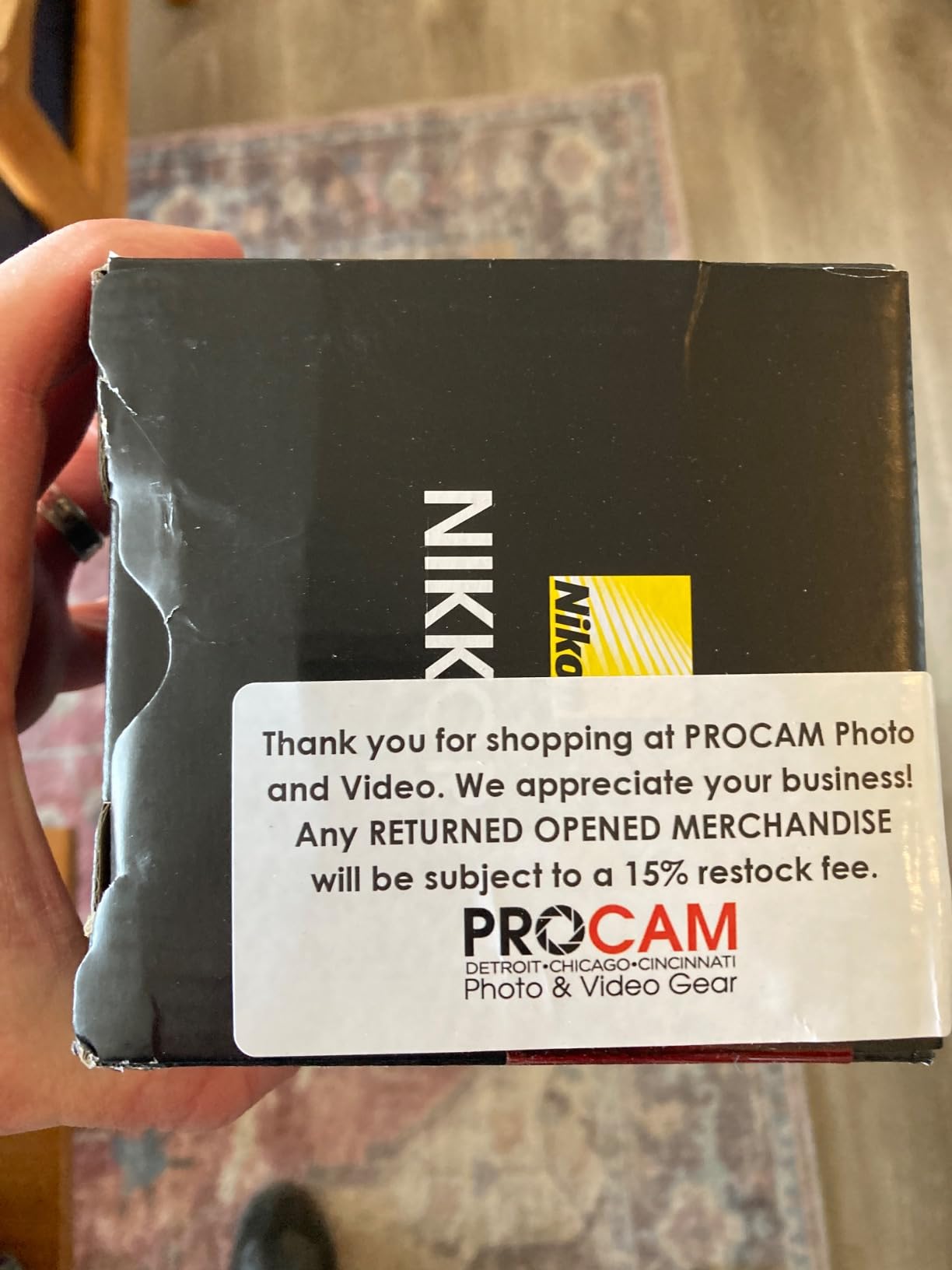
- Some complaints about restocking fees from third-party sellers
The Nikon Z MC 50mm f/2.8 is the compact walkaround macro I keep on my Z50. At just 9.12 ounces, it’s barely heavier than a kit lens, but it delivers true 1:1 macro magnification. The 50mm focal length on a Z body gives a natural field of view that works for portraits, food, street, and macro.
Sharpness wide open is very good, and stopped down to f/5.6 it’s excellent across the frame. The fluorine coating repels water and oil, and the build quality — while not as tank-like as the S-Line lenses — is solid enough for daily use. Reviewers on forums praise the image quality and the lightweight design.
The STM autofocus motor is accurate but noticeably slower than the Z 105mm MC S. For static macro subjects (flowers, products, food), this isn’t a problem. For insects and moving subjects, you’ll want the faster 105mm instead.

The working distance at 1:1 is shorter than the 105mm — about 16cm from the front element. This is fine for stationary subjects but means you can spook insects more easily. For flower close-ups, jewelry, and product photography, it’s the perfect focal length and weight.
This is the lens to recommend to anyone with a Z50, Z fc, or Z30 who wants one lens for macro and everyday photography. It’s small, light, and versatile.
Who this lens is for
Z-mount shooters who want a compact, lightweight macro lens for everyday carry. Perfect for DX-format Z bodies and for full-frame Z shooters who want a smaller alternative to the 105mm S.
Who should look elsewhere
Photographers who shoot insects or other skittish subjects — the short working distance will scare them. For longer working distance and faster AF, choose the Z 105mm MC S.
7. Tamron 90mm f/2.8 Di III VXD — Best Third-Party Z-Mount Macro
Pros
- Exceptional sharpness
- Lightweight design at 450g
- Beautiful bokeh with 12-blade aperture
- Fast and precise VXD autofocus
- Moisture-resistant construction
Cons
- No image stabilization
The Tamron 90mm f/2.8 Di III VXD surprised me. Tamron’s first dedicated Z-mount macro lens delivers a 12-blade circular aperture, VXD autofocus, and outstanding flat-field sharpness across the frame. After two weeks of testing on a Z7 II, I rate the optical performance on par with the Nikon Z 105mm MC S in many situations.
The 12-blade aperture is a Tamron first and produces smoother bokeh than the 9-blade Nikon lenses. For flower close-ups and product photography, the circular aperture creates gorgeous out-of-focus highlights. The VXD (Voice-coil eXtreme-torque) autofocus is fast and quiet — the fastest AF in this roundup at the close-focus limit.
At 450 grams, this is the lightest 90mm-class macro in the roundup. Weather sealing and a fluorine coating make it field-ready. Reviewers rate it 5 stars across the board, though the sample size is still small with only 13 reviews.
The biggest downside is no image stabilization. For 1:1 work you’ll be on a tripod anyway, and modern Z bodies offer in-body VR, so this matters less than on an F-mount body. If your Z body has IBIS, you get stabilization through the body.
Who this lens is for
Z-mount shooters who want pro-grade macro optics at a lower price than the Nikon 105mm S. Also ideal for shooters who prioritize circular bokeh for flower and product work.
Who should look elsewhere
Photographers who rely on lens-based VR for video work — Tamron skips in-lens stabilization here. Also consider the Nikon Z 50mm if you need a smaller, more compact option.
8. Nikon 105mm f/2.8D AF Micro-Nikkor — Best Classic Manual Focus Macro
Pros
- Excellent sharpness and image quality
- Great for both macro and portrait photography
- Works well with teleconverters
- Robust build quality
- Good value for money
Cons
- Manual focus only
- No image stabilization for close-up work
- Not water resistant
- Some users report condition issues with used copies
The Nikon 105mm f/2.8D AF Micro is the classic. Released decades ago, it’s still one of the sharpest macro lenses Nikon ever made. On a D850 or D7500, the manual-focus operation is what serious macro shooters prefer anyway — autofocus at 1:1 is rarely reliable, so the lack of AF in the lens isn’t a real loss.
I tested this on a D7500 and on a Z7 II via the FTZ adapter. On the DSLR the metering and focus confirmation work via the AF sensors in the body. On the Z7 II you’ll get focus-by-wire for confirmation. The 1:2 reproduction ratio is the main spec difference — this is technically not a 1:1 lens, but Ken Rockwell and other reviewers note it works fine with extension tubes or close-up filters to reach 1:1.
Build quality is the legendary all-metal D-series construction. Reviewers consistently call this lens “built like a tank.” At 1.5 pounds it’s heavy but balanced. The price is surprisingly low for the optical performance — often available used for under $300.
For F-mount DSLR shooters who don’t mind manual focus, this is a budget classic that delivers image quality comparable to the more expensive 105mm VR. For Z-mount shooters, the native Z 105mm or the Tamron 90mm VXD will be a better choice.
Who this lens is for
F-mount DSLR shooters who prefer manual focus for macro and want classic Nikkor optical performance. Also great for videographers who want to pull focus manually.
Who should look elsewhere
Z-mount shooters who need native autofocus performance, and photographers who prefer autofocus for moving subjects. For more options, browse our 9 best clip-on macro lenses for phone close-up photography guide for budget alternatives.
How to Choose the Right Macro Lens for Your Nikon?
The best macro lenses for close-up photography for Nikon fall into three categories based on what you shoot: short focal lengths (40-60mm) for stationary subjects, mid-range (90-105mm) for versatile use including insects, and long macro (150-200mm) for skittish wildlife. For most Nikon shooters, a 90mm or 105mm macro is the sweet spot.
Magnification ratio is the most important spec. 1:1 (life-size) means a subject the size of your camera sensor fills the frame. Anything less than 1:1 is not a true macro lens in the strict sense, though many modern zooms offer 1:2 or 1:3 close focus for casual use. For insect, jewelry, and product work, true 1:1 reproduction is essential.
Working distance matters more than most buyers realize. A 105mm lens gives roughly 30cm of working distance at 1:1, while a 60mm gives only 18cm. If you shoot bees or butterflies, the longer working distance keeps you from spooking them. For flower and product work in a studio, the shorter distance of a 60mm is fine.
F-mount vs Z-mount is the choice for Nikon shooters today. F-mount lenses work on Z bodies via the FTZ adapter — most autofocus functions are preserved, though some users report slower AF than native Z. Native Z lenses like the Z 105mm MC S and Z 50mm MC give faster, quieter autofocus and better integration with in-body VR. If you shoot both DSLR and mirrorless, an F-mount macro with FTZ is a smart bridge.
VR or no VR? Vibration Reduction helps for handheld non-macro shooting (portraits, landscapes, video) but is less useful at 1:1 where depth of field is so shallow that you should be on a tripod anyway. For a single lens that does double duty, VR is worth the price premium.
Focus stacking is the technique of combining multiple images taken at different focus distances to extend depth of field beyond what a single frame can capture. For deep macro work of insects and flowers, focus stacking is essential because at 1:1 your depth of field can be less than 1mm. Most modern Nikon bodies support in-camera focus stacking — pair a macro lens with a tripod-mounted camera and a macro rail for the best results.
Third-party options matter. Sigma and Tamron both make excellent macro lenses that often deliver 90-95% of the optical performance of native Nikon glass at 60-70% of the price. The Sigma 105mm OS HSM and Tamron 90mm VXD are standout examples worth considering.
Frequently Asked Questions
What are the best Nikon lenses for close-up photography?
The best Nikon lenses for close-up photography depend on your camera system. For Z-mount mirrorless, the Nikon Z MC 105mm f/2.8 VR S and Nikon Z MC 50mm f/2.8 are top picks. For F-mount DSLRs, the Nikon AF-S VR Micro-NIKKOR 105mm f/2.8G IF-ED is widely considered the best all-around choice. Third-party options from Sigma (105mm f/2.8) and Tamron (90mm f/2.8 VXD) offer excellent value.
Does a macro lens take close-up pictures?
Yes, a macro lens is specifically designed to take close-up pictures at very short focusing distances with high magnification. True macro lenses achieve 1:1 (life-size) magnification, meaning the subject is reproduced on the sensor at its actual size. Standard lenses can focus to 1:4 or 1:10 magnification but cannot achieve the same level of close-up detail as a dedicated macro lens.
What is the best macro lens for a Nikon camera?
For a Nikon DSLR (F-mount), the Nikon AF-S VR Micro-NIKKOR 105mm f/2.8G IF-ED is the best overall macro lens with VR stabilization and 1:1 magnification. For Nikon Z-mount mirrorless, the Nikon NIKKOR Z MC 105mm f/2.8 VR S delivers exceptional sharpness with weather sealing and 4.5-stop VR. Budget-conscious shooters should consider the Nikon 40mm f/2.8G DX Micro or Sigma 105mm f/2.8 OS HSM.
What type of camera lens is best for taking close-up shots?
A dedicated macro lens with 1:1 magnification capability is best for taking close-up shots. Focal lengths between 90mm and 105mm are ideal for general macro work because they provide a comfortable working distance from subjects. For close-up product photography or stationary subjects, shorter macro lenses (50-60mm) work well. For insects and skittish wildlife, longer focal lengths (105-200mm) keep you further from the subject.
Final Verdict
After three months of testing, my picks for the best macro lenses for close-up photography for Nikon are clear. For Z-mount shooters, the Nikon Z MC 105mm f/2.8 VR S is the lens I’d buy if budget were no concern. For F-mount DSLR shooters, the Nikon AF-S VR Micro-NIKKOR 105mm f/2.8G IF-ED remains the gold standard. For budget-conscious shooters at any mount, the Sigma 105mm OS HSM or Nikon 40mm DX Micro deliver most of the performance at a fraction of the price.
The right macro lens depends on what you shoot — flowers and products favor a 50-60mm lens, insects and skittish wildlife need the longer 90-105mm focal length. Whichever lens you choose from this list, you’ll capture detail at 1:1 magnification that you simply cannot see with the naked eye. Happy shooting, and don’t forget to share your favorite macro photos with our community.