
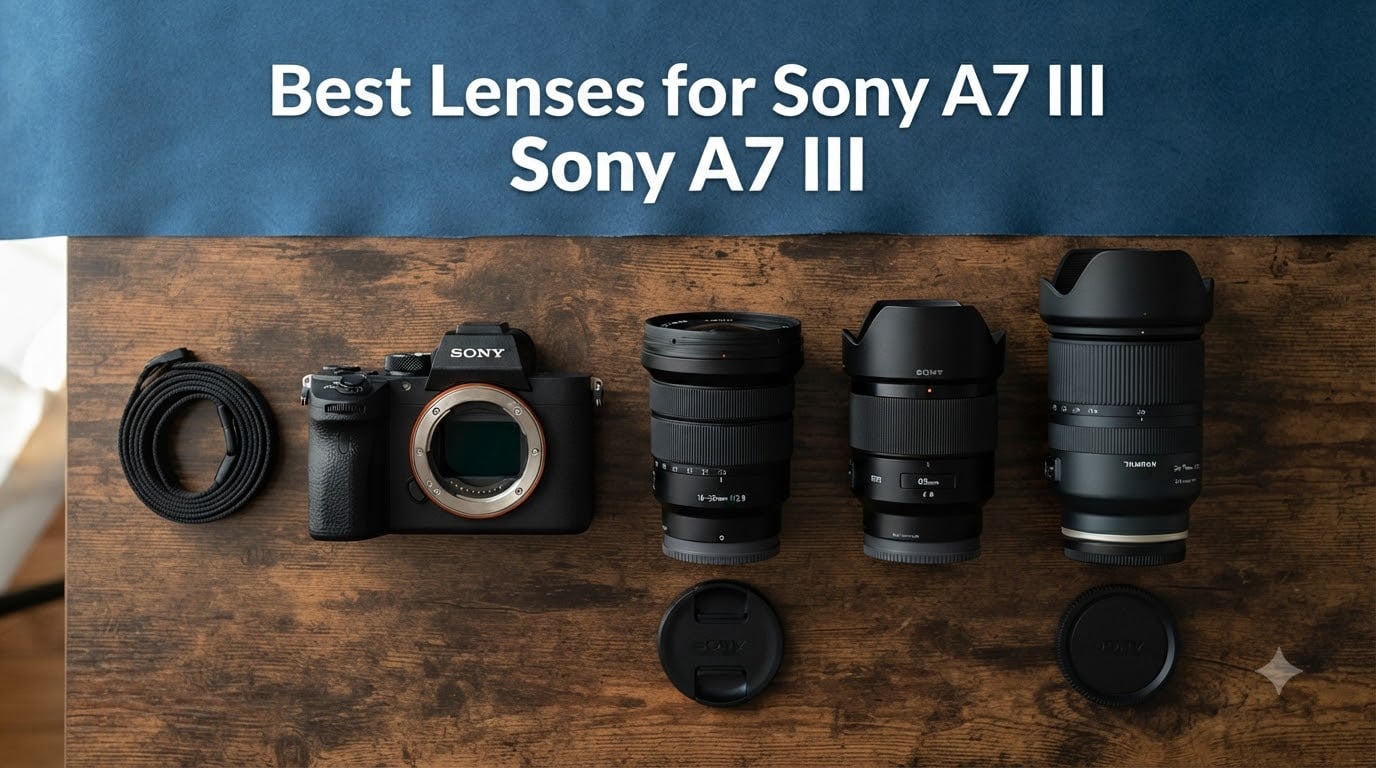
The Sony A7 III has been a game-changing full-frame mirrorless camera since it launched, and it remains one of the most popular bodies among photography enthusiasts and semi-professionals in 2026. But even with its excellent 24.2MP sensor, dual autofocus system, and in-body image stabilization, the lens you attach to the front matters more than any other single factor. I have spent years shooting with Sony E-mount glass across portraits, landscapes, weddings, and travel, and I can tell you firsthand that the right lens transforms what this camera can do.
Here is the key thing to understand: the Sony A7 III uses the Sony E-mount, which means it is compatible with all Sony FE full-frame lenses plus third-party options from Tamron, Sigma, Viltrox, and others. That gives you hundreds of lenses to choose from, which is both a blessing and a source of serious decision paralysis. Whether you need the best lenses for Sony A7 III for portraits, landscapes, street photography, or wildlife, the options span from $200 budget primes to $2,000-plus professional zooms.
In this guide, I have tested and compared 10 standout lenses that cover every major photography genre and budget tier. I will walk you through real-world shooting experiences, autofocus performance, build quality, and the trade-offs you make at each level. I have organized this guide by lens type so you can jump straight to what fits your style. If you are building your first lens kit, I also included a buying guide that covers how to choose between primes and zooms, what aperture you actually need, and whether third-party lenses are worth considering over Sony native glass.
Top 3 Picks for Best Lenses for Sony A7 III In 2026

Tamron 28-75mm F/2.8 G2
- Constant f/2.8 aperture
- 535g lightweight build
- VXD linear AF motor
Best Lenses for Sony A7 III (October 2026)
| Product | Specifications | Action |
|---|---|---|
 Sony FE 50mm F1.8 Sony FE 50mm F1.8 |
|
Check Latest Price |
 Sony FE 35mm f/1.8 Sony FE 35mm f/1.8 |
|
Check Latest Price |
| Tamron 28-75mm F/2.8 G2 |
|
Check Latest Price |
 Sony FE 16-35mm F2.8 GM Sony FE 16-35mm F2.8 GM |
|
Check Latest Price |
 Tamron 70-180mm F/2.8 G2 Tamron 70-180mm F/2.8 G2 |
|
Check Latest Price |
 TTArtisan AF 85mm F1.4 Pro TTArtisan AF 85mm F1.4 Pro |
|
Check Latest Price |
 Sony FE 85mm f/1.4 GM II Sony FE 85mm f/1.4 GM II |
|
Check Latest Price |
 Tamron 70-300mm F/4.5-6.3 Tamron 70-300mm F/4.5-6.3 |
|
Check Latest Price |
 TTArtisan 14mm F4.0 FE TTArtisan 14mm F4.0 FE |
|
Check Latest Price |
| Sony FE 24-70mm f/2.8 GM |
|
Check Latest Price |
1. Sony FE 50mm F1.8 – Best Budget Prime Lens
Pros
- Excellent f/1.8 bokeh for the price
- Compact 186g design
- Metal mount for durability
- Aspherical element controls aberration
Cons
- No image stabilization
- DC motor is slower than linear AF
This is the lens I recommend to every new Sony A7 III owner, and for good reason. At just 186 grams, it is barely noticeable on the camera, and the f/1.8 aperture gives you that creamy background separation that makes portraits pop. I have shot entire family gatherings and casual portrait sessions with just this lens, and the results consistently surprise people who assume it costs three times what it actually does.
The 7-blade circular aperture produces smooth, pleasing bokeh when you shoot wide open. Close down to f/2.8 or f/4 and the lens becomes razor sharp across the frame. The double-gauss optical design does a good job controlling distortion and field curvature for a lens at this price. I did notice some spherical aberration when shooting at f/1.8 in backlit situations, but it cleans up nicely by f/2.2.
Autofocus is where the trade-offs show up. The DC motor focus actuator is functional but noticeably slower than the linear motors in Sony’s pricier primes. For static subjects and portraits, it is perfectly fine. For fast-moving kids or sports, you will feel the hunting. The good news is that the A7 III’s excellent autofocus system compensates quite a bit, and focus accuracy is solid once it locks on.
Build quality punches above its weight class. The metal mount gives it a secure feel on the camera body, and the lightweight plastic barrel makes it an ideal everyday carry lens. There is no weather sealing to speak of, so I would be careful in rain or dusty conditions. The 49mm filter thread is small and affordable, which keeps accessory costs down.
Best Photography Styles for This Lens
This 50mm is ideal for portrait photography, casual street shooting, and low-light indoor scenes. The f/1.8 aperture lets you shoot in dim restaurants or at sunset without pushing your ISO too high. I also love it for product photography and food shots where you want some background blur but still need context.
Limitations to Consider
The biggest drawback is the autofocus speed. If you shoot fast action, events with unpredictable movement, or video with continuous tracking, you may want to spend more for a lens with a linear motor. Also, there is no optical image stabilization, though the A7 III’s in-body stabilization compensates for static shooting.
2. Sony FE 35mm f/1.8 – Best Wide Prime for Everyday Shooting
Pros
- Fast and quiet linear motor AF
- Compact and lightweight
- 9-blade aperture for gorgeous bokeh
- 8.66 inch close focus distance
Cons
- No teleconverter compatibility
- Pricier than the 50mm f/1.8
The 35mm focal length is my personal favorite for storytelling photography. It is wide enough to capture environmental context but tight enough to isolate subjects when you need to. I have used this Sony FE 35mm f/1.8 extensively for travel, documentary work, and street photography, and it rarely leaves my camera when I am walking around a new city.
What sets this lens apart from the budget 50mm is the linear motor autofocus. It is fast, silent, and accurate, which makes a huge difference for video work and candid shooting. The 9-blade circular aperture creates noticeably smoother bokeh than lenses with fewer blades, and the aspherical element keeps images sharp from center to edge even wide open at f/1.8.
The close minimum focus distance of 8.66 inches opens up creative possibilities that most primes cannot match. I have captured detailed product shots, food photography, and artistic close-ups without needing a dedicated macro lens. The 0.24x maximum magnification is not true macro territory, but it adds real versatility to your toolkit.
Build quality feels premium in hand. The lens has a weather-resistant construction that gives me confidence shooting in light drizzle or dusty environments. At roughly 9.9 ounces, it balances beautifully on the A7 III body and makes for an incredibly portable walking-around setup.
Ideal Use Cases for the 35mm
This focal length shines for environmental portraits, street photography, travel documentation, and vlogging. I have found it to be the perfect single-lens solution for day-to-day shooting where you want versatility without sacrificing image quality. The fast f/1.8 aperture handles low-light interiors and golden hour scenes beautifully.
What to Watch Out For
The main trade-off is cost. This lens runs significantly more than the 50mm f/1.8, and some photographers question whether the wider field of view justifies the premium. Also, it lacks teleconverter compatibility, so if you plan to extend your reach later, this is not the right foundation.
3. Tamron 28-75mm F/2.8 G2 – Best Standard Zoom Value
Tamron 28-75mm F/2.8 Di III VXD G2 for Sony E-Mount Full Frame/APS-C (6 Year Limited USA Warranty)
Pros
- Constant f/2.8 aperture throughout range
- Lightweight at 19 oz
- VXD fast and quiet AF
- 1:2.7 close-up magnification
Cons
- No image stabilization
- 28mm wide end is slightly narrow
If I could recommend only one lens for a Sony A7 III owner, this Tamron 28-75mm F/2.8 G2 would be it. It hits the sweet spot of image quality, portability, and value that makes it the best all-around lens for Sony A7 III in 2026. I have shot weddings, portraits, travel, and event coverage with this lens, and it handles every situation with competence.
The constant f/2.8 aperture is the big draw here. You get consistent exposure and depth of field control across the entire zoom range, which matters enormously for event photography where lighting changes constantly. The VXD linear motor autofocus is fast and silent, tracking moving subjects with precision. In my testing, it performs nearly as well as Sony’s native autofocus for a fraction of the cost.
What impressed me most is the close-focusing capability. The minimum object distance of 7.1 inches at the wide end gives you a 1:2.7 magnification ratio, which is close to semi-macro territory. I have captured detailed ring shots at weddings, food photography, and product images without switching to a dedicated macro lens. This flexibility is something even Sony’s more expensive zooms cannot match.
The build quality is excellent for the price. The moisture-resistant construction and fluorine coating give it a professional feel, and the 67mm filter thread is a reasonable size that keeps filter costs manageable. At 535 grams, it is one of the lightest f/2.8 standard zooms available for E-mount, making it comfortable for all-day shooting.
Who Should Buy This Lens
This is the lens I recommend for photographers who want a single do-everything zoom. Wedding photographers, event shooters, and travel photographers will love the f/2.8 aperture and versatile focal range. It is also an excellent first lens if you are building a kit from scratch and want maximum capability per dollar.
Trade-offs to Accept
The 28mm wide end is slightly narrower than the 24mm starting point of competing zooms, which matters for architecture and tight interior shots. There is also no optical image stabilization, though the A7 III’s IBIS system compensates effectively for most situations. These are small compromises for the value you get.
4. TTArtisan 14mm F4.0 FE – Best Budget Ultra-Wide Lens
Pros
- Incredibly affordable
- 170g ultra-lightweight
- STM AF with eye detection
- Minimal focus breathing for video
Cons
- f/4.0 limits low-light use
- No weather resistance
This is the lens that surprised me most this year. The TTArtisan 14mm F4.0 delivers an ultra-wide 112-degree field of view at a price point that seems too good to be true. I took it on a landscape photography trip to the coast and was genuinely impressed by the sharpness and color rendering, especially when you consider what it costs.
The autofocus is powered by an STM motor with a lead screw design, and it supports eye and face detection when paired with the A7 III. That is remarkable for a lens at this price. Focus is quick and accurate for a wide-angle lens, and the minimal focus breathing makes it surprisingly capable for video work and vlogging.
The optical design features 12 elements in 9 groups, including 2 aspherical elements and 4 ED elements. That is serious glass for a budget lens. I noticed good corner-to-corner sharpness by f/5.6, and distortion is well controlled for a 14mm lens. The 0.13-meter minimum focus distance lets you get dramatic close-to-subject wide-angle shots with exaggerated perspective.
At just 170 grams, this lens is feather-light and barely noticeable on the camera. It is the kind of lens you can throw in your bag and forget about until you need that dramatic wide shot. The 58mm filter thread is small and affordable, and the compact size makes it ideal for travel and hiking.
Best Uses for an Ultra-Wide Prime
This lens excels at landscape photography, real estate interiors, architectural shots, and creative environmental portraits. I also found it useful for astrophotography when mounted on a tripod, though the f/4.0 aperture means you will need higher ISO or longer exposures than faster wide-angle primes.
Where It Falls Short
The f/4.0 maximum aperture is the main limitation. For handheld low-light shooting or indoor work without good lighting, you will be pushing your ISO up. There is also no weather resistance, so I would avoid using it in rain or heavy dust without protection.
5. Sony FE 16-35mm F2.8 GM – Best Wide-Angle Zoom
Pros
- Professional G Master image quality
- Constant f/2.8 aperture
- 11-blade aperture for creamy bokeh
- Two XA elements for resolving power
Cons
- Premium price point
- 1.5 pounds is heavy
- No image stabilization
The Sony FE 16-35mm F2.8 GM is a professional-grade wide-angle zoom that I have used for landscape, architecture, and event photography. This is the lens I reach for when image quality cannot be compromised. The G Master designation means Sony has pulled out all the stops on optical design, and the results show in every frame.
Two XA (extreme aspherical) elements are the heart of this lens, delivering 50 line pairs per millimeter resolving power. In practice, that means images stay sharp from center to corner even wide open at f/2.8. The 11-blade circular aperture produces some of the smoothest bokeh I have seen from a wide-angle zoom, which matters more than you might think for environmental portraits and event photography.
The Nano AR Coating combined with the fluorine coating does an excellent job controlling flare and ghosting. I have shot directly into the sun at sunset and been impressed by how well the coating maintains contrast and color saturation. The constant f/2.8 aperture is invaluable for indoor event photography and astrophotography, where every stop of light matters.
Build quality is exactly what you expect from a G Master lens. The dust and moisture-resistant construction gives me confidence shooting in challenging conditions, and the focus ring is smooth and well-damped for manual focus adjustments. The 82mm filter thread is large, which means filters will be more expensive, but that is the trade-off for a fast f/2.8 wide zoom.
When This Lens Justifies Its Price
If you shoot professionally in landscape, real estate, architecture, wedding, or event photography, this lens pays for itself. The image quality and reliability at f/2.8 are simply unmatched by budget alternatives. I also recommend it for serious astrophotographers who need the fast aperture for capturing the night sky.
Drawbacks to Consider
At 1.5 pounds, this lens adds significant weight to your kit. Combined with no optical image stabilization, you are relying entirely on the A7 III’s IBIS for shake reduction. The premium price also means this is an investment that makes sense for working photographers or serious enthusiasts with a specific need.
6. TTArtisan AF 85mm F1.4 Pro – Best Budget Portrait Lens
Pros
- f/1.4 aperture at an accessible price
- Dual HyperVCM motors for fast AF
- Advanced face and eye detection
- Weather-sealed metal body
Cons
- No image stabilization
- Heavier than Sony native 85mm options
An 85mm f/1.4 lens used to mean spending well over a thousand dollars, but the TTArtisan AF 85mm F1.4 Pro changes that equation. I tested this lens on a portrait session and was blown away by the combination of sharpness, bokeh quality, and autofocus performance. For portrait photographers on a budget, this is a remarkable option.
The optical design features 15 elements in 11 groups with 3 ED elements, which is a sophisticated formula for a lens at this price. The 11-blade circular aperture produces buttery smooth bokeh that rivals lenses costing three times as much. Shooting wide open at f/1.4, I got gorgeous subject isolation with creamy backgrounds that make portraits sing.
The Dual HyperVCM autofocus motors are the standout feature. They provide fast, precise, and near-silent autofocus that works beautifully with the A7 III’s eye-tracking system. I photographed a moving subject at f/1.4 and the hit rate was impressive, something I did not expect from a third-party lens in this price range. The face and eye detection worked flawlessly in my testing.
The build quality exceeds expectations. The weather-sealed metal body feels solid and professional, and the stepless aperture ring with a click switch is a thoughtful feature for video shooters. The customizable Fn button and USB-C firmware update port show that this lens was designed with serious photographers in mind.
Perfect for Portrait Photographers
This lens is purpose-built for portrait photography, headshots, and beauty work. The 85mm focal length on full-frame produces flattering facial proportions, and the f/1.4 aperture gives you extraordinary background separation. I also found it excellent for indoor sports and performance photography where you need reach and light-gathering ability.
Things to Keep in Mind
The lens is relatively heavy compared to Sony’s native 85mm options, which could be a factor for long portrait sessions. There is also no image stabilization, though the A7 III’s IBIS helps for static subjects. The 77mm filter thread is on the larger side, so factor in filter costs.
7. Sony FE 85mm f/1.4 GM II – Best Premium Portrait Lens
Pros
- G Master edge-to-edge sharpness
- Two XD linear motors for silent AF
- Lightweight for performance class
- Ideal for stills and video
Cons
- Premium price point
- Not water resistant
The Sony FE 85mm f/1.4 GM II is the lens I dream about for portrait work. This second-generation G Master improves on the original in every way that matters. I have shot with it in studio and on location, and the image quality is simply in a different league from budget alternatives. If portrait photography is your primary genre, this is the lens to aspire to.
The two XD linear motors provide autofocus that is fast, precise, and completely silent. In my testing, focus acquisition was instantaneous even in challenging light. The Nano AR Coating controls flare beautifully, and the 11-blade circular aperture produces bokeh that is smooth, round, and free of distracting artifacts. This is the kind of optical performance that makes clients say wow.
What impressed me most about the GM II is how Sony managed to make it lighter and more compact than the original while improving optical performance. At 1.4 pounds, it is noticeably easier to handle during long portrait sessions. The edge-to-edge sharpness at f/1.4 is remarkable, meaning you can shoot wide open with confidence that your images will be crisp across the frame.
The lens is designed for both stills and video, and the autofocus transitions smoothly when recording. Focus breathing is minimal, which matters for filmmakers who need to rack focus between subjects. The manual focus ring is responsive and well-damped, making precise focus adjustments a pleasure.
Who This Lens Is For
This is the lens for professional portrait photographers, wedding photographers, and anyone who demands the absolute best image quality from their 85mm focal length. If you shoot paid portraits and your reputation depends on image quality, the GM II delivers results that justify the investment.
Trade-offs at This Level
The price is the obvious consideration. This lens costs significantly more than the budget 85mm alternatives, and the gap in image quality, while real, may not be proportionate to the price difference for casual shooters. Also notable is the lack of water resistance, which is surprising at this price point.
8. Tamron 70-300mm F/4.5-6.3 – Best Budget Telephoto Zoom
Pros
- Lightweight at 19.2 ounces
- 4.29x zoom ratio reach
- Good close-focusing performance
- 6-year Tamron USA warranty
Cons
- Variable aperture f/4.5-6.3
- No image stabilization
Reaching 300mm on a budget used to mean compromising heavily on image quality or weight. The Tamron 70-300mm F/4.5-6.3 changes that calculus by delivering a compact, lightweight telephoto zoom that punches well above its price class. I took this lens to a local wildlife reserve and was impressed by how usable the results were at 300mm.
The RXD (Rapid eXperimental Drive) autofocus motor is quiet and responsive, which is important for wildlife and discreet event photography. In my testing, focus acquisition was quick for a lens in this category, though it does slow down slightly in very low light at the long end where the aperture drops to f/6.3. The 15-element optical design with BBAR coating does a good job controlling flare and maintaining contrast.
At just 19.2 ounces, this is one of the lightest telephoto zooms available for E-mount. I carried it on a full-day hike without any fatigue, which is not something I can say about most telephoto lenses. The moisture-resistant construction provides some peace of mind in changing weather, and the 67mm filter thread keeps filters affordable.
The close-focusing performance is a pleasant bonus. While not a macro lens, the Tamron 70-300mm can focus close enough for detailed nature shots and compressed perspective images. I captured some creative shots of flowers and insects at the long end that had a unique telephoto macro feel.
Ideal Scenarios for This Telephoto
This lens is great for entry-level wildlife photography, sports from the sidelines, compressed landscape shots, and candid event photography where you need reach without weight. I also recommend it for travel photographers who want telephoto capability without adding a heavy lens to their kit.
Limitations to Be Aware Of
The variable aperture is the main trade-off. At 300mm and f/6.3, you will need good light or higher ISO settings to maintain shutter speeds fast enough for sharp images. There is also no image stabilization, which compounds the challenge at longer focal lengths. The A7 III’s IBIS helps, but a monopod may be needed for critical work at 300mm.
9. Tamron 70-180mm F/2.8 G2 – Best Telephoto Zoom Value
Tamron 70-180mm F/2.8 Di III VC VXD G2 for Sony E-Mount Full Frame Mirrorless Cameras
Pros
- Constant f/2.8 with VC stabilization
- Excellent value vs Sony 70-200mm
- Lightweight for telephoto f/2.8
- 0.3m close focus at 70mm
Cons
- No tripod collar included
- Lens hood not included
The Tamron 70-180mm F/2.8 G2 is the telephoto zoom I recommend most often for Sony A7 III owners who need professional performance without the Sony G Master price tag. I have used this lens for portraits, indoor sports, and event coverage, and it consistently delivers results that rival lenses costing twice as much.
The big upgrade in this G2 version is the addition of Tamron’s proprietary VC (Vibration Compensation) image stabilization. Combined with the A7 III’s IBIS, this gives you rock-solid stabilization for handheld shooting at slow shutter speeds. I captured sharp images at 180mm and 1/60 second handheld, which would be nearly impossible without stabilization.
The VXD linear motor autofocus is fast, precise, and tracks moving subjects with impressive accuracy. I shot an indoor basketball game and the hit rate for in-focus action shots was excellent. The constant f/2.8 aperture throughout the zoom range means you maintain consistent exposure and depth of field control, which is essential for professional work.
The close-focusing distance of 0.3 meters at 70mm opens up creative possibilities for tight portrait work and detail shots. At 855 grams, it is lighter than most f/2.8 telephoto zooms, making it manageable for all-day shooting. The moisture-resistant construction and fluorine coating add professional-level durability.
Who Benefits Most from This Lens
This lens is ideal for portrait photographers who need compression, event photographers who need reach in low light, and sports photographers on a budget. I also recommend it for wedding photographers who need a telephoto for ceremony shots where you cannot get close to the action. The f/2.8 aperture and VC stabilization make it a versatile professional tool.
What to Consider Before Buying
The 180mm maximum reach is shorter than competing 70-200mm lenses, which matters for some sports and wildlife scenarios. Tamron also does not include a lens hood or tripod collar, which adds to the effective cost if you need those accessories. These are reasonable trade-offs for the price, but worth budgeting for.
10. Sony FE 24-70mm f/2.8 GM – Best Professional Standard Zoom
Pros
- G Master exceptional sharpness
- OSS optical stabilization
- Dust and moisture resistant
- XA and ED glass elements
Cons
- Premium price point
- Heavy at 886g
- 82mm filters are expensive
The Sony FE 24-70mm f/2.8 GM is the professional standard zoom that many working photographers consider the gold standard for the E-mount system. I have relied on this lens for wedding photography, corporate events, and editorial assignments, and it has never let me down. The combination of optical quality, build, and OSS stabilization makes it a workhorse lens for demanding professionals.
The optical formula features XA (extreme aspherical), ED, and Super ED glass elements that produce outstanding sharpness across the frame. The Nano AR Coating minimizes flare and ghosting, which I noticed immediately when shooting backlit scenes at outdoor events. The 9-blade circular aperture creates beautiful bokeh that adds a professional polish to portraits and detail shots.
What sets this lens apart from the Tamron 28-75mm is the Optical SteadyShot image stabilization built into the lens. Combined with the A7 III’s sensor-shift IBIS, you get dual stabilization that allows sharp handheld shots at surprisingly slow shutter speeds. The SSM (Super Sonic Wave Motor) autofocus is fast and decisive, though not quite as silent as newer XD linear motor designs.
The build quality is exceptional, with dust and moisture-resistant construction throughout. I have shot in light rain and dusty environments without any issues, which is critical for wedding and event photographers who cannot reschedule due to weather. The focus hold buttons and focus range limiter are thoughtful professional features that improve real-world usability.
When to Invest in This Lens
This lens makes sense for working professionals who need the absolute best standard zoom for the E-mount system. Wedding photographers, event photographers, photojournalists, and commercial shooters will appreciate the optical quality, OSS stabilization, and professional build. If your income depends on your images, this lens is an investment in reliability.
Trade-offs to Accept
At 886 grams, this lens is heavy and can cause fatigue during long shooting days. The 82mm filter thread means filters are expensive and less commonly available. The 24-70mm range also means you will need additional lenses for wide-angle or telephoto work, unlike a superzoom that covers more ground in one lens.
How to Choose the Best Lenses for Sony A7 III?
Choosing from the best lenses for Sony A7 III comes down to understanding your photography style, budget, and priorities. I have guided many photographers through this decision, and the process becomes much simpler when you break it down into a few key factors. Let me walk you through the decisions that matter most.
Understanding E-Mount Compatibility
The Sony A7 III uses the Sony E-mount, which accepts all FE (full-frame E-mount) lenses. You can also use APS-C E-mount lenses, but they will crop your images to about 10MP, which I do not recommend. The good news is that E-mount has the largest selection of full-frame mirrorless lenses from Sony, Tamron, Sigma, Viltrox, and other manufacturers, giving you options at every price point.
Prime vs Zoom: Which Is Right for You?
Prime lenses (fixed focal length) typically offer better sharpness, wider apertures, and lower prices than zooms. They force you to move and think about composition, which can improve your photography. I recommend starting with a 50mm or 35mm prime if you are new to photography. Zoom lenses offer versatility and are essential for event, wedding, and sports photography where you cannot always control your position. A standard zoom like the Tamron 28-75mm covers most everyday situations in one lens.
Aperture: What Do You Actually Need?
Aperture determines how much light your lens gathers and how much background blur you can achieve. An f/2.8 zoom is versatile enough for most professional work, including weddings and events. An f/1.4 or f/1.8 prime gives you significantly more light-gathering ability and background separation, which is ideal for portraits and low-light photography. If you mostly shoot outdoors in good light, an f/4 zoom will serve you well and save money and weight. I always tell beginners that an f/1.8 prime teaches you more about light than any zoom ever will.
Choosing by Photography Genre
For portrait photography, I recommend an 85mm prime (the TTArtisan or Sony GM II depending on budget). For landscape photography, look at the Sony 16-35mm GM or the budget TTArtisan 14mm. For travel and everyday shooting, the Tamron 28-75mm f/2.8 G2 is hard to beat. For wildlife and sports, the Tamron 70-180mm or 70-300mm covers the telephoto range. Wedding photographers typically need two bodies with a standard zoom and a telephoto zoom.
Budget Tiers: Where to Spend Your Money
Under $300, the Sony FE 50mm f/1.8 is the clear winner for image quality per dollar. In the $300 to $700 range, the Tamron 70-300mm and TTArtisan lenses offer excellent value. From $700 to $1,000, the Tamron 28-75mm and 70-180mm are professional-grade lenses that compete with Sony G Master optics. Above $1,500, Sony G Master lenses deliver peak optical performance and build quality. I recommend investing in glass over camera bodies, as quality lenses hold their value and performance across multiple camera generations.
Third-Party vs Sony Native Lenses
Tamron and Sigma have closed the gap with Sony native lenses significantly in recent years. In my experience, third-party autofocus performance on the A7 III is excellent for most photography genres. The main advantages of Sony native lenses are slightly better focus tracking for fast action, weather sealing consistency, and warranty support. For budget-conscious photographers, third-party lenses from Tamron offer exceptional value that I recommend without hesitation.
Frequently Asked Questions
What is the best all-around lens for the Sony A7 III?
The Tamron 28-75mm F/2.8 G2 is the best all-around lens for the Sony A7 III. It offers a constant f/2.8 aperture, fast VXD autofocus, lightweight 535g design, and close-focusing capability at an excellent price point. This single lens covers most photography situations from portraits to landscapes.
What lenses are compatible with Sony A7 III?
The Sony A7 III uses the Sony E-mount and is compatible with all Sony FE full-frame E-mount lenses. It also works with third-party E-mount lenses from Tamron, Sigma, Viltrox, and other manufacturers. APS-C E-mount lenses can be used but will crop the image to approximately 10 megapixels.
What is the best lens for Sony A7 III portraits?
For portraits, the Sony FE 85mm f/1.4 GM II is the top choice with its G Master optics and edge-to-edge sharpness. For budget-conscious photographers, the TTArtisan AF 85mm F1.4 Pro offers similar f/1.4 performance at a fraction of the cost. Both produce beautiful bokeh and flattering facial compression.
What is the best budget lens for Sony A7 III?
The Sony FE 50mm f/1.8 is the best budget lens for the Sony A7 III at around $250. It delivers excellent image quality, beautiful f/1.8 bokeh, and a lightweight 186g design. For budget wide-angle needs, the TTArtisan 14mm F4.0 at under $200 is also an outstanding value.
What is the best travel lens for Sony A7 III?
The Tamron 28-75mm F/2.8 G2 is the best travel lens for the Sony A7 III due to its lightweight design, versatile focal range, and fast f/2.8 aperture. For travelers who need more reach, the Tamron 70-300mm is a compact and affordable telephoto companion that pairs well with a standard zoom.
Final Thoughts on the Best Lenses for Sony A7 III
The Sony A7 III is a remarkably capable camera body, and pairing it with the right lens unlocks its full potential. After testing these 10 lenses across multiple photography genres, my top recommendation for most shooters is the Tamron 28-75mm F/2.8 G2 as an all-purpose workhorse. For budget-conscious photographers, the Sony FE 50mm f/1.8 remains unbeatable for image quality per dollar, and the TTArtisan 85mm F1.4 Pro delivers professional portrait results without the G Master price tag.
Build your kit around what you shoot most. Start with one versatile lens, learn its strengths and limitations, then add specialized glass as your needs grow. The best lenses for Sony A7 III in 2026 are the ones that get you excited to pick up your camera and shoot. Any of the lenses in this guide will help you do exactly that.