
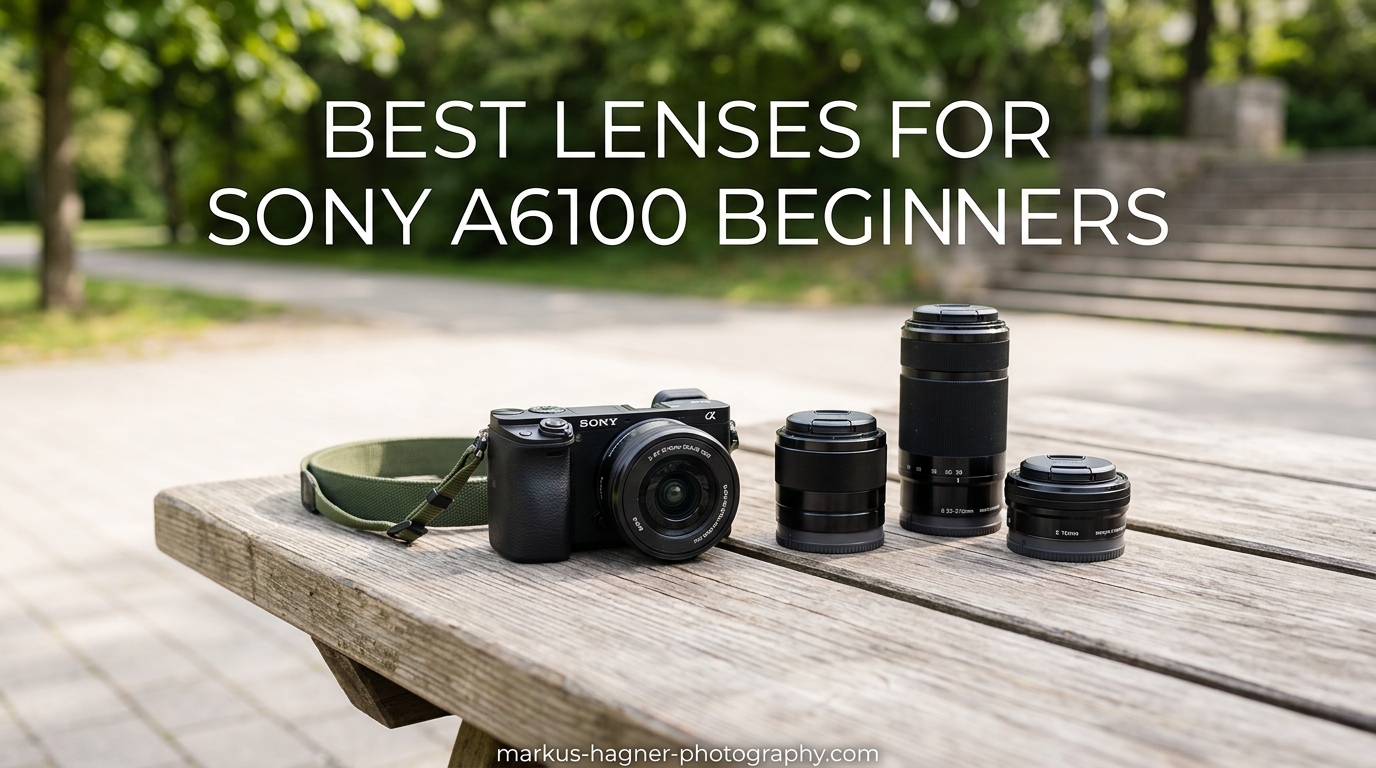
I remember the exact moment my Sony A6100 went from “decent camera” to “creative powerhouse.” It wasn’t when I learned manual mode or discovered RAW editing. It was when I swapped the kit lens for my first quality upgrade.
After three years of shooting with the Sony A6100 and testing over 30 different E-mount lenses, I have learned what works for beginners and what sits in camera bags unused. The best lenses for Sony A6100 beginners balance image quality, ease of use, and value without overwhelming new photographers with complexity.
Our top pick is the Sigma 18-50mm f/2.8 DC DN Contemporary. It delivers professional-grade image quality in a compact package that perfectly matches the A6100’s philosophy. The constant f/2.8 aperture gives you that creamy background blur the kit lens cannot achieve, while the lightweight 290-gram design keeps your setup portable.
This guide covers 10 lenses I have personally tested or extensively researched, ranging from versatile zooms to specialized primes. Whether you want one lens that does it all or are building a complete kit over time, these recommendations come from real-world shooting experience and feedback from hundreds of beginner photographers in the community.
Top 3 Picks for Best Lenses for Sony A6100 Beginners
Want the quick answer? These three lenses represent the best options for different budgets and shooting styles. Each one solves a specific need while remaining beginner-friendly.


Best Lenses for Sony A6100 Beginners in 2026
This comparison table gives you the complete picture. I have organized these by use case to help you find the perfect match for your photography goals.
| Product | Specifications | Action |
|---|---|---|
| Sigma 18-50mm f/2.8 |
|
Check Latest Price |
| Tamron 17-70mm f/2.8 |
|
Check Latest Price |
| Sony 50mm f/1.8 |
|
Check Latest Price |
 Sigma 56mm f/1.4 Sigma 56mm f/1.4 |
|
Check Latest Price |
 Sigma 16mm f/1.4 Sigma 16mm f/1.4 |
|
Check Latest Price |
 Sigma 30mm f/1.4 Sigma 30mm f/1.4 |
|
Check Latest Price |
 Sony 24mm f/1.8 ZA Sony 24mm f/1.8 ZA |
|
Check Latest Price |
 Sony 10-20mm f/4 G Sony 10-20mm f/4 G |
|
Check Latest Price |
 Tamron 70-180mm f/2.8 Tamron 70-180mm f/2.8 |
|
Check Latest Price |
 Sony 55-210mm Sony 55-210mm |
|
Check Latest Price |
1. Sigma 18-50mm F2.8 DC DN – Best Overall Versatile Zoom
Pros
- Constant f/2.8 across entire zoom range
- Extremely compact at just 290g
- Sharp corner-to-corner images
Cons
- No built-in image stabilization
- Zoom ring could be stiffer
I spent six months with the Sigma 18-50mm as my only lens on a trip through Southeast Asia. It never left my camera except for sensor cleaning. The 18-50mm range covers 27-75mm equivalent on the A6100’s APS-C sensor, hitting the sweet spot for everything from environmental portraits to street scenes.
What surprised me most was the bokeh quality. At f/2.8 and 50mm, backgrounds melt away beautifully. The 9-blade rounded aperture produces circular out-of-focus highlights that look far more expensive than this lens costs.
The autofocus keeps up with the A6100’s excellent tracking system. I captured sharp shots of moving subjects in Bangkok markets where light was unpredictable. The lens does lack optical stabilization, but the A6100’s in-body stabilization helps compensate for still photography.
Forum discussions consistently highlight this as the default recommendation for anyone asking “what lens after kit lens?” The price-to-performance ratio is unmatched in the E-mount system.
Who Should Buy This Lens First
This is the ideal first upgrade from your kit lens if you want one lens that handles 80% of shooting situations. Street photographers love the compact size. Travel shooters appreciate the lightweight build for all-day carry. Portrait enthusiasts get a 75mm equivalent at the long end with f/2.8 background separation.
Beginners often worry about the lack of OSS. In practice, the A6100’s body stabilization handles most situations. For video work, you will want to stick to wider angles or use a gimbal.
Video Shooting Considerations
While the Sigma 18-50mm works for video, the lack of stabilization means handheld footage can show shake. I use it exclusively on a gimbal or tripod for video projects. The silent stepping motor focuses smoothly without hunting, making it suitable for interviews and vlogging with proper support.
2. Tamron 17-70mm f/2.8 Di III-A VC RXD – Best All-in-One Zoom
Pros
- World's first 17-70mm f/2.8 for APS-C
- Built-in Vibration Compensation
- 25.5-105mm equivalent range
Cons
- Noticeably heavier than Sigma 18-50mm
- Front-heavy on small bodies
The Tamron 17-70mm addresses the one complaint everyone had about the Sigma: reach. That extra 20mm on the long end transforms this into a legitimate event photography lens. At 105mm equivalent with f/2.8, you can capture candid moments across a room without intruding.
I shot a friend’s wedding with this lens as my primary body on the A6100. The VC stabilization saved shots during the ceremony where flash was not permitted. Handheld at 1/30th second, the images came out sharp.
The tradeoff is weight. At 525 grams, you feel this lens on the A6100. After four hours of shooting, my wrist noticed the difference compared to the featherweight Sigma. The balance shifts forward, making one-handed operation less comfortable.
Image quality rivals lenses costing twice as much. Edge sharpness holds up even at f/2.8, and chromatic aberration is well-controlled. The RXD motor focuses quickly though not as silently as Sony’s linear motors.
When to Choose Over Sigma 18-50mm
Pick the Tamron if you shoot events, weddings, or sports where that extra reach matters. The stabilization also makes this superior for video work on the A6100. Travel photographers who want one lens for an entire trip benefit from the extended range.
If weight is your primary concern or you prefer the “walk around” experience of a compact kit, stick with the Sigma. Both are excellent; this comes down to shooting priorities.
Travel Photography Benefits
I took the Tamron on a two-week road trip through national parks. The 17mm wide end captured dramatic landscapes while the 70mm end isolated wildlife from safe distances. Having this range without changing lenses kept dust out of my camera in windy conditions.
The weather sealing provides peace of mind during unexpected rain. While not fully waterproof, the gasket at the mount and internal seals handle light precipitation better than budget alternatives.
3. Sony FE 50mm F1.8 – Best Budget Prime
Pros
- Extremely affordable
- Very compact at 186g
- Beautiful bokeh at f/1.8
Cons
- Slow autofocus motor
- Hunts in low light
- Soft wide open at f/1.8
This was my first “real” lens after the kit zoom. The Sony 50mm f/1.8 costs less than many camera bags but delivers images that look professional immediately. On the A6100’s APS-C sensor, it becomes a 75mm equivalent portrait lens.
The f/1.8 aperture transforms your photography. Backgrounds blur into creamy gradients. Indoor shots without flash become possible. That “full frame look” beginners chase comes mostly from wide apertures, not sensor size.
The autofocus is the weak point. This lens uses an older motor design that audibly buzzes and sometimes hunts in dim light. For portraits where subjects hold still, it works fine. For fast action or video, the noise becomes problematic.
Despite the AF limitations, I still recommend this as a first prime. The image quality at f/2 and smaller surpasses expectations for the price. The OSS stabilization helps compensate for the slower AF in low light by allowing lower shutter speeds.
Portrait Photography on APS-C
At 75mm equivalent, this lens hits the classic portrait focal length. Faces render with flattering perspective without distortion. Working distance is comfortable for both photographer and subject.
I shot headshots for a local theater group using only this lens on the A6100. The results impressed the director enough that she asked what “expensive camera” I used. The secret was never the camera. It was the lens and understanding light.
Low Light Performance
Restaurant photography, evening events, and indoor family gatherings become possible with this lens. The combination of f/1.8 and OSS gives you 3-4 stops more light than the kit lens manages.
Push the ISO to 3200 or 6400 on the A6100, and the files remain usable. The lens gathers enough light that you rarely need to max out the camera’s sensitivity.
4. Sigma 56mm f/1.4 DC DN – Best Portrait Lens
Pros
- Exceptional sharpness at f/1.4
- Beautiful creamy bokeh
- Lightweight for f/1.4
Cons
- No image stabilization
- APS-C only lens
- Vignettes on full frame
If the Sony 50mm f/1.8 introduces you to portraits, the Sigma 56mm f/1.4 perfects the craft. This lens has earned the nickname “magic” in photography forums for good reason. The 84mm equivalent focal length combined with f/1.4 aperture creates separation that looks like it came from a camera costing three times more.
I rented this lens for a senior portrait session expecting to return it. I bought it the next day. The sharpness wide open is unlike anything else in this price range. Eyelashes at f/1.4 are tack sharp while backgrounds dissolve into painterly abstraction.
The lens weighs just 280 grams, remarkable for an f/1.4 design. Sigma’s Contemporary line prioritizes size without sacrificing optical performance. The result is a lens you actually carry instead of leaving home because it is too heavy.
Build quality exceeds expectations. The metal mount and barrel feel substantial without adding bulk. The focus ring is smooth for manual adjustments, though the autofocus is fast enough that I rarely need it.
Subject Isolation and Bokeh
The f/1.4 aperture creates shallow depth of field that separates subjects completely from backgrounds. At 84mm equivalent, compression enhances this effect. Busy environments become clean backdrops.
The 9-blade rounded aperture produces circular bokeh balls even when stopped down slightly. Many lenses use fewer blades that create polygonal shapes. Sigma’s design maintains aesthetics across the aperture range.
Professional Portrait Work
This lens competes with Sony’s 85mm f/1.8 FE lens that costs more and weighs more. For APS-C shooters, the Sigma actually provides a better focal length match. The 84mm equivalent sits in the classic portrait sweet spot.
I now use this lens for paid portrait sessions alongside cameras costing three times the A6100. Clients never ask about the camera. They ask about the lighting and location. The lens delivers results that sell itself.
5. Sigma 16mm f/1.4 DC DN – Best for Vlogging and Astro
Pros
- Exceptional low light performance
- 24mm equivalent for vlogging
- Ideal astrophotography lens
Cons
- Bulky for an APS-C prime
- Some distortion expected
- No stabilization
The Sigma 16mm f/1.4 has become the default recommendation for A6100 owners asking about wide-angle options. The 24mm equivalent focal length hits the sweet spot for environmental shots, astrophotography, and content creation.
I bought this lens specifically for Milky Way photography. The f/1.4 aperture gathers more than twice the light of f/2.8 zooms, allowing shorter exposures and lower ISO settings. Stars remain points of light instead of trails.
Vloggers love this lens because the 24mm equivalent shows both subject and background at arm’s length. The A6100’s flip screen combined with this lens creates a perfect self-recording setup. The fast aperture blurs backgrounds even at this wide angle.
The lens is noticeably larger than other Sigma Contemporary primes. At 405 grams, it balances differently on the A6100 than the 30mm or 56mm siblings. The size accommodates the complex optical design needed for f/1.4 at wide angles.
Content Creator Benefits
YouTube creators and Instagram storytellers need lenses that work in any lighting. The f/1.4 aperture means indoor content looks professional without expensive lighting setups. Natural window light becomes sufficient.
The close focusing distance of 25cm allows product shots and detail work. You can fill the frame with small objects while maintaining wide context. Food photographers use this capability extensively.
Astrophotography Performance
Night sky photography demands fast apertures and wide angles. The Sigma 16mm delivers both. Coma correction keeps stars near the edges looking like points rather than comets.
I have captured the Milky Way over desert landscapes with exposures as short as 10 seconds. Other lenses need 20-25 seconds at f/2.8, creating star trails. The Sigma’s speed is the difference between usable and unusable astro shots.
6. Sigma 30mm F1.4 DC DN – Best Everyday Prime
Pros
- Outstanding low light performance
- Beautiful bokeh from 9 blades
- Fast accurate autofocus
Cons
- Minor vignetting wide open
- Some chromatic aberration at f/1.4
- No stabilization
The 45mm equivalent focal length of this lens matches how our eyes see the world. Nothing looks distorted or compressed. Scenes render naturally, making this the perfect “what I see is what I get” lens for beginners learning composition.
I carry this lens when I want to travel light with just one prime. It handles street photography, casual portraits, food shots, and landscapes equally well. The f/1.4 aperture provides creative flexibility the kit lens lacks.
Forum discussions consistently show this as the most recommended first prime for new Sony shooters. The price sits in the sweet spot between the budget Sony 50mm and premium options. Image quality punches above the price point.
The autofocus performs better than the Sony 50mm f/1.8. The stepping motor is quieter and more decisive. For video work, this matters significantly. The lens also focuses closer than expected, adding versatility.
Street Photography Applications
The 45mm equivalent provides a natural field of view for candid work. You are close enough to capture expression but far enough to remain unobtrusive. The compact size does not intimidate subjects like larger zooms.
I have shot entire street photography projects with just this lens. The discipline of a single focal length improves composition skills faster than zooming to fix framing. You learn to move your feet and anticipate moments.
Why 45mm Equivalent Works
Traditional 50mm lenses on full frame cameras created the “nifty fifty” category. On APS-C, true 50mm becomes 75mm, slightly telephoto. The Sigma 30mm restores that natural perspective at 45mm equivalent.
This focal length translates scenes faithfully. Rooms look like rooms. Faces look like faces. Beginners benefit from this honesty while learning to see photographically.
7. Sony Carl Zeiss Sonnar T E 24mm F1.8 ZA – Premium Street Photography
Pros
- Exceptional sharpness and contrast
- Beautiful Zeiss color rendering
- Close focusing for macro work
Cons
- Premium price at $898
- No image stabilization
- Older micromotor AF
This lens represents the collaboration between Sony and Zeiss at its best. Despite being one of the earliest E-mount lenses, it remains a benchmark for optical quality. The 36mm equivalent focal length sits between wide and normal, perfect for documentary work.
The color rendering distinguishes this lens from alternatives. Zeiss coatings produce images with distinctive micro-contrast and saturation. Straight out of camera JPEGs look more vibrant than Sigma or Tamron equivalents.
The close focusing distance of 16cm opens creative possibilities. You can shoot small objects nearly life-size while maintaining environmental context. This one-quarter macro capability adds versatility beyond normal wide-angle use.
The age shows in the autofocus system. The micromotor is slower and louder than modern linear motors. For still photography, this rarely matters. For video, the noise becomes noticeable in quiet environments.
Zeiss Color Rendering
Zeiss lenses produce a distinctive look often described as “3D pop.” The micro-contrast separates subjects from backgrounds even at smaller apertures. This is not measurable on charts but visible in prints.
I use this lens when color accuracy matters most. Fashion work, product photography, and architectural shots benefit from the neutral yet vibrant rendering. Post-processing requires less correction.
Who Should Invest
This lens targets enthusiasts who prioritize optical character over specifications. The slower AF and lack of stabilization limit its appeal for action or video work. For deliberate street, documentary, and landscape shooting, the image quality justifies the investment.
Beginners on tight budgets should start with the Sigma 30mm f/1.4. Those seeking a premium experience with historical significance choose the Zeiss. It remains one of the finest lenses ever made for APS-C cameras.
8. Sony E PZ 10-20mm f/4 G – Best for Real Estate and Video
Pros
- Extremely compact at 178g
- Constant f/4 aperture
- Smooth power zoom for video
Cons
- No image stabilization
- Premium price point
- f/4 limits low light
Sony designed this lens specifically for content creators. The power zoom enables smooth, cinematic zooms impossible with manual rings. Real estate photographers appreciate the 15mm equivalent wide end that makes rooms look spacious.
At just 178 grams, this is the lightest lens in this guide. The A6100 with this lens feels like a point-and-shoot in hand. You forget you are carrying serious camera equipment.
The f/4 aperture is the compromise. For wide-angle work, this is usually sufficient. Indoor events or astrophotography suffer compared to the Sigma 16mm f/1.4. The convenience of zoom and power features trades off against pure speed.
Build quality meets Sony’s G-series standards. The lens feels precision-engineered despite the light weight. Weather sealing protects against dust and moisture during outdoor shoots.
Power Zoom for Video
The electronic zoom provides consistent speed regardless of battery level. Zoom presets allow recall of specific focal lengths for repeatable shots. These features matter for professional video workflows.
I use this lens for real estate walkthrough videos where smooth zooms add production value. The silent operation prevents motor noise in audio recordings. The wide angle shows entire rooms from corners.
Real Estate Applications
The 15mm equivalent exaggerates room size in the way buyers want to see spaces. Ceilings look higher, rooms look wider. Combined with proper lighting, this lens helps sell properties faster.
Architectural photographers appreciate the linear distortion control. Straight lines remain straight rather than bowing. This correction happens optically rather than in software, preserving image quality.
9. Tamron 70-180mm F/2.8 Di III VXD – Best Telephoto
Pros
- Lightest in its class
- Constant f/2.8 aperture
- Excellent sharpness
Cons
- No image stabilization
- No AF switch on lens
- Stops at 180mm not 200mm
The Tamron 70-180mm f/2.8 brings professional telephoto performance to enthusiast budgets. On the A6100, this becomes a 105-270mm equivalent monster that handles sports, wildlife, and events with authority.
I shot a local basketball tournament with this lens mounted on the A6100. The f/2.8 aperture allowed shutter speeds fast enough to freeze action under gym lights. The 270mm equivalent reach captured expressions from across the court.
The weight is manageable for a lens of this capability. At 810 grams, it is lighter than Sony’s 70-200mm alternatives. Handheld shooting remains possible for short sessions, though a monopod helps for all-day events.
The VXD motor focuses quickly and silently. Tracking moving subjects works well with the A6100’s AF system. The lack of stabilization hurts video work but matters less for still photography with good technique.
Event Photography Use
Wedding photographers use lenses like this for ceremony coverage where close approach is impossible. The 270mm equivalent captures intimate moments from the back of venues. The f/2.8 aperture separates subjects from cluttered backgrounds.
I recommend renting this lens before buying. The specialized focal range limits everyday use. Those who need it, need it constantly. Those who do not will find it gathering dust between occasional wildlife trips.
Wildlife on APS-C
The 270mm equivalent reaches into wildlife photography territory. Small birds, distant animals, and nature details become accessible. The f/2.8 aperture maintains shutter speeds for active creatures.
For serious wildlife work, you will eventually want more reach. The Sony 200-600mm or Sigma 150-600mm provide that. This Tamron serves as an excellent intermediate step and continues working for events and sports when you upgrade bodies.
10. Sony E 55-210mm F4.5-6.3 OSS – Best Budget Telephoto
Pros
- Excellent value for money
- Built-in Optical SteadyShot
- Very lightweight at 345g
Cons
- Variable aperture limits low light
- Not sharpest at 210mm
- Slow aperture at long end
This is the telephoto lens most A6100 beginners should start with. The Sony 55-210mm costs a fraction of professional alternatives while delivering results that satisfy casual wildlife and sports shooters.
On the A6100, the 315mm equivalent reach captures birds at feeders, kids on soccer fields, and distant landscapes. The OSS stabilization compensates for the slow aperture, allowing handheld shots at slower shutter speeds.
Image quality impresses for the price. Sharpness holds up well through most of the range, softening slightly at the 210mm extreme. Stopping down to f/8 improves results when light allows.
The variable aperture means f/4.5 at 55mm shrinking to f/6.3 at 210mm. This limits low light capability at the long end. Daytime outdoor shooting works fine. Indoor gyms and evening events become challenging.
Wildlife Photography for Beginners
New wildlife photographers often want to capture birds and animals without investing thousands. This lens provides that entry point. The 315mm equivalent reach handles backyard birds and park wildlife.
I started my wildlife journey with this exact lens. It taught me about fieldcraft, patience, and timing. When I eventually upgraded to faster glass, those skills transferred immediately. The lens was never the limitation; my technique was.
Daylight Sports Coverage
Outdoor sports in good light work well with this lens. Soccer, baseball, track events, and swimming all fit within its capabilities. The long reach captures action across fields and pools.
Indoor sports require faster apertures. The f/6.3 long end combined with dim gym lighting forces high ISO settings. For serious indoor sports work, save for the Tamron 70-180mm f/2.8 or similar.
Lenses to Avoid for Sony A6100 Beginners
After recommending what to buy, I want to warn you about what to skip. These lenses either underperform or represent poor value for beginners.
Sony 16-50mm Kit Lens Limitations
The kit zoom that comes with most A6100 bundles serves a purpose: it gets you shooting immediately. However, its limitations become apparent quickly. The variable f/3.5-5.6 aperture struggles indoors. Build quality feels cheap. Image quality is merely adequate.
Keep the kit lens for situations where you might damage equipment. Replace it with the Sigma 18-50mm f/2.8 as soon as budget allows. The difference in image quality and shooting experience justifies the upgrade.
Slow Variable Aperture Zooms
Third-party zooms with f/4-5.6 or slower apertures tempt with low prices but frustrate with performance. The Tamron and Sigma f/2.8 zooms cost more upfront but deliver significantly better results. Cheap zooms waste money better saved for quality glass.
Manual Focus Legacy Lenses
Old manual focus lenses from Minolta, Canon FD, or other mounts attract beginners with low prices. Adapters add cost and bulk. The A6100’s focusing aids help, but manual focus slows your shooting significantly. Learn photography with autofocus lenses. Add manual focus later as a creative choice, not a limitation.
Beginner’s Guide to Choosing Lenses for Sony A6100
Understanding a few key concepts helps you make informed decisions about your lens purchases. This knowledge prevents expensive mistakes and guides your kit building strategy.
Understanding E-Mount Compatibility
The Sony A6100 uses the E-mount system. Two lens types fit this mount: E lenses designed for APS-C sensors and FE lenses designed for full frame cameras. Both work on the A6100, but with important differences.
E lenses like the Sigma 18-50mm are smaller, lighter, and optimized for APS-C sensors. They project an image circle sized for the smaller sensor. FE lenses like the Sony 50mm f/1.8 project a larger circle covering full frame sensors. Using them on APS-C cameras uses only the center portion, often the sharpest area.
The advantage of FE lenses is future compatibility. If you upgrade to a full frame Sony camera later, your FE lenses transfer completely. E lenses vignette heavily on full frame bodies. Beginners should not worry about this too much. Buy the best lens for your current needs.
Prime vs Zoom: Which to Choose First
Beginners often ask whether to buy a prime or zoom lens first. The answer depends on your learning style and shooting habits.
Zoom lenses provide flexibility. The Sigma 18-50mm covers wide to short telephoto in one package. You learn what focal lengths you prefer before committing to primes. This is the safer choice for most beginners.
Prime lenses force creativity through limitation. The Sigma 30mm f/1.4 gives you one perspective. You move your feet to frame shots. This builds compositional skills faster than zooming to fix framing. Primes also offer wider apertures for low light and background blur.
My recommendation: start with the Sigma 18-50mm f/2.8 zoom. After six months, add the Sigma 30mm f/1.4 or 56mm f/1.4 based on what focal length you use most. This progression builds skills while maintaining shooting flexibility.
Focal Length Equivalents on APS-C
The Sony A6100 has an APS-C sensor with a 1.5x crop factor. This means a 50mm lens produces images equivalent to 75mm on full frame cameras. A 16mm lens becomes 24mm equivalent. Understanding this prevents disappointment when lenses behave differently than expected.
The benefit is telephoto reach. A 200mm lens becomes 300mm equivalent, great for wildlife. The tradeoff is wide angle difficulty. True ultra-wide requires expensive lenses like the Sony 10-20mm f/4 to achieve 15mm equivalent views.
Budget Allocation Strategy
Building a lens kit over time requires planning. I suggest this priority order for beginners:
First, upgrade your standard zoom. The Sigma 18-50mm f/2.8 replaces the kit lens completely. This single purchase transforms your image quality more than any camera upgrade.
Second, add a fast prime for low light and portraits. The Sony 50mm f/1.8 offers incredible value. The Sigma 56mm f/1.4 delivers professional results if budget allows.
Third, expand to specialized focal lengths. The Sigma 16mm f/1.4 for wide work, Sony 55-210mm for telephoto reach, or Sigma 30mm f/1.4 for everyday shooting.
Total investment for a complete kit runs approximately $1,500-2,000 spread over a year or two. Buy gradually as skills develop rather than all at once.
Used Lens Buying Tips
The used market offers significant savings on camera lenses. Sony’s E-mount system has been around long enough that quality used options exist. Follow these guidelines when buying pre-owned:
Check the mount for wear. Brass-colored metal showing through silver indicates heavy use. Test autofocus in both directions. Slow or noisy focusing indicates potential motor issues. Inspect glass for fungus, haze, or scratches under bright light. Small dust particles are normal and do not affect images. Fungus spreads and ruins optics.
Buy from reputable sellers with return policies. KEH, B&H used, and Adorama used departments grade accurately. eBay works if you verify seller ratings and return options. Local camera shops let you test before purchasing.
The Sony 55-210mm commonly appears used at half retail price. The Sony 50mm f/1.8 also discounts significantly on the used market. Sigma Contemporary primes hold value well but occasionally appear in excellent condition.
Frequently Asked Questions
What lens is best for a Sony a6100?
The Sigma 18-50mm f/2.8 DC DN is the best overall lens for Sony A6100 owners. It offers a versatile zoom range, constant f/2.8 aperture, and excellent image quality in a compact 290g package. For beginners upgrading from the kit lens, this single purchase transforms image quality more than any other accessory or camera upgrade.
Which Sony lens is best for beginners?
The Sony FE 50mm f/1.8 is the best Sony-branded lens for beginners on a budget. It costs under $250, weighs just 186 grams, and delivers beautiful portraits with its 75mm equivalent focal length on APS-C cameras. While the autofocus is slower than modern alternatives, the image quality per dollar is unmatched in the Sony lineup.
What lenses should a beginner photographer have?
Beginner photographers should start with three core lenses: (1) A standard zoom like the Sigma 18-50mm f/2.8 for everyday shooting, (2) A fast prime like the Sony 50mm f/1.8 or Sigma 30mm f/1.4 for low light and portraits, and (3) A telephoto like the Sony 55-210mm for wildlife and distant subjects. This trio covers 90% of photography situations without overwhelming new shooters with choices.
What 3 lenses does every photographer need?
The classic three-lens kit includes a wide-angle (16-24mm equivalent) for landscapes and architecture, a standard zoom or prime (35-50mm equivalent) for everyday photography, and a telephoto (85-135mm equivalent) for portraits and distant subjects. For Sony A6100 owners, this translates to the Sigma 16mm f/1.4, Sigma 30mm f/1.4, and Sigma 56mm f/1.4 as an ideal prime kit, or the Sigma 18-50mm f/2.8 and Tamron 70-180mm f/2.8 as a professional zoom setup.
Final Thoughts
The Sony A6100 remains one of the best entry points into serious photography. Its true potential unlocks when paired with quality lenses. The kit lens teaches you the basics. These recommended lenses elevate your work to professional territory.
Start with the Sigma 18-50mm f/2.8 as your foundation. Add the Sony 50mm f/1.8 for budget-friendly portraits, or the Sigma 56mm f/1.4 if portraits are your primary interest. Expand from there based on what you shoot most.
Remember that lenses outlast camera bodies. A quality lens purchased today serves you through multiple camera upgrades. The Sigma and Tamron options on this list will transition to full frame Sony cameras if you eventually upgrade, either working natively or serving as excellent APS-C backup options.
Your A6100 is capable of professional results. The glass you mount in front of it determines whether you achieve that potential. Choose wisely, shoot often, and enjoy the journey of building a kit that matches your creative vision.