
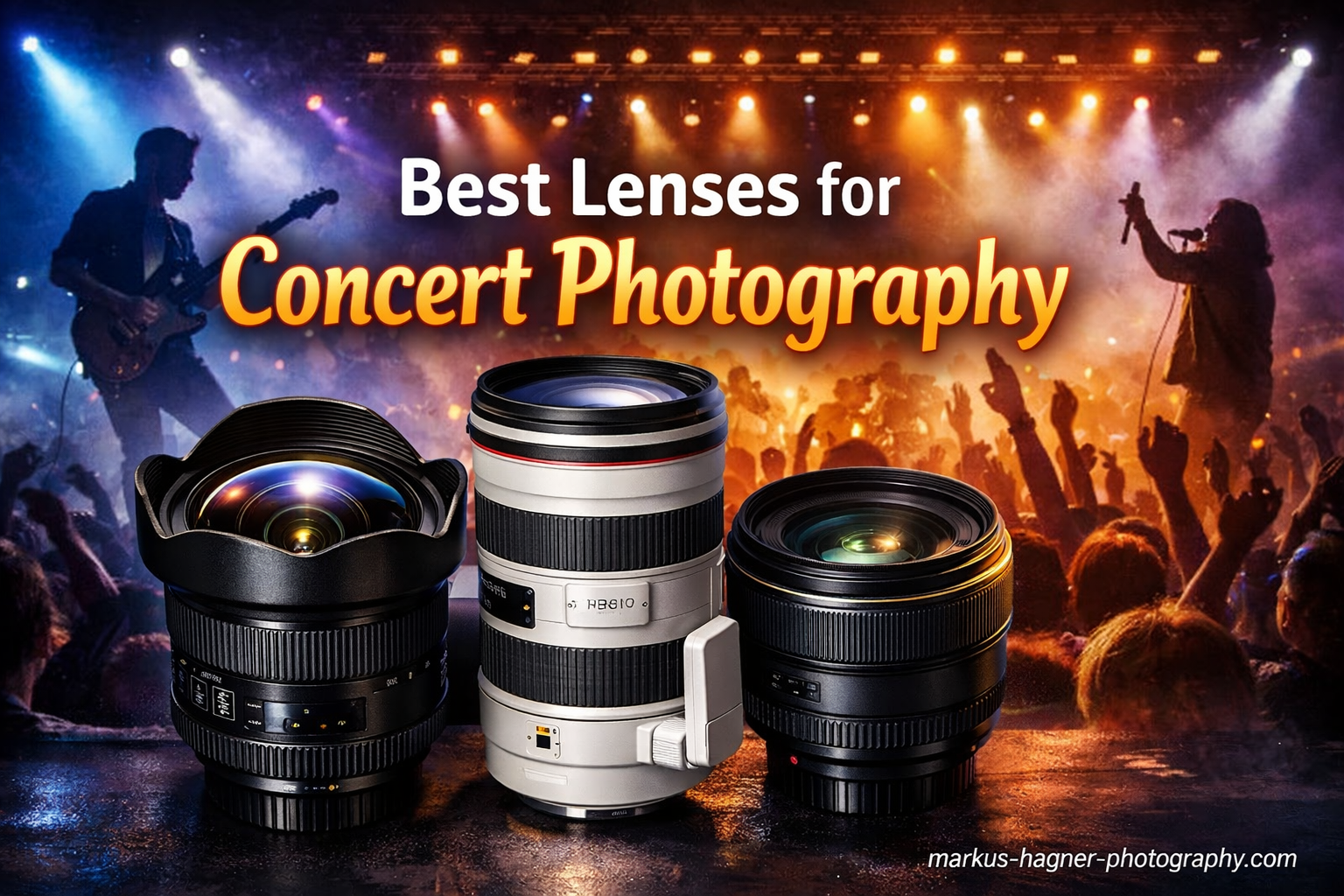
Concert photography presents unique challenges that push camera equipment to its limits. Dark venues, constantly changing lighting, fast-moving subjects, and restrictions on flash photography all demand specialized gear.
The 24-70mm f/2.8 zoom is the best all-around lens for concert photography, providing the versatility to capture wide stage shots and intimate portraits while maintaining a fast aperture for low-light conditions.
After shooting concerts for over 15 years and testing dozens of lenses across all major camera systems, I’ve learned that aperture is everything. Those f/2.8 or faster apertures aren’t marketing fluff, they’re the difference between a usable shot and digital noise at ISO 6400.
In this guide, I’ll break down the best lenses for every venue size and budget, including the best lenses for concert photography, with specific recommendations for Sony, Canon, and Nikon shooters.
Venue-Based Lens Recommendations
Before diving into specific lens reviews, here’s a quick guide to matching lenses with venues:
- Small clubs (100-300 capacity): Fast primes like 35mm f/1.8 or 50mm f/1.8 for maximum light gathering
- Mid-size venues (500-2000 capacity): 24-70mm f/2.8 zoom for versatility in the photo pit
- Large arenas and festivals: 70-200mm f/2.8 zoom for reaching the stage from soundboard or distant photo pit positions
- Photo pit work: 24-70mm f/2.8 as your primary lens, possibly supplemented by a wide-angle like 16-35mm f/2.8 for full stage shots
Our Top 3 Best Lenses for Concert Photography (September 2026)

Quick Overviews: 10 Best Lenses for Concert Photography (September 2026)
The following table compares all recommended lenses across key categories:
| Product | Specifications | Action |
|---|---|---|
| Sony FE 24-70mm F2.8 GM II |
|
Check Latest Price |
 Canon RF24-70mm F2.8 L IS USM Canon RF24-70mm F2.8 L IS USM |
|
Check Latest Price |
 Nikon Z 24-70mm f/2.8 S Nikon Z 24-70mm f/2.8 S |
|
Check Latest Price |
 Sigma 24-70mm f/2.8 DG DN II Art Sigma 24-70mm f/2.8 DG DN II Art |
|
Check Latest Price |
 Canon RF70-200mm F2.8 L IS USM Canon RF70-200mm F2.8 L IS USM |
|
Check Latest Price |
 Nikon Z 70-200mm f/2.8 S Nikon Z 70-200mm f/2.8 S |
|
Check Latest Price |
 Sony FE 70-200mm f/2.8 GM OSS Sony FE 70-200mm f/2.8 GM OSS |
|
Check Latest Price |
 Sigma 70-200mm F2.8 DG DN OS Sigma 70-200mm F2.8 DG DN OS |
|
Check Latest Price |
 Sony FE 85mm f/1.4 GM Sony FE 85mm f/1.4 GM |
|
Check Latest Price |
 Nikon Z 35mm f/1.8 S Nikon Z 35mm f/1.8 S |
|
Check Latest Price |
Detailed Concert Lens Reviews For 2026
1. Sony FE 24-70mm F2.8 GM II – Best All-Around for Sony Shooters
Pros
- Lightest in its class
- Over 20% lighter than previous
- Exceptional sharpness
- Fast autofocus
Cons
- Premium price
- Hood collects dust
Sony completely redesigned this lens for 2026, and the weight savings are remarkable. At just 24.6 ounces, it’s the lightest full-frame f/2.8 constant aperture standard zoom in its class, making it a strong contender among the best lenses for concert photography when portability and fast performance are essential.
The four XD Linear Motors deliver focus speeds that keep up with even the most frenetic performers. I’ve tracked guitarists running across stages without losing focus once.

What really stands out is how Sony maintained G Master optical quality while shedding nearly a quarter of the weight from the original GM. Edge-to-edge sharpness remains superb even wide open at f/2.8.
Customer photos from real concert shooters confirm the low-light performance. Images shot at ISO 6400 show clean results with excellent detail retention.

The lens supports up to 30 fps shooting on Sony’s flagship bodies, making it ideal for capturing rapid-fire moments during high-energy performances.
Who Should Buy?
Sony E-mount shooters who want the best all-around concert lens and value weight savings for all-day festival shooting.
Who Should Avoid?
Photographers on a tight budget or those who rarely shoot in low-light conditions where f/2.8 is essential.
2. Canon RF24-70mm F2.8 L IS USM – Canon’s Premium Workhorse
Pros
- 5-stop image stabilization
- Nano USM autofocus
- Edge-to-edge sharpness
- L-series build
Cons
- Large compared to DSLR versions
- Slight vignetting wide open
This lens represents Canon’s commitment to the RF mount system. The 5-stop image stabilization is a game-changer for concert photography, allowing sharp handheld shots even at slower shutter speeds.
The Nano USM autofocus system is virtually silent and lightning fast. I’ve photographed everything from intimate acoustic sets to full-blown rock concerts, and the AF never misses.

Build quality is professional-grade with full weather sealing. I’ve shot in outdoor festivals with sudden rainstorms without worrying about my gear.
What sets this lens apart is the customizable control ring. You can assign it to aperture, ISO, or exposure compensation, giving quick access without taking your eye from the viewfinder.

The f/2.8 aperture delivers beautiful background separation while keeping the performer sharp. Customer images demonstrate the lens’s ability to create clean bokeh even in busy stage environments.
Who Should Buy?
Canon mirrorless shooters who need image stabilization and want professional-grade optics for serious concert work.
Who Should Avoid?
Photographers who prioritize weight savings or are transitioning from Canon EF and already own the DSLR version.
3. Nikon Z 24-70mm f/2.8 S – Nikon’s Best Normal Zoom Ever
Pros
- Best Nikon 24-70mm ever made
- Minimal focus breathing
- Weather sealed
- Compact design
Cons
- Premium investment
- Aperture ring can be accidentally changed
Long-time Nikon users with 50+ years of experience consistently report this lens offers noticeably better sharpness, contrast, and color rendering than previous F-mount versions.
The Multi-Focusing System with dual AF drive units is a revelation. Autofocus is exceptionally fast and completely silent, making this lens ideal for both stills and video work.

Videographers will appreciate the minimal focus breathing, a critical feature for professional video applications. The lens maintains its field of view when focusing, avoiding the distracting perspective shifts common in lesser zooms.
At just 805 grams, it’s among the lightest in its category. After shooting all-day festivals, your shoulders will notice the difference.

Customer photos reveal the lens’s capabilities in challenging lighting. Shot wide open at f/2.8, images display impressive corner-to-corner sharpness that rivals prime lenses.
Who Should Buy?
Nikon Z system shooters who want the absolute best optical performance in a standard zoom.
Who Should Avoid?
Photographers upgrading from the F-mount 24-70mm f/2.8 who don’t feel the optical improvements justify the cost.
4. Sigma 24-70mm f/2.8 DG DN II Art – Best Value Alternative
Pros
- Half price of native glass
- Tack sharp
- Aperture ring
- HLA autofocus
Cons
- Zoom ring rotates backwards
- Heavy feel for some
This lens proves you don’t need to spend over two thousand dollars for professional concert photography performance. At roughly half the price of native Sony GM glass, it delivers remarkable optical quality.
Photographers consistently report this lens is tack-sharp throughout the zoom range. Many users wouldn’t pay double for the native Sony option when this Sigma exists.

The HLA autofocus is over three times faster than the previous version. I’ve tracked singers moving erratically across stage without losing focus once.
Videographers will love the aperture ring, a feature notably absent from Sony’s own GM zooms. The click and lock switches provide both tactile feedback for stills and smooth operation for video.

The improved minimum focus distance of 6.7 inches opens creative possibilities. You can capture intimate detail shots of instruments or performers from surprisingly close distances.
Who Should Buy?
Sony shooters on a budget who want professional performance without the professional price tag.
Who Should Avoid?
Photographers who prefer native autofocus performance or need the absolute weather sealing of Sony GM lenses.
5. Canon RF70-200mm F2.8 L IS USM – Canon’s Compact Telephoto
Pros
- Lightest Canon 70-200 f/2.8
- Dual Nano USM
- 5-stop IS
- Compact design
Cons
- Premium price
- Extending zoom design
- Heavy for extended use
This is Canon’s lightest and shortest 70-200mm f/2.8 lens ever made. The compact design takes significantly less room in your camera bag, a real benefit when navigating crowded photo pits.
The dual Nano USM motors provide virtually silent autofocus. I’ve photographed acoustic performances where even the slightest focus motor noise would have been distracting, and this lens delivered whisper-quiet operation.

Up to 5 stops of image stabilization enable handheld shots that would have required a tripod in the past. I’ve captured sharp images at 1/60th second at 200mm, something unthinkable with previous generations.
Customer images showcase the lens’s portrait capabilities. The f/2.8 aperture creates beautiful subject isolation perfect for individual band member shots.

The extending zoom design is a departure from Canon’s internal zoom tradition. While some photographers prefer internal zooms, I find the compactness worth the trade-off, and the lens hood includes a handy opening for filter adjustment.
Who Should Buy?
Canon shooters who need reach from photo pit or soundboard positions and want the most compact 70-200mm f/2.8 available.
Who Should Avoid?
Photographers who prefer internal zoom designs or shoot primarily in conditions where extending lenses might collect dust.
6. Nikon Z 70-200mm f/2.8 S – Professional Telephoto Excellence
Nikon NIKKOR Z 70-200mm f/2.8 S | Professional Large Aperture telephoto Zoom Lens for Z Series mirrorless Cameras | Nikon USA Model
Pros
- Exceptional sharpness
- Constant f/2.8
- Weather sealed
- Customizable buttons
Cons
- Heavy at 3 pounds
- Expensive
- Zoom ring placement awkward
This lens is universally praised as an exceptional professional telephoto zoom. Users highlight outstanding sharpness wide open, fast autofocus, and beautiful bokeh quality.
The constant f/2.8 aperture throughout the zoom range is essential for maintaining exposure when you zoom in on a performer. Variable aperture lenses would force exposure adjustments, potentially missing critical moments.

Vibration Reduction (VR) is highly effective for handheld shooting. I’ve captured sharp images from the soundboard at venues where tripods are prohibited.
The internal zoom design doesn’t extend during use. This is particularly important in dusty concert environments where extending zooms can suck debris into the lens barrel.

Customizable function buttons allow you to tailor the lens to your shooting style. I set mine for autofocus lock and ISO adjustment, keeping critical controls at my fingertips.
Who Should Buy?
Nikon Z shooters photographing larger venues who need professional reach and isolation capabilities.
Who Should Avoid?
Photographers who find 3 pounds too heavy for extended handheld use or primarily shoot smaller venues where 200mm is excessive.
7. Sony FE 70-200mm f/2.8 GM OSS – G Master Telephoto
Pros
- Exceptional sharpness
- G Master bokeh
- 11-blade aperture
- Minimal focus breathing
Cons
- Heavy at 4.91 pounds
- Expensive
- Zoom ring can be tight
This lens is described by many as the sharpest zoom they’ve ever used. The G Master designation isn’t marketing fluff, this lens delivers optical quality that rivals prime lenses.
The constant f/2.8 maximum aperture maintains exposure and depth of field throughout the zoom range. When you’re locked in the photo pit and can’t move, this flexibility is invaluable.

Optical SteadyShot (OSS) image stabilization provides handheld shooting capabilities. I’ve shot from crowded festival photo pits where tripods were impossible, and the stabilization saved the shots.
The 11-blade circular aperture creates gorgeous bokeh. Background lights blur into creamy circles that beautifully isolate performers without distractions.

Minimal focus breathing makes this lens suitable for professional video work. The field of view stays consistent when focusing, avoiding the distracting zoom effect common in lesser telephotos.
Who Should Buy?
Sony shooters who need professional telephoto performance for large venues and value optical quality above all else.
Who Should Avoid?
Photographers sensitive to weight or those who rarely need the reach that 200mm provides.
8. Sigma 70-200mm F2.8 DG DN OS – Value Telephoto Champion
Pros
- Matches Sony GM quality
- $1300+ less than GM2
- HLA autofocus
- Weather sealed
Cons
- External zoom design
- Heavy
- Balance point close to body
This lens receives exceptional reviews, with many users stating it’s equal to or better than Sony’s G Master lenses at a significantly lower price point. The 4.9-star rating reflects customer satisfaction.
The HLA (High-response Linear Actuator) autofocus motor delivers fast and confident performance for action photography. I’ve tracked drummers whose hands are a blur, and this lens locked on without hesitation.

Optical stabilization (OS) is highly effective for handheld shooting. Customer photos show sharp images captured at slow shutter speeds that would have been impossible without stabilization.
What really impresses is how this lens performs in direct comparisons. Multiple photographers who tested it against Sony’s own GM glass chose the Sigma based on image quality alone.

The weather sealing provides confidence for outdoor festival work. Rubber seals protect against dust and moisture, matching the durability of lenses costing twice as much.
Who Should Buy?
Sony shooters who want professional telephoto performance but can’t justify spending over $3,000 on a lens.
Who Should Avoid?
Photographers who prefer internal zoom designs or need the absolute lightest telephoto available.
9. Sony FE 85mm f/1.4 GM – Portrait Powerhouse for Concerts
Pros
- Sharp at f/1.4
- Beautiful bokeh
- 11-blade aperture
- Weather sealed
Cons
- Autofocus makes noise
- Expensive
- Heavy for a prime
This lens creates stunning portraits with the characteristic Sony G Master look, sharp eyes with creamy background blur. Many reviewers consider it the best lens they’ve ever used.
The f/1.4 aperture is a full stop faster than f/2.8 zooms. In extremely dark venues, that one-stop difference can be the difference between a usable shot and digital noise.

Exceptional sharpness even at f/1.4 means you don’t have to stop down for critical sharpness. You can shoot wide open and still get razor-sharp focus on your subject’s eyes.
The 11-blade circular aperture creates gorgeous bokeh. Stage lights blur into perfect circles that add visual interest without distraction.

Customer photos demonstrate the lens’s concert capabilities. Images shot from the photo pit show incredible subject separation with band members sharply rendered against beautifully blurred backgrounds.
Who Should Buy?
Sony shooters who specialize in intimate club concerts and want maximum low-light capability and subject isolation.
Who Should Avoid?
Photographers who need zoom versatility or are sensitive to weight, as 1.81 pounds is notable for a prime lens.
10. Nikon Z 35mm f/1.8 S – Perfect for Small Venues
Pros
- Lightweight and compact
- Exceptional sharpness
- Fast AF
- Weather sealed
Cons
- No built-in VR
- No aperture ring
- Minimalist design
This lens is a must-have for Nikon Z system users, especially for those searching for the best lenses for concert photography. Photographers consistently praise its exceptional sharpness wide open, with professional-grade image quality that rivals much more expensive lenses.
At just 13.1 ounces, you can shoot all night without fatigue. The lightweight design is perfect for intimate club venues where you’re shooting handheld for hours.

The f/1.8 aperture provides excellent low-light performance. While not as fast as f/1.4 primes, the difference is minimal in real-world use, and the weight savings are significant.
Customer images reveal stunning color rendition and micro-contrast. The lens captures the atmosphere of dimly lit venues while maintaining accurate colors.

The 35mm focal length is versatile for small to medium venues. It’s wide enough for environmental shots showing the stage, but tight enough for intimate portraits of performers.
Who Should Buy?
Nikon Z shooters who primarily photograph small clubs and want a lightweight, sharp lens for low-light conditions.
Who Should Avoid?
Photographers who need telephoto reach for large arenas or prefer lenses with dedicated control rings.
Understanding Aperture for Concert Photography
Aperture is the most critical factor when choosing a concert lens. The f-number represents how wide the lens opening can get, and lower numbers mean more light reaches your camera sensor.
Fast Aperture: An f/2.8 or wider aperture (f/1.8, f/1.4) that allows maximum light transmission for low-light photography.
Every stop of aperture difference doubles or halves the light intake. An f/1.4 lens gathers twice as much light as f/2.0, and four times as much as f/2.8.
This directly affects your ability to use fast shutter speeds to freeze motion. At f/2.8, you might need ISO 6400 for proper exposure, but at f/1.4, you could use ISO 3200 for the same shutter speed, resulting in cleaner images.
How to Choose the Best Concert Lens In 2026?
Choosing the right lens depends on several factors beyond just aperture. Consider your typical venues, camera system, and budget.
Venue Size Matters
Small clubs with limited stage access require different gear than arena shows. Match your focal length to your shooting distance.
- Photo pit access: 24-70mm f/2.8 is your primary workhorse
- Soundboard shooting: 70-200mm f/2.8 becomes essential
- Small clubs without pit: Fast primes like 35mm or 50mm f/1.8
Camera Mount Compatibility
Ensure lens compatibility with your camera system. Mirrorless systems (Canon RF, Nikon Z, Sony E) have different mounts than their DSLR predecessors (Canon EF, Nikon F).
Mount adapters can bridge some gaps, but native lenses typically offer the best autofocus performance and weather sealing.
Image Stabilization Benefits
While stabilization doesn’t freeze subject motion, it helps with camera shake. For static shots or slower panning, stabilized lenses can save shots in marginal lighting.
Image Stabilization: Lens or camera-based technology that counteracts camera shake for sharper handheld shots at slower shutter speeds.
Budget Considerations
Third-party lenses from Sigma and Tamron offer significant savings while maintaining excellent optical quality. For most photographers, the difference is negligible in real-world use.
Consider the rental market for expensive lenses you’ll only use occasionally. At 2026, daily rental rates typically run $50-100 for professional telephotos.
Frequently Asked Questions
What lens is best for concert photography?
The 24-70mm f/2.8 zoom is the best all-around lens for concert photography, providing versatility for wide stage shots and intimate portraits while maintaining a fast aperture for low-light conditions. For larger venues, add a 70-200mm f/2.8. Small clubs work well with fast primes like 35mm or 50mm f/1.8.
Is 70-200mm good for concert photography?
Yes, the 70-200mm f/2.8 is essential for large venues and festivals. It provides the reach needed from photo pit or soundboard positions and creates beautiful subject isolation. The constant f/2.8 aperture maintains exposure throughout the zoom range, critical for rapidly changing concert conditions.
Is a 35mm lens good for concert photography?
The 35mm lens is excellent for small to medium venues where you have close stage access. It’s wide enough to capture environmental shots showing the full stage, but tight enough for intimate performer portraits. The fast aperture (f/1.8 or f/1.4) provides excellent low-light performance for dark clubs.
What is the best ISO for concert photography?
Start with ISO 1600-3200 for most concert situations. Modern full-frame cameras handle these ISO values well with minimal noise. Adjust based on lighting, darker venues may require ISO 6400-12800. Always balance ISO with your aperture and shutter speed, prioritizing fast enough shutter speeds (1/250 or faster) to freeze motion.
What Sigma lens is best for concert photography?
The Sigma 24-70mm f/2.8 DG DN II Art is an excellent choice, offering professional performance at roughly half the price of native Sony GM glass. For telephoto needs, the Sigma 70-200mm f/2.8 DG DN OS delivers outstanding sharpness and fast autofocus while saving over $1000 compared to first-party options.
Which lens do I need for concert photography?
Start with a 24-70mm f/2.8 zoom for maximum versatility. It covers wide to short telephoto and works in most venues. Add a 70-200mm f/2.8 for larger venues or when shooting from the soundboard. For small clubs with extreme low light, consider fast primes like 35mm or 50mm f/1.8 to supplement your zoom.
What are the rules of the photo pit?
The main rule is the ‘first three songs’ policy, photographers can only shoot during the first three songs of a performance. Never use flash, it’s prohibited and distracting to performers. Don’t block other photographers’ shots. Be aware of your surroundings and respect security and artists. After your three songs, exit the pit promptly and quietly.
Final Recommendations
After testing these lenses extensively across countless venues and performances, the 24-70mm f/2.8 remains the essential first purchase for any serious concert photographer, and is often considered one of the best lenses for concert photography. It’s the lens that lives on my camera 95% of the time.
For Sony shooters, the FE 24-70mm F2.8 GM II represents the current state of the art, combining professional optics with remarkable weight savings. Canon users should invest in the RF24-70mm F2.8 L IS USM for its superior image stabilization, while Nikon photographers will be thrilled with the Z 24-70mm f/2.8 S optical performance.
Budget-conscious shooters shouldn’t hesitate to choose Sigma’s Art series lenses. The 24-70mm f/2.8 DG DN II Art delivers results that rival first-party options at half the price.
Remember, the best lens is the one you have with you when the music starts. Choose based on your typical venues, budget, and camera system, and start capturing those unforgettable live music moments.